Home Blog Page 1087

Shakeout BC hits SFU

0
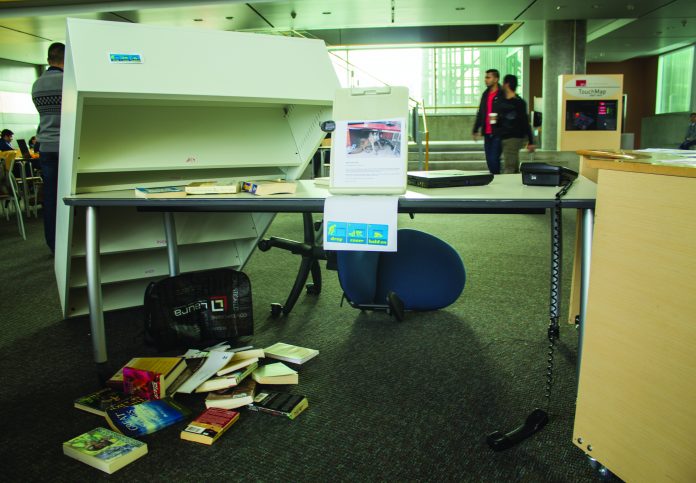
The mock-up of a post-disaster zone demonstrated the importance of securing your space.

Members of the SFU community were encouraged to “drop, cover, and hold on” last Thursday, October 16, as the university participated in Shakeout BC.

Shakeout BC is an annual event that involves people not only in BC, but all over the world, performing the same earthquake drill. This year’s drill took place at 10:16 a.m. and approximately 73,000 people participated in BC alone.

The event was held at all three SFU campuses from 9:30 a.m. to noon. SFU’s Safety and Risk Services (SRS) set up information booths and displays in order to educate passersby about earthquake preparedness, and even practise the drill with people walking by.

The day held a particular relevance for the SFU community, as the university is located in the Lower Mainland of BC, one of the most seismically active regions in Canada.

The main goal of the organizers was to stress the importance of being familiar with the internationally recognized safety procedure, “drop, cover, and hold on.”

“A lot of people are unsure of what to do if they felt an earthquake,” said Miranda Myles, emergency and continuity planner for SRS. She explained that a surprising number of people who came up to the booths were unfamiliar with the procedure.

There was also a session on earthquake safety hosted by ResLife staff in the Dining Hall the night before.

For the event, SRS staged a mock-up of a post-earthquake scene. The rooms demonstrated how an office might look if none of its furniture had been secured prior to the earthquake.

Myles explained this was “to show the importance of securing your space and making sure the things around you are secure.” This could mean fixing furniture in place or removing heavy items from high places.

Last year, SRS published a video in which McFogg the Dog demonstrates how to respond to an earthquake in various campus settings.

“You do the same thing no matter where you are,” said Myles. “Drop to the ground. If you don’t have a table to get under, you still cover your head with your hands, and try to tuck up against something like a wall, something sturdy that you can brace yourself against.”

She continued, “After the shaking stops, you should stay wherever you are for about a minute just to let things settle, and to take a minute to look around. Then proceed outside. We want to encourage people to stay away from buildings and move into more open areas like parking lots and the field.”

The video also includes some advice from SFU president Andrew Petter on how to prepare for an earthquake. “Prepare an emergency kit with items like food, water, a flashlight,” he said. “And any other essential items,” he added, as he put a stuffed bear into his go bag.


Restaurants should incorporate a no-tip policy

0
Many customers feel entitled and inherently deserving of impeccable service.

Our society accepts the restaurant industry’s hyper-sexualized, customer-driven culture as normal. Many customers feel highly entitled and inherently deserving of impeccable service, regardless of their behaviour toward restaurant staff catering to their every whim. Unfortunately, this entitlement often turns into verbal and sexual harassment.

According to a report from the New York Observer regarding sexual harassment within the service industry, 90 per cent of female restaurant workers have been verbally and sexually harassed at work. This may be due to the current cultural structures that surround the service industry, as they perpetuate certain attitudes that enable harassment.

Not only can customers be culprits, but many servers have accepted this system as a fixed set of cultural norms. Having worked in the service industry for a number of years, I’ve often felt pressured to cozy up to my customers to get to know them on a more personal level. I understand the rationale behind this — it encourages customers to return and ultimately fills a server’s pocket with more change. Often, though, the fine line between ‘friendly’ and ‘too friendly’ is crossed in order to make that 20 per cent tip.

Tipping culture puts servers in unsafe positions.

To change this established dynamic between customers and servers, a shift in power must be employed, and my solution would be to introducwe a ‘no tip’ policy. While restaurants rely on customers to subsidize servers’ wages, they could instead mark up their menu prices by a certain percentage, and pay their servers a living wage. To revoke a customer’s tipping option changes the dynamic between the customer and server by creating a level playing field — one in which servers no longer feel obligated to tolerate inappropriate customers.

While this model provides a straightforward solution in theory, it has faced some resistance. The Smoke ‘N’ Water restaurant in Nanoose Bay initially began business with a no-tip policy, though it recently switched back to the classic tipping-system due to customer preferences. Owner David Jones believes that his restaurant was slightly ahead of the curve — despite popularity with the staff, customers were unhappy with the policy, as many of them believed that tipping promotes good service.

The reality is that tipping culture creates an environment where customers are ‘always right’ and servers are placed in vulnerable positions. Rather than encouraging impeccable service, tipping fosters a work environment that encourages servers to humour or tolerate inappropriate customers who enjoy pushing boundaries. Servers should not have to throw away their dignity in exchange for a 20 per cent gratuity.

Transitioning to a ‘no-tip’ policy will not happen easily, as it always takes time to shift a cultural paradigm. However, despite the skepticism, I believe this model would change the restaurant industry for the better; without it, servers will continue to accept different forms of harassment as part of their job description.

International study to address climate change in the workplace

0
The project’s aim is to investigate green options in the workplace.

An SFU professor has joined a newly formed international research project to assess the impact of the workplace on climate change, and to make recommendations as to how certain sectors can improve their carbon footprints.

John Calvert, an SFU adjunct professor of political science and an associate professor of health sciences, is part of the team which has been awarded a Social Sciences and Humanities Research Council (SSHRC) grant to pursue their research.

The team’s project, called Adapting Canadian Work and Workplaces to Respond to Climate Change (ACW), will investigate how Canadian workplaces can be modified to minimize greenhouse gas emissions. Furthermore, ACW will examine what changes should be made in law and policy in order for businesses and workplaces to be as green as possible.

Over $2.5 million dollars has been given to the York University-led project. The SSHRC team is a collaboration of 36 participants from 17 organizations in Canada, the US, and the UK. Team members represent a range of 20 different disciplines, professions, and trades.

Project members will conduct their work in six stages, and in four groups. As an associate director of the Built Environment group — which will consider human-made surroundings that provide the setting for human activity — Calvert will have a leading role.

Although Calvert acknowledges that changing law, policy, and getting the government on board will be a challenge, the aim of ACW is to transition Canada into a lower-carbon economy. The industries that the ACW project will look into are construction, energy, manufacturing, and public and private services.

Calvert emphasized that action will be needed with or without the full support of the government. “Regardless of what party is in office, we will need to develop the skills, knowledge base and best practices in order to address climate change in the workplace,” he said.

Calvert already has some experience creating policies for the BC government, as well as with policies concerning monitoring, training, equity, and employment related to the Vancouver Island Highway project. With regards to the SSHRC project, Calvert told The Peak that he will apply this experience, with a more pronounced green focus, to his research.

Specifically, Calvert will be examining the construction industry; his knowledge of policy related to construction projects in BC provides him with suitable insight into the inner workings of the industry’s workplaces.

“My focus is the impact on work in the construction industry and the extent to which ‘green’ working practices are being integrated into the training and skills development of building workers,” he said.

According to Calvert, conducting research in climate change, investigating new laws and policies, and developing new strategies for greener work environments will allow ACW project to anticipate the jobs and workplaces of the future.

CLIVE takes People’s Choice Award at MIT contest

0
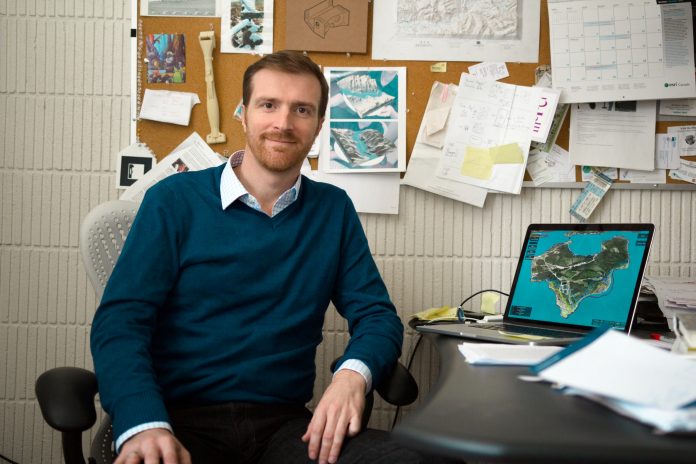
Nicholas Hedley, director of SIRL, and a SFU professor of geography is one of the co-creators of CLIVE.

CLIVE (Coastal Impact Visualization Environment) is a project co-directed by an SFU professor. The project won the People’s Choice Award at a major MIT-sponsored contest that concluded in early October.

The contest, entitled ‘Communicating Coastal Risk and Resiliency,’ focused on identifying projects that facilitate the communication of climate change data to the public, while also providing a system from which real solutions can be identified.

CLIVE is the product of a cross-country collaboration between SFU’s Spatial Interface Research Lab (SIRL) and the University of Prince Edward Island’s (UPEI) Climate Research Lab. This technology combines sea level rise and coastal erosion predictions with complex spatial data from PEI, and runs this data through a 3D game engine.

Operating as a computer program, it is controlled with either a keyboard or a game controller. The user is able to navigate within a virtual representation of PEI and trigger visual projections of sea level rise and coastal erosion for a given year (ranging from 1968 to 2100) to see how the land is impacted.

“The dialogue it has stimulated is one of our greatest success stories. It has brought science, our best science, into the public realm,” said Nicholas Hedley, director of SIRL, and a SFU professor of geography. Hedley is one of the co-creators of CLIVE, and brought his extensive background in 3D geovisual analytics to the team.

Hedley continued, “People are no longer relying upon abstract names of government science projects, wondering what it means to them. CLIVE allows them to see what it means to them, what the implications will be.”

Although the program is focused on PEI — a region identified as particularly susceptible to sea level rise and the accompanying consequences — Hedley explained the broader applications available: “One of the greatest accomplishments with this is not just with what we’ve built, but having created a workflow that is scalable and can be applied anywhere.

“We’ve had interest from countries in Europe, the Caribbean, down in the States; some are small communities [. . .] but some are whole municipalities, cities, and a couple of international governments,” added Hedley.

Hedley spoke to the real world implications of the data offered by CLIVE: “It is about designing ways to deliver data to citizens and stakeholders of all kinds, giving people infomocracy — democratic access to spatial information.

“If we’re going to make decisions about big serious problems, whether they have to do with health, environment, quality of life, every taxpayer is entitled to the information on which decisions will be made.”

SFSS AGM to decide Student Union Building fate

0
Courtesy Build SFU

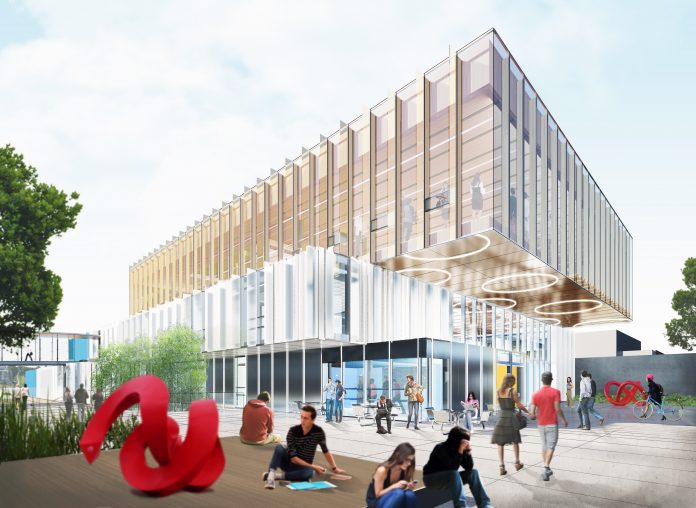
The Simon Fraser Student Society (SFSS) will hold their Annual General Meeting (AGM) this Wednesday, October 22, at which students in attendance will decide the immediate future of the Build SFU Student Union Building.

In addition to the usual society business handled at the AGM, the membership will vote on two questions related to the Student Union Building and stadium projects.

The first is a special resolution that, if passed, will allow the society to pursue a loan to proceed with the construction of the Student Union Building. The second is an addition to the bylaws that will ensure that the Build SFU levy, which will be used to pay back any loan related to the project, will not be cancelled before the loan is repaid.

Marc Fontaine, Build SFU general manager, explained the significance of this vote to The Peak: “This AGM is particularly important because the Build SFU project won’t continue on schedule if undergrad students don’t attend the AGM to vote to allow the student society to take out the loan to build the building and to amend the bylaws to add a new bylaw.”

He continued, “What’s coming at the AGM is completely expected and it’s just the next step in the project. The student society and the Society Act of BC have rules saying that societies need to ask their members — in this case undergraduate students — to approve loans.”

Fontaine also spoke to the bylaw addition: “We have a source of revenue to pay for the building, and that’s the Build SFU levy that students voted on and approved, but we need to make sure that students won’t take back that money to pay for the building before the building is paid off.

“So it’s pretty simple: it’s just the addition of the bylaw to give the banks more comfort that we will repay the loan, and that we won’t get a loan, build the building, and then stop paying the loan.”

In order to pass these questions, the SFSS must achieve quorum of 250, which is the minimum number of members needed at a meeting to conduct business. The SFSS speculates that the last time they made quorum at at an AGM was in 2008.

Zied Masmoudi, SFSS VP student services, emphasized that this AGM is markedly different from those held during the past few years. He explained, “The main difference is the agenda items. Over the last couple years, we’ve only had the standard agenda items — approval of minutes, going over the annual report, [and so on]  — it’s been pretty standard, nothing really exciting.

“This year we have more high-level decisions on the agenda, and that’s why it’s really important to have quorum this year, and that’s why it’s really important for SFU students to come out and to make a difference.”

If the questions are passed on Wednesday, the SFSS will be able to return to the banks that have made offers and sign off on those offers, meaning that construction can begin on time in April 2015.

If the questions are not passed or if the meeting fails to meet quorum, Fontaine expects that the SFSS would host a Special General Meeting in January, at which they would ask the same questions of students.

“There isn’t much benefit in waiting until January — there’s actually some disadvantage in that the project will be delayed and the opening date will be delayed, and there will be some cost implications,” Fontaine said.

The AGM will take place at 1:30 p.m. on Wednesday in the SFU Theatre on Burnaby campus, and, according to Masmoudi, will provide students with “a unique opportunity to make a difference and make decisions that will affect both the student experience and the future of this campus.”

Commemorative plaque returns to Freedom Square

1
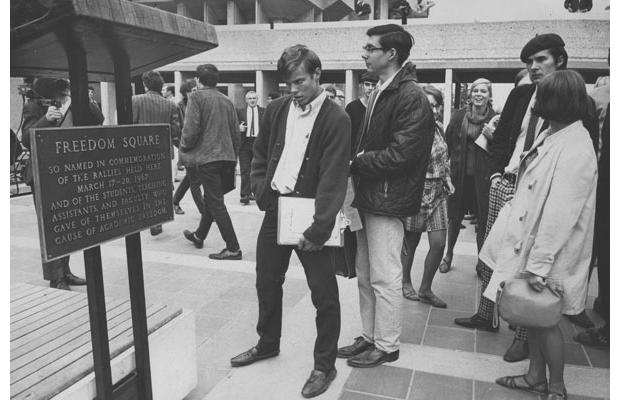
The original Freedom Square podium installed in 1968. Photo courtesy of SFU archives.

The Freedom Square plaque has been returned to SFU’s Burnaby campus after appearing and disappearing multiple times since its installation 47 years ago.

The Simon Fraser Student Society (SFSS) finally managed to track down this elusive piece of SFU history after beginning the search last year. It was restored to Freedom Square earlier this October.

The uncovered area east of Convocation Mall was given the name Freedom Square for its history of student political action.

In 1967, 2,500 students and faculty engaged in a sit-down protest in the area to demonstrate their opposition to the firing of five teaching assistants. The staff were reinstated as a result of the demonstration.

The plaque was installed the following year in commemoration of that protest and to recognize the spot as an important place for student activism, but has since spent more time away from SFU than at its home in Freedom Square.

UBC engineering students stole the plaque shortly after its installation in 1968, replacing it with an antagonizing ‘Fool’s Square’ plaque.

The plaque went on to reside in a UBC fraternity house for many years and eventually served as a TV stand for the UBC alumnus who returned it to SFU in 1990.

After its return, the Freedom Square plaque was rededicated in fall of 2000, only to disappear soon after.

The SFSS recently discovered that the plaque made its way into a storage space under a staircase in Convocation Mall. Facilities services told the SFSS that it was there for at least 10 years.

The plaque spent some years as a TV stand before being returned.

“It was a bit of a challenge to get it remounted, because nobody actually knew where it went,” explained SFSS president Chardaye Bueckert.

She also commented on the SFSS connection to the plaque: “It’s actually kind of cool. [The group that installed the plaque] was the equivalent then of the SFSS. They called themselves the SFU Student Council, but it was actually the student union who paid for it and mounted it in the first place.”

Meet the Clan: Oliver Jorgensen

0
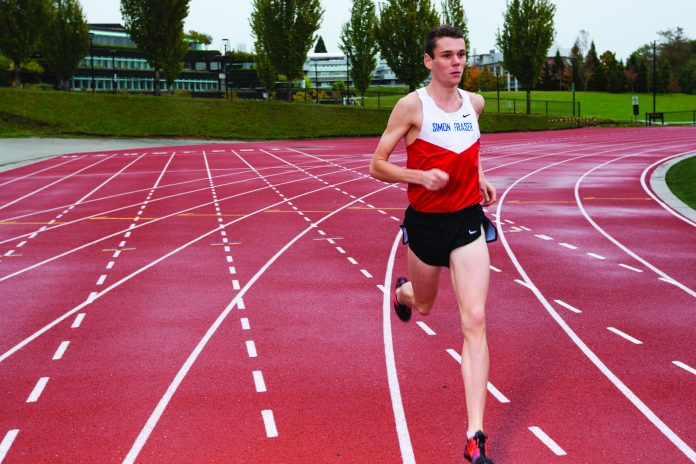
Oliver Jorgensen was the first male to qualify for the NCAA Outdoor Track and Field Championship — and he did it in his freshman year.

Screen Shot 2014-11-24 at 11.34.22 PMRookie seasons can be tough for athletes. Not only do they have to prove themselves to their coaches, but often they lack the experience and size of the veterans that they play amongst and face. In some sports, freshmen are redshirted — this means they won’t get to play with the team until their second year. Meanwhile, they have to learn the ropes of university athletics.

On the track field, though, Oliver Jorgensen has already met with tremendous success during his freshman year, becoming the first male at SFU to compete at the NCAA Outdoor Track and Field Championship, and in steeplechase, winning the Great Northwest Athletic Conference (GNAC) title. As a result, he was named the GNAC Freshman of the Year.

To top that off, Jorgensen says that this success came as a surprise to him: “My first year competing was kind of a shock. In high school I was never really front of the pack, kind of always in the middle, not the best.

“I came here and the program just clicked, and with Brit [Townsend] as a coach it all just came together. And then I kept improving and improving, until in outdoor track I won the steeplechase at the GNACs . . . it was kind of like, ‘That actually happened.’”

He explains that qualifying for the championship in the first place came as bit of a surprise. “I honestly didn’t think I was going to make it, it came down to the last minute. I ran a pretty fast time for my first steeplechase early in the season in California and we didn’t think the time would hold. We kept trying to run faster, but I got sick, I hurt my ankle, things just kept adding up and I wasn’t able to get as fast for the rest of the season. Right as they were making the national list, I was in the 20th spot and they took 20.

“It was kind of a shock, and then two people dropped out, so I was 18th, two more people were allowed in, and I was guaranteed a spot. It was pretty crazy, it happened so fast, and next thing I know I’m in Michigan [for the tournament].”

Despite his preference for track and field — a more individual sport than cross country — Olivier puts a lot of emphasis on the value of the team, saying, “It’s mentally straining and it’s physically straining, and sometimes your teammates support you a lot.”

This team dynamic extends beyond the field, as Jorgensen points out that the team motivate each other academically as well.

“[School work] can definitely be hard, especially when you’re away on the weekends. It can be really hard to do work when you’re driving in a bus for nine hours, or flying across the country. It’s hard to do homework, but that’s another team aspect: If someone starts doing homework, everyone starts doing homework.”

He explains further that he lives just off campus with six of his teammates, and the same thing applies at home.

“It’s a messy house,” chuckles Jorgensen. “It’s good because it motivates you to keep [working]. You see them going for a run, you’ve got to go too. Definitely keeps you focused on track, and focused on school, instead of doing other things you probably shouldn’t be doing.”

Despite his quick ascendance on the field, he admits to some difficulty in his first year with a university workload, saying, “It wasn’t so much right away; it was in the second semester [that] it happened to me. The first semester was fine and I kept improving. and then in the second semester my grades started to drop.”

Jorgensen adds, “When things went down for a bit, as I got injured and school got tougher, I realized, not only running-wise, but also academically, this is a lot harder than high school.”

He notes that he is “in-between majors,” stating that he did not like his original area of study, geography, and is contemplating a move into health sciences. This year, he wants to focus more on his academics and raise his grades.

“[I’d like] to be in a spot where I’m not worried about failing a test, where it’s okay if that happens, or not okay, but it wouldn’t be the end of my academics,” Jorgensen says, laughing.

He has also set his eyes on another goal, focused on his team: “My main goal right now is to get the entire cross country team to nationals [. . .] that would be the first time we’ve gotten a [men’s] team to nationals [. . .] that’s a huge accomplishment.”

Right now, he believes the team is on the right track, saying, “[We’re] doing really well right now. We’ve got some great new team members adding to the team. This year is going to be really good for us. I have a feeling we’ll have our highest placing ever in the GNAC.”

Screen Shot 2014-11-24 at 11.25.57 PM

VIFF Highlights

0


The Incident

Christopher Cross


Time travel movies generally have one main problem: they explain too much too quickly. Most of the time, this is intended to create a confusion that reflects that of the characters going through the predicament of time loops. This means that all of the plot elements surrounding the final explanation need to be entertaining, intriguing, and cohesive.

Although Isaac Ezban’s time travel film, The Incident, suffers from this problem, parts of it are interesting. Two brothers and a detective find themselves trapped in an infinite staircase after an explosion occurs somewhere outside of their apartment building. There’s no way in or out of the stairwell, but every day, anything within the room that is not biological (humans, animals, etc.) is duplicated. So every day, a vending machine in that stairwell doubles its stock, with no obvious explanation as to how or why. Meanwhile, another story has a family trapped on an infinite road after the explosion.

The two storylines are related in that there is someone injured, or at risk of dying, when this explosion happens. Because of these infinite loops, the characters are able to grow and see how they cope with the loss of someone with whom they are trapped in time.

Unfortunately, the film is rarely entertaining, and though the final explanation does help make sense of what has happened, the actual character growth takes a sideline to the semantics of the science fiction plot. This is a shame because moments of grief are far more interesting in terms of character development than seeing the before and after of someone suffering a loss — especially when the added stress of time travel is involved.


A Different Drummer

Tessa Perkins

Based on a 10-year study of eccentrics by Dr. David Weeks, John Zaritsky’s film profiles seven very interesting people and explores the concept of eccentricity.

Daniel Suelo hasn’t spent or earned a cent in over 14 years. He lives in caves, uses the town library as his office, and claims he is happier now and feels more secure than he ever did when he had money. Darla Shaw is an entertainer who seems to play dress up for a living. She received a PhD at 60 and is having the time of her life while waiting for someone to show her the rule book of how she’s supposed to act.

Gary Holloway takes people on unusual tours of San Francisco, collects tea tins, and hosts séances for his Martin Van Buren fan club. Inventor John Ward of the UK doesn’t care what others think, and if you tell him he can’t do something, he’ll build it anyway. One of his most prized possessions is his fully functional three-wheeled fire engine.

The duck lady of Vancouver, Laura-Kay Prophet, told her tragic story of being forced into homelessness and feeling like she was worthless. Her ducks got her through and she eventually started her charity Duck Soup. How about voting for England’s Monster Raving Looney Party? Lord Toby Jug carries on the legacy of party founder Screaming Lord Sutch.

Dr. Weeks found that eccentrics live longer, are more self-sufficient, want to make others happy, score higher on IQ tests, and have a great sense of humour. So maybe these folks have got it right. This documentary will get you thinking about what it means to be ‘normal.’

SFU Woodwards Students on the Homeless

0

Peak Speak: SFU Woodwards Students discuss homelessness in the neighboring downtown east-side community.

Kids to watch in the 2015 NHL Draft

0

If you follow the NHL draft, or hockey at all, you’ve probably heard of Connor McDavid, arguably the most hyped prospect to come out of Canada since Sidney Crosby. It’s also fairly common knowledge that Jack Eichel will compete with him for the first spot — this upcoming draft could be the best one since the now legendary 2003 draft. However, it’s not just the top two players who make this draft so exciting, it’s the depth behind them. Here are some players to watch out for in the upcoming draft:

Noah Hanifin (Boston College, NCAA): The 6’2, 205lb defenceman has all the tools necessary to become a dominant NHL defenceman. He’s overachieved at every level so far, with 20 points in 31 games on the same team as Eichel, and 32 in 45 on the US national U17 team. Hanfin will play in the NCAA for Boston College as a 17-year-old, which is a remarkable feat.

Draft Prediction: 3rd Overall

Oliver Kylington (Färjestad, SHL): The Swedish defenceman doesn’t have any points after his first eight games, but he’s playing as a 17-year-old against grown men in the SHL, a Swedish professional league. He’s an excellent skater, has a great shot, and has been compared to Victor Hedman. Much like Hedman, though, it may take him a while to get used to the NHL. Some scouts might be wary of taking him in light of how Adam Larrson, another Swedish defenceman, has stalled in his development after being selected fourth overall in 2011. He’s top four now, but a lot of it will depend on his performance in the world juniors.

Draft Prediction: 4th overall

Travis Konecny (Ottawa 67’s, OHL): As a 16-year-old last year in the OHL, he put up 70 points in 63 games. Quite impressive for a rookie, which is why he won top rookie of the year in the OHL. At 5’10, growing two or three inches would help his draft stock, but he’s got excellent hands, is very shifty, and is a powerful skater.

Draft Prediction: 5th – 8th overall

Mathew Barzal (Seattle Thunderbirds, WHL): This local kid from Coquitlam had a good rookie season, with 54 points in 59 games. He’s got great vision, as evidenced by 40 of those points last year coming as assists. He only had 19 goals, but that is not for a lack of ability when it comes to shooting the puck: he has a great release, but tends to pass instead of shooting. He is being compared to another highly touted pick from the Lower Mainland, Ryan Nugent-Hopkins.

Draft Prediction: 6th – 10th overall

Dylan Strome (Erie Otters, OHL): Dylan Strome is an interesting case. The brother of NHLer Ryan Strome, Dylan is having a excellent start to his OHL season, with 13 points in four games. Of course, it helps if you get a good amount of playing time with Connor McDavid. That fact alone might send Strome down the rankings, as scouts might worry if he can produce without McDavid; but he’s 6’2, and a big centre with his skillset will be hard to pass up. He could go as high as fourth, but  could easily slip to 11th if scouts are worried he’s just riding McDavid’s coattails. There’s just too much uncertainty.

Draft Prediction: 7th -11th overall

Mitch Marner (London Knights, OHL): Last year, his first in the OHL, Marner had 59 points in 63 games. Like Barzal, his vision and playmaking ability are his bread and butter. He did very well for himself on a stacked London Knights team that featured the likes of Bo Horvat and Max Domi. He could be given a bigger role if the veterans stick with their NHL clubs, which would lead to more ice time and production. He will have to overachieve and hope some of the other prospects falter in order to shoot up the draft rankings.

Draft Prediction: 8th overall