Home Blog Page 1079

Pipeline protesters repel Kinder Morgan crews on Burnaby Mountain

3

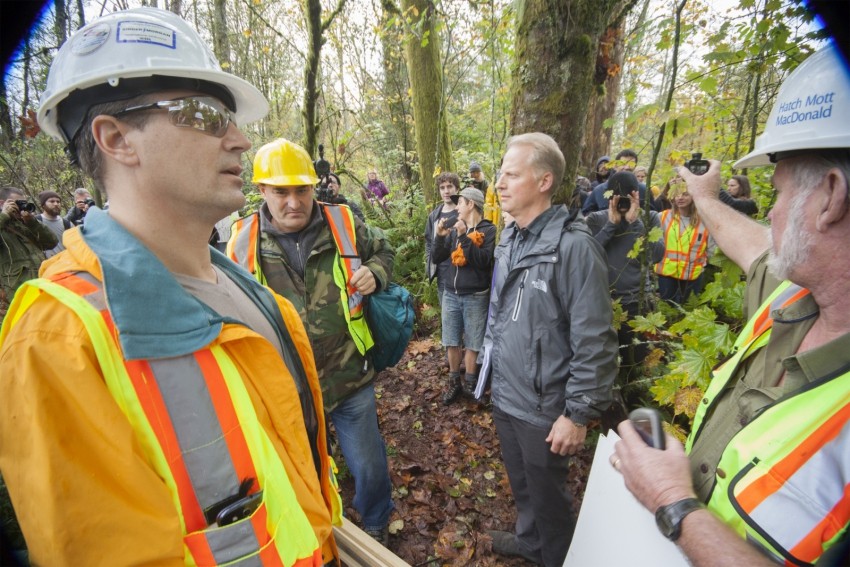
A group of protesters prevented Kinder Morgan from entering testing sites in the Burnaby Mountain Conservation Area on Wednesday morning, where they had planned to resume surveys for their proposed pipeline project.

Protesters linked arms around one of two borehole sites, and one teenager even pinned himself under a Kinder Morgan jeep, saying oil was destroying the earth and that he would stay under jeep for “as long it takes.”

This confrontation follows the National Energy Board’s (NEB) ruling on October 23, stating that the City of Burnaby cannot stand in the way of Kinder Morgan’s plan to test at sites on Burnaby Mountain. The energy company announced on October 24 that they would resume testing after 48 hours.

In response, protestors worked over the weekend to reinforce two blockades which have been present for the past month. Stephen Collis, an SFU professor of English and spokesperson for the protesters said on Monday, “We’re going to peacefully and non-violently stand in their way.”

On Wednesday morning, at 9:30 a.m., Kinder Morgan crews had yet to arrive at the site where a flood of protesters had begun to gather.

When asked why she thought crews had not yet arrived, SFU professor of molecular biology and biochemistry Lynne Quarmby replied, “They’d be smarter than to show up in the presence of all this media and all these people. [. . .] They would be foolish to show up.”

However, at around 10:00 a.m., protesters spotted Kinder Morgan crews advancing into the woods towards the first borehole. Protesters, journalists, and film crews rushed to the site where self-proclaimed caretakers were already blocking crews by linking arms around the site.

“There’s just a tremendous amount of support from the community.”

Lynne Quarmby, SFU professor of molecular biology and biochemistry


Some minutes later, the surveyors left the site. In an e-mail, Greg Toth, senior project director of the Trans Mountain Expansion Project said, “At some locations, our crews were obstructed and have left for the day.”

For Quarmby, this was a victory for the people. “We put out the call, we let people know that we were going to be here, and it’s just phenomenal the number of people that are still pouring in, so there’s just a tremendous amount of support from the community,” she said.

When asked what she thinks the next few days will bring, Quarmby replied, “We expect that they’re going to try to outwait us, but [. . .] I don’t think you can overestimate the commitment of this group of people. We will out-wait them.”


Marketa Irglova and friends perform at St. James Hall

0

Marketa Irglova has one of the purest, most serene voices I’ve ever heard, and many of her songs have the ability to bring tears to my eyes no matter when I hear them. I was overjoyed when I found out about her stop in Vancouver, as she tours in support of her new solo album, Muna. She was joined by Iranian daf player and vocalist Aida Shahghasemi, and Rob Bochnik and Joe Doyle (who also played with Irglova in the band, The Swell Season), along with opening act, Rosi Golan.

You might know Irglova as half of the duo responsible for the film, and now musical, Once, and as a member of The Swell Season, along with former partner, Glen Hansard. Hansard is another passionate musician who I’m a huge fan of, and together they made wonderful music. The Once soundtrack is not only one of favourite soundtracks, but one of my favourite albums of all time. It is too bad that they parted ways, but I’m glad that they’ve each continued making music on their own.

Irglova focused most of her time on playing new material from Muna, but she threw in a few favourites such as “If You Want Me,” “I Have Loved You Wrong,” and her Academy Award winning song, “Falling Slowly.” If that song doesn’t make you feel something, I don’t know what will. I enjoyed hearing her new music, but it was wonderful to hear those familiar favourites. Shahghasemi did an impressive daf solo, and for one song she switched places with Irglova to play piano.

The beautiful venue of St. James Hall only added to the calming, soothing quality of Irglova’s music. Featuring 27 musicians, Muna has a beautiful choral, symphonic quality to it on songs like “Point of Creation” and “Time Immemorial.” Of her new music, I enjoyed “Without a Map” the most, with its introspective lyrics and immersive quality.

This second solo album is a departure from her Swell Season days, but with its thoughtful lyrics, beautiful melodies, and deeply soothing, spiritual quality, I think it is a genuine representation of her identity and skill as a musician. Muna is the Icelandic verb “to remember,” and that is exactly what I will do with this concert.


Denise Clarke presents a new solo show

0

Denise Clarke is an accomplished, respected contemporary dance artist who is a member of the Order of Canada. Over the course of her career she has been involved in all kinds of productions, but this show is personal.

Clarke entered from stage left wearing a large hooded parka and backpack, trudging along as if through a snowy field. That was in fact what she was doing. Through narration and commentary, Clarke told the story of her trek through an Edmonton park on her way to rehearsal two days before Christmas. She was on her way to rehearse this show, and began to wonder why she was bothering with a solo show that nobody would come to see.

Then she spotted a section of the park that was a pristine blanket of snow, you know, the kind that makes you think ‘wouldn’t it be great to mess up that perfection?’ So she did, and does in the show. She put down her bag and did a sequence of her choreography in the snow. That is, until a laberdoodle and its owner came upon her.

This love of dance, and the power of dance to lift our spirits, is a theme that runs through the show. She tells another story about being in an Ottawa park at 3:00 a.m., and having the urge to dance alone to the Paul Simon coming from her headphones. So she did.

This show is personal on another note, as well. While preparing the show, her brother and dad both passed away, and as she explains, her dad was the type of person who always said he didn’t want her to stop what she was doing “just because he kicked the bucket.”

Through all this pain, dance was a large part of her ‘cheer up program,’ and she brought a beautiful peachy pink ballgown to change into and waltz around the stage. She admitted that she’s always wanted to do that in a solo show. For this section, four girls came down from the audience, changed into their dresses, and joined her in a grand waltz.

Another part of this show that I loved were Clarke’s lists, which she translated into movement. She listed her favourite books, each with a corresponding movement, which she dances when she needs cheering up. Her ability to translate story into movement while incorporating witty, entertaining commentary is unlike anything I’ve seen.

Wag was presented October 21 to 25 at the Firehall Arts Centre. For more information, visit firehallartscentre.ca.

Sloan attracts young and old to Commodore

0


For their new album, Commonwealth, each member of Sloan helms one side of the record representing the four suits of a deck of cards. The band has always collaborated on songwriting, and on this album each of them has a chance to be the front man. In this same spirit, their live show had the band members switching places and sharing the limelight.

They began playing the Spade side of the record, followed by the Shamrock, Diamond, and Heart sides, with older songs in between such as “It’s Plain to See” and “Unkind” from Double Cross. “Unkind” had the crowd clapping along to the beat and singing the infectious lyrics.

From Jay Ferguson’s Diamond side of Commonwealth, they played “You’ve Got a Lot on Your Mind” which fit right in with their older hits and had the crowd nodding along in approval. This moved right into the following song off the record that references the theme of the album directly with lyrics like “She played a diamond where a heart should land” and “The house will always win.” This is a very well written song, and sounds as though Sloan just crossed the pond from Britain.

Of course, the members of Sloan are not from Britain, but from Halifax, and are now based in Toronto. Their patriotic side comes out on “The Rest of My Life” as they sing “One thing I know about the rest of my life, I know that I’ll be living it in Canada.” Screaming that along with everyone brought me back to Canada Day a few years ago when Sloan performed in Surrey.

Chris Murphy’s Heart side has a different tone, but it suits the band nonetheless. Songs like “Carried Away” were very easy to sing along to. They brought out “Believe in Me” from 1988, and the older fans in the crowd were very pleased.

The range in audience ages was really nice to see at this show, as Sloan have managed to keep their fans from the ‘90s while also attracting some new fans along the way. Maybe not everyone could relate when they sang “I Hate My Generation,” but everyone enjoyed this 1994 hit.

After taking a break, the band came back for round two and got everyone pumped back up with their 2001 hit, “If It Feels Good Do It.” “Misty’s Beside Herself” from the Heart side of Commonwealth slowed the pace down, and then they switched gears once again to play one of my favourites, “Who Taught You To Live Like That?” and “Ill placed trust” from 2006’s Never Hear the End of It.

With such a large discography, the band has a lot of material to draw on, and they played a well-rounded and lengthy set. Before the encore, they played two more that everyone could sing along to: “The Other Man” and “Money City Maniacs.”

They thanked the crowd for allowing them to do an encore, and expressed that they still love that feeling of being called back on stage. The group is still humble, and clearly loves making great rock music. They ended the night with the first song off Commonwealth, “We’ve Come This Far,” “The Marquee and the Moon,” and “She Says What She Means.” It was a fitting way to end a night of visiting their extensive discography.

Quantum is dance inspired by particle physics

0

Swiss choreographer Gilles Jobin’s Quantum represents a blending of art and science. Jobin participated in Collide@CERN, an artist residency initiative of The European Organization for Nuclear Research, where he was inspired by particle accelerators and physics.

Quantum is what came out of that residency, and it demonstrates an awareness of patterns, clusters, and the idea that we are all made of these particles that are constantly moving. The piece begins with six dancers shaking frenetically on the spot, as the lights above them sway back and forth.

The lights are a work of art in themselves, and are a lumino-kinetic installation by Julius von Bismark. This made the lighting extremely dynamic, as the three large bulbs swung in different patterns and at varying speeds throughout the performance.

The dancers’ movements seemed to be influencing the movements of the lights, and they added an extra element to the work as they too had to be choreographed. The way the circles of light moved as the lights swayed was an effective way of changing the mood and pacing of the work and, at times, added an extra pulsing, rhythmic element.

In tight jumpsuits with a detailed geometric pattern, the dancers moved around the stage in various clusters, with one dancer beginning a movement and the others following suit until the chain reaction of movements changed their formation. These sections were reminiscent of atoms moving in clusters and affecting each other in a chain reaction.

The soundscape of this work was not melodic at all, and contained a few sections of very piercing sounds that had a few audience members grimacing as they covered their ears. This only added to the scientific, clinical feeling of the work as the dancers moved around a bare, starkly lit stage.

With impressive contact work and inventive choreography, this is a fascinating work that blends the two fields of art and science into a unique creation.

For more information, visit thedancecentre.ca.

A day at the Art/Book fair

0

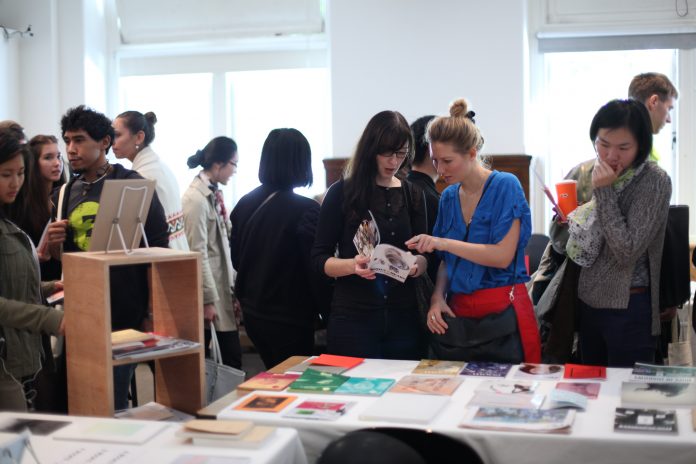
During the month of September, local artist-run culture gets into the full swing of things with an annual swarm of show openings throughout the Vancouver area. One centre, however, is creating a new tradition in the first week of October.

The Peak sat down with founder Tracy Steffanucci, as she prepares for the third annual Vancouver Art/Book Fair, which is produced by Project Space and takes place on October 4 and 5.

The Peak: Could you start by giving us a bit of background information on Project Space? How did it come about and who was involved?

Tracy Steffanucci: Project Space is a non-profit organization dedicated to publication as an artistic medium. Our main projects are the Vancouver Art/Book Fair, Project Space Press, OCW Magazine and projectspace.ca.

The organization evolved out of a magazine I co-founded in 2006. In 2011, under the leadership of Jaz Halloran and I, we opened a bookshop/gallery in Chinatown and began operating under the name Project Space. We closed the storefront in 2013, but we are still very active with our other projects.

Peak: Why the Vancouver Art/Book Fair as an event? This is the third installation of the fair — have you noticed anything changing in the Vancouver publication community now that the fair is a mainstay?

Steffanucci: VA/BF was founded in response to an absence of art book fairs in Canada and on the West Coast (though after we founded the fair we were pleased to see Printed Matter launch an LA Art Book Fair). Our city and country have active and vibrant artist publishing communities, and fairs are an ideal place to circulate books, generate discourse, engage new publics, and foster relationships between artists, publishers and the public. VA/BF acts as an invaluable piece of cultural infrastructure; it seemed absolutely necessary to launch one here.

In Vancouver in particular, we have a fairly sizable and active community that is producing art books — though we are still working on helping to make the various smaller communities that make up this broader community more visible and connected. I do see results and am excited for ongoing development in this regard.

For example, Nathan Jones and Michael Lachman’s Print Ready exhibitions at Dynamo Arts Association are fostering a community around artists’ zines. Or 221A’s recent collaboration with Brick Press for Dan Starling’s bookwork The Part of No Part is a good example of an artist-run centre collaborating with another art publisher. We’ve also been posting art publishing–related events to our blog at projectspace.ca, and are impressed by the number of groups hosting such events and how frequent they are.

Peak: They say the third time’s the charm. What can visitors expect, or be surprised by, at this year’s VA/BF?

Steffanucci: VA/BF takes over three floors of the Vancouver Art Gallery Annex to present works by hundreds of artists and publishers — from exhibitor tables to installations and other displays — as well as hourly talks and performances, an art and coffee lounge (with free organic, fair trade coffee from our official coffee sponsor Ethical Bean) and more.

This year, some highlights include Jordan Abel, award-winning Nisga’a poet and author of a new artist book we’ve published titled Un/inhabited; Hugh Frost of Landfill Editions, a Stockholm-based publisher that produces books as well as various other art objects.

Other highlights include Rachel Gontijo Araujo of A Bolha Editora, a Sao Paulo–based publisher that is committed to disseminating under-represented Brazilian works in other countries, Lauren Mackler, founder of Los Angeles’ Museum of Public Fiction, which produces an art journal that compiles print artist projects and texts in connection with thematic group exhibitions; and Helena Keeffe, a San Francisco–based artist whose project Standard Deviation discusses valuation of artistic labour.

The passion evident in the work on display at VA/BF is palpable. There is nothing quite like talking directly to an artist or publisher about the work they’ve created — hearing the back-story and the intention from someone who is incredibly passionate about it.

The range of work on display is outstanding, meaning there is something for all kinds of book lovers and also that it is almost impossible to not discover anything new and exciting.

Of course, there are also things like free tote bags given out at the door — which doesn’t hurt. Give yourself lots of time, as there are many rooms of books and artists’ projects to explore, as well as hourly talks and performances.

The Vancouver Art/Book Fair opens with a Members Preview October 3 and runs October 4 and 5 from 12:00 to 5:00 p.m. For the real book aficionados, be sure to check out Artists’ Books Week, which is a series of events in parallel to VA/BF that runs September 29 to October 5. For more information, visit vancouverartbookfair.com.

Bad batch of candy corn could harm trick or treaters’ taste buds, warn police

0
There could be striped disappointment lurking in your child’s trick or treat bag.

Police are warning trick or treaters about a particularly uninspiring batch of candy corn that could pose a risk to children’s taste buds.

“No one is in immediate danger of being disappointed,” police announced to candy enthusiasts earlier this week, “but we are monitoring things closely. We’re taking a ‘better safe than bummed out’ approach to the situation. Anyone with any information about the subpar candy corn should contact us immediately.”

The candy has already disappointed Vancouver teens Trevor Smith and Todd Chan, and police are saying similar incidents could be on the horizon.

According to a police report, Smith and Chan purchased the alleged candy corn from a bulk aisle at Superstore. Instead of just being content with how average the candy was, the youth told police that they were unsatisfied with how bland it tasted.

“At first we thought it tasted like regular candy corn, which I guess tastes like sugar but not as good,” Smith recounted to The Peak. “After a couple of pieces, neither of us were really feeling it though. I still have most of the bag so I might just give the rest to my parents. I’d feel bad just throwing it away.”

A junk food belonging to the ‘sweet’ family, candy corn is a popular treat for this time of year — which police say makes it especially prone to disappointment.

“People get excited that they can buy candy corn in stores again and they immediately think back to eating it when they were kids. When people are nostalgic, they’re more susceptible to be underwhelmed by something. Just because a candy is seasonal doesn’t mean it can’t be mediocre.

“It’s Halloween, so of course people are going to be hopped up on Tootsie rolls, miniature chocolate bars, and anything else they can get their hands on. It’s important that people are aware of what kind of candy they’re ingesting so this doesn’t happen to them.”

The situation is similar to an incident in 2012, where police issued an advisory on all Sun-Maid Raisins, after reports flooded in about raisins that were drier and more stale-tasting than usual. Sun-Maid representatives responded by saying that that’s just how raisins are supposed to taste and the allegations were eventually dropped.

Until more is revealed about the dispiriting candy corn batch, police are advising trick or treaters to stick with candies that they already know will be disappointing, like Almond Joys or those little suckers with the shitty gum in the middle.

Satellite Signals

0

Woodward’s

Last Wednesday, October 22, SFU Woodward’s hosted a panel discussion on the book, Red Skin, White Masks: Rejecting the Colonial Politics of Recognition, written by Glen Sean Coulthard, an assistant professor in the First Nations Studies Program and the Department of Political Science. According to the event description, the book challenges the “now commonplace assumption that settler-colonization can be reconciled through a process of cultural recognition and accommodation.”

Surrey

SFU Surrey hosted its 7th annual Diwali event at Surrey’s Crown Palace Banquet Hall on Tuesday, October 21. The event celebrated Indian culture and attempted to engage with the local South Asian community.Over 300 South Fraser business, government and community leaders, as well as SFU alumni, faculty, students, and staff attended the dinner.

Harbour Centre

A lecture by Brown University’s Rebecca Schneider on October 22 discussed contemporary performance-based art alongside Paleolithic cave art, exploring performance as a historical artifact. Schneider asked questions such as: How long is the live? How live are the dead? And why are these questions surfacing now?

The NDP’s childcare plan may not be easily accessible

0
The NDP hasn’t shed light on how the plan will reach out to those impoverished.

Last week, Leader of the Opposition Thomas Mulcair announced a proposal to launch a nationwide childcare program that would seek to provide affordable and quality childcare services to families across Canada. Mulcair’s announcement looked to set up what will be the NDP’s key platform issue come election time next year.

While the promise of affordable and universal childcare is an obvious boon to the Canadian economy and serves to only further gender equality, the true accessibility of this plan remains unclear.

The issue of childcare is, at its heart, a gender equality issue. Too often, families are unable to either find or pay for daycare, and too often, women are expected to assume the responsibilities of primary caretakers due to patriarchal cultural norms; thus, the government’s inaction to provide such care disproportionately burdens women.

This is of particular concern considering the staggeringly high number of women pursuing post-secondary education and poised to take on leadership roles in all industries in Canada. However, the realization of gender equality will be stagnant until systemic barriers to employment and career advancement for women can be negated by an effective childcare system.

Most importantly an effective  childcare policy would be self-sustaining. The surplus of women who would be able to enter the workforce would not only significantly grow the economy, but their income would also provide crucial tax revenue for the government.

The blind nature of such a policy will not help the most vulnerable people in our society.

In Quebec a similar childcare policy has been in place for quite some time and the outcomes have been encouraging. Economist Pierre Fortin argues that “[the] ripple effect of [women’s] employment pumped an additional $5.2 billion into the Quebec economy, boosting the province’s Gross Domestic Product by 1.7 per cent” which easily pays for the “$1.6 billion annual child-care costs” the province incurs to pay for such a plan.

One thing remains abundantly clear; the current status quo of childcare in the form of the Universal Child Care Benefit makes no economic sense. One hundred dollars per month is not nearly enough to cover the exorbitant price of childcare (which on average can surpass $1,000 per month).

The NDP’s policy will cost $5 billion dollars a year  by 2023. This policy not only subsidizes the cost of daycare to $15 a day, but also involves providing a million additional care spaces for just double that amount.

However rosy universal childcare may seem, I remain concerned that the NDP policy will, like the troubling majority of social policies, only be enjoyed by the most privileged groups in our society. The policy seems to invoke a universal language but I am doubtful that such language is appropriate given the starkly different economic realities that Canadians face.

An OECD study found that in Canada “low-income, single-parent families[. . .]pay, on average, 48 per cent of their net income” on childcare services. What has the NDP said as to how these families are to benefit under this new plan? Nothing. The waiting lists for these care spaces will give no preference to families who need such subsidized services in order to subsist.

The blind nature of such a policy will not necessarily help to ameliorate the conditions of the most vulnerable and impoverished people in our society, which is what a truly socially minded social policy ought to do. If it fails to do so, it takes its place as just another empty political gesture and we have plenty of those in Ottawa, Mr. Mulcair.

Genetic engineering takes steps towards building superhumans

3

The superpowers of heroes such as Spiderman, Captain America, and the Hulk have become a frequent sight in movies and TV shows, but new technology may mean that you could see them in your day to day life, sometime in the near future.

A paper recently released by Stephen Hsu, a professor of theoretical physics at Michigan State University, asserts that by tweaking our genomes, we could make humans drastically smarter. He explained that by modifying gene variants, human intelligence could be increased to 10 times what it is now.

The paper has inspired renewed discussion in the academic community around the issue of genetic modification and how it might be used to give people ‘superhuman’ powers.

Last week, a man who had been paralyzed for two years walked again following a transplant to his spine. The treatment involved the injection of olfactory ensheathing glial cells (OEGs) into the man’s spine, which were able to create new nerve cells and repair damaged ones.

Michel Leroux, professor in SFU’s Department of Molecular Biology and Biochemistry, acknowledged the uses of stem cell technology: “It’s simply basic biological principles that multicellular animals, such as us, employ to grow from a single cell to an adult.”

However, he speculated that, “we will require 50 plus years to get closer to really understanding mechanisms at the molecular level inside our cells.”

Human engineering is not just limited to comic books anymore. John Gurdon and Shinya Yamanaka, who won the Nobel Prize in Physiology or Medicine in 2012, discovered that adult cells can be reprogrammed back into stem cells.

These stem cells can then be pushed to develop into a huge variety of adult cells: skin, bone, muscle, or even nerve.

The technique, called induction of pluripotency, has made previously impossible therapies a reality. A short list of examples includes repairing damage to the heart after a heart attack, creating new insulin producing cells for diabetic patients, and even constructing a kidney from scratch.

Human engineering is not just limited to comic books anymore.

Such advances in the use of genetic engineering are reminiscent of a ‘healing factor’ that allows superheroes like Wolverine and Deadpool to heal their injuries supernaturally fast. When asked whether reprogramming a human’s body like this would ever be possible, Leroux suggested that it represents a logistical challenge.

“The main issue there is delivery,” he said.

Currently, there are many methods for modifying cells’ behaviour, but most involve somehow getting foreign genes into the cell. There is even a ‘gene gun’ currently on the market, which fires DNA-coated gold particles into cells. Despite the innovation, physically getting DNA into many cells in a living organism is extremely difficult, at least for now.

Gene editing tools like CRISPR — clustered regularly interspaced short palindromic repeats which take advantage of natural DNA repair machinery to engineer the genome — might mean that scientists are that much closer to giving humans supernatural healing or amplifying the abilities that we already have. For instance, infants under a year old that have lost a finger tip can regenerate the finger, much like how a salamander can regenerate a lost limb.

Leroux explained that the excitement behind CRISPR is due to its incredible versatility and that “remarkably, it works in everything that’s been tried.”

However, with these powerful tools also come ethical challenges. Leroux had his own opinions on the matter. “Personally, I could say that if you know that your children will have a particular genetic disorder and you’re able to fix that, I think that’s ok,” he said. “So is that where you draw the line? You can pre-fix problems but you can’t enhance existing traits.”

For good or bad, Marvel or DC, the capabilities to engineer superhumans are already here.