Home Blog Page 1073

SFU reclaims title as Canada’s top comprehensive university

0
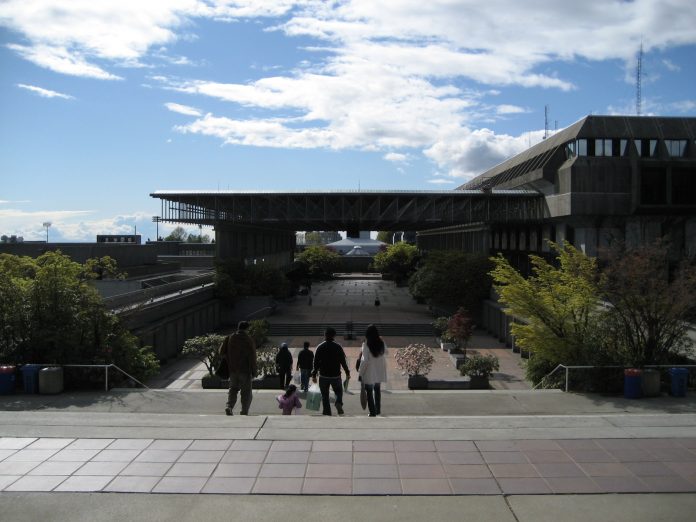
Not only is SFU on top of a mountain, it’s also on top of Maclean’s comprehensive university rankings.

SFU has once again snagged the top spot as Maclean’s number one comprehensive university.

Maclean’s compiles rankings of Canada’s best post-secondary institutions annually, and over the past 24 years, SFU has been awarded top comprehensive university 11 times.

The category compares universities based on their research, range of programs at the undergraduate and graduate levels, as well as their professional schools.

SFU president Andrew Petter noted the university’s significant development in recent years, saying, “I think our strength as a research institution has grown remarkably in the last 10 years.” He continued, “The success of our faculty in terms of their research productivity is showing up not just in Maclean’s.”

SFU was also recognized in the QS University Rankings, where the school placed 16th among universities under 50 years of age around the world. SFU was the third North American school down the list, below only the University of Calgary and UC Irvine.

SFU and the University of Victoria (UVic) have been jockeying for the Maclean’s top comprehensive spot since 2007, and even shared first place in 2008.

“It is gratifying to know that when you look at all the major indicators that Maclean’s looks at, that we’re not first in every category, but across the [Maclean’s] piece, we and UVic are really the two leaders in the country,” said Petter. UVic sits behind SFU this year, as the second best comprehensive university in Canada.

Petter spoke to the significance behind these rankings: “I think that our strength comes from the fact that we are a comprehensive university and that we offer our students such breadth in course offerings, and therefore our library holdings, and our programs reflect that breadth.”

The president explained that it is hard to know for sure what sets us apart from other schools, given that the rankings are subject to so many variables. He referred to a familiar SFU theme, telling The Peak, “SFU is a different kind of university in a way that doesn’t show up in the rankings, and perhaps it won’t surprise you to know that I think it relates a lot to the theme of engagement.”

Petter went on to cite recent events in which SFU has engaged the community, such as the SFU Public Square community summit held two weeks ago around the topic of innovation and offerings to students for “experiential learning” through co-ops and semesters in dialogue.

According to Petter, SFU offers a “diversity of learning cultures and experience” in that it has “three campuses embedded in different communities.”

Despite strengths, Petter admitted that SFU is not without its challenges. “As a large commuter campus university, we have some work to do. I think I would like to see much better performance in terms of students satisfaction than SFU has gotten.”

He mentioned that increasing residence on campus, and not only Burnaby campus, could play a part in building campus community.

The university also struggles with deferred maintenance. “It’s no secret that this is a campus that is almost 50 years old. It’s in need of some pretty significant tender love and care and we really need some investment on the part of government to deal with those issues,” said Petter.

Addressing those maintenance issues is only one way in which Petter hopes to see SFU grow and develop. He said he is looking forward to the completion of the BuildSFU project, since it will provide a space for students to “engage with each other.”

“A lot of learning takes place outside the classroom,” Petter added. He explained that he hopes that this will contribute to building better connections between domestic and international students.

Petter also pointed to the Surrey expansion as an exciting development in SFU’s not-so-distant future. The university plans to double the size of Surrey campus over the next five to eight years and has already procured the space, and is waiting now for approval from the province to proceed.

To conclude, Petter commended the hard work and enthusiasm of faculty and students that have added to the university’s current success. “SFU has a wonderful energy about it. Students are the main contributors to that energy.”


White Cowbell Oklahoma have a unique stage show

0

From their heavy-rock riffs and southern Tex-Mex aesthetics, to collaborations with famous Canadian artists such as Feist and Sloan, White Cowbell Oklahoma has proven to be a rock group like no other.

With a dedicated cult fan-base and over 12 years of critically praised shows, the recent release of their newest album Buenas Nachas sees them paving new style paths, while maintaining the classic rock style that has defined them to date.

Lead singer Clem Clemsen, in the midst of preparation for an upcoming headlining tour, took time to discuss the band’s newest addition during a phone interview with The Peak.

The Peak: Buenas Nachas seems very different from your old stuff. What led you guys to record this album?

Clemson: Put it all down to LSD [laughs]. To be honest, we were heavily inspired by Bosch paintings and David Lynch. We noticed that in Europe, the audience would applaud after the guitar solos and riffs which we borrowed from older bands, such as Pink Floyd and Deep Purple. So we decided to delve deeper into our older record collections to get more indulged in those styles, which I guess must have had an effect in our songwriting styles.

P: Sweet. So I heard you guys have reduced your band roster?

C: Yeah, we reduced our lead guitar players from nine to three in order to focus more on the harmonies and guitar-monies. Nine players was way too much to handle.

P: What would you say is the aesthetic you were going for with Buenas Nachas?

C: Well, at the start we were heavily inspired by ZZ Top’s 1976 album Tejas and the whole southern, desert, Mexico vibe. So we were definitely trying to reference that type of desert imagery containing coyotes, cows, truckers on meth, etc.

P: What does the title of the album mean?

C: A literal translation would be “Good Evening” in Spanish. However, we intentionally misspelled the “Nachas” as a play on words that translates to “Nice Ass” in Spanish slang.

P: Nice. It seems like you guys took a more artistic, euro-prog rock approach compared to your previous [records]; should fans expect more of these styles in future albums?

C: Yeah, definitely. Most of the members in the band actually have a lot of conceptual ideas that we sit around and discuss, while eating peanuts and dressing like the Illuminati.

P: Your shows have a reputation of being very energetic and spontaneous, i.e. strippers, pyrotechnics, etc. Should audiences still expect this energy during live shows?

C: Definitely! When it comes to live shows we want audiences to get what they pay for, when they are paying all this money for tickets. We grew up in a time when artists such as Alice Cooper and Kiss were incredibly popular and very theatrical; we try to retain that classic show experience that is not only a reiteration of our recordings, but an all encompassing show. We want audience members to have that memorable experience of being at a White Cowbell Oklahoma concert, rather than simply any concert.

P: Wow, definitely sounds like an experience! Cannot wait to see it! Last but not least, are you excited to come to Vancouver?

C: Very excited. We are really good friends with the co-headliner Big John Bates, so it’s going to be cool to get drunk and heckle them until they throw beer bottles at our faces. Overall, we are looking forward to it.

White Cowbell Oklahoma will headline alongside Big John Bates and special guests at the Biltmore Cabaret on November 13. For more information, visit whitecowbell.com.

Inspired by Rosa Parks, student with laptop refuses to move to back of lecture hall

0
Wright hopes that her actions will go down in history, just like her grade did.

An SFU student took a dramatic stand Tuesday afternoon in favour of what she describes as her “inalienable right to make everyone behind her watch her browse Etsy.”

Despite being asked several times by her professor to move, in accordance with his rule that students with laptops sit near the back, third year student Madeline Wright remained front-row and centre for the duration of her American history class.

“I was standing up for what I believe in, just like we learned Mrs. Parks did,” Wright said, following her private meeting with the prof to discuss the incident. “I’ve been forced to sit in the back my entire undergraduate life, just because of my laptop — I had to take a stand!”

Unlike her hero, Wright says that she was not arrested or even forced to leave the class, but claims that her fate was almost as bad, as she was glared at and verbally abused by the pen-and-paper kids in the class.

“They yelled at me to ‘get to the back’ and to ‘shut that thing off,’ as if preferring to take notes on a computer was a choice or something,” Wright explained. “I can’t believe this type of discrimination still exists in the 21st century!”

While Wright admits to having faced far worse treatment — she isn’t even allowed  to have her laptop out in certain classes — she says she won’t give up her fight until all those with open computers are permitted to sit in any seat, at any university.

When asked whether she could learn any other lessons from what she’s being taught in class, Wright responded “Well, we were learning about Rosa Parks and the whole ‘refusing to change seats when someone asks you to’ thing … but recently we’ve moved on to, like, ‘civil rights’ or something.

“I don’t know, it’s really boring so I just go on Facebook.”

Be courageous, be kind

1

So, this is it — this is where I bid you all a fond farewell. I’ve decided not to reapply for my position as The Peak’s copy editor and this, my inspirational, insightful editor’s voice, is me saying goodbye.

I’ve been pondering what I want to write about, what I want to leave with you all: something personal and anecdotal, something cliché and ‘wise,’ something funny and light — luckily for me, however, I was inspired by two gentlemen who came into The Peak offices last Wednesday.

They were concerned, offended even, by an article that we had published the week before, and sought us out, in the bowels of the MBC, looking for answers.

Let me pause to say that confrontation is hard. Your voice starts to tremble, you feel that flush crawling up your neck, you second guess what you’ve said as soon as the words tumble out of your mouth — it’s a fucking miserable experience. But it’s a necessary part of life as an adult; things offend you, they hurt you, they piss you off, and you can either let those things fester and maybe dissipate, or you can seek out resolution.

Okay, back to the office. These guys were clearly upset, they explained their multiple issues with the piece, and our Editor-in-Chief and myself were left to respond, to defend the article or to capitulate where necessary. They weren’t aggressive, they weren’t mean or hysterical, they made valid points, and as I listened to them speak, all I could think was . . . ‘Damn, these guys really, really care.’

We’ve all seen enough comments sections to know that responses to unpopular opinions are often personal.

Passion like that amazes me. And it leads me to my first piece of advice: care. I know you’ve heard this one a million times. But this time really hear it. We are young people, we are informed people, we are the people who must make waves, who must get riled up, who must seek out answers, who must demand answers because it matters and it makes a difference.

The concerns of those two gentlemen were heard and taken into account and will affect future decisions at The Peak, because they cared enough to ask, “Why?”

Are you fired up? I sure hope so. But before you grab that torch and storm that gate, I’ve got a second piece of advice: be kind.

You care about something, you know your shit and this thing is extremely important to you, and then you read or hear an opinion that flies in the face of everything you believe, everything you know to be true. You feel it in your gut, as if someone’s punched you in the stomach. You are afraid because this wrong, misinformed, unclear (insert your adjective of choice) opinion is out in the ether, possibly swaying people in the wrong direction.

Before you rip into the person spouting off all of that figurative black smoke, take a breath and remember that that person is, in fact, a person. It seems simple enough, and yet our tendency to overlook the whole humanity thing continues to shock and awe me.

We’ve all seen enough comments sections to know that the flak received by purveyors of unpopular opinions is often personal and sometimes brutal. But it’s understandable. That feeling I described earlier — that punch in the gut feeling — is personal and can feel like an attack. We lose ourselves in our fear, and we lash out. We gather our arsenal of verbal sticks and stones and we let loose, forgetting (or ignoring) that there is a person somewhere in the midst of it all.

No amount of passion or outrage exempts you from being decent; take steps in your own life to make the change that you want to see rather than abusing others for their ‘misinformed’ opinions. Start dialogues, ask the hard questions, but be kind.

Women’s soccer close rebuilding season

0
As they wrap up their season, the women's soccer team moves closer to becoming a contender.

With last Saturday’s 3-0 loss to the Western Washington Vikings, the Clan women’s soccer team closed their season. It was the second straight game where they were shutout, and the 10th time this season (out of 18 games).

However, this was to be expected; this season was a year of rebuilding and tempered expectations for the team. As head coach Annie Hamel told The Peak at the beginning of the semester, their goal for this year was to “[have] the best success that we can with the team that we have, build game-in and game out on our successes, and look forward to what the future holds.”

The team finished with a 2-16 overall record, with both of their wins coming in Great Northwest Athletic Conference (GNAC) play. Olivia Aguilar led the team with three goals, and keeper Priya Sandhu appeared in all of the team’s 18 games. Their big problem throughout the year was their decision making and composure with the ball, and they suffered too many unforced turnovers. But this can and will be fixed with more practice and as the team builds more chemistry together heading into the next season.

The future is bright for this team. With eight freshmen on the roster, a handful of returning players, and surely a new recruiting class, the women look to continue to grow next season. The trick is to take another step to contention, and hopefully to eventually compete for a GNAC title.

Remembering our troops through poetry

0

John McCrae’s “In Flanders Fields” is rightly included in any anthology of poetry from the First World War. It alone has become required reading for most Remembrance Day memorials, and can also be credited with making the poppy the symbol for the butchering on the Western front. But such a summary inevitably fails to communicate McCrae’s original intent when composing the poem in 1915.

This poem was not written to implore for the war’s end, or even to force the reconsideration of military strategy, but rather as a plea for more troops to enlist in the war, lest the sacrifices of so many be counted in vain.

Rupert Brooke best describes, in his poem “The Soldier,” what many saw as the true aim of the conflict, especially amongst those enlisted legions during the early days of WWI: “If I should die, think only this of me: That there’s some corner of a foreign field that is forever England.”

This view of the war would survive for many even after its end, but as the war years progressed, soldiers on the front lines began to doubt their eventual catapult over the trenches. By the middle of the war, the pre-war years had already become immortalized for the lost innocence contained within their boundaries.

World powers used the Archduke’s assassination as the premise upon which to wage the First World War, readjust their own territories, confirm their countries’ boundaries, and assert their own power. The poetry of the latter war years embodies the notion that, because of this hunger for power, the youth of a new generation had to mature in the drudges of trenches.

It was this realization that would soon materialize, that would see Brooke’s poetry and the sentiments of McCrae replaced by sentiments of writers such as Wilfred Owen. Almost as if he was responding to the mentality, not only of Brooke, but of the many who believed in the war’s cause, Owen wrote in 1916, after watching a fellow soldier succumb to a German gas attack, a warning to those who believed in the idea that war would bring a soldier glory.

Owen, who would die before the signing of the Armistice, began the chorus of soldiers who felt themselves needlessly sacrificed and killed, sent out of the trenches and into “no man’s land” to pay their share of the butcher’s bill. Horribly, history confirms just that.

For instance, the Battle of the Somme would see the death of 400,000 troops for 12 kilometres of territory, which when gained, added nothing to the prospects of Allied victory. Even that number is deceiving; the figure is only the British count, and is probably an underestimate if the casualties of the first day alone remained constant.

Owen’s apt phrase that the “poetry is in the pity,” seems to ask that, whenever one wears a poppy, or sits through a Remembrance Day memorial, they remember those troops and their suffering — something their poetry tried to give a voice to.

Gait to the Spirit is a riveting Indian dance festival

0

Bright colours. Solo performers. A serene stage that is a blank canvas awaiting rhythmic dancing. The Gait to the Spirit culture festival for classical Indian dance showcased these elements, and more. From October 31 to November 2, the Mandala Arts and Culture Society featured several renowned classical dancers from India, Canada, and the United States performing this beautiful art form.

Unlike bhangra, the folk dance of Bollywood, classical Indian dance is more reverent, deeply moving, and spiritual in origin. The festival’s artistic director, Jai Govinda, is also the founder of a dance academy that trains people in the art of bharata natyam, a classical Indian dance style.

He says of the festival’s poetic title, “Gait is a way of walking, and ‘to the spirit’ refers to [how] most classical dance maintains roots in the temple and that spiritual connection [is made on] the dance floor. Aficionados and people who are well travelled are attracted to the festival’s beauty.”

The October 31 show featured Meenakshi Srinivasan, a dancer from India who Govinda brought back because she was well-loved by audiences at the 2010 festival. The November 1 show featured the talents of Janaki Rangarajan, while the November 2 show saw a double feature of performances by Sujit Vaidya and Nivedha Ramalingam.

Prior to the show, The Peak  sat down with Nivedha Ramalingam to discuss the meaning and aesthetics behind her performance. Her feature was comprised of three parts: an opening offering to God called the pushpa njali, a worshipful dance called slokam, and a final pradosha number that paid tribute to the god of dance.

Ramalingam has been studying the art of bharata natyam dance for nearly 15 years, and is currently pursuing her masters in the dance form at the prestigious Annamalai University in India.

“People can have a misunderstanding of Indian dance and will often relate it to Bollywood dancing,” she says, “[Classical Indian dance] is completely different.

People who watch the show will be able to see that distinction between the two. Arts is a dominant feature of Indian culture, and it is important for people to see and support emerging young artists doing this form of dance.”

I had the pleasure of watching Ramalingam dance for myself, and true to her word, her dance was definitely distinct from those associated with Bollywood and bhangra. Her feet moved quickly and gracefully, and an enchanting air of reverence shadowed her performance. While her movements were certainly structured, a thread of grace was woven through them, and her passion and joy for her art was easily communicated.

Gait to the Spirit was a gem of a festival that shone light on an often underappreciated art form. It not only provided audiences with a scene of beauty and art, but also enlightened them on the many facets of Indian culture.

Sex offenders should be nurtured back into society

2
On the surface, it is almost intuitive that the more morally reprehensible an act, the harsher the punishment.

Sexual crimes are heinous, of that there’s no doubt. Not many things can threaten one’s personal sense of security and safety more than being sexually assaulted. Nevertheless, the hitherto approach of incarcerating offenders and blacklisting them upon release ought to be overhauled in favour of an approach which focuses on rehabilitating and reintroducing offenders into society.

On the surface, it is almost intuitive that the more morally reprehensible an act, the harsher the punishment. As an extension of the principle of representative democracy, we expect the judicial system to act on laws which represent our prevailing moral attitudes.

To this end, one would think it only appropriate that sex offenders — and criminal offenders as a whole — are punished in accordance to the severity of their crimes.

However, these standards are hedged when dealing with offenders who are judged not sound of mind. As opposed to the standard legal proceedings that involve jail time and other punitive measures, the ‘straightening out’ of offenders whose sanity cannot be legally proven is delegated to mental health institutions.

The punishing realities of an iron bar cell are traded in for a regimen of psychiatric evaluations and treatment, with an emphasis on mental health improvement so that the convicted no longer poses a threat to society.

Lower income inequality and higher standards of living decrease recidivism rates.

Treating sex offenders as individuals who require medical aid instead of hard-hearted criminals deserving the full scorn of society, would, to an extent, be equating sex offenders to the clinically insane.

The problem here is that, while the clinically insane can be argued to be unable to comport their actions according to the dictates of what is moral, sex offenders are generally aware of why the act of sexual assault is criminal. So why should sex offenders be given the same legal treatment as those who are clinically insane?

The superior recidivism rates of Nordic countries could serve as a good reason. Compared to the rates of recidivism in the US and the UK, which fall between 50 and 60 per cent, only 20 per cent of prisoners in Norway end up re-offending. The effects of lower income inequality and a higher standard of living on recidivism rates is worth exploring.

In the US and the UK, the longstanding role of the judicial system -— as legislators of retributive justice — means that those convicted of breaking the law are sentenced to punishments that are deemed equal in severity to the crimes committed.

Contrast this with the angle taken by the Nordic judicial systems, in which a stronger emphasis is placed on rehabilitating and reintegrating offenders back into society by providing educational and vocational opportunities. This approach mirrors the current treatment of clinically insane offenders in that the focus is on building them up instead of tearing them down.

Perhaps the judicial system should continue to represent prevailing moral convictions, as there are other institutions in place that focus on rehabilitating individuals. But moral convictions are continually evolving, as evidenced by the history of what we thought was the right way to treat one another.

We are better off focusing on the flourishing of society as a whole, rather than bickering about what kind of hell a sex offender should be put through.

RE: “Your environmentalism is nauseating”

2

Dear editor,

Miss Cassondra Lozynsky wrote a lovely piece detailing the failings of any and all environmental sentiment. Allow me to paraphrase: “Jeez guys, how dumb are you? Our sweaters are made from oil, so duh, that’s just the way it is.” While I am floored by Lozynsky’s deep analysis, her emotive musings have left me far from convinced.

Planting greenery and picking up garbage are worthy endeavors, however, I’d hazard a guess that the economically astute Miss Lozynsky would head for greener pastures (pardon the pun) should the pay change at her current position.

All red herrings aside, the author lovingly reminds us that it is stupid to dislike pipelines, as they are inevitable. Similar arguments have been proposed whenever paradigm shifts are in the air. In fact, not so long ago, some laughed at the prospect of the car. What a stupid idea? Where would that ever go?

Miss Lozynsky’s most egregious error was failing to mention climate change. People are not opposed to pipelines because they are pipelines, they are opposed to the greenhouse gases that they will permit, allow, and foster. When large energy projects are undertaken it isn’t for a couple years, it’s for 30- to 50-year time horizons.

What your fellow classmates, and others, are worried about is the pipeline putting more carbon dioxide into the atmosphere, and the economic necessity of using this expensive pipeline to regain its investment costs. In a world that must transition to something other than oil, creating a pipeline that will need to be used for the next half century is not a wise decision.

The Globe and Mail just published an article examining the United Nations’ statements on climate change. What does it say? Let’s see: “The world must wean itself off of fossil fuels, and soon, to avoid the most severe long-term consequences.” This doesn’t seem to support the building of a pipeline, does it?

I understand that we are currently addicted to oil. But to believe that this can never change is foolish. Preaching a ‘reality’ doctrine prevents us from aiming for what could be attainable, not what is currently attainable. Miss Lozynsky attacks her classmates for not understanding the wider issues surrounding environmentalism, but I wonder: does she understand the wider issues herself?

Sincerely,

Gabriel Roy-wright,
SFU Student

Just a Gent wows Vancouver crowd on international tour

0

With almost 50,000 followers on Soundcloud, and almost two million plays of his official remix of “Best Day of My Life” by the American Authors, Just A Gent is going places fast. Currently on his international Stories To Tell Tour, this 17-year-old DJ from Newcastle, Australia is making a name for himself around the world.

In an interview with The Peak, Just a Gent described his live performances as eclectic, but directional. He said, “Basically, I like to take them on a journey — a progression through the whole set. I play a lot of classic tunes in the mix, and a lot of unreleased music, it’s really ranged, but it’s still got a formula to it.”

But why the stage name? Just A Gent explained a little about his backstory, saying, “A few mates and myself used to go to parties dressed up as gentlemen, and we called ourselves ‘The Gents’ . . . it kind of evolved from my friendships.”

As to how he became a DJ, he said, “I was trying to be like my cousin. When I was 10, I DJ-ed my first ever gig, and it was for a group of disabled people for their Halloween party. It was fun, they made me sing Lady Gaga into the microphone.”

His Stories To Tell Tour has been extremely exciting and difficult for the young DJ. He described the constant travelling: “It’s fun, it’s tough though. It’s so hard, doing these late gigs then waking up so early to catch a flight, and then travel. I always end up getting sick when I tour — I call it ‘The Tour Cold.’”

For fans of Just a Gent, the year’s end will bring very exciting news. “I have an EP coming out soon, by the end of this year. It’s one of the funnest things I’ve ever done musically, and the fact that it’s my own originals as well is awesome . . . you kind of have more of a proud feeling.” His passion for his work was truly evident in the interview, as he stated “It’s good to be doing what I’ve always wanted to do — I’m only 17.”

I had the chance to watch his performance at Celebrities Nightclub on October 28. His set started with an amazing remix of “Phantom of the Opera,” a personal favourite of mine. Just A Gent truly lived up to his name in a suit, top hat, and bow tie. The crowd seemed to be overtaken by the music; it seemed to have a life force of it’s own.

He read the crowd extremely well, knowing how to make bodies move on the dance floor. His transitions were varied, but excellent, rarely losing momentum. I heard numerous people in the crowd asking about the DJ, and where they could find his music.

Every so often, he would physically engage the audience, creating a connection to the crowd. At one point, he took the microphone and said, “I’m only 17 years old and I get to tour the world, it’s pretty awesome.”

At the end of the set, he played new mixes from his upcoming EP. The music was great, showing the amazing promise this young DJ has in store.

For more information about Just a Gent, visit soundcloud.com/just-a-gent.