Home Blog Page 1057

Tu Dors, Nicole is a captivating film about a banal life

0
Photo courtesy of micro_scope.

Summer. The temperature is hot. Nicole awakes from a one-night stand. She is about 20.  The parents go away. The house is left to her and her brother. He practices with his band in the house. Nicole works at a thrift store. She gets a credit card. She talks to her friend. The band practices. Nicole works at the thrift store. She talks to her friend and the band.

The drummer sets the repetitive beat. Boom. Boom. Boom. The girl walks aimlessly across a field. Pat. Pat. Pat. While eating an ice cream, she says to her friend, “Is this going to be our entire summer? We can do whatever we want. We can go wherever.” The girl is not a kid; the girl is not an adult; the girl is. . .

After graduating from high school, many are still caught in the middle: they are at adult age and look the part, but internally they are closer to being kids. They continue to live at home while working for close to minimum wage. They have no idea what they want to do with their lives. So they daydream, dream, daydream. Tu Dors, Nicole (You’re Sleeping, Nicole), a Québécois film, is about an ensemble of young adults that spend their waking lives sleeping — doing nothing. Nothing at all.

Photo courtesy of micro_scope.

This is a bizarre and surreal film, so grounded in the perspective of its wandering twentysomething protagonist that its redundancies are emotive and its lack of narrative structure endearing. Must a film that tries to realistically capture the banality of someone’s life be banal itself? Tu Dors, Nicole would beg to differ.

The director, Stéphane Lafleur, has managed to make a film firmly cemented in the aimlessness of his characters, yet it remains quirky and light on its feet. Tu Dors, Nicole is heartbreakingly realistic because of a subtle performance by Julianne Côté and chillingly atmospheric black and white cinematography, which hints at the character’s subjective experience.

It is equal parts real and surreal, but the reason it works is because it’s always reflecting something about the characters, whether internal or external. We don’t doze off, because Lafleur finds different ways to evoke the loneliness his characters feel, instead of only having one boring tone.

One way he does so is through the symbols of childhood that surround Nicole: she plays cowboys and Indians, throws a giant stuffed bear into the trash, rides a bike everywhere she goes, and even plays on a playground.

More intriguing is the presence of a young boy that Nicole babysits, who has the voice of a man. He is mature and immature: a paradox reflected in Nicole. Like her, the boy spends his life wanting to be an adult. Nicole is stuck in her childish ways yet bound to them, even if they no longer bring her any joy.

Nicole holds onto a trip to Iceland (paid by her credit card) for hope. When asked by a friend what she will do there, she says the same thing she does here: nothing. But at least Nicole will be doing nothing somewhere else. She needs to break free from the monotony. Break the drums and stop the repetitive beat. Boom. Boom. B. . .

When Nicole leaves behind her childish ways, the ellipses will be erased, the repetitiveness of her life will be broken, and the black and white world will fade to colour. The escape to Iceland will also happen within herself. Nicole will become an adult.

Previously published in The Tri-Cities Now.

The surprising story of SFU’s blue pyramid

1
Photo courtesy of Krista Loewen.

When a person turns 100, they become a centenarian. But what is it called when they reach the halfway point? This question led me to discover the word ‘quinquagenarian.’ This year, Simon Fraser University and its art collection will become quinquagenarians. Through a variety of sources, the SFU Art Collection has accumulated an ad hoc and varied mix of artworks, including the Academic Quadrangle’s Blue Pyramid.

The collection’s size and diversity — approximated at 5,500 works in total — has grown through acquisitions overseen by a variety of SFU faculty and directors, and through donations from collectors, artists, and corporations looking for tax write-offs. A handful of these are on display in the SFU Galleries’ Geometry of Knowing exhibitions, and over 1,000 works of art are shown on SFU campuses in public locations year-round.

This series of articles about the Collection will provide background information and historical context on particular works on display, and a few hidden in the vault, to show how the collection represents and contextualizes a quinquagenarian SFU.

The SFU Art Collection began in the Academic Quadrangle. Gordon Smith’s coloured tile mosaic, found on the west end of the AQ and overlooking Convocation Mall, was the very first piece to be included in the collection. Arthur Erickson, the chief architect of SFU’s Burnaby campus, was an intellectual colleague of Smith’s, and he also designed Smith’s house.

Erickson had the idea that art should be integrated into the architecture of the campus, as opposed to being added after the fact. The AQ is an auspicious location to begin to look at the history of the SFU Art Collection, both in how Erickson’s brutalist design makes a literal frame of the landscape, and that it’s probably one of the most-travelled outdoor areas of SFU.

The Terry Fox memorial and Carlos Basanta’s “Oval Reflections,” a.k.a. the egg-avocado, feature most prominently due to their proximity to the AQ walking path. Despite this, neither have the contentious history of the blue metal pyramid obscured behind the grove of shrubs in the AQ.

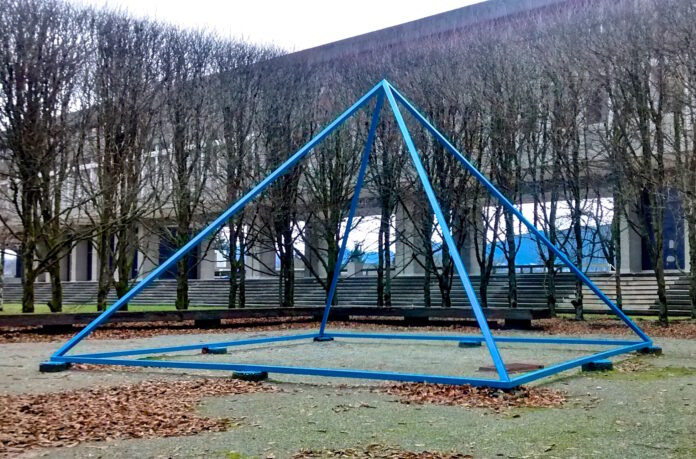
Donated to SFU in 1977 by collector Ian Davidson, the pyramid is titled Energy Alignment Sculpture, Pyramid in the Golden Section. It was designed by Bridge Beardslee, a sculptor from California.

The Vancouver Art Gallery commissioned the blue, tubular steel pyramid in 1976 for the project Documenting a Power Line. Intended to be aligned to the North Star, it conforms to the proportions of the Cheops pyramid in Egypt and the golden ratio (1:1.618), and, prior to its donation to SFU, was installed at the Queen Elizabeth Theatre plaza.

After its arrival to Burnaby, the pyramid, which the artist describes as “an attempt to make discoveries about light and energy patterns within the city,” became the subject of debate around its location in the AQ.

Prior to being anchored to its concrete base in 1978, the pyramid rested freely on the gravel courtyard within the grove of shrubbery, and was victim to pranksters who took advantage of its mobility. One of the pyramid’s significant sites of relocation was the other pyramid in the AQ: the terraced mound of earth meant to represent Burnaby Mountain.

One of the most outspoken voices against locating Beardslee’s pyramid upon its permanent location in the gravel courtyard was Blair T. Longley.

Longley, who later became associated with various political parties including the Green, Rhinoceros, and Marijuana parties, made an impassioned plea — documented by the SFU Art Collection through various news clippings and letters addressed both to the SFU Art Gallery director and to Beardslee himself — to locate the sculpture atop the AQ mound and to align the sculpture with Magnetic North, as opposed to True North as per the artist’s wishes.

Longley’s arguments, which invoke his seemingly genuine and earnest interest in “pyramid power,” as well as his belief that “for the pyramid to function it needs to be oriented with the earth’s magnetic field,” are inspiring — even a minimalist work of art can instigate an impassioned conversation around the artwork’s meaning.

After the Ball modernizes Cinderella

0
Photo courtesy of Pacific Northwest Pictures.

After the Ball is a beautiful revision of the traditional Cinderella story. With so many different versions out there, it is refreshing to see one that not only modernizes but also adapts the story in such a way that it becomes more than a simple retelling of a well-known tale.

The film focuses on a struggle that can be understood by people of all ages: finding a place in the world, and being true to oneself. This adaptation is set in the realm of fashion and designers. Kate Kassel (Portia Doubleday) aims to be a top designer, but despite her evident talent, she finds herself trapped in the shadows with no job available.

Photo courtesy of Pacific Northwest Pictures.

The company Kate wished to join denies her entrance because of her father’s reputation. Her father, Lee Kassel, was said to have stolen and redesigned an idea from that same company and marketed it as his own, and Kate is viewed as a potential spy for her father’s company, Kassel.

Family is one of the central themes of the film. Kate’s relationship with her father is tightly linked to her motivations and actions throughout the movie. She originally joins Kassel to establish her own design career, but her motivation changes when she discovers the company’s diminished ideals and her stepmother’s growing influence over the designs, her father, and ultimately, the company.

Fashion has often been associated with superficial or exaggerated beauty, but this film shows that there is a quality of personality imbued within it. Fashion is about finding a balance in perception, but it also a matter of connecting with individuals. A design can be beautiful, exquisite even, but also revealing of the person underneath.

Kate’s stepmother forgoes the creative side and strives for profit instead, creating a demanding, lifeless environment that seeps through the company into the retail stores.

For Kate, making money is secondary to making the customers feel worthy and beautiful with the clothes they wear. She truly cares about her father and seeks to repair her ties with him as a daughter and a designer, aiming to mend the fraying connection between the Kassel designs and their customers.

Throughout it all, love is rendered as a side plot. Kate’s stepmother and her stepsisters never interfere with her relationship with her prince charming as they do the original tale. Upon meeting Daniel (Marc-André Grondin), a shoe designer, there is an immediate attraction. Their relationship develops gradually, making the result more believable than after only one night of dancing.

Kate’s godmother owns a vintage shoe store named After the Ball, and she and her friend Richard, are always there to give Kate advice.

The title is also a reflection of the sequence of events that happen after initially falling in love.m After all the misunderstandings are cleared up, and beyond finding a happy ending or discovering true love, Kate is able to repair her relationship with her father and find love with Daniel. More importantly, though, she becomes a better version of herself.

Coastal First Nations Dance Festival presents traditional First Nations culture

0
Photo courtesy of Dancers of Damelahamid.

Dancers of Damelahamid has partnered with UBC’s Museum of Anthropology (MOA) to bring a spectacular show of First Nations culture to Vancouver. In the works are six days of signature acts, artist presentations, and school performances by indigenous artists from across North America.

Headlining the festival are hoop dancer Jesse McMann Sparvier from Calgary and sisters Urseloria and Nikollane Kanuho from Arizona, USA. Both acts are inspired by traditional pow wow dance and promise to provide spectacular entertainment and cultural education.

In their eighth year of the festival, Dancers of Damelahamid is a product of artistic director Margaret Grenier’s cultural history. A member of the Gitxsan Nation in northwest British Columbia, Grenier’s parents began the company out of the resurgence of First Nations song and dance with the lifting of the Potlatch Ban in the 1950s.

The festival is a mixture of many different First Nations traditional dances from across BC,  Yukon, Alaska, and Washington, along with special guests over the years coming from as far as Australia and Peru. “All of us who have been part of this festival are peoples who have gone through a lot of cultural loss,” reflected Grenier.

This year’s festival is also introducing a new presentation called Artist Talk — “an opportunity to learn a little bit more depth [and] how the songs and dances that were not practiced for such a long period of time [were brought] back,” explained Grenier. This year, Terry-Lynn Williams-Davidson, a Haida artist and lawyer of Aboriginal environmental law, will be presenting at the MOA on March 3.

Another significant aspect of the festival is its focus on bridging the gap between First Nations and non-First Nations communities. “I don’t see many opportunities, especially in larger urban centres, to really bring a number of communities together at this scale,” added Grenier.

The school performances also help to close the gap by educating youth on First Nations culture. Additionally, Grenier explained that there has been “so much experience with young aboriginal youth really finding cultural esteem and self-esteem in being part of the [school] performances.”

Furthermore, the festival provides First Nations communities with an opportunity to grow. Grenier noted how “the sharing [of cultures] makes [First Nations communities] non-static, the sharing makes it something relevant to people today.” She added that the festival is unique in that it “is not a festival where the artists feel like they are the only one group representing First Nation’s dance, so it opens up more opportunity to have certain songs and dances.

“The purpose of the festival really comes down to the community,” Grenier explained, “I think that the most important thing is to see the diversity of what is being shared — that each nation has a very unique dance practice, unique songs, and a unique history — [so that] generalizations [are not made about First Nations peoples].”

The Coastal First Nations Dance Festival will be held March 7 to 8 at the Museum of Anthropology. For more information, visit damelahamid.ca.

SFU Lacrosse holds on to stomp the Broncos in extra time

0
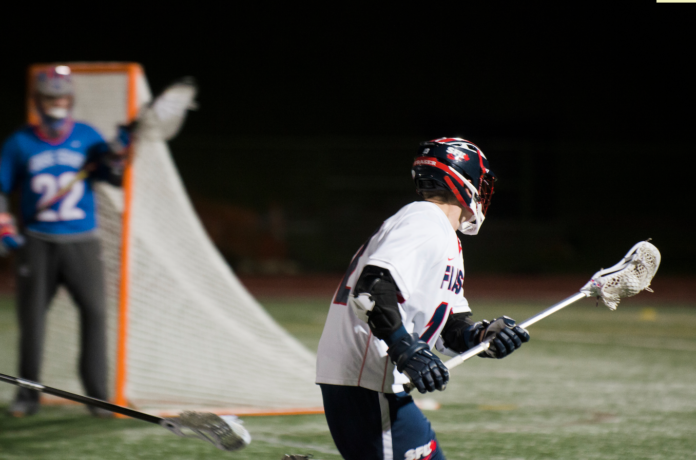
Attacker Lyndon Knuttila, who shares the team lead in goals with 11, had scored against Boise State. Image Credit: Brandon Hillier /The Peak

The Clan fought tooth and nail to win their first conference game against rival Boise State Broncos 16–15 in overtime Friday, February 20. It was a back-and-forth game, with both teams fighting until the very end.

The Clan held the lead until the last few minutes of the game, when Boise went on a late-game run to steal the lead with 50 seconds left. With their lead cemented, the Broncos won the following faceoff and tried to run the clock out.

Freshmen Colton Edwards made a heroic defensive play, which caused a Boise turnover and sent the Clan on a last-ditch attack. This led to a series of quick passes that found junior attacker Iain Vickers open on the crease, allowing him to bury the ball with 0.3 seconds left to send the game into overtime.

Overtime became two and a half minutes of speed and intensity, with senior midfielder Sam Clare showing the crowd why he’s one of the best players in the league, scoring with his strong hand on a solo drive that Boise State goaltender Ian Jameson had no chance of stopping.

According to Clare, the key to the Clan’s victory was their focus on getting ground balls and constantly pushing at 100 per cent, despite the adversity they faced.

“They made a bit of a run of the game and made it close,” he said. “It was really important that we kept pushing and that we stayed in the game.”

Clare led the team with six goals and two assists, followed by the regulation time hero Vickers with three goals and two assists, freshman attacker Greg Lunde with four goals and one assist, and junior attacker Lyndon Knuttila with three goals.

Sophomore goaltender Jeremy Lashar stood between the pipes for the full 60 minutes, stopping 13 of 28 shots for a save percentage of .464 on the game, bringing his season save percentage to .546.

The Clan are on the road for the with games against Arizona, Colorado State, and Chapman before returning to Terry Fox Field to take on long-time conference rival Washington Huskies on Saturday, March 14 at 6 p.m.

Clan track and field team deliver best-ever indoor performance

0
Image courtesy of SFU Athletics

It was a busy couple of days for the men and women of SFU’s track and field team during the Indoor Championships, February 21–22 in Nampa, ID.

The weekend produced a good share of firsts for the Clan organization, as the team achieved their collective goal of a third place finish amongst the rankings of other competing institutions, their best ever at an indoor event. In total, the women’s team finished with an outstanding 104 points and the men with 95 to lift the team to new heights.

At an individual level, many talents shone brightly for SFU. The outstanding weekend was highlighted by the massive accomplishments of senior Lindsey Butterworth, who picked up three Great Northwest Athletic Conference (GNAC) titles for the 800 metre, distance medley relay and mile events. The North Vancouver native was named the Female Performer of the Meet for her efforts.

“This past weekend was amazing, the team really came together and everyone competed at their best to come out with the best team finish SFU has ever had,” said Butterworth. “Everyone was so supportive the entire meet which made the atmosphere and experience so much better. It feels great to be able to finish my last indoor conference meet with not only individual success, but team success as well.”

Senior Cameron Proceviat’s also earned his first-ever career GNAC title in the Men’s 800 metre event. Proceviat proved to be a key teammate in the men’s distance medley relay and 4×400 metre relays as well, where he won two additional titles.

Day two of the meet also saw a stunning result come for graduate student Jennifer Johnson, who set a new record to earn an individual title in the women’s 3,000 metre event — this was her second of the championships after winning alongside Butterworth in the distance medley relay.

Track and field head coach Brit Townsend was thrilled with the recent string of performances by her team, and says the athletes raised the bar for their future endeavors.

“We’ve added some significant people to the team that are competitive at this level, and as soon as you do that it brings the level of performance up of everybody,” Townsend told The Peak. “Now there’s a new expectation of what we need to do for things to qualify and for what is possible.”

The weekend will be remembered for its strength of team spirit, fuelled both in athlete numbers and in enthusiasm.

“It was a great team event,” added Townsend. “We had 50 athletes there and that’s the most we’ve ever brought. So that makes the team spirit a lot stronger with people cheering and supporting everybody that was competing.”

Coach Townsend remains encouraged for what the season has in store and on the new possibilities with more athletes possibly competing at the Nationals. Only time will tell on how much more this organization can achieve.

Meet the Clan: Sam Clare

0
As of Friday, February 27, midfielder Sam Clare leads the team in points with 19 in four games, and is tied for first in goals with 11. Image Credit: Brandon Hillier
As of Friday, February 27, midfielder Sam Clare leads the team in points with 19 in four games, and is tied for first in goals with 11.
Image Credit: Brandon Hillier

Screen Shot 2015-02-25 at 3.12.04 PMThose of us with siblings know how close the family bond can be. From our senses of humour to the clothes we wear, it’s safe to say that our brothers or sisters have a huge impact on us. For midfielder Sam Clare, the fact that he plays lacrosse is something he attributes to his brother Nathan.

“I started [lacrosse] at a young age, I think probably like four or five actually. My brother started playing, he gave tee-ball a chance, and never really took off with it [until he found lacrosse], and when it was time for me to pick a sport, I guess I was kind of born into lacrosse,” says Sam.

Although they share the same sport, they play on opposite sides of the field. Nathan was a Men’s Collegiate Lacrosse Association (MCLA) All-American honourable mention defenceman “locked in the defensive end his entire career,” while Sam “patrols the whole field” as a midfielder, and is known for his penchant for offence.

Another thing they share is the school they attend and play for. Nathan graduated from SFU in 2013 with an environmental sciences degree. However, they never had a chance to play with each other, as Nathan graduated from the team the year before Sam played his freshman year.

Initially Sam followed his brother into an academic field as well — geography — but he instead decided that he was more interested in the health sciences.

“I’m pretty interested in biology so I thought maybe this is right down my alley,” explains Sam. “It was a bit of a tough decision because obviously my mom wasn’t happy with me going, ‘Hey, I’m going to switch majors now,’ because I was already a year and a half into geography, but it just felt right.

“I think my health science-related class was probably Bio 101, and everything went well. I had a really good semester,” he adds. “[It was] kind of like a sign, like, ‘you’re kind of meant to do something in this.’”

Sam’s major wasn’t the only the thing he changed his mind on. Before coming to SFU, he almost commited to the Rochester Institute of Technology (RIT), where he would have played on their NCAA Division III lacrosse team, before a gut feeling told him to stay home.

“I did have a few offers to play NCAA lacrosse in the States,” he notes. SFU’s lacrosse team is not a varsity team, and therefore not an NCAA team. “I was actually scheduled to go and sign a letter of intent with RIT [. . .] but I just pulled out last second, and I’m like, ‘I’m going to stay close to home, I’m going to play lacrosse for my hometown university, and carry on the tradition my brother started.’

“I had a really good offer, but I don’t know, there’s not too much to say about it, it was just kind of an impulse decision, I wasn’t really feeling it.”

He notes that the decision was bittersweet, as he noticed the success RIT had while playing on the SFU roster — reaching at least the NCAA National Championship quarterfinals every year since 2011, and making the finals in 2013, Sam’s sophomore year.

However, he doesn’t regret the decision. Far from it — he has embraced his role as a key playmaker and goal scorer, winning the Pacific Northwest Collegiate Lacrosse League (SFU’s division) freshman of the year award, with 34 goals and 39 points in his first year.

This early success can be attributed to a goal he made in his senior year of high school: to drive play instead of waiting for the play to come to him.

“[Lacrosse] didn’t really spark until about Grade 12,” Sam explains. “I was kind of a backseat player most of my life, [I] didn’t really take any initiative to be the guy that goes out there and puts five or six goals in the net a game. It just happened in Grade 12, I said to myself, ‘I want to be an elite player now,’ and I had a pretty good [year].

“Whenever I have the ball, I want to score, I want to set someone up to score,” he adds.

The smooth transition to his freshman year at SFU was aided by the fact that his coach from the Burnaby Mountain Selects — an “elite lacrosse touring program” he joined in Grade 12 — was SFU Lacrosse head coach Brent Hoskins.

“It made the transition really easy [because] our relationship had already been built,” Sam explains. “It really affected my game too, just because I already know the coach, I already know the staff and a lot of the players, I almost felt as a freshman coming in that I was a sophomore [. . .] you don’t have that much to prove because everybody knows who you are.”

After the season is over, Sam is contemplating taking a break from lacrosse — even playing soccer, a sport he quit playing in Grade 11 to focus on lacrosse. However, for now his focus is on winning a championship with SFU’s lacrosse team.

“It’s been such a good ride,” Sam muses. “You don’t want to have a bad game when you’re a senior because [. . .] that’s what people are going to remember.

“[I’m] to come out firing on all cylinders.”

FUN FACT:
Favourite Food:
“That’s a tough one,” Sam responded. “I would probably have to go with sushi [. . .] I tried sushi when I was like seven or eight and I’ve never looked back since. I have sushi like two or three times a week.”

City of VancUBER

0

UBER_web

Recently, I visited a friend of mine in Montreal. After a night out, we decided to try to catch a ride home using Uber, an innovative new ride-sharing app. But it was a busy night and we were getting impatient, so we decided to just hail a cab instead.

We only needed to travel around 10 blocks down a straight street to our destination, and we even had the best route pulled up on Google Maps. However, upon entering his car, our cabbie immediately started insisting that he knew a shortcut and took us off the main route, clearly winding through residential streets to make the meter run up.

He even came to a complete stop outside of some restaurant that wasn’t even open and went on to tell us all about how we should come back and visit this restaurant, all while the meter ticked on. It cost us three dollars to hear about a restaurant that wasn’t our destination in what should have been a simple couple-minute zip down the street.

If this man had been an Uber driver, we would have written a terrible review about him and might have never used his service in the first place, had we known this is how he would behave.

That’s what separates Uber and similar apps to the typical cab experience. In theory, with Uber, the user is given a voice and thus power over their purchasing decisions. In turn, riders are more likely to get friendly and efficient drivers who receive their business based on the merit of their reviews, and not by aggressively picking up desperate pedestrians.

If we had waited for an Uber in Montreal, we might have avoided this experience. But in Vancouver, anything other than a taxi isn’t even an option — at least for now.

NEW APP IN TOWN

The classic tale of the bad taxi experience may soon become a thing of the past if apps like Uber have anything to say about it. Uber is an established international ride-for-hire app that allows users to connect with ‘crowdsourced’ drivers to hail rides rather than using a typical taxi.

These Uber drivers are not certified taxi drivers, but rather average people who own a driver’s license and are willing to drive app users around for extra cash. If the app makes its return to BC, it could be a great way for SFU students who own cars to help pay for classes without having to commit to a 9–5 desk job.

Uber’s popularity stems not only from its recruitment of drivers, but also in its user-friendly review feature, which puts more control into the rider’s hands when choosing who is picking them up.

The app is only available in participating cities, is completely cash-free with pre-set fares, and gives users the ability to view driver’s ratings and reviews before deciding to ride with them. Vancouver is not currently among the participating cities.

Uber is not the first app to try to challenge standard and somewhat outdated taxi services, and it will probably not be the last — development of these apps has become a popular topic of debate all around the world, for politicians and taxi companies alike.

In Vancouver, the app has recently gained media attention for trying to reenter the BC market after withdrawing in 2012. The California-based app was forced out of BC after six months, when the provincial transportation regulator forced the service to classify itself as a “private car service,” requiring a minimum 75 dollar fare.

The reason Uber succeeds in so many other cities and avoids regulations imposed on car rentals and taxis is by classifying itself in courts as first and foremost an app for connecting drivers and riders, rather than a car-for-hire service company.

This past November, Uber announced that it had plans to return to Vancouver and began running ads to hire Vancouver drivers. Almost immediately following this news, the Vancouver Taxi Association filed an injunction against Uber, stating that it does not properly adhere to provincial licensing requirements for taxi drivers. According to the association, this would not only put Uber at an unfair advantage over taxi companies, but would also put riders at risk.

UBER PROBLEMS

Like any company that tries to skirt around big players, Uber is almost constantly under attack by various lawsuits trying to stunt its growth. But given that consumers have so much power in today’s markets, with apps giving them direct access to the services they want, it’s hard to keep something so in-demand at bay.

Uber was established in 2009, and only really began expanding internationally in recent years. This opened the gates for a lot of backlash all over the world concerning how the company is run.

It’s easy to see why taxi companies would have a problem with Uber. They allow anyone to become a driver for the service, thus making a taxi driver’s licenses and company’s permits virtually useless.

This has caused ongoing criticism of the big player taxi company’s motives in cases where they claim to be protecting consumers — The Province recently reported that “the latest research from New York City shows that since Uber and other “ride-hailing” apps flooded into that market in 2013, the value of cab licenses plummeted from $1.05-million to $805,000.”

Reports such as this feed speculations that the main reason taxi companies want to keep smaller businesses and apps out is to keep the value of taxi permits high. To be fair, there is merit in some of the legal action against Uber, as car transportation service apps are only just beginning to set regulations to protect themselves, drivers, and passengers alike. This means that there are bound to be kinks in the system that must be worked out over time.

A big topic of debate is whether it is safe to take a ride with an Uber driver based on the company’s current hiring processes. There have been some recent allegations of sexual assault of riders by Uber drivers. Just this past January, The LA Times reported on two alleged assaults taking place in Uber cars within a three week period.

Uber has even had to shut down operations in Delhi following allegations of the rape of a female passenger by a male driver just this past December. According from an article published on February 15 in Reuters, “[Uber] applied for a radio taxi licence and resumed operations, but its application has yet to be officially approved.”

There are cases like these popping up all over the world which has caused concern in areas where Uber is trying to expand, such as Vancouver. This in turn brings into question the company’s background checks, which are no minor matter when riders are alone and getting into cars with these drivers.

RIDE SCARES

When taxi companies seek legal action against Uber and similar services, they tend to argue that the company does not require the same amount of licensing and permits that taxi companies do, and this allows potentially dangerous drivers into their system.

However, even though taxi companies claim to have a more rigorous background check system in place, there is still a staggering amount of reported rapes and assaults by taxi drivers all over the world. A simple search of the term “taxi driver sexual assault” returns thousands of hits and stories from all over the world.

CTV News reported that, in Montreal alone, 17 cases of reported sexual assault by taxi drivers were reported in 2014; in 2013, there were 29 such cases. The Montreal police department has even gone so far as to warn intoxicated women to avoid using taxis alone, as the cases of drivers taking advantage of vulnerable passengers has become increasingly prevalent in recent years.

By no means is one company any better than the next in this respect, but at the very least it doesn’t make a strong argument against Uber’s services when passengers could be just as unsafe in a regular taxi.

Since I cannot currently test Uber’s services in Vancouver, I polled my community of Facebook friends about their impressions of the app’s service. Out of the 30 or so separate replies that I received, I found that a lot of female Uber users all over the world (from Australia, the US and Toronto) felt that using the app is actually a safer option than taking a cab.

These women expressed a unanimous feeling of comfort when they can review a driver ahead of time and know the name of whomever picks them up. One responder in Australia stated, “I feel way safer knowing someone knows where I am at all times, especially when travelling alone. I love that you have a record of the driver and they know where they are. I also like it going through google maps because you can see whether it’s a direct route and you’re not getting ripped off. Also, it’s way cheaper and I find Uber drivers have way better attitudes.”

In comparison, when you hail a taxi, your driver is all but anonymous to you during the transaction, making some women feel very uncomfortable with the whole process, and with good reason.

Just last month, Global News reported that a Calgarian woman was sexually assaulted by her taxi driver, but there was no clear evidence as to who the driver was when she went to report him to the police, as she didn’t know his name. The man was eventually caught and is now facing trial, but the fact that she could not go the authorities with any concrete information is a scary reality that can sometime leave cases like this unresolved.

TAXI AND SPEND

Likely a big reason that user friendly companies like Uber and Airbnb (a similarly ‘crowdfunded’ website for people to rent out their homes) are fast-growing despite political and legal action against them is because people are fed up with the typical ways in which they can get ripped off by standard companies.

Why would you pay to stay in a sketchy hotel with unfriendly staff when you can pay less to stay in someone’s home, and you’ve read reviews about this someone ahead of time to make sure that they are nice, fair, and hospitable before making any commitments to staying with them?

The same concept applies to Uber. Overall, this seems to be the allure of these new app services over standard taxis — and what the people want, they will inevitably get.

Whether or not Uber will be able to make a return to BC still remains unclear, although the company seems optimistic as it is already pouring resources into currently recruiting drivers in Vancouver. Uber held a hiring fair just this past October, and CBC reported that it even offered a 40 dollar incentive to applicants.

There is an Uber Vancouver Twitter account that was created the first time Uber was in Vancouver, and as of last summer, they have started posting again.

The company has made it clear they are intending to return to Vancouver and are looking  to gain the attention and support of Vancouverites wanting the service back.

Uber’s marketing team kicked off the company’s comeback a one-day Uber Vancouver ice cream truck service, where users could request an ice cream truck to come to them via the app. On July 18, 2014, they tweeted “I scream, you scream, WE’RE BACK VANCOUVER with #UberIceCream!”

The account also flaunts the success of the company in other Canadian cities, and urges followers to sign a petition to get Uber back into Vancouver.

Regardless of Uber’s future performance in BC, it is clear that this app has stirred up a need for change at the hands of consumers in regards to car transportation in the city.

Vancouver taxis have been found by SFU master’s graduate Benn Proctor to have some of the highest fares in the country, as well as the lowest number of taxis in Canada and possibly in North America as well. Proctor told CTV that “to get the same number of cabs per capita as Calgary, Metro Vancouver would need some 1,900 new cabs,” according to his research for his thesis which studies the taxi industry in Vancouver.

Just last year, BC Business reported that the Conference Board of Canada found that there were only .24 taxis per 1,000 residents in Vancouver. Anyone who has tried to hail one on a busy night downtown will not be surprised by this.

Clearly, the need for some sort of change is in the air, and Uber might just be the answer. If not Uber, something else will follow, and likely find a way to work within BC’s tight regulations. The demand for a better car transportation service is here and eventually something will step in and provide the supply.


Biological Love

0

As a small child, I loved spending days at the beach digging for shellfish, heaving rocks aside to reveal tiny scrambling crabs, and peering over docks to watch the shimmers of light darting below as little fish pecked at the last piece of hot dog I had dropped into the water.

As a biology student, I have not only been able to continue to observe nature’s curiosities, but have been encouraged to retain my so-called childish wonder of the natural world.

Studying biology in university has served to validate my love of nature and all its complexity. It is astonishing how dramatically the study of biology shifts depending on the scale at which one is making an observation.

In biology, you can study ecology and learn about the interactions between groups of plants, animals, and the Earth ranging across the oceans. On the other hand, you can choose to focus on the internal workings of a single heart cell and watch it beat under a microscope. It is amazing when you learn how to relate these different ranges of focus on the natural world, and start to understand how they are all interconnected.

Often I find myself awestruck when I stop to consider the scope and scale of what we understand about biology. I can feel what I hold in my hands and I know what I can see; beyond that yields to the forces of the imagination. I find imagining that which I cannot directly experience in the field of biology to be rather delightful.

If you pay attention, the details of the natural world are incredible. Next time you walk past the opening of an anthill, take a moment to consider that it is the opening to a complex network of tunnels and chambers with an organized community containing its own Queen, soldiers, and workers. At the beach, remind yourself of the fact that the waves at your feet are a part of a vast ocean, connected with others around the globe!

As I have progressed through my degree, I’ve found my perception of the world has changed. Walking through the forest, or even down the streets of Vancouver, I have come to notice my surroundings under ‘the biologist’s lens.’

I can’t help but take notice of the lichen growing on the trees along the boulevard, or the trail left by the slug across the pavement. While this may be because I come from an artistic household, I also notice how beautiful these scenes are — like little pieces of art that have appeared just for me. The lichen grows as delicate fractals of silver lace, and the slug’s slime-trail has an iridescent quality that sparkles in the sunlight.

Being surrounded by other biology enthusiasts has also been something of a revelation to me. I have found a close network of friends who won’t think I am peculiar for stopping to look at a big old cedar, a slimy black slug, or a tiny delicate mushroom. Instead, I am greeted with a similar enthusiasm and sometimes a fun fact or Latin name. It honestly feels like some biologists are walking encyclopedias, ready to spill over with facts and observations.

Biology is also great because it is simply fun. Personally, I am appreciative of the opportunities I have had to get my hands dirty once in a while. I have had labs that involved planting seeds, drawing starfish, and even canoeing down a river for a field course I participated in last summer.

In today’s world, we are all coming to terms with the reality of a degrading climate and the fact that delicate ecosystems are being pushed to their brink. It is therefore immensely important that we encourage children and adults alike to take notice of the natural world.

The consequences of our actions are melting glaciers, poisoned soils, and shrinking what little we have left of our once lush and diverse ecosystems. Species are going extinct every day at an accelerated rate, and that is just the tip of the (melting) iceberg.

While this is evidently scary from an anthropocentric perspective — as we are progressively making our own habitat less hospitable — we should also mourn the loss of biodiversity and raw beauty of our planet.

However, there is no need to be entirely negative. While learning about biology helps us all to understand what we have to lose, it also shows us the remarkable resilience of nature and its capacity to heal and adjust itself. And that gives me hope.

I am astounded daily by the diversity and immensity of life on our tiny blue and green dot in this solar system, and have consequently come to be humbled in understanding my place upon it. No matter what I choose to pursue after I finish my degree, one thing is for certain: I will always be a naturalist, and studying biology is going to get me there.

Chinese zodiac signs for the modern generation

0

Welcome to 2015, or as it’s known in Chinese mythology, the year of the sheep. According to predictions, the next six months will see a lot of carry-over conflict from the year of the horse, but afterwards things will be more relaxed than they were in 2014. But with the new lunar New Year already underway, I’m going to say what everyone else has already been thinking: the Chinese zodiac is long overdue for a reboot.

My first argument: it’s 2015. Everything’s getting a reboot these days. The Odd Couple just got rebooted; despite no one ever asking for one. Annie got a cringe-tastic reboot last year, and even Reboot’s slated for a reboot in the to-be-determined future. We need to board this buzz train before it leaves the station, folks.

Now, I’m sure some of you are thinking, “Why would we want to reboot the Chinese zodiac? It’s been working out just fine.” But let me ask you this: when was the last time you saw a pig that wasn’t paired with some scrambled eggs and toast? How long has it been since you actually saw an ox or a dragon? They’re archaic symbols that are out of place in a post-modern world. Selfie sticks, listicles, and arm-flexing emojis: these are what the new generation is known for, and they should be represented in the Chinese zodiac.

I’ve even gone ahead and constructed a whole new Chinese zodiac 2.0, complete with what your old sign was, what it’s been replaced with, and what that symbol says about you. It’s time to say goodbye to the year of the sheep and hello to the year of the cupcake-flavoured vodka.

If you were a rooster, now you’re an arm-flexing emoji
The bad boys and girls of the Chinese zodiac, arm-flexing emojis are proud, painfully honest, and meticulous when it comes to details. Even though some people find you a bit obnoxious, it just makes them like you even more.

If you were a pig, now you’re a package of reduced-fat turkey bacon
Packages of reduced-fat turkey bacon are the nicest people around. They’re loyal to their friends, have genuine intentions, and are always willing to lend a hand. They also make for the perfect breakfast companion, if that’s up your alley.

If you were a monkey, now you’re a viral video
Eager to try anything at least once, viral videos are known to be the imitators of the zodiac and will take anyone’s original ideas and try to make it their own. Viral videos are also increasingly innovative, but less trustworthy than most.

If you were a tiger, now you’re a Miley Cyrus
Romantic and unpredictable, Miley Cyruses can be as charismatic as they are moody. They’re also fiercely independent, while still being possessive of others. Make sure you’re on your toes whenever in the company of a Miley Cyrus.

If you were a dragon, now you’re a DVD copy of The Avengers
Aside from some gnarly end-of-the-world parties, nothing says 2012 like the DVD release date of Marvel’s super box office hit The Avengers. Just like dragons, DVD copies of The Avengers are lucky, self-assured, are known to take risks, and are guaranteed to make, like, waaaay too much money.

If you were a sheep, now you’re a bottle of cupcake-flavoured vodka
Gentle and sweet, bottles of cupcake-flavoured vodka have trouble mediating conflicts, but they’ll be your best friend when life gets you down. They get along best with teenagers with an unlimited data plan and Miley Cyruses.

If you were a rat, now you’re a procedural cop drama
Incessantly popular and financially sound, procedural cop dramas will never disappoint but will usually fail to bring anything new to a situation. While sometimes they get hung up on the details, this isn’t always a bad thing.

If you were a horse, now you’re a teenager with an unlimited data plan
If a teenager with an unlimited data plan had to be summed up in a single word, it would be “freedom.” While sometimes a show-off and headstrong, this only complements their desire to be free and independent — even though they’re more reliant on others than they like to admit.

If you were an ox, now you’re an identity thief
Hard-working and methodical by nature, you can count on an identity thief to get the job done. Make sure to never lie to or go back on something you’ve promised an identity thief, as they’re known to be vindictive if ever wronged.

If you were a rabbit, now you’re a selfie stick
Selfie sticks, while often criticized for fast-tracking business ventures and sometimes being a total trainwreck, can bounce back from criticism easily and be all the better for it.

If you were a snake, now you’re a BuzzFeed listicle
Wise beyond their years, BuzzFeed listicles are more philosophical than most and are quick to adapt to most situations. They are the go-to advice-givers of the Chinese zodiac, so if you’re ever uncertain about something, seek out a BuzzFeed listicle.

If you were a dog, now you’re a Shoppers Optimum Reward Program
If there’s one thing Shoppers Optimum Reward Programs are known for, it’s loyalty. They’re dutiful, compromising, and will give you unconditional love and support. Everyone loves a Reward Program.