CreativeMornings Vancouver received Martin Jackson, one of Canada’s paramount calligraphers, in their studio last Friday for a short talk on the topic of ink.
In a Q&A with CreativeMornings, Jackson spoke about his love for the written word. “Handwriting can be so beautiful, it is part of who we are, it can say so much about our personality,” he said.
Surrey
Students got all dolled up to walk the red carpet at the Simon Fraser Student Society’s inaugural Hollywood North Gala last Friday, hosted in the brand new Aria Banquet Hall near SFU’s Surrey campus. A formal dinner and dance, the event invited students to dress to impress, or to dress as their favourite Hollywood actor.
Harbour Centre
On Wednesday Mar. 4, guest speaker Marie Groupy gave a lecture at SFU Harbour Centre titled, “The State of Exception Theory by Carl Schmitt and the Ambivalent Criticism of Liberalism.”
The presentation was based on Groupy’s upcoming book, which deals with the emergence of the idea of the state of exception during the interwar period. Similar to a state of emergency, the state of exception is based in the sovereign’s ability to transcend the rule of law.
Davies was inducted into the SFU Sports Hall of Fame in 1986, the Burnaby Sports Hall of Fame in 2009, and the B.C. Sports Hall of Fame in 2010.
- Vancouver Sun
Davies was inducted into the SFU Sports Hall of Fame in 1986, the Burnaby Sports Hall of Fame in 2009, and the B.C. Sports Hall of Fame in 2010. – Vancouver Sun
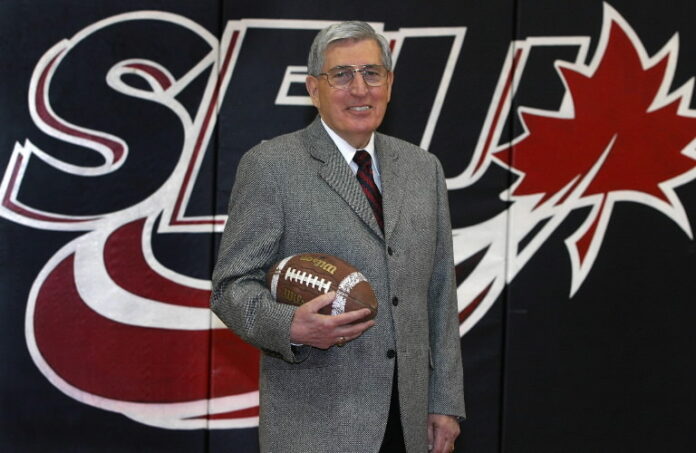
Fifty years after helping launch SFU Athletics, SFU’s founding athletic director and head football coach, Lorne Davies, has passed away.
Davies died on Feb. 27 in St. Paul’s Hospital after suffering from an illness related to his heart and kidneys.
“Lorne meant everything to SFU Athletics — it was his life’s work,” said Milton Richards, SFU’s senior director of athletics and recreation in a statement by SFU Athletics. “We will forever carry his spirit in our hearts every time our student athletes put on the Clan uniform to enter competition,” he said.
Chancellor Gordon Shrum chose Davies to head SFU’s athletics program during the school’s inaugural year, a position he held for 30 years until 1995.
Jason Beck, the curator and facility director of the BC Sports Hall of Fame, commented on the contribution Davies made to BC sports over his lifetime. “The amount of great athletes and coaches [. . .] that have come through SFU, you can’t put a figure on it, it’s probably in the thousands. So [his] impact on Canadian sport is immeasurable,” he said.
Beck got to know Davies over the past few years before his induction into the Hall of Fame in 2010. A former SFU student himself, Beck was struck by Davies’ dignity, positivity, and determination.
“He was very modest,” Beck continued, remembering his first interview with Davies in his office in the AQ. Davies assumed that Beck knew very little about him, and Beck recalls that “he actually gave me a resume, which I thought was kind of cute. I humoured him and looked through it, but a lot of the things on there were well-known.”
Davies chose the original Clan colours — blue, red, and white.
Beck explained that Davies “raised the standard” of athletics at SFU, and in western Canada in general, by hiring full-time coaches for the first time and marketing SFU as a national training centre. Davies also promoted equal opportunities in sports for female athletes, growing the athletic department from three men’s and women’s programs in 1965 — football, basketball and swimming — to 17 programs.
In a more understated way, Davies’ impact can be seen every day at SFU: in the Lorne Davies Complex, which was named after him, and in our school’s colours. Davies chose the original Clan colours — blue, red, and white — and said they represented loyalty, courage, and honesty, respectfully. “Our crest will always be a tribute to Lorne, his values, and his vision,” commented Richards in an official statement.
A man of many accomplishments, Davies was perhaps less well-known for his work on athletic scholarship programs. “It’s kind of taken for granted today that if you’re a university athlete, you get some help,” Beck mused. “Fifty years ago, it was quite the opposite.”
In recent years, Davies championed the Terry Fox Humanitarian Award Program, which aims to honour the spirit of Terry Fox. According to Beck, Davies counselled Fox before and during his Marathon of Hope, and remained involved in the campaign after his passing.
“[Davies’] impact on Canadian sport is immeasurable.”
Jason Beck, curator and facility director, BC Sports Hall of Fame
During this time, Davies became very close with Stan Stewardson, Fox’s basketball coach at SFU. The two worked together for 10 years, and the impact Davies made on Stewardson’s life is exemplified by the letter of support the latter wrote when Davies was to be inducted into the Hall of Fame.
“His support never wavered,” Stewardson wrote. “He gave me freedom to run my program. He was my boss, he was my friend. His inspiration, advice, and confidence was always present. [. . .] Psychologically, he’s a genius. He was never defeated and his mental toughness inspired every coach he came into contact with. He set the standard in all of Canada for athletic leadership.
“Lorne Davies is what Simon Fraser Athletics is all about.”
“Hello, welcome to the psychiatric hotline! If you are obsessive-compulsive, please press one repeatedly. If you have multiple personality disorder please press numbers, 3, 4, 5 and 6. If you are depressed, no matter which button you press, no one will answer. . .”
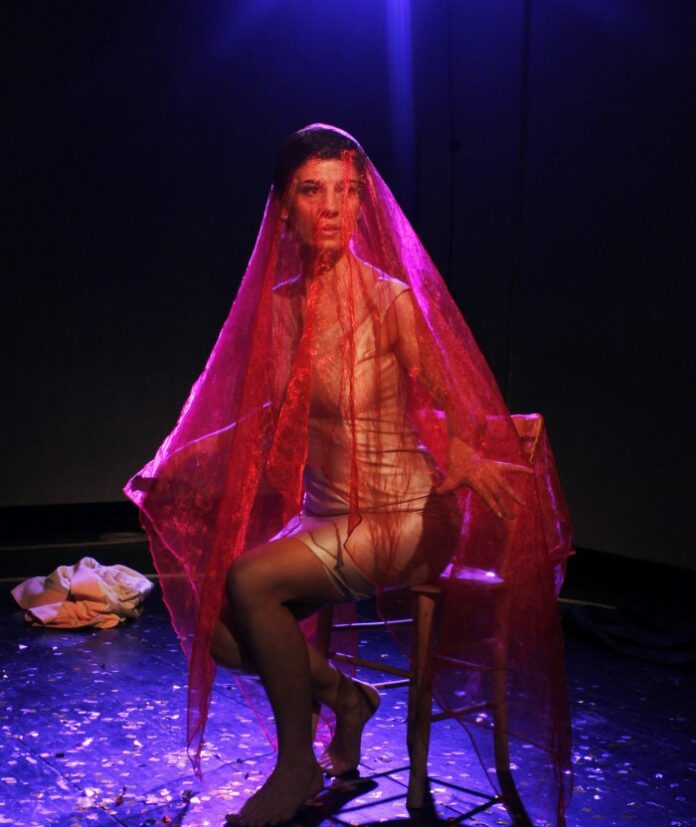
The Village is a one-woman performance by Canadian artist Tina Milo, who delivers a powerful message about why some women find themselves giving up their hopes and dreams, sinking into depression, and forsaking their individuality — along with their sense of reality. Milo uses different media as her platforms for interpretation, fusing acting, physical theatre, film, live music, and visual art.
Photo courtesy of Una Skandro.
The beginning of the performance built slowly, as the setting was established. Milo portrays an actress auditioning for the role of a depressed woman, and her opening words were full of pauses and blanks, revealing nothing of the woman’s identity. There was a sense that this was deliberate, meant to create a character that could represent anyone, including those in the audience.
Milo divulges the woman’s dream of being a famous actress and her hope for a glorious life. She reveals, as the women ages years into the future, that nothing has happened the way she had imagined — the woman loses her child and her hopes of being an actress. Her relationship with her husband has become distanced, and the love that they once had has dissipated over the years. Gradually, she reveals the fragile nature of the depressed woman’s inner state of being.
The play itself was a dense performance filled with multiple layers of meaning and symbolism — from the text, to the mixed media, to Milo’s choice of costume and props. A film was projected on the back wall and occasionally showed Milo putting on makeup or brushing her hair. The film’s full meaning and relationship with the play was up to the interpretation of the audience.
The setup for the stage was interesting. A rope formed the rough shape of a circle around other props, with an opening towards stage left. Within the circle were a variety of props, including two chairs, one of which was made for a child; a vertical steam iron; layers of coats piled up; an accordion; and a table covered in wine glasses. The encircling nature of the set up and the cluttered effect of the objects reflected the nature of Milo’s one-woman performance.
Milo was able to capture the essence of her character through her diverse talents in acting and vocalising. Throughout the piece, Milo’s powerful voice communicated melancholy, despair, and joy. Her voice crafted the layers of the depressed character she portrayed, and the audience was invited to join in the journey as she sang out melodies of happiness and sadness into the steam iron-turned-microphone.
Milo portrays the woman’s desire to change and her decision to find strength within herself. “It takes a village” she says in her final monologue.
The Village is about more than the hardships and sorrows of a single individual, and truly a journey about life. The performance depicts a variety of difficulties people encounter, and the potential for change that everyone has within themselves.
The SFSS board of directors approved a letter in support of the ongoing initiative by the First Nation’s Student Association (FNSA) to permit indigenous catering on SFU campuses.
Currently, only specific caterers are permitted to provide food for events taking place at SFU, but the FNSA is concerned that these groups are unable to create indigenous foods desired by SFU’s indigenous community.
By issuing this letter of support, the SFSS hopes to make headway on this issue, which students have been discussing over the past year.
Students demonstrated the skills they’ve learned in the lab. - SFU
Students demonstrated the skills they’ve learned in the lab. – SFU
A “Picture yourself as an SFU grad” caricature booth and a “Spin the Wheel of Fortune for free tuition” station were just two of over 60 activities presented by the staff, students and faculty during SFU Surrey’s annual Global Community open house.
The event featured tours of the campus, cultural performances, ethnic foods, and information sessions on the innovative academic programs offered in Surrey.
Throughout the evening, the centre stage was graced by SFU’s Pipe Band, highland dancers, a Chinese dance company, local band Good for Grapes, VanCity Bhangra, and SFU president Andrew Petter, who welcomed the community to the satellite campus.
The Peak spoke to some of the student exhibitors about the unique learning experience that the Surrey campus offers.
Second year molecular biology and biochemistry student Jessica Vanuik was volunteering in the biological sciences teaching laboratory at Podium 2 — a room full of cell models, microscopes, preserved rats, and a live stick insect habitat.
She acknowledged the spaces and courses offered at the campus: “I really appreciate the state-of-the-art lab spaces, with all the equipment, all the diverse exercises we can do here at SFU Surrey.”
Vanuik continued, “SFU Surrey offers some really great, really interesting classes of [molecular biology and biochemistry], introducing this topic to new students.”
She added that due to the smaller class sizes at Surrey, “You can have longer talks [with the professors].”
In Galleria 3, a group of computing science and software systems students presented their “Halo Suit Project” from CMPT 433. The students used electronic hardware, controlled via their cell phones, to dictate the suit’s external lights and water cooling system.
Fourth year student Chris Hamilton and his teammates were demonstrating some of the computer-controlled components of the project.
As his group members helped the visitors try on the helmet, Hamilton explained that, “Surrey is a little more hands-on [ . . . ] a little more interactive, instead of just theory,” which he noted was the predominant focus of classes in Burnaby.
“We’re able to build a cool project like this, there’s a lot of opportunities here. It’s a lot of fun,” he said.
The world literature department hosted a photo booth featuring literary character costumes including Sherlock Holmes, Odysseus and, the Cat in the Hat, along with their associated books.
Second year student Elda Hajdarovac commented, “Not a lot of people know what world literature is, so we hope to try and show people that [it] isn’t just about literature, but about analyzing, examining, and immersing yourself in different cultures [and] interactions between different people.
“The diversity that SFU Surrey offers makes it the perfect place to do that,” she explained. “We want to show that [world literature] is very engaging — much like SFU is.”
SFU Hockey opened the BCIHL playoffs yesterday with a 3–2 win against the Trinity Western (TWU) Spartans.
TWU finished the season at first place, while the Clan ended up with the fourth and final playoff spot — a role reversal from last year, when the Spartans upset the second-placed Clan in three games. SFU entered the game with a slight edge in the season series, going 4–3 and having won their last two games against the Spartans.
“The key to the victory [was] emotion,” said head coach Mark Coletta. “We played well, we fought hard, we got timely goaltending, and we got a good effort from 20 guys.”
Forward Adam Callegari opened the scoring on an early power play, giving the Clan the early lead 4:42 seconds in.
Trinity Western tied up the game in the second period on a roughing penalty to SFU forward Tyler Mah. As if to cement their status as the enemy, the Spartans blared “Chelsea Dagger” as their goal song.
Jono Ceci deflected a Jared Eng slapshot from the point 10:27 into the second to give the Clan back the lead. When a pick hit a ref’s skate, Trinity Western had a breakaway and very nearly tied the game — however, SFU goalie Jordan Liem made a great save and helped the Clan go into the second intermission up by one.
Callegari scored his second of the night to put the Clan up by two in the beginning of the third period.
The Spartans appeared to have decreased their deficit by one goal when TWU forward Cody Fidgett — who led the league in goals scored — scored on a turnover caused by a bad SFU pass. However, the refs waved it off, much to the chagrin of the hometown crowd.
With 3:21 left, Trinity Western scored to make it 3–2. Despite an initial onslaught after scoring the goal, the Spartans were unable to sustain much pressure with an empty net, and the Clan cruised to win game one of the best of three.
“We’ve got to stay disciplined, stay out of the box — we know that — and we’ve got to play good defensive zone coverage,” commented coach Coletta looking forward to the rest of the series. “We were scrambly at times and we’ve got to keep pucks to the outside. And Fidgett is a threat everytime he touches the puck, so we’ve got to shut him down.”
Should the Clan win at home tonight, there will be no need for a third game, and they will move on to the BCIHL Finals.
Playoff Round 1, Game 1
SFU: 3 TWU: 2
First Period:
SFU (PPG) Adam Callegari (1) (Ceci, N Sandor) 15:18
Second Period:
TWU (PPG) Mattias Schmitt (1) (Bakken, Harcoff) 15:13
SFU Jono Ceci (1) (Eng, N Sandor) 10:27
Third Period:
SFU Adam Callegari (2) (Basham, Murdoch) 16:39
TWU Jake Harcoff (1) (Unassisted) 3:21
SFU will be taking on the Trinity Western (TWU) Spartans in a best of three series with games this Thursday, Friday, and Saturday. The Spartans have home ice advantage, with Thursday and Saturday’s game at the Langley Event Center, while SFU’s sole home game comes Friday at 7 p.m.
The Spartans dominated the BCIHL this year — they finished in first place with 36 points and a 17–5–2 record. They also scored the most goals, conceded the fewest, and feature the second- and third-highest ranked players in scoring, Cody Fidgett and PJ Buys. It will be a tough matchup for the Clan, especially in a short best of three series where luck is such an important factor.
“I think we want to make sure we do the right things,” head coach Mike Coletta told The Peak. “Play hard and limit mistakes, like what we did the last two home games against them back three weeks ago, when we outscored them 7–1 in two games. We have to make sure we’re doing those little things to be prepared.”
Going up against the top-ranked offence is a tough challenge, but Coletta is convinced the Clan are up for it.
“You have to be cognisant of who’s on the ice, and make sure you have the right matchup. I think our top three lines can match up with any lines in the league. So I think it’s more important that we know who the right defensemen are. I think [Jesse] Williamson and Mathew Berry-[Lamontagna] did a great job on [Cody] Fidgett, and I know PJ Buys didn’t play last game, so they’ll be up for the challenge and hopefully things work out.”
SFU won their last two games against Trinity Western, and won the season series 4–3. But coach Coletta doesn’t see that as an advantage for his team heading into the series. “I think the playoffs are a totally new can of worms, and I think the regular season gets chucked out the window,” he said.
“There’s a different atmosphere, there’s a different emotion level that comes along with playoff hockey. Although it’s nice to win those games, I don’t think we can rest on those results. We have to make sure that Thursday night is a brand new game.”
One factor SFU may struggle with against the Spartans is special teams. SFU ranks fourth in both power play and penalty kill percentage, while TWU ranks first in both. In the end, special teams could be the deciding factor in the series.
Olli Jokinen, pictured here with the Calgary Flames in 2012, was one of the many questionable acquisitions by the St Louis Blues. Image courtesy of Adam Jones (flickr).
Olli Jokinen, pictured here with the Calgary Flames in 2012, was one of the many questionable acquisitions by the St Louis Blues. Image courtesy of Adam Jones (flickr).
It was business as usual at the 2015 NHL Trade Deadline. Some teams loaded up on candidates for a cup run while teams on the opposite side of the spectrum were looking to offload players for future assets. A total of 24 trades were made on the day — most of them depth moves — while many of the biggest moves were made in the days leading up to the deadline. Here’s my take on the winners and losers of this year’s trade deadline.
Winners: Arizona Coyotes
The tank is officially on in Arizona. The Coyotes traded their best defenceman, Keith Yandle, to the Rangers for a first-round pick in 2016 and a second-round pick in 2016, as well as John Moore and Anthony Duclair. The real prize for the Coyotes in the trade is Duclair, who showed great chemistry with top prospect Max Domi at the World Juniors. If they manage to get either Connor McDavid or Jack Eichel in the upcoming draft, they will be a force to be reckoned with in future seasons. They also traded their best forward in Antoine Vermette to Chicago for 2015 first-round pick and prospect Klas Dahlbeck in a year with a particularly deep first round.
Losers: Detroit Red Wings
The Red Wings simply paid too much for Erik Cole and Marek Zidlicky. Detroit gave up a second-rounder in 2015 along with prospects Mattias Janmark and Mattias Backman and a conditional third rounder in 2016. Zidlicky is 38 and Cole is 36, so their best days are definitely behind them. As well, Cole has not scored a playoff goal in his last 23 playoffs games. The Red Wings were better off staying put then giving up assets for two players who aren’t likely to make much of a difference.
Winners: Montreal Canadiens
The Habs didn’t need to bring in a big name like they did with Thomas Vanek last year, they needed to bring in depth players — and that’s exactly what they did. Jeff Petry is a solid defenceman in terms of possession, and it only cost them a second-round pick and a conditional fifth. They were also able to bring in a Devante Smith Pelly, Torrey Mitchell, and Brian Flynn, all players who will help contribute to the bottom six.
Losers: Washington Capitals
Curtis Glencross is not much of an upgrade on any of the Capitals’ forwards, and considering they had to give up a 2015 second- and third-round pick, this deal is questionable at best. Tim Gleason is also not much of an upgrade, having only one goal and seven points after 55 games with the Carolina Hurricanes. The Washington Capitals will likely be one and done in the playoffs, and if that happens, giving up those picks will have been a tremendous waste.
Winners: Anaheim Ducks
By acquiring James Wisniewski and Simon Despres, the Ducks added to a young blueline that was already pretty solid. Wisniewski is highly underrated, and to not have to give up a first round pick like Nashville did for Franson is a steal. Despres is also an upgrade on Ben Lovejoy. Tomas Fleischmann and Jiri Sekac are also solid depth moves for a team looking to make a serious run at the cup.
Losers: St. Louis Blues
The trade for Zbynek Michalek puzzles me, as he has a concussion and there is no guarantee that he will play in the future — he’s been out since Valentine’s Day. Olli Jokinen is done, and Robert Bortuzzo will be spending more time in the pressbox than on the ice. Although the Blues are aiming for a Stanley Cup this season, you couldn’t tell that from their Trade Deadline moves.
Jacob Markstrom, picture here playing for Team Sweden, will finally get another chance to show off his ability at the NHL level. Image courtesy of Tricia Hall (flickr)
Jacob Markstrom, picture here playing for Team Sweden, will finally get another chance to show off his ability at the NHL level. Image courtesy of Tricia Hall (flickr).
No matter your opinion on his play or his contract, it was unfortunate to see Canuck Ryan Miller go down with an injury. But the situation does provide a good opportunity for both Eddie Lack and Jacob Markstrom.
One of the biggest knocks on Miller was that his contract limited the play time of the team’s two backup goalies.
Lack appeared to be ready for the starter job last season, offering consistently solid performances behind former goalie Roberto Luongo. Though he struggled last year when made starter, this might be due to former coach John Tortorella’s choice to play him 19 straight games in his first NHL season — and maybe just playing for Tortorella in general.
Since then, he has been relegated to only the odd start on either the easier back-to-back game, or when Miller has been out of it.
Now we’ll get a proper chance to gauge where he’s really at, and whether he can handle starting night-in and night-out. And at a realistic pace as well — head coach Willie Desjardins is unlikely to run him into the ground as there’s another goalie getting a chance.
Markstrom, on the other hand, has been tearing up the AHL. At the time of Miller’s injury, he was second in the league in goals against with a 1.95 GAA, and third in the league in save percentage with .933.
Needless to say, he’s ready for a shot at the NHL level.
Markstrom was a top goaltending prospect, picked just outside of the first round at 31st overall, so it’s no doubt he has great potential. However, he has always had a hard time translating his game to the NHL — so much so that the Florida Panthers, the team that originally drafted him, gave up on him.
John Tortorella trusted him so little that he rode Lack 19 games while only playing Markstrom once.
To add to that, the Canucks’ three NHL-ready goalies — Miller, Lack, and Markstrom — all have one-way contracts. For the Canucks to have played Markstrom previously, it would have meant calling him up from the AHL. Eventually the team would have had to send him down — which means losing him on waivers — or carry three goalies for the rest of the season, a very undesirable situation.
According to Sportsnet analyst Elliotte Friedman, with Miller now injured, the Canucks can play Markstrom for nine games without fear of losing him on waivers. With Miller out at least four to six weeks, they will finally get a chance to see what they have in Markstrom.
Though Miller’s injury prevented a trade from happening before the deadline, this opportunity will allow the team to see which goalie will be able to carry the load of being the full-time starter.
Whichever one proves themselves up to the task may also raise their trade value in process.
As bad as it is to say it, Miller’s injury could, in the long term, be a good thing. How else would we get the chance to evaluate the Canucks’ two upcoming goalies?
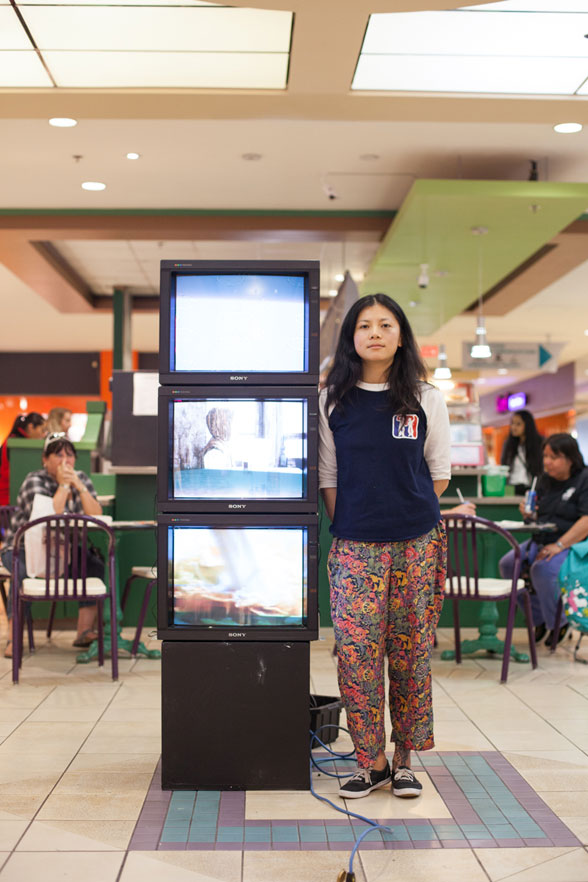
In June 2014, Casey Wei, a graduate of SFU’s Masters in Fine Arts program, bravely engaged Kingsgate Mall to explore the intersection between art, music, community, and the public space of commerce. As an artist-in-residence at the Western Front, she programmed a month of “Happenings” that included live music, an audio talk show, dance and open mic, an art flea market, tarot card readings, book readings, and artist talks. It was all done with generosity and good intentions, and to express how she felt about the mall.
“Going to the mall was a big deal for me when I was growing up, wei explained, “Kingsgate is meaningful to the neighborhood and a spot where a lot of gentrification is going on. A lot of people respond to Kingsgate Mall out of nostalgia.”
Photo courtesy of Scout Magazine.
In the art world, the term “happenings” calls up artists such as John Cage and Allan Kaprow and the Fluxus movement of the 1960s and ’70s that explored chance operations, indeterminacy, and unconventional modes of presentation.
The Western Front has a long-time connection to Fluxus and supports music practices that blur boundaries, from composed works to electronica and noise. Wei’s idea for her residency began with plans for an installation, but they quickly evolved into a much larger project. On top of working in film, video, and other genres, Wei is a musician. Her latest project is Late Spring, a band she established with two other MFA graduates.
Kingsgate’s management was behind the project and within the first few days the Happenings were integrating well. People enjoyed the leather couches and rugs in the lounge, brought magazines and CDs for the public library rack, lined up for tarot card readings, and participated in the open mic. Someone even left an anonymous request for a chess table. “I like that the art was undefined, because art can be more than just what someone calls it,” Wei explained. “It’s possible to get cynical, but everything can be art if you just allow it to be.”
Unfortunately, two weeks into the project, the mall’s management cancelled it. “Some of it was the combination of art and music in a non-normative context,” said Wei. “It’s like that; Fluxus artists don’t have a 9-to-5 existence, but the Mall does.”
To a certain extent, the Happenings suffered from a few moments of tension around unclear expectations for appropriate mall behaviour versus what Wei described as, in one instance, a bit of “artistic irreverence.”
Wei said the relationship was transformative and continues to be positive, despite the abrupt ending. “In some ways it was a discovery of what the Mall could handle and what it really wants. It may have reached a limit in the myth of Kingsgate as a local centre, but it was interesting to see how much it could take and remain fair to everyone involved.”
As an indication of the excitement generated by the Kingsgate Mall Happenings, Wei screened her film about the Happenings to a full audience at the Western Front in February.
Michael Turner, a Vancouver author best known for his book Hardcore Logo, responded with readings that included his poem, “Kingsway,” which describes the avenue as, “a place to get lost, to lose oneself — both a starting point and a destination.” Wei had invited him to deliver readings during the Happenings, but the opportunity was lost when the project was cut short.
Wei will be putting her good experience to use again in April. She was awarded a 10-day residency at Toronto’s Chinatown Centre to develop a site-specific installation that includes film screenings, mah-jong tables, tai chi, and karaoke to encourage the Chinese community to participate. When asked if she planned on developing a reputation as a mall artist, she laughed and said, “I’m just grateful for the opportunity to make things and engage in live study.”