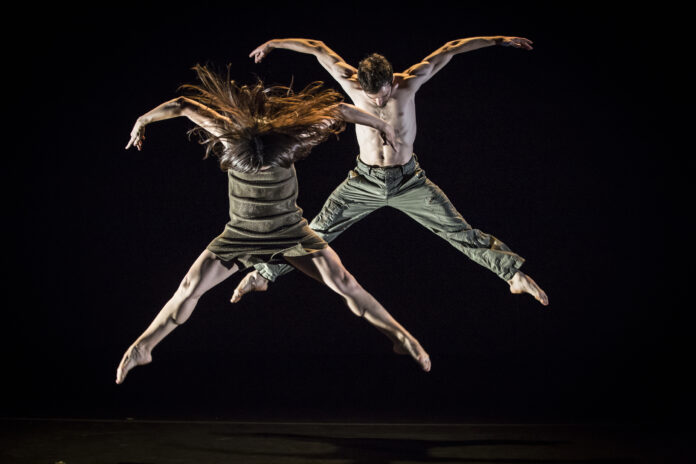
As the current International Resident Dance Company for the Chutzpah Festival, Bodytraffic have brought their bold, contemporary dance from Los Angeles for four Canadian premieres. Company directors Tina Finkelman Berkett and Lillian Rose Barbeito combine highly skilled dancers and cutting-edge works by intrepid choreographers to create their distinct style.
Grooving to a stunning smooth jazz playlist, the dancers in Richard Siegal’s The New 45 moved as if the music was controlling them. Every flip of the wrist or turn of the ankle was in sync with the music, interpreting it in playful, fluid motions.
Photo courtesy of Tomasz Rossa.
Kollide by Kyle Abraham was a slower, more serious work that seemed influenced by ancient mythology. Dressed in muted, natural tones, the dancers embodied characters that represented ideas larger than themselves. The deliberate pace allowed for plenty of time to ponder the meanings and interpretations of the work.
Joshua L. Peugh’s A Trick of the Light brought the tempo and playfulness back up as the dancers paired up in pastel coloured ‘50s era dresses and old fashioned suits. The choreography blended in some funny quirks — the dancers smelled their feet periodically, and one dancer struggled to pull a rope from one side of the stage to the other until he made it across, only to turn around and continue in the other direction.
The old-fashioned romantic songs in this piece added to the wistful tone, along with the confetti dropped on some of the couples by dancers carried across the stage on their partner’s shoulders. I loved the way this piece played with a classic waltz, adding in elements of surprise and plenty of fun.
Once again, before you go by Victor Quijada was a fitting, melancholic way to end the program. With hip-hop, breakdance, and street dance influences, this work was effortlessly cool, perfectly synchronized, and full of wonderful dynamic tension. The lighting also added an element of mystery, as dancers emerged from the darkness at the back of the stage to join the rest of the group. The final moment featured one dancer raised up by invisible hands, a single light shining on her face.
Bodytraffic’s return to Chutzpah this year shows why they are such a renowned contemporary company, and I hope they will continue to share their diverse repertoire with us.
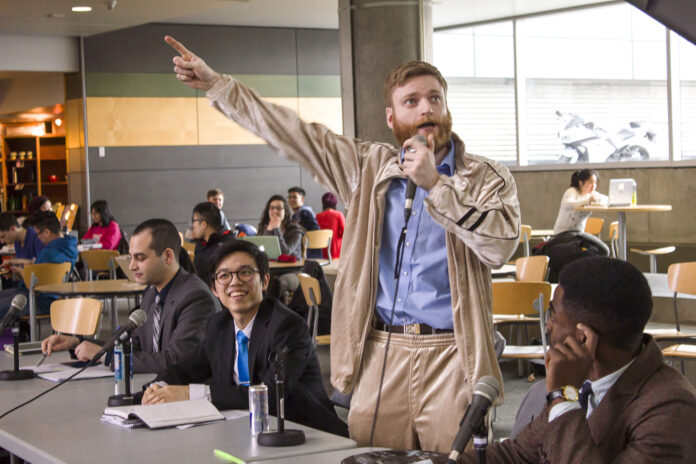
The Presidential candidates laugh as Erik Hadekaer declares his stance on Taco Tuesdays. (Spoiler alert: he is pro-Taco Tuesdays.) - Leah Bjornson
The Presidential candidates laugh as Erik Hadekaer declares his stance on Taco Tuesdays. (Spoiler alert: he is pro-Taco Tuesdays.) – Leah Bjornson
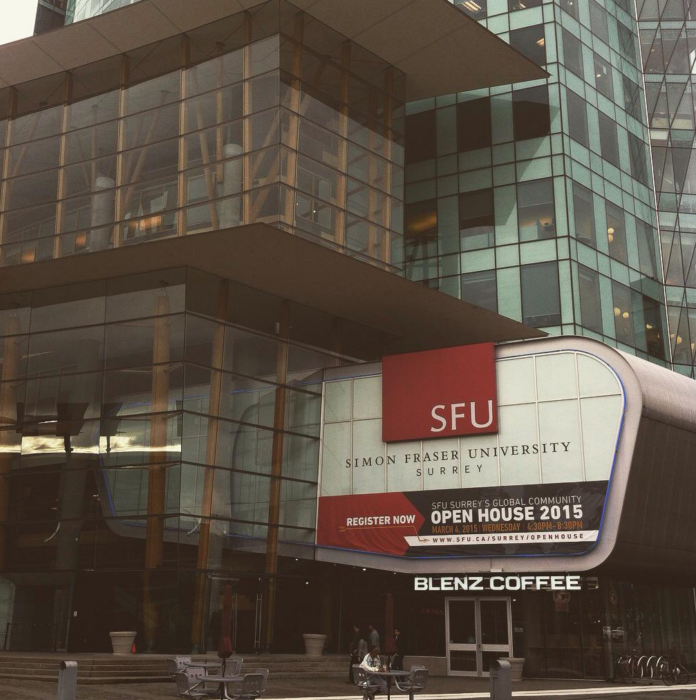
Students meandered in and out of the SFU Surrey atrium last week while candidates for the Simon Fraser Student Society (SFSS) elections vied for their votes at the first debate of this year’s election season.
The atrium was scarcely populated when the debates began at 10:30 a.m. last Thursday, as students occasionally peeked over the railings to watch candidates debate issues related to advocacy, student involvement, and financial responsibility, among others.
The faculty and at-large representative debates were fairly cordial, as candidates discussed their plans for engaging students and bridging the perceived gap between the SFSS board and the membership. Several candidates suggested creating an online database for their faculties and clubs in order to better connect students across campus.
After an hour, discussion shifted to focus on the upcoming referendum questions. This year, the board of directors has put forward three questions to be voted on by the student body in the upcoming elections.
Current SFSS president Chardaye Bueckert spoke briefly about the proposed reallocation of fees from the Space Expansion Fund Levy to the SFSS Emergency Food Bank Program. If passed, $0.25 per full time student and $0.13 per part time student would be shifted to support the food bank, which has recently expanded its services to SFU’s satellite campuses. “This would provide an annual budget of $32,000 for the program,” explained Bueckert.
Current VP external relations Darwin Binesh then spoke to the proposed shift of $4.75 per full time student and $2.37 per part time student from the Space Expansion Fund to the Membership Fee Levy.
The executive debates started with a bang when Brady Wallace (REAL) was the only VP University Relations candidate to take the stage. The Independent Electoral Commission (IEC), who was mediating the debates, asked if the audience had any questions for Wallace, after which he queried if he could ask one of his own.
Wallace addressed his absent opponents, asking how committed they are to the position considering their absence. He then responded on their behalfs: “not very.”
After the debate ended, VP Student Life candidate Deepak Sharma (REAL) gave Wallace a standing ovation.
Binesh (REAL) was also the only VP Student Services candidate present, as Shery Alam (SCHOOL SPIRIT) was ill. When asked how he plans to work with transit after the U-pass program is modified, Binesh responded, “I have formal negotiation experience [. . .] I do plan on fighting for a very fair rate.”
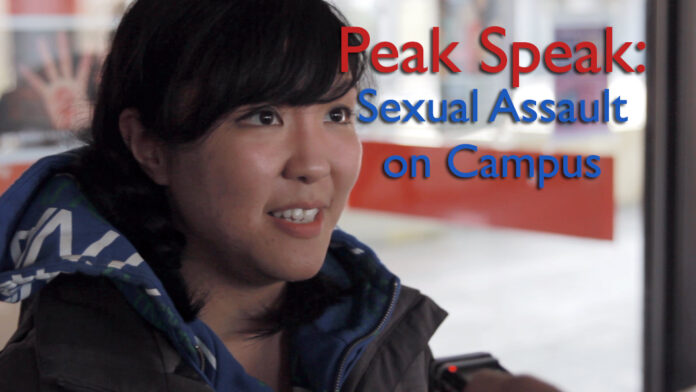
All four of the VP External Relations candidates were present to battle for students’ votes during a lengthy discussion, which addressed issues such as government relations and advocacy. The discussion peaked when Bueckert asked how the candidates plan to address sexual assault on university campuses, if elected.
Candidate Blossom Malhan (REAL) said she wants these issues discussed more openly on campus. “You have the right to be protected at this university,” she added.
Karan Thukral (SCHOOL SPIRIT), Arjan Mundy, and Kathleen Yang echoed this advice, with Yang highlighting the need for transformative justice approaches.
The VP Student Life and the VP Finance debates were particularly contentious, with each pair of candidates exchanging quips and questions.
VP student life candidates Hassan Liaquat (SCHOOL SPIRIT) and Sharma (REAL) emphasized that the position should be about more than “throwing a couple successful pub nights” — although both added that they had “done a few of those.”
VP Finance candidates Barbara Szymczyk (REAL) and Karan Thakur (SCHOOL SPIRIT) threw out figures from the current SFSS budget, speaking to what adjustments they would make in the upcoming year.
At 1:04 p.m., the presidential candidates Kayobe Fatoba (SCHOOL SPIRIT), Erik Hadekaer (S.P.A.D.E.S. 2015), Zied Masmoudi (REAL), and Enoch Weng took to the stage. Fellow candidate Johnny Aether (LAN Party) sent in a note apologizing for his absence.
Before sitting down, Hadekaer removed his formal suit, put on a velvet gold tracksuit, and began cracking glowsticks, which he then threw to members of the crowd during his opening statement.
Masmoudi begun by asking his opponents what their first priority would be if elected. Weng said he would focus on uniting the board priorities and ensuring the group was ready to work as a team. For Hadekaer, the emphasis was on Taco Tuesdays. “We will bring tacos to everybody!” he exclaimed.
Fatoba said he wants to lead by example and try to keep the board focused on working together. “Less politics means more possibilities to do what we are elected to do,” he stated.
Masmoudi later stated that the board needs to reevaluate its mission: “One of my main priorities would be to set a goal for the society.”
Candidates parleyed for almost an hour on how to improve the society before the IEC wrapped up the debates at 2 p.m.
The candidates will continue to debate next week at Harbour Centre and Burnaby before the campaign period closes on March 24.
If you couldn’t make it to the Simon Fraser Student Society (SFSS) Surrey debate this morning, don’t sweat it! The Peak has you covered. We will be providing election coverage throughout the following weeks, but for now, here is a taste of what you missed this morning at SFU Surrey.
1. When the candidates told other candidates about their candidacy.
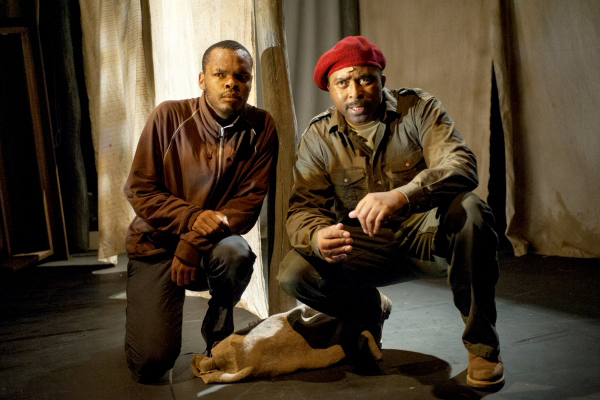
In early February, it struck me that I had been in Vancouver for three years and had been blessed with the opportunities of attending myriad shows, but none of these had been from my home continent of Africa. When I had the opportunity to see the Canadian premiere of the award-winning Cadre by South African playwright Omphile Molusi, I realized the wait was worth it — I was treated to a show that was well written, soulfully performed, and wittily choreographed.
As I entered The Cultch and made my way to my seat, I noticed that there was a young African man on stage, walking around calmly. He was bouncing his head slowly up and down the theatre, looking at everyone who entered. Every now and then, he made an adjustment to the set, fixing an unsatisfactory angle of the props. This instantly made me assume that he was a perfectionist. As the show went on, I realized that his perfectionism paid off splendidly.
Photo courtesy of The Cultch.
The performance started with a powerful monologue by Gregory, played by Omphile Molusi. He is joined by two multi-character players, Fezile Mpela and Lillian Tshabalala. The story begins in the mid 1960s and continues until the end of apartheid before bringing us back to 2015.
It was a powerful performance by the actors on a simple, almost minimalist stage. I loved how the entrances and exits were portrayed through a draped clothesline. I also appreciated the continuity of having Gregory in the same clothes through four decades while the other characters changed swiftly in and out with the help of simple costumes.
Molusi’s captivating storytelling ability carries this play forward while his talented co-stars go through many character changes and do so creatively. The play is about the struggle of life, love, and loss during apartheid. It has a wonderful comedic element that made the audience laugh childishly at its most heartwarming moments
This was Molusi’s first time in Vancouver, and I hope he comes back again soon with another production, if not the same Cadre.
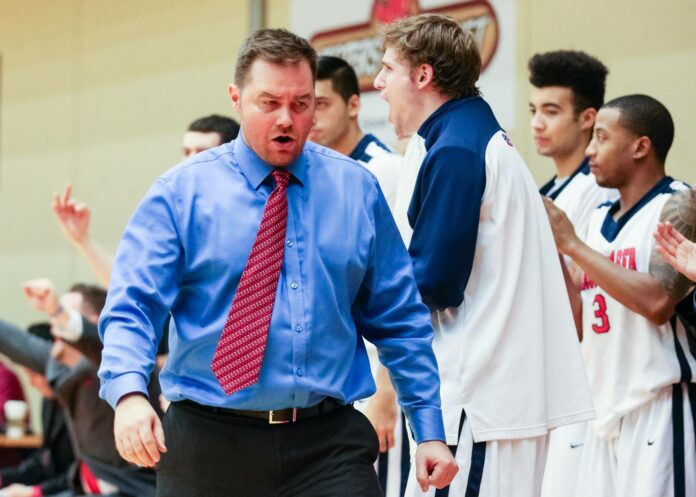
SFU Athletics announced today that James Blake, who has served as the head coach of the men’s basketball program for five years — and the entirety of the time the team has been in the NCAA — has resigned.
Blake called the choice to move on a mutual decision between himself and SFU Athletics. He did note, however, that he was “very shocked” to leave the team he has coached for five years.
“It’s a little bit on their side, it’s a little bit on our side, [but] their side I was a little bit shocked with, that’s all I can say,” said Blake. “I thought that we had a good year, but unfortunately, I think it’s based on a five-year period that I was at Simon Fraser, and unfortunately we didn’t win enough games.
“That’s the problem with this business: it’s a performance-based business — [that’s] both the problem and the success of it.”
Blake express some frustration about leaving after the team’s best season in its NCAA history — going 6–12 in the conference, and leading the whole NCAA Division II in scoring. “It was a fun team to watch,” he noted. “I don’t know what else they expected, if you score 105 points a game, and I think sometimes when non-athletic people make athletic decisions, this is what you get.”
“I have accepted James’ resignation, and I want to thank him for all of his hard work during our transition into NCAA,” SFU’s athletic director Milt Richards said in a press release. “James spent five years putting our program in a position to successfully compete at the NCAA DII level in the Great Northwest Athletic Conference and I wish him well in the future. James is an excellent recruiter who will be an asset to any program he chooses to lead.”
Blake took over the program in 2010, when 15-year veteran head coach Scott Clark left the program to coach at Thompson Rivers University. The Clan were entering their first year in the NCAA, a challenge that intrigued Blake, who had spent nine years coaching in the NCAA with American schools.
“I walked into this thing not knowing what to expect,” he reflected. “I was excited about a Canadian school going to the NCAA [. . .] the first couple of years were so tough because of the transition period, I never expected it to be that hard, but if I’m ever put in that situation [again], I’ll know exactly what to do.”
SFU Athletics announced that it “will immediately begin an international search to find the next head coach.”
So, what’s next for Blake?
“You know what, I just found out, so I don’t know,” responded the now former head coach. “I’m really excited about spending time with the family, and being a tourist in my own town, and taking my wife and my baby for a walk on the seawall.”
SFU wiped away what can only be described as a disappointing regular season — where they scored less than 30 points and placed outside of the top two for the first time since the 2007/08 season — by sweeping the Trinity Western (TWU) Spartans in the first round of the BCIHL playoffs.
Saturday night, the Clan returned home to the Bill Copeland to play game two after defeating the first-placed Spartans 3–2 the night before.
At only 1:47 in, Trinity Western put in the first goal of the night. Just over six minutes later Spartan forward PJ Buys, who was third in regular season points, made the lead 2–0 on the powerplay. It looked as if it may just have been TWU’s night — payback for the loss at home.
However, it didn’t take long for SFU to answer with one of their own, as forward Jono Ceci notched his second of the playoffs to put the Clan up on the scoreboard.
There would be no more scoring in the first period, but less than a minute into the second, SFU forward Trent Murdoch tied up the game.
TWU took back the lead five minutes later, but Murdoch wasn’t satisfied with one game-tying goal, so he put another in the back of the net. 3–3.
Trinity Western decided to continue this game of back-and-forth goals, and once again took the lead off of a Ryan Bakken goal, and the team went into the second intermission ahead.
Adam Callegari, who scored two the night before for SFU, scored his third of the playoffs to tie the game for the final time. Instead of following the score-and-be-scored-on routine of the the second period, forward Jeff Mysiorek gave the Clan their first lead of the game — and what would turn out to be the game-winning goal.
Nick Sandor, who led SFU in scoring in the regular season, nabbed the sixth goal just to put the cherry on top. Although there were still 10 minutes left, the goal seemed to kill any chance of the Spartans coming back, or even scoring a goal. The Clan won 6–4.
Notably, SFU shut down BCIHL leading goalscorer Cody Fidgett — who had 25 goals in the regular season for TWU (seven more than second place) — holding him to a single point and no goals.
The trip to championship marks a return to form for the Clan. Having competed every year since the event’s creation, the team lost their chance to compete for the first time last year; they were upset in the first round by TWU, who were then the underdogs at third-place. SFU is currently tied for most BCIHL Championship titles, having won the playoff tournament three times.
The Clan will travel to Castlegar, BC this weekend to face their BCIHL finals opponents Selkirk College, who are the defending BCIHL champions — having not only won last season, but also the season before. SFU narrowly edged Selkirk College in the season series, going 3–2, winning the deciding game in a shootout. However, Selkirk College had previously defeated SFU in the BCIHL finals in 2012, sweeping the Clan.
Selkirk hosts the championship round, as they are the higher seed — second to SFU’s fourth place. Games ones and two will be played Friday and Saturday night at 7 p.m. In the case of a tie, game three will be held Sunday night.
Playoff Round 1, Game 2
SFU: 6 TWU: 4
First Period:
TWU Jacob Mills (1) (Wheeler) 18:23
TWU (PPG) PJ Buys (1) (Fidgett, Schmitt) 12:11
SFU (PPG) Jono Ceci (2) (Ball, N Sandor) 9:46
No Regrets is an up-and-coming rap duo based out of Vancouver, having opened shows at various venues around the city for artists including Riff Raff and Problem. Made up of Cliché, a Indian-Vancouverite, and Scoota, an African-American hailing from Alabama, the duo intend to make “quality music with no regrets.” Known for tracks like “She Ready” and “Loyalty,” No Regrets make it look easy to cross cultures, regions, and genres through their music.
Photo courtesy of No Regrets.
The Peak: What is the meaning behind the band name, No Regrets?
Scoota: Basically, to us, No Regrets means diversity. We have no regrets; we stand behind that. We make music for the world.
Cliché: It means do what you want to do in life, look forward in whatever you do.
P: You often describe your music as a movement. What messages can be attributed to this movement?
S: It doesn’t matter where you’re from, everyone can relate [to one another]. We all go through the same things, we all can relate in some type of way.
C: There’s a big stereotype as to how music is made and where it originated, but you could be from a different culture, skin colour, religion, race, you can make music however you want to and express yourself.
P: How would you describe your sound?
C: We make music, we feel music, [and] we listen to music. For example, when we listen to beats, we don’t really care where it’s coming from or who made it. If we like it, we get on it, and we speak what we feel. When we do our music, we do it for the world. Our music is showing that everybody can come together; it doesn’t matter where you’re from. Some people would say ‘I like East Coast music’, or Gucci Mane from the South; [we acknowledge] they’re both good music. We don’t have these barriers.
P: Both of you work with Isaac Min, a producer with South Korean roots. How does working with a multicultural team affect the musical process?
S: It makes it easier; having accepted the differences and being diverse, it’s just embracing that. We start out with that, and we take our knowledge of music, our different backgrounds, and gel all of that together. We try and get the best product that we can, the best sound that we can.
P: What was the process like working with James Ferguson, an alternative rock musician, on “Why This Kolaveri Di,” an ethnic track involving Tamil?
C:It wasn’t difficult at all. It was really cool mixing alternative rock and hip-hop. It was just cool working with him because he brings in another creative side. I was coming up with stuff, Scoota was coming up with stuff, and James would come up with stuff that we didn’t even think about.
Recessions, terrorism, and 9/11 have left a firm imprint on the kinds of films that have been produced in the last 15 years or so. Superheroes, a once shining beacon of hope, have become morally ambiguous. Many Hollywood films are nihilistic. Even Disney fairy tales that were once happy parables now focus more on tragedy and ambiguity. But Kenneth Branagh’s retelling of Cinderella isn’t one of them.
Last year two post-modern twists of old animated stories were released. Maleficent was Sleeping Beauty told from the villain’s point of view, and Into the Woods was a musical that weaved between many updated fairy tales while subverting their formulae, questioning happy endings and including darker subjects like adultery.
During a recent debate with a Marxist friend, she explained that she hated the classic heartwarmer, Sullivan’s Travels, just because it was enjoyable and pleasant. “What would Marx think?” she exclaimed. “It’s advocating a distraction for the masses, so they can forget about the oppression of capitalism.” For her, a film is good if and only if it is Marxist, depressing, and preferably experimental. Now there is the antidote to our capitalist ailments!
The tremendous irony is that Sullivan’s Travels is speaking against this very attitude. It’s about a wealthy Hollywood filmmaker who wants to make a serious drama about the lower class but discovers that accessible comedy is a far better cure for cultural madness than depressing “art.”
By my Marxist opponent’s criteria, our film industry should be in a golden age. Sadly, dark subject matter does not necessarily lend itself to profundity or, more simply, good filmmaking. All of this is to say that Karl Marx would hate Kenneth Branagh’s Cinderella — and maybe that’s why I like it.
The film is so old-school (pre-15 years ago) that it almost feels inventive and fresh. None of the post-modernity, cynicism, and nihilism common in so many of today’s films is present in this one. Cinderella is poignant, sincere, and uplifting. Cinderella is a virtuous person dealing with extreme hardship in a way that is relatable and worthy of emulating. The story remains predictably close to the original classic, but excels in its polished execution.
The visuals create a fantastical but believable world by using sweeping camera movements through crane shots of landscapes and CGI visual effects that don’t feel phony. Sandy Powell’s costume design is eye candy, including the delicate contrast between Cinderella’s vibrant blue dress and the other drab, lifeless ones at the ball.
The film comes to life, however, through Lily James’ performance as Cinderella. She sells her inner beauty through genuine reactions to her sisters’ and stepmother’s cruelty, which makes the ending and the evident “happily ever after” that much more uplifting.
Distraction or not, the only thing oppressive at the movies today is gratuitous and unnecessary darkness. That’s probably why I responded so strongly to Kenneth Branagh’s glossy but simple Cinderella. Sullivan would be proud. The classic is back and it’s not in black.