Home Blog Page 1050

Missing and murdered Aboriginal women deserve justice

0
Photo credit: The National Post

According to The Globe and Mail, the United Nations Committee on the Elimination of Discrimination against women released a damning report which accused Canada of “violat[ing] the rights of Aboriginal women by failing to thoroughly investigate why they are targeted for violence.” The committee added its voice to numerous others who advocate for a national inquiry into the matter.

It is clear from this report that the Conservative Party does not take violence against Aboriginal women seriously. However, the Canadian government must be the one to take action, as they are responsible for this issue in the first place.

The Canadian public has launched itself into a frenzy over the spectre of terrorism, which truly hasn’t been much of an issue. RCMP records state that 1,181 Aboriginal women have been murdered or declared missing in Canada, and yet for many this does not provoke the same gut reaction of righteous indignation. The public, for the most part, remains starkly unemotional. For evidence of this complacency we need look no further than Prime Minister Harper.

He is a near-authoritarian arbiter of justice (see Bill C-51), yet on this issue his stance is reserved and calm. Just this week he announced his support for a bill which would introduce life sentences with no chance of parole for crimes like murder and terrorism, which he called “repulsive” and “heinous.” Why isn’t Harper repulsed by the scourge of violence against Aboriginal women? The most Harper can muster is that a national inquiry on the issue “isn’t really high on our radar.”

Centuries of racist policy in Canada have left the nation’s Aboriginal peoples disadvantaged — subject to racial discrimination, cultural genocide, and the societal consequences of poverty. As of 2006, approximately 50 per cent of all ‘status’ aboriginal children were living in poverty. In Manitoba, where the Aboriginal population is higher than most provinces, that number jumps to 62 per cent.

It is clear that the Conservatives do not take violence against aboriginal women seriously.

Poverty has profound effects on a people. It is correlated with increased exposure to crime, violence, exploitation, substance abuse, and mental health issues, all of which have become endemic in Aboriginal communities. The Canadian government is solely responsible. When the Indian Act was first introduced in 1876, it imposed draconian restrictions on Aboriginal peoples in regards to who had ‘status’ and who did not.

Furthermore, it victimized Aboriginal women who married out. These women would lose their status, legal recognition, and be cut off from their families, communities, and support networks. This is where the seeds of a future of abuse are sown.

The residential school system routinely abused Aboriginal children sexually, physically, and emotionally, and gave them trauma which they carried throughout their lives. The current violence is just a continuation of a history of similar brutality.

The only difference now is that the state, instead of being the direct perpetrators, are law enforcers who have more pressing agendas than to deal with violence against Aboriginal women. After all, how can we expect a government that has consistently dehumanized and oppressed these women to suddenly care about their safety?

A national inquiry is necessary for justice to be achieved, full stop. It is clear that the status quo has not adequately protected Aboriginal women, and an inquiry could do two things. First, it could explore the root causes of violence. Second, and most importantly, it could provide justice for countless victims.

A society where individuals are well aware that committing violent acts against Aboriginal women is routinely met with impunity is one in which Aboriginal women will continue to be victimized. Moreover, for the families of victims like Loretta Saunders and Tina Fontaine, it denies them any sense of restitution.

For Aboriginal women living in Canada, a national inquiry won’t eliminate a culture of violence and oppression. But it’s a start.

Louis Riel House to close, deemed beyond repair

0
Louis Riel House is the oldest residence on campus. - Talha Qadir
Louis Riel House is the oldest residence on campus. – Talha Qadir

SFU recently announced that Louis Riel House, the residence that primarily houses graduate students and families, will close at the end of August due to structural and air quality issues.

Current residents have been asked to vacate by that time. This has sparked an outcry from residents who are not eligible to apply for any other on-campus housing — most of which offers single-bed dorm rooms only — and must find alternative housing for themselves and their families.

After completing a full assessment of the condition of the building, SFU has deemed the structure beyond repair and has decided it must be torn down.

In a press release on March 10, the university wrote that “The wellbeing and safety of residents at Simon Fraser University is a top priority. Given ongoing concerns with the structure and indoor air quality at Louis Riel House Residence, and following a recent assessment [. . .] it is clear that the mechanical systems and building envelope are at the end of their service life.”

The release also stated that Louis Riel residents are an important part of the campus community, and that the university will continue to meet with and assist students and families as they develop next steps.

Concerns about the general upkeep of the residence have been expressed over the past several years, but it wasn’t until last September that SFU began a thorough inspection of individual units and common spaces in Louis Riel to address issues with black mould.

In an online update, the university stated, “The assessment identified a number of moisture sources which are resulting in damaged building materials, fungal contamination and reduced indoor air quality.”

During the inspection process, 39 residents were relocated to alternate housing on campus due to health risks in their units.

Several Louis Riel residents have protested the closure throughout the process and held a press conference on the morning of March 10 following the announcement.

At this conference, Louis Riel resident Teresa Dettling said that, had she known about the issues in the building, she would have thought twice about moving in. “We were all lied to about the condition of the building before we took possession of our apartments,” she said.

Many of Dettling’s neighbours expressed concerns about how they are going to finish their education if there is no place for them or their families on campus. SFU Residence and Housing has communicated its intentions of “reviewing its housing plan for the future” and to meet the need for family housing, but has offered no immediate solution.

All the residents of the condemned building were invited to a closed town hall meeting later that evening to have their questions and concerns addressed. Security was present outside Shell House where the meeting took place. Dettling stated that their presence was an “intimidation tactic” on the part of the administration.

Dettling approached the Simon Fraser Student Society (SFSS) board at its meeting on March 11 on behalf of the Louis Riel Community Association to ask for the society’s support.

She explained that she and fellow residents are looking to be relocated to other housing on campus — something the university has not promised to accommodate — as well as to request that SFU incorporate low-income housing into future residence projects.

“Any type of pressure you could put on the university [. . .] would be extremely helpful to us,” she said.

SFSS President Chardaye Bueckert advocated for assisting Dettling’s group and moved a motion to that effect. The society agreed to endorse their declaration and to support them “as required and requested.”

“If the SFSS is not in favour of affordable family housing on campus, I don’t know why we’re here,” said Bueckert.

The Louis Riel Community Association will be holding a rally on Wednesday, March 18 in Freedom Square next to Convo Mall to stop the “displacement” of Louis Riel’s students and families.

How your St. Patrick’s Day celebrations appropriate my culture

0
Illustration by Momo Lin

When you think of cultures that have faced adversity throughout history, the Irish are frequently overlooked. Whether it’s British home rule up until the early 20th-century, stereotypes about being lazy and drunken good-for-nothings, or light-hearted comments about serious tragedies like the potato famine, Irish people are often targeted but rarely given sympathy for their cultural background.

It should come as little surprise then that the most discriminatory practice those of Irish descent face is also one of the most widely celebrated holidays of the year: St. Patrick’s Day.

“That’s impossible,” you might think to yourself while adjusting your shamrock-shaped novelty sunglasses. “St. Patrick’s doesn’t demean Irish heritage; the day celebrates it!” Once a feast day of religious and cultural significance to the Irish people, the holiday has been seized by the masses and turned into a green-beer infused orgy of debauchery in which every jackass from Hamilton to Hanoi claims to be Irish. For actual Irish people, including myself, this appropriation is utterly offensive.

Sure, we like our pints of Guinness as much as the next functioning alcoholic, but the last thing we need are frat packs of culturally-insensitive bros running around, getting wasted on our behalf. If we wanted to get drunk, we would. We’re really good at it, and we don’t need non-Irish people doing it for us.

Think I’m overreacting? Allow me to convey the seriousness of this appropriation epidemic with a real-life anecdote from last year. While attending an SFU St. Patty’s Day Pub Night, I was forced to witness my friend drunkenly hit on women while wearing a “Fuck Me I’m Irish” T-shirt. My friend is Japanese, and is no more Irish than a McDonald’s Shamrock Shake. If anyone should be having sex with anyone because they’re Irish, it’s me!

Everyone appropriates my culture willy-nilly and there seems to be no relief, no justice in sight. After several years spent in post-secondary, it has become evident that this school and its students care little for the plight of its Irish-Canadian students.

So what can my fellow Irish brothers and sisters do to fight back against this atrocity? As much as it pains me to say it, we must boycott this holiday and refuse to celebrate it. Without our approval, St. Patrick’s Day will lose any and all credibility. Refrain from dripping green dye into your favourite lager; drink from shot glasses that you didn’t buy from the dollar store; and save those temporary four-leaf clover tattoos for a day where cultural appropriation is less rampant. Like Earth Day, or maybe Thanksgiving.

Remember, Irish brothers and sisters, the only reason they appropriate our culture is because, in the words of a great Irishman, “They’re after me lucky charms!”

How to be a Winner

0

Moe Alternate WEB

Nearing the end of my fourth term on the Board of Directors of the SFSS, I feel that this is an appropriate time to share my experience with all students, especially those interested in running for office this year.

I served four terms as a member of the Board — two terms as the Applied Sciences representative, followed by serving as the last Member Services Officer (now split into two positions, VP Student Life and VP Student Services), and am presently serving my final term as the VP University Relations.

I ran for the first time in my very first year at SFU without knowing anything about the Simon Fraser Student Society. It seemed like a mad decision, but I went for it anyways.

Being new to the campus and to university life in general, this seemed like a risky move. I expected to be humiliated by my opponents, who were all more involved around campus, especially the incumbent — but I was wrong.

Running for the first time was the best decision I ever made. I met so many enthusiastic people who cared enough to put their name forward, step out of their comfort zone and try to make a difference for the student experience at SFU.

I wasn’t elected the first two times I ran for office, but I finally succeeded in a by-election in 2010.

There are certain factors you need to consider before and during the election period to ensure success. Your goal might be winning the position you run for, but that doesn’t happen to majority of people who participate. Your chances as a first timer in the election might seem low — but is it worth a try? Absolutely!

If you think you can bring new values to the table and improve the SFSS organization in any way possible, you should run in the SFSS elections. Some people are motivated to create awesome events, some want to get into advocacy work, some want to increase our collaboration with external organizations. The choice is yours.

This leads me to my main point: how to be a true winner in the SFSS elections.

There are a lot of things you need to do before the campaign period even begins. Before you put your name in the ring, you should research the SFSS organization thoroughly: the projects, committees, bylaws, and constitution. It is a lot of information, and you are not expected to memorize it all; you should strive to become with the structure of the society and its operation.

Talk to as many current and past Board directors as you can. Share your ideas and what you want to bring to the table. Familiarize yourself with the current issues the society is facing (financial, operational, communicative — whatever it may be) and see if your solutions can assist the situation. Maybe even include them in your platform!

Create a solid platform with a maximum of three key points, and don’t bullshit. If you promise lowering tuition fees you better have a plan to execute with a timeline. Otherwise you might find yourself making false promises.

Design awesome posters and campaigning material, but don’t rely on them. During the election period, the school gets filled up with thousands of posters. Yours will likely be lost in the pack.

During the campaigning period, I suggest running independent rather than being part of a slate. Slates at SFU don’t work. They take away from the freedom of candidates, as you must confirm everything with your team — and if someone screws up in the slate, everyone gets blamed.

Slates also create the illusion of support in a free-for-all game. If you are part of a slate, remember that the chance of your entire team winning is very low. So be nice to everyone running in the elections, because you never know who you might be working with.

You should also talk to clubs and Departmental Student Unions. We have hundreds of these groups, and they all vote. Go to their meetings, learn their struggles. Also, be nice to the staff at the SFSS. They may not be able to vote, but if you do get elected, you’ll be glad you made the effort.

Personally, I am against classroom speeches. It’s a waste of the tuition students pay to be in class and learn. If you plan to give classroom speech, arrange it with the professor beforehand, and keep it short.

Focus on meeting people, rather than hanging out with the people that already declared their support for you. Spend one minute maximum talking with each student when campaigning, and aim to reach out to as many students as possible. It’s a lot of work, but if you don’t waste your time, you can do it.

Lastly, do not fall behind your academic commitment. School comes first, and you should learn how to manage the SFSS work and schoolwork simultaneously from the beginning — otherwise, your term will be hell.

During the voting period, you are not allowed to campaign, but you can still remind your friends to vote in the elections.

Lastly, if you win the election, please remember that it is just the beginning. You have accepted the serious responsibility of representing over 25,000 people, and you will be making a lot of difficult decisions. In doing so, always keep in mind those who trusted you with their vote, and the impact your choices will have on the SFU community.

If you lose, it is not the end of the world. You have expanded your network and learned a lot through this new adventure. I strongly recommend getting more involved in the society initiatives and committees, in order to get ready for the next year.

Best of luck to all candidates and future board members!

Woohoo, Boohoo

0
Photo courtesy of Flickr

Woohoo: Throwing a Party

Raise that green stout high — it’s time to make your ancestors proud.

St. Patrick’s Day is right around the corner, and you’ve promised your friends a drunken romp for the ages. You’ve hit the dollar store up for every tinseled shamrock and shot glass you can muster. Soon you’ll be feasting and drinking to your heart’s delight in the company of dear friends! Who cares if your neighbors have small children? It’s spring break; they can sleep it off!

You’ve waited all year for the chance to wear that “Kiss me, I’m Irish” T-shirt, and nothing is going to stop you now. Green couch stains and horrible attempts at an Irish accent are in your foreseeable future, and you wouldn’t give it up for a pot of gold. Stick on that ginger peach fuzz and get your jig on; you’re kicking off spring with a bang.

Boohoo: Throwing Up

Your stomach is a festering geyser of cheap booze and green food colouring, ready to go off at any minute. The grip on the toilet bowl is firm; you can’t risk letting the room start to spin again. One burp confirms your worst fear; it’s coming up, and nothing’s going to make it otherwise. You brace your arms and lower your head into position. In no time at all, you’ll be given an abdominal workout that could put a Cross Fit class to shame.

Eyes bulging, jaw unhinged, you let out a war cry. Bile courses up your throat and ejects itself through your mouth and nostrils. After bidding farewell to breakfast, lunch, dinner, and two six packs of beer, you lean against the wall begging for it to be over. Shortly after, the geyser in your stomach comes again twice as hard. Somewhere, someplace, your ancestors are laughing and face-palming.

Carbs aren’t the enemy, research suggests

0
Just like Regina George, our researchers are trying to understand roles of carbohydrates. - Esther Chang

Just like Regina George, our researchers are trying to understand roles of carbohydrates. - Esther Chang
Just like Regina George, our researchers are trying to understand roles of carbohydrates. – Esther Chang

SFU has joined a new national research council that investigates glycomics, the study of the structure and function of carbohydrates in biological systems.

Six scientists from SFU have joined over 60 others across Canada in the Canadian Glycomics Network (GlycoNet), which received $27.3 million in federal funding last month.

GlycoNet is one of the leading health-related research networks to receive funding from the federal Networks of Centres of Excellence program. Boasting a set of multidisciplinary researchers from across Canada, the organisation is playing a key role in large-scale research initiatives, such as glycomics, with the aim of improving human health.

David Vocadlo, an SFU professor of chemistry who has joined GlycoNet, told The Peak what glycomics is all about.

“Many people think of carbohydrates as simply a source of energy used by the body. Remarkably, however, the body takes glucose and converts it into about 10 different types of specialized and distinct sugar units,” he explained. These specialized sugar units are then taken by cells and stuck onto proteins that are distributed throughout the cell, coating its surface.

The sugar units play different roles, all the way from conception through development and into adulthood and aging. Vocadlo continued, “We don’t really know all the roles played by these different sugar structures in the body, and that is a topic of intense international interest.”

He also noted that the study of glycomics may contribute to our understanding of neurodegenerative diseases and cancer.

“In diseases such as cancer and neurodegenerative diseases, the cells that are affected show differences in how they use sugars. In cancer, for example, the cells take up additional glucose to feed their growth, and this creates stress on the cells,” Vocadlo said.

“Cancer cells protect against this stress by changing the levels of specialized sugars found on certain proteins. So, if we can identify these changes and then understand how these changes impact these diseased cells, we can enable the development of new therapeutics.”

Vocadlo said he believes these findings could help with the development of new therapeutic strategies for diseases such as Alzheimer’s and Parkinson’s. Glycomics could also have wide ranging significance in areas extending to antibacterials and antivirals including vaccines.

Ultimately, Vocadlo is enthusiastic to be joining GlycoNet, and will begin by focussing his research on understanding and controlling carbohydrate-processing enzymes.

Relay for Life rallies students to the cause

0
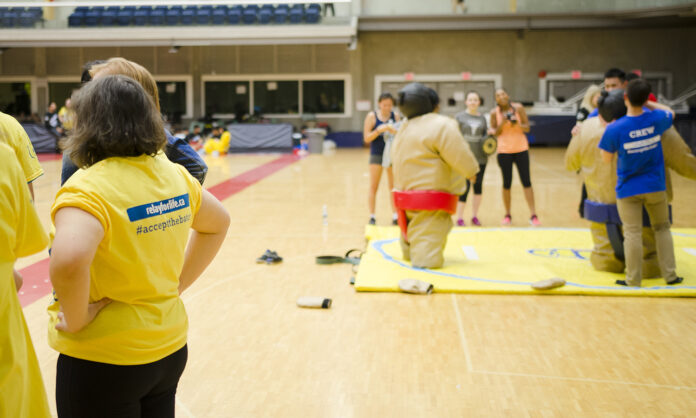
Participants engaged in activites such as sumo wrestling and zumba. - Brandon Hillier
Participants engaged in activities such as sumo wrestling and zumba. – Brandon Hillier

Students were in motion around the clock in the West Gym on SFU’s Burnaby campus to raise funds and awareness for the Canadian Cancer Society.

The annual event took place from 7 p.m. on Friday, March 6, 2015 to 7 a.m. the following morning, and students and members of the SFU community raised $18,666 this year, as of press time. Donations are still being accepted, and that number is still rising.

Over the past seven years, SFU has raised over $200,000 for the Canadian Cancer Society.

Event attendees raised money and pledges in teams and walked, ran, or wheeled around the track for the duration of the 12 hour event. Attendee Jenna Gigantelli enjoyed the event, saying, “it was wonderful being there with my friends, because we all stepped up together to show our support.”

The event also involved a number of other activities, including a photo booth, sumo wrestling, zumba, live music played throughout the night, and a pancake breakfast in the morning.

Brooke Sherwood, the team lead for community giving for the Canadian Cancer Society’s Greater Vancouver region, explained the importance of the Society’s work within the community.

“Not only is [the society] a funder of research, it also provides a lot of support programs that can’t be funded by the government,” she said. “There are a lot of missing links that people on a cancer journey require, and the society raises money to support them.”

The Canadian Cancer Society not only funds research projects, but also runs a pediatric camp for children and their families in Maple Ridge. Called Camp Good Times, the centre provides low-cost or free lodging for cancer patients and their loved ones, near cancer treatment centres across the province. Through this support, they aim to enable everyone to fight their cancer, no matter their financial situation.

At 11 p.m, attendees participated in ‘Laps of Remembrance,’ when each attendee was encouraged to decorate a luminary in support or memory of someone who fought or is fighting cancer.

The track was lit by the luminaries, and laps were done in the dark, while “Hallelujah” was played and a dancer performed below the track amongst luminaries spelling out “hope.”

Gigantelli explained that the memorial meant a lot to her, as her dad is a cancer survivor. “The whole time, all I could really do was be so thankful my dad is still with me, and reflect on what it would have been like if his luminary was a memorial one,” she said.

When asked what she intended to accomplish that night, Sherwood said, “We hope that [the event] brings meaning. The reality is, if we were to ask everyone in the room if they know someone who’s had cancer or is on the cancer journey, unfortunately the vast majority of people would put their hands up.”

SFU’s fitness centre should remove its women-only hours

0
Photo Credit: Fast + Epp

Two law students at McGill, Soumia Allalou and Raymond Grafton, recently approached their university student union about creating women-only hours at McGill’s fitness center. Their proposal was met with widespread criticism, and rightly so.

In fact, an online petition opposing women-only fitness hours was created soon afterwards, and I fully support it. It’s upsetting that in a society striving for equality and inclusiveness, a public gym funded by both sexes should shun away one sex at certain times of the week. What’s further upsetting is that this problem already exists at SFU.

It’s Saturday morning and I have just met up with my best friend. We’re planning on pumping iron at SFU’s fitness center, and we arrive there at about 8:30 a.m. When we walk through the doors to the fitness center, we’re told to leave. Why? It’s women-only hours.

We’re actively trying to create a society that’s more inclusive, so it’s contradictory to create women-only hours in a university gymnasium that is funded by students of both sexes. In her proposal to McGill’s student union, Allalou tried to reason that women have less access to equipment, are “intimidated” in the weights section, and feel less comfortable in the gym environment, implying these women may be subject to harassment by men.

Firstly, men face the same difficulties obtaining dumbbells, barbells, plates, and machines. There aren’t gender rules to dictate who gets access to these things. I’ve seen plenty of men aimlessly stare at a piece of equipment only to watch it then be taken by someone who has the courage to ask the current user for a chance to use it. It’s not a gender problem, it’s an inability to speak up.

Gender-only hours advance the attitude that the two genders are radically different psychologically and physiologically.

Secondly, being intimidated in the dumbbell or weights sections merely comes with being inexperienced at the gym. I’ve also observed plenty of men who hesitate to enter the dumbbell area because they notice the flurry of activity. Again, once gym-users of any gender break out of their comfort zones, they’ll realize that everyone generously shares weights.

Finally, if you’ve been harassed in any way at the gym, then report the individual. Verbal or sexual harassment is by no means okay, but it doesn’t mean all men should be punished because a few of them have done wrong. Having worked out regularly for six years at five different gyms, I can assure everyone that men are generally polite and helpful to women in the gym.

To further explain how ridiculous women-only hours are, I’ll reference an activity that is dominated by women: yoga. It doesn’t make sense to say there needs to be a men-only yoga session because men are shy and inexperienced with yoga. And it’s not the case that women are extremely better at holding poses or more flexible in some innate way.

Women who engage in yoga are simply better at yoga because they practice yoga. To have gender-only hours advances the attitude that men and women are extremely different psychologically and physiologically.

Women can be just as strong as men. SFU should understand this, and should take note of McGill’s example in not setting women-only hours at their fitness center. Ideally, they should follow suit.

SFSS election heating up as incumbent candidate locks hopeful newcomer in boiler room

0

With election season underway for the Simon Fraser Student Society (SFSS), things are heating up as promising newcomer Shaylene Pratt has already hit her first political roadblock: being locked in the boiler room of the Maggie Benston Building by current SFSS president, Steven Roberts.

“Honestly, I was expecting something like this to happen,” Pratt told The Peak, through the locked door of the basement boiler room where she’s been trapped since last Wednesday. “Friends of mine warned me that student politics could be a petty and mean-spirited arena, so I’m not too surprised.”

Pratt claims she was lured into the basement by Roberts via an e-vite for a super-secret mock debate meant to give candidates an opportunity to practice before the actual debate next week. Since being locked in the boiler room, Pratt has begun to doubt the mock debate’s legitimacy.

“Looking back on it, a basement doesn’t seem like the likeliest of places to hold a mock candidates’ debate,” admits Pratt. “You win this round, Steven!”

Roberts’ political opponents are calling the move cheap and uncalled for, but Roberts’ supporters claim that Pratt knew what she was getting into when she collected the 12 signatures necessary for a student to run in the SFSS elections. Roberts has also shot back at critics, saying that anyone who thinks they’re qualified enough to represent their university’s student population on the SFSS board should at least be able to escape a dark, perpetually-humid boiler room.

“She’s going to play the victim here, but I think people need to stay focused on what’s important,” Roberts posted on his electoral Facebook page, which currently has 82 likes. “Our school needs leaders who will advocate for students and not just disappear for days at a time without any explanation. SFU students deserve better.”

Pratt admits that the recent setback has caused her campaign to lose serious momentum, citing lack of food and increasing symptoms of dehydration as reasons behind her current slump in the polls. As well, she’s feeling more pressure than ever to concede to Roberts — if only so she is allowed to leave the increasingly warm boiler room. 

Pratt explains: “The students have SFU have a right to a more transparent governing body and . . .  wait, do you hear that? Is someone out there? Please, help me!

“I guess that was just the pipes or something making a noise.”

In an effort to remain as objective as possible, The Peak refused to assist Pratt in her escape, concluding that such an action might be interpreted as partisan support for Pratt as a presidential candidate.

Thankfully, Pratt was able to tape 1,200 posters around campus before her political rival locked her in the basement, so she remains hopeful that students will remember her platform when they head to the polls between March 24 and 26.

Clan softball split Sunday doubleheader

0
The fifth inning was the Clan's downfall.
SFU were able to muster eight runs in game one, but only two in the second game. Image courtesy of SFU Athletics

Looking to bounce back from two losses to division rivals Central Washington the day before, the Clan entered the doubleheader on Sunday, March 8 against Concordia University with a .500 record of 8–8. With a focus on getting the bats going early, the Clan were unable to match Concordia’s firepower with a consistent offence.

The first game of the doubleheader started with a bang, as right-fielder Rachel Proctor smacked a grand slam in the first inning to centre field for her first home-run of the season, giving SFU an early 5–1 lead. However, things got tight when the Clan’s shaky pitching, along with a cold offence, allowed Concordia to get back into the game.

With momentum swinging in Concordia’s direction, head coach Mike Renney found a way to turn things around by inserting pitcher Kelsie Hawkins in the fourth inning. Hawkins quickly settled in — she retired the first three batters she faced in the inning and did not allow a run the rest of the game, earning SFU the first win of the doubleheader 8–4.

It was a different story in the second game. SFU’s lone home run came from designated hitter Kaitlyn Cameron, who rang off a two-run shot in the second inning to keep the game close at 3–2.

The third inning marked an offensive outburst by Concordia. The team scored five runs off the bat, putting the game out of reach for the Clan. SFU’s offence was only able to muster a total of three hits, and the Clan’s streakiness at the plate was its eventual downfall, leading to the 9–2 loss.

When asked about the team’s inconsistency after the game, Renney commented, “It is more mental than physical, and often in both softball and baseball, the term ‘hitting is contagious’ is used.”

The team’s relative inexperience may have contributed to their struggles at the plate, but the need for a response in the stress of competition is evident.

“We need to be more battle-tested to the point that we become more comfortable being uncomfortable,” Renney said.

There were some positive takeaways from the split games on Sunday. Arguably the brightest moments for the team came on the defensive side in the first game, which featured solid play by shortstop Danielle Raison, dominant pitching by Hawkins, and an all-world diving catch at first base by Alex Baylak.

Despite their loss in the second game, the Clan showed resiliency throughout the doubleheader that allowed them to hold their own against Concordia’s team. As coach Renney put it, “like a strong branch we bent some but did not break, which is a character trait that we can build on.”