Snip snip! Shear kindness led this student to the Convocation Mall stage last Wednesday. - Talha Qadir
Snip snip! Shear kindness led this student to the Convocation Mall stage last Wednesday. – Talha Qadir
Volunteers performed open-air haircuts on Burnaby Campus in Convocation Mall last week, inviting students to shave it all to raise money for cancer research.
Held on March 18, the event was open to the entire SFU community. Many students stepped up to the barber’s chair, smiling and chatting as their hair fell to the ground.
Balding for Dollars is an annual event held by SFU’s Club For the Cure. This was the eighth year of the event, which has raised about $22,000 annually.
Participants donated their hair, enjoyed music and a barbeque concession, and learned about local cancer organizations. Ride to Conquer Cancer and the Canadian Cancer Society were among those present.
Typically, the annual event has a turnout of about 75 to 100 participants, and this year was no different. SFU students showed up in large numbers to support the cause.
Club for the Cure at SFU was founded in 2004. This year’s event was co-directed by SFU students Erika Pan and Faaria Samnani. According to Pan, the club’s purpose is to “raise awareness of the issues associated with cancer.”
The Convocation Mall stage was used for participants to have their hair cut or shaved. Many participants fundraised online, collecting pledges in support of their hair being donated. Others walked by and spontaneously decided to donate their hair as well.
Proceeds from the event will be donated to the BC Children’s Hospital’s oncology unit, which in turn supports research and children battling cancer here in Vancouver.
Raising money for cancer is something Pan has been heavily involved with since high school, and something she’s happy to do. “In high school I was quite involved in putting on events that raised money for cancer and BC Children’s Hospital,” she said. “So this is a way of continuing that tradition.”
Cancer is a disease that affects about two in five Canadians over their lifetime. Samnani spoke about how much the event meant to her personally. “I have had family members impacted by cancer. I think a lot of people have,” she said.
She continued, “I think this event is really important in [that it is] able to share with people how much cancer has affected us and how much we support it.”
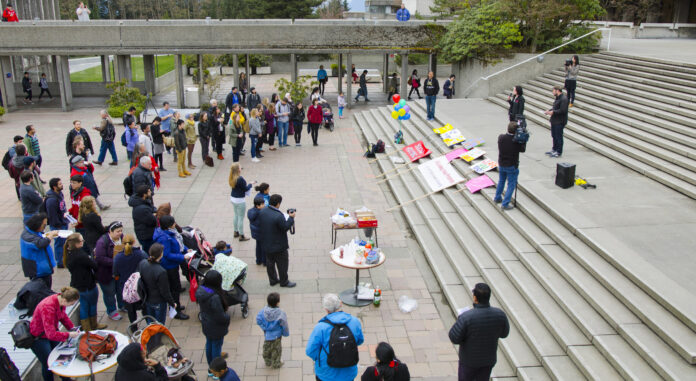
Students, staff, and community members gathered in Freedom Square for the rally. – Talha Qadir
“Hey hey, ho ho, we don’t want to go!”
Shouts echoed across Freedom Square on SFU’s Burnaby Campus on Wednesday, March 18, as students, families, and supporters rallied in protest of the impending eviction of the residents of Louis Riel House (LRH). No representatives from the university were present.
SFU authorities announced on March 7 their decision to close the oldest residence on campus, effective as of August this year. SFU has condemned the building due to structural issues and health concerns associated with black mould.
Amid signs marked “We don’t want to change our school” and “Keep your promise SFU,” attendees gathered to listen to concerned residents share their stories from the steps of the AQ.
A current SFU student and resident of LRH, Teresa Dettling, told those in attendance that the residents would not be leaving quietly. “We want to save our community,” she announced to onlookers. “We want to be able to be moved across the campus to affordable housing. And we want in the future for SFU to include affordable low-income housing for students so that students from all different backgrounds can come to university and pursue their educational goals.”
For the past month, residents have been collecting signatures to petition the university to ensure that “all the current and future low-income families and graduate students in Louis Riel House are provided with appropriate housing on the SFU Burnaby campus.”
Nevertheless, the university website states that they “cannot guarantee that current residents will be able to find alternative housing within the same price range.”
Ten speakers shared their stories with the audience, including international student Shenwei Huang, who is pursuing his PhD in computer science.
“We feel we are abandoned,” stated Huang. “The university decided to close the building, but they don’t have a plan, they don’t have a considered plan in advance, to finance alternative, affordable, on-campus or near-campus buildings.”
He continued, stating that it was antithetical that SFU was “demanding their students to engage the world without considering their basic needs [such as] a safe home, affordable home, financial sustainability, and emotional support.”
Mai Abdelmoaty, whose husband is finishing his PhD in electrical engineering at SFU, reflected on the difficulties of the past month. “It [is] very hard, the stress that we’re going through,” she said. “They [SFU] only care that they don’t call it eviction, but it’s eviction. If you don’t ask us or consult us, it’s eviction.”
The rally lasted over an hour and a half, with more than 200 people joining in during the event. The group plans to continue demanding that SFU rehouse all the residents of LRH on the mountain at the same rents that they are currently paying, and that they replace the housing lost due to the building’s closure.
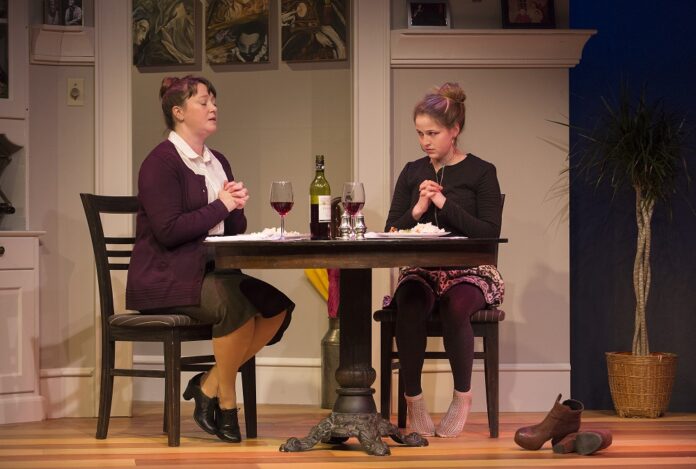
We all have our own personal belief system that guides us, gives us hope, and helps us navigate our lives. Judy (Jenny Wasko-Paterson), chose a lifestyle of celibacy and devotion to God as a nun, and her faith does not waver — until her past comes to visit.
While the subject matter of Catholicism may be alienating to audiences, I found the underlying themes strong enough that the characters shone through the framework.
Photo courtesy of David Cooper.
Essentially, this is a story about identity, doubt, and regret. Judy is forced to reevaluate her choices and think about the path she chose in life, as her friend and fellow professor Frank begins to question his faith as well.
Frank (Mike Wasko), who has been a priest since he was 18, begins to wonder if celibacy is natural and yearns for personal connection and love with another human being.
It was a treat to see the chemistry between this husband-and-wife acting duo, as Frank and Judy shared a drink in Judy’s office for “Scotch Friday.” Frank confides in Judy and confesses that he knows there is more than friendship between them, but Judy remains steadfast in her determination to be a good nun.
Coupled with Frank’s questioning of his faith is Judy’s relationship with Ruth (Lili Beaudoin), a new student who shares her views about the Christ myth and its relation to Greek mythology. The two debate the topic fiercely, and it turns out that convincing Judy of her views is not Ruth’s only motive.
Shawn Macdonald’s play, which he describes as “a love story,” may be about struggling with the Catholic faith on the surface, but at its heart is a powerful story about the experience of questioning everything you believe in.
Sister Judy will be presented by the Arts Club Theatre Company on their Revue Stage from February 26 to March 21. For more information, visit artsclub.com.
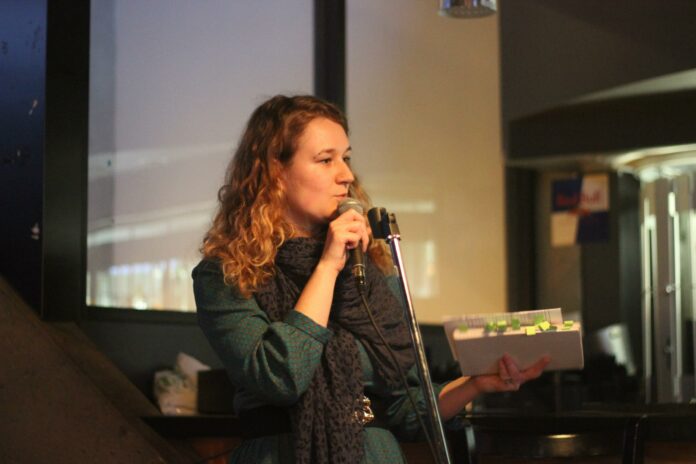
At the SFU Highland Pub last week, the English Student Union (ESU) held their second Grand Poetry Slam as a follow-up to their successful event held during the fall semester.
As an improvement on the first poetry slam event, the event now featured celebrity judges, including The Peak’s own sports editor, Austin Cozicar. The other two judges were Tiffany Werth, an associate professor of English, and Ryan Fitzpatrick, a local poet pursuing his doctoral degree at SFU.
The event included 16 participants with a few last-minute additions, double the participants of the previous slam. Each performed their own spoken word poetry, with some opting to do two pieces.
Of those participants, some alumni and non-SFU students even performed, and were warmly welcomed by the audience and participating poets.
The organizers kicked off the event with their own poetry. Both Hussan Riasat, ESU president, and event coordinator Sophia Kreuzkamp performed during the event with their own humorous poems. ““You’ll Cowards Don’t Even Smoke Crack” [performed by Tyler Knoll and written by Viper] was a specific [highlight],” commented Cozicar about the comedic performance by the ESU vice president.
Throughout the night, the audience was entertained by the variety of poems performed, which ranged from brief to lengthy and from light to more serious topics. At the end of the competition portion of the night, guest judge Ryan Fitzpatrick performed some of his own poetry, including the pieces “Falsified” and “White Excellence.”
Despite the addition of judges, the event itself sported a very positive and supportive atmosphere for competitors throughout the night. With free drinks provided, the event itself evolved into a social gathering as the audience offered support all of the poets, providing snaps to them when needed and showering each one with applause.
Participating poet Yvette Rancourt commented, “I really enjoyed the atmosphere. I thought the space and the set-up turned out well — it felt cosy and the audience was very positive.”
Riasat attributes the positivity to the diverse appeal of slam poetry. “People aren’t just seeing it for purely the poems, but also the fun and social aspect of it,” he said. “It’s an overall positive environment for people who want to come and share or just enjoy the spoken word.”
Prizes were awarded at the end of the night after the judges tallied up their scores. Last-minute addition Dylan Hughes won third place and a $20 gift card to Renaissance Cafe, Ruramai Munyanyi won second place and a $30 gift card to the Highland Pub, and Jordyn Vanstone won first place with a $50 gift card to the SFU Bookstore.
“Their poems were not only passionate, but were recited very well on the technical side of things,” added Riasat. Overall, the night allowed many SFU student to show off their talent, which for the judges was what the event truly was about.
“The highlight of the night was watching people perform, put [themselves] out there, [and] put their own creative works out there,” concluded Cozicar.
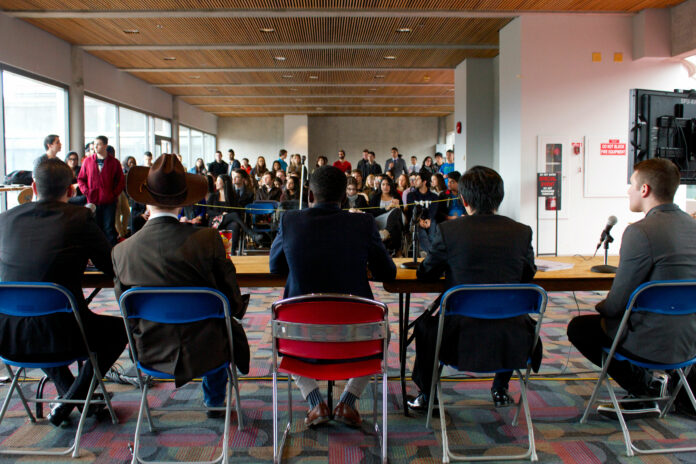
The five presidential candidates sat before an audience of over 100 students and staff. – Leah Bjornson
Described by one audience member as an “emotional rollercoaster,” the Burnaby debates saw tensions reach an all-time high as executive candidates battled it out for the student vote.
With topics ranging from timesheets to accountability to Madonna, the candidates debated for almost six hours in the West Mall Atrium yesterday in front of a crowd that reached over 100 spectators by the presidential debates.
After a relatively cordial debate between the VP University Relations candidates, the VP Student Life candidates took the stage. Almost immediately, candidate Deepak Sharma asked his opponent, Hassan Liaquat, why he thought he was the best candidate considering his perceived lack of knowledge. Liaquat responded, “I’ve done my research, I know how to represent students.”
Sharma’s comments elicited a response from the audience, too, when one student asked him to what he attributed his arrogance, and why he was criticizing Liaquat rather than talking about his own work.
As they had done all week, the VP External Relations candidates remained respectful and friendly as they debated issues to do with transit, government lobbying, and communication. Candidate Arjan Mundy reiterated that he has the utmost respect for his fellow candidates: “There is no wrong choice here.”
Candidates debated topics ranging from timesheets to accountability to Madonna.
In his closing statement, candidate Karan Thukral removed his hoodie to reveal that he was wearing a shirt signed by SFU students who had concerns about the society — a statement the audience greeted with applause.
Issues related to communication were discussed during the VP Student Services debate. Both candidates, Shery Alam and Darwin Binesh, raised their concerns that the SFSS does not effectively communicate with the membership. Binesh stated, “It’s 2015 and we push paper. A lot of paper. It’s absurd!”
The mood was lightened when Presidential candidate Erik Hadekaer took the mic to ask the candidates how they would support his Taco Tuesday platform should they be elected, stirring a wave of #tacotalk comments on social media.
Karan Thakur and Barbara Szymczyk were up next for the VP Finance candidate debate. Both explained how they planned to make “money talk” easy for non-business students. Szymczyk said she would like to use the multimedia platform SFSS Shorts to communicate SFSS financial info, while Thakur stated that he would rather meet with students directly.
By the time the five presidential candidates took their seats at the debate table, the Atrium was full of students, with lines of students with questions for the candidates forming down the aisles. The debate began in a professional tone, with candidates discussing the importance of student advocacy, governance reform, and teamwork, but quickly turned personal.
Hadekaer asked candidate Zied Masmoudi about his timesheets from his past term as the VP Student Services, stating that he had spent almost 800 hours on the concert events alone. Masmoudi responded that he had spent a lot of time on the events, but consistently did work beyond what he recorded. “My timesheets do not reflect most of the work I do,” he stated.
One of the highlights came when a young girl who identified herself as a “future SFU student” asked the candidates what legacy they planned to leave behind for her. Candidate Johnny Aether replied that he wanted to take the society back to its “radical roots” and increase its advocacy efforts.
The mood in the room shifted when current SFSS Business Representative Shadnam Khan accused candidate Kayode Fatoba, who is also the current VP Student Life, of billing for meetings he had missed. Khan then tweeted out pictures of Fatoba’s timesheets and the meeting minutes, which showed that he had been absent.
Fatoba replied that he receives a volunteer stipend for extensive volunteer work, and may not always record it diligently.
Another member then accused Fatoba of promoting his professional startup through the SFSS website, citing the SFU’s Got Talent splashpage as an example of where Fatoba had linked to his own site. Fatoba responded that he did so because his company had assisted with the event.
Two more students — SASS president, Dion Chong, and Chief Electoral Officer, Oscar Sanchez — then asked Fatoba what the staff could expect from him as president, given his “history of disrespecting staff” and his election infraction, which as of the Burnaby debate totalled $190.
Fatoba responded that he had always put the interests of students first, and that this might have led him to disregard rules.
The emotions continued when Aether discussed his personal struggles as an SFU student, which had left him feeling isolated early into his university career. He received two rounds of applause from the audience.
Fatoba was also visibly upset: “I’m not here because I want to. I’m here because other people believed in me.”
At this point, Hadekaer interrupted with some timely levity: “My bum’s getting sore.” Candidate Enoch Weng proceeded to ask everyone to stand up and lead the candidates and audience members in a quick stretch.
Closing statements shortly followed, with the debate closing at approximately 6:15 p.m. Executive candidates will have a final opportunity to answer questions from SFU students on Friday at 1 p.m. during The Peak’s Twitter Townhall.
In the third debate this week, Executive candidates for the 2015 Simon Fraser Student Society (SFSS) General Elections battled it out at SFU’s Harbour Centre campus. There were so many amazing moments, we couldn’t just settle for 10! So, here are the 24 most noteworthy moments from the online debate conversation.
1. When we considered starting a drinking game with all of the buzzwords.
The first “engage” of the day has been spoken by VP UR candidate Ali Najaf in his opening statement. Take a drink. #electSFSS#burndebate
Candidates and a few attendees gathered in a small lecture hall in Harbour Centre yesterday to participate in the second all-candidates debate of the 2015 SFSS general elections.
After the first few candidates debated, it became clear by the varying level of applause that different slates had set up camp on opposite ends of the room.
The first of the executive positions discussed was VP University Relations. Brady Wallace (REAL) spoke to different student issues that would require liaising with the university, such as the closure of Louis Riel House. His opponent, Ali Najaf (SCHOOL SPIRIT), declined to comment as he has been working with SFU Residence and Housing on this issue.
VP External Relations candidates spoke about how they intend to advocate for and reach out to students, the merits of mailing lists, as well as how they would approach sponsorship. Arjun Mundy acknowledged the capability of his fellow candidates present, saying, “Anybody running for this [opportunity] would do a good job.”
Current board members then advocated for two levy-related referendum questions that would reallocate funds to grow the food bank program and to increase the society’s financial flexibility by moving more money into the general fund.
The two VP Student Life candidates discussed how to better engage council members and student groups.
During the VP Student Services debate, candidate Darwin Binesh (REAL) recognized that the society’s services are not perfect, but there are some that are used more than others that should be prioritized, such as the U-pass program. Both Binesh and Shery Alam (SCHOOL SPIRIT) stated that throwing a concert is not a part of their platform.
While the candidate participation had increased from last week’s Surrey debate, many sent in regrets, and some submitted a written statement. VP Finance candidate Karan Thakur sat alone at the table, talking about updating the society’s outdated timesheet system. “We’re not in the ‘90s,” he said.
Nearly all the presidential candidates were in attendance. Eric Hedekar (S.P.A.D.E.S. 2015) raced downtown on transit after a class on Burnaby Campus, but was ultimately too late to participate.
Johnny Aether (LAN Party) and Enoch Weng both spoke about wanting to change the negative associations students have with the SFSS. Weng asserted that the political atmosphere of the society was “alienating” to students, while Aether shared his dismay at how often he hears people use the word “hate” when discussing the society.
Kayode Fatoba (SCHOOL SPIRIT)’s platform focused on community building and furthering the efforts that he has already made. “The reason I’m running is that I don’t want all that to be in vain,” he said.
Fatoba came under fire twice during the debate when members questioned his attendance and tardiness, as well as being “disruptive” in his position as current VP Student Life. Fatoba returned that Student Life is a more “spontaneous” position, and that “The community knows my character.”
Zied Masmoudi (REAL) stressed the importance of hard work: “Inspiring people is not just about buzzwords and having people applaud you.”
He went on to say that ultimately, it’s wrong to get hung up on elections results: “It’s not a question of how many votes you got. It’s about doing your due diligence in a responsible way.”
The 2015 Simon Fraser Student Society General Elections hosted a second all-candidates debate yesterday afternoon at SFU’s Harbour Centre campus. Here are some of the most noteworthy moments from the online debate conversation.
1. When Presidential candidate Zied Masmoudi commented on the importance of putting hard work behind words.
Masmoudi: “Inspiring people is not just about buzz words and having people applaud you.” *applause* #electSFSS#vandebate
4. When candidates entertained the possibility of a split vote.
Audience question implies winning candidate may not get majority vote. So basically they’ll be Harper circa 2008. #electSFSS#vandebate — The Peak (@PeakSFU) March 17, 2015
5. When it wasn’t even about that cash money.
Mad skrilla isn’t Thakur’s motivation: “If you’re looking for money, I think you should apply for a job somewhere else.” #electSFSS
6. When current President Chardaye Bueckert loved open textbooks a lot.
Lots of shout outs for the BC Open Textbook Program and the SFSS Open Textbook Campaign at the @SFSS1 Election Debates! Awesome. #electSFSS — Chardaye B (@ChardayeB) March 17, 2015
7. When Wallace said he was against involving academics in the VP University Relations job. . .
Wallace on why academics are not highlighted in his platform: “The scope of the student society is not to delve into academics.” #electSFSS
Politely disagree about it not being SFSS scope to get into academics. Course access + related things that DSUs fight for. #electSFSS — Gloria Mellesmoen (@karmaglow) March 17, 2015
9. When no one knew how many petitions there were for international student tuition fees and/or the Louis Riel House closure.
Confusion abounds as to how many petitions there are for advocacy campaigns. Yang pulls out phone to look it up. #electSFSS#vandebate
10. When Presidential candidate Johnny Aether earned the respect of the whole room.
Aether: “It’s not about votes, it’s about respect. And I hope I’ve earned your respect today.” #electSFSS#vandebate — The Peak (@PeakSFU) March 18, 2015
SFU has ended its regular season with a pair of losses on Friday and Saturday to the Selkirk College Saints at the British Columbia Intercollegiate Hockey League (BCIHL) finals. The losses provided the Saints with their third straight BCIHL championship, and third straight sweep for the title.
The Clan entered the series with a 3–2 regular season record against the Saints.
“It was one of those situations where we were a little bit overanxious,” said SFU head coach Mark Coletta. “We had a handful of guys who played good, and then a handful of guys who just played uptight, and a little bit too nervous.”
The Clan were downed in the first game by a hat trick by Selkirk forward Ryan Edwards, who led the BCIHL playoffs in goals with six. SFU lost 3–1, despite what coach Coletta described as SFU’s most dominant stretch of hockey over the weekend in the third period. However, the Clan were badly outshot 33–15. Forward Graham Smerek had SFU’s lone goal.
SFU went into Saturday’s game hoping to extend their playoff series to three. Just under two minutes into the game, SFU defenceman Jesse Williamson took a high sticking penalty. The penalty was just about killed, when with one second left on the powerplay, Selkirk forward Thomas Hardy opened up scoring to give the Saints the early lead.
Although that was the end of the scoring in the first period, it was not the end of SFU’s woes. Forward Michael Sandor was assessed a ten-minute misconduct penalty for a hit to the head. Though he came back without incident when his 10 minutes were up, defenceman Tyler Mah was ejected from the game just a few minutes later for a hit from behind — a significant loss for the team’s blueline.
A point shot by defenceman Jared Eng tied the game for SFU. The team would control much of the second period’s play as well, outshooting Selkirk 12–10 in the period.
Two goals 30 seconds apart by the Saints near the end of the period proved a crushing blow to the Clan, and as it turned out that was all Selkirk needed to win. End of second, 3–1.
SFU pulled their goalie at the end of the third to try and claw their way back into the game, but the result was an empty netter for Selkirk.
With 20 seconds left, SFU forward and first-round hero Adam Callegari, who ended the playoffs with four goals, managed another goal for the team. But by then, it was too late — Selkirk were crowned the BCIHL champions with a 4–2 victory.
With the victory, Selkirk College became the first team in BCIHL history to win three straight championships, and are now tied with SFU and the University of Victoria for the most BCIHL championships at three.
“Overall, you can look at it as an average season for us,” coach Coletta reflected. “Your expectations are winning a championship, and if you don’t win, it’s a failure in my opinion.
“We’ve got to regroup and figure out how we win that championship.”
The 4–2 loss marked the final game in an SFU jersey for Mah, Eng, Jono Ceci, Taylor Piller, Trent Murdoch, and goalie Andrew Parent.
“Our seniors did a great job for the past four years, [but they] just couldn’t get over that hump for whatever reason,” noted Coletta.
However, he remains optimistic about the team’s future.
“I think we’ve got a good core of young guys coming back, we have a great recruiting class coming in, so I think there’s some big, big things coming up in the future, especially next year.”
Playoff Round 2, Game 2
SFU: 2 SC: 4
First Period:
SC (PPG) Thomas Hardy (2) (Vlanich, Postmus) 16:26
Second Period:
SFU Jared Eng (3) (Smerek, Piller) 16:06
SC Jamie Vlanich (2) (Hildebrand) 4:42
SC Ryan Edwards (6) (Dyck) 3:12
Third Period:
SC (EN) Ryan Procyshyn (1) (Spear) 0:46
SFU Adam Callegari (4) (N Sandor, Jang) 0:20
Shots:
SFU 25
SC 28
Goalies:
Jordan Liem (SFU): 24 Saves/ 27 Shots .889 SV%
James Prigione (SC): 23 Saves/ 25 Shots .920 SV%
Three stars: 1st: SC #71, Jamie Vlanich 1G, 1A 2nd: SC #29, James Prigione 23 Saves, .920 SV% 3rd: SC #19, Thomas Hardy 1G, 0A
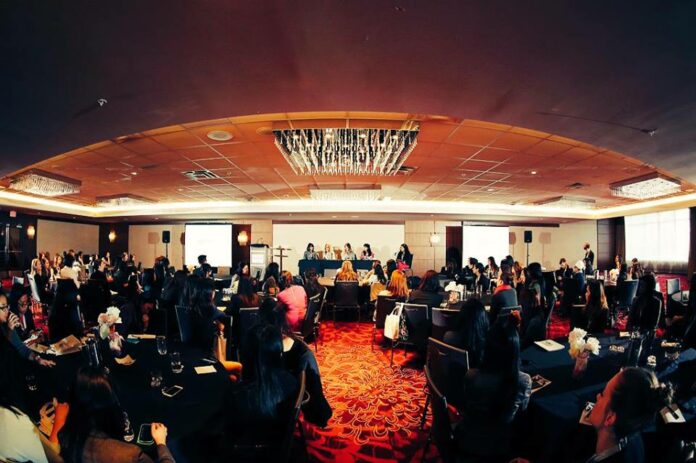
The SFU chapter of the Young Women in Business (YWiB) organization held their fifth annual International Women’s Day conference on March 7 at the Pinnacle Hotel in downtown Vancouver.
The event brought together young SFU women and men alike to connect, get involved, and take part in workshops to prepare them for their future careers.
International Women’s Day has been celebrated on March 8 of each year since 1911. The day was created to celebrate the achievements and empowerment of women around the world.
Organized by SFU student Joscelyn Tan, this year’s event brought in successful industry professionals to lead workshops and give keynote speeches for the attendees.
As stated on the YWiB SFU website, the conference was intended to celebrate women in business as well as those who will be in the future: “I find that a lot of networking events are very geared towards people who are already professionals, and [for] people who are starting out, sometimes there isn’t as much support in that area.”
YWiB SFU’s annual International Women’s Day conference provides tools and motivation from peers and mentors to allow its members to achieve professional success in their own lives, through chances to meet and learn from female heavyweights in the business industry.
Starting at 9 a.m., the conference was an all-day affair. The theme of “Make it Happen” — encouraging the proactive advancement of women — was punctuated throughout the day by keynote speakers such as Narges Nirumvala, CEO of the speech coaching service, ExecutiveSpeak, and Leah Jeannette Boyle, founder and director of The Lipstick Project, which offers free spa treatments to people with serious health issues.
Speeches and workshop were set up for attendees to learn from women who have come before them, gaining advice on aspects of the business world such as appropriate clothing for different environments and how to hone leadership skills. The aim was to provide the skills necessary for attendees to embody the theme of the conference, and make it happen for themselves.
The day began with an exhibition of local businesses and organizations, such as The Lipstick Project and Sole Girls, where attendees mingled in the foyer before being ushered into the conference room for the opening address and the first keynote speaker, Nirumvala.
Nirumvala urged guests to aim for excellence through impacting others. Her speech focused on her own personal story of being fired from her job and almost filing for welfare. Through her failure, she managed to discover her true talents, and soon became a public speaker and published writer, working with nationally renowned companies.
When asked what she wanted to impart to the young women listening to her speech, Nirumvala said, “Failure: that’s where the learning is.”
She continued, “I want people to learn from my growth.”
Following Nirumvala’s speech, attendees were broken up into smaller groups and led to the first of two of their selected workshops. Lunch broke up the day, with another chance to network with other young attendees and professionals alike.
The second keynote speaker, Boyle, took to the podium after the conclusion of the second workshop of the day, leading the conference into its final hour.
According to Tan, the conference was meant to be a place to establish connections between peers and friends and build a support system.
This system is what she believes will allow each young woman to find success. “As a soon-to-be young professional in the workforce, I’m not alone,” said Tan.