Industrial workers often have to trust their equipment with their life.
- Talha Qadir
Industrial workers often have to trust their equipment with their life. – Talha Qadir
If you’re going to be hanging off any large structures in the near future, you might want to make sure that your safety gear holds up under pressure.
Carolyn Sparrey, an SFU professor of Mechatronics Systems Engineering, in partnership with JADE Engineers Inc., has examined how energy absorbing lanyards — pieces that connect safety harnesses to structures in many industrial workplaces — uphold their safety features after various types of wear and tear.
Sparrey spoke to the impact her research could have in helping to prevent workplace injury. She told The Peak, “To those working in the field, [lanyards are] their lifeline. It’s the thing that could ultimately save their lives in the case of a fall.”
The study used drop tests conducted at a brand new facility, developed along with BCIT. Sparrey explained that the drop tower setup “is the first of its kind in western Canada that is not at a private company.”
The researchers looked at how various types of damage could affect the performance of the lanyards. The team exposed lanyard to environmental conditions such as cool temperature and precipitation, as well as to damage from cuts. The tests, Sparrey explained, showed that “pretty much their performance was consistent across the board.”
She continued, “There was no obvious effect of environmental damage on the mechanical performance. There was no obvious effect of weld damage or cuts. Even with cuts that were made 50 per cent of the way through [. . .] it still performed as it should.
“Where we did see catastrophic failure was when there was heat damage.”
Sparrey hypothesized that this was because, while cuts leave a functioning portion of the lanyard still intact, heat melts the fibres of the lanyard and “affect[s] the overall mechanical integrity of the system.”
She acknowledged that one of the limitations of the study was that it used a 100 kg steel mass, which doesn’t effectively demonstrate how a moving person affects the dynamic of a fall. In her next round of studies, she intends to use a crash test dummy, which she predicts will absorb part of the energy from the fall and lead to less deployment of the lanyard.
Sparrey also intends to study situations in which a lanyard might wrap itself around a beam or structure. “One of the things were looking at is how we protect against that,” she noted. “What kind of intervention or technology can we put between a lanyard and an edge or a beam so that it doesn’t result in a catastrophic failure?”
Despite these results, Sparrey is cautious of drawing definitive conclusions: “Our overall conclusion for all research is we need to do more studies.”
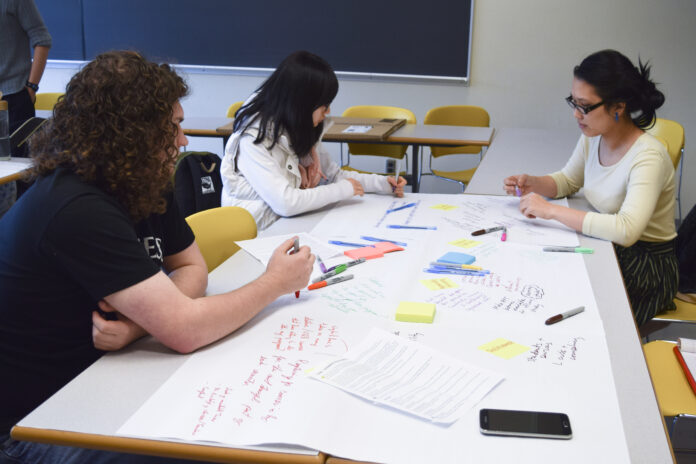
The initiative held three focus groups last week to gauge student concerns.
SFU’s Task Force on Flexible Education (TFFE) held a series of focus groups last week asking students what would improve their experience at SFU.
The TFFE created these focus groups to gather data for their research on how SFU can best meet the changing needs of university students.
Students did not hold back their criticisms of the university in last Tuesday’s session on SFU’s Burnaby campus. “We don’t have the opportunity to express our thoughts,” commented Brittany Lu, a second-year physics student.
“Why isn’t there a loan program for books?” asked Prodpran Wangcherdchuwong, a second-year International Studies student, citing the high cost of university textbooks.
Based on the feedback, the Task Force team has already been able to draw some preliminary conclusions.
“SFU is a highly commuter campus. A lot of students are employed or self-employed, there is a large number of English as an additional language students, [and] technology is all around us,” said project manager David Porter.
Based on this new knowledge, he continued, “We are building a set of recommendations [and] out of those recommendations there will be initiatives that will move forward.”
In the three focus groups held on campus, each involving 10 to 20 students, participants were asked their top three concerns and were given the chance to offer written feedback throughout the session.
“Registering for courses is by far the most stressful time of the semester,” said Caden Knudson, a fourth-year business student. “Why do I have to take so many elective and WQB requirements that have nothing to do with my program?”
Porter explained that “students are asking for programs that would allow them to really consider employment as part of their reason for being at the institution, they are looking for a much more practical environment.”
Wangcherdchuwong emphasized the need for opportunities for students to engage in skill-based learning. “If the business students have it, why can’t [the social sciences] have it?” she posited.
Students also voiced concerns about campus spaces, support systems, and online resources, including SFU Canvas.
The TTFE has already released a discussion paper on textbook costs and recommended that online or open textbook options should be considered more seriously. This supports the findings of a SFU Bookstore survey in 2014, which stated that 76 per cent of students think that textbook costs are too high.
Porter said SFU is looking to ultimately find “design programs that better meet student needs, what kinds of teaching approaches could we try, [how can we] use technology effectively, how can we empower students to make better academic decisions themselves, and what kinds of learning spaces could we create around campus.”
The focus group has only engaged a small number for students thus far and has collected limited data on student concerns. “If these focus groups are successful, it is just the beginning. It is clear that we need more student input,” said Porter.
Although only in her first year, Michelle Waters is already one of the star golfers on the women’s golf team. Photo courtesy of Michelle Waters.
Although only in her first year, Michelle Waters is already one of the star golfers on the women’s golf team. Photo courtesy of Michelle Waters.
One reason golf is such a challenging sport is the emphasis on the mental game. Although the physical fundamentals are certainly important — and a challenge in their own right — the most important aspect of golf is keeping your head in the game: not getting too flustered when you hit a bad shot and not getting ahead of yourself when you’re shooting well. This is something freshman Michelle Waters knows all too well.
“It’s really about what’s going on between your ears,” she notes.
“Unlike high-impact sports like basketball or soccer, you can’t lash out when you’re on the golf course, and my biggest challenge is getting too up or down on myself. I’ve learned to maintain a level head,” Michelle says. “My dad used to say to me that ‘if you hate golf, golf hates you’. That is something that has always stuck with me.”
Michelle is quickly becoming one of the Clan’s top golfers in the program this season. But she can still recall a time when she’d rather be at the driving range than the course.
“I didn’t enjoy tournaments in the beginning,” she laughs. “I was terrible when I started, and wanted to get better.”
Early success in the sport inspired Michelle to take an interest in golf that she had never had with any other sport.
”Golf was the first sport [where] I applied myself, and by my third tournament I broke 80 for the first time. The opportunity for success in a women’s sport was better in golf than basketball and soccer for me.”
It didn’t hurt that Michelle landed a job at a golf course via a family connection at 14 — a job that allowed her to golf for free.
“A year later, I was playing competitively,” she notes.
Hailing from Qualicum Beach, a small town on Vancouver Island, Michelle’s early success with at SFU speaks volumes to her ability to adapt, as she moved out on her own for the first time. Though home isn’t too far away, she does admit that it can be difficult: “Being away from home is tough. The combination of living on your own and new sense of freedom are new to me.”
Michelle is proud of her adjustment to SFU, and her desire to achieve a high level of success in every facet of her life has fueled her ambitious goals for the future.
“My goal this year is to travel to all the tournaments, while averaging a score of 78, all while balancing my schedule at SFU,” she explains without hesitation. “I want to see the SFU women’s golf team become more of a force, make a name for myself, and ultimately have a lasting impact legacy on the program.
“If it works out, I would like to maybe take a shot at professional golf. It’s not set in stone, but for me to get there I [need to] play scratch golf.”
If Michelle can break 80 by her third tournament, becoming a scratch golfer is definitely something achievable.
Joining two other freshmen on the team, Michelle is part of a young nucleus who plan on taking the women’s golf team to the next level. In the recent Vikes Shootout in Victoria, it was the freshmen that led the team to a third place finish. Michelle also led the team at the Pioneer Shootout in California to a 10th place finish, with a team-low round of 77 for a two-day stroke total of 158.
Michelle acknowledges that the nerves never quite go away — she just has to play through them.
“Usually before a tournament I’m a little anxious, and I’ll try to calm myself down my hitting shots on the range and whatnot. But it doesn’t really go away until after the first swing of the day that counts towards the score,” Michelle admits.
“There’s no real method to the madness, I just have to remind myself that every shot counts and to keep calm, because there’s no redos in golf. From that point on, I just try to take everything in stride.”
FUN FACT: Best Round Ever:
“My best score is one over on a par 70 at a course called Qualicum Beach Memorial, I was playing in a one day Zone Six Junior Summer Tour Event. It’s a nine-hole course where I went 34 and 37 for a total of 71. Except I was a little peeved after the round because I lost by two shots, so when we were checking scores I accidently signed for a 72. That’s a mistake you only ever make once.”
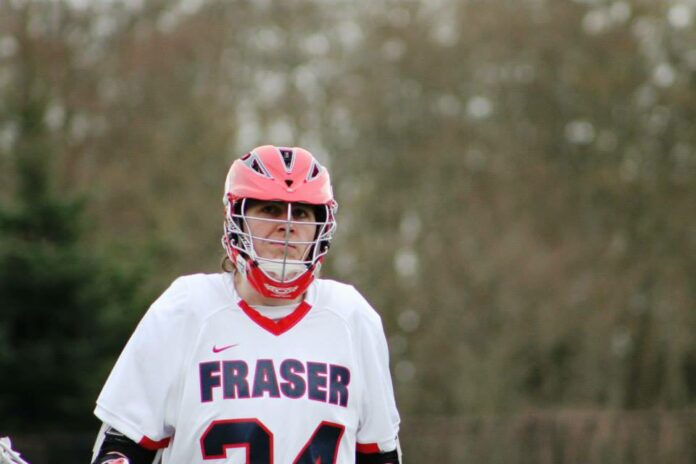
An injured Clan lacrosse team executed a huge fourth quarter rally to top longtime conference rival University of Washington Huskies 13–8 on Terry Fox Field.The win brings the Clan to 4–0 in the conference and 6–4 on the season.
The team was missing attacker Lyndon Knuttila, who is tied for second on the team for goal scoring, as well as defencemen Alex Thomson, Cameron Chisholm, and FOS James Irwin. Attacker Tyler Kirkby, who led the entire Men’s Collegiate Lacrosse Association in goals last season with 65, and defenceman Michael Vandenbossche are also out for the season, having not played a single game.
Senior midfielder Sam Clare opened the game’s scoring in the first minute with a beautiful cut across the top and a hard outside shot to give the Clan the early lead — his first of two. The Clan finished the quarter up 3–1.
The team struggled for the next two quarters; they scored no goals in the second and were outscored 4–3 in the third. SFU headed into the final frame tied at six.
With one quarter left, a fire seemed to be lit somewhere in the tired Clan squad, going on a seven-goal tear while only giving up two to end the game with a final score of 13–8.
“After jumping out to an early lead, our effort stalled a bit in the second and third quarters, but we were able to get back on track and close out the game down the stretch,” said head coach Brent Hoskins. “This was an important win to lock up a playoff spot and prepare for another challenging stretch on the back half of our schedule.”
Leading the way for the Clan was freshman attacker Greg Lunde with three goals and two assists.
Sophomore Jeremy Lashar stood between the pipes for the full 60 minutes, stopping 12 of 20 shots for a save percentage of .600. Clare (26G, 10A) moves into the third spot in the conference and ninth in the league for scoring, and Lunde (19G, 16A) moves into the fourth spot in the conference and 11th in the country.
The Clan now enters the second half of their season, with a weekend off before traveling to Oregon to take on Caly Poly and conference archrival Oregon, then to Utah to take on Brigham Young University and the University of Utah. They finish off the season at home taking on conference favourite Oregon State and Montana before the Pacific Northwest Collegiate Lacrosse League playoffs at the beginning of May.
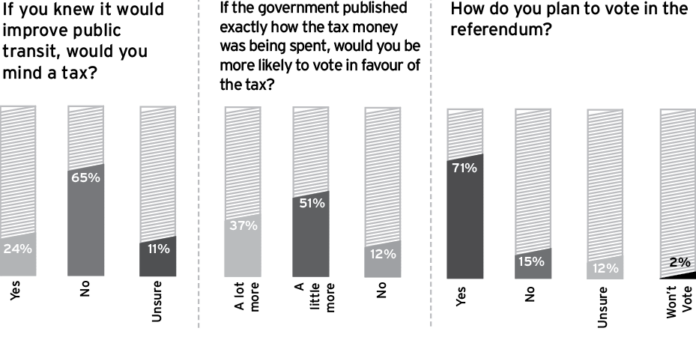
71 per cent of respondents said that they planned to vote ‘yes’ on the upcoming referendum. - Phoebe Lim
71 per cent of respondents said that they planned to vote ‘yes’ on the upcoming referendum. – Phoebe Lim
This spring, Metro Vancouver residents cast their ballots on an issue that may leave lasting changes on the public transit scene.
The vote on the Metro Vancouver Congestion Improvement Tax will gauge public opinion on a new plan to fund the development of public transit improvements that includes light rail in Surrey in Langley, increased bus service, a new Pattullo Bridge, and extending the Millennium Line SkyTrain to Arbutus Street.
The ballots, accepted until May 29, will read “Do you support a new 0.5% Metro Vancouver Congestion Improvement Tax, to be dedicated to the Mayors’ Transportation and Transit Plan?”
However, critics of the new proposal are concerned that the money might not be managed properly. There are pervasive complaints about the Compass Card fare validation system that was introduced to curb fare evasion, but has so far cost nearly double the money originally stated. The system was slated for operation in spring 2013, but has since met many delays.
A recent poll by the Angus Reid Institute showed that the ‘no’ side of the campaign was in the lead, with 61 per cent against the new tax versus only 27 on the ‘yes’ side.
The Peak posted a survey online for SFU students, staff, and alumni, and 80 respondents offered their opinion.
The attitude of those surveyed was generally pro-public transit, with 65 per cent not minding a new transit tax if it would definitely benefit public transit.
Further, 88 per cent responded that they were more likely to vote yes if the government published a faithful audit of government spending on public transit. Earlier in March, business tycoon Jim Pattison was announced to lead a public accountability committee, but transparency and accountability remain a hot-button issue.
Last, in contrast with the Angus Reid poll, 71 per cent of respondents said that they planned to vote ‘yes’ on the upcoming referendum.
While SFU students have vocalized their dissatisfaction of the transit service to campus, it seems that so long as it’s done properly, they are willing to pay a little extra for their ride up the mountain.
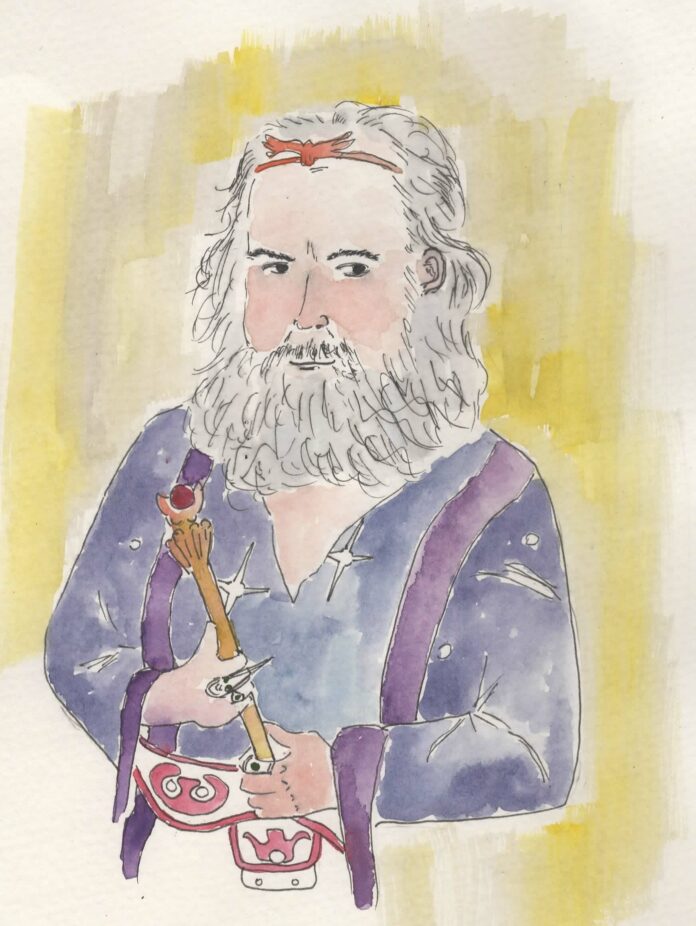
A self-described wizard and founder of the neopagan religious movement the Church of All Worlds, Oberon Zell-Ravenheart has been involved with neopaganism since its beginnings in the ‘60s. He is the editor of neopagan magazine Green Egg and is also headmaster of Grey School of Wizardry, a Hogwarts-style institution dedicated to training students in the magical arts.
Based out of Sonoma County in California, this fascinating institution has captured the hearts and minds of many interested in the topic of magic — or “magick,” as Zell-Ravenheart refers to it.
The Peak spoke to Zell-Ravenheart to learn more about how he became involved with magick and what people have to say about his school of wizardry.
Interview has been edited and condensed for print.
The Peak: For the magically uninformed, what is the essence of magick? What is its source? And how does one start to become a wizard or witch?
Zell-Ravenheart: In its essence, magick is probability control through non-material means. Wizardry means wisdom, and wisdom can be summed up through considering the consequences. The function of who we identify as a wizard is someone who knows something others don’t know and someone who is wise. A professor or philosopher is the most comparable thing to a wizard today.
P: When did you first develop an interest in the arcane arts and begin on the path to becoming a wizard?
ZR: My interest has been lifelong and my first readings on the subject as a child were the Greek myths. This interested me in both theology and mythology and this led into an interest in fantasy. I noticed the recurrence of the wizard in these stories. I became further interested in superpowers and psychic abilities. Professor Xavier from X-Men was my archetype when I founded the school.
P: Does one need to be a Neopagan to be a wizard, or is magick something that connects multiple different cultures and religions?
ZR: Magick is universal and you don’t need to be a pagan to be a wizard; a wizard is not like a priest. The founders of all religions are all identified as great wizards and were referred to that way by many people. I am a pagan; that’s just my religion, but in the Grey School we have Christians, Jews, and Sufi Muslims.
P: What do you have to say to critics of the Grey School of Wizardry or the Church of All Worlds, who may see it as a commercial scheme or as an attempt to create some sort of reality out of what many consider to be fantasy?
ZR: We charge very little and we only charge for what we need. Harry Potter makes more money than we do. The popularity of that series gives people a handle to understand what we are doing.
P: You’ve spent a fair amount of time searching for what are considered by many to be mythical creatures. What types of fantastic creatures have you encountered in your journeys as a wizard?
ZR: I was the one who rediscovered the lost secret of the unicorn. I raised unicorns and exhibited them; they were real creatures in ancient times and we recreated them. We made a four-year exhibition license with the Ringling Brothers Circus to exhibit them. We also went searching for mermaids in New Guinea. I do a column and blog every three months called Creature of the Month.
P: How often do you receive comparisons to Dumbledore and Gandalf? Of the two, which wizard do you prefer or feel much more of a connection to?
ZR: I get that comparison quite a lot. I get more connections with Dumbledore as a headmaster of a school of wizardry. For most of my life, I have identified with Gandalf.
P: Finally, what is a basic spell or magical ability you can teach me right now over Skype that I can do to gain a basis in magick?
ZR: The most universal spell everyone does at least once a year is the birthday wish, where you make a wish. Most of spellwork is making a wish through intention and you don’t want to screw up what you want to say. You want a spell for love, you want it on a Friday dedicated to Frigga the Goddess of Love. If you want a spell for gold, you light it on Monday and you state your intention and you burn the candle while meditating. These are the ways you activate a spell. It gets more elaborate as you bring in more associations.
To learn more about the very real Oberon Zell-Ravenheart, check out his website: http://www.oberonzell.com/
Guys, I’m tired of being discriminated against. They jeer, they taunt, they look at me like I’m some sub-human. But I’m not. I’m a real person with real feelings who’s fed up with being victimized and singled out just because I’m a bandwagon sports fan.
Sports fans like to look down on the bandwagoners: the fans who become fans only once a team gets really good — or, in my case, a fan who jumps teams because of one superstar player.
My bandwagon? LeBron James.
I love basketball. In fact, I was utterly convinced at the age of nine that despite my 5’6” father’s stature, I would become the greatest point guard that ever lived. Legend says that back in the days of jousting contests, damsels-in-distress and cowboy duels, a team by the name of the Grizzlies used to play for Vancouver. Alas, they were long gone by the time I came of age.
So, instead of rooting for my home city, I began to root for a boy from Akron, Ohio who had just finished high school and was ready to take on the world. I liked him. I liked his story. I liked his mentality and I liked his vulnerability. So after seeing him play his first game in 2003, I decided that wherever LeBron played, I would cheer.
Is that so wrong?
I was desperate to feel that deep connection and passion to the game that true NBA fanatics felt. But with no hometown to cheer for and no roots in any other city, I chose a player to support. Not as callous and cold a decision as you thought, eh?
In fact, I’d argue that my bandwagoning ways are in some ways more legitimate than others’ decision to support a particular team. After all, players have personality. You grow to understand them, hate them, love them, and genuinely care about them. You stick by their side through thick and thin, and defend their honour in the face of relentless criticism, and that takes loyalty.
Teams? Well, teams change. Coaches get fired. Players get traded. The only constant are the superficial mascots and jersey colours, and even those change occasionally.
My buddy is a Kobe Bryant fan, and he also happens to be an asshole. (I’m not surprised.) But we share one thing in common. The other day, he told me how scared he was that Kobe would retire — that a part of his childhood will vanish, along with his love for the game.
That doesn’t sound like a superficial connection to me. That sounds human.
On March 17, Woodward’s campus once again opened its doors to a lecture series on Aboriginal issues. Titled “First Nations Innovation and Decolonization using ICT,” the lecture explored how Aboriginal peoples are using new media technologies, and how this could potentially support decolonization process. The speakers also discussed the relationship between policies, governance, and organizational structures within Indigenous technologies development.
Surrey
Surrey Campus invited everyone to the screening of the documentary Directly Affected on March 19. The film features those living near and affected by the Kinder Morgan pipeline extension plan. Followed by an expert panel, the screening was meant to give voice to the people directly affected by the events.
Harbour Centre
Wednesday March 18 featured an hour-long Lunch Poems session at SFU Vancouver. It introduced Erín Moure, a translator of poetry from many different languages and a poet with passion for social issues, and Andrew McEwan, an established author with a unique take on poetry involving the use of SCII binary code for letters.
*Please note that the followings represents the views of some of The Peak staff and do not reflect the views of the Peak Publications Society.
The Peak’s editorial staff submitted votes for their preferred executive candidates for the 2015 SFSS elections. After tallying the results and hearing various opinions, we have selected the following candidates, who we collectively feel are best suited for the positions.
President:
Our pick: Zied Masmoudi
This year, we have five excellent and unique candidates running for the position of President
Johnny Aether was honest and respectful throughout the debates, but his lack of experience was a dealbreaker. Although Kayode Fatoba has a year of board experience as VP Student Life, some remain unsure whether he has the skills to manage the society. Fatoba’s relationship with current staff and board members and his $190 worth of campaign infractions were red flags.
Our runners-up were Enoch Weng and Erik Hadekaer, tied with three votes each out of 12. Weng is intelligent, friendly, and seems to have connections with many students, including those in the rotunda groups. Nevertheless, his optimism has also been perceived as naivete, and he seems to lack tangible SFSS experience.
Hadekaer is a joke candidate, except that he’s not. Beyond promises of ponies and Taco Tuesdays, Hadekaer has plenty of experience with student organizations and a calm, steady voice that would suit the leader of the board. His maturity would totally benefit him in the position, and his ideas around restructuring the work of the society to make it more efficient are great. The guy’s a radical, but in the best way.
Ultimately, though, the votes fell in Zied Masmoudi’s favour. As the current VP Student Services, Masmoudi has been an integral member of the SFSS and knows what it takes to ensure the society functions. He communicates his plans with clarity and confidence, and understands the limitations of the position. Although he may lack the charm of some of his fellow candidates, his experience and accomplishments speak for themselves.
VP Student Services:
Our pick: Darwin Binesh
Since the top priority for the VP Student Services is to ensure that services such as the health plan, transit, and food and beverage services operate smoothly, we chose the candidate with the most knowledge of society matters and student needs.
Most of the staff approved of Darwin Binesh. Speaking concisely and respectfully, his experience on the board this year worked to his advantage during debates.
Competitor Shery Alam lost some of the editors’ confidence when he asserted that all services are equally important, rather than prioritizing services that are more widely used by students. In contrast, Binesh highlighted the importance of ensuring the future of the U-Pass as we transition to the Compass Card.
Alam’s platform included bringing back the night line, a 24-hour confidential crisis line, and emphasized an appreciation for student feedback.
Binesh, on the other hand, wants to bring us into the “information age,” with a digital database of the society’s membership. He already has our vote, but we’d be even more impressed if he agreed to return to his former, ’90s-style hairstyle.
VP External Relations:
Our pick: Kathleen Yang
The VP External Relations race is probably the most competitive of the entire election.
Karan Thukral, a fourth-year business student, has got some excellent business credentials. Blossom Malhan has an extensive political academic background, having worked with BC Youth Parliament and a plethora of SFU clubs and events.
Arjan Mundy was our runner-up. He’s a likeable guy who seems truly dedicated to bringing together a strong community. His claim to “support innovation, engage community, and improve communication” is not hard to believe given his experience as president of SFU’s Tau Kappa Epsilon.
But Kathleen Yang wins due to her clear vision on where to focus her attention in the position. We noted her advocacy work and plan to involve herself with other universities’ board meetings to ensure that SFU is up-to-date on recent issues — something that we haven’t seen for quite a while. Yang knows who needs to be lobbied and where to find the important resources.
VP Student Life:
Our pick: Deepak Sharma
Have you seen Deepak Sharma’s smile? But it’s not just those pearly whites — Sharma was our clear winner because of his vast experience.
Currently sitting on the board of directors as the Sciences Representative, Sharma has worked with 11 DSUs and was influential in putting the referendum question to create a Faculty Science student union on the ballot, showing that he can already navigate the intimidating processes of the student society.
Despite also having lots of event organization experience, Hassan Liaquat is a little heavy on the buzzwords. While full of ideas, his unfamiliarity with the society shows through his lack of knowledge of current projects and procedures. Though we do like the platform point of “more puppy rooms.”
At the end of the day, Sharma’s experience makes him a safe choice. He’s got a great handle on what projects are possible within the position, and how to make those projects happen.
VP Finance:
Our pick: Barbara Szymczyk
Ah, VP Finance — arguably the most thankless executive position of them all. Responsible for keeping track of the Society’s multi-million dollar finances, it takes a special kind of person to want to take on this role.
Both candidates running this year bring experience. Thakur is the current president of the SFU Entrepreneur’s Club, and he’s got plenty of business cred off-campus. He also wears the hell out of a suit.
However, many of us were turned off by Thakur’s flippancy and aggression in debates, as well as his unwillingness to send his platform to us for our elections issue. Despite his professionalism, he doesn’t seem like the right fit.
Barbara Szymczyk has more SFU-based experience, having been a Senator and an assistant for the SFU Food Bank. Her platform is also more geared to helping SFU students, noting that our money should be going to what we care about the most, and she displays a better understanding of the functions of the board.
Despite her nervousness during debates, Szymczyk is our pick.
VP University Relations:
Our pick: Brady Wallace
With the Build SFU project in trouble and the debate over international student tuition hikes going strong, it looks like the next VP University Relations will have a lot on their plate.
Joke candidate Ally Van Poa boasts a funny and incisive platform, but he lacks the necessary skills. Ali Najaf boasts an impressive list of accomplishments, including a role on the Senate, but his question-dodging in debates and unclear platform turned us off.
Our runner-up was Lia Fallah. Despite a lack of experience within SFU, Fallah boasts plenty of outside credentials, including volunteer work. She’s confident, well-spoken, and brings a lot of interesting ideas to the table, including a plan to gain formal recognition of the board from the university.
Ultimately, though, 10 of our 12 voters chose Brady Wallace as our ideal candidate. As the current FASS rep, Wallace has more experience with board. He also openly supports initiatives like the Food Bank, Open Textbook Project, and (ahem) Build SFU. He occasionally comes off as a little overenthusiastic, but there are worse things to be in this role. Wallace is our guy.
Stolen underwear found in University of Calgary residence
A security alert was issued to students living in University of Calgary’s residence due to student reporting finding misplaced underwear in their own rooms and others.
Some of the underwear they found went missing from their rooms, but they also found dozens of pairs of bras and panties that didn’t belong to them. One girl found 75 pairs of used panties in her room. Most weren’t hers, reported The Gauntlet.
Although there was no evidence of forced entry into the dorms, and campus security is unsure of what exactly happened, new locks have been installed to prevent any further intrusions or thefts.
With files from The Gauntlet
Ryerson club excludes white students from forum on racialization
Two first-year journalism students, Trevor Hewitt and Julia Knope, were asked to leave a forum hosted by Ryerson’s Racialized Students’ Collective because, being white, it was argued they were not victims of racialization.
The students planned to report on the event for a journalism assignment. A Ryerson Student Union coordinator confirmed that “members of the collective have requested a safe space on campus where they can have an open conversation.”
“If their goal in these meetings was to end racialization then it needs to be something everybody is involved in,” said Knope.
With files from The Ryersonian
Dalhousie Student Union leaves allegedly discriminatory provincial advocacy group
Dalhousie Student Union (DSU) council voted to leave and disassociate themselves from the provincial student advocacy group, Students Nova Scotia (SNS) due to “concrete evidence of systemic sexism, discrimination and unprofessional behaviour.”
Prior to the vote, DSU president alleged “the organization has a culture of racism, and that racist comments were frequently made and then ‘laughed off’ by members of SNS.”
Although in attendance, the SNS executive director was not permitted to deliver a speech he had prepared to council, and claimed that the DSU has not been a safe space for SNS supporters.