Home Blog Page 1044

Women’s basketball snap three game losing streak

0
Image Credit: Hamed Yaghoubi Shahir /The Peak

After three defeats straight on the road — a losing streak not seen by the Clan since their inaugural NCAA season in 2010-11 — the women’s basketball team won at home Thursday night.

Facing the Central Washington Wildcats, the Clan played their best game defensively, keeping the Wildcats to a mere 50 points — a season best.

“The team really showed some grit,” said head coach Bruce Langford. “I thought the best thing was [that] defensively, we’re as good as we’ve been all year.”

Despite the end result, it was the Wildcats who opened up the scoring with a three-pointer by team point leader Jasmine Parker. Initially, it looked like it might be a close game between the two teams, who shared the same number of conference wins with six each.

However, the Clan really pulled ahead by way of their shooting behind the three-point line. Two straight threes turned a measly 13–10 lead into a nine point lead — a lead that that would only balloon from there, at one point reaching 36 points.

SFU went seven for 12 behind the three-point line in the first half, only to improve to shooting nine in the second half, missing only two.

In the first half, the scoring was spread throughout the team, with guard Katie Lowen leading the team in points with 10. However, the second half more or less became the Erin Chambers show, as she put up 16 out of her 25 points in that half.

As a sign of how well SFU was playing defensively, in the second half, the Clan went 6:12 without allowing the Wildcats a single point. It should be noted that coming into this game SFU allowed on average 72.1 points per game, an average that placed them as the second-worst scoring defence in the Great Northwest Athletic Conference (GNAC).

In the closing minutes of the game, two Clan players who hadn’t seen much action — at least on the scoresheet — put up some numbers. Freshman Perrine Fuchs, who played only five minutes and only 13 previous points, threw a long range three-pointer with 1:38 left. This was her third straight game with a three-pointer.

The rest of the game would belong to Division I transfer Alisha Roberts who put up eight points in a period of 1:10.

The Wildcats would have the last two points — a buzzer beater — but not the last laugh. The Clan won by a margin of 84–50.

With the victory, SFU takes sole possession of fourth place with a record of 7–5. On Saturday, they will take on the North Nazarene Crusaders, who are currently second-last in the GNAC, along with the conference-worst scoring defence.

Chambers will have a chance of becoming second all-time in GNAC scoring, only two points behind the current second place record holder. She is only 81 points behind first place with six more games to go.

SFU

Points: 84
Field Goals: 31–58 (53.4%)
3 Pointers: 16–23 (69.6%)
Free Throws: 6–8 (75.0%)

CWU

Points: 50
Field Goals: 18–49 (36.7%)
3 Pointers: 7–18 (38.9%)
Free Throws: 7–15 (46.7%)

Player of the Game: Ellen Kett

Although she didn’t end up on top of the scoresheet, Ellen Kett’s solid defensive contributions early on no doubt helped pave the way to the Clan victory. As well, she did her part on the three point line going three for four on three point field goals.

Points: 9
Assists: 2
Rebounds (Off-Def): 0–5
 

Spring Jam artists revealed

0

The line-up has been finalized for the Simon Fraser Student Society (SFSS)’s second spring concert, the SFU Spring Jam, coming to SFU on Friday, March 20.

Performing this year will be local band Derrival, who earned second place in the 2014 Peak Performance Project. Performing alongside them will be Australian DJ duo Stafford Brothers, and a second brother act, Cash Cash, who are an electronic dance music (EDM) group from the United States.

SFSS VP student services Zied Masmoudi spoke to the significance of supporting local talent like Derrival. The group includes SFU student Deven Azevedo, who majors in environmental science and serves as a student representative on the SFU board of governors.

“I’m really happy to have this band play this time,” said Masmoudi. “It means a lot for local talent — they’re an up-and-coming band. They play very good music.”

The Stafford Brothers are well-known DJs in Australia, and Masmoudi told The Peak that they tend to bring unique elements to a show, such as over-sized bananas and inflatable kangaroos.

The final set and headliner, Cash Cash, consists of two brothers from the eastern United States. Some of their more popular tracks, such as “Take Me Home,” can be heard on local radio.

The concert will be similar in layout to the Fall Kickoff concert last semester, and will also feature a closed-off 19 plus beverage garden. Masmoudi says one difference students can expect to see is in the production quality, as the budget has been increased from previous concerts.

The overall expected cost of the concert is approximately $81,500, with almost half allocated for the talent. This will be nearly double what was spent on artists for the Fall Kickoff.

“We’re going to have better quality artists this time, and the tickets will be cheaper than in the fall,” Masmoudi said.

Similar to previous concerts, there will be an after-party following the show. He could not confirm whether or not they will have an emcee, but alluded to the possibility of “a special guest.”

Long time men’s soccer coach leaves to head the Vancouver Whitecaps FC 2

0
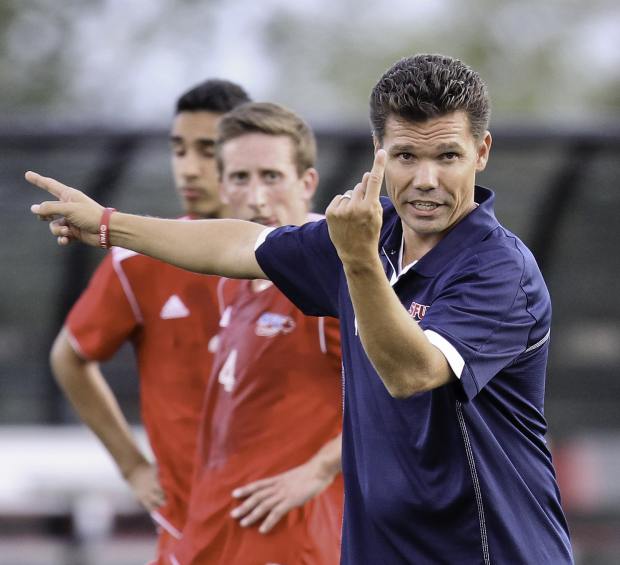
Former men's soccer head coach Alan Koch will play a large part in developing the future of the Whitecaps.

Following his years of resounding success at the helm of SFU’s men’s soccer program, it was announced Friday that head coach Alan Koch has joined Vancouver Whitecaps FC 2 — essentially a player development team for the ‘Caps — as the first head coach for their inaugural season.

The seven-year tenure as coach began in 2008, where Koch, a former member of the men’s soccer team himself, would guide the squad in its transition from NAIA play into NCAA Division II competition. Each challenge of the division was well-taken, and Koch orchestrated an undefeated season in 2011 before he took the Clan into back-to-back NCAA Division II final four finishes in 2012 and 2013.

The day after his official presentation to the media with the Whitecaps, Koch spoke with The Peak at SFU’s Terry Fox Field all dressed in his blue and white tracksuit, admittedly with a bittersweet feeling on his return to the grounds.

“I love SFU, I love everything about it,” said Koch. “It is a sad day to move on, but I will always be a proud alumni both as a student, as a coach, and as a player. I will always be around coming back to watch the guys play, that’s for sure.”

Even amidst the many congratulatory remarks of late, the native of South Africa is fully focused on his new task at hand and the hopes to achieve great things.

“It’s great to have a new job, but I’m just excited to hit the ground running and get some work done,” continued Koch. “Now I want to go out and give the team, the club, and the fans something to celebrate.”

The journey from player to coach has been a rich one for Koch, and courtship from the Vancouver-based club has been there from the get-go. An offer to play for the ‘Caps arrived immediately following his career as an SFU athlete, but Koch opted to continue his play in Ireland.  Upon his return, a partnership began with the Whitecaps, as he worked as the women’s team coach before also aiding the club as a scout.

Now with a full time commitment on the horizon, Koch believes that the coaching opportunity with the first year USL PRO (United Soccer League) team is the next best step.

“I have a lot of respect for the organization, the people that manage it, as well as [Whitecaps head coach] Carl Robinson and his technical staff — it just felt like the right decision,” he said.

For those who witnessed the matches played by the Clan under the leadership of Koch, it is clear that there will be big shoes to fill. SFU’s Director of Athletics Milt Richards echoed these feelings when he told The Peak what great qualities the coach brought to the soccer program.

“He’s a great teacher, a great mentor, and always enjoyed working with the student athletes,” said Richards. “Of course he’s exceeded expectations over the years during our transition from the NAIA into the NCAA. Thanks to him we’ve reached the top 10 level, and we will always be grateful for that.”


Seahawks snatch defeat from the jaws of victory

0
The Seahawks seemed to always to find a way to win, but on Sunday — the most important game of the year — they found a way to lose.

Seahawks coach Pete Carroll will have a lot of explaining to do.

His decision to throw the ball on second down on the one yard line, with 20 seconds to go, will go down as one of the worst play calls in the history of the NFL — he essentially threw a second straight Vince Lombardi trophy in the garbage. Rookie Malcolm Butler intercepted the pass, which led to a New England Patriots win.

This play call changed the game from a likely victory into a crushing defeat in an instant. For all the good Pete Carroll has done for the Seahawks — building them into a contender and a powerhouse in the NFL — this will probably go down as his most memorable moment, and that’s a shame.

The Seahawks should have just run the ball. Even if they didn’t get it in on that play, they could have easily taken a timeout and tried again. This would have left the Patriots with maybe two Hail Marys, and I would take those odds easily. I mean, you have arguably the best running back in the NFL on your team, a guy who has shown time and time again he can knock over opposing tacklers and go downfield. And he only needed one yard. One yard!

And even throwing the ball wasn’t necessarily a bad call — it was the play design, throwing the ball on a slant route into very tight coverage. If the coaching staff had their heart set on throwing the ball, why not run an isolation route? Get Jermaine Kearse or Chris Matthews, who were both having big games, on the outside and throw it to the far corner, and hope that one of them catches it. If the play doesn’t work, its not a big deal, as it’s an incomplete pass and the clock is stopped. Then you can run the ball. But instead, the ball was turned over and now the rest is history.

What appeared to be a storybook ending to another amazing season instead became something more akin to a twist ending to a bad horror movie. And unfortunately for Seahawks fans, I have a feeling this is the closest they are going to get to winning the Super Bowl for a long time.

Metro Vancouverites to vote on transit tax

1
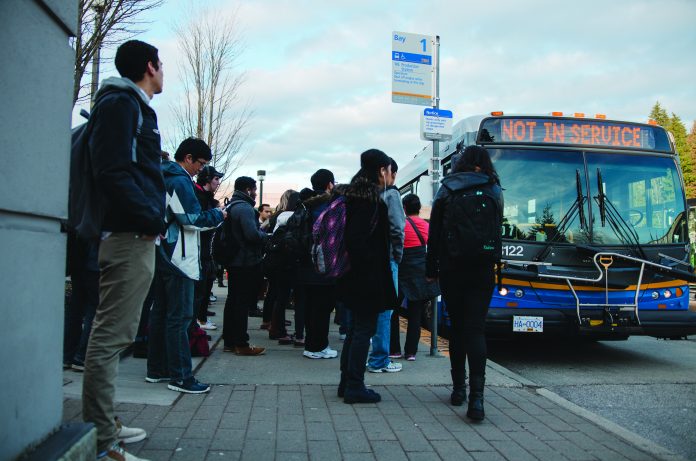
If passed, a portion of the funds will contribute to improving transit service to SFU’s campuses.

In the upcoming transit referendum, Metro Vancouver residents will have the opportunity to vote on a transit tax that would increase the Provincial Sales Tax (PST) by 0.5 per cent.

The referendum, if passed, would allow for improvements in transportation across the region.

The funding generated by the tax increase would go towards realizing the vision of the Mayors’ Council: its Transportation and Transit Plan.

The Plan includes light rail service through Surrey and the Langleys; a 25 per cent increase in bus service across the region; a 50 per cent increase in SeaBus service; and an 80 per cent increase in nightbus service.

The Plan also intends to implement 11 new B-line routes throughout the region, add rapid transit in the Broadway corridor, and replace the Pattullo Bridge between New Westminster and Surrey.

Gordon Price, a city planner and the director of SFU’s The City Program, argues that this transit tax is needed in order to help accommodate the region’s future growth in population.

It is projected that one million people will be coming to live in Metro Vancouver in the next 25–30 years. Price noted that, as of now, “the existing transportation system cannot accommodate them.”

In addition to accommodating population growth, Price sees the expansion and improvement of transportation as essential to the development of the Metro Vancouver in the areas of the economy, job creation, and sustainable growth.

“Whether you measure it in the time lost by congestion or pollution, we will pay.”

Gordon Price, SFU City Program director

He stated that there is widespread support for this transit tax, with a broad consensus among most of the mayors, city councils, businesses, the port of trade, environmental groups, community groups, and transportation advocates.

Mayor of Port Coquitlam Greg Moore explained that the plan would greatly benefit SFU students, with a new B-Line bus from downtown Vancouver connecting the Vancouver and Burnaby campuses. The plan also includes the expansion service from Surrey City Centre and at the SFU exchange in Burnaby at Production Way.

Specific to Burnaby Campus, Translink’s Executive VP, Strategic Planning and Stakeholder Relations, Bob Paddon, assured that transit going up the mountain to SFU would be improved.

If the referendum fails, Price pointed out that “we are still going to have to pay. In fact, we are going to pay to build more infrastructure to handle the growth of automobiles.”

He continued, “Whether you measure it in the time lost by congestion or pollution, we will pay.”

Price foresees cutbacks to mass transportation, which will result in the worsening of crowds on the 135 bus or buses going to Commercial/Broadway.

Opposition to the referendum is concerned that Translink will not spend the transit tax money efficiently.

The mayor of West Vancouver, Michael Smith, wrote last week in an op-ed, “Government does not have the right to ask citizens to pay more in taxes unless they can assure them that their money will be well spent.”

He continued, “Transit has been treated for too long like a political football, being kicked back and forth between the province and the region. The proposed plebiscite offers no relief from this.”

Paddon countered this by emphasizing that there will be continual audits and reports on how much money is raised and what it has been spent on.

Additionally, the referendum has been set up so that, if passed, the PST money would go into a separate fund, not in the account that handles TransLink’s general expenses.

Paddon asserted that he does not see any reason why the public should not trust TransLink, as they have been audited several times in the past, with the most recent 2012 audit having yielded a positive report.

Ballots will be sent out on March 16, and the voting period will last through to May 29.

Startup finds unusual exhibition spaces for Vancouver artists

0

Do you have your artwork hiding somewhere in the dark recesses of your dorm room? Well, it’s time for your masterpiece to be front and centre at a unique location, thanks to a new startup by an SFU entrepreneur.

Alex Dorandish, an SFU communications student, has created Folion, a service that seeks out unconventional exhibition sites for artists to display their artwork. The aim is to maximize artist exposure.

For Dorandish, the idea was the result of personal frustration over being rejected from a lot of Vancouver’s conventional galleries.

His big break came when Beau Photo, a Vancouver business, sponsored one of his artwork productions, and the now-defunct Sugar Studios in Gastown displayed it for a day. To promote his exhibition, Dorandish used social media to encourage people to come and view his artwork.

By repeating this process, Dorandish managed to gain greater exposure, even succeeding in getting his work selected for couple of exhibitions in Vienna and Paris.

“It was heartwarming to see people asking me about my work,” he said in an interview with The Peak.

For Dorandish, this experience revealed the problem of making a name for oneself as an artist in Vancouver. “Something is different in North American art exhibition that makes it so difficult to break into,” he said. “It leaves artists exhausted and [. . .] heartbroken over the number of rejections.”

This is further complicated by the proliferation of art on the Internet. “I don’t want the art to be just a digital file,” explained Dorandish. “I want everyone in our community, especially the next generation to see, in public, out there, and understand the world through art. Wouldn’t that be a better world?”

Channeling his struggles as an artist, he decided to create a platform to help artists display their art in locations other than just galleries: Folion. The online service invites local artists to create a profile where they can showcase their artwork with the intention of getting it noticed by the community. Gallery owners can peruse the site to find unknown talent and potentially begin partnerships with the artists.

Dorandish has also made the service free for SFU students to use, indefinitely.

After kickstarting his initiative, Dorandish eventually expanded his team to include four other partners.

Twelve months later, the team has turned their idea and their passion for art and exhibition to a platform that can be used by artists, art lovers, and everyone in the community.

Currently, Dorandish is looking for 10 artists to showcase their art for a temporary exhibition, with Folion set to launch online on February 15.

SFU to teach the craft of craft beer

0
Since every harvest is different, each graduating class will have a signature flavour.

This year, SFU is launching a new initiative to explore the Lower Mainland’s growing role in the craft beer brewing community.

Beginning this fall, the university will offer a certificate in Craft Beer and Brewing Essentials — a non-credit Continuing Studies program.

“It’s way out in the left field from anything else we’ve done,” admitted Larry White, director of Careers and Professional Programs at Lifelong Learning.

According to White, the university has tried to be responsive to the community and industry needs by paying attention to the labour marketing information and the interests that are growing and emerging in the community — craft beer is one of these.

Gary Lohin, the brewmaster of Central City Brewery in Surrey, commends SFU for thinking outside the box. The university has already worked with Central City in the past on a course called The Science of Brewing in the Department of Biological Sciences.

The Craft Beer and Brewing Essentials Certificate developed from that popular course, held last January, which drew many students’ interest.

More than 20 new craft breweries opened in BC last year.

The new program was developed in collaboration with SFU’s Faculty of Science and its Lifelong Learning and Continuing Education programs, along with the support and partnership of the Central City Brewery in Surrey.

“This is a natural advancement of that partnership,” says White. “We would like to also partner with other craft brewers that have a different approach to brewing, perhaps different equipment, [or a] different methodology.”

According to White, the industry of craft brewing in Vancouver has been steadily growing over the past five years. More than 20 new craft breweries opened in BC last year, many of them situated in the Lower Mainland.

The certificate program covers five courses over a period of roughly six months, beginning in October 2015 and expected to run until June of 2016. The program will take place at the SFU Surrey campus, and touches upon the business, fundamentals, and practical aspects of craft beer brewing.

Students can be expected to learn about the basics of brewing, and to gain hands-on training and experience working in a brewery.

As White explains it, the program is meant for those already in the industry, those striving to enter the industry, and home brewers seeking to learn more about the craft, the fundamentals of brewing, and the nuances of the brewing industry.

The program will begin by introducing simple beer styles, such as the pale ale, in order to ensure that students have a solid foundation to work from. Once they have an understanding of the basics, students will be able to take the craft into multiple directions, explained Lohin. “There are no boundaries after this. You can add whatever you want,” he said.

“We’re trying to show people that [. . .] there’s so much involved in brewing that it’s like a microcosm of a little community,” Lohin continued. “I think the door is wider open than they think it is.”

Helen Wussow, the Dean of Lifelong Learning at SFU, explained that if interest continues to grow, they could potentially expand the program to incorporate preparation for the international brewmaster’s designation test.

She also mentioned the hope of expanding the program in such a way that people from all around the world would be attracted to come.

Currently, the program is still in the early stages, and the team is looking for qualified instructors.  “Once we’ve got them identified, then we can start constructing the day-to-day curriculum along with them,” explained White.

Statisticians give athletes a competitive edge

0
Much like in the popular film, Moneyball, statistics can make the difference in the clubhouse and on the field.

Does the home team advantage exist? Can one estimate the performance trajectory of soccer players? When is the right time to pull a goalie in a hockey game? Tim Swartz, an SFU professor of statistics and actuarial sciences, gave a recent lecture on his research discussing sports analytics.

The lecture, hosted by the Faculty of Science, is a part of SFU’s Café Scientifique.

Swartz shared his recent studies on the home team advantage, assessing value of the draft positions in Major League Soccer’s SuperDraft, handicapping for the Royal Canadian Golf Association, and determining when to pull a goalie in hockey.

One of his studies focuses on the home team advantage in the NBA and NHL, and found that there has been a general decrease in the home team advantage over time.

Swartz’s research will not only assist avid sports fans with their fantasy drafts, but may also help general managers in decisions about team rosters and contracts.

“A lot of professional sports teams are jumping on board and now have an analytics team working for them,” said Swartz. “Professional sports teams are always looking for ways of doing things differently in order to gain a competitive edge.”

As the world of sports has begun to track various statistics more closely, Swartz notes the importance of being able to properly analyze the mountains of data.

“We are now in the era of ‘big data,’ which means that sports teams have a lot of data that they may not know what to do with, so there is a real need for statisticians,” he explained. “For example, in the NBA, they have cameras that measure the location of the ball and the players 25 times per second.”

“We’ll never be able to eliminate the chance element in sports.”

Tim Swartz, SFU professor of statistics and actuarial sciences

He continued, “There is a massive amount of data to analyze. More data than could fit on your laptop.”

Swartz believes that sports analytics have the potential to greatly affect sports. He explained, “Previously the focus was more on individual players and their improvement, but now there is a broader focus on the behavior of teams and their complex interactions.”

Although analytics can help sports teams gain a competitive advantage, Swartz admitted that they will never be able to completely predict what will occur on game day.

“We’ll never be able to eliminate the chance element in sports,” he stated. “Most of the work is striving to simply do things a little bit better, to gain a competitive edge.”

As an active soccer player and sports enthusiast, Swartz plans on continuing research in sports analytics, and now plans to investigate the role of fielding in cricket.

What’s next for the Build SFU projects?

1
Marc Fontaine, Build SFU general manager, looks down as the debenture question fails to pass by a 10 per cent margin.

Earlier this month, the Simon Fraser Student Society (SFSS) did not receive permission from the students present at their Special General Meeting (SGM) to pursue a loan for Build SFU’s Student Union Building (SUB) and Stadium projects.

The motion only garnered 65 per cent of the 75 per cent of votes needed to pass, which means that the board cannot obtain a loan and begin construction on the SUB.

Instead, the board must now consider alternative ways to move forward, as they still need the permission of the membership to obtain a loan.

At their latest meeting, at-large representative Rebecca Langmead began the discussion by questioning the dedication of the board to the project.

“I have noticed that without me, board and executive timesheets [from January 7] only mention SGM outreach and SGM a total of 13 times. From everybody,” she said. “My timesheet mentions SGM outreach 20 plus times.”

With reference to the sentiment from some students that the SFSS had been acting as the official ‘yes’ campaign for the Build SFU project, Langmead then asked a pointed question of the executive members:

“Do our executives agree that the board should be in support of a project that is their own and a department that has been created through the SFSS? And I would like an answer from each and every one of you.”

The executives voiced their support for the project, after which several members claimed that they had intended to speak on the project’s behalf, but the question was called too early.

At this point, VP university relations Moe Kopahi questioned why there had been so much confusion as to whether or not they could pass the debenture at an AGM versus during a referendum.

“We have an entire department allocated to this. How could this happen?” he exclaimed. “I want to know whose duty was this, to do this digging and let us know, because under my impression, [. . .] the AGM or SGM was the only option.”

Marc Fontaine, the general manager of Build SFU, asserted, “I was quite surprised to hear at exec the other day that there was such confusion because I have never been confused.

“I do not believe that I ever stated that it was the only option, that it was not possible to hold a referendum,” he continued. “But it seems to have been inferred that way.”

“It’s the safe answer, to be opposed to something.”

Marc Fontaine, Build SFU general manager

The board then moved to a private in-camera session to discuss the matter. Upon returning, the board had made no decision as to the next steps forward. Bueckert said they would be discussing the matter offline.

The Peak spoke with Fontaine after the meeting to hear his thoughts on the SGM.

“I’m disappointed by the results of the SGM because I think there was a lot of misinformation in the weeks prior to the meeting,” he began. “I think a lot of the claims against the project were not the full story and were taken piecemeal.”

When asked what he thought about the support for NoToBuildSFU, the campaign against the project, he replied, “It’s the safe answer, to be opposed to something. Change is difficult and change costs money.”

Fontaine estimates that because of the failure to pass the debenture, the project will be delayed by at least six months, and the board will likely have to hold a referendum regarding the projects. In addition, the Build SFU team will begin further outreach this week.

“I think it’s really important that we step back at this point — the Build SFU department and the student society — we step back for a while, talk to students, and listen to students,” he said. “So that we can, if necessary, take steps to adjust the project to make it what students are looking for.”

Fontaine added, “And perhaps we will end up with a better building at the end of it.”

Men’s basketball close the month with a loss

0

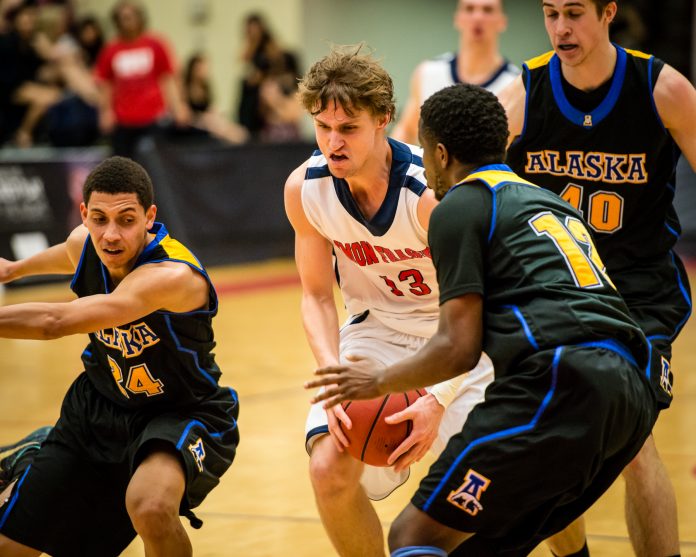
The men’s basketball team closed January with a loss Saturday evening. The team fell to the Alaska Anchorage Seawolves by score of 115–98, ending a two-game winning streak.

Clan guard/forward Roderick Evans-Taylor opened up the scoring with a good layup, but the Seawolves would respond quickly with two straight three-pointers — a problem that plagued SFU all night.

Alaska Anchorage could seemingly shoot from anywhere, downing 20 three-pointers in all and shooting 62.5 per cent.

“They’re a very good three point shooting team,” explained head coach James Blake. “Our game plan was to get them off the three point line — I know it didn’t look like it — but that was our job.

“We just didn’t commit to what we do defensively, and that was disappointing.”

Despite this, SFU spent much of the first half neck and neck with Seawolves — often down only two points. The continual three-pointers wore on the Clan though, and they ended the half down 62–43. The gap had started to grow in the last six minutes, when SFU was outscored 20–7.

The gap only widened from there, as Alaska Anchorage scored 10 straight points to open the second half, earning a 29-point lead.

Clan guard Daniel Deflorimonte broke the vicious cycle with a layup. SFU eventually cut the gap by nearly half — ending the game down 17 points — but the result was the same: a loss.

“We just got a little too high on our horses from our two wins,” said coach Blake. “We haven’t really been playing very well offensively. It’s been our defence, guys buckling down and committing to trapping [that won those games]. We went away from that for some reason.”

Blake also cited the high amounts of three-pointers as being demoralizing to the team: “When teams make shots on you [. . .] the heads go down, the bad attitudes rear their ugly heads, again it’s been a while since we’ve seen them but we’ll clean that up for next week.”

Despite the loss, this was SFU’s highest-scoring game since their 107–103 loss five games ago. The Clan aims to rebound on the road Thursday against the Montana State Billings Yellowjackets, who are currently tied for last in the Great Northwest Athletic Conference.

SFU

Points: 98
Field Goals: 37–75 (49.3%)
3 Pointers: 12–31 (38.7%)
Free Throws: 12–15 (80.0%)

UAA

Points: 115
Field Goals: 35–58 (60.3%)
3 Pointers: 20–32 (62.5%)
Free Throws: 25–32 (78.1%)

Player of the Game: Sango Niang

Image Credit: Sango Niang

For the second night in a row, Sango Niang was The Peak’s player of the game. Topping Thursday’s match with a game-high 24 points, Niang was one of the few bright spots of an otherwise disappointing game. Although the story of the night was the Seawolves’ ability to drop three-pointers, Niang was respectable in his own right, going four for nine.

Points: 24
Assists: 5
Rebounds (Off-Def): 2–3