Home Blog Page 1042

Sports Briefs…

0
Jovan Blagojevic described the pre-season matchup as “business” and not “friendly.” Image Credit: Hamed Yaghoubi Shahir /The Peak

Men’s Golf

Men’s golf achieved their second NCAA tournament victory last Monday and Tuesday at the California Baptist Invitational in Corona, CA. John Mlikotic led the team with a total score of 214 (-2) in four rounds of golf, despite opening the tournament with the highest Clan score in the first round. He shot 70 (-2) and 68 (-4) in the final two rounds, and placed second individually at the tournament. Mlikotic’s effort won him the GNAC Golfer of the Week award. “We are not firing on all cylinders right now so to come away with a win in this tournament against many of our rivals tells me the team is starting to believe in itself,” head coach John Buchanan told SFU Athletics.

Track and field

Track and field were honoured with Great Northwest Athletic Conference (GNAC) awards on Tuesday. Senior Lindsey Butterworth, who achieved the women’s 800-metre title at the national championship, was named the GNAC Indoor Track and Field Athlete of the Year. Freshman Paige Nock was voted the conference’s top female freshman, while graduate student Jennifer Johnson was named the GNAC Female Newcomer of the Year.

Women’s Basketball

Last Monday, Clan basketball star Erin Chambers was named an honourable mention for both the 2015 Daktronics/Division II Conference Commissioners Association Women’s Basketball All-American team and the Women’s Basketball Coaches Association (WBCA) All-America Team. This marks Chambers’ second straight appearance as an honourable mention on the WBCA All-America Team.

Whitecaps

Jovan Blagojevic and Alan Koch returned to Terry Fox Field for one last preseason game for the Whitecaps FC2 on Saturday, March 21. Despite Oregon notching the first goal, the former SFU men’s soccer midfielder and coach guided the FC2 to a 3–2 victory over Oregon State University. Blagojevic scored the game-winner in the 84th minute. The FC2 began their regular season against the Seattle Sounders FC2 on Sunday.

Wrestling

SFU wrestler Oscar Balaqui was crowned the 50 kg Canadian National Junior champion for the second year in a row. Balaqui has spent the season as a redshirt, having won last year in his senior year of high school. 2015 Clan signee Nolan Badovinac achieved second place in the 84 kg category. At the senior nationals, sophomore Josh Kim placed fifth. On the women’s side at the juniors, freshmen Tiffany Hibbert and Payten Smith earned silver medals, and Ashley Osachuk and Abby Lloyd earned bronze.

Softball

Clan softball went one for four in Montana, playing the Montana State University-Billings (MSUB) Yellowjackets in two doubleheaders over Saturday, March 21 and Sunday, March 22. The Yellowjackets outscored SFU 32–13 over the four games, with the only victory coming in the second game on Saturday in a 10–9 result — the other games the Clan were held to two or fewer runs in the rest of the games. “[MSUB] came out with energy, scored runs early and shut down our offence. The games were all but done early from an emotional point for us,” head coach Mike Renney told SFU Athletics.

With files from SFU Athletics, GNAC Sports, @SFUWrestling, and the Vancouver Whitecaps

Kiss your current U-Pass subsidies goodbye

0
Photo Credit: Brandon Hillier

The U-Pass program has been extremely beneficial for students all over the Lower Mainland, but with the ongoing transit referendum, the future of the program may be at risk.

According to the U-Pass website, and from an SFU City Conversations event I was part of with the chief negotiator for the program, the current contract with TransLink for our U-Pass prices ends next April and will need to be re-negotiated. However, if the referendum does not result in a ‘yes’ vote, the U-Pass program may likely cease to exist.

As students, it is crucial that we become involved in our community by voting in this referendum. The Metro Vancouver region is our home and many of us will continue to live here beyond graduation, and we have a responsibility to the place we live. We pay thousands of dollars at university to invest in our future careers; it only takes minutes to register online, and mail in our ballots to invest in the future of our home.

In order for the U-Pass program to continue, students must come together and vote ‘yes’ for better transit. At the City Conversations event, Jonathan Cote, the Mayor of New Westminster, stated that this vote seems to be a method the Mayors’ Council is using to see if the public is invested in transit improvements for the region.

This would be so that municipalities and the province will be even more invested in transportation needs. According to Cote, the tax increase is not a major funder of the projects, but rather an indicator of our commitment to transportation — a necessity we must be willing to invest in for the future.

The transit tax is an indicator of our commitment to transportation.

Unfortunately, this measure of community commitment would backfire if the referendum results in a ‘no’ vote. Discussion at the event surrounded how the Mayor’s Council will take this as a message from the region that we do not care enough about a healthy, sustainable, and congestion-free region to invest in transportation.

This message could also undermine future U-Pass negotiations, since current funding for our transit system’s services has been maxed out. Past incidents, such as a U-Pass price hike a few years ago, have shown how TransLink, under higher political authority, may not maintain subsidized fares for students if they need more money to increase services. From a business point of view, it makes sense to charge students more for the services they are using if we take no action to try and make our services better.

However, we can avoid another U-Pass price hike — or even losing the pass altogether — by voting ‘yes,’ the tax money from everyone in the Lower Mainland will go towards actually increasing services throughout the entire region, so there will be even more accessibility, hours, and places to go with our shiny blue U-Pass.

We shouldn’t take what we have for granted. We have U-Passes thanks to the hard work and advocacy from students like us. Let’s be the next group to do something beneficial for all students.

Obscure facts you might not have known about the Cadbury Creme Egg

0
Photo courtesy of Abul Hussain (Flickr)

The approaching Easter holiday can only mean one thing: a return of everyone’s favourite chocolate-shelled candy. Celebrate the seasonal emergence of the Cadbury Creme Egg with these little-known, fun facts!

1. Over 500 million Creme Eggs are produced every year.

2. When Cadbury sponsored the Olympic Games in 2012, they released a series of commercials featuring Creme Eggs partaking in Olympic sports.

3. Creme Eggs have been around for almost 100 years. Its inventors, the Cadbury brothers, had been attempting to make an alarm clock completely out of chocolate and they accidentally created the first Creme Egg.

4. Similar to normal eggs, Creme Eggs are a good source of protein. They also contain high levels of omega-3 fatty acids, which can help prevent types of heart disease. And they glow in the dark if the moon is waning.

5. While counting electronic ballots during the 2008 municipal election, a computer glitch led to a Cadbury Creme Egg being declared the mayor of Fredericton, New Brunswick. The Creme Egg stayed in power for less than 24 hours.

6. Creme Eggs are famous for the many different ways a person can eat one. According to a survey conducted by Cadbury, the most popular way for someone to eat a Creme Egg is by melting it in a pot and using an eyedropper to slowly transfer the liquid into their mouth.

7. Creme Eggs are Barbra Streisand’s pet python’s favourite snack.

8. If your iPhone 6 battery is low and you don’t have access to a computer port, plug the charger into a Creme Egg. The creamy centre acts as a miniature power source and will charge your phone.

9. The original version of Hasbro’s board game Clue included a Creme Egg as a potential murder weapon. However, shortly after the game’s release, reports poured in of people who had nearly choked to death while trying to eat the fake Creme Egg. Clue’s creators deemed the Creme Egg too much of a real weapon and replaced it with the candlestick.

10. If you’re baking and run out of Creme Eggs, you can use applesauce as a substitute. (A quarter of a cup for every Creme Egg the recipe calls for.)

Sensationalized headlines could lead to mass global extinction, warns expert

0
Photo courtesy of Wikimedia

Overdramatic newspaper headlines and misleading presentation of information to the public could lead to the eradication of multiple species on Earth, according to a local expert.

The warning comes from Chandler Finks, a tenured professor of sociology at Simon Fraser University. Finks, 55, claims that the kind of sensationalizing and “quote cherry-picking” that more and more media outlets are practicing can often “distort” the bigger picture and “could lead to problems” down the “line” — including the end of all life on this planet, assumedly.

“I think it’s interesting how some newspapers present the facts,” Finks wrote in an email response to The Peak’s inquires. “You never know when someone’s going to blow things out of proportion.”

While Finks failed to elaborate on what these aforementioned “things” are, we can assume that they will have an overwhelming impact on every one of Earth’s living organisms, including all plant life, animals, bacteria, and even humans. Elaborating further, if this trend of deliberately presenting “the facts” in a misleading way continues, Finks believes this will cause all of these entities to “blow” up and leave our planet devoid of life. 

These and several other shocking words are just part of Finks’ 200-word email, which was leaked by The Peak last Thursday.

In the email, Finks’ main criticism of the media was focused on whether “newspapers” are doing enough to ensure that incorrect data doesn’t lead to mass panic or to the general realization that everyone one day will die, no matter how much you might try to deny or avoid any mention of it. Finks goes on to say that death is “inescapable” for humans, which is just stating the reality — but isn’t reality scary when you start actually thinking about it? The answer is yes.

For mankind, it would appear the writing’s already been on the wall for quite some time. In 2014, the Madagascan dwarf hippopotamus was declared officially extinct by International Union for Conservation of Nature. Back in 2011, the western black rhinoceros was also declared extinct, though no individual of the species had actually been recorded for five years.

While Finks does not specifically mention either of these animals in his email, they can be seen as prime examples of what is to come for the rest of Earth’s inhabitants if proper “proportion” is not maintained by media outlets.

As for when this seemingly unavoidable fate is likely to manifest, Finks is reluctant to say, but suggests that we might “never know.” In the meantime, the best humans can hope for is accurate reporting in the news and an end to media over-embellishing every single unimportant detail.

BC needs a higher minimum wage

0
Photo Credit: Brandon Hillier

British Columbia has the highest cost of living of any province in the entire country and the second highest rate of poverty, yet the provincial government remains complacent about poverty reduction.

Recently, BC Jobs Minister Shirley Bond announced that after being stagnant for several years, the minimum wage would be raised by 20 cents to a measly $10.45 per hour. For the sake of comparison, once these changes go through in September, BC will have the lowest minimum wage in all Canada except for Saskatchewan and Alberta.

Even with the new increase, an individual with a full time job being paid the minimum wage and with no dependents will be $5,000 short of the poverty line if living in Metro Vancouver. We must ask ourselves: In what world does a “minimum wage” not provide for the most basic and “minimum” standard of living?

The minimum wage is an integral part of any poverty reduction plan. It is meant to help the commonly-termed ‘working poor’ — individuals who may work tirelessly at one, two, or even three jobs and yet barely manage to scrape by the poverty line, especially if responsible for multiple dependents. These individuals are not impoverished because they do not work hard, but rather because the wage floor has been set disproportionately low in comparison to the poverty line.

A robust minimum wage is not meant to replace government welfare programs targeted towards the unemployed, disabled, or elderly. Nor is it meant to replace socialized medicine and subsidized transportation. Rather, its purpose is to provide a predictable basic income for workers who are less in demand. It is a bastion of a healthy economy; the minimum wage gives consumers income to spend and contribute to the economy, rather than making them rely on assistance programs.

In what world does a “minimum wage” not provide for a “minimum” and most basic standard of living?

There are multiple progressive minimum wage systems worth considering in creating a policy that works for BC. For instance, in Australia, a country with lower than six per cent unemployment, the minimum wage is set at $16.87 (Australian dollars). The Australian system is flexible and progressive in that the high minimum wage is only for workers above the age of 20.

Those who are younger face a progressively lower wage, a policy which is quite rational. There is no justification for a 15-year-old to make the same wage as someone 10 years older with far more financial burdens.

Another possible approach would be a separate minimum wage for municipalities with higher costs of living. This is already in place in prosperous US cities such as Seattle and San Francisco, who have pledged to implement municipal minimum wages set at around $15. The status quo in which the province imposes a “one-size-fits-all” solution does not consider discrepancies in costs of living. Allowing municipalities to set their own minimum wage would allow each city a wage that corresponds to its own unique living expenses.

I can recall with a heavy dose of nostalgia the days when I earned minimum wage hanging clothes in a dusty old thrift store. While $10.25 was plenty for myself, I remember one co-worker in particular who worked a day shift at the store and a night shift in the fast food industry just to scrape by a living for her and her two sons.

For too many people, the current minimum wage is a sore excuse for actual poverty reduction. It is time the provincial government takes concrete steps to ensure that all BC residents can put food on the table.

SFU football names new offensive coordinator

0
Joe Paopao replaces Jacques Chapdelaine, who was both the team’s head coach and offensive coordinator. Image courtesy of Ottawa Citizen

Last Wednesday, SFU Athletics announced Joe Paopao as the newly hired offensive coordinator of the SFU football team.

Paopao, a native of Honolulu, HI, is no stranger to the BC football scene, having spent seven of his 11 seasons playing in the CFL with the BC Lions before multiple stints on the BC Lions coaching staff, including one season as head coach in 1996. He has held coaching jobs on various CFL teams, serving as the head coach for the previous Ottawa franchise, the Ottawa Renegades, for all four seasons of its existence from 2002–2005.

Nicknamed the “Throwin’ Samoan” for his ability as a quarterback, Paopao has also coached at the university level, serving as the offensive coordinator for the Waterloo Warriors from 2007–2011 before being named the university’s head coach, a position he held for two seasons before returning to the Lions as a receivers coach in 2014.

SFU head coach Kelly Bates had first-hand experience working with Paopao on the 2014 Lions coaching staff, where Bates was the running backs coach and draft coordinator.

“I know what Joe’s about,” he said. “Joe has many accolades, many accomplishments, he’s got a wealth of football knowledge, but the thing that drew me to Joe, and the thing that makes him the perfect hire, is that he cares about people. His actions prove that day in and day out.

“He will have a positive impact on everyone that he runs into and he works with in this program,” Bates added. “I felt like it was a steal to get him, and I think this place is fortunate we have him.”

Paopao hopes to bring stability to an institution that has lacked a consistent coaching staff for the last few years, with three different head coaches in three years and a different offensive coordinator each year since 2011.

“I’m their fourth different offensive coordinator in four years, [the team is] getting four different messages, four different philosophies offensively, and it can’t be easy,” Paopao noted. “I’m sensitive to that. They’re tremendous young men, but they’re still human beings. When you’re 18, 19, 20, 21 — it’s not easy when there is constant turnover.”

Both Paopao and Bates emphasize the importance of developing the student athletes as human beings.

“I’ve been coaching a long time, been in the pros for 30 years, it’s like my ninth year in university, so I understand what it takes,” Paopao said. “It takes patience, it takes being consistent with the message to student athletes — and I enjoy the process, having sent four of our children to university. I get it.”

Part of Paopao’s plan is to make sure that the student athletes are excelling academically. He notes his belief that this will also help the team on the field.

“We’re going to have to trust in the things that Bates is trying to implement, which is you’ve got to go to class, we’ve got to make sure they get the tutorial help they need,”  he continued. “That’s a big investment in them by the university throwing a scholarship, and their parents who are investing in their future. We also believe that next four to five years are going to influence the next 40, 50 years of their life.

“In our game, each play lasts anywhere from three to five seconds, that’s all,” Paopao continued. “So before that and after the ball is snapped, that’s where being a good student and being disciplined mentally [comes in].”

The goal of the SFU coaching staff is to get the team to being a competitive force in the Great Northwest Athletic Conference, as SFU has not achieved a winning record since joining the NCAA. In 2014, SFU actually had less wins than the season before, going from a relatively low three wins to just two. Paopao acknowledges that it’s not going to be an easy task, and it won’t happen right away.

“It’s like building a house, I mean it doesn’t happen in 10 minutes or 10 days,” he said. “It’s no different than starting university. In your first year, nobody graduates, there’s a process to it — you have to see how things work in it, but you have to keep working at it.”

Green week sparks sustainability dialogue

2
- SFU
- SFU
– SFU

A week of events related to green issues, called Reinvest in Our Future Week, was held by the Simon Fraser Student Society (SFSS) last week to generate conversation about environmental issues on SFU campuses.

The events were held in conjunction with SFU 350, Sustainable SFU, SFPIRG, and the Wilderness Committee.

For SFSS VP Finance Adam Potvin, the week was an opportunity to bridge the gap between proponents and opponents of fossil fuel infrastructural expansion. He hoped that with a deeper understanding of the issues, the community could engage in more productive dialogue.

“I’ve always been frustrated at the lack of understanding between the two sides,” explained Potvin. “I felt like there was no real middle ground, and I thought that both sides [the right and the left] were kind of talking past each other.”

He continued, “What I want to see is a more nuanced approach that seeks to combine realising that oil is a necessity [. . .] but at the same time there needs to be an effort to steer our community towards renewable energy.”

The week kicked off with an event titled Visioning our Future on March 23. Students and community members discussed what they wanted to see in our community’s future, both economically and environmentally.

Tessica Truong, environment rep for the SFSS, was particularly impressed by the dialogue at this event. “At first the tone of the conversation was a bit pessimistic [. . .] but soon it moved to [defining] what SFU’s role could be, not just as a research institution but a hub of innovation,” she explained.

Later in the week, community members and SFU students gathered in the Maggie Benston Centre to discuss issues related to the proposed Kinder Morgan Pipeline expansion through Burnaby Mountain. For Potvin, this event was what he had been looking forward to most.

“The Kinder Morgan dialogue is probably the marquee event in my mind,” he said. “I think just because it’s so applicable to SFU and the SFSS.”

Some of the topics on the table included how to engage SFU students in the SFSS submission to the National Energy Board (NEB), environmental concerns, and the NEB consultation process. Terry Waterhouse, SFU’s chief safety officer, was also present to discuss concerns around the tanker farm at the bottom of Burnaby Mountain, among other things.

The week of events culminated in a panel discussion on Thursday afternoon where students and staff discussed The Role of the University in Society: Divestment as a Case Study, and a talk on Friday called “How does climate change impact my health?”

Students in the Divest SFU movement have been pushing the university over the past several years to shift its investments from fossil fuel companies to other, more sustainable sectors.

To keep an open dialogue on these issues, Potvin explained that organizers wanted to brand the event as a “Reinvest” rather than “Divest” conversation: “We’ve kind of wanted to focus more on the proactive side of things. Rather than the whole, ‘Rah rah down with oil,’ it’s more ‘Rah rah let’s look at renewable energy.’”

Truong commented on the overall intent of the events: “I think what will emerge from the conversations is what students want. What are they concerned about. And I think those will definitely be included within our submission [to the NEB this September].”

Mental health week aims to reduce stigma

0
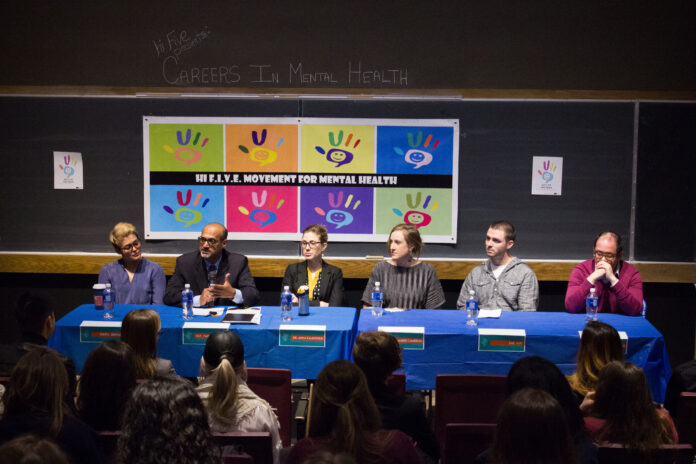
Professionals from the mental health field spoke at Thursday’s “Careers Night in Mental Health” event. - Photo courtesy of Jennifer Hoffmeister
Professionals from the mental health field spoke at Thursday’s “Careers Night in Mental Health” event. – Photo courtesy of Jennifer Hoffmeister

Last week was ME Week at SFU, bringing free food, puppy time, and wellness workshops to students on the university’s different campuses.

The initiative was held from March 23 to 26 and aimed to promote mental health awareness. SFU’s Hi F.I.V.E. club collaborated with the Simon Fraser Student Society (SFSS) and Health and Counselling Services to bring a variety of mental health-oriented activities to the SFU community.

Hi F.I.V.E. is a movement that originated at SFU and has since spread to campuses across North America, which “aims to eliminate stigma towards those who are experiencing mental health distress or illness.”

Erika Horwitz, Associate Director of Counselling, summarized the goal of Hi F.I.V.E.: “We want people to stop thinking of ‘them’ and ‘us;’ the ‘mentally ill’ and ‘us.’ To really understand that just like you have physical health and you may get sick with the flu or a virus, it’s the same with mental health.

“You can be doing great at one point and not so great at another.”

Jennifer Hoffmeister, a Hi F.I.V.E. organizer, spoke to The Peak about how she hopes the week’s events can help to reduce stigma around mental health issues. “A lot of it is awareness,” she said. “We kind of don’t perceive mental health as something we need to talk about.”

Hoffmeister hoped that events during the week might help spread the word about mental health issues on campus, as well as the resources available to students.

However, she pointed out that stigma is a barrier to receiving care. “People shouldn’t be afraid to talk about it,” she said. “You can’t get help if you’re not going to talk about it.”

On Monday, Hi F.I.V.E. set up tables in the Southeast AQ to promote the event and distribute information about the various services offered by Health and Counselling, the Canadian Mental Health Association, and the BC Psychological Association. Tuesday saw a pancake breakfast that had a turnout of over 1000 students.

Hoffmeister said with a chuckle, “I think we spent almost [one and a half] to two hours flipping pancakes and serving pancakes.”

On Wednesday, professionals gave massages to stressed-out students and a drop-in yoga session was offered. In Saywell Hall on Thursday, students played with puppies brought in by Health and Counselling Services staff.

A highlight of the week was Thursday’s Careers Night in Mental Health event. The event gathered six professionals working in mental health fields to speak about their own careers as well as respond to students’ questions and concerns about mental health on campus.

The organizers for ME Week were enthusiastic about how the event was received by the student community. “It kind of opens up the opportunity to talk to students about [Hi F.I.V.E. and Mental Health],” said Hoffmeister. “We actually have the opportunity to speak with them about something that, if we just walked up, they might not be normally as receptive to.”

They also noted that turnout for careers night was triple what they had last year for the same event.

Friday was proclaimed a “Day of Kindness” at SFU, culminating in a Kindness Party in Convocation Mall. Horwitz noted, “There is very good research that has found that kindness and compassion is very good for mental health, for the person giving and the person receiving.” Hi F.I.V.E. handed out coffee and cookies, inviting students to “pay it forward.”

Horwitz summed up the day’s intent: “If you want others to be happy, practice compassion. If you want to be happy, practice compassion.”

Student newspaper under fire for running an informed opinions article

0
Photo by Brandon Hillier

SFU’s student paper is facing criticism for publishing an opinions-related election article in the newspaper’s opinions section.

The article, which appeared in the March 23 issue of The Peak, was titled “The Peak picks their 2015 SFSS candidates” and included endorsements for six candidates running in the then upcoming Simon Fraser Student Society (SFSS) elections. However, when posted online, the piece received several accusations that the opinions article was biased and didn’t belong in a publication meant to incite further dialogue.

“I can’t believe how clearly biased this article is,” one online commenter posted via Facebook. “The newspaper’s staff have no right to make educated endorsements based on previous professional experiences with candidates running in the election. Who the hell do they think they are? I might not have any experience with running a newspaper, but I think I know how a newspaper should be run.”

The piece in question was a collaborative effort between 12 of the newspaper’s staff members; informal votes were anonymously cast, compiled, and then elaborated on to create digestible information for interested readers. According to sources, the staff’s intention had been to mimic what most major newspapers already do and use its extensive prior knowledge of the candidates to vocalize who they thought would perform best as part of the SFSS board.

“I bet The Peak are just endorsing whoever they’re all friends with,” said another online commenter. “It’s very unreasonable that they didn’t endorse my friend, who’s also running. If they can’t endorse both their friends and my friends, then they shouldn’t be endorsing anyone at all. How is that reporting objectively?!”

Concerns were also raised about whether a newspaper should be allowed to print the article and file it online under the opinions section, since it’s clearly just an opinion and some people might somehow mistake it for news.

“What if someone reads this, doesn’t realize that it’s an opinions article [. . .] and blindly follows the endorsements?” Another commenter said, as part of a 859-word post. “People are totally unable to develop an opinion without having it spoonfed to them, so this puts the non-endorsed candidates at a huge disadvantage.

“It’s not about the extensive objective reporting they’ve done in previous issues, like their election special. This one article has made me lose total respect for the whole publication. Forever!”

Aside from a short, supplementary post the aforementioned Facebook update, The Peak has yet to officially comment on the negative feedback, but sources say the staff hopes people can learn to think for themselves and not blindly follow what they read, regardless of how it’s being presented to them.

Board Shorts

0

SFSS to jointly fund NEB Research Assistant

In cooperation with the Graduate Student Society (GSS), the board moved to hire a Research Assistant to assist the societies in researching and preparing their submission to the National Energy Board regarding the proposed Kinder Morgan pipeline.

Both groups applied for and received intervenor status in the last year, and will work with the Research Assistant to formulate their submission, due by September 1, 2015.

Increase to chief electoral officer hours

The SFSS voted once again to increase the number of hours available to the chief electoral officer (CEO), Oscar Sanchez, so that he can finish the 2015 SFSS elections.

On March 11, the board voted to increase Sanchez’s billable hours from 150 to 200, since he had already worked 143 of the 150 allotted to him.

Sanchez asked for another 100 hours to be added “to be safe.” “We’re still dealing with outstanding infractions, we’re backed up on paperwork, we’ll have to do all the budgeting for next year,” he said. “There’s still a substantial amount of things that need to be done.”

Board approved the increase in the CEO’s hours from 200 to 300.