Monica Lewinsky returned to the public stage to speak about her very public scandal at the TED Conference Truth and Dare on March 19.
“At 22, I fell in love with my boss. At [. . .] 24, I learned the devastating consequences.” It’s no secret that Lewinsky was publicly and globally humiliated by Internet users due to her sexual relationship with then-president Bill Clinton. “I was branded as a tramp, tart, slut, whore, bimbo, and, of course, ‘that woman,’” she recalled from the comments posted online.
Lewinsky’s ‘slut-shaming’ experience was one of the first of many experiences women have had online since 1998. But this type of web-shaming is only one of the forms of a bigger, more prevalent issue: cyberbullying. This issue is responsible for similar recent events, including the leaked nude photos of female celebrities such as Jennifer Lawrence and Kaley Cuoco.
Cyberbullying is a problem that needs to be addressed due to the exponential damage it has caused, not only to women, but to all genders. However, we can counteract this issue through simple online compassion.
One mustn’t forget the other notable and devastating occurrences of women’s privacies being infringed upon online, due to desensitized online hatred. Look no further than British Columbian Amanda Todd’s suicide, provoked by the online abuse she received from posting a topless photo — a tragedy that could have been prevented if more online users had actively recognized the sensitive situation, and stood up against this harassment.
Unfortunately, cyberbullying has become incredibly prevalent in our society. According to a study by Internet security firm MacAfee, at least one in three teenagers are now bullied online in America. Moreover, online anonymity allows for hatred that often targets women, minorities, and LGBTQ individuals. Because of this, Lewinsky is now calling for a revolution, and I stand behind her.
The reality is that changes must be made through web users.
Comment sections, forum posts, and personal profiles have become the public battleground for what seems like a neverending spread of hate. With social media platforms failing to offer protection, cyberbullying also stole away lives like that of Nova Scotian Rehtaeh Parsons. While our government needs to create laws that make this a crime, the reality is that changes must be made directly through web users.
We have the power to affect real change on the web, and to fight the disassociation between the real person and the virtual profile that cyberbullying causes. The Internet has become a bystander society that continues to permit this behaviour — since the consequences that occur from such behaviour in the real world often do not apply, this online culture has projected a deafening silence that blocks the pleas of real person’s pleas behind the screen.
Though, it is easy for us to become upstanders within our bystander society: we just have to counteract the negativity by making the personal choice to empathize with our friendly comments, rather than remain desensitized.
“Empathy from one person can make a difference,” Lewinsky advised.“Compassionate comments help abate the negativity.”
With so many suicides and so much harm caused by cyberbullying, the least you can do is to click with compassion.
Guest speaker Gwynne Dyer engaged an SFU Woodward’s audience in a difficult discussion on March 25, titled “The New World Disorder?”
Following instances of war in Libya, Iraq, and the recent conflict in Ukraine, is the world getting out of control and heading towards violence, chaos and another cold war? Dyer gave a more positive spin to the issue, emphasizing it is “not as bad as it seems.”
Surrey
Beedie School of Business held the fifth annual Opportunity Fest at SFU Surrey campus on March 26.
The festival gave students a chance to display their innovative projects and ideas, and be recognized for their work. The judges also selected several winners who received prizes for their efforts.
Vancouver
Students were offered a two-day NVivo for Windows intensive training program over March 27 and 28. The workshop was created and facilitated to build students’ knowledge of NVivo qualitative data analysis software.
It thoroughly explained the use of NVivio from the set-up step to the final report and presentation step, and gave aspiring researchers a chance to practice using the analysis software.
March, April, May: the spring semester is coming to a rapid end and the time for course registration is upon us. Another term where we must face the challenges of schedule accommodation for our institution as we attempt to meet their demanding prerequisite requirements. These prerequisites are often topics that are not of interest to us and are typically seen as a means to an end.
As irrelevant as these courses may be, they are highly publicized and promoted by the university. Everyone is familiar with classes that meet our WQB requirements, regardless of their minimal appeal. What is not advertised, though, are directed study course opportunities.
As students who are supposedly “engaging the world,” we need to be aware of opportunities that encourage us to take education into our own hands and be given the opportunity to resist the conformity of a conventional university classroom.
Directed studies are available in every department that I have researched. English, education, business, sciences, and mathematics all allow for these opportunities. They are typically accessible for third- and fourth-year undergraduate students.
Yet when students register for their courses, directed studies have a minimal course description that make them seem confusing and unappealing. SFU describes these courses as “independent reading or research in topics selected in consultation with the supervising instructor.” Snooze.
Perhaps this ambiguity is due to the university’s concerns with the quick success of too many students. While SFU encourages academic success, it also encourages students ‘take time’ to complete their education. Under the regular class-structured system, students are more likely to experience less success, which in turn may set back the amount of time it takes to complete their education and allow the institution financial gain.
They leave room for creativity and independence, so a student can succeed in all courses.
Directed studies, on the other hand, are geared toward what the student is interested in learning. They leave room for creativity and independence, and with this added motivation, a student can succeed in all of his or her directed studies courses.
This semester I had the privilege to partake in an empowering directed study within the Faculty of Education. I have been able to take control of my own education by reading articles that are important to me. My particular directed study meets once a week in the Highland Pub, where we discuss social issues in education. We also have the opportunity to mentor students during office hours, a deeply engaging educational experience.
I have the freedom to choose what I study and eventually compile a final project that is useful and relevant, rather than an academic paper that will only see the recycling bin.
I have never been so impassioned by a course in the five years that I have been a student at this institution. Directed studies provide a much-needed escape from the monotony and stress of regular coursework. I recommend them to all students at SFU.
Earlier this month, a Vancouver woman, Kristen Hilderman, was shamed by a flight attendant for breastfeeding on the plane without a cover. A similar event took place in a Manitoban mall only days before. While feeding her child, Tara Léger was asked to move into a washroom, despite the fact that she was discreetly nursing where she was.
Both women reported feeling attacked and humiliated by those who called their breastfeeding to the attention of those around them, suggesting that what they were doing was “offensive.”
Cue the eyerolls from the large community of people who think that public breastfeeding is either a non-issue, or that asking women to “cover up” and “take it elsewhere” is an appropriate response.
But the truth is that standing up for public breastfeeding is incredibly important in struggle for gender equality. To shame a woman for breastfeeding publicly sends the message that they should self-consciously hide what they are doing.
To nurse a child is not about publicly displaying your breasts. It’s about nourishment. Mothers aren’t looking to make a statement or expose themselves — they simply want to feed their children. Breastfeeding is completely natural, and is proven to have many health benefits for newborns, yet too many women are ogled at and receive rude comments.
Mothers aren’t looking to make a statement or to expose themselves.
Every day we see sex on TV and underdressed models on the covers of magazines. If the society we live in has no issue advertising the human body, why do so many people feel uncomfortable with mothers who breastfeed? The short answer is that, when the female body presents itself in any sort of nonsexual way, the general public doesn’t seem to know how to react.
According to Léger, mothers have to overcome “humility hurdles” when it comes to nursing, and if that’s the case, then the last thing we should do is go out of our way to shame them. The idea that breastfeeding is in some way a personal offence is ridiculous. Women don’t do it for themselves; they do it because their child needs to be healthy and fed.
It’s high time we start respecting them and their bodies, instead of accusing them of indecency.
The truth is that breasts are not objects to be romanticized and sexualized; they are a part of the body that serves an important role in terms of child upbringing. A woman should never feel ashamed for using them for this purpose.
Breastfeeding in public is not the problem; how we think of the female body is. It’s their choice where to breastfeed, and it’s up to them to decide what their child needs. I sure wouldn’t want to eat my lunch in the bathroom, and I doubt mothers want their babies to either.
TV’s golden age is upon us. The small screen has become a more incisive storytelling medium than ever before. Just ask Walter White, Don Draper, or Frank Underwood.
Finally, creators are using the multiple-episode structure to their advantage, delving deeper into character arcs, constructing complex story lines, and providing a highly satisfying and distinct viewing experience from that of the silver screen.
But where’s the hit homegrown Canadian programming in all of this? I can’t remember the last time a friend recommended that I watch the latest show the CBC picked up, and whenever I do happen to catch an episode of Murdoch Mysteries, the camera-work, lighting, dialogue — well, all of it seems just a bit tackier and less professional than what I’ve grown accustomed to.
Canadian TV has failed to truly resonate with audiences and churn out highly entertaining content over the years. Of course there are the rare exceptions, such as Trailer Park Boys, but if there is a Renaissance happening, I think we ought to be a part of it.
Canadian programming has been lacking in part because one of the CBC’s mandates is to “reflect Canada and its regions to national and regional audiences.” That sounds great, but there are only so many Alberta references I’ll get when I watch Little Mosque on the Prairie because well, I’m not from Alberta. The mandate places predetermined constraints on TV writers, limiting how inventive they can get with their stories.
We of the HBO generation are used to watching sometimes dark, sexual, nuanced, creative television.
To create compelling programming also means likely offending viewers. A good portion of our original programming funnels through the CBC, and as a public broadcaster, they’re not really in the business of pissing people off. Finally, you often need money to make good television, but when you and the rest of your Canadian brethren haven’t proven you can make great TV, no one will trust you with a big budget.
It’s time to take risks, shell out some cash, and join the movement, Canada.
We are the HBO generation. We grew up watching dark, sexual, nuanced, creative television that explore themes that resonated with the human condition. To engage us, you’ll need to start taking risks. Less of the traditional ‘you can watch it with your grandma’ programming, like Murdoch Mysteries, and more “stylized, smart and sexy,” like BBC’s Sherlock.
Moreover, if you want to document our history and culture as the CBC does, you need to do so in a compelling manner. Boardwalk Empire, with its story about Prohibition-era America and the criminals and politicians that ruled it, will be talked about for years to come. If Canadians are to watch programming that tells our story, we need to create honest, thought-provoking drama, no matter how risky and expensive it may be.
Finally, it’s about national pride. We have our authors, our comedians, and our pro athletes. It’s about time we have our TV, too.
The sense of pride we feel when our writers produce great work and the rest of the world watches may just do more for Canadian solidarity than another period drama based in 1900s Toronto can.
There’s a generation of Canadian actors, directors, storytellers ready to tell stories more passionate and challenging than we’re used to, and it’s about time we fully support them. After all, it’d be a damn shame if their homegrown talent is never put to use.
I’ve been drinking my coffee black since the beginning of last summer. It was a tough habit to get into! Straight, black coffee can be painfully bitter, though once I acquired a taste for the drink, I’ll say that waking up to a fresh-pressed pot of black-gold is absolutely terrific. I’ve decreased the intensity of my heartburn problems, and have contributed to the less rapid deterioration of my health — all while loading myself up with the wonder drug, caffeine.
But, I’ll admit, there is the odd time that I decide to add a bit of sugar in my morning cup o’ java, and when I do, it’s ecstasy. A mouth-gasm of enhanced, sweetened flavour that sends my brain into a buzzing overdrive. Sometimes I’ll order that double-double, just to give myself an extra kick. Adding sugar once in a while, and in small doses, ain’t no biggie, and it gives me a simple something to indulge in from time to time.
Boohoo: Coffee in your sugar
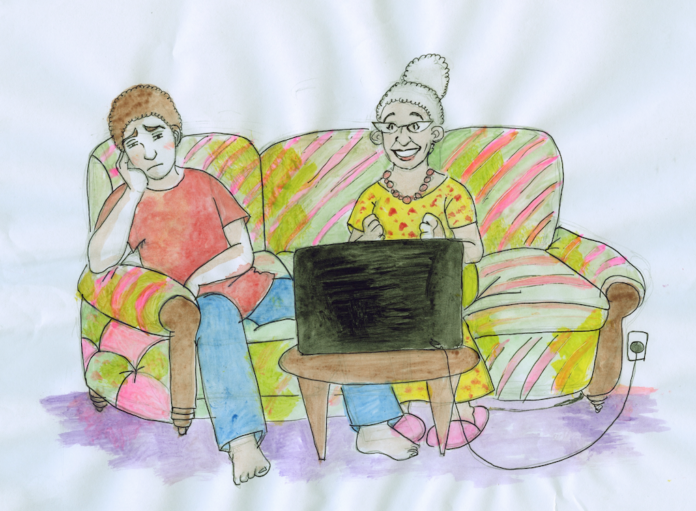
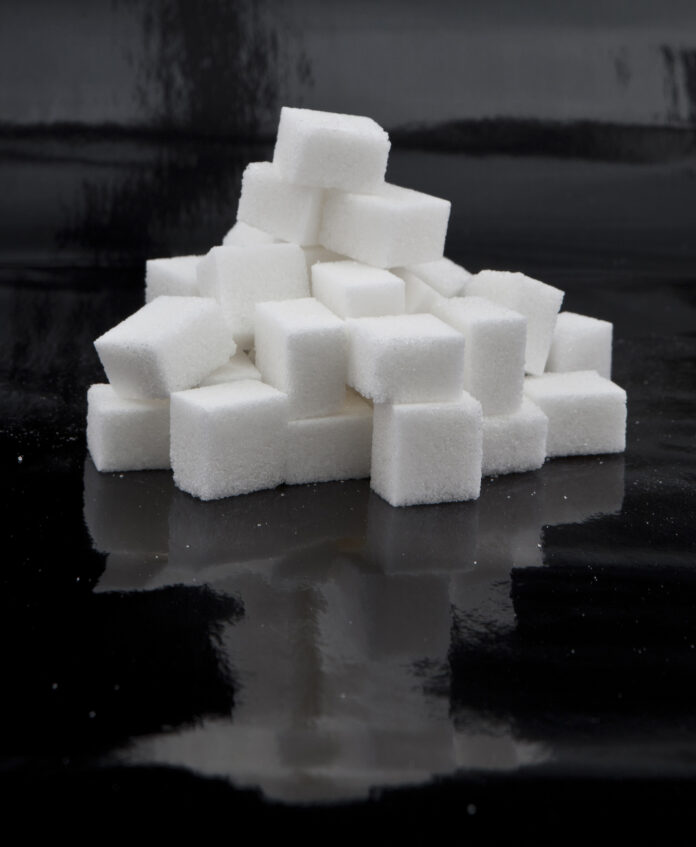
My grandma used to spoon four heaping teaspoons of sugar into her coffee cup. She’d also have two cups per day. For those like me who have trouble with math, that’s eight heaping teaspoons of sugar in the morning!
My grandma obviously had blood sugar levels of steel, and I’ve never been able to understand how people can consume so much sucrose without keeling over from cardiac arrest.
So, if you’re one to add coffee to your sugar, here are some facts you learned in your high school biology class: sugar contains fructose, and too much of this can destroy your liver, which means you could die. Overloading your liver can lead to non-alcoholic fatty liver disease, which means you could die. Sugar also causes insulin resistance, which leads to type II diabetes, which means you could die. Sugar also leads to cancer, which means . . . wait a sec, did you just read my mind?
In short, don’t die. Keep away from all that sugar!
Of the four teams, “The Explorer” emerged victorious with its innovative business plan. - Brandon Hillier
Of the four teams, “The Explorer” emerged victorious with its innovative business plan. – Brandon Hillier
SFU students brewed up some healthy competition last Friday in a craft beer marketing contest held by SFU and Central City Brewing and Distilling.
As part of its plan to launch the Simon Fraser Brewing and Distilling Corporation this spring, the two organizations launched a competition to design the first brand of beer sold by Fraser Brewing.
The competition asked entrants to design “light lager that is easy-drinking, ‘gateway’ beer” meant to guide customers who tend to drink “mainstream” beer into the craft beer market. The beer also had to cost less than $10 per six pack of cans.
Tim Barnes, VP of Marketing and Sales for Central City and one of the judges, said that the goal of the night was “to engage with the student population, to get an idea and a plan together for the new beer.” He continued, “We wanted to integrate with students and have students give us their ideas on what they thought would be great beer.”
Barnes was joined on the judging panel by Steve Dooley, executive director of SFU Surrey, Mike Volker, executive director of SFU’s Innovation Office, Darryl Frost, the founder and CEO of Central City, and Gary Lohen, the Central City Brew Master.
The contest’s conclusion was held at the SFU Surrey Campus Mezzanine on last Friday, following a week of presentations by the competitors. The week highlighted the work participants had done over the past months, and they were evaluated based on four criteria.
First, a business plan submission that detailed product category, the target consumer, and recommendations on the product’s price, promotion, placement and packaging.
Second, a 10 to 15 minute presentation for the judges’ panel. Third, a creative concept — a “brand idea and story behind the beer” — to give the product a unique flavour. And fourth, a creative brand name for the beer.
Four groups presented in the finals on March 27: Beaver Lager, Semester Ale, The Explorer, and one team that presented two beers, Slackline Lager and Frisbee Ale. Overall, Barnes said that The Explorer team stood out for their comprehensive business package.
The Explorer team was comprised of students Carmen Javier, Tiana Lo, Jagroop Gossal, and Muhammad Atif Saad, all of whom are students in event organizer and SFU professor Sarah Lubnik’s BUS 338 Foundations of Innovation course. According to Lubnik, the team “played on Simon Fraser’s importance in BC history at the same time as referencing SFU’s image as a campus of explorers and adventurers.”
“We still may not use the exact name of the beer, but we liked their plan. Their plan was really good,” commented Barnes. “The competition was less about the beer name and more about building a really strong business plan.”
The Explorer was not the only winner, as Barnes stated that the runner-up presented a “great beer label design, which we may actually use.”
The Simon Fraser Brewing and Distilling Corporation will now move into production of its first beer, and is already planning to release a second beer in 2016.
Joe Fresh contributes $1 million to Ryerson’s fashion centre
Fashion students at Ryerson University rejoiced as the Canadian brand, Joe Fresh, announced its donation to and collaboration with the university’s fashion program to “create a new fashion innovation centre: The Joe Fresh Centre.”
The centre will provide students with access to workspaces, mentorship programs, and seed funding, which will “[put] Toronto on the fashion map may happen a lot sooner than later.”
Third-year fashion communications student Katy Sun noted, “We’ve got some really talented people here that are passionate about what they do. As students, most of us probably don’t have the funds to start our own business, so it’s a great opportunity.”
With files from The Ryersonian
UQAM threatens striking students with suspension and expulsion
Administration at Université du Québec à Montréal (UQAM) have announced intentions to take an assertive approach against students who took to the streets of downtown Montreal last week to protest increasing tuition fees.
Nine students were informed that they could potentially “face either one-year suspensions or [. . .] outright expulsion as a result of actions committed during protests on campus over the past two years.”
Although UQAM has a history of political activism, one of the students threatened with expulsion, Justine Boulanger, explained that such a threat is unprecedented. “It’s the first time the university has issued notice of disciplinary action for political activities,” she said.
With files from The National Post
Rotten food served at Memorial University triggers social media outcry
Pictures of mouldy lemons, undercooked pork chops, and dead flies in tacos served at Memorial University’s dining hall are among the images that students have been posting on sites such as Facebook, Twitter, and Imgur.
Dining hall meal plans are mandatory for students living in residence, and cost over $2,000 each semester.
MUN dining services claim that the social media posts may not accurately reflect the issues that should be brought directly to their attention. However, students claim they “regularly bring issues to staff’s attention — and the list of sub-par food experiences can’t be brushed off as social media hype.”
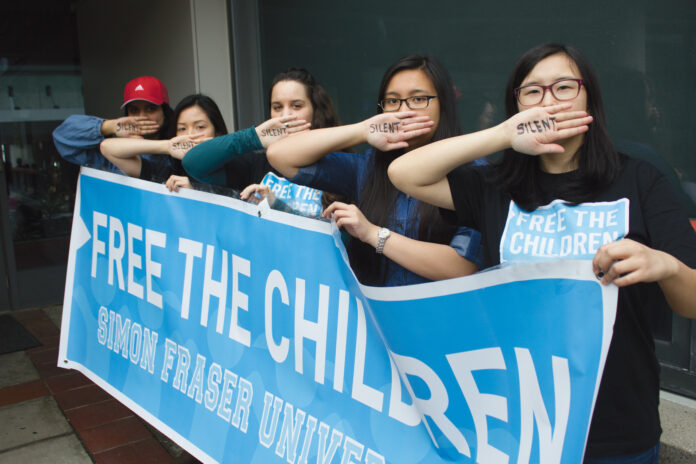
Free the Children SFU is raising money to build a school in Haiti. - Leah Bjornson
Free the Children SFU is raising money to build a school in Haiti. – Leah Bjornson
When asked how their event was going, organizers from Free the Children SFU replied: “Quiet, but good.” Unlike most events, quiet was a sign of success for the team, considering they were leading students in a vow of silence on SFU’s Burnaby campus last week.
Participants pledged to refrain from speaking for 24 hours “in solidarity with children whose voices are not heard and rights are not upheld around the world or those here at home who are bullied,” according to the Free the Children website.
Event organizer Selena Van Aert told The Peak that the point of the vow was “taking a silent stand so other people don’t [have to].”
She explained the meaning behind refraining from speaking for the 24-hour period. “It kind of is symbolizing how these girls who don’t have the right to education, how they aren’t able to speak out about it, they just have to go along with what their life is about [as decided by others],” Van Aert said.
Thousands of students at high school and university campuses around the world take the pledge every year to go silent for 24 hours, as a show of support for the rights of girls living in poverty.
SFU’s Burnaby campus is no exception. Van Aert brought attention to why SFU students should be concerned about events such as the Vow of Silence. “I think it’s important for SFU to know about it because we are so privileged to be here and have education and have everything that we have here,” she continued. “Having the awareness shows everyone how lucky they really are and how there are so many who aren’t.”
Members of the club collected pledges during the week of March 23, inviting students to take the vow on March 26 in West Mall. Organizers also sold boxes of Dunkin’ Donuts and took photos of participants with their hands placed over their mouths with the word ‘silent’ written on them.
Free the Children SFU has been raising funds over the past two years to build a school in Haiti. So far, they have raised approximately $5,000. “We’re hoping to be able to raise, and we will, that $10,000 to build that school,” Van Aert commented.
When asked how she felt about having to stay silent for 24 hours, Van Aert replied, “I think it will be really hard. [. . .] Communication is what we’re doing throughout most of the day.
“But at the same time I’m excited because I’m able to let people know about this issue that’s going on around us in the world,” she concluded.









 The Adventures of Agoraphobia Man: World Defender (Jacey Gibb)
 Seagull Square (Jill Mandrake)
 Peers (Leslie Lu)
 Much More Better (Talha Qadir)




Click with compassion
Monica Lewinsky returned to the public stage to speak about her very public scandal at the TED Conference Truth and Dare on March 19.
“At 22, I fell in love with my boss. At [. . .] 24, I learned the devastating consequences.” It’s no secret that Lewinsky was publicly and globally humiliated by Internet users due to her sexual relationship with then-president Bill Clinton. “I was branded as a tramp, tart, slut, whore, bimbo, and, of course, ‘that woman,’” she recalled from the comments posted online.
Lewinsky’s ‘slut-shaming’ experience was one of the first of many experiences women have had online since 1998. But this type of web-shaming is only one of the forms of a bigger, more prevalent issue: cyberbullying. This issue is responsible for similar recent events, including the leaked nude photos of female celebrities such as Jennifer Lawrence and Kaley Cuoco.
Cyberbullying is a problem that needs to be addressed due to the exponential damage it has caused, not only to women, but to all genders. However, we can counteract this issue through simple online compassion.
One mustn’t forget the other notable and devastating occurrences of women’s privacies being infringed upon online, due to desensitized online hatred. Look no further than British Columbian Amanda Todd’s suicide, provoked by the online abuse she received from posting a topless photo — a tragedy that could have been prevented if more online users had actively recognized the sensitive situation, and stood up against this harassment.
Unfortunately, cyberbullying has become incredibly prevalent in our society. According to a study by Internet security firm MacAfee, at least one in three teenagers are now bullied online in America. Moreover, online anonymity allows for hatred that often targets women, minorities, and LGBTQ individuals. Because of this, Lewinsky is now calling for a revolution, and I stand behind her.
Comment sections, forum posts, and personal profiles have become the public battleground for what seems like a neverending spread of hate. With social media platforms failing to offer protection, cyberbullying also stole away lives like that of Nova Scotian Rehtaeh Parsons. While our government needs to create laws that make this a crime, the reality is that changes must be made directly through web users.
We have the power to affect real change on the web, and to fight the disassociation between the real person and the virtual profile that cyberbullying causes. The Internet has become a bystander society that continues to permit this behaviour — since the consequences that occur from such behaviour in the real world often do not apply, this online culture has projected a deafening silence that blocks the pleas of real person’s pleas behind the screen.
Though, it is easy for us to become upstanders within our bystander society: we just have to counteract the negativity by making the personal choice to empathize with our friendly comments, rather than remain desensitized.
“Empathy from one person can make a difference,” Lewinsky advised. “Compassionate comments help abate the negativity.”
With so many suicides and so much harm caused by cyberbullying, the least you can do is to click with compassion.