Home Blog Page 1041

Cinephilia: Inherent Vice is a convoluted tale of ’70s debauchery

0
Photo courtesy of Warner Bros. Pictures.

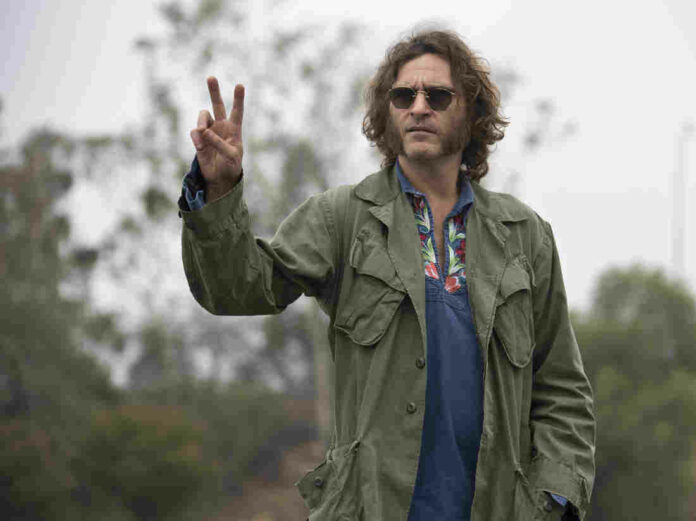
Paul Thomas Anderson’s adaptation of Thomas Pynchon’s novel, Inherent Vice is a labyrinth with no way out; the more you think about its plot and try to piece together all of its clues, the more the solution eludes you.

The point is to become immersed in its conventional setup and the lunacy of its journey through a mad and corrupt world.  The film unfolds like a ’70s conspiracy thriller where everything leads “straight to the top” (think Chinatown), except that Inherent Vice offers no solution to the mystery or reprieve from the paranoia.

Doc (Joaquin Phoenix), a private investigator, is looking into the disappearance of his ex-girlfriend’s millionaire boyfriend, who has a girlfriend, who also has a boyfriend. The story has even more friends, girlfriends, boyfriends, non-friends, and people who are just downright unfriendly. Oh, and things get much more convoluted than that.

The film also jumps from one moment to the next without disclosing how we got from point A to point B. Anderson’s movie seems to be about as stoned as its characters and as hungover as the time period it depicts. This is deliberate: regardless of whether or not you agree with Anderson’s unconventional vision, you have to marvel at the uncompromising nature of his intent.

What were we talking about? I don’t know. Forget it.

Inherent Vice features an enormous ensemble cast who play exaggerated caricatures of 1970s archetypes in a dense plot with hippies, prostitutes, drug dealers, dirty cops, and rich men gone crazy, creating a hallucinatory world full of distinct individuals (and memorably over-the-top performances from Josh Brolin, Benicio Del Toro, and Martin Short).

In order to enjoy the film you have to get lost in each individual moment and not worry about where the plot is heading. 

The viewer is never given a gateway into any of the characters’ experiences through stylistic flamboyance, as in other films about druggies. Anderson avoids point-of-view shots or any subjective visuals but rather plants his camera down and simply observes these whack-jobs. He’s creating a sense of time and place where the characters are trying to hold onto a lifestyle that is fleeting. 

If taken as a plot-driven procedural, Inherent Vice would be a frustrating mess with one-dimensional characters and underdeveloped plotting. Taken as a period piece, it fascinates in almost every moment.

The film initially immerses you with its genre conventions, which recall the paranoid thrillers of the ’70s, before it subverts their formulae and leaves you lost in its insane world without any coherent resolution.

By the time the credits came, when I was airlifted out from the labyrinth, I found myself eager to return. There has to be an answer to the mystery. There has to be someone at the top pulling all the strings — right? Or has the movie just made me as paranoid and stoned as hippies losing touch in the ’70s?

Blasted is overtly shocking theatre

0

Provocative and dramatic, British playwright Sarah Kane’s Blasted was met with hostility and outrage upon its 1995 debut. The play was originally condemned for its use of absurd brutality (in one scene, for example, one of the characters sucks out another’s eyes). But it quickly became a historic piece of theatre.

In commemoration of its 20th anniversary, Pi Theatre is presenting the second-ever professional staging of Blasted in Canada. Despite its legacy, the play has only been staged a handful of times in all of North America. North American producers have been largely unwilling to confront the ambitious theatricality and courageous acting that the play demands.

Artist Director Richard Wolfe and the Pi Theatre have endeavoured to bring the conversation surrounding Blasted to Western Canada. The play continues to generate controversy due to its intense violence, but it is also demanding and highly theatrical on an artistic level.

“The play is about the link between intimate violence and the institutionalized violence of war,” explained Wolfe. “The violence is not a glorification of violence, it is not for entertainment, but [Sarah Kane] was showing that all war is a nightmare.”

The play opens with a disturbed man’s brutal seduction of a young woman in his hotel room. The wrenching domestic scene is interrupted by the arrival of a war-hardened soldier — an event that blasts open “the metaphorical door that stands between us and institutional violence,” Wolfe explained.

Still, the play portrays the profoundly sensitive side of humanity. “It is a love story, too,” Wolfe described. “There is a real sense of need [for] compassion and human contact.” The play is the convergence of the most horrific, malicious acts with the desire to be loved.

Written when Sarah Kane was only 23 years old, Blasted was the first of five plays she wrote before the her suicide in 1999 at the age of 28. Her influential work deals with love, desire, pain, torture, and death.

Wolfe’s production features daring and brilliant actors Cherise Clarke, Raresh DiMofte, and Michael Kopsa. Acclaimed set designer Drew Facey confronts the challenge of creating a set capable of exploding each show, while Simon Fraser University alumnus Remy Siu will provide sound design.

After the performance, audience members are invited to mingle in Pi Theatre’s adjoining lounge. “The play doesn’t give answers, it just makes you think and makes you feel,” explained Wolfe. “We want people to come down after the show and have a couple drinks and talk about the experience.”

People who are interested in dangerous art and polished aesthetics will enjoy this non-traditional performance. “There is high theatricality, there is fantastic acting — the play is electric,” described Wolfe. “If you like theatre [that] you will be engaged in, then you’d enjoy [Blasted].”

Blasted will be presented by Pi Theatre April 10 to 25. For more information, visit pitheatre.com.

An alien race clashes with humanity in Home

0
Photo courtesy of Dreamworks Animation.

Tim Johnson’s Home is a computer animated science fiction-comedy film about an alien invasion with an interesting twist. Themes such as friendship, accepting differences, and finding a place of belonging are blended with a good dose of humour in this fun-filled kids’ movie.

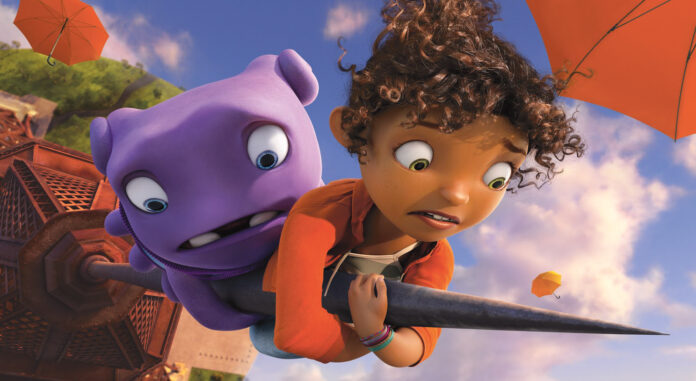
Home begins when an alien race, the Boov, uses an anti-gravity special power to captivate and transport humans to a distant desert planet in order to take over Earth. Unlike most members of his alien race, Oh (Jim Parsons) is an overly enthusiastic and lovable Boov who naively believes that everyone is his friend.

In reality, Oh is strongly disliked by fellow Boov, a feeling that is only augmented by his serious blunder: Oh accidentally invites the entire galaxy, including the Boov’s enemy alien race, to his housewarming party.

Banished from the Boov and attempting to run away to a Boovless spot on Earth, Oh runs into a feisty human girl named Tip (Rihanna) who escaped captivity and now longs to reunite with her mother. Although Tip is initially repelled by and distrustful of Oh, both eventually develop a friendship and unite to find Tip’s mother — and save the planet while they are at it.

The hero of the movie is Oh. His use of incorrect English (possibly correct in Boov language) in statements such as “can I come into the out now?” or “my warming-of-house party” are sure to draw laughs and ‘awws’ from the audience. Jim Parsons’ voicing of Oh further adds to the character’s likeability.

One of the most amusing scenes in the film comes when Oh is unable to stop his body parts from bursting into dance when he is first introduced to human music.

Although the storyline is fairly simplistic and mostly geared towards young children, the film provides deeper messages that adults will surely pick up on. In one scene, Oh tells Tip that the Boov were informed that the human race was backwards and needed the Boov to liberate them, an obvious reference to colonialist ideologies.

In Home, acts of friendship and understanding are what lead to viable solutions to the world’s problems. Tip and Oh team up to find Tip’s mother and fix Oh’s mistakes, suggesting that this may be the only way to build a sustainable home.

All in all, Home is an adventurous ride, with an important lesson on friendship to teach its young and mature audiences alike.

Cézanne, The Poetics of Space, and Unscrolled impress at the Vancouver Art Gallery

0
Photo courtesy of The Georgia Straight.

Last Wednesday, I had the pleasure of visiting the Vancouver Art Gallery and seeing its three stunning exhibitions: Cézanne and the Modern, The Poetics of Space, and Unscrolled.

On the first floor of the gallery until the May 18, you can find impressionist paintings collected between the 1940s and ’50s by Henry and Rose Pearlman.

As indicated by its name, this exhibition is focused largely on works done by painter Paul Cézanne. Working with materials such as watercolours, Cézanne pushed his bright colours outside of his sketched lines as a reaction to the complexities of real life — he was building his works out of pure colour.

All of the pieces on display in this collection showcase artists who were reacting to the invention of the photograph — once real life could be captured in that form, painters and sculptors began to challenge themselves to create their own vividly colourful and often over-exaggerated impressions of life.

The Cézanne exhibition features works that cannot be found anywhere other than this tour collection — they are usually housed at Princeton University. I would recommend checking this exhibition out for the rare opportunity to see this stunning collection.

Until April 6 on the second floor of the gallery you will find Unscrolled, which includes a collection of works by 10 currently active post-modern Chinese artists who are both challenging and working within confines of traditional Chinese art and history. I found this exhibit extremely stunning; all the works pushed boundaries in their own way to create memorable pieces addressing Chinese culture and heritage.

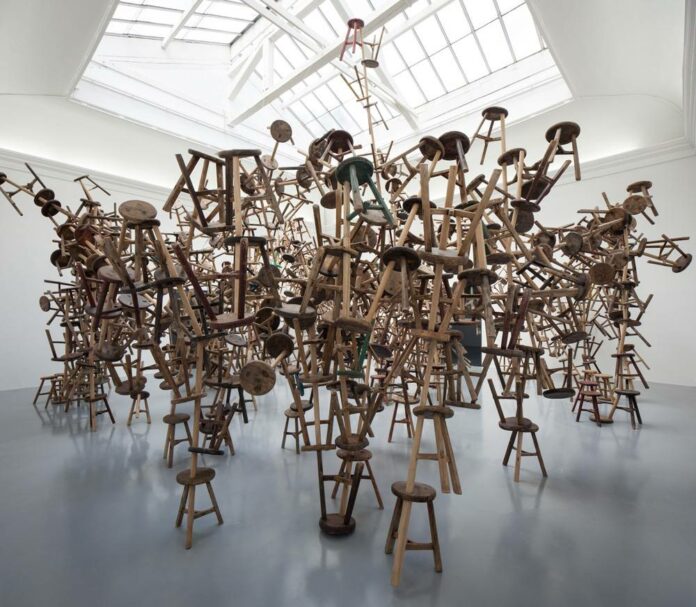
In one room, you can find an interactive piece entitled Bang by famous Chinese activist and artist Ai Weiwei. This piece is made up of almost 900 antique chairs that were traditionally found in Chinese homes due to their resilient structure and ease of creation. Needless to say, Bang is completely breathtaking. Visitors are free to walk through the art and interact with it as it tells a story of Chinese culture now lost.

On the third and final floor, until May 24, you can find The Poetics of Space, an exhibition curated around the investigation of space and our place within it. The artists featured in this collection range from historical to current. Because of this, each piece or set of pieces is unique. The viewer is given a wide range of styles, mediums, and outlooks via the varying perspectives of each artist.

It is clear that while each of the current exhibits at the Vancouver Art Gallery are able to stand alone, they all benefit from one another’s themes and reception.

A walk through the gallery starts with some of the early beginnings of the rejection of standards and practices in art and the world. You are then led into a new age of self-reflection that looks back while striving forward, and you end with varying perceptions on the world around us and the ways in which artists throughout history have challenged our perspectives. What a wonderful way to spend a day.

A conversation with Vancouver’s rising hip-hop star, Dkay

2
Photo courtesy of Hip Hop Canada.

Having dropped his debut album last October and opened for major hip-hop talents including MGK, YG, and Hopsin since, Dkay is a rapper to watch out for in Vancouver’s local hip-hop scene. His fun and energetic music, along with his promotion of the city, have given his name a lot of buzz within Vancouver, and he’ll be opening for big-name Atlanta rapper Waka Flocka Flame on April 9 at Venue.

Photo courtesy of Hip Hop Canada.

The Peak: How excited are you to perform with Waka Flocka Flame?

Dkay: I am pretty excited moving forward with this show; there is going to be a lot of high energy and I like that. Waka Flocka is for sure one of the bigger artists I’ve opened for and that’s [. . .] got good energy because the crowd’s really excited.

P: When you are on stage performing, what type of vibe do you like to give off?

D: I’ve been MCing and hosting parties for a really long time, so I have a good ability of reading the crowd and trying to keep the energy high and keep them interested. I like to bring my audience through a story, and I give a little introduction before each song so that they know what they’re expecting and they can feel a vibe off the song before it starts.

P: Who are your biggest influences as an artist?

D: I would say there’s a mixture of 50 Cent and Nelly. Those dudes made me really want to start rapping. Since I’ve been rapping I’ve been influenced by Drake, YG, Ty Dolla Sign, and Lil Wayne. You know, it kind of changes as the music changes.

P: Do you feel you fit into a subgenre within hip-hop?

D: I would definitely say that my sector is not defined yet. Every region has their own style: East Coast, West Coast, the Bay Area — even Toronto has a developing sound. I’m trying to do the same thing and put Vancouver on the map, and come out with something that’s unique.

P: Being from Canada, have you found it tougher to sell yourself as a rapper and artist?

D: To be honest, I actually find that Canada is the least receptive to my music. In the United States and different countries they are used to having different outlets for music, so they are less picky. In Vancouver they support their local artists, but they also want to hear music from major artists that don’t come from the city.

P: Where do you see yourself within the Vancouver hip-hop scene right now and in five years?

D: I am about to put out another EP in a year. In five years, I hope to be an established mainstream hip-hop artist in Canadian and American markets, hopefully overseas as well, and I’m trying to set up my own record label called Leftside Music Group, but I’m the only artist on there right now. I’ve got a couple different producers and songwriters working for me right now, but I’m hoping to sign other artists once I blow up.

P: Referring to your song “Friend Zone,” what advice can you offer to the fellas struggling with the friend zone?

D: The reason it comes up is because guys are a little bit shy and nervous, and don’t really know how to put their true feelings on the table. And that’s when guys get put in the friend zone. If guys put their genuine sides forward, a decent girl’s not gonna shut that down. I think we gotta stop worrying about being embarrassed and just go for it.

Do the Honours

0

page2feach

Introduction

A couple of weeks ago it was announced that Bill Nye would be receiving an honorary degree from Simon Fraser University.

Best known as the host of the ‘90s American educational TV show Bill Nye the Science Guy, Nye is the CEO of The Planetary Society, and was recognized in 2010 with the Humanist of the Year Award from the American Humanist Association.

He will be among four individuals who will speak at SFU’s convocation ceremonies this October, and in exchange for his words, he will be given an honorary doctorate in science from our school.

The announcement was met with a lot of excited buzz from many students, who were undoubtedly entertained and educated by Nye during their formative years and who are now relishing the opportunity to see him in the flesh.

Although Nye may be one of the biggest names to receive this distinction in recent memory, SFU hands out a number of honorary degrees during every convocation ceremony. Since our school opened in 1965, 296 have been given out.

Over the years, this practice has been met with scrutiny from some members of the SFU community who question whether it is appropriate to hand out degrees to people who have little to nothing to do with the school, and have not acquired them through the same hard work as students.

Since honorary degrees are an SFU Senate decision, criticism also occassionally emerges over whether these honours are perhaps just presented to the highest bidders. This sentiment was  made clear in a letter to the editor in The Peak in 1968 that stated“a lot of students bitch about having to pay too much for their university degrees, but has anyone thought about how much H.R. MacMillan and the others who will receive honorary degrees from Simon Fraser have paid or will pay for them.”

Nevertheless, whether for good or bad, there are many SFU honorary degree holders who are quite notable. The following people may all come from different walks of life and have made their living in a number of different ways, but they all share one thing in common: they got degrees from SFU without having to do this whole ‘attending the school’ nonsense.

1965: The Rt. Hon. Lord Lovat

Before a single student was even given the chance to earn a legitimate degree from SFU, five people were given honorary titles. Four out of the five, including BC premier W.A.C. Bennett, were instrumental in the creation of the new university. The fifth, however, attended the school’s official opening ceremony on a rare visit to Canada.

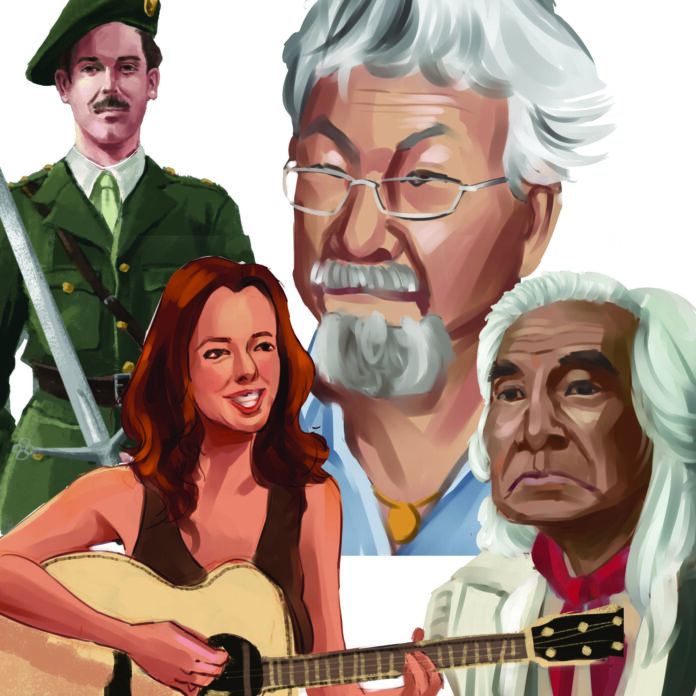
The Rt. Hon. Lord Lovat was born in Inverness, Scotland in 1911. As a commanding officer in the Dieppe Raid during World War II, Lovat was awarded the Distinguished Service Order (DSO). He later joined the British Government as Parliamentary Under-Secretary of State for Foreign Affairs, but resigned upon Prime Minister Winston Churchill’s election defeat. He formally retired from the army in 1962 but retained the honorary rank of brigadier.

His connection to Simon Fraser? His name was Simon Fraser. Brigadier Simon Christopher Joseph Fraser, 15th Lord Lovat and 4th Baron Lovat, DSO, MC, TD, to be precise. Although he is not the Simon Fraser for whom the school is named, he attended SFU’s opening ceremonies as a representative of the Fraser Clan, the Scottish family the school is named after.

He didn’t get his degree for free, either. He donated a claymore  — or great sword —to SFU. It was first used by a Fraser at the Battle of Culloden Moor in 1746, and it quickly found a use at SFU as an intramural sports trophy during the school’s early years. It remains a part of convocation ceremonies to this day, as the claymore bearer is the one who leads all graduands to Convocation Mall.

1967: Marshall McLuhan

While today the words “the medium is the message” are certainly spoken several times a day within our school’s communication department, back in 1967, the concept was still relatively new. In the very same year that famed communications philosopher and professor, Marshall McLuhan, published The Medium is the Message, he spoke at SFU’s very first-ever convocation ceremony.

Born in Edmonton in 1911 and raised in Winnipeg, McLuhan enrolled in engineering at the University of Manitoba but quickly switched faculties and earned his BA in 1933 and his MA in English a year later. He proceeded to study at Cambridge, where he received his PhD in 1943, before returning to North America to teach, at which point he began to focus intently on media studies. He published his most famous book, Understanding Media, in 1964, and was a fixture in media discourse in the late ‘60s, returning to relevance with the rise of the Internet.

Two thousand guests were on hand to watch McLuhan deliver his convocation speech, and he shared the spotlight with fellow honorary doctorate recipients Madge Hogarth and Leon Koerner, as well as 12 graduating students, SFU’s first student to receive a PhD and, according to The Peak’s coverage, the “curious mall roof” — which, despite fears to the contrary, did not collapse and crush the entire audience.

1971: Daniel George

A longshoreman, a construction worker,  a school bus driver, the band chief of the Tsleil-Waututh Nation, an Academy Award-nominated actor; Daniel George wore a lot of hats over the course of his lifetime. One of those hats ended up being the funny ones you have to wear at SFU graduation ceremonies, where he was presented an honorary degree in 1971.

Born as Geswanouth Slahoot in North Vancouver in 1899, George originally went by the English name Dan Slaholt until it was changed upon his arrival at residential school at age five. After spending most of his life working odd jobs and being a band chief, in 1960, at age 60, he picked up his first acting job on a CBC television series called Cariboo Country. After a few other minor roles in TV and film, George was offered a major part in the revisionist Western comedy Little Big Man, starring Dustin Hoffman.

George received acclaim for his performance in the film and won several awards, including the Producers Guild of America Award, the National Society of Film Critics Award, and the New York Film Critics Circle Award. His introduction at the 1971 convocation ceremony, however, made it clear that he was being honoured for more than just his acting. It was written that “it is the man himself rather than the actor we chose to honour: a man of dignity, wisdom and gentleness, a leader well qualified to guide his people caught in the throes of transition.”

1983: Jack Webster

Perhaps the most prominent and most controversial journalist to ever work in BC, Webster’s honorary degree is especially significant in that his nomination sparked contention within the SFU community.

Born and raised in Glasgow, Scotland, Webster grew up with an incredible work ethic: by the time he was 16, he had already dropped out of school and was working three newspaper jobs at once. He worked 14-hour days, including weekends, and often covered the city’s roughest crime beat, Gorbals, an area in which “policemen go in threes.” In 1939 he joined the British Army, served for four years, became chief reporter for a London tabloid and then packed up and moved to Vancouver.

After six years at The Vancouver Sun, Webster switched over to radio, a medium he would continue working in for essentially the rest of his life. He began his own hotline show in 1978, and was still working on it when he was honoured by SFU.

This honour was challenged by SFU’s student society president, Ross Stewart, who believed Senate’s choice was politically motivated. Stewart stated that “a lot of the selection process is political, as well as due to lobbying,” and that Webster’s selection was “at least in part” an attempt by the university to secure better press treatment. Webster flat out denied the charge, and told The Peak to give Stewart “my worst possible regards.”

1991: Bill Reid

One of the greatest North American artists of all time, SFU was just piling on when they finally awarded Bill Reid with an honorary degree in 1991. He already had five from other institutions, including UBC, and had received countless awards for his artwork.

Born to a Haida mother and a European father in Victoria, BC, Reid was not conscious of his native heritage until he was a teenager. At age 23, he visited his mother’s home village in Haida Gwaii,  BC, where he met his grandfather, Charles Gladstone, and learned that he had been a carver of argillite and an engraver of silver bracelets. Gladstone had learned his skills from his great-uncle Charles Edenshaw, a renowned Haida artist.

After seeing Edenshaw’s work, Reid declared that “the world was not the same” and soon dedicated his life to art with Edenshaw as his inspiration. Reid created over 1,500 works over his illustrious career. His most famous pieces are two twin statues: The Jade Canoe, which is located at the Vancouver International Airport, and The Black Canoe, which was placed at the Canadian Embassy in Washington shortly after Reid earned his honorary degree from SFU.

Reid was responsible for reviving a great deal of Haida art and culture. He was pivotal in introducing the world to the great art traditions of the indigenous people of the Northwest Coast. According to the biography written by the Bill Reid Gallery, “his legacies include infusing that tradition with modern ideas and forms of expression, influencing emerging artists, and building lasting bridges between First Nations and other peoples.

2000: David Suzuki

Fifteen years before Bill Nye’s honorary degree was announced, SFU recognized another ‘science guy’ who starred in his own television show.

A third-generation Japanese-Canadian, David Suzuki was born in Vancouver in 1936. In 1942, during the Second World War, he was sent to live in an internment camp at Slocan, in the interior of BC, along with his mother and two sisters, while his father was forced into a labour camp. After the war, the family moved east and eventually settled in London, Ontario.

Suzuki attended university in the United States, acquiring his BA in Biology in 1958 from Amherst College in Massachusetts, and his PhD in Zoology from the University of Chicago in 1961. He soon returned home to work as a professor in the genetics department at the University of British Columbia, a post he held for almost forty years. While at UBC, he had a major influence on the careers of many young scientists, some of whom would go on to teach at SFU.

Suzuki began his broadcasting career in 1970 as the host of the weekly children’s show Suzuki on Science on the CBC. Although the show only lasted a couple of years, he continued to work in TV and radio and eventually took over as host of The Nature of Things in 1979, which he hosts to this day.

Beyond his academic and television work, Suzuki is an outspoken activist for protection of the environment and is well-known for criticizing governments for their lack of action on the issue. According to his introduction at the 2000 convocation, “Dr. David Suzuki has worked to make this world a better, safer place for everyone.”

2004: Special Convocation: The Dalai Lama, Shirin Abadi, Desmond Tutu

During a historic visit to Vancouver by three Nobel Peace Prize winners in 2004, SFU presented honorary degrees at a special convocation held at the newly restored Christ Church Cathedral on April 20. While the 14th Dalai Lama, Tenzin Gyatso, made all the local headlines, he was also accompanied by two other notable figures.

Shirin Abadi, an Iranian human rights activist, gave an address in which she called upon our youth “to tolerate and to listen to the opposing opinions and take them to heart,” and also emphasised the importance of the role that governments have in supporting education.

Desmond Tutu, the first black Archbishop of Cape Town and bishop of the Church of the Province of Southern Africa — famous for his campaigns to fight HIV/AIDS, tuberculosis, poverty, racism, sexism, homophobia, and transphobia — followed her speech and apparently “had the audience in stitches with his good-natured wisecracks,” according to The Peak. “By the end of his address,” the article continued, “several observers were seen wiping tears from their eyes.”

For his part, the Dalai Lama also entertained the crowd, which had a ticket lottery due to high demand. He noted that a church was an interesting venue for the ceremony, and that the event was a fine example of religious harmony. While he joked that “of course, I’m Buddhist. To myself, Buddhism is best,” he clarified “that doesn’t mean Buddhism is best religion of the world.”

2011: Sarah McLachlan

While it is common for recipients of honorary degrees to treat guests of that year’s convocation ceremony with a speech, it is rare that they also sing them a song.

When singer-songwriter Sarah McLachlan was given an honorary doctorate in fine arts in recognition of her charity work in 2011, she serenaded the audience with two songs that were met with a standing ovation from a large part of the crowd.

Born in 1969 and raised by adoptive parents in Halifax, Nova Scotia, McLachlan took to music at an early age. As a child, she took vocal lessons, as well as lessons in classical piano and guitar. While her high school bands were short lived, her school’s yearbook predicted that she was “destined to become a famous rock star.”

After signing a record label in 1988, McLachlan moved to Vancouver, and with the release of her second album Solace in 1991, she had her mainstream breakthrough in Canada. She has since released six more studio albums and has earned multiple platinum certifications.

In 1996, she co-founded Lilith Fair, a unique concert tour and travelling music festival which consists solely of female solo artists and female-led bands. The festival ran for three summers before being revived in 2010.

McLachlan has become notable for her charity work, and has raised millions of dollars for women’s charities, AIDS sufferers, and inner-city kids, not to mention her work for the ASPCA, to which she leant her song “Angel” for a commercial that is impossible to watch without being brought to tears. While her convocation speech was brief, she told graduates to “dream big” before launching into a performance of her song “World on Fire.” 

Standard Party First Aid & CPR: How to assess and resuscitate a lame party

0

Congratulations on enrolling in your first Standard Party First Aid & CPR course. The skills you learn here will ideally never have to be used in real life, but they will be helpful in preserving fun times if the occasion ever rises.

In this unit, you’ll learn the steps on how to handle yourself if at a party where you and others are at risk of not having a good time. We will also cover how to asses the situation and perform basic Cool Party Recovery (CPR) in order to prevent further loss of fun.

Note: In this scenario, we will be looking specifically at incidents that happen within a person’s household. Major buzzkills can occur outside of the home, and should be handled on a case-by-case basis.

Illustration by Chen Chen

The “rescue process” and assessing the situation

Start things off with what’s known as the “rescue process.” First, assess the scene and check that there are no immediate threats that could put you at risk of being totally over this party. Once it has been determined that the party is salvageable, you should focus on the “primary emergencies”; if someone looks near the breaking point or like they’re about to start a fight out of sheer boredom, they are a primary emergency and should be assisted first. After that, you can take care of “secondary emergencies,” or people who are clearly not enjoying themselves but are still managing to force a smile.

Note: Assessing the situation is the first and most important step. If a party is clearly beyond saving, there’s no sense in endangering your own social life by also becoming a victim. 

Illustration by Chen Chen

Moving someone into the “recovery position”

One of the most important things to know about Standard Party First Aid is the “recovery position.” After checking for primary and secondary emergencies, do a visual assessment of which attendees are the least attractive. (Anyone below a five on the hotness scale should be noted but this can be a sliding scale, depending on the number of people at the party.) Approach the >5s one by one and inform them that you know Standard Party First Aid and you’re here to help the party. After they’ve given their consent, gently help the person to the floor and roll him/her onto their side so they are facing away from the rest of the party. Once they’re in the recovery position, ensure they are comfortable and move onto the next person.

Illustration by Chen Chen

If someone is choking up or telling a bad story

If you spot someone openly trying to flirt with another person but they keep choking up and making things awkward for everyone, you may have to intervene. Encourage the bumbling individual to bend slightly at the waist and repeatedly hit his or her upper back, flat palmed, until all of the dumb anecdotes and cheesy pickup lines have been successfully forced from the person’s airway.

Note: To verify that a person is completely out of boring things to say, have them say a few sentences and listen for any references to their new addiction to juice bars or cliche jokes from early ‘90s SNL skits. If present, it’s possible you will have to reapply another cycle of open-palm hits in their back. Repeat until signs of a personality begin to emerge.

Illustration by Chen Chen

Treating a smelly individual or body part

The more people there are in a room together, the higher the risk of one or more of those people having pungent body odour. When left untreated, an individual’s stank can severely bring down the mood of a party and may even lead to some attendees saying they have to work in the morning and leaving early. Help the affected smelly person to the nearest sink and run warm, soapy water over the stink-infected areas. If the odour persists even after being washed, call emergency party services and inform them of the situation.

Illustration by Chen Chen

Moving someone who’s passed out from boredom

In severely boring cases, a person can actually fall asleep while standing up and injure themselves by toppling over. If you see someone continuously yawning and with their eyes less than 10 cm open, they could be at risk of passing out. Quickly recite them a joke you read on the Internet or talk about how your friend’s friend once hooked up with Quentin Tarantino and it was apparently as weird as you’d think it would be. Your main goal is to keep the person awake until a Flip Cup tournament can be organized or someone suggests ordering pizza.

Note: If you’re too late and the person has already collapsed from boredom, help move them to another room and inform the host. They’ll regain consciousness later on when the party is either picking up or officially winding down.

Illustration by Chen Chen

Applying an arm sling to prevent over-texting

If you notice a person has been constantly checking his or her phone all night, they might be suffering from broken social skills and will require your immediate attention. Using a piece of fabric, wrap the person’s dominant hand and tie the ends into a knot behind his or her neck. Ensure the fabric is tight and the hand cannot escape. While this won’t prevent someone from checking their phone entirely, it will at least slow the process until they finally leave or their phone dies.

Note: An arm sling may also be necessary if the person is always showing other attendees pictures of his or her kids, even without prompting.

You are now equipped to administer Standard Party First Aid & CPR in any situation that might be in danger of reaching critically un-fun levels. Remember that, as an administrator of Standard Party First Aid, you have a responsibility to ensure maximum enjoyment is had by all and that any threats to a good time are dealt with safely and in a timely fashion.

The upcoming soccer matchups include a rematch between last year’s finalists

0
Image Courtesy of Soccer Talk

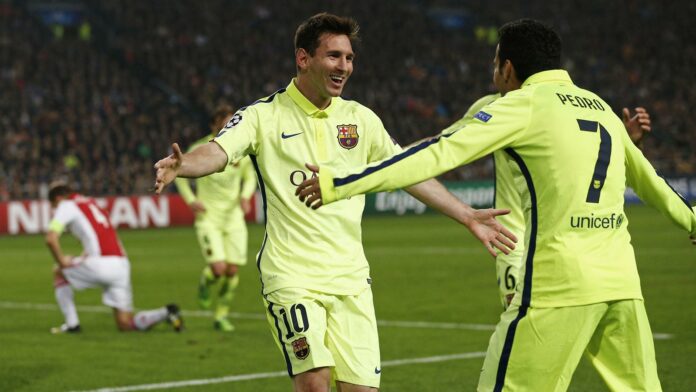
The Champions League quarter-final participants were determined March 19, and the announcement provided us with a slate of quality matchups, including a rematch of last year’s final and yet another match between players Zlatan Ibrahimovic and Lionel Messi.

Reaching this round is a very big deal for these clubs — only five more weeks of games remain in the 21-week tournament to crown the champion. The first matches will start Tuesday, April 14 after the international break ends. Here are my predictions for the round of eight:

PSG vs. Barcelona

These two teams always seem to face each other; they met in the round of eight in 2013 and were in the same group in this year’s tournament. Despite pulling off a thrilling last-minute upset against Chelsea in the round of 16, PSG are the clear underdogs against Barcelona. Both teams won at home during the group stage, and PSG will also be without Ibrahimovic for the first leg, as he got a controversial red card in their last match. But after Messi’s performance against Manchester City at the Camp Nou, how could you go against him?
Prediction: Barcelona

Porto vs. Bayern Munich

Porto are heavy underdogs against a very strong Bayern side — one that demolished Shaktar Donetsk 7–0 at home. Bayern also have an 11-point lead in the Bundesliga, which means they can afford to rest some key players and put all of their effort into the match. But Porto are in good form, having won or tied every game so far in the competition, something that neither Bayern nor Real Madrid can say. Porto striker Jackson Martinez will be back after missing the last leg with an injury, but it won’t be enough against a fantastic Bayern side with too much depth to go out in the quarter-finals.
Prediction: Bayern Munich

Juventus vs. Monaco

Juventus fans will like this draw, as they are facing the lowest-ranked team left in the competition. Monaco fans will also like this draw, as they avoid the four heavy favourites in Barcelona, Bayern Munich, Real Madrid, and Atletico Madrid. Juventus will be the odds-on favourites in this matchup, but will be without influential midfielder Paul Pogba, as he is out seven weeks after being injured in their last match against Borussia Dortmund. Juventus are stronger defensively than Arsenal, but should be cautious not to underestimate Monaco like Arsenal did at home.
Predicted Winners: Juventus

Real Madrid vs. Atletico Madrid

Probably the biggest matchup of the quarter-finals sees a rematch of last year’s final between two bitter rivals. Although on paper Atletico Madrid is the lesser team, Atletico seem to have had Real Madrid’s number since the final, having won four games and drawn two against them since, including a 4–0 thrashing in February. Real’s recent form has not been very good, and it will be interesting to see what manager Carlo Ancelotti does to try to repair the situation. Atletico barely got through to this stage, having to win on penalties. It will be a very even matchup, but I think Atletico can pull off an upset here and advance.
Prediction: Atletico Madrid

I think someone hid raptor eggs for the kids instead of the store-bought eggs I watercoloured

0
Illustration by Momo Lin

Good work, team! That’s an official wrap on another Burnaby Heights Neighbourhood Easter Egg Scavenger Hunt. This event wouldn’t have been nearly as successful without all of our volunteers. Every one of you really gave it 110 per cent this year, the kids all seemed to really enjoy themselves, and I’ve already had some good feedback from a few of the parents.

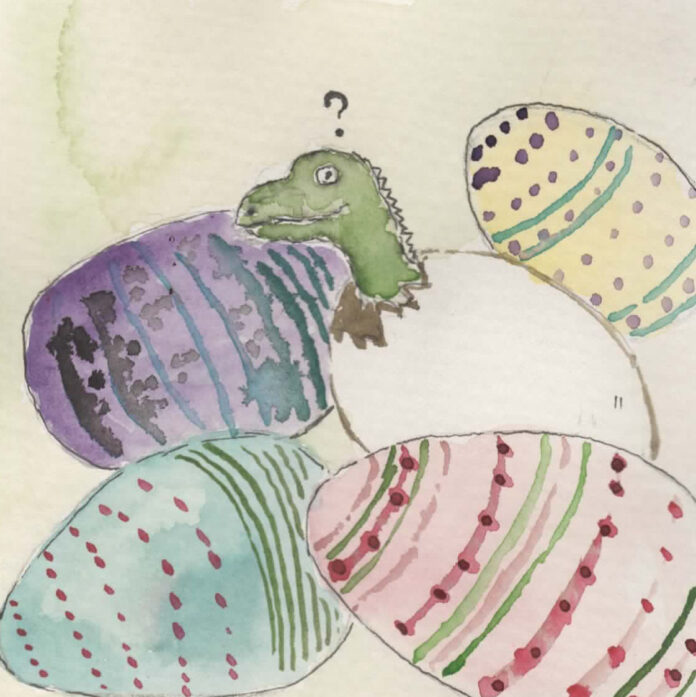
Also, it’s probably unrelated, but I thought I’d mention it anyways: I noticed that my stockpile of precious velociraptor eggs seems to have misplaced itself sometime in the last few hours. Has anyone seen my dinosaur eggs? They’re large, sort of an off-eggshell white, and whenever you hold one, you get the overwhelming feeling like you’re playing god.

The last place I remember seeing them was in the rec centre supply closet. I was busy counting them, as someone with two dozen velociraptor eggs often does, when Francine asked to help with a particularly nasty streamer entanglement outside. When I came back, my pile of eggs was missing. Does anyone remember moving them?

Perhaps you saw them on the floor and moved them onto a shelf so they weren’t a tripping hazard? Or maybe someone shuffled my dinosaur eggs out of the way so he or she could have easier access to the beautifully watercoloured eggs I prepared for the Easter egg hunt? Nope? You sure you didn’t accidentally move them, Carol? Just checking.

I also hate to bring it up, but I wish that you guys had followed my instructions and hid all of the Easter eggs instead of just some of them. There’s no point in us having leftovers because it’s not like we can save them for next year’s hunt. Judging by how many Easter eggs are left in the supply closet, I’d say you guys hid less than half of them.

Like, a lot less than half. Not even a dozen, or maybe even fewer?

Try to remember, folks: this holiday isn’t about us, it’s about making the kids happy. And you know what makes kids happy? Finding watercoloured eggs on the ground and putting them in a little pastoral pink or yellow basket. If that’s not Easter, I don’t know what is.

After talking to you all here, I think it’s pretty clear what happened here. We have to acknowledge the reality that someone, Carol, likely mistook the genetically modified raptor eggs I’ve been working on for the last 10 years for the $5 chicken variety that I spent an hour decorating with stripes and polka dots.

We don’t have to panic, though. Not yet. The eggs aren’t set to hatch for a few more days, so that should be enough time to find out who took them home, trade the raptor eggs for the decorated ones, and verify that it was klutzy Carol who accidentally used the wrong eggs. Sorry, I mean figure out who moved them.

Well this whole event went from fun to none fairly quickly here. Everything should work out okay though. The only real threat is Carol’s incompetence.

Sorry, Carol. We all thinking it.

Union members vote “yes” to strike vote

0
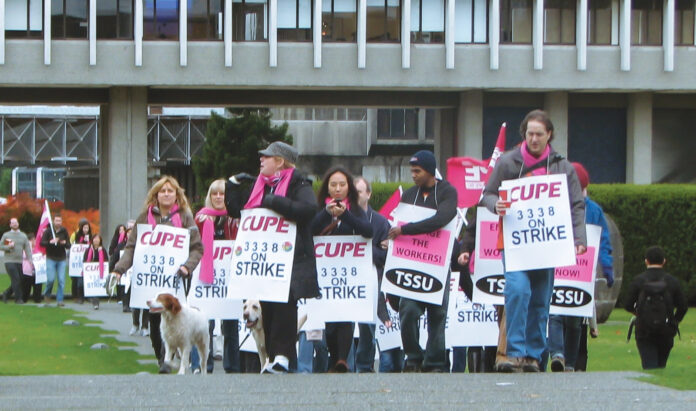
TSSU members last went on strike in 2012. - Photo courtesy of vancouverwob.blogspot.ca
TSSU members last went on strike in 2012. – Photo courtesy of vancouverwob.blogspot.ca

After almost a year of negotiations with SFU, the university’s Teaching Support Staff Union (TSSU) has voted overwhelmingly in favour of the option to take job action this summer.

In a vote held between March 24 and 26, 92 per cent of TSSU voting members voted against the current offer from the university. Their previous collective agreement expired on April 30, 2014.

As a result, the university’s teaching assistants, tutor markers, sessionals, and English language and culture interpreters will now decide whether to engage the strike vote to commence job action, or choose to wait.

Should the union choose to engage in job action, they would be putting pressure on the administration without withdrawing their services, therefore retaining their wages. However, they must hold an additional vote should they wish to initiate a picket line and withhold all services.

Since February of this year, there have been 15 bargaining sessions between the two sides, with neither reaching an agreement. “Without some additional pressure, it is the opinion of the contract committee that no progress can be made and we will be forced to accept the employer’s concessions,” stated the TSSU website.

“Our members have spoken with a unified voice, and they are demanding that SFU’s administration engage in serious, good faith bargaining to address their concerns,” said Derek Sahota, spokesperson for the TSSU, in a press release. Sahota referred to the current agreement as “a broken system,” which he believes SFU could easily repair at no extra cost.

The TSSU’s Chief Steward, Reagan Belan, outlined what she felt were the key issues facing the union: job security for sessional instructors; benefits and equity for continuing language instructors at Harbour Centre; priority access to teaching assistant work for graduate students, and equal pay for equal work for all teaching assistants.

“Most teaching assistants balance the responsibilities of their jobs with full-time work as graduate students, while many sessional instructors maintain several jobs to earn a living,” said Belan in the release.

The TSSU held a Special General Meeting (SGM) on March 27 to ratify the vote and elect members to a strike committee, who will decide the union’s course of action in the upcoming weeks.

Although the university was unable to give an updated comment before press time, their “Labour Issue” web page published the following statement early March 27: “We understand that TSSU members have voted in favour of a strike. The University remains committed to a negotiated settlement that can only take place with both sides at the bargaining table, striving to achieve a new collective agreement.”

The statement continued to note, “Even with a strike vote in hand, the union can elect to return to the bargaining table and resume negotiations.”