Home Blog Page 1039

Meet the Clan: Jared Eng

0
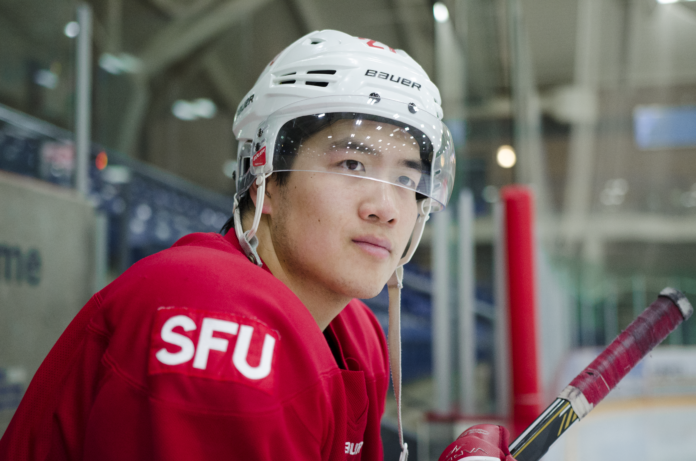
Last year, defenceman Jared Eng led all defencemen on the team with 20 points in 23 games, and is following that up with another strong season, clocking 12 points in 21 games. Image Credit: Brandon Hillier

With hockey being Canada’s national obsession, many kids grow up dreaming of donning the maple leaf, to one day play for Team Canada. Jared Eng is one of the lucky ones. He has represented his country on the highest stage — not in ice hockey, but in roller hockey at the world championships in Germany.

“It’s pretty special,” said Jared. “To wear the Team Canada jersey, it’s something you always dream of as a kid. I mean, it’s not the same as playing in the Olympics, but it’s still a good experience, and you get to play with some top-end players.”

Despite what he has achieved in inline hockey, his ice hockey career has a very familiar beginning.

“Well, growing up in Victoria they had the minor hockey team, the Panthers. And they had some good players, such as Jamie Benn and others who are in the NHL, and I remember them all playing roller hockey. I think it’s something where you can just rollerblade outside and it was similar to street hockey, except you just play on your rollerblades.”

He also said that it is good practice for ice hockey during the summer months. However, this is a matter of some debate. “I know that’s there a controversy, that some people say it’s bad for your skating stride,” he says.

“Personally, I think it’s only helped me in terms of my hands and patience. If you do play competitive, like I had with the option to go overseas and play with Team Canada, there’s some pretty talented hockey players there.”

Jared’s hockey career has not only taken him to Germany, but to the United States as well, where he played two years for the Sacred Heart Pioneers, an NCAA Division I school located in Fairfield, Connecticut. He played there for two seasons before deciding to come home and play for the SFU Clan in the BCIHL.

“[During] my two years at Sacred Heart, our team didn’t do so well, and things didn’t work out the way I wanted to and as the team wanted to. I just wanted to come back and play closer to home.”

It was also an adjustment to play in the BCIHL from the NCAA, and not just in terms of play style. “It’s a bit different. One, you’re wearing cages in the NCAA. And two, it’s a bit more scrambly, but at the same time you get some high end, young players who want to take more time to develop. I’d say there’s a difference of speed, but both leagues are very good.”

The Clan is fortunate that Jared decided to come home, as he has become one of SFU’s better defencemen the past two seasons. Last year, he led all defencemen on the team with 20 points in 23 games, he is following that up with another strong season, clocking 12 points in 21 games. He’s known for his ability to effortlessly move the puck up the ice, something that he identifies as one of his strengths.

“I think just being able to move the puck up to the forwards as quickly as I can, as well as being able to break out of the zone. I’d classify myself as a puck-moving, offensive defensemen, but I can take care of things in my own end, too,” Jared explains.

Playing at such a high level for as long as he has, you’re bound to work with some very excellent players. Most notably, he played with Ryan Nugent-Hopkins in Major Midget League. Ryan has gone on to a successful pro career with the Edmonton Oilers, after being drafted first overall in the 2011 NHL entry draft.

“When I was playing with him, I assumed he would be a pretty arrogant kid, being first overall in the WHL draft. But he’s one of the most approachable, nicest guys I’ve ever met. He’s a team-first guy, and he’s doing some special things in the NHL.”

You also don’t get as good as Jared is at a sport like hockey by being complacent. This is the reason he still has some big goals set for himself after his playing days at SFU.

“After playing for SFU, I would enjoy trying to go to Europe to play professional hockey. But it sort of depends how well we do this year, and the connections I make and who I know,” he notes.

He also would like to end the season in the BCIHL, by winning a championship: “It’s something that hasn’t happened in a little while here, but with the team we have, we can do it.”

FUN FACT:
Superstition:
Hockey players are notorious for being very superstitious, so it’s no surprise that Jared had one of his own. “If I’m not doing so well with black tape, I’ll change it up to white tape,” he says.

Bill C-51: a violation of civil liberties

0
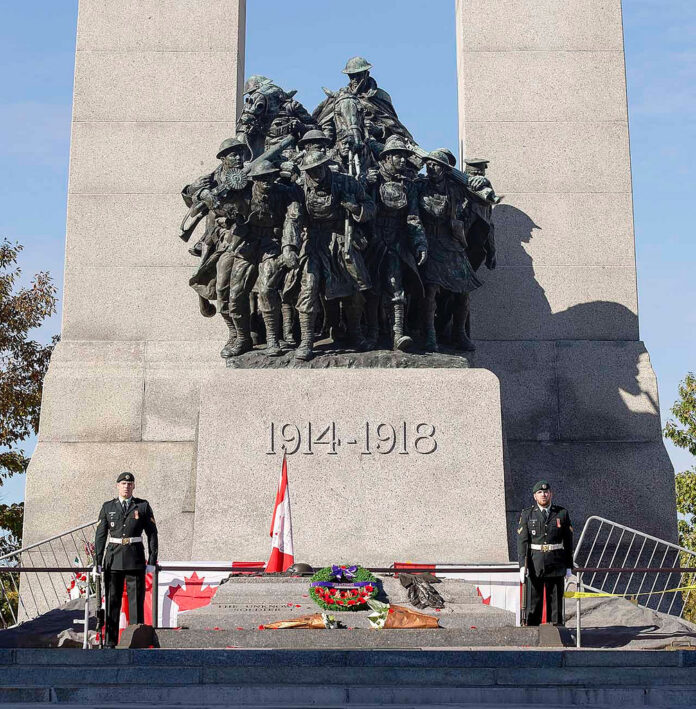
Image Credit: Canadian Forces

The Conservative majority government, led by Stephen Harper, has just introduced Bill C-51, an act that stands as one of the most authoritarian pieces of anti-terror legislation in the world.

Speaking to a nation that has seen two domestic attacks in past few months, Harper is well aware that fighting fire with fear will garner wide support amongst the Canadian public.

However, rather than seek to address the root causes of terrorism by trying to curb radicalization, C-51 erodes civil liberties and circumvents democratic oversight.

The bill gives new powers to the Canadian Security Intelligence Service (CSIS) to disrupt and interfere with suspected terror attacks, as well as giving CSIS more access to the private lives of Canadians. The bill also criminalizes the promotion of terrorism and allows for secrecy in court proceedings.

Moreover, police can now detain terror suspects without being charged for twice as long as before, and can also detain suspects on the suspicion that they may commit a terrorist act, rather than on certainty. Unlike in the UK, the US, and France, this bill does not offer any mechanism for legislative oversight to monitor the usage of these overreaching powers.

Civil liberties exist for a purpose. They entrench a fundamental distrust of any authoritarian law, however benevolent it may seem. Whether or not the Conservative government deserves the trust of the Canadian people with their most private and personal information (spoiler alert: they don’t!) is irrelevant.

Too often abuses of power and corruption go unchecked in a too-powerful state. Moreover, privacy and other freedoms allow us to maintain dignity in our lives. Once we surrender these rights, they will be gone forever; there will be no point in the future where the government will not be able to muster up some threat that warrants the continued suppression of civil liberties.

Similarly, the right to due process and a fair legal system cannot be contravened for any reason. These principles exist so that those who are convicted of crimes can still expect humane treatment and to be dealt with in courts that are open, fair, and diligent. They give courts a sense of legitimacy by holding them up to a higher standard. Without them, our legal system cannot rightly claim to be fair and just.

Harper has a proven track record of hiding things from Parliament. Several years ago, the then-minority Conservative government refused to hand over documents to Parliament that would likely implicate the government in having a hand in the torture of detainees in Afghanistan. Harper muzzled diplomats who would have spoken out, directly violated our charter, and even prorogued Parliament to stop further inquiry.

And now we are expected to trust Harper with even more power?

Harper himself has admitted he isn’t sure whether these new measures would have stopped the attack on Ottawa. So why introduce them at all? The motivations behind this law are purely political, designed to prey on a fearful electorate. Harper has turned terrorism into an issue that necessitates harsh laws and a ‘clash-of-ideologies’ rhetoric.

Harper’s sudden interest in protecting Canadians is disingenuous and illusory. Canadians must be diligent and demand that their civil liberties not be the collateral loss to fight an imaginary threat.

Ask Professor Peak

0

Are you an SFU student or faculty member who needs some relationship, student, or SFU related advice? In 150 words or less, send your issues anonymously by visiting the-peak.ca/professorpeak. Your entry could be published in our next issue, along with some helpful advice from Professor Peak!

Help! The N-word in the songs I like singing to are destroying my karaoke nights!

DEAR PROFESSOR PEAK: My friends from residence and I have taken up weekly karaoke nights and I need your advice: a lot of the songs I gravitate towards feature the N-word, sometimes prominently. This word makes me feel uncomfortable; while I enjoy the songs, I find the lyrics distasteful. I’m upset that the karaoke bar doesn’t include the radio-edited versions of songs in their lists. What should I do when these parts come up? Should I self-censor myself? Should I try to remember that it’s just a song and I’m not the one who wrote it? —ANGRY STUDENT

DEAR ANGRY: First off, props for having a weekly karaoke night with your friends! This fact alone already makes you way cooler than most people. In regards to your concerns, I think the suitable option for you would be to replace the words you feel uncomfortable saying with similar-sounding alternatives. For example, I have in the past used the word “nickel” in place of the n-word when singing songs. You could also use words like “nipple,” “nymph,” and “needle.” In fact, these alternate words could make for a highly entertaining and humourous karaoke night. If your friends are upset because you’ve chosen to use these alternatives, just calmly explain to them your concerns, and keep up the great tunes! —PROFESSOR PEAK

Get out of the classroom

0

This past summer, I embarked on one of the most memorable adventures of my life. It has become clear to me now — six months and one drained bank account later —  that studying abroad has provided me with an education I never could have received back home.

By this I mean no disrespect to SFU. I am proud to be a part of this university’s community. But there are things about this world that I could not have learned in a lecture in Saywell Hall.

As a political science student who one day hopes to work in the federal government, Canadian politics and culture is at the forefront of my interests. When I set off to study for a year in France, the last thing I expected was to be given lessons in anything regarding Canada.

To my surprise, I have learned something new about the country I call my home almost every day, all while living over 8000 kilometers away.

The regional paper I read and the locals I talk to have no connection to Canada — no fondness, no political affiliation or patriotism to cling to. I have been given an opportunity  from them to hear a multitude of opinions free from all bias, curriculum and political motivation. For me, this has played a massive role in the development of my own opinions.

While my professors have done a great job at giving me an understanding of large themes, it would all be for nothing if I could not compare it with own personal, informal experiences. This has forced me to reflect on the importance of pursuing my education on an informal level. By an ‘informal education’, I mean the kinds of learning you can’t experience in class.

I can attest to the fact that it’s easy for students to get wrapped up in their undergraduate studies. All too often I find myself worrying about having a high enough GPA, about WQB requirements, and all the little parts of my degree that will hopefully guide me towards a nine-to-five job. But four years of intro-to-this and advanced-that is not enough in terms of achieving a well-rounded education.

Living abroad has given me the opportunity to engage in conversations with students from around the world, and to hear opinions on Canadian politics and culture that I haven’t encountered back home.

Getting to have these discussions in a social setting with a small group of students from around the world serves a very different purpose than attending a lecture consisting of 100 people.

Formal schooling teaches you the ABCs of your field, but there is often very little room for a more personal discourse that allows for everyone to elaborate on their experiences, values and personal opinions. In short, attending class is simply not enough.

Living abroad has given me the opportunity to have real debates and learn about how my country’s policies are perceived on an international level.

One of the most memorable instances of this was in the days following the shooting on Parliament Hill this past fall. Many of my friends approached me, knowing that I am Canadian and that I would be following the story’s development, to talk about the media coverage and gun crime in their own countries.

While there are still another few months left in my exchange, I have reached the conclusion that pursuing learning opportunities, in unofficial and relaxed environments, is absolutely necessary in terms of establishing a complete education.

It’s important to note that studying abroad isn’t the only way to go about this kind of education, either. Whether you’re volunteering locally, joining clubs or organizations, or teaching yourself a new skill such as cooking, you will in some way be growing your own abilities and mindset. It’s important to constantly be filling your life with opportunities to learn more about yourself and the world we live in.

With this exchange also came the opportunity for me to live alone, away from everyone I’ve ever met. And while I miss my friends and family every day, I have been forced to learn how to care for myself in ways that I never had to before. These kinds of experiences help us develop ourselves, our opinions and our personal skills.

It can be hard to find the motivation to engage in these kinds of experiences. Students are often drained mentally, physically, and financially from focusing so hard on their formal studies, but the reward is worth the additional time and energy. Our degrees will ultimately mean nothing if we have no developed sense of self to prove for it.

Informal education is a way of complementing our formal schooling. We need both to build a comprehensive understanding of ourselves and the world around us.

For anyone who truly wants to prepare themselves for life’s responsibilities, to gain an edge in the competitive job market, or to make themselves a well-rounded individual, it is absolutely necessary to get out of the classroom and look for the opportunities that will balance their schooling with their learning.

SFU researchers are Stanford-bound

0
Isabelle Côté - SFU News
Isabelle Côté – SFU News
Wendy Palen
Wendy Palen – SFU News

Two SFU biology professors have been chosen for the prestigious Leopold Leadership Program (LLP) at Stanford University.

Twenty applicants were selected from across North America, in fields ranging from ecology to economics, to take part in a rigorous training and networking program. This year’s fellows include SFU’s own Isabelle Côté and Wendy Palen.

The LLP’s mission is to change the way people think about and use science in key decision making. This means translating researchers’ knowledge into policy and business action.

Côté, who specializes in invasive species and marine conservation, said she feels she was selected in recognition of her efforts to make science more accessible. Since her last sabbatical, Côté said, “I’ve been experimenting more and more with various forms of science communication.” These include Twitter, podcasts, and short videos summarizing her work.

Associate professor of biology, Wendy Palen, was also selected as a 2015 Fellow. Palen specializes in the ecology of aquatic communities. She is currently on sabbatical and did not reply to The Peak before press time.

“Scientists are notoriously bad at explaining what they do, what they’ve discovered, and why it’s important,” said Côté. “On the other hand, government is making [it] very difficult for scientists to contribute and seems hell-bent on making decisions that fly in the face of evidence.”

She hopes that the LLP will allow her to more strategically communicate and promote her discoveries. The program also provides an opportunity to network with past and present fellows and strike up collaborations.

Côté admitted she and Palen have never worked together before, but said, “You’d be surprised how many science collaborations start from social interactions!”

The LLP includes two intensive training sessions, offered one year apart, on environmental problem solving and leadership. Between sessions, fellows receive ongoing webinars and peer and mentor support while they put what they have learned into practice at their home institutions.

Accessibility and action are the major goals of the LLP, according to its website. The program aims to help researchers engage with policy makers and business people who make decisions affecting the environment. At the moment, Côté said, this dialogue is very limited — a problem that both sides must work to fix.

Côté noted the promise of the LLP’s vision of increased collaboration between scientists and government. She said, “I think that both sides need to learn and change for society to benefit more from science.”

Overall, Côté is excited to become involved with this international program. “It’s a great honour and a great opportunity,” she concluded.

Perusing the benefits of reality TV

0
Image Credits: Brandon Hillier

Some people spend their free time writing music and jamming with their friends. Others volunteer overseas, building homes and saving orphans while travelling the world.

Me, I like to watch reality TV. And that’s okay.

When people find out that I have a guilty pleasure — especially one that does not appear to have any discernible value — they always ask why. Why do you, a full-time student with many extracurricular commitments, waste your precious free time engaged in such  a dull pastime?

Editorials online explain how people watch reality TV because it gives people a certain schadenfreude, or pleasure from seeing the struggles of others. Alternatively, these shows lead viewers to juxtapose the experiences of the characters with their own lives, frequently casting themselves in a comparatively flattering light. More often than not, these explanations imagine human nature as critical, judgemental, and ultimately ugly.

Judgements like this implore viewers to peel themselves off of the couch to engage in more high-culture activities. Spending a day reading Dostoyevsky or Whitman cannot be considered a waste of time, because readers are going to take away valuable life lessons.

These sentiments imply that wasting my life away in front of these television programs is something I should be ashamed of. And if you buy into the myriad of explanations for why people watch reality TV, then yes, I probably should be ashamed of it. 

And I completely agree; thinking critically about a Beckett play or a Dickens novel  — if you’re actually engaging with the material — is a better way to spend your day than streaming the full fourth season of Dance Moms.

However, that shouldn’t devalue pleasure derived from more low-brow sources. After a long day of collaborating in seminars, writing pieces in the office, or coaching on the soccer field, watching awful TV gives my mind a break from fairly constant stress. Instead of having to engage with a program that requires my undivided attention, I can flip on Property Brothers or Project Runway and toodle around the house or type away on my laptop.

Beyond a way to turn my mind off at the end of a long day, reality TV gives me, my friends, and my family something to enjoy together. We find ourselves scheming along with the characters, cheering their victories and booing their betrayals.

For us, the latest episode of Survivor doesn’t have to leave us with some deeper insight. That’s not why we watch it. We can balance our intellectual nights spent with Tolstoy, Eliot, and Didion with our indulgent evenings spent with Jeff Probst.

When it comes down to it, I don’t have any profound explanation for why I spend an obscene amount of time watching FaceOff, or Big Brother, or MasterChef, other than it allows me to wind down and spend time with those I’m close to.

While there rarely comes a moment during an episode of Naked and Afraid that causes me to think more deeply about the human condition (unless the human condition involves shitting yourself to death on the side of a mountain in the Himalayas), reality TV is just this guilty pleasure that I love.

And that’s okay.

Study aims to reduce stigma around mental health

0

Researchers from SFU and Strength In Unity BC are “looking for a few good men” — more specifically, self-identified South, East, and Southeast Asian men, ages 17 and up — to join a conversation about mental health.

Strength In Unity’s nation-wide study, funded by the Movember Foundation, will evaluate the effectiveness of two different workshops in reducing the stigma around mental health in Asian men. This intervention study is the first of its kind in Canada.

Cindy Jiang and Peter Hoong, workshop facilitators and SFU masters of public health students, said this demographic has a strong need for dialogue around mental health. People from immigrant backgrounds seek out mental health services at a much lower rate than others, and these services often lack cultural understanding.

“There’s this odd, perhaps curious interpretation of suffering or enduring silently, and repurposing that as strength,” said Hoong, “so that in itself can also be stigmatizing.”

Rodrick Lal, professor of education at SFU and the study’s co-investigator, said this “double stigma” is often the result of traditional family dynamics that both celebrate and isolate male children. Lal said men in all societies face pressure to act as the main breadwinner and maintain their family’s reputation.

While Lal recognized that this stigma is universal, he noted that it affects certain communities differently than others. Due to a variety of factors, Asian men are often left out of the dialogue around mental health.

The two workshops being tested, Contact-based Empowerment Education (CEE) and Acceptance Commitment Training (ACT), take different approaches to mental health.

CEE focuses on connecting people with their fellow participants and the community at large in order to become mental health leaders. ACT is more geared towards introspection, giving participants the tools to tackle self-stigma.

Lal said community outreach will also involve training religious leaders. He hopes that working within existing cultural systems will encourage men to seek help.

The study is occurring simultaneously in Vancouver, Calgary, and Toronto. All three sites are currently seeking participants for the workshops which, Jiang said, are highly interactive. However, the workshops are not therapy or treatment for mental illness.

After information sessions at SFU’s Burnaby and Surrey campuses, Jiang said students’ reaction has been overwhelmingly positive.

“SFU students have been very much engaged and interested in mental health [. . .] so I think [they] should be proud of themselves for that,” said Jiang.

Jiang, Hoong and Lal hope this study will promote greater dialogue, break down cultural boundaries, and, as Lal put it, “mobilize boys and men to become champions or community mental health ambassadors to address stigma in their cultural communities.”

Get them the Greek

0

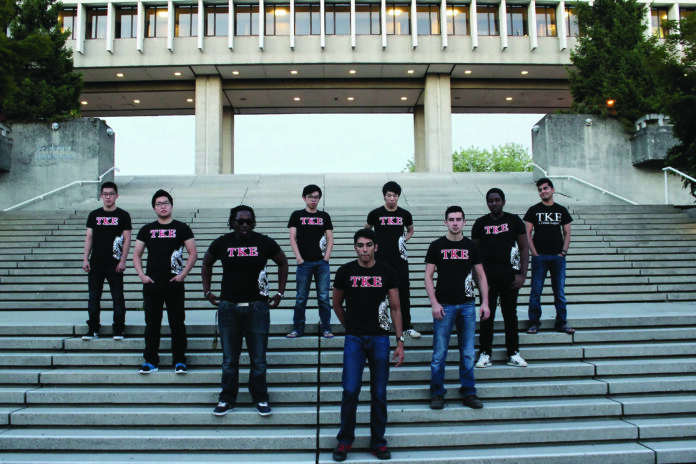
CMYK-SFU Frat TKE - Sisi Zhou

The idea of sororities and fraternities, and Greek Life as a whole, has always been a debate on university campuses. Whether universities — and their students —  choose to accept these student-led groups, greatly varies from campus to campus.

At SFU, the history of these types of organizations has been a confusing one. Tim Rahilly, as Associate VP, Students, explained that “the story of fraternities and sororities on campus, as brief as it is, is tied to its evolution as a younger university.”

When the university first opened, the question of Greek Life Organization (GLO)s on campus came up almost immediately. The issue went to the university Senate, and, according to Rahilly, they believed that “fraternities and sororities were inconsistent with the values of SFU.”

SFU was then a new, radical campus. As a result of this Senate decision, the university determined that they would have no formal relationship with fraternities or sororities. While this decision came about 50 years ago, it still “presents a challenge for the university,” according to Rahilly.

According to Rahilly, on the one hand, they want to take into account that the acceptance of and attitudes surrounding the presence of GLOs at universities have clearly changed since the 1960s, but on the other hand he said “there’s still a fair amount of dialogue that needs to occur.”

For their part, fraternities and sororities are quick to add that they are not looking for much. They plan to work with the SFSS, and eventually SFU, in the hopes of gaining recognition from the university. From there, they are looking for table bookings, room bookings, and the ability to advertise on campus ,things granted to every other SFU club. However, unlike many other clubs, they are not looking for funds.

The GLO-Down

Fraternities and sororities are “Greek Letter Organizations” based on tradition and the facilitation of long lasting connections, friendships, and family. Typically, fraternities accept anyone who self-identifies as male, and sororities accept anyone who self-identifies as female.

Christine Jamieson, of Kappa Beta Gamma, explained, “when you come to SFU, there are so many organizations and clubs, but a lot of them focus on one activity or interest. Within Greek Life, there is a place for everyone to fit in. Your place might not be within KBG, it might be within another organization, but it’s not exclusive to someone who just likes fencing, or someone who just likes tea.”

All the organizations stress that it’s really about finding your right fit within an organization. There are many to choose from; if one doesn’t fit with you, or you them, there are other options.

“Having a third sorority on campus gives girls the opportunity to find their own fit, so they don’t have to join a sorority just for the sake of being in a sorority,” explained Panteya Niazi, of Alpha Pi Phi.

The main point the Greeks at SFU stressed when asked about their own experiences, and why they choose to pledge (join their organization), was a sense of home.

Bhav Bansi, of Alpha Pi Phi, spoke of her newfound home in SFU’s third sorority.  “All I knew of sororities was what I saw in the media. I saw how amazing and how accepting everyone was. It didn’t matter if you were part of another sorority or another fraternity, everyone has each others’ backs. It’s such an amazing feeling of community.”

SFU is often described as a lonely commuter campus, especially to new or transfer students. This was something many of those The Peak interviewed had in common, though every individual has a unique story of why they ‘went Greek.’

Nader Kassem, the founder of Delta Kappa Epsilon, said he was inspired to start a fraternity at SFU after seeing how it made his friend at another university into a better man. Delta Alpha Theta’s Zaryn Lohrasbe shared the benefits of being in a sorority: “you never have to feel alone. It has made it easier to be at SFU. It gives me a reason to go to classes; I know I’ll see someone during the day.”

Brandon Wong, a member of Tau Kappa Epsilon, said that he was skeptical before joining his fraternity. However, he now sees it as his brotherhood, and he knows that he can rely on any and all of the other 29 members.

“I had a bad image of fraternities,” Wong explained. Now, he says, he has “close friends to rely on [. . .] I can rely on any of those 30 guys and they can rely on me. It changed my view of what fraternities meant. To me, it is a brotherhood.”

All Greek to Me

As many people are aware, there are many common stereotypes associated with being a sorority girl or a guy in a fraternity. One GLO member said, “I would like to remind everyone of what it feels like to be stereotyped. I’m sure we’re not the only ones experiencing it.”

“The Greeks that used to exist don’t exist anymore, at least in SFU’s case,” explained SFSS At-Large representative Rebecca Langmead. “Greeks have a bad reputation — many schools in the last couple years have banned Greek Life on their campuses. It’s tough, with a bad reputation, to go forward from that.”

According to many GLO organizers and members, there’s a common misconception that people who are in fraternities and sororities are not smart, or are uninterested in academics.

Christine Jamieson of Kappa Beta Gamma explained, “I’ve run into those stereotypes every single time I’ve said, ‘I’m in a sorority,’ and people are like ‘I didn’t know you were dumb.’ It’s rude, and it hurts. I wish they would take the time to get to know us — we’re smart young women looking for a support system.”

Lohrasbe agreed, explaining that, being in a sorority, the girls she is surrounded with “make me want to do better in school just because I see how good some of them are.”

Giving back to the community is also a key part of the Greek Life, according to many of SFU’s GLO members. Different organisations approach philanthropy differently, but all of them keep it as a main focus of their community involvement.

Some, like Kappa Beta Gamma’s work with the Special Olympics, offers an international philanthropic connection. Others, like Phi Kappa Pi, chose their philanthropy based on what interests them. Their biggest fundraiser is their annual Movember campaign.

Some focus on mental health, some on local charities and organizations within the Vancouver area. All the organizations stress the importance of volunteering in student life.

GRID-lock

Many people don’t quite understand what has been going on between the Greek Letter Organizations and the Simon Fraser Student Society this year. The SFSS has a club mandate that applies to all SFU clubs, which states that clubs cannot discriminate against any person. By definition, GLOs do not adhere to this policy.

Fraternities and sororities state that they cannot accept members of the other gender, a main part of what makes them what they are, and this goes against the SFSS’s mandate.

For a club to be recognised by the SFSS, they have to accept anyone who wants to be part of them. A temporary organization, entitled GRID (Greek Representation and Interest Development) was established over the past year, and is in effect until September 2015. It encapsulates the president and an elected representative of each social fraternity and sorority (except the newest).

This group is working on addressing the SFSS’ concerns, and potentially approaching the university together for recognition.

On January 21, the SFSS held a Special General Meeting (SGM) with the discussion of Greek Letter Organizations on the agenda. In the non-binding opinion poll, students voted 77 per cent in favour of Greek Life at SFU.

Delta Kappa Epsilon’s founder and president Nader Kassem said that the positive outcome of the Special General Meeting made him “very hopeful for the future — it made me feel like that whole year I’ve put in wasn’t wasted.”

Tyler Bryant of Phi Kappa Pi said it was “nice to see that there’s a dialogue. There doesn’t seem to really be any outright opposition, just a lot of questions. This is a period of questions.”

All of the GLOs stressed that they are completely open and happy to answer any questions people may have. This year, they have tried to facilitate more open dialogue with the students, both through the Greek Town Hall last November and the SGM.

“I think if the fraternities and sororities want to [discuss recognition from the university], they’ve got to get going,” Rahilly told The Peak. “And there’s no guarantee it’s a positive outcome.

“We have to sit down and do our due diligence. We need to make a determination of what is right for the university.”

Going forward, it’s now up to the fraternities and sororities to continue to reach out to students, to break down the stereotypes and assumptions that have existed since the founding of SFU, and ultimately to decide if they want to move forward to seek recognition from the university and club status from the SFSS.

List of Greek Life Organizations at SFU

Sororities

Kappa Beta Gamma

Kappa Beta Gamma was the first sorority at SFU. They were established November 24, 2012, and serve as the Alpha Gamma chapter. Their international organization was established in 1917, and is made up of 19 chapters in Canada and the US. The SFU chapter currently has 59 active sisters, and 11 alumni.

Mission statement: Character, Culture, Courage.

Delta Alpha Theta

Delta Alpha Theta was the second social sorority at SFU. Established in Windsor, Ontario is 2005, the Beta (second) chapter at SFU is the only extension of the organization. SFU’s chapter was founded January 1, 2014 by 12 SFU students.

Mission statement: Passionate about creating outstanding female leaders by providing a modern environment conducive to academic excellence, philanthropy, team work and life-long sisterhood.

Alpha Pi Phi

Alpha Pi Phi is SFU’s newest sorority. It is still in the colonisation process, meaning it is yet to become a recognised chapter. Currently, it is made up of seven girls who hope for it to become a chapter later this year, and hope to hold their first recruitment period next fall.

Mission statement: To provide sisterhood through love, loyalty and friendship.

Fraternities 

Phi Kappa Pi

Phi Kappa Pi was the first social fraternity at SFU. They have been at SFU since February 2012 and are a national fraternity, meaning their four chapters are all in Canada. They currently have 50 active members, and are the Omega Epsilon chapter of their organization.

Mission statement:  To create a cohesive body of honourable men at Canadian Universities, having at heart the welfare of Canada, and to promote among them enduring loyalty to their respective Alma Maters.

Delta Kappa Epsilon

Delta Kappa Epsilon at SFU is the Tau Beta colony of the 171-year-old international fraternity. They began in September 2013, and hope to become a chapter by next September. In the last year, they have grown from five to 14 members.

Mission statement: Gentleman, Scholar, Jolly Good Fellow.

Tau Kappa Epsilon

Tau Kappa Epsilon is a colony of the international Greek Letter Organization, with chapters in countries outside of North America as well. Their organization began in 1899, and they were founded at SFU in September 2014. They currently have 30 members.

Mission statement: Better Men for a Better World.

Professional 

Alpha Kappa Psi

Alpha Kappa Psi is a co-ed, professional fraternity at SFU. Founded in Fall 2013, they currently have 20 members, and are still a club, not a chapter. Their international organization has over 100,000 members. Though they are a business fraternity, they are open to members of any department who are business-oriented.

Mission Statement: Providing resources for enhancing the educational experience of future business leaders

Phi Delta Epsilon

Phi Delta Epsilon is a co-ed, professional fraternity at SFU. They are an international medical fraternity and have over 35,000 members worldwide. They have 40 members at SFU, and are open to new members who have plans to attend med school in the future.

Mission Statement: Facta Non Verba: Deeds Not Words

Non-humans of SFU

0

Non-humans

Satellite Signals

0
Image credit: Eleanor Qu

Woodward’s

Woodward’s Community Singers invited “all voices” to their latest workshop on Thursday, Feb. 5. An annual program since 2009, SFU student singers can drop in and lend their voices to a range of musical genres. Commitment- and audition-free, the program’s aim is to bring together students with a similar passion for music and create a community atmosphere.

Surrey

Simon Fraser Brewing and Distilling Corp began a competition on Feb. 6 for SFU students to design the brand for their newest craft beer product. The new company, set to launch this spring, is a partnership between Simon Fraser University and Central City Brewers and Distillers. The competition, which finishes on March 20, provides SFU students with the opportunity to pitch their business designs and see them realized.

Harbour Centre

SFU professor of Hellenic Studies and Criminology Andre Gerolymatos hosted “Flashpoint—Terrorism and Fear: Our New Normal?” at Harbour Centre on Feb. 10. A terrorism expert, he broke down the recent events across North America and Europe and analyzed the risk of such an attack happening in Vancouver.