Home Blog Page 1023

The ladies have it in J Caesar

0

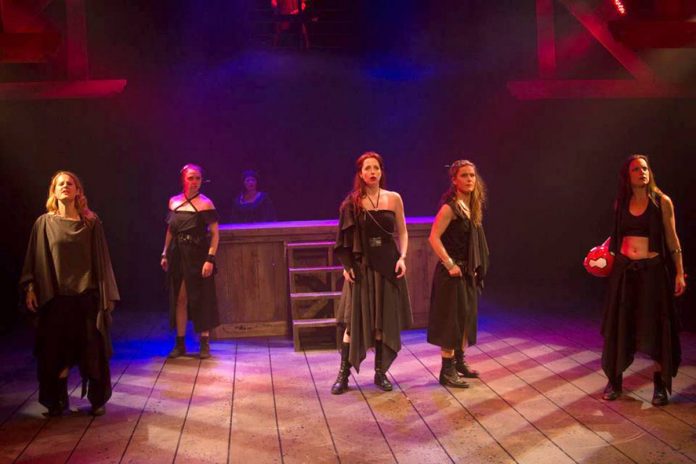
Julius Caesar is an epic political drama full of betrayal, and I’ve always thought of it as one of Shakespeare’s most masculine plays. But the all-female cast of J Caesar showed that ladies can have just as much fun with the story.

This incredibly talented cast managed to convey the basics of this lengthy play in a condensed version that retains most of its message. The themes of friendship, loyalty, and loss turn out to be less powerful, but more personal. Focusing on the seven characters Caesar, Brutus, Cassius, Casca, Strato, Calpurnia, Antonia, and Portia allowed us to get to know them personally, and still feel connected to their ambitions, during the short run time.

The sound design stood out as bursts of “Hail Caesar” echoed as if from afar and jarring metallic sounds coloured the fight scenes, enhancing their sharp choreography. The props chosen for swords and daggers were unique: they were more shiny blunted sticks than swords. While more realistic weapons would have been more appropriate, they were creatively held in the hair or in a belt when not in use, which was a nice addition.

When Caesar was assassinated, the blood was depicted with strips of bright red fabric tangled around their fingers, and, while slightly distracting, this was a clever solution to messy death scenes. A more realistic use of blood would have helped me stay engaged with the story, but the fabric stood out and pulled attention away from the action.

Each character was dressed in a different assortment of black, draping garments that added to the overall sombre tone, and the sparse set allowed for the actors and the plot to be the focus. The actors delivered lines with conviction, and drew me into the struggles of the characters.

Overall, I was impressed with what this production was able to accomplish with such a colossal text, but some of the gaps in the text made for a clunky ride that didn’t always make sense. There seemed to be scenes missing, and as characters got into a new bit of dialogue there was some filling in to be done by the audience to catch up with them.

Amanda Lisman as Caesar was triumphant, and Caroline Cave’s Brutus was aching with culpability. Antonia, played by Tracey Power, was perhaps the strongest character, being the one who avenged the death of her friend. Full of psychological tension and political unrest with a feminine twist, this classic play was treated well by the ladies in J Caesar.

J Caesar was adapted from Shakespeare by the Escape Artists and presented at the Kay Meek Centre May 21 to 29. For more information, visit escapeartists.ca.


Peak Speak: Stephen Harper designs new “dad jeans”

0

This week The Peak asked SFU students how they would react to Stephen Harper starting a line of “dad jeans”?

Created by Paige Smith
Special thanks to Jacey Gibb

SFU athletic director resigns

0
Photo courtesy of SFU Athletics

After three and a half years at the helm, SFU’s athletic director Milton Richards has announced his resignation.

Arriving in November of 2011, Richards came to SFU after 12 years as the athletic director at the California State University (CSU) Stanislaus in Turlock, CA, and served as the athletic director at the State University of Albany, where he guided the athletic program from NCAA Division III to Division I.

“I think Milt came to us at a really critical time when [SFU] was seeking full membership in the NCAA, and [he] took on that challenge with a lot of enthusiasm,” said Tim Rahilly, SFU’s associate vice president of students. “[He] really helped SFU make the best case to the NCAA, and also used his very broad network of connections in the US to help us.”

Shortly after taking the job at SFU, Richards made all SFU home games free for students, a policy he previously implemented at CSU Stanislaus. Further, it was under his eye that SFU became a full fledged member of the NCAA.

Highlights of his time at SFU, he said, included, “being able to go to Division II, [. . .] establishing the academic first program, [and] the fact that we’re going to finish in the top-25 in the director’s cup.”

“I’m just really thrilled that it’s the best experience I’ve ever had in collegiate athletics.”

Richards will return home to Turlock, CA, but he will continue to serve as head of the department until July 2.

“When I took this job, I made a commitment to get us through the [NCAA] Division II process, and I was confident that my wife was going to move with me,” Richards said. “[But] then she had commitments in Turlock and was unable to move, and we’ve been doing this for three and a half years [. . .] she just retired, and she’d prefer to stay in Turlock, so it was just the right time to move on.

“It’s the best experience I’ve ever had in collegiate athletics.”

Milton Richards,

SFU athletic director

“I will absolutely miss SFU, I will miss my coaches, I will miss everything that’s here, very much so.”

Rahilly, who will serve as the interim head of athletics, said that the search for a new director of athletics and recreation will commence after Richards leaves.

“Milt’s here for another month, and then we will start the process of getting ready for the search,” he explained. “One of the things we’ll do is we’ll meet people and ask what are the characteristics and skills and abilities that we need in our next senior director of athletics and recreation. I imagine we’ll be aiming to interview in the early fall.”

Rahilly also noted that preference would be given to Canadian candidates, but the search would, however, include international candidates. Richards himself was the first American director of athletics at SFU.

“We want someone who has a background in both recreation and athletics, someone who is familiar with the NCAA, and I think we want someone who has a broad sense of the issues around campus recreation, in particular, wellness and campus engagement [and] someone who is able to work with community partners, alumni, [and] donors,” Rahilly added.

Predictions for the Champions League Finals

0
Photo courtesy of Eurosport

The upcoming Champions League Final on June 6 pits two vastly different teams against each other. Barcelona are the team with the high price players, paying €81 million for Luis Suarez and paying a reported €57.1 million for Neymar. Juventus have thrived on smart, frugal transfers, picking up Andrea Pirlo and Paul Pogba for free, and paying very little for outcasts like Carlos Tevez and Patrice Evra.

Barcelona’s path to the final was marked by dominance. They easily beat Manchester City, Paris St. Germain (PSG) and Bayern Munich on their way to the final, scoring five goals over two legs on both PSG and Bayern. They’ve won the La Liga title, beat Athletic Bilbao three to one during this year’s Copa Del Rey final, and will be looking to win the Champions League for the fourth time since 2006.

The attacking trio of Messi, Suarez, and Neymar have a combined 117 goals in all competitions, and are by far the best front three in world football. With a couple more years of production like this, we could be remembering them as the best of all time.

Five years ago, Juventus were a mid-table team in Serie A, struggling to qualify for the Europa League. Five years later, they are in the Champions League Final — a remarkable turnaround. This is mostly due to their shrewd business in the transfer market, such as picking up the aforementioned Paul Pogba on a free transfer from Manchester United.

Juventus were fortunate in their draws during the knockout stage, having to first face a slumping Borussia Dortmund squad and then a lackluster Monaco side. But their defeat of Real Madrid should leave no doubt that Juventus can once again compete against the European elite.

The key for Juventus in this match will be to shut down the front three of Barcelona. It’s easier said than done, but Juventus are one of the best defensive teams in Europe, and they have shown through this competition and domestically that they can limit their opposition’s chances.

Barcelona will most likely dominate possession for the majority of the match. They will have to be careful of the counterattack that Juventus will impose, as players Tevez and Morata looked very dangerous on the break against Real Madrid.
As a Juventus supporter myself, my heart says that they will be able to complete the treble, but my mind says that Barcelona are a cut above. If I was a betting man (which I am) I would not bet against Barcelona and their terrific attacking trio in this match.

SFU Bookstore first in country to accept Bitcoin

1
AVMs have been placed in bookstores on SFU’s Burnaby, Vancouver, and Surrey campuses. - Phoebe Lim

SFU is the first Canadian university to accept the international digital currency, Bitcoin, in its bookstores.

SFU has partnered with Bitsent to place automated Bitcoin vending machines (AVMs) in the Burnaby, Surrey, and Vancouver campuses, unveiling the AVMs at ribbon cutting ceremonies on Tuesday, May 26 through to Thursday, May 28.

At the ribbon cutting event in Burnaby on Tuesday — where students were treated to a $5 gift card with any $20 purchase at least partially using Bitcoin — Mark McLaughlin, executive director of SFU’s Ancillary Services, explained that this will allow students to try out Bitcoin, and explore a new technology.

“For us at the bookstore, it’s about SFU being a bold and innovative university,” he said. “We’re giving students the opportunity to try it out on a small scale.”

SFU had previously made the news as being the first Canadian university to accept Bitcoins for donations last September. McLaughlin credited student initiative as the reason that SFU was willing to give Bitcoin a chance, noting the drive of the SFU Bitcoin Club.

“Students really persisted,” he said. “[The SFU Bitcoin Club] have been working hard at this, they’ve been working with us, they’ve been pushing us, and we want to respond to students. We’re here for students and we want to inspire them.

“A lot of students coming to SFU nowadays are passionate and want to change the world. Well, maybe through Bitcoin, they’ll be able to change the world.”

“For us at the bookstore, it’s about SFU being a bold and innovative university.”

Mark McLaughlin,

SFU Ancillary Services,

executive director

As a decentralized digital currency, Bitcoin allows instantaneous transactions without the need for a debit or credit card, and is not held or regulated by any bank. For vendors, Bitcoin has fewer fees to process than for debit or credit cards.

“[Bitcoin] kind of makes you want to rethink about the concept of money, why it has value,” said SFU Bitcoin Club president Mike Leung, who founded the club in 2013. “Bitcoin has a lot of benefits over traditional currency and how it’s used.”

A student can purchase Bitcoins by downloading an app on their phone called a digital wallet. With the wallet, students can put cash into the AVM — which has a six percent processing fee, two percent going to SFU, with the rest going to Bitsent — and receive the equivalent amount in Bitcoin. One Bitcoin, as of Thursday, May 27, is worth around $295 Canadian, but they can be purchased in fractions.

The nature of the Bitcoin means that its value can fluctuate in comparison to physical currencies, meaning that there is both a risk of devaluation for long term investors, and a possibility for investment — in November 2013, one Bitcoin reached an all time high price of $1,242 USD.

However, Bitsent founder Leo Dominguez explained that the volatility of Bitcoin is currently low enough that one can purchase Bitcoin and spend it without worrying about it devaluing between the time you hit the AVM and head to the checkout.

“Unless you’re holding the Bitcoin for several days, weeks, or months, you’re not exposed to the volatility,” he noted.

SFU is not taking any chances, though. Any purchase made in Bitcoin is immediately converted into Canadian dollars by the payment processor Bitpay.

McLaughlin sees the potential for other Ancillary Services establishments, such as SFU’s coffee shops, to adopt Bitcoin as well, if the bookstore’s acceptance of Bitcoin is a success. However, he is adamant that there no plan to accept Bitcoin for tuition, despite student — and particularly international student — interest.

“Bitcoin is really brand new. These things take time to work through the system, and we’ll see. Bitcoin’s here today, might be gone in a year, we don’t know,” McLaughlin said. “Right now, within the bookstore, [it’s] just to create a little environment so students can really test it out and see for themselves.”

A Tribe Called Red’s Suplex is a diverse EP

0

Suplex, the latest offering from Ottawa’s electronic trio A Tribe Called Red, finds the group jumping from one influence to the next, and even though this EP has a total of four songs (with one being a remix of another track on the EP), it seems like A Tribe Called Red wouldn’t have it any other way.

Back in 2012, when their debut album was shortlisted for the Polaris Prize, Tribe already had a reputation for fusing traditional first nations singing and drumming with various electronic genres. This release, though short, does not disappoint.

The opener “Suplex (feat. Northern Voices)” pairs dubstep wobble bass with glitchy Aphex Twin snare rolls, while “The People’s Champ (feat. Hellnback)” finds Samson Cree rapper Karmen James Omeasoo (aka Hellnback) addressing modern Aboriginal issues like reservations and role models over standard hip-hop drum beats and bass lines. His verses may not be as smooth as other rappers, but the raw emotion on lines like “You talk and I walk, that’s the difference” are all that really matters.

The real standout track, however, is “Bodyslam” and its remix by Calgary production duo Smalltown DJs. The opening is part funk, part disco, almost like a lost drum take from Michael Jackson’s “Rock with You.” This fades away into a build that introduces the song and subsequent remix’s main synth line. “Bodyslam” is Suplex’s most danceable track, with plenty of bass drops over house-influenced beats.

Though the album moves around from track to track the intention is clear: A Tribe Called Red are using their music as a platform to promote other, often aboriginal, artists. Three out of the four tracks feature guest musicians from varying musical backgrounds.

The band wants diversity, and rightly so. Mainstream music, be it rock, pop or alternative, always struggles with the confines of a genre. If a song isn’t radio-friendly, if it’s not commercial, if it doesn’t fit the parameters of what the public want to hear, chances are it’ll have to fight to see the light of day.

Without artists promoting other independent, local artists we lose part of the variety that culture, especially music culture, needs in order to stay fresh and exciting.

As for A Tribe Called Red, they haven’t lost their taste for experimentation. They’ve struck a fine balance between traditional First Nations music and modern electronica.

Cinephilia: When Marnie Was There is a poignant film about loss

0

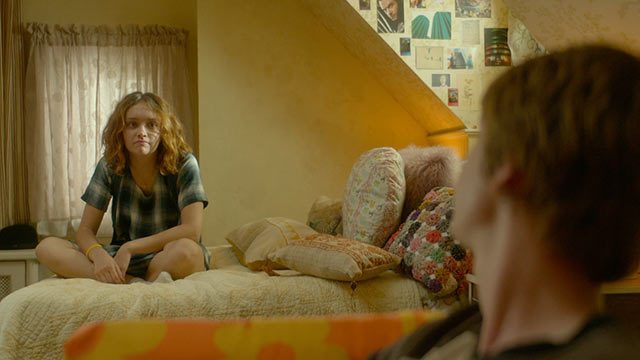
If you’ve ever lost a loved one, you’ve experienced the emptiness, depression, and longing to retain every memory. How are you going to live without them? Old photographs, bedrooms, and other significant places draw old memories which bring solace, but also the painful reminder that you will never see them again. When Marnie Was There — the last film from Studio Ghibli before a hiatus — is a painful and inspirational depiction of this feeling’s many forms: death, neglect, and alienation.

Anna Sassaki, an awkward girl with little sense of gender conventions, is an asthmatic orphan being raised by a good-natured couple in a metropolitan city in Japan. But once she finds a government cheque reimbursing the couple for their care, she becomes suspicious of their intentions and grows even more distant.

After having a scary asthma attack, Anna’s doctor recommends she go relax in the country where the air is cleaner and life simpler. When she temporarily moves in with her adoptive aunt and uncle in a small town, she befriends a young girl named Marnie who lives in an old mansion across a lake that many of locals believe is haunted.

As their relationship develops and Marnie randomly disappears or confuses someone else’s name for Anna’s, it becomes clear that Marnie is not a corporeal person from the present. She might be a ghost or just an imaginary friend.

Anna, unlike heroes such as Frozen’s Elsa, has no magic, but only her will. The flights of fancy are not merely a ploy to attract kids to the theatre like so many animated films, but an evocative technique meant to help us understand what is going on in Anna’s head. Unlike Disney’s protagonists, Anna may not be beautiful or charismatic, but her anxieties and self-loathing are relatable and truthful. She learns to overcome universal feelings of loss and self-doubt without the help of a Prince Charming.

The film’s poignancy and pathos derive from how each character tries to hold onto old memories of loved ones through synthetic substitutes. Anna’s adoptive aunt and uncle are trying to preserve what they have of their grown up, absent daughter by taking Anna in. Anna is given their daughter’s old clothes, and, in an even more telling moment, the aunt says, “Your room’s upstairs. It was my daughter’s room. It’d be sad to clear everything so I left it as it was.”

Other supporting characters arrive, like an older woman who spends her days painting the old mansion across the lake and a fisherman who almost never speaks. All these characters are intertwined not only by their connected past, but also their desire to recreate it: the woman through her paintings and the fisherman through his routine. Motifs of photographs, sketches, diaries, letters, and old buildings reinforce this aching feeling of trying to preserve memories of loved ones.

When Marnie Was There is a profoundly affecting experience that comes as close as any cinema to evoking real, human emotions. Like almost all of Ghibli’s work, this is a film for both children and adults that doesn’t patronize its audience with blind adherence to a forced formula or cheap sentimentality.

Where most animated flicks try to make their way into people’s hearts with catchy pop songs, When Marnie Was There earns our tears with its gradual pace that recalls Japanese master Yasujiro Ozu. It’s nice to see subtle characterization that doesn’t underestimate its audience’s capacity to engage with grounded, unexaggerated characters. Any single frame of this beautiful film, which draws its visual inspiration from impressionist paintings, has an elegantly soft touch and the emotional weight of a dumbbell.

This film floats like a butterfly but stings like a tattooing needle. It make us consider the imprints that have been left on our own skin.

Poltergeist doesn’t live up to its original

0

The original movie is better.

I know that is probably not  what you’re wondering about as you go into 2015’s Poltergeist since most of the time remakes don’t hold a candle to their original. Usually, if a movie’s remade, it’s a classic, or at least enough people would call it something worth remaking. But it’s hard to capture that magic twice, and generally the remake just tries to update the original for modern times, with modern filmmaking techniques (CGI, jump scares, etc.), which usually suck away that magic.

I wouldn’t be quite so hard with the new Poltergeist, as it was watchable and decently entertaining — a lot of these remakes like the 2010 version of A Nightmare on Elm Street are just downright awful and annoying. But at the end of the day, this film feels more like a mediocre Insidious ripoff than its 1982 original.

In this version, the Bowen family move into a new house in the suburbs. When the father Eric (Sam Rockwell) is laid off from his job, they have to “settle” for some crappy house the whole family hates — although it’s bigger than any townhouse I’ve ever seen, and even has a decent-sized yard.

The son is scared of everything, the youngest daughter fulfills the typical three- to five-year-old-child who talks to the ghosts as if they’re imaginary friends, there’s the selfish teenage sister., and the mother mothers.

But it turns out the house is built on top of a graveyard, where someone moved the tombstones but not the bodies. Now there are ghosts. The youngest daughter gets lured into the ghost world and communicates through the TV, and the family wants her back.

So they hire university paranormal researchers who then get some British ghost hunter (Jared Harris) who has a TV show that’s a parody of Ghost Hunters to get back their daughter.

That’s the plot. The first thing is, you don’t really care about the characters — they’re a stock horror family. One of the things that was effective about the original is they built up characters that you care about. It wasn’t Oscar-level characterization, but they felt like a real family; when the ghosts took the girl, the pain felt real, relatable. Here, they’re just going through the motions.

Of the actors, the only one doing anything really interesting is Sam Rockwell. Even though he’s just playing the stock dad character, he seems to be doing something interesting for the first half of the movie. Too bad he has nothing to do once the ghosts come.

The whole subplot of the family being poor and maxing out their credit cards seems entirely unnecessary. It doesn’t build toward anything, it doesn’t have any bearing on the plot. Perhaps it’s supposed to make them more relatable, or drive home the theme of family somehow, but overall scenes like the dad maxing out the credit card at the Home Hardware knockoff store just detracted from the film. And the family’s house is not the kind of house you move into if you have no income earners.

Overall the movie isn’t offensive — though there are annoying things like the reality TV angle, the movie ending with some rock song, and the CGI. It’s a decent enough horror movie, especially when comparing it to a lot of the “found footage” movies. But it’s just another one of the pack. You’re probably as well off seeing Insidious 3.

That being said, if you’re like me — the kind of person who’d watch a mediocre but decently entertaining horror movie — then you’ll probably walk out somewhat satisfied.

Five obscure films you should see

0

2015 was looking like a horrible year for movies. The first six months saw some tremendous disappointments like Michael Mann’s clichéd Blackhat, the Wachowski’s stupid Jupiter Ascending, and Joss Whedon’s mind-numbing Avengers: Age of Ultron. I also managed to sit through Fifty Shades of Grey. No comment.

Despite my initial cynicism, though, this year seems to be turning around. It’s produced the blockbuster Mad Max: Fury Road, and also these five hidden gems (ranked in order of preference) which have managed to fly under the radar.

Me and Earl and The Dying Girl

If Me and Earl and The Dying Girl were a person, I would wrap my arms around them and squeeze as hard as I could. Based on a single viewing, this is one of the most affecting and lovely films I’ve ever seen. It’s funny, sad, moving, and profound. That it also subverts almost every expectation, while reinventing tropes you’ve seen a million times, makes it that much more unpredictable and moving. The story focuses on Greg, an awkward high school senior. He interacts in the safety of his empty social cocoon and befriends a girl with leukemia. This is the film The Fault In Our Stars wished it could be.

Predestination

This is probably one of the most accessible yet inventive films to fall between the cracks in some time. Adapting Robert A. Heinlein’s short story, All You Zombies, brotherly duo Michael and Peter Spierig have crafted an intimate character drama with one of the most unique time travel premises of recent years. Ethan Hawke stars as a bartender who begins to talk to an effeminate-looking man. The customer bargains a bottle of booze that he can tell him the most insane story the bartender has ever heard. No spoilers, but the two have a more personal past than you will ever see coming.

Ex Machina

This film, about a middle-rung coder chosen by an eccentric billionaire to investigate the consciousness of what could be the first self-aware android, fascinates with philosophical debates of free-will and determinism as well as materialism and dualism. It’s a thought-provoking film that should thrill both high- and low-brow audiences alike with its witty dialogue, suffocating tension, and profound themes. Ex Machina is real, hard sci-fi, and not of the Abrams variety.

Slow West

Can a film celebrate the clichés and conventions of a genre while completely reinventing them? Well that’s exactly what Slow West does in the short span of 82 minutes. This compelling and funny film, whose subversion has been compared to the work of Quentin Tarantino and the Coen Brothers, sets itself up as a run of the mill western about a 16-year-old boy who has moved to the frontier to save a damsel in distress, while accompanied by a Clint Eastwood-like outlaw. Unlike most Westerns, Slow West isn’t about old American myths, but rather the films that have embraced them.

While We’re Young

“You’re just an old man with a hat,” Adam Driver proclaims to Ben Stiller’s hipster wannabe in Noah Baumbach’s funny but poignant film. The director of The Squid And The Whale and Frances Ha demonstrates once again that he is a master of writing comedic dialogue that feels natural and raw, yet subtle and gut-busting. While We’re Young is the best Judd Apatow comedy Apatow never made.