

By: Hannah Fraser, News Writer
Content warning: mentions of genocide.
During the week of summer convocation at SFU, some graduates wore Palestinian keffiyehs, held up signs and Palestine flags while crossing the stage, and refused to shake hands with president Joy Johnson. The convocation took place June 11–14. At the morning celebration on June 11, SFU students dropped a banner from a window of the AQ during president Johnson’s speech and held banners on the steps of Convocation Mall in live camera view. On June 12, another banner was dropped from the balconies overlooking Convocation Mall. All of these acts protested SFU’s continued investment in companies that fund Israel’s genocide against Palestinians.
These protests came two weeks after SFU’s Board of Governors agreed to start discussing divestment from these companies, and a week after the Faculty Association of SFU passed two BDS motions urging SFU to divest. The BDS movement — Boycott, Divestment, Sanctions — began in 2005 as “a Palestinian-led movement for freedom, justice and equality,” according to the BDS website.
This is the first time SFU has officially acknowledged students’ and faculty’s calls to divest.
The companies SFU invests in include BAE systems, Booz Allen Hamilton, and CAE Inc., which “have collectively facilitated the killing, maiming, or displacement of millions of individuals,” according to a statement from SFU Faculty for Palestine. These companies equate to $7.2 million “of the joint endowment and non-endowment invested funds of $1.13 billion as of March 31, 2024.”
The Peak interviewed SFU Students For Justice in Palestine (SJP). SFU SJP is a student group in support of Palestinian liberation and freedom, who say SFU’s “agreement to discuss divestment is not an action to divest.

“These actions were in solidarity with the students, faculty, staff, and university administration in Gaza who were not able to have a 2024 convocation ceremony as all universities in Gaza have been bombed and destroyed by Israel,” said SJP. A May 29 open letter by Palestinian academics called upon “friends and colleagues around the world to resist the ongoing campaign of scholasticide in occupied Palestine.” The United Nations classifies scholasticide as “systemic obliteration of education through the arrest, detention or killing of teachers, students and staff, and the destruction of educational infrastructure.”
“We, students, refuse to be used as talking points and to receive praise for our advocacy work when the university puts us in positions of marginalization and stifles movements on campus through various tactics including stalling, fear, and manipulation.” — SFU Students for justice in palestine
The Peak also interviewed Clint Burnham, a member of the SFU Faculty for Palestine and English literature professor. The SFU Faculty for Palestine is part of a broader, “Canada-wide solidarity network of academics committed to advancing the struggle for Palestinian liberation, justice, and equality through the academic sector.” Burnham said he was at convocation on June 11 and 13, and that he and three other faculty from the English department were wearing keffiyehs in support of Palestine.
On June 12, the banner dropped by students during Joy Johnson’s speech read “SFU Students for Palestine / Divest / Free Gaza.” Johnson’s speech praised students’ “incredible advocacy work,” though SJP deemed her speech “hypocritical.”
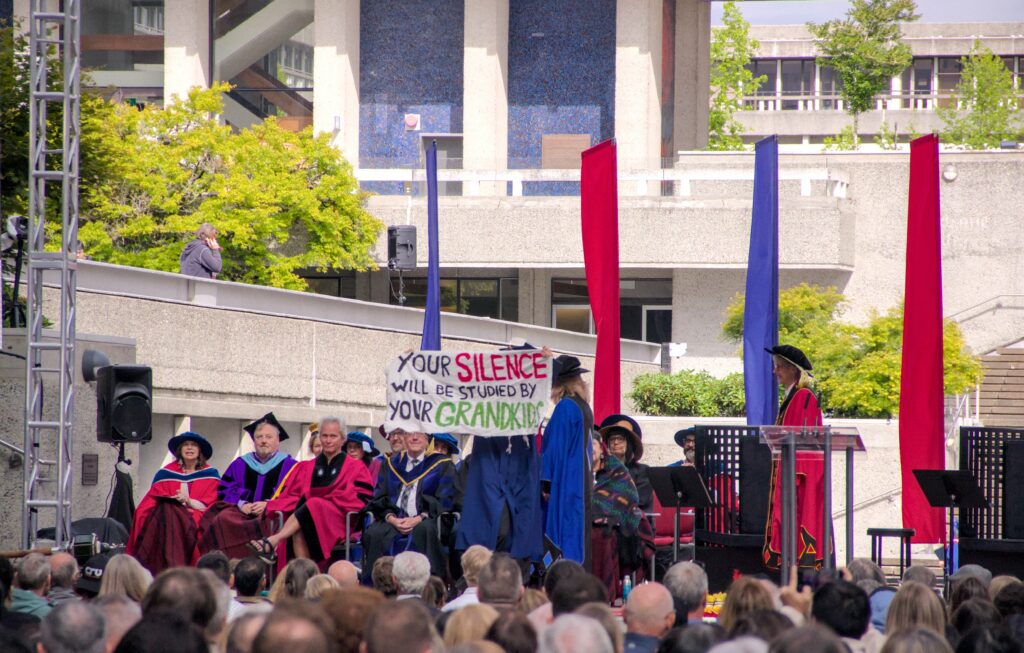
“SFU has still not met the demands of students and workers to divest from genocide, agree to a first contract for research assistants, and directly in-house our cleaning and food service staff,” said SJP. “We, students, refuse to be used as talking points and to receive praise for our advocacy work when the university puts us in positions of marginalization and stifles movements on campus through various tactics including stalling, fear, and manipulation.”
In a statement to The Peak, SFU stated, “SFU respects the right to peaceful protest, and in consideration of protest action at convocation ceremonies across Canada and the US, the university ensured that safety for all was considered in convocation preparations.”
SJP claimed there was an “unprecedented amount of security during ceremonies” including “a room in the library for people who felt ‘uncomfortable’” and “bag checks.” SJP also said, “The university widely circulated a document outlining [a] de-escalation strategy in the event of protests at convocation that singled out pro-Palestinian actions.”
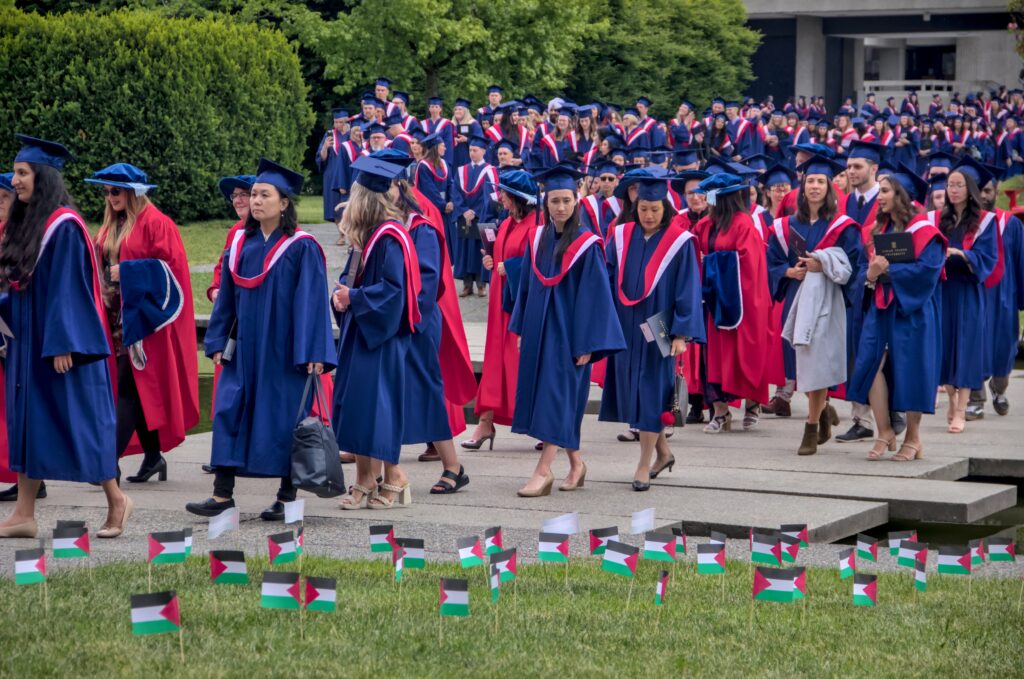
To this, SFU stated there was a “welcoming centre for guests to enjoy quiet time and light refreshments” at convocation and they “introduced a bag check and bag concierge service,” but that “there was no significant increase in security presence compared to previous years.” Professor Burnham said he did not notice a large increase in security at convocation.
For more information on SFU SJP’s campaign, visit their Instagram @sfu.sjp. For more information on SFU Faculty for Palestine, visit their website at sfufacultyforpalestine.ca/.


