


By: Amal Abdullah
SFU Colour is a club dedicated to enhancing physical spaces with art and colour on Burnaby campus. Currently consisting of three club executives, it was launched as a club in January 2018, but has been running as an initiative since last September.
SFU Colour’s ultimate goal is to help students and local artists create art pieces on campus, thereby making SFU a nicer place for the observer. In an interview with The Peak, co-president Federico Cerani said, “With art, the relationship between the observer and public space becomes closer.”
Though they’re still a new club, they intend for their first pilot project to be a professional mural at the lower bus loop, also known as the SFU Transportation Centre Bay 2. In order to gain traction among students on campus, the club executives put together a petition last fall during Clubs Days, gaining approximately 200 signatures. “We put together a petition to show the university it’s not just two crazy people,” Cerani laughs. “There are people behind us and students support us. We’ve always wanted this to be work by the students for the students.” According to club executives, most people who hear about the project tell them it’s a great idea.
However, they’re having difficulty putting their project together. “It’s such a revolutionary idea at SFU that there’s no proper channels of [going about] this. There’s no guideline to follow. We’re trying to [reach out to] main actors and groups on campus for their support [. . .]” According to SFU Colour, Student Engagement felt that the project wasn’t engaging enough for students, but SFU Health and Counselling Services was very supportive. “Students don’t have the best mental health, and if the colours they see are vibrant, it leads to better mental health.” said Cerani.
So far, SFU Colour has had a few meetings, as well as some email correspondence, with SFU Facilities, which is the entity in charge of all building-related projects on campus. They have yet to approve their pilot project.
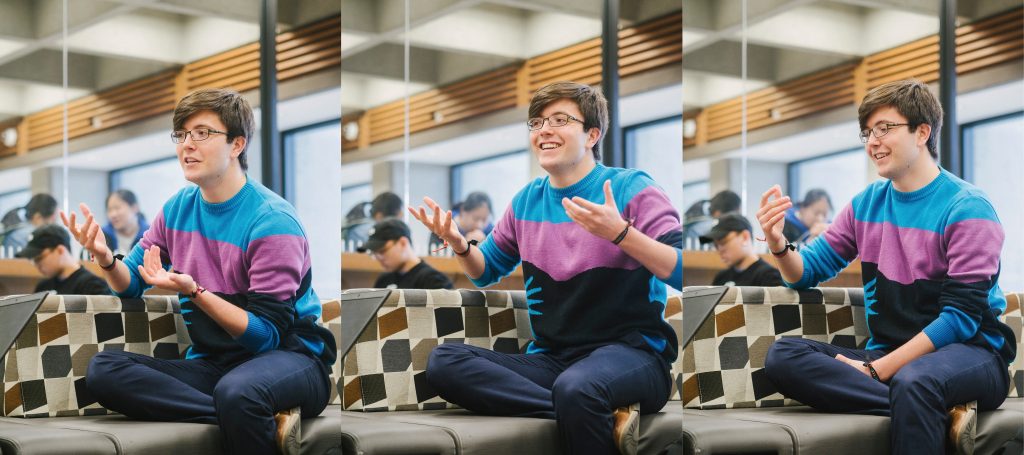
Cerani feels that mural work makes a place look nicer. “You could have a rough neighbourhood, but if it’s nice to look at, you’ll want to go for a stroll,” he said. His goal is to replace the image of a prison that people have when they think of Burnaby campus, and he wants people to think about Arthur Erickson as the famous architect, and not just someone who supposedly designed prisons. Cerani thinks that Burnaby Mountain is very much isolated from the rest of Burnaby, and he feels that art could give students a more enjoyable time when they’re up on campus.
For co-president Marielle Wall, SFU Colour is an avenue for marginalized voices to speak and express their objectives through art. Another idea that SFU Colour would like to launch is an open mural for students that anyone could paint at any time. It would be a constantly changing mural that would become new every day. To Cerani, that’s what real mural work is: it shows the feelings of the population, and it will change because the emotions and feelings of the population change.
Want to join SFU Colour? Check out their SFSS Go page or like them on Facebook at SFU Colour.


