Home Blog Page 993

Why Should Anybody Go to University?

0

Why should anybody go to university?

That’s not a rhetorical question. It’s a question I have been asking myself for the last two years of my degree. Recently, I have begun to wonder whether I’ve made the right choice in spending years in post-secondary education.

Years of mathematics courses have taught me that, when faced with a large, complicated problem — was it all worth it? — it is often helpful to start by looking at a smaller, simpler problem; namely, why did I choose to go to university?

In retrospect, I believe my primary reason was that I had just gotten out of high school, I had good grades and I loved learning, so continuing my education seemed like the socially acceptable thing to do. It’s what everyone else does, right?

But this isn’t what I believed at the time. Suppose you were to travel back to 2009. You would find Ben Buckley, recent high school graduate in small-town British Columbia. He’s planning to spend two years studying at a local community college, then finish his degree at a university. If you ask him why he’s doing this, he’ll give you a series of inoffensive, people-pleasing responses: “I love learning”, “I want to make sure I get a good job”, “I want to be a more culturally sophisticated person” — and he’ll mean it sincerely.

I began with these optimistic hopes, but towards the end of my degree, I was just going through the motions and trying to get my coursework over with — a classic case of what is sometimes called “senioritis”, the tendency for university students to lose motivation in their final year of study. What happened between 2009 and 2015 to make me so jaded?

When a person loses the ability to enjoy something, it is often a symptom of depression. In fact, I went through a major depressive episode in 2012 and 2013. Mental illness is shockingly common among university students. Compared to many students, however, my experience was actually rather anti-climactic — after months of having every moment of every day feel like a repetitive nightmare, I got myself to SFU Health and Counselling, where I started seeing a counsellor on a semi-regular basis, and got a prescription for Sertraline (an SSRI better known on the streets as Zoloft).

But it got me thinking.

Universities put a lot of resources into increasing awareness of mental illness and making resources such as counselling and medical help available to students. This is all well and good, but when students are taking their own lives so often that universities have to take aggressive measures to prevent it, it seems to me that there’s a bigger problem here. It might be time to consider the possibility that there is something intrinsically unhealthy about university studies — or at least, the way we approach it.

On the surface, there doesn’t appear to be anything inherently unhealthy about going to university. There is nothing that precludes having a lifestyle that includes classes and homework in addition to exercise, healthy eating, a positive social life, and plenty of sleep.

And yet, many students, including myself, struggle to have any balance in their lives during their studies. During my years at SFU, I constantly ate simple carbohydrates, stayed up until four in the morning doing homework the night before it was due, got very little exercise, and struggled to find opportunities to meet people.

If you had asked me at the time why I was unable to have any kind of balanced lifestyle, I would have said something like, “There’s not enough time in the day.” Actually, more realistically, I would have burst into tears and said something about how I’m a terrible person who can’t manage my own life. But in either case, it would have felt like there wasn’t enough time.

This is a little strange though, because I actually had plenty of time on my hands. My classes only took a couple hours each day, and try as I might, I was never able to find a part-time job during my studies. I joined a few student clubs, but even that only took a couple more hours out of my week. We’ve established that I wasn’t using the time to sleep, meditate, exercise, or catch up on my homework.

People often underestimate how much stress can consume their life. I believe that, when I was stressed out by all my problems at once — classes, my health and lifestyle, my inability to find a job, my complete lack of a social life — the distraction made it impossible for me to focus on one thing at a time.

As a result, I spent a lot of time on the internet, consuming unchallenging content, usually YouTube videos, image macros, or thinkpieces about how the latest pop-culture phenomenon is “problematic.”

I craved information, which makes it odd that I didn’t harness that craving to consume the information right in front of me — namely, the textbooks I had spent hundreds of dollars on for my classes.

It’s a bit funny to think that there were plenty of parts of my experience at SFU that I enjoyed — the library, the professors, the clubs, the people — but the whole experience was ruined by the one thing I was actually there to do: to take classes. University would be a fine place, if it weren’t for all those pesky courses.

Even among people who have graduated from university, the courses themselves rarely make for fond memories. When I ask people about what they remember most fondly about their post-secondary education, they are more likely to talk about the friends they made, or the clubs they joined, or the interesting events they attended. Most of them don’t remember any of the material they learned in their courses.

I can’t help but wonder if it would make a difference if we replaced every university with a four-year vacation resort for people who had good grades in high school. You could charge the same amount of money and still hire professors and have computer labs, libraries and clubs, but classes would be strictly optional and have no grades. It would be less stressful, and everybody would learn about as much as they were probably going to learn anyway.

I believe that I had unrealistic expectations about university. Formal education is advertised as a magical institution that you can apply to, go through a series of challenges, and emerge as an improved human being. But really, there’s nothing magical about it. You go to a building, you take some courses, then you leave.

And that’s not necessarily a bad thing, if you know what you’re getting into, and you know what you want to get out of the experience.

One thing that fascinates me is the number of adults who go back to school to get a second degree, or to otherwise continue their education. Several members of my family have returned to school. For example, my aunt studied social work at university when she was in her late forties. She studied alongside my cousin (her daughter) and they graduated the same year. I suspect that my aunt enjoyed her studies more than I enjoyed mine. At the very least, I bet she got more value out of the experience. She didn’t just go to university because everyone else was doing it — she made a conscious decision to study in a field of her choice. It would be nice if we lived in a society where this is how everybody treats post-secondary education: as a conscious choice, not as a way to kill four years of your life.

As for me, I will officially graduate from SFU in October — I am still not sure if I want to attend my own convocation ceremony.

I don’t want to support the idea that there is something magical about getting a degree from a university. My years of post-secondary education were not an epic story that needs a satisfying conclusion. They were just a series of events — some good, some bad — in the longer story that is my life. Perhaps if I had known this six years ago, I could have relaxed and enjoyed those years a little more.

Piped Up: How a Small Student Club became SFU’s Voice Heard Around the World

1

It was the early 1980s — 1981 to be exact. Then-SFU president, George Pedersen, was in attendance at a Clan football game at Empire Stadium on what John Buchanan describes as a miserable rainy night.

The stadium, which usually held thirty thousand people, was practically empty on this particular night. It had perhaps “five hundred or a thousand people,” according to Buchanan, the current head coach of SFU’s golf team. There were ten or twelve players standing in the center of the field, their uniforms drenched and muddy.

“[The uniforms], in a sense, represented the school at this time,” Buchanan continued, a notion “that annoyed Pedersen.” The team, visually, were nothing special to look at, and did little to foster any sense of tradition or culture at the school.

After the game, Pedersen called up Buchanan, who, at the time, was in charge of recreation and clubs — there needed to be a better representative for the school.

But what? Who could represent Simon Fraser University, a school which was named after a Scottish explorer and which had already adopted Scottish traditions as their own?

A pipe band, that’s what.

SFU already had a pipe band, yes — a pipe band that consisted of pipers and drummers who attended the university, students who played for four years, graduated and moved on with their lives. However, the university, particularly Pedersen, was looking for a group of players who were more stable and could represent the school.

How could they get a prestigious pipe band that would stay consistent, as students came and went from the university? 

They came up with the idea to recruit some help: the City of Port Moody Pipe Band. However, they could not possibly have dreamed what would happen next. SFU wouldn’t just get a pipe band that represented the adopted Scottish heritage of the school, but a professional band that would represent SFU on the world stage, amongst the best of the best — and rock out alongside some pop music legends.

[dropcap]T[/dropcap]he SFU Pipe Band initially came into being in the fall of 1966 when it began more or less as a student club created by a Scotsman with an English accent by the name of Dennis Roberts. Initially, he did not receive much support from the university, which became clear by the cheap uniforms that the band of eight or nine members wore. Three or four of the members were students and the rest were friends of the students.

Scott Marshall, an early member of the club, said while speaking to SFU’s student newspaper, The Peak, in 1966 after the announcement that the school was getting a pipe band, “We’re trying to get some tradition going at SFU.”

Simon Fraser, whom the university was named after, was of Scottish descent, hence the school embraced its adopted Scottish heritage. The introduction of a pipe band seemed like a natural extension of this.

The aim of the band was to build up spirit at the new university, which was something that the institution seemed to lack — SFU was trying to compete in UBC’s town.

The early band — for financial reasons — was restricted to male individuals who could actually pipe. In that same article in The Peak from 1966, Marshall spoke about how the band was not going to act as a training group, they sought members who could pipe or drum well.

However, shortly after its initial creation, interest in the band fizzled out.

The band reorganized in 1973 and had some success after this. A notable highlight is when they performed at the 1975 Grey Cup parade in Calgary.

However, it wasn’t until 1981 when the band really picked up steam and became the SFU Pipe Band as it is known today.

In 1981, Buchanan and Ian McGregor, the Manager of Recreation and the SFU Director of Recreation respectively, were asked by Pedersen to speak to the City of Port Moody Pipe Band on behalf of the university. Pedersen had given the piping program to Buchanan after Roberts left. Buchanan was asked to help elevate the status of SFU as a quality institution and the recruitment of high quality musicians was a way of creating that public image.

The City of Port Moody Pipe Band was led by the Lee Brothers, Terry and Jack, two world-class pipers. These two men went on to form the nucleus of the Simon Fraser Pipe Band, as their renowned reputations drew other successful musicians in.

Initially, the Port Moody Pipe Band was wary of the invitation to pipe under the SFU banner, as it seemed too good to be true. As a result, the band set aside some money in case the deal fell through — obviously, this was not the case.

The union, however, gave the band the opportunity to perform more often than they did with the city of Port Moody. Previously, the band performed only once a year at the cenotaph on Remembrance Day.

SFU-Pipe-Band

Unlike Dennis Robert’s band, which didn’t receive much university funding, the new band received tartans (kilts) that cost about $12,000, which shows how important it was to the university that the band visually looked the part of belonging to an established institution.

On April 1st 1981, the Port Moody Pipe Band had agreed to become the new SFU Pipe Band, and shortly thereafter, the band had its first performance at the June convocation — at this time, the mayhem that is convocation all happened on a single day.

Robert MacNeil, the current SFU Pipe Band Society president, describes the turning point for the pipe band as a moment in December of that same year when the band won their first competition in British Columbia under the SFU name.

Previously, they had competed against the other two Tier 1 bands in the Lower Mainland, but this was the first time they had outperformed both of them, which led to more competitions. The following year, the band competed at a piping competition in Chicago, in which they placed second. The week after, the band won the Grade 1 North American Championship in Maxville, Ontario.

This victory led the band to be invited to play and compete in the 1983 Grade 1 World Championship in Scotland, which is like the Holy Grail for pipers —their Stanley Cup, so to speak. The fact that the band was being invited to the World Championship in their second year under the SFU name speaks volumes to the enormous amount of talent and dedication of the musicians combined with the support of the university.

The band had become a world power.

In 1995, the band won the Grade 1 World Championships in Scotland for the first time. A small band from Burnaby became one of only four bands outside of the UK to gain this honour. And it came after a self-described down year for the band.

“The year before [1994] we had not had a good run at the World Championships. We ended up seventh which was out of the prize list and it was very demoralizing, but the band basically sort of knuckled under and thought we are going to be able to get over this,” explained MacNeil.

“In late March, we found out that the championships in Scotland that preceded the worlds were changing format so that the order in which the bands compete was going to be based upon the results from each previous championship.”

In the World Championships, when you played was everything. Going too early would likely guarantee a poor placing, so it was advantageous to go as near to the end as possible, to ensure that the judges would remember the performance clearly.

SFU’s poor placing the year before meant that the team would go fairly early — drastic measures were required. PIPE BAND3

“We thought that if we didn’t play at one of those championships beforehand, our seventh place the year before would put us ninth from the end, which is pretty far, so we took a calculated risk; no band had ever done this before,” MacNeil continued.

The team flew to Stirling, Scotland and competed in the regional championship before the World’s in late June.

“We ended up playing seventh from the end there, but ultimately ended up getting third in that competition, which then put us third from last in the order to play for the World’s. Of course, everybody was talking about the SFU Pipe Band’s bold move to go play at the championship and getting third.”

Then, at the World Championships, the band won both their events cleanly, playing a medley of songs for both competitions. MacNeil describes the feeling as “complete exhilaration.” Since then, the pipe band has gone on to win five more times at the World’s — in 1996, 1999, 2001, 2008, and 2009.

The prestige wasn’t just limited to competitions — the band also became the first pipe band to perform at two renowned venues: Carnegie Hall in New York City in February 1998 and the Sydney Opera House in Australia in April 2001.

On top of that, the pipe band made a dent in the world of pop music, which included gigs opening for Scottish rock star, Rod Stewart, twice during his Vancouver concerts in 1989 and 1991.

The band warmed up the Vancouver audience. Instead of performing on the stage like a traditional opener, the band played throughout the crowd surprising their audience with the sweet sounds of bagpipes.

“It was unreal,” exclaimed MacNeil.

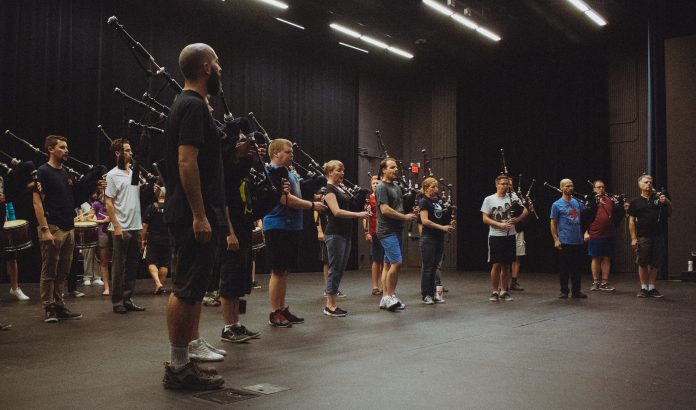
[dropcap]T[/dropcap]he SFU Pipe Band now has five different bands. Surprisingly enough, the band that plays at convocation ceremonies is not the same band that plays at the large competitions. The one that many people on campus have heard is the younger players, or the reserves, known as the Robert Malcolm Memorial Band.

The band name is derived from the first names of two of the SFU Pipe Band’s members, Robert Barbulak and Malcolm Bokenfohr, who were tragically killed in a car accident in November of 1993. The tragedy brought the band closer together and led to the creation of a new band that was geared toward the development of dedicated, as well as talented young musicians, pipers and drummers.

The future of the Pipe Band appears promising. MacNeil, one of the band managers, describes the steps he plans to take to ensure they remains successful.

Strategies have changed slightly since pipe major Terry Lee retired two years ago and Alan Bevan took over as pipe major. According to McNeil as with “any institution, there is a necessary succession that must take place so that the organization may continue.”

He explained that the focus is on nurturing strong leaders and players for the junior pipe bands so that they can lead the future Simon Fraser University Pipe Band. One way he intends to cultivate such a strong junior band presence is by “moving from a simple junior pipe band to an institution styled along the lines of an academy of music.”

Of course, his intention is not to abandon the current band structure. MacNeil explains that this new endeavour will be an effort to “[take] the best of what [pipe instructors] know, and weave it into that type of mainstream musical institution.”

The junior pipe band is also being exposed to new performance experiences to foster their interest in the piping culture worldwide. Typically, pipe bands outside of the United Kingdom travel to Scotland to compete, as it’s the country where the bagpipes were popularized and integrated into the culture. MacNeil, however, plans to take a junior pipe band to the New Zealand Pipe Band Championships in 2017 as a “unique cultural experience.” Surprisingly, New Zealand has a thriving piping culture, with various skilled bands, much like Canada.

The SFU Pipe Band is not a university band in the traditional sense. They do not conjure up the stereotypical image of college kids in a marching band. They are a ceremonial band — they were the City of Port Moody Band. They left that band because the city of Port Moody didn’t utilize their voice; they are now SFU’s most important ambassadors.

“But if you trace it back, it began with a love of Scottish pipe music and to know that that started in the early days of the university and we were able to take that mantle and carry it forward was really important,” MacNeil said. “In thinking about the 50th anniversary, to know that piping and drumming was an early part of [SFU culture] is really special for the band and others to know.”

Animal Bowl

1

With eight seconds still on the clock, the fans are already on the field and they’re taking the southern goal posts out of the ground. The northern goal posts — away from the play — are already gone, taken out by anxious fans while there are still two minutes left.

That capped off a day filled with fights, riots, smoke bombs, and mayhem. And a football game.

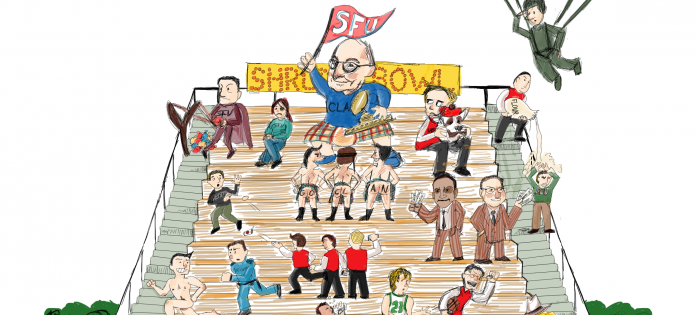
SFU easily won the Gordon Shrum Trophy in the first football matchup against their natural rivals: UBC. Though the score was only 32–13, it wasn’t much of a game according to some of those watching. To some, it was a disgrace.

“I can think of no good reason for continuing this game next year,” said Denny Boyd of the Vancouver Sun. “I think it was lousy football and the behavior of both student bodies was juvenile.”

But to others, it was a lot of fun. The man himself, Gordon Shrum, said the crowd had “exuberant spirit.”

And perhaps to Boyd’s chagrin, the game did continue — amidst the chaos and scheduling conflicts — and became the defining symbol of the rivalry between the two schools.

PullQuote1

[dropcap]T[/dropcap]o begin, we’ll have to go way back. Many now know Gordon Shrum as the inaugural chancellor of SFU, and perhaps as the father of the institution. Those from the 1960s are more likely to remember him from his time as chairman at BC Hydro, and as a master manager with a keen ability to get things done.

Lesser known, however, are his contributions to football.

Shrum arrived at UBC in 1925 as a member of the faculty of physics, coming fresh off a stint as a research assistant at the University of Toronto, where he gained fame for liquefying helium. The UBC football team was founded the year before.

“He was an academic,” said Fred Hume, a UBC historian. “But he also had an interest in football, and had really liked the American model.”

“He liked the idea of football bringing alumni back, [creating] school identity, spirit, all of those things.”

Shrum, who did not come from a football background, and was a self-described “novice” in sports such as basketball and rugby, explained in his autobiography, “I had always been a strong supporter of student athletics…Growing up on a farm, I had never had an opportunity to participate in sports, and I regretted this all my life. I wanted to give others a chance to participate at a high level.”

Before long, in addition to his duties as a professor, he became involved in administration, quickly gaining a reputation as a skilled organizer and a hard worker, sitting on an estimated 30 committees.

Influential during the building of UBC’s first sports stadium in 1937, Shrum tried to build up all UBC sports, not just football.

He raised money for the athletics program, he hired top-tier coaches, and even tried to recruit top-end talent. In 1953, Shrum hired Don Coryell to coach the Thunderbirds — Coryell would go on to become a head coach in the NFL twenty years later. Shrum also assisted in attempting to recruit future San Francisco 49er fullback John Henry Johnson, who retired fourth in all-time pro rushing yards.

However, Shrum’s dream for an American-style football program would run into many roadblocks. UBC was more into British university traditions, centered around soccer and rugby, and as Hume puts it, “not playing sports for the glory of the school” as US universities do. And though the school had other means of financially enticing student athletes, the school did not hand out athletic scholarships — a policy that Shrum wanted to change.

The UBC football team struggled, as Shrum couldn’t quite do what he wanted. His hire, Coryell, would leave the university after two years with a 2–16 record, going back to the US, where he would later be credited with innovating the pass offence. John Henry Johnson predictably did not end up at UBC.

If only Shrum could have his own university, where he could make the rules. In 1961, Shrum was forced to retire from UBC as he was 65 years old, the mandatory retirement age — however, he had other ideas. Then-premier WAC Bennett put Shrum in charge of BC Electric — now BC Hydro — and in charge of the Peace River Dam Project.

Shrum did a good enough job, that in 1963, Bennett called him up again for a new project — to build a new university. Now, Shrum could do things his way.

At this new institution, they would give out athletic scholarships, play against American schools, and make the other Canadian universities mad.

Thus, a rivalry was born.

pullquote2

[dropcap]I[/dropcap]n 1965, Shrum appointed Lorne Davies, a former coach at UBC who had both playing and coaching experience in the US, to head SFU’s athletic department. Davies would also serve as the head coach of the football team for its first eight seasons.

The SFU Clansmen burst out of the gate without a league, as the Canadian collegiate system wouldn’t allow them to play because of their athletic scholarships. SFU played surprisingly decent football for a first year institution — with a 2–3 record in the 1965 season — but were left without any real rivals, and as of yet, no bowl game or playoffs to look forward to.

Shrum wanted the Clan to eventually compete in the Rose Bowl. Considering the minute funding and the fact that they weren’t even in the right league, that was not even a remote possibility.

However, the perfect rivals were right here, about 30 kilometres away: UBC.In 1966, Davies called off a UBC-SFU football game, as well as a basketball game between the two schools.

However, in 1967, it was game on — the two schools would meet and play American rules football. The date: October 16. The venue: Empire Stadium (then home to the CFL’s BC Lions). The prize: The Gordon Shrum Trophy, and of course, the right to be called the best in BC.

The year prior, UBC head coach Frank Gnup — who was actually hired by Shrum in 1955 — had reportedly boasted, “Tell SFU to come around in 10 years or so when they’re ready and we’ll  have some laughs,” calling SFU, “that elementary school on the hill.

By the time the game did come around though, both sides made the case that they were the underdog. The general consensus, however, was that UBC would win, as they were the more experienced football team. In addition, there was a considerable age gap between the two teams.

“We were playing guys who were a lot older than us,” said SFU’s Dave Cutler, a kicker and linebacker who would go on to a 15-year CFL career with the Edmonton Eskimos, noting that UBC had many guys already in their mid-20’s. “They were the cream of the crop in Vancouver in terms of football teams, and we were just the upstart up the hill. To play them was a huge honour, because we were playing one of the best teams in Canada.” clanbirds

A number of players had previously left SFU for the UBC program.

The two schools really took to the game, which drew an interest for university sports not seen before in BC. And it didn’t take long for the antics to begin.

Early one morning, SFU officials found that their practice field was defaced with the letters “U-B-C” burnt into the grass. In retaliation, some SFU students went to the UBC agriculture barn and spray-painted the cows with “S-F-U”, and released them onto the streets.

On the Sunday before the game, the UBC engineers kidnapped SFU’s student president, Art Weeks, taking him to UBC, with the intention of exhibiting him at the Monday night matchup. However, on Monday morning, some SFU students went and rescued the president, with The Peak reporting that it took only four SFU students to take on the 10 engineers holding him captive.

When the red-jacketed UBC engineers marched onto the SFU campus, and into the AQ, defensive back Jim Jardine noted that some football players had to be stopped from physically assaulting them.

“We had a number of coaches intercept members of the football team who were fully prepared to remove engineers,” he said. “That wouldn’t have gone over well.”

SFU fans, for their part, organized a pre-game bonfire before being bussed to the game, where it was rumoured they would burn an effigy of UBC’s head coach.

While the student body got into the antics around the game, for Shrum, the game was “the realization of a recurring dream which many of us had had at frequent intervals during the past 40 years.” In the program for the game, he continued, “Big time collegiate football has at last arrived in British Columbia. This is only the beginning.”

“The wholesome spirit of rivalry between UBC and SFU is good for both campuses, and I hope it spreads to the whole gambit of academics, intramural, and extramural activities.”

Before the game, Shrum paid the SFU team a visit, and his presence intimidated the lot.

“He was a really tall guy, he was about 6’3, 6’4, I remember he had a really long overcoat,” Cutler explained. “I can’t remember what he said, all I remember thinking was this was a big deal, we weren’t playing for marbles here, this was for the whole enchilada.”

This — plus a shoot-em-up movie that the team went to the night before (for “motivation” and so that the coaches could keep tabs on the players) — left the players fired up, ready to face their “Goliath” in front of almost 15,000 fans.

“We were a band of brothers and we were all going after the same holy grail,” said Cutler.

pullquote3 copy[dropcap]S[/dropcap]hrum kicked off to start the first ever Shrum Bowl at 8 pm, which followed parading UBC Queen candidates in convertibles, cheerleaders from both sides, and the Dal Richards band. The game did not start without incident though.

The engineers — who had purchased a block of 800 tickets — arrived, led by Lady Godiva on a white mare (a topless woman on a horse). As part of their entrance, they shot smoke bombs at the Simon Fraser east side stands.

The game itself was a little bit of a disappointment — at least for those UBC fans there actually to watch a game of football. SFU quarterback Wayne Holm took the game into his own hands, running three touchdowns himself, and passing for another two.

The slight underdog took clear control of the game, leading 32–0, not surrendering a score until 11 seconds had gone off the clock in the fourth quarter when UBC finally put up a touchdown. According to The Peak, UBC’s Ron Ritchie netted the team’s second touchdown after he “took a Clan punt on his own 25 yard line and took it back for a touchdown, running right past the last Clan defender who had his back turned to the play, arguing with a UBC player.” The game concluded 32–12 with SFU taking home the Gordon Shrum Trophy for the first time ever.

The antics did not end with the pre-game hijinks. The crowd took over as the main source of entertainment in the first half after the engineers “kidnapped” an SFU student. As SFU supporters rushed to his aid, a melee broke out in the northwest corner of the field. It took police 15 minutes to get things back under control.

shrumpicture

The halftime show was headlined by a marching band from Bellingham, WA, but the fans easily supplied their own entertainment. An engineer ran erratically across the field with a highly productive smoke-torch; students hammed it up on the end of a chorus line; and a student dressed up to resemble an ape to taunt the engineers.

At the end of the game, orange smoke bombs were thrown onto the field. And yes, fans dashed away with the goalposts before the game even ended — though when the second one was taken, officials decided to call it a day, ending the game with eight seconds still on the clock.

While an untold amount of bottles, water bombs, and eggs were thrown, there was only one report of an injury. An SFU coed was struck by one of the smoke bombs — apparently rotten egg gas in balloons — and was led to a first aid station. She returned to watch the remainder of the game with a patch over one eye.

The rough and tumble atmosphere was hardly contained to those watching the game. There were a total of 45 penalties — 21 to UBC and 24 to SFU — and at least two players were tossed out of the game.

The event itself garnered mixed reactions.

“I must say that the display put on by both universities and the UBC engineers at the game on Monday night certainly deserves reproach,” wrote “P. Morgan,” a second year arts student in a letter to the editor of The Ubyssey.

“If this is what it represents, I feel digusted [sic] and ashamed to be a student at this university.” Shrum, however, loved the event, praising the “exuberant spirit,” despite “the actions of a few boorish, unidentified rowdies.”

Regardless of popular opinion, with the excitement over the first UBC-SFU football matchup, it appeared to be on its way to becoming an annual institution. And that it did — for another four years.

pullquote4

[dropcap]O[/dropcap]n October 21 1968, the second annual Shrum Bowl was held, and this time expectations were that the game was clearly in SFU’s favour.

“We became the guys to beat,” explained Cutler.

And SFU did not disappoint — winning the game 27–7. By the first half, the Clan were up 21–0, and Davies was so confident of a win that backup quarterback Dave Syme finished the game.

While SFU did not disappoint, the event wasn’t the spectacle the first one was. Only 5,187 fans showed up to the second contest — nearly a third of the fans from the first. The antics — the  UBC engineers were once again led to their seats by Lady Godiva and did a lap at halftime which provided a comical moment when her horse stopped halfway around and refused to move — were there, but naturally, with the lesser crowd, quieter than the year before.

“It never, ever had what the first one had,” said Chris Beaton, who played right tackle for the Clan and would go on to become the longest tenured coach in SFU football history.

A clear dominance by SFU led to less fans coming out to the games, and growing animosity between the two teams.

Shrum Bowl III would be the first game that UBC did not lose, ending in a 6–6 tie. It was finally a game that SFU and UBC appeared as two equals — UBC even had a chance to win it with a last second field goal kick. It was at the end of the game though, and with no timeouts left, UBC ran out of time without kicking. The newness of the bowl was apparent when there were no rules laid out about overtime and the game merely ended in a tie when the clock ran out. 

AdvertShrum

The rainy weather, however, likely downplayed whatever goodwill the competitive UBC squad brought. Attendance decreased from 4,001 to 3,131 from the third to the fourth bowl.

And whatever goodwill game number three earned, was completely wiped off the table when SFU would put up their biggest beatings yet in Shrum Bowls IV and V, dominating UBC 61–6 and 42–0 respectively.

These losses left UBC bitter, with then-assistant coach Tom Thomson telling The Ubyssey before Shrum Bowl V in 1971, “We do studies, then play football,” insinuating the belief by UBC’s personnel that SFU’s athletic scholarships and lower entrance standards were the reason for SFU’s much greater team.

“We shouldn’t have beaten them but the score shouldn’t have been that bad,” Frank Gnup told the media following the 1971 game before adding “I don’t think they’ll play the Shrum Bowl anymore.”

While Davies met with UBC to schedule game six, a week after the fifth, due to its lopsided nature the Shrum Bowl was called off. Though a good portion of the blame was placed on the gap between the two teams, it also didn’t help that the Canadian Intercollegiate Athletic Association (CIAU) — the league that UBC played in — decided that it didn’t want its members playing SFU.

The Shrum Bowl was dead. The dream was gone.

pullquote5

[dropcap]I[/dropcap]n 1978, the Shrum Bowl had been dormant for seven years, and now it was about to see its first revival. Gnup who had coached UBC for 18 years was fired in 1973, and sadly passed away three years later of a sudden heart attack. After one season under coach Norm Thomas, Frank Smith would arrive as the new head coach of the Thunderbirds in 1974. Despite going 1–8 in his first season, Smith would take UBC football new heights.

Though Gnup was seen by many of his players as a father figure and mentor, according to the UBC Hall of Fame he had learned to accept that “UBC’s players were those who came to school for an education first, football second.” shrumbowlattendance

Smith changed that. In a short time he was able to turn UBC around, leading them to a Hardy Cup (the Canada West conference trophy) victory in 1976. Smith was taking the Thunderbirds in the direction that Shrum had dreamed of while at UBC.

It’s only fitting that he’d be the one to lead UBC into battle against SFU once again.

In May 1978, the Canada West (UBC’s conference in the CIAU) decided to let UBC (and its other members) to once again play against SFU. But the deal for a new Shrum Bowl was far from done. Animosities over the layoff hindered negotiations. Disagreements over which sets of rules the game would be played under — SFU suggested alternating rules each year, while UBC insisted on Canadian rules (which SFU criticized, as UBC was responsible for BC high schools playing American rules in the 40s). The game looked like it might never happen.

Then UBC president Doug Kenny and SFU chancellor Paul Cote came up with an idea: a one-year, no future commitment deal for charity — the proceeds of the game would go to the United Way. The two sides couldn’t argue against charity, and Shrum Bowl VI was to be held Saturday, November 25. 

The one hitch was that this game was to be played under Canadian rules.

UBC wasn’t the only team that looked different on the sidelines — though still the athletic director, Lorne Davies had stepped down as SFU’s coach in 1972.

The week before, UBC had lost the Vanier Cup game (the CIAU championship) and now had to play an exhibition match against their crosstown rivals. “It’s kind of difficult to come back from winning the Grey Cup and then have to play another game against somebody who isn’t in your league,” said Smith.

The fans were back and over 12,000 fans crowded into Empire stadium to see the two teams. And this time, with a UBC team coming off of their best season in history, and the Clan’s historical dominance, it was bound to be good.

It ended up being close, as predicted. UBC’s quarterback Dan Smith played very well and threw for two touchdowns. SFU, on the other hand, earned most of their points off the foot of Walter Passaglia, the brother of CFL star and former SFU player, Lui Passaglia.

SFU would surrender their first Shrum Bowl, largely because of a failed fake-punt on their own 20. UBC capitalized and scored a touchdown to win 22–14.

Perhaps thanks to the fact that UBC won and was competitive, the game returned as a yearly event.

Even the fans came back the year after: 12,420 fans attended Shrum Bowl VII — and were treated to a 4–3 (for UBC) borefest of a game in poor weather. Because of the torrential downpour that accompanied the game, passing wasn’t an option and it therefore became a kicking contest.

The charity aspect may have deterred some of the shenanigans that were prevalent in the original series. The games were still rowdy — there was fight on the field in 1981 between students of both schools that interrupted a halftime presentation put on by United Way featuring wheelchair athletes showing off where its aid goes — but overall, it seemed a calmer event.

Unlike the 60s, where SFU never lost a game and UBC’s only solace was a tie, UBC seemed to have an upper hand in these contests. After UBC won the first two upon resumption of the bowl, SFU would destroy UBC 30–3 in 1980, but UBC repaid the favour swamping SFU 33–1 in 1981.

In 1982, there was no doubt in anyone’s mind who would win the game.The Thunderbirds had their best season in history up to that point, and just the week prior to the contest they had made it to the College Bowl and won their first Vanier Cup.

While SFU was perhaps the most competitive opponent the T-Birds faced all year, UBC still racked up a 14–0 lead in under eleven minutes of play. When the heavy rain started however, so did SFU’s game. Robert Reid led the charge and scored a touchdown and racked up 100 yards on 15 carries.

The bad weather didn’t allow much scoring in the second half. UBC ended their stellar season by proving they weren’t just the best team in the country, they were the best team in the city.

It seemed as though the game was now truly between two competitive rivals, and that there was some good football. Perhaps the event would finally be the annual game that Shrum dreamed of.

However, it was only a matter of time that scheduling problems would arise. According to The Province, “the CIAU put the kibosh on the game’s late November date” — right after the Vanier Cup. They didn’t like the attention SFU was taking away from UBC’s CIAU priorities — notably, they were unhappy in 1981 when three UBC players skipped their All-Canadian awards in Toronto to practice in Vancouver for the Shrum Bowl.

Once again, the Shrum Bowl would rest.

pullquote6

[dropcap]T[/dropcap]he Province reported that after a “lengthy lobbying period” by Frank Smith with the CIAU, that UBC got a bye week in the second week of September 1987.

And finally, the game would become the annual event so dreamed of before, with the teams playing 22 games in 23 years (with 1994 being the only victim of scheduling difficulties). Instead of taking place at one neutral stadium, the game would alternate between home fields: Swangard Stadium for SFU and Thunderbird Stadium for UBC.

And while the games of the late 70’s and the early 80’s were relatively quiet, the “exuberant spirit” came back in a big way.

For the 1987 contest, The AMS (UBC’s student society) tried to bring their fabled ‘Trojan Horse’ into Swangard but were stopped by police who worried that it might cause a riot.

Earlier in the day the 30-foot horse had been distributing condoms at the AMS barbeque and there were big plans to drive it around the stadium. The RCMP didn’t let it past the gate and AMS director Tim Bird and Don Isaak were forced to spend the next hour and a half dismantling their creation which took over a week and a half to build. They only got to watch the last few minutes of the game.

SFU fans for their part, burned a UBC flag.

The contests of the 1990’s really brought out the rivalry in fans.

The year? 1996. The place? Thunderbird Stadium. The game would turn out to be a 25-15 victory for SFU, dominated by the offensive line.

It began innocently enough in the stands — SFU fans drowning out UBC’s chant, “U-B-C” with “K-F-C”. Thanks to apparently inadequate security and an inattentive RCMP detachment, things quickly devolved.

“[There] was never, ever an outside company that did security,” said Steve Frost, SFU’s current sports information director who has followed the game through a number of capacities throughout the years. “It was always the rugby club, or the wrestling team was the security, so they were in charge of policing themselves.”

“Insults began to fly back and forth, then eggs. Then the battle was on,” wrote John Oswald in The Peak.

One UBC fan decided to cross no-man’s land and take on the SFU crowd by himself. “This individual was justly rewarded for his efforts with a severe pummelling at the hands of the kilt-clad Clan supporters. After this, three of the kilt-clad lot lifted their kilts and mooned the T-Bird supporters in ‘Braveheart-ian’ fashion.”

And nothing says fun like drunken sod fights. When eggs ran out, fans started tearing up the sod field to throw at each other. Some disgruntled UBC fans started throwing sod at the Clan bench — they were not thrown out of the game. However, SFU fans who shielded the players and retaliated were — home team bias. The Clan moved their bench to the opposite side of the field in the second half. In the second half, some UBC fans snuck up on unsuspecting Clan fans from behind, and hurled eggs at them.

Some drunk guys from SFU wearing kilts decided to go beat up the Thunderbird and at least tore off his “head”. These same fans defended McFog the Dog — SFU’s new mascot at the time —  from the same fate, outnumbered two-to-one apparently.

And it wasn’t just antics and drunken shenanigans, the games brought out true school spirit.

“You could feel university sport mattered,” said Farhan Lalji, and analyst with TSN who worked as the Sports Information Director at SFU between 1991 and 1994. “There was Shrum Bowl week, there were events on campus prior to the game.

“Football kind of has that event mentality that it can bring.”

And the game on the field was something to watch too. Though the games were mostly technically exhibition, the two teams didn’t look at it this way.

“In football, there really are no exhibition games,” said Lalji. “This isn’t soccer, we don’t play friendlies.”

Beaton and Frank Smith were the coaches for some of the best matches — with Beaton coaching SFU from 1983, before the Shrum Bowl resumed, to 2005, while Smith coached UBC until 1994, when his son Casey took over.

Beaton, who served on Smith’s coaching staff in the 80’s before returning to SFU as head coach, recalled, “There was only one thing Frank Smith wanted to do, and that was beat SFU.”

Smith denied that it was the only thing he cared about — pointing out the team’s Vanier Cup wins as a highlight of his time at UBC — however, he noted that it was a “key game” and the effect the game had on recruiting. 

The game also saw the rivalry of Canadian football versus American football, Canadian university athletics versus American university athletics.

“There was a unique quality to the game when both universities were playing different rules, in different leagues, with different philosophies,” recalled Lalji. “There was just that natural debate between what was better.”

When the game started back up in 1987, the game was exclusively played under American rules. That was par for the course until the 1994 cancellation. When the game came back in 1995, it was still played with American rules at Swangard Stadium, SFU’s home. However, in 1996, an agreement was reached to alternate rules depending on the home team — SFU would obviously have American, and UBC Canadian.

That stayed the same until 2002 — when SFU joined the CIS (formerly the CIAU), the Canadian league.

Much of SFU’s competition in the NAIA, the American league they had been competing in, had jumped ship to the NCAA Division II, and at the time SFU wasn’t able to make the jump, so they came back to Canada.

Now the games were more or less just another game. SFU played UBC twice in the season, though they still hyped up one of the games as the Shrum Bowl.

“I think it really lost a lot when SFU joined the CIS,” said Lalji.

In many ways though, the game was more important than ever — playoff implications were on the line. The October date consistently held for the Shrum Bowl meant that a win or a loss often meant the difference in making (or missing) the playoffs.

“It was awesome because standings were involved,” recalled Beaton. It was no longer just about bragging rights.

But the stint in the Canadian leagues was short-lived. In 2009, SFU was accepted into the NCAA, and played their last season of football in the CIS. Though they’d play one more game in 2010, while SFU was playing exhibition games in the NCAA, this would put an end to the two-plus decades of a near-annual matchup between SFU and UBC.

With one dream accomplished — joining the NCAA — the other seems dead.

For now.

pullquote7

[dropcap]T[/dropcap]hough the two schools have spent much of their histories — and much of the Shrum Bowl’s history — in separate leagues, when this new separation came, they couldn’t find a way to play the game.

In August of 2011, it was announced that for the first time since 1994, there would be no Shrum Bowl.

It didn’t help that the number of bye weeks — weeks off, where the two interleague teams could theoretically play — in the Canada West conference (UBC’s conference) was reduced from two to one. With only one bye week, in recent years UBC has vetoed the idea of playing on the one bye week to rest their players.

““UBC and Simon Fraser both want to play the game,” then-athletic director Milt Richards told The Peak earlier this year.

Last year, it had appeared that progress had been made towards Shrum Bowl XXXIV, when the two schools had reached a verbal agreement that they would play the Labour Day weekend, providing it was open.

However, the NCAA did not approve of the game this time.

“We approached the NCAA for a waiver to play the game prior to the start of the Division II schedule during the September Labour Day weekend,” Frost told The Peak in February. “This weekend is traditionally reserved for the opening of the Division I season. The NCAA denied our request.”

“The thought is that, if the NCAA would allow us to start a week early, that would be a big advantage over other schools,” Richards explained.

There did appear to be progress towards a game played in December, alongside the Subway Bowl, in BC Place, however, as of yet, nothing has been announced.

“More than anything, I just think that it was a very important event in the amature sports landscape, province-wide, regardless of sport,” said Lalji, who also was the former president of the BC High School Football Association.

The game cultivated school spirit, and fostered what Shrum called, “a wholesome spirit of rivalry,” and really gave something students and athletes to look forward to when it came school time.

Whether you were into watching a good game, playing football, or simply wanted some reason to care about the school, the Shrum Bowl was a great event. Perhaps soon this recurring dream will be realized again.

The Only Escape: The Early Years of the SFU Theatre

0

By: Tessa Perkins Deneault

Until 1976, SFU only offered non-credit programs in theatre, dance, film, music, and visual arts, which one might assume meant that the school cared little about the fine arts.

To the contrary, unlike UBC — which took 50 years before building their own theatre — SFU got one the day it opened.

And yes, there weren’t any credits for theatre. But what that meant was that students in any faculty at SFU could partake in the arts. The theatre was home to not only dedicated actors and dancers, but to scientists and would-be business people to flex their dramatic muscles, and get an education outside of their classrooms, outside of their degrees.

“People majored in other departments, but they came to the arts because they cared deeply about [it],” said Nini Baird in a 2006 interview produced by SFU’s Retiree Association.

And unlike the quiet, inconspicuous building you now find next to Maggie Benston Centre (now called the Leslie & Gordon Diamond Family Auditorium), the theatre was a vibrant hub of creative and cultural activity. Press from Vancouver even came up the hill to see what all the fuss was about and some of the people involved even became nationally and internationally renowned artists.

Baird continued, “SFU became an example for universities right across North America for its approach to alternative environments for the arts.”

savagegod

[dropcap]“[/dropcap][dropcap]W[/dropcap]hen I first got here to Simon Fraser, it was exciting, it was new,” said Penn Lewis, a charter student. He had been accepted by universities in the UK and California, but SFU was the one he wanted to attend. Having been shy in his adolescence, he liked the concept of an original university with small class sizes and tutorials.

“My parents had somebody drive me here for the first month or two, and I got very annoyed at that,” he laughed. “You have to get away from that. I was seventeen and extremely shy. You would never have seen me without a jacket and tie and slacks.”

Despite this attitude, Lewis was attracted to the theatre.

“It opened me up,” he explained. “Most people knew you couldn’t even touch me – I was very hypersensitive. I would really freak out, and there was a little talk about it, but the people in the theatre helped.”

The mixture of all kinds of people — according to Lewis “there were characters [with] big egos and little egos” — made it a very interesting place to be.

Lewis preferred to remain behind the scenes — he helped the theatre with whatever they needed, whether it be selling tickets, promoting the shows, or stage management.

The program was a fascinating learning experience where students were exposed to all kinds of ideas: “that’s what happened in the theatre.”

[dropcap]T[/dropcap]he theatre officially opened on November 25, 1965 with a production of A Man for All Seasons directed by Tom Kerr.

The cast included some very talented people who went on to find a great deal of success in professional theatre, film, and television.

One of the lead roles went to Norman Browning, who came to SFU straight from high school and went on to become a leading man in major Canadian theatre companies. He also has numerous film and television credits including a role in the 1997 feel-good family classic Air Bud.

However, for the director himself, the endeavor was a stressful one.

documentsfromhell

“The first year at Simon Fraser was a nightmare,” said Kerr. “I was used to being in charge — things were very difficult and disorganized.”

There was an atmosphere of unrest, and the feeling that “every time you got up, there was a strike.”

Kerr found himself at SFU at 32 years of age after realizing that he was going to need a degree to be taken seriously by many people. He was known for teaching theatre and for his already impressive directing credits and awards including Best Director at the Dominion Drama Festival in 1964.

“I needed some education, so I went to SFU,” explained Kerr, “and I was asked [if I] would do the drama?”

“I’d been told I’d be doing [the drama program], but I hadn’t made my degrees yet.” The fact that Kerr was not an academic and hadn’t finished his degree turned out to be a problem.

“There was one professor who made it very difficult for me,” said Kerr. “He asked me to write an essay about theatre in Canada, and then ripped it apart. I just had to get on with it.”

Kerr felt that the professor was jealous of his success in the theatre and took it out on him by giving him bad marks. One of his friends hadn’t done the assignment for this professor’s class, so Kerr wrote the paper for him, and it received a B. “If he knew I had written it, I would have failed. So I had that to deal with.”

“I almost had a nervous breakdown,” he said, commenting that he had also been elected to the board of governors of the newly formed Peak student newspaper.

This stressful period in his life didn’t last long because he soon moved on and went where the theatre called his name.

“I did three terms and got the hell out,” laughed Kerr.

“Sometimes I barely got to class,” he admitted. “But I could write an essay, so I got through. I just wanted to get out and get on with my career.
[dropcap]“[/dropcap][dropcap]I[/dropcap] was hired to be the guy to set up the visual arts,” Iain Baxter& explained. Until Baxter&, who changed his last name to legally contain an ‘&’ sign, arrived in 1966, SFU didn’t have any Visual Arts program, but he changed all that and put his experimental ideas into practice.

“Going to Simon Fraser for me was coming to this new place where we could have new ideas.”

Baxter&, who is often referred to as “The And Man,” had obtained a degree in zoology and biology, but after a trip to Japan in 1961, he decided to do an MFA in the arts. “I became aware of Marshall McLuhan [and] to see art as information.”

The non-credit nature of the programs gave the instructors a lot of freedom, and Baxter& probably took advantage of that freedom more than anyone when he decided to condense 13 two hour lectures into one 26-hour lecture. “I thought maybe you’d learn just as much,” he said.

“I happened to be judging a fashion show, so we went to that.” The class met on campus at eight in the morning and had walkie talkies to keep in touch throughout the day. “We went downtown. I took them to a sushi restaurant, before [they] were on every block. There are a lot of visual aspects to Japanese food.”

They also visited many artist studios and the Vancouver Art Gallery before returning to the university to watch movies. The final assignment for the course was to write a report about the day.

“In the early days,” said Baxter&, “basically, it was your class. I decided to just do this idea I had.”

And nobody stopped him, although there were a few criticisms. “One dean said, ‘Why don’t we just hire you for one day instead of the whole semester?’”

SFU was a place where new, unique, and unconventional ideas could flourish, and nobody was going to shut you down before you tried. thedevils

Baxter& was instrumental in founding The Centre for Art and Communication at SFU, which he described as “one of the first places in Canada that focused on art and communications — looking at the arts as integrated.”

Along with Baird and other staff members, they took their time and spent over a year discussing how the centre would be set up, which Baxter& found valuable because it allowed him to think in a more multidisciplinary way.

“The theatre was the hub,” explained Baxter&, describing it as a place where all major events, lectures, and performances would take place.

“President McTaggart-Cowan embraced that whole centre,” he said. Although “a lot of [the faculty at] the university weren’t happy it was non-credit, we were protected by the president.”

With strong support from the administration and the freedom to experiment in a non-credit program, Baxter& was able to put his radical ideas to the test.

“I did another talk, up there, one time – it was a lecture – one part involved asking the audience to come down row by row and sit at a desk and I took their name, age, weight, and photo,” he described. He had thought it would be a neat idea to find out the weight and age of the audience.

“The theatre was the only escape for [the students].”

Those involved with the theatre weren’t all SFU students. Students, staff, and faculty came to SFU from many different parts of the country because of well-known directors and the experimental, cutting-edge work that they were creating.

One such director was John Juliani. Juliani joined SFU in 1966 and founded his Savage God Theatre Company that same year. He went on to perform at the Stratford Festival, and was a highly regarded director across the country until his passing in 2003.

Juliani said in a 1989 interview on the Rogers TV series, Conversations, “It was an exciting time at Simon Fraser. They were turbulent years, but certainly a seminal time for me and I think for a lot of the people who worked up there.”

Dance students were also integrated with the theatre when productions would need to incorporate any kind of movement or dance. The dance program was founded and developed by Iris Garland, a highly regarded and well-known contemporary dance artist who passed away in 2003. Garland was a faculty member at SFU until her retirement in 2000.

With such a tight knit community in the arts, students from all disciplines would spend time together. “My girlfriend, for a while — she was in dance,” remembered Lewis. “They would tell us to get involved in sports, but you need to do dance for the fluidity and movement. So people would take things like Scottish dance, and people wondered why anyone would take that – but it would help you in the theatre.”

“The theatre integrated with all of these different things,” said Lewis. All of the arts came together in the theatre. This included the music program led by R. Murray Schafer, a pioneer of soundscape studies and composer, writer, music educator, and environmentalist who led the World Soundscape Project during his time at SFU.


[dropcap]A[/dropcap]nother thing Kerr had to contend with were protests, sit-ins, and an atmosphere of unrest. 
“A lot of the friction seemed to come from sociology,” Kerr said. “They had a lot of left-wingers. Frankly I wasn’t any wing — I just wanted to get on with it.” Many people in the theatre shared that sense of distance from the political protests happening on campus.

Protests would sometimes disrupt rehearsals according to Juliani. “You’d be in the middle of a rehearsal and suddenly you’d lost people because they were ‘sitting-in’ in the library.”

Juliani described the activism as coming from the sociology and anthropology departments: “They were manned with a lot of Marxist scholars and that was no secret.”

“What was happening in the community was one thing; what we were doing in the theatre was the opposite. I never thought that the theatre people, although many of the students in the productions were involved in politics, took a political stance.”

The theatre program at SFU was lucky because, being non-credit, they didn’t have the same level of accountability that a credit program might have. “UBC could probably never have put on several of those plays. They would not have touched Centralia (a 1967 play based on the 1919 Centralia, WA labour dispute that resulted in six deaths, numerous wounded, and still bitter feelings) because UBC was supported by MacMillan Bloedel,” Lewis explained.

While the theatre didn’t experience too much controversy, Lewis recalled one scandalous incident during a production of Juliani’s The Devils when a harpist from the Vancouver Symphony came up to be part of the show.

“She almost stole the show. She had to sing, and she was a streetwalker wearing a tight bodice, and she was fairly well-endowed,” laughed Lewis. “She came out and sang her tune, and there was a gasp in the audience because she had made little rosettes as if her bosom had popped out a little bit from her corset. This caused a scandal. It was controversial . . . We sold out every night.”

The theatre was usually supported completely by the administration and President McTaggart-Cowan. “I don’t remember us having a real controversy about any of the plays we did. There was a warning about language,” Lewis recalled. “I remember that a couple of times in our lunch series. And, I think there was a warning to John Juliani about clothing, especially after that item in The Devils.” The lunch series, in which student works were presented for free to the campus community, were an important part of the contemporary arts program right up until they moved to the Woodward’s campus in 2010.

school4buffoonsLewis described the theatre community at SFU as being very close, sometimes spending days on end with each other working on a project. “There was one in particular, I think we were doing the Centralia project in 1966 — it was extremely long and they did a workshop and we were here overnight and overnight — it was 48 hours or more.”

Through the common goal of creating meaningful theatre, Lewis said he developed lasting relationships and trust with his classmates, describing the way the theatre helped create the strong sense of community that SFU is known for.

“You learnt about joint efforts and working together,” stating he also learned how to relax and feel comfortable in his own skin, as that is something actors must do in order to take on another identity.

“They were phenomenal times,” Lewis reflected. “People were looking forward to it.”

“I was getting messages from Europe and from friends and relatives in the East, and I know other people were [too]. You were getting these phone calls, and they would say ‘what is your new play; what are you going to do?’”

The theatre at SFU had a large part in establishing a sense of community, and promoting creative and intellectual freedom.

“I had friends and relatives who went to other universities, and they didn’t come away with the same type of intellectual fervour at all,” said Lewis. “And, of course, they were looking at us saying — oh, that’s too radical. But if you don’t have it in university, when is there time to express it?”

Correction notice: This story, as originally published, attributed the line, “some of the activism, which he described as coming from the sociology and anthropology departments: ‘They were manned with a lot of Marxist scholars and that was no secret'” to Penn Lewis, however, it was John Juliani who had been quoted. The Tartan apologizes to Mr Lewis for the error.

University Briefs

0
Photo courtesy of The Varsity

UBC Board of Governor’s chair steps down amid national controversy

[VANCOUVER] – John Montalbano, formerly the chair of UBC’s Board of Governors, resigned from his position on August 25 amid controversy over Montalbano’s response to a blog post published by Jennifer Berdahl, a professor in the Sauder School of Business.

The blog post, entitled “Did President Arvind Gupta lose the masculinity contest?” was written in reference to Gupta’s resignation as UBC’s President earlier that month. According to Berdahl, Montalbano responded by calling her at her home to discuss his concern that the post, in his words, “had the potential to damage UBC based on its assertions.”

Berdahl then published a second blog post detailing her conversation with Montalbano, which has led to a debate over whether his actions constituted a threat to Berdahl’s academic freedom. This has included several calls for Montalbano’s resignation, including open letters from the Canadian Association of University Teachers (CAUT) and UBC’s own Faculty Association.

Montalbano has publicly ceded his position to Vice-Chair Alice Laberge pending an investigation from the university’s Fact Finding Process. He will remain on the Board in the interim.

With files from The Ubyssey


University of Toronto under fire for anti-vaccination course

[TORONTO] – A course at the University of Toronto Scarborough has attracted controversy for allegedly including anti-vaccination material.

According to several students interviewed by The Varsity, “Alternative Health: Practice and Theory,” taught by homeopath Beth Landau-Halpern, includes anti-vaccination content in its syllabus without sufficient counter-arguments. CEO of Public Health Ontario and U of T’s vice-president Dr. Vivek Goel has countered claims that the course is academically “unbalanced,” arguing that students are already familiar with arguments surrounding the study of vaccinations from previous courses.

Landau-Halpern claims that the reaction from the scientific community towards the course constitutes bullying, and argues “the assertion that science is objective and impartial is erroneous.”

With files from The Varsity


International students to require new travel authorization

[FREDERICTON] – A student at St. Thomas university is calling for the university to reexamine its policies on accessibility after a professor rejected her doctor’s note.

Katherine Cleven, who suffers from focal segmental glomerulosclerosis (FSGS) and pituitary Cushing’s disease, says she received a failing grade after her professor neglected to accept a note from her doctor excusing her from class. This was in preparation for Cleven to receive brain surgery to remove a tumour. “I was essentially told [by the professor] I was lying, I wasn’t actually sick,” Cleven told The Aquinian.

Though the university’s Student Services department was unable to comment on the specific case, director Shannon Wright noted that the university is limited in its ability to accommodate special cases. “All students do still need to meet the academic requirements of their classes,” she said.

With files from The Aquinian

Satellite Signals

0

Surreysurrey

SFU Surrey’s Week of Welcome takes place from September 8 to 11. This entire week promises a line-up of free food, campus club booths, and lots of activities to take part in, like jumbo board games and miniature golf.


Harbour Centrevancouver

Check out one of many Philosopher’s Cafes, a discussion series where you can chat about any number of topics. This session, “Other Minds,” is hosted by Michael Picard and promises an interesting look into the minds of others, and our own! Drop in at 12 p.m. on Friday, Sept. 11 in room 220.


Mr. Student Union Building

0

When Simon Fraser University opened its doors in September of 1965, it was labeled by chancellor Gordon Shrum as “the instant university”. In only 30 months following its conception, Shrum had established a fully-formed campus with 2,500 new students ready to learn.

From its design process, to its construction, and even its traditions, everything came together extremely quickly.

Student Union however was not instant.

It took more than a month to establish the first student government and years for it to evolve into its current state. In many ways students at SFU are still trying to learn how to govern themselves.

There was one student, however, who from the very beginning had instant dreams for the students of Simon Fraser.

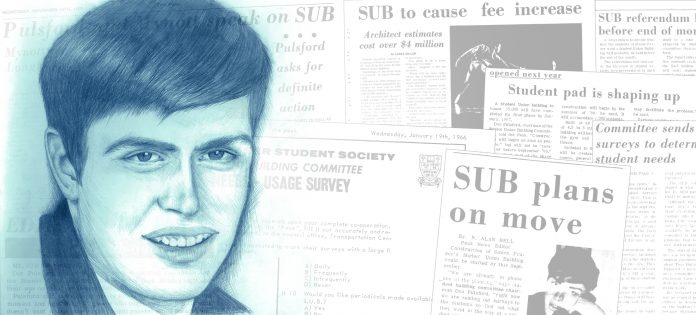
As a member of the inaugural student society executive council, Don Pulsford was at the forefront of all student issues.

Although he only spent four semesters at the school, he helped establish the student newspaper, fought against tuition fees, organized sit-ins and park-ins, and worked as the student society’s first Public Relations Officer.

His biggest passion however was the Student Union Building. It was with Pulsford that SFU’s first attempt at its never ending quest for a SUB began, a dream which is only now, 50 years later, really looking as if it will soon finally be fulfilled.

Befitting to the school he loved, Pulsford unfortunately ended up living an instant life. However, his vision is more relevant to our campus than ever and whenever the SUB finally does rise, it will be a testament to his enduring legacy.

[dropcap]D[/dropcap]onald Arthur Pulsford was born on December 23, 1942 in New Westminster, British Columbia. His parents divorced at a young age and he lived a quiet life with his mother and stepfather. At ten years old he was joined by a step-brother, Ralph Allen Hanson.

As a student at Lester Pearson High School, Pulsford wrote for the school’s award-winning student newspaper The Mike and covered issues such as “pink slip” detention cards, wrote odes to student parking lot woes, and interviewed an English teacher obsessed with poetry about death.

According to classmate David Mustart, who was an editor for the publication, the young Pulsford was very bright, and a great writer.

“But of course his life was hell, having hemophilia.”

For all Pulsford’s intelligence and passion, he was clouded by darkness. As a hemophiliac, a hereditary genetic disorder that impairs the body’s ability to control blood clotting, he was unable to live the typical rambunctious childhood of a young boy.

While he had a great interest in sports — especially the element of physical contact — it wasn’t an option for him. Even if he were to just bump something, with the impact, the blood would start filling up pockets around the joints and cause great pain. He wanted to wrestle, but doing so left him bloody and bruised.

After completing high school, tragedy struck Pulsford’s life. At the age of 18, his eight year old brother passed away. Ralph also suffered from hemophilia and his untimely passing was directly related to it.

The premature death had a huge impact on Pulsford whose life became further complicated when his own medical struggles caused him to spend two solid years in a hospital bed between graduation and post-secondary.

Often not allowed to see friends and without television in the hospital, he was forced to be alone with only his mind. For two years he just read books and trained his brain and his mind, day in and day out, waiting for the opportunity to be free.

Pulsford’s freedom from the dreary life of a hospital patient perfectly coincided with the opening of a school which would immediately become known for freedom.

As an older student — Pulsford was 23 when he enrolled as an undergraduate at the new Simon Fraser University — and clearly motivated by a sense of urgency caused by his hemophilia, he became involved in the school’s burgeoning student politics right away and hoped to be president of the new student society.

He had competition though. Tony Buzan, a graduate of pre-med from UBC, had been invited to SFU not only to study English, Mathematics and Creative Writing, but to run the new student union. Although they should have been rivals, according to Buzan, it did not take long for them to join forces.“I met [Pulsford] in the student offices with his followers,” Buzan explained of their first encounter. “He was very vibrant and very passionate and he presented his case for being president. And I presented him mine. After an hour of in depth discussion, he said, there’s no good reason for me combatting you because basically everything we want in the Student Union, we agree.”

Pulsford therefore decided to run for the society’s Public Relations Officer position and have a place on council, but support Buzan’s bid for president. This ended up getting the pair in some controversy early on when in a speech for the PRO position, Pulsford did not mention his platform, but simply campaigned openly for Buzan’s presidency.

After receiving a scolding from editor Sam Steenhuus in the campus newspaper, The Peak, Pulsford and Buzan issued formal apologies. Buzan ended up winning the election and Pulsford took his seat on council by acclamation. While their letters to the paper deny collusion, Pulsford and Buzan soon became best friends at the young university.

According to Buzan, it was not easy for them as politicians as “the first student body, as we were called, was composed of every dimension of revolution.”

“Simon Fraser was designed to bring together all the people from around the world who were involved in any kind of revolution. You know, many of them banned from their own countries,” Buzan explained. “Essentially the student body was composed of a boiling pot of United Nations revolutionaries. And that’s where Don ended up.”

While Pulsford’s unique journey to university and his extraordinary mind certainly placed him among the united outcasts of this new revolutionary institution, he had an interest that few around him had the foresight to be passionate about. Pulsford was one of the first students to care about the SFU student, and he did so before anyone even knew what ‘the SFU student’ was.

[dropcap]“[/dropcap][dropcap]I[/dropcap] still remember him sitting in that English 200 class . . . he just turned around, at the beginning of the class and said, ‘What do you think about that Tartan?’”

Rick McGrath, a first-year charter student at SFU, remembers his first exchange with Don Pulsford quite well, because in many ways it ended up changing his life. 

It was the second week of classes in 1965 and Pulsford sat next to McGrath and began complaining about The Tartan, SFU’s first student newspaper. In Pulsford’s mind, because it was set up by Lorne Mallin, a student who had transferred from UBC, it didn’t really have SFU student concerns in mind.

McGrath did not share his level of outrage, but agreed to go to a meeting where they set up a rival paper called the S.F. View. Instead of declaring himself the Editor-in-Chief, Pulsford nominated the 18-year old McGrath as a candidate to go to a vote. Due to McGrath’s experience of having had a paper route as a kid, he was elected to be in charge.

The paper eventually forced a merger with The Tartan to become The Peak, the campus’ current paper. While Pulsford left the new publication as soon as it began, McGrath went on to become a longtime editor and columnist, transitioning his skills into a lengthy career in journalism and writing.

McGrath still remembers Pulsford as being ahead of the curve on caring about student issues.

“He was interested in all this stuff [that] nobody else was really thinking about at all,” he explained. “I don’t know why he was interested in the student body. The thought has crossed my mind that he may have been passionate, but he also could have just been managerially organized and interested in setting things up his way.”

According to McGrath, Pulsford was very organized compared to the rest of the young, confused campus and was a typical ‘backroom’ guy, an enigmatic personality on campus. Being older and having a deeper understanding of history, he had a huge opportunity to make an immediate impact.

As McGrath describes, “there were no seats, the clocks didn’t work, it was mayhem and to a certain degree, there was nothing on campus for students.” After his success in getting SFU’s first true student newspaper started, Pulsford was ready to take on the rest of campus life.

[dropcap]A[/dropcap]s student society PRO beginning in October of 1965, Pulsford was immediately thrown into the fire of the volatile world of student politics. His biggest concerns involved protecting the interests of his fellow students for which he received support, but also chagrin.

He was involved in all of the council’s early decisions and projects including: starting a student guide service, creating a student telephone directory, hiring a campus crier and the establishment of a soap box in the mall which according to Buzan was a hotbed of free speech.

“Every week, I or the council members, including Don, were publicly threatened with impeachment,” Buzan remembered. “They were either ‘pinko communists’ or were ‘fanatical right-wing maniacs or ‘over the top in sexuality’. Other times students were being gay. You name it. So my council members, and Don, had to defend ourselves.”

“I’m pleased to say that we never lost,” he added.

One of Pulsford’s early tasks was to be in charge of what posters were acceptable to be put up around campus. While the Executive decided that “lively remarks” were alright and obscenities should not be permitted, at soapbox rallies there were calls for council to explain Pulsford’s authority to take down any posters he didn’t consider in the interests of students.

He received similar complaints about his sudden decision to call for the abolition of fees at Simon Fraser in November of 1965 when the rest of his council was only in favour of freezing them.

According to Sam Steenhuus, while many supported the movement, “Pulsford should also state his reasons for wanting to abolish fees. It would be well worth his while to do so, because alone he can do nothing.”

Personally, Pulsford was also involved in organizing a ‘park-in’ which forced the replacement of SFU’s mud-pit parking lots with gravel and, in an action close to his own struggles, chaired a Medical Health Committee who brought a Doctor onto campus.

By the end of the semester however, Pulsford had found a project that was more fitting to his interests and passion. After less than three months, according to council meeting minutes: “Don Pulsford resigned in order to chair a committee to investigate matters concerning the Student Union Building.”

[dropcap]T[/dropcap]he idea of creating a Student Union Building at SFU was first brought up at a luncheon between chancellor Gordon Shrum and student council members in October of 1965. While President McTaggart-Cowan had plenty of interaction with students, a meeting with Shrum was rare, which made the SUB idea quite salient to members of the council.

As a building that was intended to house everything that was in the interest of students, Pulsford was first in line to lead the project. Seeing as he was nearly the only one at the university who wanted such a responsibility, the main leadership role was his.

Along with Tony Buzan, he became co-chairman of the SUB committee in late November and was independently in charge by early 1966.

Wishing to waste no time, Pulsford set in motion plans for the SUB beginning in December of 1965. In order to hear directly from students on what they wanted included in their building, he sent out letters on December 19 to all the directors of SFU’s already amazingly long and diverse list of clubs, and asked for them to be returned by January 1.

“The SUB building, was a generic idea [but] Don was the great fighter to make that dream come true,” Buzan said of Pulsford’s role as the SUB committee chairman. “He was incredibly commit-

ted. He was a good leader because he was so kind and supportive. He was good at fighting for the good.”

“He also was good at building teams.”

Along with his good friend Buzan, Pulsford recruited a number of students and faculty members to be on his team to get the SUB off the ground. Fellow students Dave Alder, Bob Swift and John Mynott were on the SUB committee as were faculty members Dr. G. Kitchner and Dr. A. McPherson. The team was rounded out by council culture director, Art Tomlinson, who served as Pulsford’s assistant for a fee of $1.00.

In early January, with the project barely started, Pulsford was already looking to the end of the rainbow. In the January 5, 1966 issue of The Peak, he is quoted as saying that “construction will begin as soon as possible but will not be completed before September ‘68.”

Current plans expect construction for a SUB to begin (hopefully) sometime in 2016.

[dropcap]U[/dropcap]nder Pulsford’s leadership, plans were prepared for a SUB that would eventually house 20,000 students and the first construction phase was intended to begin in either the summer or fall of 1966. The building was to be located in the area between the Madge Hogarth residence and the gym. At the time, this area was a parking lot but was also the allotted space left by Erickson-Massey (SFU’s architecture firm) for such a structure.

In addition to the letters he had solicited from clubs and students suggesting how much and what sort of space they were interested in, Pulsford had a usage survey distributed to the entire student body through The Peak on January 19, 1966.

There seems to have been no question in Pulsford’s mind at the time as to whether or not the project would happen. It was just a matter of when.

The Peak survey did not ask “would you like a S.U.B.?” but did raise the question “Would you like a bowling alley in the S.U.B.?” and also “please indicate your preference: A) 5 pins B) 10 pins”.

In the first month of the project, there was a great deal of excitement surrounding everything that could go in the SUB. The Bridge Club wrote to Pulsford requiring card tables, the Sports Car Club wanted a garage-racing pit, and “Rick Bauder (Arts 1)” proposed a room for billiards and snooker. Pulsford and his team also had extensive correspondence in order to determine the feasibility and cost of a non-denominational chapel as part of the SUB.

By February however, the issue of financing quickly deflated the air out of Pulsford’s party. On February 2, it was confirmed that building the SUB would cost at least $4.5 million and according to SUB committee member and ombudsman, John Mynott, a fee increase would be required if the project were to happen.

This possibility caused a lot of arguments amongst the council. Some members, like Dave Alder thought it was absolutely necessary, while others, such as treasurer Bob Penny didn’t think it was worth it at all. Many, like Mynott, stood in the middle, believing it was up to the students to decide how they wanted their money spent.

Despite being obviously dedicated to the SUB, Pulsford was torn as he was also a notable advocate for lowering fees. He did not want to see an increase of more than $3, but conceded that it would probably have to be at least $5. Mynott’s best estimate, taking into account enrollment increases, was a $10 increase.

Pulsford and the committee immediately began seriously looking at alternate financing options, but were stumped at every turn. The school didn’t yet have any alumni who could help out, they did not wish to use administration money as it could take away student control, and their letters asking for federal and provincial support were met with polite refusals.

Even a student fee increase would be a challenge. Although the council planned a public drive for funding, according to Shrum this would not be approved by the Board of Governors. He suggested a much smaller building which could be expanded later, a frustrating notion to the fast-living Pulsford.

Although Pulsford and Buzan set a referendum for March to find out both, whether students wanted the SUB and if they would be willing to pay for it, with the realities of bureaucracy sinking in and a lack of funds preventing the SUB from moving any further at the present time, it all became too much for Pulsford. On February 21, he quit.

[dropcap]D[/dropcap]espite having printed quite a bit of criticism of the SUB and Pulsford in the past, The Peak’s editorial following the resignation of the man they called “Mr. SUB” was quite somber.

“Pulsford, for all his wiered [sic] methods of doing things, was a one man committee. He fathered the SUB and up until now has been playing the role of mother as well,” they eulogized. “He thinks there will be no difficulty in finding a new chairman, and that he will be able to take over the position with ease just by reading the SUB file. We doubt this very much.”

The Peak explained that Pulsford was “perhaps the one person on campus who could get his way with council and even more important with Tony Buzan” and also wrote of The Peak’s own plans for the SUB.

“We were to eventually get a good portion of the basement in which to eventually produce a daily newspaper.”

While they signed off on Don and the project, and said that they would miss the copy and controversy he provided for them, he wouldn’t stay gone for long. On March 14, two weeks following his resignation, he sent a letter requesting that the Student Council reconsider and allow him to come back.

When he had left, it had been because of lack of funds and also because he “felt it was no job for a student”. Apparently, the financial prospects were better and he had matured significantly in 14 days. According to his letter, a major problem with other universities’ SUB buildings had been resignations by their chairmen and felt as if he would be doing the students a disservice by not continuing.

As difficult as it was for him to do, he wrote that the project would be delayed and he would be careful to take a more methodical approach to his planning. He had wanted an instant SUB but over time had realized that he would have to slow down.

Throughout March, both the referendum signifying students desire for a SUB and the referendum agreeing to a financial commitment to the SUB passed and the project was slowly moving along. Unfortunately by June, Pulsford was forced to leave the SUB project again. This time it was not by his own volition and he wouldn’t be able to come back.

After carrying on as SUB committee chairman at a more relaxed pace, Pulsford tried to extend his political power further and ran for President of the ‘66 summer council. Buzan had left to tour the world and although he wished for his friend Don to take up his post, it did not work out.

A student named Alex Turner took the election with 94 votes while Pulsford finished third with a respectable 60 votes. While this shouldn’t have necessarily spelled the end for his SUB, he vehemently disagreed with Turner and the new council when it came to the project.

After being asked to present to council on the SUB or be dismissed, Pulsford wrote a letter to Turner, as he put it: “in reply to your ultimatum”. In the note, which they read aloud in council on June 20, Pulsford states that “since the majority of this semester’s Council members ran on a platform of an exclusively administration-built Student Union Building, and since council is in any case, constitutionally powerless to deal with S.U.B., I do not choose to appear before Council at this time.”

Pulsford continued by saying that he would make his report at the first meeting of the fall and keep the data inaccessible to them, with the exception of the Ombudsman.

While he was convinced that council had no power over him, there was a vote which agreed to “remove him with thanks” and a new SUB committee was immediately set up under vice-president John Kenward and science rep Doug Sandberg.

The SUB project slowly evolved into a building with less and less emphasis on students. Pulsford made one last plea for his version of the SUB in November of 1966 after fall president John Mynott pushed for a joint faculty-student building called “the Longhouse”.

Pulsford, worried about a lack of communication between the administration and students, was quoted in The Peak warning students to not agree to a fee increase prematurely for the Longhouse. The Longhouse had plans to be partially financed by the administration, an element which concerned the pro-student Pulsford.

Mynott dismissed Pulsford’s comments and simply wrote that he hoped President McTaggart-Cowan realized his thoughts were simply “a letter from an individual student [and] not necessarily the opinion of the whole student body.” It was the last time Pulsford would have to be criticized for speaking for SFU students.

[dropcap]A[/dropcap]fter the fall of 1966, Pulsford never addressed the Student Union Building issue publicly again. At a school of instant creation when it came to anything that came from the administration, he had been unable to get a project dedicated to students past the stage of squabbling and politics.

Exhausted by the life of a student politician, he retreated back to the world of newspapers he had occupied in high school. In 1967, he became the Production Manager at The Peak, a refreshing change of pace.

It was at this time that he also found love. Through Tony Buzan, he met Mayling Weaver, a recent UBC graduate who began studying English at SFU in its second year.

“He was a very romantic man,” Buzan recalled. “When I left BC traveling around the world, Mayling and he fell in love.”

They were soon married and the pair worked together in the summer of ‘67 as Mayling was elected Editor-in-Chief of The Peak. While she remembers Pulsford experiencing a lot of suffering due to his hemophilia, she still looks back on that time in her life fondly.

“He was a very congenial person and he was a very gentle man, in both senses of the word,” she recalled. “He had a gentle disposition, but at the same time he had a very good sense of humour. A slight sense of playfulness there… very bright too. He was a very likeable person.”

After a semester at the student paper, Pulsford was hired as the Editor-in-Chief of a newspaper in Jasper, Alberta called The Jasper Gateway. He left SFU and went off with Mayling for what Tony Buzan believes was a more relaxed life.

“He wanted peace. He wanted tranquility. And he wanted an environment in which he could really think and be creative,” Buzan said on Pulsford’s journey away from SFU. “One of his great joys was for his own creativity . . . poetry, music . . . when artists work, they al- ways feel fulfilled. So being in nature, which is where he was going, in a job that was purely creative, he didn’t have to end up in political meetings, business meetings, which he did find a little bit tedious and taxing.”

“Similarly, he needed to make sure he was taking care of himself. He could only take care of other people by taking care of himself. Because if he didn’t take care of himself, he’d be gone.”

However, while in Jasper, Mayling recalls that his health was a major concern. He had lived a fast paced life, taken a lot of risks, and now it was all tragically coming to an end.

[dropcap]“[/dropcap][dropcap]O[/dropcap]n January 27, 1968. I was in England, in London, at that time, and looking forward to going back and that is when I got the telegram announcing his death.”

Perhaps of all people, Tony Buzan was most affected by Don Pulsford’s tragic and sudden death. According to Buzan, during their conversations Don had often described a recurring nightmare he had.

“His main fear was that, he would be driving a car on his own and the car would crash when he was on his own. And he would bleed to death. And he could do nothing about it,” Buzan recalled. “He technically never drove on his own. He was always with somebody. And once, he did.”

Pulsford was 15 miles from the town of Lake Louise, Alberta when his car collided with a snow plow on the Jasper-Banff Highway. Funeral services were held at the Unitarian Church of Vancouver and a memorial service was also held at Simon Fraser in front of the three flags at the entrance of the university.

Shortly after his death, Buzan wrote his first poem, entitled “Death of a Hemophiliac” about and in honour of his departed friend. While Buzan has gone on to have a distinguished career studying and writing about issues surrounding the brain and thinking, he has continued to be inspired by Don Pulsford.

“It was the loss of one of the great brains in British Columbia. You know, he definitely was one of the great brains in British Columbia.”

[dropcap]A[/dropcap]fter Pulsford left the SUB project, it was never quite the same. After a few stops and starts, in the fall of 1968, a new plan for a combined student-faculty-staff “University Centre Building” began. The UCB project ended up being a success and was opened in 1970, although it was quite small and only really consisted of one of the amenities that students desired: a pub.

In the mid-90s the UCB was renovated and a new student service building — which received half of its funding from administration — was attached to it, creating the Maggie Benston Centre. There was still however a need for more areas just for students.

It wouldn’t be until 2006 that a project began that matched the scale and magnitude of Pulsford’s original vision. After a great deal of planning, in 2013, the Build SFU campaign launched and they have since made concrete plans to bring a SUB to SFU. While they have faced similar problems as Pulsford did in regards to financing, the project is still looking like it will eventually break ground.

Fifty years after it seemed like he was the only one who cared about the SFU student, Pulsford’s attitude has spread across the entire student population with not just one student, but hundreds, if not thousands, taking on his mantle. Current members of SFU’s student society credit the success of the most recent SUB project to having many Don Pulsfords, not just one champion.

“I would say it’s definitely been a team effort, because no single board has really pioneered it and nobody on our staff and management side either,” SFSS President Enoch Weng explained about the Build SFU campaign. “It’s a reflection of [all students’] voices, and the students that are currently pursuing it have advocated for it, and have invested countless hours and time and effort into it, those are the real champions.”

“You don’t really see them, because they’re out working in the background . . . [but] these are the people that I think should be given the credit.”

According to Tony Buzan, when the SUB opens it will be the fulfillment of Pulsford’s dream.

“The SUB was like a monument in his mind for caring and looking after and protecting students,” he said. “So that building was a monument for the love of education and students and making sure that that building was there to guarantee a better educational future for the province and the world.”

“One can fight for that and to have that building raised as an icon for the legend of Don Pulsford.”

The Peak’s guide to SFU’s 50th Anniversary Kickoff

0
Photo courtesy of SFU

The ‘big day’ has arrived at last! After spending half a century resting just on top of one, SFU is finally over the hill.

SFU welcomed its very first students on September 9, 1965. Though it was once coined the “instant university,” looking around today, you see an establishment with history behind it and a future ahead.

The university is more than ready to share its joy with its students, staff, faculty, the greater community, and really just the world at large. This September 9 will be a day of food, music, speeches, and celebration across SFU’s three campuses. The event will be hosted by SFU alumnus and CityTV Breakfast Television host Riaz Meghji.

There will be free welcome back events at SFU Surrey and Vancouver that will be live streamed on Burnaby Campus to include everyone in the excitement.

Here is a handy dandy guide to help you enjoy the Burnaby Kickoff celebrations to the fullest.


The party don’t start ‘til you walk in

The event kicks off at 11:30 a.m. in Freedom Square. You could use this time to settle in, mingle, and find somewhere with a great view for the programmed festivities.


Fusion performance

Scottish highland dancing and bhangra do not seem like two things that go together, but we have been promised by President Andrew Petter that they really do: “You’d be amazed at how well the two fit together!” The SFU Pipe Band will be featured in this multicultural performance, starting around 11:45 a.m..


“Speech, speech, speech, speech!”

Full disclosure, there probably will not be people chanting “speech,” waiting for the first speaker to pick up the mic. Find some sweet standing room and listen to a few speeches, starting at 12:05 p.m..


Legacy song winner performs

After months of anticipation, the winner of the SFU Legacy Song Contest will finally be announced. Will it be “Make a Simon Fraser U,” “WE ARE SFU,” or “Engage the World”? The entire SFU community is on the edge of their proverbial seats! The winner will perform after being announced at approximately 12:30 p.m..

Food carts and full stomachs

Standing around listening to all of those speeches must have made you hungry. By the time they’re over, it will be right around lunchtime. (Though, if you’re a traditionalist who believes lunchtime is at noon sharp, it will definitely be past your lunchtime.) There will be a variety of food vendors on site until 1:30 p.m., when the event wraps up.


Birthday fun

Make your mark! Sign the giant birthday card. Wish SFU the happiest 50th birthday in the world, with a gentle reminder that 50 is the new 40, 60 is when you really get to know yourself, etc. There will also be a giant birthday cake to match. If you like things that are chocolate and fair trade, you are going to love this cake.


Live in the digital age

Follow along with the official hashtag (#SFU50) and your social media posts could be projected for all attendees to see.


Chalk it up to a great time
There will be chalk provided for guests to decorate SFU’s iconic concrete campus with messages and artwork.

Windstorm does severe damage to Metro Vancouver

0
The area around SFU residence was also affected. - Alfred Zhang

The worst windstorm in recent memory blustered winds of up to 90 km/h through Metro Vancouver on the last weekend of August, uprooting small trees and throwing branches onto power lines, vehicles, and houses.

The storm was also accompanied by heavy rainfall. More rain fell on Friday, August 28 through Monday, August 31 than had fallen in the area all summer.

Traffic was thrown into disarray, as BC drivers seemed to disagree on how to handle the four way stop procedure when a traffic light is without power. Finally, making a bad situation worse, BC Hydro’s website was down for most of the weekend.

BC Hydro reported that nearly 50 per cent of its customers on Vancouver Island and Metro Vancouver lost power due to the storm — the worst power failure in their history. Workers were called in from across the province, even as far as Williams Lake and Fort St. John. BC Hydro’s Twitter reported that there were still just over 100 customers without power on the morning of Wednesday, Sept. 3, and several minor power failures have occurred since then. As of Thursday, the repairs had cost $15.4 million.

Washington state was also badly affected by the storm, with half a million people without power at the height of the storm and two associated deaths.

SFU Burnaby was without electricity for about half a day, running on backup generators until late Sunday afternoon. Phone services were also badly affected, continuing to experience technical issues until Monday afternoon. UniverCity and Discovery 1 and 2 were without power until 11 p.m. Monday.

Kurt Heinrich, Director of University Communications, explained that SFU staff “weren’t aware of ever having a complete power of this duration, so it’s quite a unique event.”

Many of SFU’s buildings are covered by the 23 emergency generators on campus. These generators are tested monthly and can provide 24 hours of energy before needing to be refueled. The cleanup of the debris and damage on campus is ongoing, but the cost is estimated to be around $20,000.

Heinrich, who was on campus during the power failure, said that SFU staff were surprised to find a wedding occurring on campus during the storm.

Despite the dangerous nature of the storm, Courteney and Michael Rushworth were married in the Diamond Alumni Centre during the power failure, having made the decision to carry on despite the storm. SFU facilities and catering staff put on a candle lit reception, reheating food on barbecues and using a gas generator to power the sound equipment for the first dance.

Although the windstorm is now over, the freshly battered Metro Vancouver’s situation has been suggested to be a sign of worse weather to come. Climate change scientists have been asserting that more extreme weather like this will become commonplace if global warming continues without sufficient regulation.

Whether it was due to harsh weather, or an unlucky summer, this storm reminded BC residents what it is like when mother nature cuts loose.

Made with liquor and love

0
Photo courtesy of Paul Alberts.

Having never been to a mixology competition before, I wasn’t sure what to expect at the Vancouver finals of Made with Love. What I didn’t expect was a trade show style set up and voting with dog tags. I pictured a stage, set up almost like a cooking show, with mixologists creating fancy drinks while they or a commentator explained what they were doing and why the ingredients would work well together. Then samples of the drink would be passed around. What I had imagined was much more entertaining than the reality.

We were greeted with a drink of Campari and Red Bull Yellow before entering a large conference room at the Fairmont Vancouver Hotel, which was lined with tables against three walls and tall cocktail reception tables scattered in the centre. Upon entering the event it wasn’t clear where to begin or how one would vote for their favourite drink. Eventually an emcee made a barely audible announcement explaining the purpose of our dog tags — we were supposed to give them to the creator of our favourite drink. Then the dance music began.

Each mixologist had quite an elaborate set up at their table as they tried to create an entertaining experience while making their drink for you. One table featured men in togas making “Aphrodite’s Milk” (it was just gin and greek yogurt – gross unless you like the taste of straight gin). Another table attempted to bring the beach indoors by having you stand in a sandbox while your drink was being made. Their rum based drink did have a taste of the Caribbean and wasn’t bad, although it was very strong.

The lack of variety of the liquors used in the drinks was a bit disappointing. The mixologists were sponsored by a few select brands: Campari, Hendrick’s Gin, 1800 Tequila, Jack Daniel’s Tennessee Honey, Disaronno, Skyy Vodka, Wild Turkey Bourbon, and Appleton Rum.

Some of the tables had a canapé paired with their drink, which was a nice addition. My favourite by far was a chocolate gelato paired with a vodka-based drink infused with rosewater. Both were delicious. Other than that drink, I was hard pressed to find one that didn’t make me shudder on first sip from the sheer alcohol content.

Another table that deserves praise for their performance element was a Campari table set up like an old Parisian carnival. There was a ring toss, popcorn, and a mixologist with sparkly make-up making a whisky ice cream float. The ice cream was delicious, but after that ran out the rest of the drink was quite bitter.

Even though I struggled to find a good drink, I was entertained by the interesting people wandering around the room, and now I know I can stick to my good old Long Island iced tea.

14 of Vancouver’s best barchefs presented their creations, and here are the winners:

Public’s choice:
#1 Adrian Lindner, Beach Bay Café
#2 Stephen Tufts, Dickie’s Ginger Beer
#3 Frank Palter, Fairmont Waterfront

Judges’ Choice:
#1 Tyler Williamson, Fairmont Pacific Rim
#2 Adrian Lindner, Beach Bay Café
#3 Frank Palter, Fairmont Waterfront