Home Blog Page 986

In the deep end

0
Photo credit: Lisa Dimyadi

In about my fourth lifeguarding shift at a new pool, I looked into the deepest end of the water, and I saw a person sunk deep, motionless with her arms and legs spread out. Just moments before, I was recalling in my head the story of a near-drowning that I had heard.

This isn’t that ironic, though. It’s like when you think of a song and it comes on the radio at the same time. It’s serendipitous, but you probably forget all the times the song doesn’t come on. In retrospect, I anticipated swimmers drowning every guarding shift I worked, before and after this.

In the story I was thinking of, a guard always insisted on looking directly down the side of the pool, and, because of this, they spotted and pulled out a physically disabled woman who had slid along the pool’s side to the bottom.

For the first time, I was guarding a very busy area with many splashing kids. I was thinking about this story, I looked down, and I saw her. Blood rushed to my head; no one knew her.

I dove in and focused on my t-shirt dragging my arms. I covered the woman’s mouth and pulled her up. Another guard was with me in the water, and she found no pulse and no breathing. The woman’s lips were blue and her face was pale. I looked back at her face twice while we pulled her, and I thought, “I killed someone.”

I only remember bursts of moments afterwards. We brought her to the shallow end, other lifeguards lifted her out; a swimmer, not a lifeguard, actively performed compressions on her chest; I held the defibrillator, and two guards yelled to put it on; I pressed the pads on the wrong sides of her torso, and the helping swimmer pulled them off and corrected them.

I was helpless, incompetent, weak, stupid, and useless.

I looked back at her pale face twice while we pulled her, and I thought, “I killed someone.”

I remember, afterwards, I stepped into my dad’s car and cried a lot. I rode home with my parents and I felt numb; when we arrived, they went out to do plans, probably because I implied that this all didn’t affect me much. Our house was huge and most of the lights were off.

I thought about a short while in my life, around when I felt a powerful, general numbness. For one period, it was all I could think about; one night in particular, I couldn’t sleep for hours because of it. I didn’t tell anyone how I felt, though. I didn’t want to burden them, or even accept it.

There in the house, I turned on many lights, and my hand shook the phone against my ear. I tried many, but could only reach one friend that night. He listened to everything I had to say, and it didn’t matter that he didn’t know how to respond.

Days later, a local newspaper released an article about the incident and how Jane, the woman, had survived. It hailed the swimmer who helped in the pool, implying that if he wasn’t there, she would have died. It didn’t mention the six trained lifeguards also involved.

In the following weeks, I met with another friend, a fellow lifeguard. We talked about this, and her own incidences, when she felt guilty, shameful, scared, and incompetent. I would shake and cry, but I spoke about it. And going forward from there, I found many generous people who wanted to give me their attention, and talk about their own personal stories.

Talking about this now, my pulse gets stronger, and I feel waves of guilt and shame.

But after that time, three years ago next month, I promised myself that my feelings would always have weight, that I would always have weight, and that I could change.

I also promised that from then on, if anyone needed me to be, I would be the one listening on the other end of a phone or the other side of a table.

The sad irony between social justice and persecution online

0
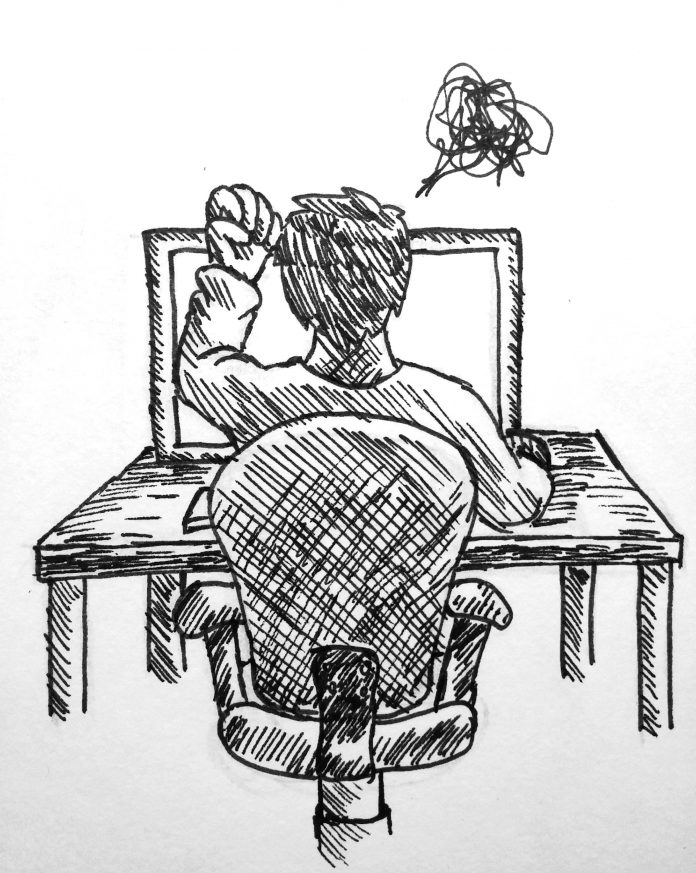
Photo Credit: Zach Chan

The Internet is the illusion of an independent society. It serves as a singular location where individuals from different parts of the globe are able to interact. From the “Stop Kony” movement in 2012 to the recent #BlackLivesMatter campaign, online activism reflects a timeless narrative that drives all social change: a yearning for freedom.

In terms of speech and expression, the digital era boasts a lack of restraint that has never been experienced in history. The idea seems like a fairy tale; world peace is on the horizon as honest and authentic communication occurs between people of different cultures. Unfortunately, the Internet is not a utopia where individuals can say anything without lasting repercussions.

Social rules of this time period revolve around the ideal that diverse individuals should be accepted as equals. We look at history in a condescending manner as we compare it with today’s ‘greater’ era of acceptance and equality. Something interesting has been occurring for the past few years that casts doubt on the superiority of the modern social world.

Views that seem to conflict with those ideals of acceptance and equality have been policed through intense criticism online. Any action that can be construed as bigotry in any format is something to be exposed and punished. With the online world being self-regulated, the vision of cyber interaction as a sincere experience becomes a fantasy. The blurred line between cyber justice and social persecution reflects the myth of freedom of speech in the era of the millennial.

Instead of encouraging equal treatment and privilege, attempts at online social justice tend to turn into persecution whereby a single party is treated with hostility from large numbers of people as a result of having or expressing certain views. Fear is not an effective solution to prejudice, and is even less effective in a time when any infringement on freedom is greatly resented.

Fear is not an effective solution to prejudice.

It is difficult to separate justice and persecution when online activists seem to lose sight of their purpose in an eagerness to retaliate for perceived prejudice. There seems to be no patience for ignorance or room to learn about diversity.

If the consequences of being politically incorrect can be as intense as losing employment, staying silent is the best course of action. Yet silence is detrimental to the wider dream for world peace and social equality because people from diverse groups cannot communicate and begin to adjust the distorted lenses by which they may view each other.

The blurred line between justice and persecution online poses a danger to any citizen. One only has to be labelled a bigot to suffer the wrath of cyber justice, regardless of the truth. A misconstrued or wrongly worded phrase has the potential to invite a massive wave of cyber attacks.

It is too easy to forget the human on the other side of the screen, while it is too difficult to empathize with someone that seems so hateful. Individuals, in their fear of offending people, may prevent communication with people from other cultures. Ironically, this wall between different groups is a disadvantage to online social activists looking for large, diverse numbers of people to come together for one cause.

We are both liberated and imprisoned by the Internet when it comes to self expression. We are free to say what we please but are exposed to the consequences of making certain statements. As a result, freedom of speech online is a luxury depending on how little public opinion is important to the life of the subject.

Cross country teams aiming for national success

0
Photo courtesy of Christopher Oertell

Both the men’s and women’s cross country teams had highly successful seasons last year. The women finished seventh in NCAA Division II and won their first ever GNAC title, while the men’s team were invited to their first ever national meet.  


This year the stakes are even higher. The women’s team come into this season ranked eighth nationally, and are the preseason favourites to win the GNAC title. The men, on the other hand, are ranked third in the GNAC preseason poll, and are the 25th ranked team nationally. For the women, it’s about staying focused amongst big expectations.


“I don’t think they’ll suffer from overconfidence,” said head coach Brit Townsend. “We are not going to be bringing our best team for the first couple of meets. Jennifer Johnson is just coming off a stress fracture, Addy Townsend is very anemic right now, and Peggy Noel is coming off an injury [. . .] these first meets can be a really good chance to find out how the new recruits are doing, and what kind of shape the returning people are in.”


The men aim to match the same high level as the women, and coach Townsend is very confident that they can achieve that. “They are extremely motivated, and their goal is to make it to the national championship. We have some great new additions this year, we have Dallas Barker, Carlos Vargas, Rowan Dockerty, who is a triathlete from the island, and Shawn Miller. So I’m excited to see how that all works together. It will be very competitive to see who will be in our top seven… it’s going to be interesting to see where our men can get to this year.”


The biggest loss for the team will be Lindsey Butterworth, last year’s co-female athlete of the year at SFU. “Obviously she was a great asset to our program over the years, and we’re sorry that she’s done. But I’m also excited about her future.” Her leaving the team will be a big void to fill, but coach Townsend is hopeful that new recruits will “develop to the level that she’s been at.”


The team’s first meets will be at Seattle University on September 19th.

Satellite Signals

0

WEB-woodwardWoodward’s

Lawrence Hill, author of the acclaimed novel The Book of Negroes, will join up with CBC Hot Air radio host Margaret Gallagher to discuss the process of transferring a novel to a television miniseries at “The Book of Negroes: From Page to Screen” on Thursday, September 17th, at 7:00 p.m..

Surrey

surrey

Engage with political issues that affect you at “Creative Publics,” an interactive art workshop which aims use art to spread awareness about the political issues relevant to the upcoming federal election. Join in on Friday September 18th from 12:00  — 4:00 p.m..

vancouverHarbour Centre

Learn more about Kurdish history with “Women Warriors of Kurdistan,” a panel discussion featuring Kurdish activist Nissy Koye, and fighter for the Kurdistan YPJ Hannah Bohman, as they discuss “the power of female fighters” at Women Warriors of Kurdistan on Sunday, September 13 at 4:00 p.m..


SFU PhD candidate starts work on a new heart diagnostic app

0
Laurin’s 3D heart model emulates the vibrations of a real human heart. - Ariel Mitchell

SFU Biomedical Physiology and Kinesiology PhD candidate Alexandre Laurin has spent his summer in France at the École Polytechnique developing a 3D interactive computer model to emulate the intricate behaviours of the human heart and chest.

Laurin’s ultimate goal is to use smartphones to diagnose heart conditions, bringing the diagnosis to us.

He worked as part of the Mathematical and Mechanical Models with Data Interactions in Simulations for Medicine (M3DISIM) group, focused on applying mathematical modeling and biomedical engineering to modeling the heart.

“You need the model first to understand what’s going on, then you can build the app for a smartphone,” Laurin told SFU University Communications.

The group started with studying the mechanical properties and movements of the heart and chest, examining the bones and cartilage that comprise a chest. They then use this information to form an elementary model of the chest using simple geometric shapes.

This model allows the team to detect vibrations in the heart. As of now, their program examines the minute gaps between detected vibrations to determine which valve of the heart is opening or closing, thus completing the simulation.

His work with M3DISIM is in tandem to his work at the SFU Aerospace Physiology Lab, led by SFU professor Andrew Blaber, where he obtained the necessary seismocardiograms of a real heart to compare to the vibrations simulated by his computer model.

Despite all the hard work Laurin has put in, developing a model is just the beginning. What the program cannot detect is the underlying reason behind the vibrations. “What we don’t know is what is causing the vibration reading, so if we ever want to diagnose wrong or weird vibrations, we need to really understand the mechanical and electrical variables of each vibration,” said Laurin.

In other words, each vibration has inherent qualities that correspond to different signals and movements in the heart. Laurin’s heart app would have to detect, process, and match these vibrations to observed data to produce a diagnosis for a patient’s condition.

Laurin anticipates that it would take at least another 10 years of work developing the app to reach a final product.

While this summer internship, partially funded by a Graduate International Research Travel Award given by SFU, has come to an end with the completion of the model, he plans on returning on a second trip to fine-tune the model.

What Canadian individuals can do to stop the Americanization of Canadian identity

1
Photo credit: Talha Qadir

Degrassi first aired in the ‘70s and was re-launched in the early 2000s. Since then, it has been on the air for over a decade and has brought forth all kinds of Canadian talent, most notably rapper and songwriter Drake. Unfortunately, the long-running teen drama wrapped up this summer, and we said goodbye to the series that attempted to encapsulate the plight of the modern Canadian teenager.

However, we don’t have to say goodbye for long — Netflix has since announced that it has decided to continue the show. One of the longest-running Canadian productions, one that has allowed many Canadian actors to make their mark, is becoming an American Netflix series.

At first, this may seem relatively insignificant — after all, it is just a teen drama, right? Well, it’s not quite that easy to write off. Degrassi’s transition is indicative of a larger cultural shift happening Canada: a slow Americanization of the Canadian identity and Canadian ‘things,’ like TV programming.

Netflix absorbing Degrassi is just one of the recent examples of how Canada is crumbling under the pressure of American culture. Canadian philosopher Marshall McLuhan said in 1967 that “Canada is the only country that knows how to live without an identity”; this simply isn’t true, as Canada does have an identity, an identity which is being threatened by creeping Americanization.

Canada is not America, and we should not aspire to be something that we aren’t.

Of course, there has always been an American presence in Canada, but our music, movies, and pop culture influences are increasingly coming from our southern neighbours. And if we don’t find preventative measures to counteract this kind of cultural shift, then Canada’s culture will continue to fade.

Besides an increase in government support for the CRTC and Heritage Canada, the best line of defence in protecting identity starts with us; we need to re-engage with Canadian culture. This could be as simple as the next time you’re picking a leisure read. Seek out a Canadian author, or alternatively, try out one of the new CBC television productions when fall TV programing kicks off. In reminding yourself of the importance of supporting Canadian singers, authors, actors, and artists, and by choosing to engage with them, you will help keep Canadian culture vibrant and alive.

Canada is not America, and we should not aspire to be something that we aren’t. American culture can, at times, be great. After all, it does offer up fantastic movies, music, and celebrity icons, but at the end of the day we are Canadian and it’s in our best interest to properly support and defend our own identity.

Thus, I encourage you all to try something new, be it a local French-Canadian poutinerie, a piece of Aboriginal literature, or a Canadian film. We have a cultural identity and we should do our best to preserve it.

World Sexual Health Day enlightens SFU students

0
Photo courtesy of HuffingtonPost

SFU held a commemoration of the fourth annual Sexual Health Day at the SFU Segal Building in downtown Vancouver.

The event, which occurred on Friday, September 4, was organized by Roanne Millman and Jennifer Pink of SFU’s Close Relationships Lab. The event was well attended, despite this being the first event of its kind in Canada, with representatives from the BC Women’s Hospital, Men’s Health Initiative, and Vancouver Coastal Health, to name a few.

World Sexual Health Day is an international event founded by the World Association of Sexual Health (WAS) in 2010. The organization “promotes sexual health throughout human life spans all over the world by developing, promoting and supporting sexology and sexual rights for all.”

The day is now promoted in over 35 countries through dialogue, networking, and education about sexual health issues. SFU’s event was the first of its kind in Canada. This year’s theme was “Sexual Health for a Fairer Society.”

The event featured three speakers who were well-versed in sexual health issues. The first of the presenters was Lori Brotto who is, among many titles, an associate professor in UBC’s Department of Obstetrics/Gynaecology, as well as an Allied Staff Member in the Division of Gynecologic Oncology at the Vancouver Acute Health Service Delivery Area.

The second speaker was Dorothy Shaw, the Vice President of Medical Affairs at BC Women’s Hospital, as well as a clinical professor in UBC’s Department of Obstetrics/Gynaecology.

The third was Shannon Griffin, RN and sexual clinician with the Men’s Health Initiative.

All three speakers tackled issues of sexual health and human rights, such as proposed new millennium development goals for gender equality — these include the promotion of sexual health and protection against sexual discrimination.

With the United Nations (UN) and many other advocates backing these changes, the dialogue at the Segal Building could not have come at a better time. This was highlighted by Shaw, who is an expert in global sexual health and the role of institutions like the UN in spearheading an effective strategy against practices such as female genital mutilation.

In an environment of free discussion, Brotto explained a new drug designed for women experiencing arousal dysfunction, much like Viagra for men. The drug, named Addyi or flibanserin, was recently approved by the FDA in the United States. In an interview with The Globe and Mail, Brotto said, “There is evidence to support those things — they’re just not medication.” She echoed these sentiments at the Segal Building, criticizing the oversimplification of a complex disorder with an “easy fix.” This led to a discussion about what constitutes female arousal on a mental and physical level.

Griffin explained her work with the Men’s Health Initiative and her insight into the questions, concerns, and misconceptions that men have about sexual health.

All in all, the event was a success on its inaugural run, according to co-organizer Jennifer Pink. She told The Peak that the group hopes to get World Sexual Health Day recognized as a national day of deliberation. For now, she is pleased with the first steps: “What is relevant to students is that this event raises discussions about sexual health and curiosity about these issues.”

Campus kickoff celebrates 50 years of SFU

0
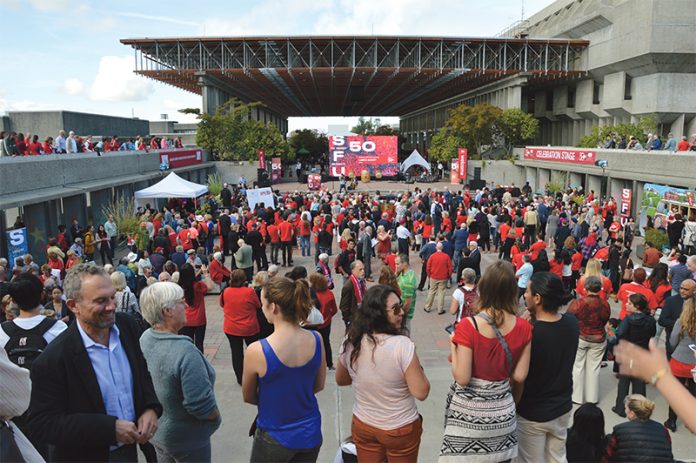
Crowds gather in Freedom Square for Campus Kickoff. - Lisa Dimyadi

SFU celebrated 50 years of “engaging the world” with a day packed with merrymaking, bagpipes, and an almost comical overuse of the word ‘engage,’ with events ranging from a casual celebration in Freedom Square to a swanky evening affair in the AQ courtyard.

The event saw nearly 2,000 guests enjoy the evening celebration. Of the $250 million set as a fundraising goal, organizers say $185 million ended up being raised from donors.  Organizers are still determining the total cost of the day’s events.

The day began with the Campus Kickoff, which began at 11:30 a.m. in Freedom Square. Hosted by CityTV Breakfast Television host Riaz Meghji and live-streamed to SFU’s satellite campuses, the kickoff began with a fusion dance performance that incorporated highland dancing, bhangra, and Aboriginal drumming.

Web-SFU50-2-Choong Jin Ng

Afterwards, multiple individuals shared words of wisdom and reflected on SFU’s past 50 years. Said SFSS president Enoch Weng, “I’m just so excited to see past students, current students, and even future students [. . .] as we come together to celebrate what it means to be SFU [. . .] I can only imagine the great things we’ll achieve here at SFU as we move towards the next 50 years.”

The Campus Kickoff was followed by the serving of fair trade chocolate cake and a food truck festival which whetted appetites for the evening event, appropriately dubbed “Celebrate and Savour.”

The latter event was hosted by Bard on the Beach Artistic Director and Founder  Christopher Gaze. Attendees included Provincial Minister of Advanced Education Andrew Wilkinson, Burnaby Mayor Derek Corrigan, andLieutenant Governor of BC Judith Guichon.

Guests enjoyed culinary creations from local eateries such as Vij’s Restaurant, Chez Christophe Patisserie, and The Vancouver Fish Company, while mingling in the AQ Gardens, which were transformed into a lavish venue, outfitted with lantern lighting and a large stage at the end of the reflection pond.Web-SFU50-4-Choong Jin Ng

Members of the Teaching Support Staff Union were present at the event, toting signs, some of which read, “President Petter, Engage Your Workers,” and speaking to attendees in order to spread their messages and explain what their core issues are that they have brought to the bargaining table. The union has been on strike and is currently in mediation with SFU administration.

At the end of the night, SFU wrapped up its 50th Anniversary with a bang, putting on a dazzling fireworks celebration. The AQ was then lit up with pyrotechnics set to a musical score.

Web-SFU50-3-Choong Jin NgOne of the most emphasized components of the day was the presence of charter students who were part of the original cohort of SFU students to attend the school in 1965. Nearly 200 charter students were estimated to have attended the day’s events and their presence was acknowledged and appreciated by the number of speakers throughout the night.

SFU President Andrew Petter made an address to attendees and the charter alumni in particular. He said, “We, the students, the faculty, and supporters of SFU, who are the beneficiaries of your work today, look with pride and admiration at what has occurred in five short decades.”

He continued, “These are the gifts that we have received from those who have gone before us. And they give us the responsibility to make sure that we are no less committed, no less energetic, no less passionate, Web-SFU50-Choong Jin Ngand certainly no less engaged as we move forward.”

During the morning event, it was announced that SFU student Caleb Sung and producer Brett Janzen had won the Legacy Song contest with their song “Engage the World.” Brendan Bernardo was the people’s choice award winner with his creation, “Make a Simon Fraser U.”

The theme of engagement echoed throughout the day, including Petter’s closing remarks of his address to the sea of SFU red in Freedom Square.

“I want to say I look forward to working with everyone here, as we all do, to build an even brighter future for the next 50 years. Let’s engage!”

New masters program trains “ecosystem physicians”

0
Photo courtesy of skoeber / Flickr

Simon Fraser University has partnered with BCIT to offer a Masters in Science (M.Sc.) in Ecological Restoration.

The two-year program begins this fall. It will allow students to gain the benefits of both theoretical science and experiential knowledge from both campuses. Students who enroll in the program will be learning skills needed to restore ecosystems that have been harmed through human affairs and industrialization.

Ingrid Stevanovich, Dean of SFU’s Faculty of Environment, spoke to the The Peak and explained how this unique program came to be.

“While there are other programs that address challenges of ecological restoration, there is no comparable graduate program that covers the full breadth of interdisciplinary offerings that range from science, through the social sciences — as well as the technical aspects of the actual practice of remediation,” said Stevanovich.

She continued, “The program emerged as a collaborative process between both institutions. It was very much faculty-driven. Faculty members at both institutions promoted the idea, recognizing a) a gap in ecological restoration science training in Canada, and b) a tremendous need within the field of ecological restoration for better research and improved practices.”

Students will not only take classes at both SFU and BCIT, but also they will be engaged in various restoration projects across the Lower Mainland.

Some of the main topics they will learn inside the classroom and out in the field are these: how to assess degraded ecosystems, design a restoration prescription, develop and initiate detailed monitoring programs, establish scientifically-based approaches, and develop and apply project management guidelines.

Stevanovich emphasized how this program allows students to gain both practical and theoretical knowledge.

“The core intent is to provide the practical training that is BCIT’s specialty, with the core, high-integrity scientific expertise at SFU. [. . .] Both SFU and BCIT also excel in community engagement and practice-based learning, so it is a great partnership.”

The program consists of 36 credits. Exactly 18 of these credits will be at SFU, while the other 18 will be taken at BCIT. Students will take courses such as ecological restoration, project management, and research methods, and will even take a class where they must complete an applied research project.

A key component of the program will be that students visit active restoration sites around the Lower Mainland and learn valuable skills in understanding and taking measures to restore such sites.

Stevanovich spoke to the demand for careers in ecological restoration.

“There is no doubt that the field is going to be growing in demand — from the impact on ecosystems of industries, such as mining, forestry, or fishing, to the changes imposed upon ecosystems by urban growth. We have our challenges cut out for us as we seek to restore damaged ecosystems worldwide, and this joint graduate program is the new medical school for the environment.”

According to Doug Ransome, director of the program at BCIT, human activities have drastically affected the environment and climate. Said Ransome, “Restoration scientists and practitioners are ecosystem physicians.”

Don’t ban my laptop from class!

1
Photo Credit: Lisa Dimyadi

[dropcap]“[/dropcap][dropcap]I[/dropcap]banned laptops in the classroom after it became common practice to carry them to school,” writes a computer science professor for The New Yorker last June. I find this sentence, much less the rest of the article, perfectly encapsulates a portrait of ignorance; a technologically out-of-touch professor, and the academic stifling that currently barricades too many 21st century classrooms.

Students at this school are most certainly familiar with that sinking feeling, the prickling annoyance that jabs at our insides when a professor adamantly announces during the first class that students will have no choice but to take notes the old-fashioned way. Laptops snap shut, pens click, papers rustle, and under-the-breath groans ensue. What better a way to make a decent first impression on your tech-savvy, new age students? Sorry professor, but you just lost your fiery chili pepper on Rate My Prof.

Scholars will argue that to take notes with pen and paper way allows students to engage with what they learn, as the movement of imperfect pencil strokes forces us to think objectively about the information we record. That, and profs seem frustrated with the idea that students have access to so many distractions during class; Amazon whispers of a full wallet, and Facebook pleads on its knees for attention in the face of a boring economics lecture.

What these professors fail to understand is that while they bask in the academic superiority of pencil to paper, they’re actually the ones who lag behind everyone else; as is particularly the case with scholars who’ve been teaching for over 25 years. It seems a no-brainer to say at this point, but digital usage is simply the modern student’s way of learning — it’s how we communicate and receive most of our information; it’s a way of life, plain and simple.

Perhaps some professors dislike the idea that a computer can undermine their intellectual authority.

Before I get into the real meat of the argument, perhaps I’ll quickly shell out the most obvious components: as a typist of over 80 words per minute, I record lecture notes far faster than when writing by hand. And this isn’t to say that I turn into a ‘transcription zombie’ when I attend class, as I find I’m able to comprehend information quite well while my fingers fly around the keyboard. Now, I can’t speak for everyone in this case, but I’m certain that I’m not alone in stating these facts.

I find that the rapid pace of a personal computer helps me to formulate my thoughts in a way that a pencil cannot when I struggle to scribble and condense information before the lecture slide switches over.

Apart from this, an open technology lecture eliminates any whispered communication between classmates; I find that most students nowadays will send a mere text or chat message if they feel the need to have side conversations.

But buried beneath the most obvious excuses are the ones that aren’t as pronounced. Open technology allows those with learning disabilities to better comprehend information that is being thrown at them. Certain programs and technological tools help these students more easily decode messages and ultimately gather more value from their education in ways that weren’t as possible during the days of old.

Perhaps some professors dislike the idea that a computer can undermine their intellectual authority; that there’s a chance they’ll be booted off their scholarly high-horse once an online encyclopedia proves they might actually have their facts incorrect. If so, I must ask, shouldn’t we embrace these opportunities? Open web access broadens the search for knowledge, and provides professors with a handy reference tool should they mistake anything they teach. It’s definitely not uncommon to find an eager beaver in the front row raise a hand to correct a professor during class.

However, the thing that irks me the most when it comes to banning all personal technology from class is that doing so defies the main mantra a university should stand by — that is, independent and critical thinking. I’ll keep this prompt: we’re adults, so please treat us as such. A recurrent theme that seems to spring up in the pieces I’ve written for The Peak is the notion that it’s a student’s responsibility to better themselves. The same concept undoubtedly applies here.

Evolve your teaching practices so that students can engage with the lecture digitally.

If a personal computer is what will make a student most comfortable to learn, then it’s that student’s right to use this item in an adult environment where making one’s own decisions is encouraged. To all the profs who are frustrated when pupils don’t pay attention in their class: maybe it’s your responsibility to get with the times, and realize that learning environments have changed since days before it “became common practice to carry [laptops] to school.”

It’s easy to turn to students and barrage them with, “if we learned this way before, we can definitely do it now!” But to actually put this into practice may not be so simple. In a time when most students think and perceive reality through personal technology, to lose sight of such for an extended period time may be comparable to a digital withdrawal.

In this case, it’s in a professor’s best interest to embrace technology with us. Rather than confine us to a 1940s style classroom — an environment we simply aren’t as accustomed to — evolve your teaching practices so that students can engage with a lecture digitally, take short and frequent break periods, and allow us to make innovative use of our computers since we’d prefer to use them anyways.

By accepting and accommodating the digital tools that students now use to learn, professors can ease their way into a realm of academia that they themselves might not admit they’re actually afraid of, and would allow students a sigh of relief into a ready mental state more coherent for the lecture hall.