Home Blog Page 940

Women’s basketball down to six players

1
Meg Wilson is out for the year, one of the team’s many recent injuries.

Have you ever wanted to play basketball for the SFU Clan? Well, now may be your chance. The women’s basketball team is going through an injury crisis the likes of which Head Coach Bruce Langford has never seen. The team is so desperate for players that they’re looking to the student body to fill the gap for the injured players. No matter what position you play, you will be welcomed to the team with open arms.

“Well, when you only have six or seven bodies you can’t afford to be too choosy,” explained Langford to The Peak. “If a person can play, if a person can shoot, if a person has a basketball IQ, [we’re looking for them].

“Everybody likes bigger or faster, but right now we’re in a position where [. . .] we need to find somebody who can sort of be the finger in the dam for the rest of this year to help us get through it.”

This all started over the team’s road trip, where, though the team won some games, they lost some players along the way.

“We had a good weekend in California where we won two games and lost one. And then we had a couple of injuries. Meg Wilson, who everyone would agree is probably one of our best players, is out for the rest of the year with compartment syndrome. [She will be] getting an operation in December, we hope.

“Then we lost Sophie Swant to a concussion, and we lost Sam Beauchamp to a knee injury that we’re not certain yet what that’s going to get diagnosed as. So we’re crossing our fingers. We’re down to six players which is a bit of a challenge for a season, so we’ll see.”

However, one former player has already stepped up to help the team during this unprecedented injury crisis.

“One of our [former] players who played a year and a half and then became our trainer for the last couple of years, Rachel Halipchuk, we’re going to add her to the roster for the rest of the year. She knows what we do, she knows what we run, she’s athletic, she shoots the three a bit, so we’re excited to add another body.”

The NCAA has some strict rules regarding who is eligible to play. Players must have had 24 credits per year in each of the years that they have attended school, and taken at least 12 credits in their last full-time semester. For example, a third-year player has to have taken at least 24 credits every year previous to be NCAA eligible. “There’s just like nine pieces of the puzzle that need to be right in order to be certain they would be eligible. It’s a challenge.”

If you can ball, give Head Coach Bruce Langford a call at 604-614-4667, or email him at [email protected].
Men’s basketball loses second game straight

0
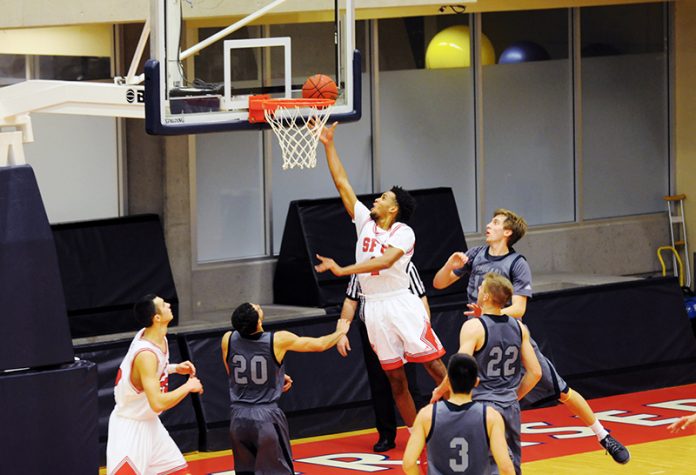
Oshea Gairey (middle) was a standout.

Saturday night, SFU’s men’s basketball team played their last home game against Colorado Christian University before they open up their GNAC season December 3. Despite looking good for some stretches of the game, the Clan wasn’t able to put any solid runs together, and ended up losing 89–79.

Screen Shot 2015-11-27 at 3.56.49 PM“They’re a team that doesn’t make mistakes, and we’re still a team that makes those mistakes,” said Head Coach Virgil Hill after the game. “We keep shooting ourselves in the foot. Whether that’s missed free throws, turnovers, missed box outs, [or] rebounds [. . .] until we can complete those, we’re going to find ourselves in the same [situation].”
SFU dug themselves an early hole in this one, as the visitors ran out to a 7–4 lead which quickly turned into a 14–8 lead. The Clan was missing easy buckets, and just couldn’t defend the three. The half ended with the team down 38–34. SFU’s Michael Harper had a strong half with eight points as well as four defensive rebounds.

In the second half, SFU came out with renewed purpose and desire. Hidde Vos was able to hit a big three early on, and a bucket by Michael Harper gave the Clan their first lead of the game. However, they weren’t able to hold on to it for long. Colorado was deadly from behind the arc, finishing the game over 50 per cent from behind the three-point line. Despite junior Max Barkeley’s attempts to drag SFU back into the game — at one point boasting four straight threes — the Clan was subjected to their second straight loss the in two nights to the same team.

A big player in the Clan’s defeat was Colorado Christian’s Stefan Hackethal. Playing like a young Steph Curry, he finished the night with 28 points, and a ridiculous 70 per cent three point percentage.

“He didn’t do anything [in the previous game] that was noticeable,” explained coach Hill. “Today, he comes out and all of a sudden he doesn’t miss a shot. We probably didn’t play him as well as we could.”

So what does Hill think needs to be improved the most heading into GNAC competition?

“I think it’s going to be guarding the ball in terms of penetration. The GNAC teams are probably a little more athletic, so we have to be able to, one: stop them in transition, which most of the team are very good [at]; and two: get them to play five on five. Just keeping people in front of us and then hopefully get the rebound.”

The team’s first game against GNAC competition will be against Seattle Pacific at 5:15 p.m. on December 3 in the West Gym.

Facebook values Western lives over Middle Eastern ones

0

[dropcap]I[/dropcap]n light of the Beirut and Paris tragedies that occurred November 12, there has been, to say the least, a media frenzy. Millions of Facebook users have overlayed their profile picture with a French flag — an option that Facebook not only makes available, but automatically suggests when you log on. Facebook also implemented its “safety check” feature during and in the aftermath of the attacks, allowing users to ‘check in’ to let family and friends know they’re safe. While Facebook’s actions may have good intentions, they show value over the West than the East.

Firstly, not only was this the first time in history that the safety check has been implemented in a non-natural disaster scenario, but the check was only initiated after the Paris attack — not the Beirut bombings that happened 24 hours prior. Furthermore, the option for the flag is limited to the French flag. The Lebanese, or any other country’s flag, aren’t options.

Defenders of this choice to exclude the Lebanese flag argue that users can make a Lebanese flag version themselves, but this isn’t the point. Rather, the point is that Facebook doesn’t give users the option to add it automatically.

Firstly, with regards to the flag overlay, there are more French Facebook users than Lebanese; therefore, more people would be inclined to use the French flag. However, if the point is solidarity rather than shared experience (which it must be, considering only a minority of those with the French flag have ever been to Paris or have family or friends there), why should number of users matter? More importantly, why is the popularity of the flag even relevant? Shouldn’t those who want to express solidarity with victims of tragedy be given an easy way to do so?

When a nation with whom we identify with is attacked, it makes us feel more at risk as well.

Secondly, defenders of the safety check feature have explained that mobile connectivity is comparatively weaker in Lebanon, making the safety checks less useful. Formerly, safety checks were implemented during natural disasters (the 2011 tsunami in Japan, typhoons in the Philippines) where there were also major connectivity problems. The premise behind safety checks is to provide solace for families and friends during an emergency that poses danger to human life. Connectivity has never before been considered in these situations, so why now?

The question then becomes: why does Facebook value Western lives over others? I argue this is because Facebook is the product of an entire society that does this very thing constantly.

Western nations identify with France more so than with Lebanon for a variety of reasons, including similar racial distribution, religions, and government styles. Additionally, France is a strong ally of both the United States and Canada, and Paris is a common vacation spot for Western families. When a nation that we identify with is attacked, it makes us feel more at risk as well. We begin thinking: If it happened to them, it might happen to us.

Widespread Islamophobia only exacerbates this problem. This prejudice, curated in part by Western governments in an attempt to justify wars throughout the 20th and 21st centuries, has flourished in post-9/11 North America. This leads our society to be less sympathetic with Middle Eastern tragedies, such as Beirut, regardless of the context that surrounded the incident.

However, none of these are valid excuses for Facebook. As a billion-dollar enterprise, Facebook doesn’t need to wait until it becomes more socially acceptable to care about non-white lives. In fact, as such a popular social media site, Facebook has the opportunity to spur some amazing change. Facebook, take a first step: treat similar international emergencies in a similar fashion.

Alex Iezzi’s journey comes to an end

0
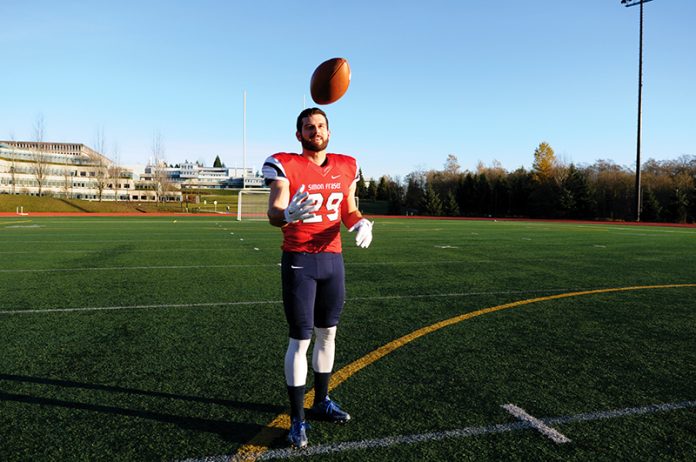
From Ontario, Alex played on the team for three different head coaches and in two different positions.

To many, football is widely recognized just for the physical contact, padding, and touchdowns, but for college players it’s a lifestyle that requires commitment, organization, and great mental awareness. From winning on the field to winning in the classroom, senior running back Alex Iezzi has brought his best effort with him through his journey as a part of the Clan over the past five years, from 2011–2015.

Alex’s story starts in London Ontario, where he played 12-man football as a running back on offense all throughout high school. However, his passion for athletics began at an early age when playing soccer.

“I played soccer for seven years when I was younger and that was my first sport. [. . .] I still really love watching and playing,” said Alex.

Schools such as Queens, McMasters, St. Francis Xavier, and SFU all expressed interest in Alex’s athletic ability during his final year of high school. Alex’s father’s advice to explore opportunities outside of Ontario helped him make the choice to move out west to play in the NCAA.

“My dad was born in Montreal and now works in Ontario, but he was moving around everywhere when he was younger and wanted me to experience the same thing [. . .] he was just telling me to get out and explore what’s out there.”

SFU provided Alex with the opportunity to explore western Canada, but it also gave him the chance to see different regions of the United States when traveling to football games.

[My dad] was just telling to get out and explore what’s out there.

“It was great to travel around and go to places like Los Angeles, Northern California, Las Vegas, and even Utah. I think that place is pretty cool.”

As is common for many freshman, Alex redshirted his first year at SFU, which gave him a chance to adjust to a new life in a new place. “Like many first-year students, I was a bit nervous for school because I didn’t know anyone, especially because I was from out of province,” said Alex.

The following year Alex made the decision to change positions and play defense after asking his coaches what the fastest way to travel with the team and earn playtime on Saturdays would be.

“Coach Johnson [former SFU head football coach] sat me down in one of the tutorial rooms in west mall after our running back meetings during camp in August and told me that he could really use me on defense, since they were lacking some personnel at the slot corner position.”

Such a transition can prove challenging for any athlete, but going from a running back to a defensive back position requires a player to learn a completely different running technique and overall strategy for the game.

“I didn’t even [play] defensive at all in high school [. . .] defensive concepts, playing inside or outside the hash marks, covering receivers; these were things that were super foreign to me at the start,” he said.

Alex was up for the task, and his decision to move on from the running back position proved successful: he made an immediate impact on the team, earning extended playtime and helping the 2012 team establish its most successful season since entering the NCAA.

One of his most notable performance with SFU came during the penultimate game of his second year, when injuries forced him into the starting position against Humboldt State University. After starting the game trailing 24–0, Alex helped dig his team out of a deficit by recovering not one, but two separate fumbles from the Humboldt offense, and taking them both to the house for touchdowns.

“I was thrown into the Humboldt game which was extremely foggy and I was a bit nervous because of the atmosphere and the speed of the game [. . .] the first one came pretty easy since the ball right in front of me after the running back had fumbled it, but the second one took a bit more effort since I had to get off a blocker, grab the ball, and weave around the quarter to walk in for the touchdown.”

The following three years proved to be a bit of a challenge for Alex and many other football players as they experience playing for three different head coaches within that same period.

“There were a lot of coaching changes over the next few years and that forced me to change to the safety position since we were running different defensive schemes [. . .] at that point I wasn’t enjoying myself as much. It wasn’t the same feeling I had during the second year since we constantly had new coaches and new things to learn.”

Entering the 2015 season with a new head coach, Alex made the decision to go back to running back position where he would be able to close out his collegiate career on his own terms. Lingering injuries kept him out of a few games this season, but Alex’s motivation and commitment helped him to finish what he started at SFU.

Screen Shot 2015-11-27 at 8.41.31 PM

WQB requirements are pointless

2

[dropcap]W[/dropcap]QB — writing, quantitative, breadth. Since I began at SFU in 2012, I have spent way too much time investing, financially and otherwise, in classes that have had nothing to do with my degree, my interests, or my academic skill.

These classes are supposed to make for ‘well-rounded’ students, but I’m not convinced that thet have been anything other than a massive waste of my time. In total, these requirements amount to 10 additional classes over the course of our studies — sometimes you luck out and a class just so happens to be a part of your degree program, but for the most part, we get screwed by these requirements. Ten courses, after all, amounts to over two full semesters’ worth of extra school, and can cost upwards of a few thousand dollars.

I have slogged through earth sciences and kinesiology, almost ripped my hair out taking archeology, and cried myself to sleep for fourth months as I pushed myself through a Canadian history class. None of these classes led to a newfound interest in the given field, nor did they make me appreciate these subjects any more than I already did. The fact of the matter is that I would have rather explored different subjects on my own terms, without worrying that I was falling out of compliance with my graduation requirements.

SFU has built its reputation on being the a comprehensive university with diverse faculties, but there is fine line between being well-rounded, and stretching your studies too far over a variety of unrelated fields. Truth be told, there are plenty of unique courses at SFU that I am way more interested in than an introduction to some science topic, but I’m not going to have time to explore those subjects because of the amount of time I spent fulfilling my WQB requirements.

All of us are adults who should be allowed to have full control over our studies. If someone wants to solely focus on computer science, then that’s their prerogative. To force an academic interest where it does not exist is a waste of time, energy, and money. In herds, students consistently enroll in what has been deemed “a good science class for an arts student,” but what does that even mean?

I imagine having massive groups of students enrol in a class solely because it has been deemed an ‘easy science credit’ is a massive inconvenience for those registered who are actually invested in that subject matter. I simply can’t contribute to a conversation the same way a student who is passionate in that subject can.

When I took BPK 110, I only met one kinesiology student over the course of the semester. One. The rest of us were there only to complete our WQB requirements. I can’t imagine having to be a prof or a TA in a class where 90 per cent of the students are only there to check off a box on their transcript. I will be the first to admit that I don’t try as hard in my WQB classes, because I am simply uninterested and unmotivated.

Having huge swaths of students who are, without a doubt, more apathetic towards the subject creates a less desirable classroom atmosphere and more work for the educators, since they constantly have to help bridge the materials for students from other departments. Honestly, everyone walks away a winner when you let students decide what they should study.

Woohoo, Boohoo

0

Woohoo: Christmas Eve

Put aside the capitalist layer of gobbledygook that  often overshadows Christmas and admire what the penultimate hours of the Noël blitz really stands for: sharing a moment with loved ones and getting some much-needed time with the family. At the end of the day, it’s all that really matters. It’s about slowing things down and just taking a moment to be thankful for your health and the people around you that help make your life the lovely gift that it is.

The wonderful thing about the holiday season over the last few years is that it has lost its exclusivity. All walks of life are welcome to enjoy the celebration and make their own meaning out of the holiday in a way that fits their family’s values. And hell, if that isn’t worth raising the eggnog and rum up for toast in this jumbled and shook up world, I don’t know what is.

Boohoo: New Year’s Eve

As the drunken ensemble of people around you begin the countdown from five, it becomes ever more apparent to you that hosting a New Year’s Eve party was a catastrophic mistake. Five people are passed out in your bathroom drenched in the regurgitate combination of spinach dip and cotton candy vodka. Four types of liqueur have stained your upholsteries and have ruined your coffee table irreparably.

Three inebriated colleagues have tried to make out with you and have only succeeded in head-butting you and slicing your lip in two places. You have received two noise complaints and you’re about one police visit away from giving your landlord ample reason to kick your vociferous ass to the curb.

And to make matters worse, you are so wasted the room is spinning like your little brother’s Beyblade. Good luck trying to call in sick tomorrow — you’ll need nothing less than a gurney and toe tag to pull the wool over their eyes this time.

BoG-gled

0

Sustainable Investment

The board was presented with a motion to increase the amount invested in what is classified as “sustainable investment holdings.” The $12 million, or 3 per cent of the endowment portfolio, currently invested will be increased to $20 million, or 5 per cent of the endowment portfolio.

Said SFU President Andrew Petter, “This very much puts us in a leadership position. Concordia and Trent, I think, are the only two other universities that have actually gone this direction in creating funds, or in our case enlarging funds, for this kind of purpose.”

Concerns were raised by undergraduate student representative Deven Azevedo about how the other 95 per cent of the endowment could be invested “potentially in morally ambiguous funds.” In addition, he expressed concern over the lack of commitment to when the remaining portion of the endowment portfolio would be dealt with.

Petter responded to this concern by noting this is a positive first step and that there are ongoing discussions around how to measure the university’s carbon footprint and whether it is better to divest or be an “active investor.” After a vote, the motion passed.

Energy Utilization Policy

The board voted to approve a university-wide policy on energy utilization effective immediately. The policy is to help the university reduce its overall greenhouse gas emission levels.

Said board member June Francis, “We decided to have a policy that strongly reflected our expectations around following the guidelines without making it a policy that we could not actually enforce.”

These considerations gave rise to amending language in the policy, which previously read “required” and “encouraged,” in regards to SFU community members and campus groups becoming more energy efficient and reducing greenhouse gasses. The new language dictates that these groups are “expected” to do so, in order to meet these institutional goals.

The week in comics

0
BW- Three piece
Three Piece by Rosemarie Perkin


three piece - krispy kreme
Three Piece (by Rosemarie Perkin)

CMYK-Seagull Square Seagull Squre (Jill Mandrake)

GOOD_AgoraphobiaThe Adventures of Agoraphobia Man: World Defender (Jacey Gibb)

Week 3Peers (by Leslie Lu)

Screen Shot 2015-11-29 at 9.01.26 PMCreator’s Pet (Destiny Hsu)

HUMOUR: WikiLeaks exposes Trudeau’s plan to use college students as renewable energy source

0

WikiLeaks has dropped a bombshell right before the start of the UN Climate Change Conference in Paris: Justin Trudeau plans to replace petroleum with college students as the world’s leading energy source.

When asked by media about these revelations, the Canadian prime minister was unapologetic about his proposal.

“The world is facing both a serious energy crisis and a rise in global temperatures,” said Trudeau, outside of the Louvre. “The only way to combat this is by finding a source of renewable, clean energy that is more available and efficient than solar, tidal, or nuclear. We believe we have found that source, and that is in the natural hyperactivity found in college students worldwide.”

According to the WikiLeaks document, Canadian scientists had known about the immense power of stressed young adults since 2008. However, Stephen Harper muzzled the scientists in order to protect the “dignity of college students.” Justin Trudeau argues, however, that college students have no dignity during exam season.

“Let’s be real here. When you’re mixing Four Loko and Adderall and contemplating selling your 98 Corolla to that one guy who actually attended lecture in exchange for his notes, you have no dignity left. You literally can’t sink any lower,” Trudeau said, citing his own experiences at McGill.

The following is a list of ways that Trudeau’s Student Energy Plan will be implemented.

Student tear harvester: Statistics Canada has shown year after year that the number of crying students drastically increases during finals, as they accept their impending doom. By using a system of funnels attached to popular student study spots, the government of Canada hopes to recycle the massive amounts of tears that these young scholars expel. The vast quantities of H2O captured through this system could be used to water drought-ridden fields, or it can be reintegrated back into the college environment and used to hydrate legions of thirsty undergrads unable to get a date.

Kinetic energy capturing vests: A lethal mixture of immense stress, no sleep, and copious amounts of coffee causes college students to shake uncontrollably during the weeks leading up to finals. The government of Canada hopes to capitalize on this rapid release of kinetic energy by attaching kinetic energy-capturing vests to all people enrolled in a post-secondary institution. Whenever students vibrate uncontrollably, the vests convert and store that kinetic energy. Once students finish their final exam, they will hand in their paper along with their vests, and then curl up into the fetal position, ready to be used once again by the government.

Fetal position sofas: The cost of making sofas is immense, and it represents an immense drain on the Canadian economy. However, researchers at the University of Saskatchewan have discovered that after final exams, 93 per cent of students immediately enter the fetal position and hibernate until their next term begins. Therefore, Canada, in partnership with IKEA, will be using college students as temporary sofas during their period of hibernation. “These students are the best material possible for making sofas,” said Canada’s Minister of Furniture Development. “They’re rigid enough to put together and stack like Lego, yet quite plump to sit on as they’ve spent the last couple months being beaten down by assignments, exams, and the realization that they’ll never amount to anything in life.” No official word yet on  what the new sofas will be called, but sources say the frontrunner is Hunoreschesuckers.

HUMOUR: Christmas to come even earlier next year, take over “Halloween” season

0
Illustration by Phoebe Lim

A controversial announcement surfaced in Whistler this weekend which could very well change the Christmas landscape forever. Over caviar and Dom Perignon, the leading fat cats of North America’s most prolific supermarket chains announced a controversial decision to scrap Halloween 2016 in favor of creating more space for Christmas-themed paraphernalia and primetime advertisement spots.

Retail stores from all across North America have reportedly already discarded plans to display any Halloween products and related promotions next fall. It is also reported that some companies have already begun marketing preparation for the next batch of nonsensical consumer fads, such as the recently announced Snoop Dogg’s Easy Baked Oven and Mr. T’s refurbished line of X-rated Shrinky Dinks.

While the contentious decision has left some divided, an unforeseen amount of consumers have recently spoke up in favour of Halloween’s dismissal. For a strong majority of Yuletide yahoos, the reception has been warmer than a toasting yule log and nothing short of an early Christmas present.

“I’m sure the little kids will be bitching about it the most, but that’s life. It’ll be good for their little minds to get the kick in the head they sorely need,” said SFU education major Hernando Castro. “Besides, this is going to give me such a head start on my Christmas shopping.”

Pending on the success of next year’s supersized Christmas, sources say Halloween could be canceled indefinitely.

Halloween enthusiasts, on the other hand, have taken the news hardest of all. Citing the loss of the ghoulish holiday as a horror in line with the bite of a razor blade apple.

That’s right: gone are the days of knocking on stranger’s doors for free candy and being scared shitless by Halloween movie marathons, for Halloween has been laid to rest by jolly old Saint Nicholas and his pack of corporate tycoons.

One chairperson even took to his personal Facebook account, proclaiming excitedly: “The people have spoken loud and clear with their wallets. They want more Christmas, and by jove, we will give them what they asked for. Suck it, Halloween.”

To get more insight into the announcement, The Peak sought out economics professor Fitz Ingram for further comment and what it could mean for the holiday landscape.

“Halloween just isn’t the money-maker it used to be. Tootsie rolls, pumpkins, and sexy Minion costumes — it’s just not enough to keep the average multi-million conglomerates sending their board members to Monaco and Venezuela,” said Ingram.

“Companies want to fleece us of every bit of cash we got. And the only way they can do it these days is by gutting Halloween like a Jack o’ Lantern and selling human-sized Toblerones to put in their kid’s stockings. Companies are taking the first steps to making Christmas a year-long extravaganza of marketing brilliance. And this is the first step in their master plan. Just you wait and see.”

With Halloween scrapped, people can expect to hear Yuletide butchering of their favourite Christmas songs by shoddy cover artists as early as mid-October. Those mourning Halloween’s passing are advised to eat their remaining candy stash slowly, for the age of trick or treat has set in the souls of every gore lord and scream queen across the Northwestern hemisphere.