Home Blog Page 846

Give science more credit and put away natural remedies

4

[dropcap]O[/dropcap]n April 26, Albertan couple David and Collet Stephan were found guilty of neglecting their 19-month-old son, Ezekiel Stephan, who died of meningitis in 2012. The defence argued that the parents, who attempted to heal Ezekiel through natural remedies rather than by seeking professional medical help, believed he simply had the flu.

Prosecutor Lisa Weich noted the Stephans had been warned by a registered nurse that Ezekiel likely had meningitis, and additionally that they should have been able to interpret their son’s symptoms as something more serious.

Having been born and raised in Eugene, Oregon, a city known for its Birkenstock-wearing, organic garden-planting, and vegan-eating residents, I’m familiar with the type of people who swear by their home remedies. My own family exists in this circle. For Christmas, my sister once gave me an awful serum that supposedly reduces anxiety, and my mother keeps a bottle of echinacea to treat colds and the flu — the same medicinal mixture that the Stephan parents used — stocked in the medicine cabinet at all times.

I’ve never complained about my family’s alternative health practices because, if need be, we seek professional advice. We have healthy diets, exercise, and yes, take echinacea. When that isn’t enough, we pay the doctor a visit. This is what the Stephan family should have done.

Ultimately doctors are here to treat us, to cure us, and to save us. Why would they want to do anything else?

I have plenty of qualms with the population that favours alternative medicine. Scientists have developed amazing medicines, remedies, and cures, so why do some of us refuse to use them? I understand the distrust in big pharmaceutical companies, and I understand the anger toward powerful higher-ups who care more about their bank accounts than patients (looking at you, Martin Shkreli). Ultimately though, doctors are here to treat us, to cure us, and to save us. Why would they want to do anything else?

It’s foolish to believe otherwise. Dr. Paul Offit, director of the Vaccine Education Center at the Children’s Hospital of Philadelphia, says turning to unproven alternative medicine is not the answer to our cynicism about conventional medicine.

Alternative medicines are considered inherently less harmful because they are perceived to be more natural. However, alternative medicine lacks testing. According to doctors Phil Fontanarosa and George Lundberg, in the Journal of the American Medical Association, “there is no alternative medicine. There is only scientifically proven, evidence-based medicine supported by solid data or unproven medicine, for which scientific evidence is lacking.”

At worst, these medicines can hurt us. At best, they heal us. Often, they simply do nothing. Such was the case with Ezekiel Stephan.

The world of ‘unproven’ medicine extends beyond one tragic case with a sick child. This is about a generation of children raised without vaccines that have worked for decades because ignorant parents are worried they may cause autism.

This is about children dying of suffocation because parents no longer trust the chemicals in inhalers long-known to treat asthma. We now live in a world where germs, viruses, and bacteria have become increasingly dangerous, and now there’s an entire generation of children whose immune systems are perfect targets. 

There is no doubt that David and Collet Stephan loved Ezekiel, but as Weich put it, “sometimes love just isn’t enough.” Ultimately, had the Stephan family sought medical help for their son earlier, he would probably still be alive today.

Student-faculty romance. Sorry, where’s the problem?

4

[dropcap]L[/dropcap]eave it to the UBC administration to consider a means for sexual assault control that’s so shortsighted it’ll leave you questioning the professional competency of the institution. The Globe is currently frolicking in a sticky story that involves potentially ‘legislating love’ between students and faculty members at the university.

UBC faculty say they’re “‘absolutely’ willing to consider a ban” on consensual relationships between these two parties, The Globe reports. This is primarily as a means to avoid the coercive power dynamics involved in any sexual assaults on students. The school’s interim president Martha Piper alludes that such a ban may be necessary to stop such troubling behaviour — a ban akin to that between a doctor and patient.

Of course, all the hoopla surrounding sexual assaults on school grounds has Canadian universities frantically ensuring that assault policies are given a thumbs-up from their politically correct patronage. But sadly, this is a case in which executive action may be taking measures that are more invasive than needed to secure everyone’s safety on campus. Dr. Piper openly admits that she is unaware of any other Canadian university to have implemented this kind of ban.

Wake up, Piper: it’s because every other university realizes that such a ban defies the natural sexual attractions that occur between two consenting adult humans.

Now, the same could be said for the school’s current conflict-of-interest policy requiring that faculty do not formally assess any student-lover with whom they have current classroom connections. But the ban UBC is proposing would be a trivial restriction on freedom of choice outside the classroom.

Every other university realizes that such a ban defies the natural sexual attractions that occur between two consenting adult humans.

While The Globe references one incident of alleged assault by a former PhD candidate at UBC to explain the school’s willingness to implement a campus-wide ban, Dr. Piper doesn’t use any evidence to prove that all ‘academic love’ is dangerous. So maybe she should draw upon actual data, or conduct some proper research to prove that this dirty romance epidemic propels unrelenting assaults — as if that’s the only thing faculty members want to do.

If this is the case, we might as well ban people from consensual relationships altogether. Yes, sexual assault occurs, but because student-faculty romances are so rare, it’s safe to say that non-consensual encounters happen far more often outside the academic world than within it.

Further, to liken this kind of ban to a patient-doctor relationship couldn’t be more misguided. It insinuates that patients can’t date doctors from a hospital they visit, even one who isn’t registered as their doctor. It simply doesn’t make sense.

I hope never to see the day when school executives power trip so much that they start blindly pulling Orwellian policies out of their rears to restrict who we sleep with when there are no professional connections involved. While we’re at it, how about they restrict with whom students and faculty marry and have children?

Cite your sources, Dr. Piper. Sure, it might be a little weird to see second-year Sally from psych class necking with a 65-year-old, nearly retired Nobel winner, but in the end our choices are ours to make as consenting adults, regardless of your opinion.

Pentatonix returns to Vancouver for an impressive show

0
A cappella group Pentatonix performed at the Pacific Coliseum April 28.

Three years ago, Pentatonix was still relatively new, performing an intimate concert at the Vogue. On April 28, they returned to Vancouver performing in front of a packed Pacific Coliseum. The a cappella quintet used their voices exclusively, and brought the Vancouver audience an incredible show.

Pentatonix, which won the NBC music competition The Sing Off in 2011, opened their performance with their original songs “Cracked” and “Na Na Na.” At one point, vocalist Scott Hoying remarked to the crowd, “This is incredible, seeing so many people come out to an a cappella concert.”

His surprise comes on the heels of the rise in popularity of a cappella in mainstream music. With the advent of TV shows and movies like Glee and Pitch Perfect, it created the perfect conditions for Pentatonix to break on to the charts. After a brief stint with Sony, Pentatonix began releasing music to their YouTube account, which boasts over 10 million subscribers and over one billion views.

Highlights of the concert included their covers of Jack Ü and Justin Bieber’s “Where Are Ü Now” and Megan Trainor’s “No,” a Michael Jackson-inspired powerhouse medley, and performances of original songs off their 2015 self-titled album such as “Can’t Sleep Love,” “Rose Gold,” and “Water.” The show demonstrated the diverse and unique talents of its individual members as well, such as bass singer Avi Kaplan’s operatic training. Beatboxer Kevin Olusola’s also performed Bach’s “Prelude No. 1” on the cello with a beatboxing twist. There was a brief moment where Pentatonix invited up some audience members and serenaded them, making everyone else slightly envious.

Pentatonix was joined in concert by New York native AJ Lehrman and YouTube sensation Us the Duo. Both acts performed high-energy sets before Pentatonix stepped onto the stage. From the beginning to the end, the energy never stopped and Vancouver audiences were treated to an extra-special night; even more special when it was noted that so far, Vancouver is the only Canadian stop on their World Tour.

In all, the concert ran seamlessly and showed just how cool and popular a cappella has become. From the powerhouse vocals to the light-hearted jokes in between songs to the incredible visuals that were projected in the background, Pentatonix brought something special to Vancouver on Thursday night. It was clearly evident in the enthusiastic cheering and singing in the audience — and on the transit ride home that followed.

NEW MUSIC FRIDAY

0

By: Sarah Finley, Courtney Miller, Nathan Ross, and Jessica Whitesel

Follow The Peak on Spotify to stay up to date on New Music Friday.

“Can’t Stop the Feeling” – Justin Timberlake

Jessica Whitesel: This is probably going to be the song of the summer and I don’t really know how to feel about that. I mean, it’s not the best song, but it’s also not the worst. You can dance to it, which is cool, but it’s pretty average and repetitive.

Sarah Finley: Definitely a catchy summery song that could easily be listened to on road trips. I’ve never really been a huge JT fan, but I can dig this one.

Courtney Miller: It’s fine. It’s very rhythmic with catchy lyrics, but I’m turned off by the random electronic alterations to his voice.

Nathan Ross: “Can’t Stop the Feeling” continues the unfortunate trend of bland, rhythmically repetitive songs where a singer declares how much they’re really feeling it, à la “Happy” by Pharrell Williams. I’m happy for Justin, but this isn’t his best work, and it’s too tailormade to be a flirty summer single. (For the record, the best “Happy” song belongs to C2C)

“Dark Necessities” – Red Hot Chili Peppers

JW: As always Flea’s bass playing is 10/10, but I wish they would ditch the Stadium Arcadium sound and go back to their earlier style. It’s not as bad as some of the songs that were on Stadium Arcadium, but it doesn’t really compare to songs like “Californication” and “Under the Bridge.”

SF: It’s truly impressive to me that Red Hot Chili Peppers are still cranking out music, but unfortunately this track is just kind of. . . dull. Subdued vocals and guitar scales don’t keep this listener’s interest.

CM: I feel like this isn’t their best song. Yes, the musicality is still there, but is doing weird electronic things with the sound a new trend? I find it makes the song discordant.

NR: It’s always tough to compare the Red Hot Chili Peppers to their old music as their roster keeps changing, and guitarist Josh Klinghoffer isn’t John Frusciante who wasn’t Hillel Slovak — depending on which fan you ask. It’s an okay, if a little broody, song from the Peppers. Flea is given maybe a bit too much prominence, as if to show off that this song still has some of what has made RHCP successful in the past.

“Figure it Out” French Montana feat. Kanye West and Nas

JW: This is interesting. It doesn’t sound like a song that would be released in 2016 with all the autotune and the rapping over a repetitive sung line. If that got toned down and the focus was placed more on their rapping — since they all are talented — this would have been a better song.

SF: Melancholic, light vocals begin the track, segueing into Kanye’s classic digitized voice — which quickly dies out. Ordinarily I love when Kanye collabs with other artists, but this time he’s overpowered by Nas and French Montana.

CM: What is the point of auto-tuning rap-or anything? This song would be much improved by cutting back on the effects.

NR: I agree with Jess that this song sounds like it should have come out years ago. Some of the verses are pretty uninspired (looking at you, Kanye), and the repetition gets old. Fast. (Side note: I know this is on Spotify, but watch the music video. Male power fantasies flying around everywhere like there’s no tomorrow)

“I Need A Forest Fire” – James Blake feat. Bon Iver

JW: I don’t really know what is happening with this song, but I don’t hate it. It reminds me of a lot of Bon Iver’s other music so maybe that is why I don’t find it too weird or discordant. I wouldn’t necessarily seek this song out but I wouldn’t skip it if it came on either.

SF: Two of my favourite artists in the world in one track? Yes, please. Calming and meditative, Bon Iver’s uniquely high voice excels here, meshing seamlessly with slow percussion and James Blake’s signature sound. My heart is so full.

CM: The song didn’t go anywhere until halfway through and I’m still not sure why they need a forest fire. It was really monotonous, and like 90 percent of the lyrics were “[something unintelligible] I need a forest fire.”

NR: This song won’t be for everyone, but you can count me in the group of people it works for. The looping works, and it is a good example of how to repeat sounds in your pieces while continually adding on to them, while allowing this song to grow, like a forest fire if that symbolism isn’t too on the nose for you.

“Explode” – Charli XCX

JW: It’s Charli XCX so it’s a pretty solid track, but it’s not like it will become an instant classic or anything. But what I find impressive is that it is from The Angry Birds Movie, so I am expecting this to be the best part of that whole disaster.  

SF: My initial cringe at realizing this song is from the Angry Birds soundtrack is dedicated to our Arts Editor. Anyway, Charlie XCX’s classic I-don’t-give-a-fuck vibe that she introduced to the world at large in her feature of “I Love It” by Icona Pop is ever present and lovely in her newest track.

CM: It’s fun and lighthearted but seriously all of the electronic sound edits just detract and distract from the song. Stop this ridiculous trend! Otherwise it’d be a great pump-up song to dance to.

NR: Putting myself in the mindset of one of the Angry Birds from the movie this song is on the soundtrack for, I would listen to this on my way to go blow up somewhere in a fit of unhinged lunacy. I’d probably have some (lots of) alcohol in my system though, and I’d have to deal with the aftermath instead of exploding into nothingness. This track took me to some dark places. It’s catchy, though.

“True Sadness” – The Avett Brothers

JW: This song continues what The Avett Brothers do best which is making good music. Sometimes the lyrics get a little too relatable but that’s not a bad thing. I will probably listen to this song more than once and stick it into my regular rotation.

SF: My guilty pleasure in music is a well played banjo. The Avett Brothers miraculously make a song called “True Sadness” sound, for the most part, upbeat and happy through major guitar chords and optimistic vocals.

CM: A country/folk song that’s high-tempo, is musically fun and positive, but that lyrically is kind of depressing. I also find the vocalist is decent, but does weird roaming key changes.

NR: This is a solid, if a little humdrum, diddy from The Avett Brothers. It’s a lot more upbeat than a song called “True Sadness” would suggest, but it does line up with how this group usually sounds. It works well as a reflection piece, and teases for a bigger album which will definitely be one that grows on you.

“Burn the Witch” – Radiohead

JW: I will admit I am not a huge Radiohead fan BUT this isn’t the worst song ever. It feels more like is should be a song from the ’90s which is ok, I grew up in the ’90s and listened to a lot of Radiohead when they were newer. So it felt like I was six again, which was cool.

SF: Radiohead is one of those generally overrated bands that you brag about seeing live to all your hipster friends. This track combines fast-paced strings, slow vocals, and percussion that can’t make up its mind.

CM: The music really seems to overpower the vocalist, and it’s not very harmonious at all. There is improvement in the relationship between the vocals and the music about halfway through, but it doesn’t last. I’m also not sure why the singer sounds high on acid, but it’s not working for me.

NR: I’ll admit that King of Limbs didn’t do it for me, but if “Burn The Witch” is a taste of what their as-of-yet untitled album will be, I’m back on the Radiohead train. It evokes everything that I like about Radiohead, namely Thom Yorke’s voice dancing overtop a beautiful, haunting melody. This is my pick for track of the week.

“Complicated” – Fitz and the Tantrums

JW: I am really not a huge fan this song. I’ve listened to some of their other tracks, and I liked those ones better. This is like a weird mix of post pop-punk and DNCE with some cheerleaders. It’s kind of a hot mess but I can see why people would like it, but it’s not for me.

SF: God bless Fitz and the Tantrums. This track epitomizes the sexual tension and miscommunication that revolves around FWB and one night stand relationships. Relevant to uni students everywhere.

CM: Love the minimalistic keys opening and the melody that asks for people to sing along. The repetitiveness helps that goal, but not the song overall. It gets dull after a couple of minutes.

NR:I liked Fitz and the Tantrum’s earlier stuff, but this is a huge turn off for me. It sounds too overproduced for my tastes, and Michael “Fitz” Fitzpatrick comes off as whiny in his lyrics, and I just don’t care for what he has to say.

“In the Arms of a Stranger” – Mike Posner

JW: The intro sounds like a warm up in Pitch Perfect, so that was kind of weird. But that being said, I kind of like sad Mike. You get this mix of I’m sad and my life kind of sucks, but that’s ok because I am going to make the best of it. You also get some pretty decent tracks out of sad Mike.

SF: Once I get over my initial shock that Mike Posner is back in the game, this song is catchy as hell. I’m a sucker for a singer with a backup choir, and this is no exception.

CM: I really like how the intro builds upon itself. It doesn’t fall into a rut. The vocals seem at half-strength for most of the song, so more of them would’ve been great, but overall I love the construction of this song.

NR: The first thing I thought when listening to this song was that it was a promo for the next season of Glee. Then I remembered that Glee hasn’t been a thing for over a year, and was thankful for that. Still, this track isn’t the worst that could come out of Glee, like in the first half of the first season when there was hope and a good storyline and a showrunner that didn’t jump ship.

“Hotter Than Hell” – Dua Lipa

JW: I swear I have heard this exact song before. More than once, and by multiple artists. Please stop making the same fucking song over and over. It makes no sense whatsoever to sound exactly like every other artist out there. Please for the love of God come up with an original idea at least once. It would be nice for a change.

SF: Female singers with deep voices will truly be the death of me. Seductive and dancey, Dua Lipa will definitely be on my to-watch-for list.

CM: The vocals are well-showcased, with great range which is fantastic. It’s not repetitive, which is a blessing, and the great steady beat makes it a toe-tapper at least.

NR: What exactly is hotter than hell? Isn’t hell supposed to be the hottest? That’s why it is the worst, right? Does the devil have a secret hideaway that is even hotter? Is it too hot for him, and he sends the worst people there? Isn’t the devil a good person if he traps and punishes all evildoers? Anyway, this song is boring and generic and these are all things more interesting to think about than this song.

“100x” – Tegan and Sara

JW: I really, really, really want to consistently like Tegan and Sara but I just can’t. This is just one of those songs that I can’t get behind. It might be because it is slower and sad or that I just don’t like Tegan and Sara as much as I feel I should.

SF: Tegan and Sara are the loves of my life. Warning: Anyone who’s gone through a long drawn-out breakup should avoid this track as it will hit way too close to home.

CM: It’s a sweet slow song and I can imagine a great interpretative dance going with it. Classic Tegan and Sara vocals, but there’s a maturity in this song that’s greatly enjoyable.

NR: This will be a nice rallying cry for people who need to leave their partners but can’t because emotions are tough and sticky and people are weird. It’s a slow jam, and feels like it is holding back a little bit, but it comes through rather pleasantly. Too many break up jams feel like a conquering song, this acknowledges the ugly emotional complexity that breaking up brings.

“Hurts So Good” – Astrid S

JW: She has a nice voice, but she isn’t really doing herself any favours by sounding like the weird bastard child of Ariana Grande and Fifth Harmony. If she did something that was a little more unique she would be able to stand out in a music scene that is reaching its saturation point with female singers since she will get lost in the shuffle. It’s too bad really since she is better than they are.

SF: Toxic relationships provide great lyric material and musical inspiration, evidently. Fairly simplistic in vocals, instrumentals, and lyrics, I listened to this track probably three times trying to come up with something to say. So, there’s that, I guess.

CM: I like her voice, and the way it conveys emotions in a very real, believable way.  The minimal accompanying music to her voice makes her voice stand out much more than I expected. Overall it’s worth at least a third listen.

NR: “Hurts So Good” isn’t anything new, but Astrid S is a good enough singer to make this work as a radio hit. Nothing innovative or creative here, which is disappointing from someone trying to make it on their debut album, so hopefully this isn’t a sign of things to come.


okay.odd.

0

okay.odd. explores the construction of curiosity, and the space between thought and perception — inviting the audience to “encounter a version of themselves that they feel, but do not know.”

This “multimedia meditation session” was created by Hong Kong Exile — an interdisciplinary arts company led by artists Milton Lim (theatre), Natalie Tin Yin Gan (dance), and Remy Siu (new music).

As projection and sound become the core of the meditation, the performer, Aryo Khakpour, serves as the constant presence that grounds the audience in the space of contemplation.

The Peak was able to chat with lead artist Milton Lim ahead of the production’s full-length rEvolver debut.

The Peak: Can you describe the performance and how it is being presented?  

Milton Lim: okay.odd. is a multimedia meditation session where I lead the audience through a process of word association. Through projected text and image, you are encouraged to follow your mind’s curiosity, your tangential thoughts, and potential unconscious beliefs.

P: What do you mean by “multimedia meditation session”?

ML: My combining of multimedia and meditation started as a small joke, pairing two things that otherwise seem contrary. It has since become an earnest attempt at creating a space for personal introspection and centredness, using digital media as the medium by which we come to understand this particular type of meditation.

P: How is this piece different from other productions that Hong Kong Exile has done in the past?

ML: Each of Hong Kong Exile’s projects has been different. We take turns as project leads, so I have been the primary artist behind okay.odd. This piece has also been a testing ground as I move into designing my own visual media and sound design, which will continue to serve me as a director/creator of original works.

P: How close did you come to what you described as “constructing curiosity” and “allowing curiosity in all directions”?

ML: I can only go off feedback of the people who have spoken to me after the piece, but I would say: we’ve come very close.

P: In your artist statement, you mentioned being “fascinated by our societal adherence to exist in environments surrounded by screens and moving images”; and how, “we are continually shaped by our relationship with these materials.” Can you explain what you meant and how it relates to the performance?

ML: When I was doing my psychology degree at SFU, I was fascinated by social systems and how many lived experiences and identities we can subscribe to at once.

I’m interested in how our identities are becoming (for better or for worse) increasingly framed and sometimes hidden away by emergent technologies. Especially considering the psychology of marketing; design of user interfaces; game-like reward-based interactivity; and our proximity to a screen/content at any given moment.

Most of okay.odd. takes place on a flat 2-dimensional screen and I’m attempting to distill some of these processes to make visible some thought-patterning that we may or may not be conscious of.

After presenting multiple excerpts, the full-length version officially premieres at The Cultch, from May 12–21.

Beowulf

0

Marc Castellini was in his final semester at SFU studying Beowulf in an Old English course and completing a directed studies course in playwriting when he thought of combining those two interests by writing a play about Beowulf. Now a graduate of SFU’s theatre program, Castellini has brought former classmate and fellow graduate Kaylin Metchie on board to direct the production that will be shown as a site-specific work at The Cultch during this year’s rEvolver Festival.

“It seems like there are lots of voices and different moral ideologies represented in Beowulf,” explained Castellini. While there were likely many versions of Beowulf told, only one written version survives and it seems full of ambiguities with erasures and overwriting that suggests there were competing versions. The competing voices telling the story in this play grew out of the voices and opposing perspectives that Castellini perceived to be within the Beowulf text.

At an outdoor location the show will begin at dusk, as five competing storytellers address the audience to share their version of the events of Beowulf before nightfall. The play is meant to leave us wondering about how history is recorded, how stories are passed down, and how the written word can give authority to a certain version of events and preserve it for posterity.

While the starting point for the play is the oldest piece of written literature in the English language, the themes that Castellini and Metchie put forth are relevant today and the play requires no prior knowledge of Beowulf. “We’re still writing stories, but not everyone has a voice,” said Metchie explaining that this applies to many areas of our lives including politics, journalism, historical documentation, and the way dominant cultural voices can wipe out others.

“The story ends up being about the difficulty of figuring out the truth of the past and the power dynamics of storytelling,” said Castellini. In the end, one of the five voices does seem to dominate and win out, but Metchie explained that the play then questions how authoritative any story can be when based on memory and the way our personal interpretations can further affect the truth.  

A good story about storytelling, this show will remind you of the world of the monsters, warriors, and heroes from Beowulf’s time and make you think about the way we construct and preserve narratives for all time.

Mis Papás

0

Mis Papás is a highly physical performance set as a 15-round boxing match.

Written and directed by Pedro Chamale Jr. — co-artistic director of rice & beans theatre — the bilingual (English and Spanish) performance follows Chamale’s parents Stella and Pedro Sr., years after making a life in Canada, where an illness “throws a monkey wrench into their life plans,” pushing Pedro Sr. to the edge of his life and back.

The Peak had an opportunity to speak with Chamale about the upcoming performance of Mis Papás at the rEvolver Festival.

The Peak: What lead you to perform Mis Papás again? What do you hope to achieve?

Pedro Chamale Jr.: After our last production, I wanted to do rewrites and tackle the script again. We also wanted to reach a wider audience by applying for the rEvolver Festival. I hope that the audience walks away with a sense of awe at the physicality of the performances and that the show will hopefully speak to those that have gone through a similar experience.

P: How closely does the script relate to the information your parents gave you?  

PC: The script came out of scenes that I had written while taking Block A [a playwriting class at Playwrights Theatre Centre]. A lot of the text is from talking with my parents and from what I remember as a child. It is not verbatim text and I have taken liberties to imagine what had been said. The story about my grandmother threatening the doctor is all true though! What an amazing lady she was!

P: What were the reactions from other immigrated families/individuals?

PC: One night, after a talkback, a Mexican family had stayed behind. They told us that the play was their story; and how much it meant for them to see Latinos on the stage and to see a story that tells a bit of what life can be like after immigrating. Although the events are not exactly the same for them, it spoke to very similar situations that they have had to face.

P: Why did you choose the form of a boxing match to retell the story?  

PC: My dad was an amateur boxer back in Guatemala. It is also something he trained me in. My playwriting teacher, David Geary, kept nagging me to think about boxing as theatre. So eventually I took the form of a boxing match and placed it into the show.

P: How was the process of preparing for this production and offering the actors real boxing training?

PC: Preparing for this show has been both a blast and a challenge — in the best sense though. It was important to get the actors’ bodies comfortable with hitting and being hit during the boxing scenes. With so much physicality and testing of endurance in the piece, it was essential that I could push the actors physically, and know that they would be capable and safe. With that said, a typical rehearsal begins with skipping rope, circuit calisthenics, shadow boxing, followed by mitt-training. This has all helped to make the fight scenes look as though two people were boxing and not two actors pretending to box.

Mis Papás is performing at The Cultch from May 11–15.

Kolejka

0

Kolejka is a heart-warming, grown-up puppet show, inspired by the Polish board game of the same name.  

In Kolejka, Babushka steals and makes her way to the front of bread-lines by any means necessary. The audience gets the sense that she’s looking for something, to fill a missing piece in her life.

star star theatre and The Troika Collective have jointly crafted a story about loneliness and human connections, featuring a combination of rod and shadow puppets, clotheslines, physical theatre, and rockin’ gypsy punk.

Randi Edmundson talked with The Peak about the inspiration, creative process, and bringing puppetry to Vancouver.

The Peak: What was the inspiration behind Kolejka?

Randi Edmundson: It was based on a Polish board game. In the game, you stand in bread-lines and try to complete a shopping list. You can thwart your fellow players, keep them from achieving what they’re doing, and try to get ahead yourself. It was intended to educate, remind people about communism in Poland, but it’s also really fun — kind of an interesting combination. In the show, you’ll see some bread-lines, waiting, and tricking each other to get ahead, but it’s taken a bit of a departure to something a little more narrative.

P: Can you explain the creative process in bringing this to life?  

RE: One of the cool things is that basically everyone has been in the rehearsals, contributing to the story development and throwing ideas for design elements. We spent a lot of the early rehearsals playing with the stuff we thought we wanted. It’s neat, because a bunch of the imagery we came up with, within the first couple of days, has been feeding the creation of the story.

P: Are there other puppets or human characters besides Babushka?

RE: We gave Babushka a little dog companion, Laeika — sort of modelled after the Russia dog sent to space. We added an old man, as a counterpart, we’re calling him Sergei.

We use hats, glasses, things like that, as puppets themselves in a way, to throw these side-community characters in the mix. The puppeteers take on different human characters and work pretty physically on stage to embody them.

P: What does star star theatre ultimately hope to achieve through telling this story?

RE: One of our main interests is to promote and encourage the development of puppetry in Vancouver. It’s interesting that a city as big and culturally active as Vancouver doesn’t have more puppetry, so we’re excited to bring that on one level to Vancouver.

In terms of the story, living behind the iron curtain, sometimes you couldn’t get your hands on things you needed, things as basic as toilet paper. What’s exciting is that the characters still manage to live on, to love, and to connect with one another, no matter how challenging it is to have this basic necessity that they are looking for. We all have challenges in our lives and finding connection within that, I think it’s something we understand.

Kolejka will perform at The Cultch, from May 11–22.

SFU builds better bionic hand for 1st cyborg Olympics

0

“The most exciting moment… was feeling my left index finger and the little finger for the first time since my accident.”

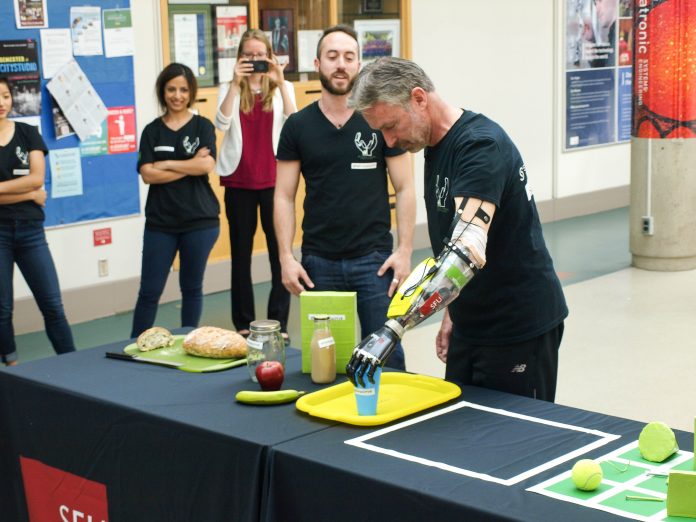
These were the words of Canadian Paralympic skier Danny Letain, after demoing a new bionic hand prosthesis built by SFU researchers from the School of Engineering Science. The team is working with Letain to help him compete in the inaugural Cybathlon competition in Zurich, Switzerland in October.

The Cybathlon is called the world’s first “cyborg Olympics.” The games will be hosted by the Swiss Federal Institute of Technology. SFU’s team is the only one from Canada participating in the Cybathlon. In total, there will be 80 teams from over 30 countries.

The team will have eight minutes to perform six tasks of everyday living using the prosthetic hand, including using kitchen items, completing puzzles, opening doors, and more.

The bionic hand, created in Engineering Science professor Carlo Menon’s lab, was originally intended to help stroke patients. Menon thought the technology could also be used by amputees. He explained that conventional prosthetics are not very intuitive.  

There is a high rejection rate among patients, and control systems have not significantly changed in over 50 years, he said.

The hand, a collaboration between SFU, Barber Prosthetics, and Steeper Prosthetics, is much more intuitive. It utilizes “a completely new approach to picking up signal and controlling an electric prosthesis from someone’s body,” said Barber Prosthetics head of Research and Development, Brittany Pousset.

She explained how “machine learning” might improve users’ motion availability. The hand itself is a Bebionic 3, on loan from Steeper Prosthetics of Leeds, England.

SFU’s contribution to the technology is the new control structure of the hand. Most systems used today were developed 50 years ago. These myoelectric devices are controlled by electromyogram signals that measure only two electric signals. SFU’s control structure uses force myography to detect intricate muscle movements along the surface of the remaining limb using a band of sensors around the forearm.

“With this new system, it feels like I’m opening and closing my hand,” said Letain. One of the greatest improvements of the device, according to Letain, is the ability to use the prosthetic limb above his head, something conventional systems fail to deliver. 

The SFU team, known as MASS Impact (Muscle Activity Sensor Strip), is part of the MENRVA Research Group. It’s made up of biomedical engineering and kinesiology research students and alumni. MASS Impact, Letain, and prosthetists from Barber Prosthetics have been working on this project since June of last year.

The hand takes a few minutes to “train” before use. Once activated, Letain cut bread, moved small objects, and even opened a jar using the prosthetic hand. The demonstration drew a large media audience including CTV, the Canadian Press, and many others.

Letain lost the lower part of his left arm in an accident while working on a CP Rail train on September 2, 1980. He said, “as an athlete… it’s the desire to win and the desire to do your best” that pushes him to persevere when things are challenging.       

“The SFU team is amazing, and they inspire me to want to be a part of it and want to do more,” said Letain. “I just see them as a bright, energetic group that is a true pleasure to be a part of.”