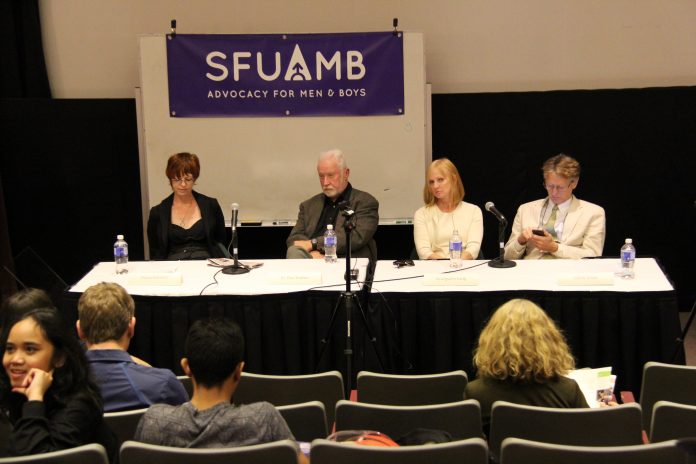
The SFU Advocacy for Men and Boys (SFUAMB) club hosted a free event, “The Accusation is the Verdict: Is Canada’s legal system anti-male?” on June 17 at Harbour Centre. The event was sponsored by the Canadian Association for Equality (CAFE) Vancouver, and hosted a four-person panel to discuss anti-male legal biases in Canadian society.
The panel included two lawyers: Carey Linde, a lawyer with 40 years of experience who pushed for shared parenting in Canada; and Georgialee Lang, with 25 years of experience and the winner of the 2010 Best Canadian Legal Blog award for her blog, Lawdiva.
Also on the panel was Dr. Don Dutton, PhD in Social Psychology and a tenured professor at UBC. Dutton has researched and reported on the need for police to be trained in dealing with domestic disturbances, and has published more than 120 peer-reviewed articles. Legal activist and YouTuber Diana Davison, who has focussed on gender equality and feminism in the legal system, was also on the panel. The panel was moderated by lawyer George Balabanian, whose specializations include gender and political theory.
The discussion focused primarily on family law, including custody disputes, divorce proceedings, domestic abuse cases, and disparities in legal aid resources provided by the government. The panel also tackled men and crime, gendered violence, and how men are treated by the courts.
When asked, “Is Canada’s legal system anti-male?” Dutton remarked, “I don’t know, but I have my suspicions.” He challenged what he saw as the misconception that men are always perpetrators and women are always blameless victims in domestic abuse, saying it is “not supported by research data.”
He also pointed out that men face 63 percent longer prison sentences in the US than women for the same crime. “Everything is perceived differently” when different genders perform the same criminal act, he said.
Davison focused primarily on public perceptions of the legal system, and the “court of public opinion.” She noted more high-profile cases are becoming subject to media opinion, regardless of what courts decide, exemplified by the cases of Jian Ghomeshi and Brock Turner, where calls for extrajudicial punishment have resonated on Twitter. She said that public faith in the legal system is very important, warning the audience of the emergence of “journalists [who] decide they’re cops” not reporting real facts because they “don’t make for good headlines,” in her opinion.
Lang discussed the challenges men face in family courts. Many fathers are “lucky to see their kids four times a month” following divorces, she said. When accused of domestic violence in family courts, “the burden of proof is on the accused [men],” a point echoed by Linde.
Linde challenged gender biases in Canadian society and the legal system. There is a general misconception, Linde claimed, that fathers are innately worse caregivers than mothers. This belief that a father is a passive bystander in childcare is reflected in the Supreme Court of Canada, when in the case of Young v. Young (1993), Justice Claire L’Heureux-Dubé wrote, “men as a group have not yet embraced responsibility for childcare.”
SFUAMB president Jesse Velay-Vitow thanked the SFSS for their support in hosting the event, as he said that SFU administration had requested the event be cancelled or postponed, although did not elaborate why.
He expressed his hopes for future collaboration with other SFU groups, like the Women’s Centre, who were invited but it seemed that none attended. He argued that both groups work to promote equality, and that gains for men are not losses for women. Both groups have “so much in common,” said Velay-Vitow.