Home Blog Page 822

SFSS looking for input from students on issues that matter

1
From left to right, Arr Farah, Mark Thompson and Natalia Gretskaia hand out freezies for those who complete the survey.

The Simon Fraser Student Society’s (SFSS) Advocacy Committee is looking for students to tell them what their most concerning issues are — and they won’t stop until they hear from enough of them.

After conducting a survey online and in the halls of SFU with little fanfare over the past couple weeks, the survey will be extended until they reach at least 500 students.

“Right now, we have around 330 responses,” said SFSS VP external relations Christine Dyson. “Our goal initially was to get to 750 responses, however if we get above 500 we’re taking that as a credible amount.”

Dyson said the Advocacy Committee wanted to make sure they had heard from enough students, to avoid missing any major issues that students are facing on campus before deciding their campaigns for the year.  

“Very simply, we just want to hear student concerns and what it is that is important to them, so that we can direct our time to the issues that best reflect student needs,” she said.

A survey like this has never been done by the SFSS before, according to Dyson. She and the rest of the committee thought it would be the best starting point for this year, because they want the work they do to best address actual student concerns.

So far, the issues addressed have touched upon sexual assault on campus, TransLink and transit issues, and academic issues, including SFU’s class withdrawal policy.

Students will be able to take the survey online, and might happen to stumble across the Advocacy Committee giving out the survey in person, often with a free freezie for completion.

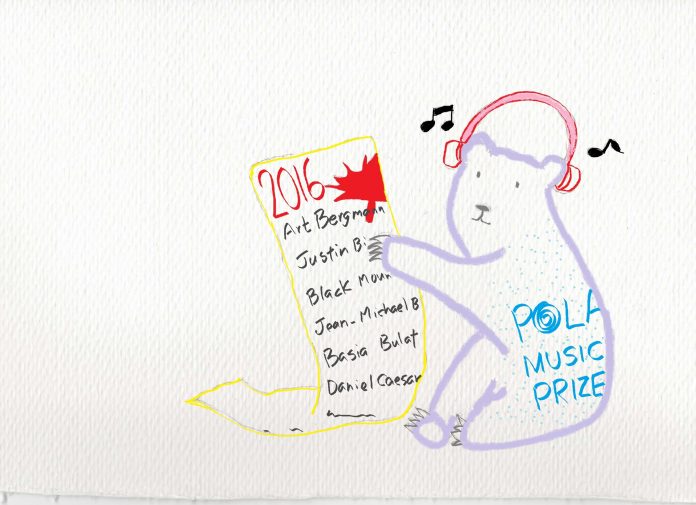
Our 2016 Polaris Music Prize short list

0
Canadian musicians shine like the North Star with the Polaris Music Prize.

How does the Polaris Music Prize work?

“The Polaris Music Prize is a not-for-profit organization that annually honours and rewards artists who produce Canadian music albums of distinction. A select panel of music critics judge and award the Prize without regard to musical genre or commercial popularity. Polaris Music Prize nominees and winners will be selected solely on artistic merit without regard to genre, sales history, or label affiliation.” – Polaris Music Prize 2016 rules and regulations

Often forgotten and overshadowed by big-name American acts, Canadian musicians kind of get the short end of the popularity stick. That’s what makes the Polaris Music Prize great: it’s all about Canadian music.

Ahead of the official 10 album short list announcement on July 14, we’ve decided to compile our own short list here at The Peak. Each of us created our own short list, and then the we featured the most frequently mentioned albums on our compiled list. Albums are presented in alphabetical order by artist.

Coeur de Pirate – Roses

This is my favourite album on The Peak’s short list. Coeur de Pirate alternates between English and French lyrics, giving a unique multicultural feel to the album. With a mellow-pop sound and beautiful vocals, this album is a fantastic listen for any occasion. Sure, only people who are fluent in French can be sure of how good the lyrics are, but if the feelings they invoke are any indication, they’re amazing. If you’re looking for a Canadian Halsey, I highly recommend this album. – JP

Destroyer – Poison Season

Destroyer was shortlisted for their 2011 release Kaputt, and Poison Season keeps the bar high for them. It’s important to acknowledge Kaputt’s success, because frontman Dan Bejar has acknowledged that he wouldn’t have been as ambitious with Poison Season had Kaputt been a flop. All the elements to love from Kaputt are still there — the elaborate musicality, Bejar’s poetic lyrics — and it also builds upon the feelings of yearning for more out of life. Bejar clearly believes that life can be a more beautiful thing, and the way he expresses that through Destroyer is a treat for Canadians to empathize with. – NR

Drake – VIEWS

With a refined sound and sharp lyrical focus, Drake shows his unique strength for unvarnished honesty and introspection on his latest, VIEWS. “Too Good,” “Controlla,” and “Views” are all highlights, and what is noticeable about this album is that it truly functions as an album, with no single song overshadowing the rest. The whole thing feels like a coherent thought, with songs flowing into one another seamlessly. By the end of it, you’ll feel exhausted but enlightened by the glimpse into a deeply complicated artist. – JD

Grimes – Art Angels

Art Angels is a bewildering and restless work of art. Its songs seamlessly mix pop, EDM, and electronica, but what is truly unique is that Grimes never sounds derivative. Moreover, Grimes as the sole producer, writer, and instrumentalist of this album puts herself into every corner of it. From the sonic highs of “REALiTi” and “Butterfly,” to the dancefloor stomp of “Venus Fly” and “Kill v. Maim,” to the sun-tinged pop with a dark side of “California” and “Flesh without Blood.” This album is filled to the brim with excitement and energy — even after hearing this album over and over, it still feels like I’m listening for the first time. Without a doubt, Grimes has made not just the best Canadian album of the year, but the best album of the year, period. – JD

Half Moon Run – Sun Leads Me On

This album doesn’t feel Canadian. This could be a good or bad thing depending on your perspective, but given the overall strength of the album that is more of an inconsequential fact. The strong vocals along with the well-developed sound and strong production values allow this album to stand up to bigger name American indie-folk artists like Gregory Alan Isakov and Lord Huron. This album — and Half Moon Run — have been on pretty high rotation for me and it would be nice to see them get recognized for their talent. – JW

Carly Rae Jepsen – E•MO•TION

What makes this album great is how Carly Rae Jepsen tries something a bit different with every song, but they all stay true to her sound. Known for her upbeat pop anthems, E•MO•TION brings that and more: from the dance track “Boy Problems” to the softened love song “Favourite Colour,” Jepsen really explores what can be done in an electro-pop album. This album is, without a doubt, Jepsen’s best work. Suck it, “Call Me Maybe.” – JP

Junior Boys – Big Black Coat

This Ontario duo have always made electro records for that one sad guy at the party who only talks to the people he already knows (read: me), so it came as a surprise when they released Big Black Coat last year, easily their most accessible and extroverted album yet. There are elements of disco, krautrock, and even straightforward pop on here, all brought together by singer Jeremy Greenspan’s sexy warble. The Boys have done plenty of great work over their decade-long career, but Big Black Coat deserves special recognition for how much it tries — and how often it succeeds — at doing something entirely new. – MJH

Peaches – Rub

Peaches (née Merrill Nisker) has never been one for modesty or moderation, and we can thank our lucky stars for that. The singer and performance artist has become an icon as a result of her embrace of gender fluidity, sex positive lyrics, and grotesque music videos. Long story short, she is awesome. And Rub is arguably her brashest, sexiest, and downright weirdest record ever, featuring such gems as “Can’t talk right now / This chick’s dick is in my mouth” and “Pussy’s big and I’m proud of it / You can dig dig dig in and out of it.” Seriously, how can you say no to that? – MJH

Andy Shauf – The Party
I haven’t been able to stop listening to The Party since it came out. The singer-songwriter that Shauf has become manifests itself beautifully here with his stories of the partygoers, and his ability to blend that all with piano, clarinet, guitar, and strings is beautiful. The most common comparison made with Shauf is to Elliott Smith, but The Party allows him to clearly define his own space, one that should be recognized by the jurors of the Polaris Music Prize. The ability to put such a range of emotions and moods to catchy compositions shows as much. – NR

The Strumbellas – Hope

This album isn’t all exhilaration and fun times, as the lead single “Spirits” would lead you to believe. It’s a well-balanced album filled with lyrics that manage to be both poignant and catchy at the same time. While this catchiness could come across as almost obnoxiously pop-y sounding, they manage to avoid that by making you want to sing along with lyrics like “Nothing is OK / Oh, except for this night.” It’s the little things that make this album a standout in a sea of albums that just sound sort of the same. – JW

Albums to match every stage of your summer road trip

0
Road trips are just as much about the music as the experience.

Summer’s here, and with it comes plenty of reasons to be hitting the road. Music festivals, weddings, cabin getaways, trips back to your hometown — through any combination of the above, you’ll be spending plenty of time on the road, sweat-soaked skin likely pressed grossly against the back of a car seat.

With that in mind, I’d like to make a declaration: the greatest musical offence a road-tripper can commit — not including the sin of just choosing straight-up bad tunes — is to have an itchy musical trigger finger. Playlists were literally made for road-tripping, but if you’re putting on an album, listening to a handful of tracks and then already scrolling for the next album, you need to rethink your game plan. Or you can forgo giving it any more independent thought of your own, and just check out some recommendations from a certified, seasoned road-tripper like myself.

Start of the road trip: The beginning of the road trip is all about momentum, so start with something loud and high-energy. Keep in mind that the start of a road trip is usually plagued by false starts — last-minute stops at the grocery store, filling up on gas, circling back to someone’s house to retrieve a forgotten, crucial item — so maybe wait until you’re officially on a highway to pull out the big guns.

Recommended listening:
Guitar Romantic by the Exploding Hearts: A fun punk-pop album with a grisly backstory: while on tour for Guitar Romantic, the band was in a car accident and only one member survived.

Leave Me Alone by Hinds: Pleasant fuzz-rock, buoyed by a pair of standout female vocalists.

The Courtneys by The Courtneys: While the Courtneys’ self-titled release is in my regular music rotation year-round, there’s a noticeable spike during the summer months.

Middle of the road trip: That initial embarking buzz has worn off, and conversation may be dying off a bit. This is where you call on the albums with a good, steady beat, or even albums with noteworthy lyrics that might otherwise get lost in the commotion at the start of the road trip.

Recommended listening:
Elephant Eyelash by Why?: The band’s signature blend of hip-hop and indie-rock make for a sprawling, lyrically nostalgic album that benefits from close-listening.

Reconstruction Site by the Weakerthans: A dream of mine is to one day drive across Canada listening to nothing but the Weakerthans. I’ll let John K. Samson’s voice take the metaphorical wheel.

Thr!!!er by !!!: !!! albums can get a bit silly, but they’re at their best on this catchy, beat-driven release from 2013 — and just in case the question arises during your road trip, their name is pronounced “chk chk chk.”

Night-time driving: Often, time constraints mean you’ll be driving through at least part of the night, which can be tricky. You want something mellow enough so that people trying to catch some shut-eye can do so in peace, but you don’t want an album so ambient that the driver falls asleep and kills y’all. Throw on one of these albums to find a happy medium.

Recommended listening:
The Colour in Anything by James Blake: The album’s a surprisingly effective combination of sexy and haunting, which matches the tone of night-driving perfectly.

The Fall by Rhye: Silky smooth music that slips seamlessly between genres and into your trailblazing ears.

The First Days of Spring by Noah and the Whale: Break-ups produce some of the best music, and this album — inspired by the disintegration of frontman Charlie Fink and Laura Marling’s relationship — is the perfect combination of heartbreak and cautious optimism.

Pale Dīan has more in common with university students than you know

0
With the departure of the original drummer a name-change was in the cards for the band.

Formerly known as Blackstone Rngrs, Pale Dīan is a band from Austin, Texas specializing in dark pop/dream pop. Consisting of vocalist/keyboardist Ruth Ellen Smith, guitarist Derek Kutzer, and drummer Nicholas Volpe, Pale Dīan is a group that strives to make an emotional connection with their audience.

Unfortunately, they weren’t able to cross the US/Canada border to play their scheduled show at the Rickshaw Theatre on June 19. They talked to The Peak, though, and expressed that they were really excited to play here. They’ve never played a show in Vancouver, and it seems like that won’t change anytime soon.

Kutzer cited influences in Roy Orbison, Cocteau Twins, and Bob Dylan, and said his favourite song to play is “In a Day.” Smith, on the other hand, favours the album intro off Narrow Birth, as well as “Diana.” She also added that she feels the “stage is therapy for me. I am raw and not expecting to show or feel any other way than exactly how I am.”

On the subject of moving from the Blackstone Rngrs project to Pale Dīan, Kutzer said, “Well, we had just let go [of] our drummer and original member of Blackstone Rngrs, and we had finished recording about half of what became Narrow Birth, and we kind of took a step back and viewed everything and realized that whatever was developing was something different than Blackstone Rngrs.“We had grown apart from the name, and really felt overly self-conscience [sic] about it, and thought it was the right time to make a change. Ever since we started Pale Dīan we had a newfound confidence, and it really felt more like ‘us.’ It felt more natural, for sure.”

Narrow Birth is their debut LP. “If I could break it down into one sound, I’d say buzzy/distorted,” said Kutzer.

The trio is also familiar with hardship, and trying to make ends meet — a struggle students are often all too familiar with. They spend almost all the time away from the band working to pay rent and finance their lives.

“It is hard to have a normal life,” admitted Kutzer. “When you are gone for two months at a time, you’ve got to figure out all those finances, because you’re not generating the income to pay all of your bills and rent, and to top it all off, you’re working some job that pays shit wages/tips, which means you gotta work a whole lot of hours to earn anything substantial.

“So, yeah, we all work a whole lot. But we are trying to get to a level where the band can start replacing the so-called day jobs for generating the income it takes to survive in a market-capitalist system.”

Kutzer even joked about having a ‘normal life’: “Wouldn’t it be nice to tend a garden? Wouldn’t it be nice to not stress about where I’m gonna live when I get back, or not have to find someone to sublease my room? Wouldn’t it be nice to not work service industry and independent contractor jobs just because they [all] have a flexible schedule? All those things would be nice! But, nah. It is nicer to create something on your own terms and then take it out to the world, even if it means sacrificing a great deal of the so-called comfortable life.”

CINEPHILIA: Wiener-Dog is trapped in its own matter-of-factness

0
The characters and their portrayal make this film feel meaningless.

Todd Solondz, the director of cringe-comedies like Happiness and Storytelling, observes the world without corrective lenses. Movies can project idealized images, but Solondz sees things as they are. His films are about the messy pieces in life and how they never seem to fit together. His latest, Wiener-Dog, is no sequel to Lassie, let me tell you. The characters drift like the eponymous dachshund, from one stage of life to the next, without much say of how things go or where they end up.

There are four stories as a dog is passed between owners, each one following an older character. A young boy, who is kept on a tight leash by his miserable, bourgeois parents, is trapped inside his cold, urban home without any outside friends. Dawn Wiener, who was abused by her peers in junior high — depicted in Solondz 1995 film Welcome to the Dollhouse —  runs into bully Brandon, and they go together on a trip to meet his brother. The third story follows a screenwriting professor who is uninterested in life and his students, and in the final chapter an elderly woman is visited by her granddaughter who needs money.

The form is made up of long, static, and stilted shots. When the camera moves, it’s with a snail-paced pan or dolly. The characters are situated awkwardly in the frame, imprisoned within its “matter of fact-ness.” An ensemble of deadpan performances by Greta Gerwig, Danny Devito, Kieran Culkin, and Julie Delpy are trapped in a deadpan world. There are only a few grace notes and tender flourishes: a hug between two estranged brothers or a grandmother’s selfless gift.

Robert Bresson’s Au Hasard Balthazar, which followed the parallel lives of a girl and her donkey as they age, is a clear influence. But while Bresson made a saintly prayer, Wiener-Dog is a mutter into the void. Solondz’s film is restricted by his worldview — meaningless about meaninglessness. Within his philosophy, there is thankfully room for humanism and vivid moments of joy and pain. But seen through the eyes of a nihilist, life is a grand folly, neither happy nor sad. Wiener-Dog ends in the only way it could have: with a punchline, not an elegy.

Independence Day: Resurgence falls short of expectations

0
They're back, but they should have Just stayed away in the first place.

Independence Day: Resurgence is a block without the buster. With dry dialogue, failed attempts at comic relief, and two-dimensional characters that leave audiences wondering why they were even in the film, it falls short of the expectations set by its predecessor. The film places too much weight on new actors who deliver downright unsatisfying performances.

However, it’s not all bad. The film does have moments of exhilaration and sci-fi action spectacles. This is especially the case at the beginning of the film, when a gigantic alien spacecraft destroys cities with its own gravity, landing on Earth as if it is a huge glove that grips the planet like a baseball. The biggest spectacle of the film is the military’s battle against the invaders’ monstrous queen, whose colossal size rivals that of Godzilla and King Kong.

After 20 years of peace and prosperity, Earth has become highly advanced, integrating both human and alien technology to improve its military strength. After the characters discover that an alien ship even more devastating than the previous one is on its way, they once again find themselves fighting for the preservation of the human race.

An underlying theme is the film’s advanced innovative technology. The modern military aircraft, state-of-the-art weaponry, and a tightly secured alien prison in Area 51 reflects the highly mechanized world in which the film is set. But as interesting as these themes can be, they do little to alleviate the film’s lack of heart.

The film is ultimately hindered by the lack of a compelling core relationship, such as that between Will Smith and Jeff Goldblum in the first Independence Day. While Goldblum does return, the absence of Smith in this sequel definitely hurts the film as a whole. Without his hotshot attitude and memorable humour, this sequel ends up being incomplete and empty.  

The weakest link of the cast is Liam Hemsworth, whose portrayal of a hotshot pilot is little more than an archetypical character that has been done way too many times before. From his weak chemistry with Goldblum’s character to his not-so-funny scene of urinating in front of aliens inside their spaceship, his character can only be described as a caricature of Tom Cruise’s Maverick from Top Gun and Chris Pratt’s Peter Quill from Guardians of the Galaxy.

On top of all of these failings, the one that really takes the cake is the presence of a talking alien sphere near the end of the film. (Spoiler!) The sphere, which poses as an obstacle to the alien forces in conquering the universe, ends up becoming an ally of the human race. This development completely breaks the film’s momentum and ends up being downright silly.

Overall, Independence Day: Resurgence copies its predecessor without including any of the heart or energy that made it great. Although Goldblum leads the charge once again, the film fails to meet expectations with low-quality dialogue, two-dimensional characters, cliché heroisms, and repetitive close calls that elude any possibility of being genuine. Any hopes for this sequel to have the same excitement that made the first film an entertaining adventure fades away within its first 10 minutes.

The Pacific rocked the stage at Studio Records

0
Even on a tiny stage the band had a huge presence.

The band previously known as Room 202 have reinvented themselves as the Pacific. A move lead singer and acoustic guitarist Zishan Abdullah said stemmed from the fact that “we’re all west coast boys and love the city we live in. I’ve always had an affinity for the coast, all the way from beautiful BC to the sandy beaches of California.”

Bassist Earl Moya and lead guitarist Rosendo Flores are the other two founding members from Room 202. Rhythm guitarist Rick Nolet and touring drummer Jarren Louie are relatively new additions, and they did wonders to elevate the group’s sound during their performance at Studio Records on June 25. The Pacific opened for other local bands Gold & Shadow, In Bliss, and Hawking.

Abdullah talked about some of his favourite songs to perform: “I’m going to have to go with “Vibration.” We played it for the first time and boy did we feel it. I also really like “Lost Souls.” A lot of our fans are about to finish school and step into the ‘grown-up’ world now. That song touches on the topic, and how easy it is for us to get lost in our own worlds. It’s different, it’s scary, and it’s getting real.”

Abdullah is intimately familiar with those feelings, having recently graduated from UBC. This is good news for fans, though, because that means that “I have more time to commit to the band. I’m an engineer by day and a musician by night, and we’re going to fly at the speed of light from here on out. This is an exciting time in all of our lives and I really hope we can make some solid memories as a band and with our fans.”

They certainly made some memories with fans at Studio Records. Between group sing-alongs to crowd-pleasing covers — namely “I Want You to Want Me” by Cheap Trick and “This Love” by Maroon 5 — and their infectious energy, we all went home with fond recollections. Their cover of Hedley’s “Hello” was also a winner that night, pumping up the crowd with their stage presence, despite the tight fit of five guys on a small stage.

Moya was super groovy, a true delight to watch, and Flores hit those solo notes with the touch of an old pro. The Pacific’s songs are alternative rock with some pop thrown in for good measure. They love what they do, and they do it well. “Always strive for excellence and success will follow you everywhere you go,” is some free advice from Abdullah.

With the new project, the band has left some of their older Room 202 songs off their setlist, stating that their goal is to create brand new material for their shows. “The band really takes pride in putting on an entertaining performance for our fans and making sure they get what they came for,” Abdullah told The Peak.

“We definitely may throw in some favourites from Room 202 once in a while, because who doesn’t love “European Girl”?” The song is arguably their most famous original creation, and garnered plenty of appreciation and anticipation at Studio Records.

They don’t have an EP available yet, but they are hoping to get one out once they’ve finished writing new songs for it. “We are working hard to make sure every song on that EP is well-written and purposeful.” You can still catch them this summer though. They’re hoping to work out a tour of Western Canada once more songs are ready to be performed, but you can see them at the Roxy sometime this August.

Entrepreneur donates $10 million to SFU to establish institute

0
SFU alumnus Charles Chang wanted to give back to SFU after the school "did a lot" for him.

Charles Chang, a Beedie School of Business alumnus, has donated $10 million to SFU to  create the Charles Chang Institute for Entrepreneurship. Chang is the founder of Vega, a multimillion dollar nutritional company which offers a variety of vegan products.

The institute offers courses in various faculties such as applied sciences, health sciences,  environment, and communication, among others. Students who complete the requirements will receive the Charles Chang Certificate in Innovation and Entrepreneurship, along with their program major degree.

Chang spoke to The Peak about the motivation behind his decision: “The reason I want to give back is because SFU did a lot for me. I did my co-op there, [got] my degree there, and I feel like SFU and I are aligned when it comes to entrepreneurship.

“Especially when Vancouver becomes more and more expensive and harder to afford, I look at the kids and think where they’re going and how they can afford to live here and so forth. The way to do it is to create an entrepreneurship mindset — whether it’s actual experience or just people who think more about entrepreneurship,” Chang suggested. “That’s the biggest long-term benefit that I can give.”

As Chang explained, the idea to donate to the institution started a year ago: “There’s been a lot of conversations going back and forth and working together with SFU to figure out what the best way was to make the biggest difference.”

He emphasized the wide accessibility of the university to those from a diverse array of disciplines. “The issue is that everyone has access — whether you’re in sciences or in arts or in design or in engineering, it doesn’t matter. Wherever you are, you can actively participate in the institute in getting the certificate in entrepreneurship, and we are not only promoting business students. That is what matters.”

The details of the Institute and its plans are still in development, and The Peak will be offering further updates as required.

SFU president Andrew Petter expressed his gratitude to Beedie Newsroom. “Thanks to Charles’ generosity, students from all disciplines will have the opportunity to gain market knowledge and skills, and to learn how to transform their ideas and innovations into businesses and social ventures.”

On the Simon Fraser subreddit, SFU senator Paul Percival wrote a clarification on the news: “As a member of the university Senate, I feel that I must make clear an important detail which the press release glosses over: While Charles Chang has donated money to support the institute and the certificate program [. . .] he has no control over the operations of the institute or the curriculum of the certificate program.

“SFU would never compromise its academic integrity for the sake of donations.”

What is killing Howe Sound sea stars?

0
Climate change is a likely factor in the uptick in wasting disease.

In the summer of 2013, the sea stars that once carpeted North America’s west coast began dying by the millions, prompting an SFU research team to investigate.

“Evidence for a trophic cascade on rocky reefs following sea star mass mortality in British Columbia”  is a study recently published by SFU’s Jessica Schultz, Ryan Cloutier, and Dr. Isabelle Côté. The paper documents the findings of the group as they dove in the waters of Howe Sound in the wake of one of the largest sea animal mortality events ever recorded.

The mortality of the sea stars is attributed to wasting disease, as researchers from Cornell University reported in 2014. The virus has been present in sea stars for decades, but became lethal for undetermined reasons. The marine biologist team at SFU examined the effects the sea star mortality had on the surrounding ecosystem.

“[Our team was] in a good position to do this [research], because a couple years before, we had done surveys around Howe Sound for a separate study where [. . .] we had collected information of parts of the ecosystem which are now affected,” Dr. Côté explained to The Peak. To examine the differences between the ecosystem before and after, the team surveyed a total of 20 sites.

Their study found that the population of the sea star prey, green sea urchins, had quadrupled while the population of sea urchin prey, kelp, went down by about 80 percent. Furthermore, the abundance of small shrimp and crabs in the water decreased as well, possibly owing to the dramatic decrease in their primary food and shelter source, the seaweed. This domino effect in the marine ecosystem due to the disappearance of the top predators (sea stars) is a prime example of what biologists call a trophic cascade.

When asked what the most remarkable finding from the dives were, Dr. Côté responded with an observation the team made about the sea urchin population: “Given the size that the urchins were, they were probably already around before the sea stars died,” she said. The phenomenon is known as a release of fear effect, where prey may have been previously hiding in undersea cracks and crevices, only to come out of hiding when the sea stars disappeared.

Dr. Côté and her team have yet to determine whether the sea star disappearances constitute a one-off event, or are part of a larger global warming effect. “When you look at the sea star and urchin populations, they are known to go through cycles of boom and bust for various causes,” stated Dr. Côté.

If anything, she maintained that her alarm regarding the situation was due to the geographical extent of the sea star disappearance, from California to Alaska. The taxonomic extent was also concerning, as 20 different species of sea stars have been affected.

“I’d like to think, and I’m pretty certain,” opined Dr. Côté, “that the sea stars will re-establish themselves.”

NHL Draft picks are not always precise: Beedie prof

0
Peter Tingling's research shows that the Vancouver Canucks have ranking error 38 percent of the time.

For most people, the NHL Draft is when a year’s worth of scouting comes together to make in-depth predictions on players’ futures. But according to Peter Tingling, an associate professor in the Beedie School of Business, people in charge of these decisions do not always make the best ones.

“In terms of decision making, what I would say is that most teams are not very good at it, and what most teams talk about [doing], they don’t do,” Tingling told The Peak. “My research quite clearly states that this business about whether teams draft by position or best player available, it’s just nonsense.”

In particular, Tingling’s research on the Draft focused on ordinal ranking error. As an example, he mentioned the players picked by the Chicago Blackhawks in the 2003 Draft, some of whom were key in the Blackhawks’ recent Stanley Cup wins, such as Brent Seabrook, Corey Crawford, and Dustin Byfuglien.

However, they were not picked in that order. While Seabrook and Crawford were picked first and second respectively, five players were picked by the Blackhawks before they eventually selected Byfuglien. According to Tingling’s research, ranking error would occur 28 percent of the time if you simply randomly selected players. The Vancouver Canucks have ranking error 38 percent of the time, while the Red Wings, widely considered one of the best drafting teams in recent memory, have ranking error 56 percent of the time.

Another aspect of Tingling’s research is the value of Draft picks. It likely comes as no surprise to learn that the most valuable pick to have is first overall. Over the last 30 years, all the first overall picks have played more than 160 games, and there is “statistical significance” within the first 30 picks, according to Tingling. However, there is no real statistical significance between late-second round picks and third round picks, and none between picks 120–210.

Tingling’s research has caught the attention of some NHL executives, and figures such as St. Louis Blues general manager Doug Armstrong have reached out to speak with the professor about his research.

“He [Armstrong] asked some incredibly insightful probing questions. [. . .] I sent him some of my research, he phoned me up, and one of his questions was ‘Talk to me about the inter-round variance.’ [. . .] This is not some guy who just knows arithmetic. This is a guy who is asking a pretty sophisticated question.”

Tingling’s upcoming research has him still focusing on the NHL, but this time looking at the relationship between front office movement and on-ice movement.

“Our research shows quite conclusively that [as] front office movement goes up, trading goes up. If I’m Vancouver, and I send one of my AGMs [Assistant General Manager] to Florida, then you’d expect there to be more trades, because we know each other.

“What’s interesting is that what we find that the more you trade [with a particular team], the more likely you are to go to that team, so there’s a bit of a circular relationship.”