Home Blog Page 810

SFU football is focusing on the process

0
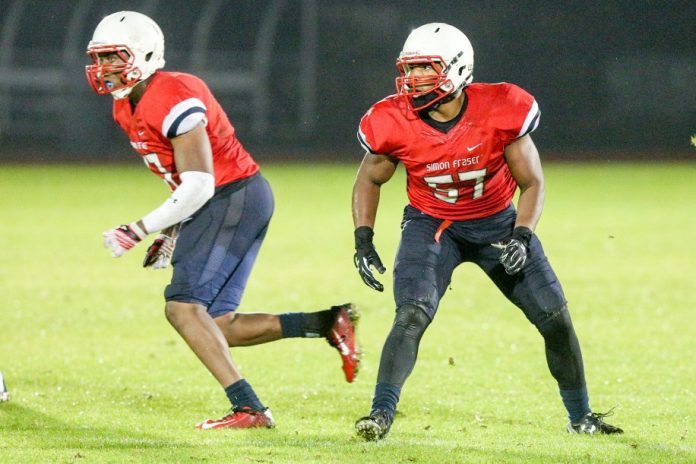
Jordan Herdman (#57) will be tasked to lead the Clan defence once again

For the first time in a long time, SFU football has some stability, at least in the coaching department. Head coach Kelly Bates has returned for a second season in charge, and is looking to avoid last year’s winless campaign. Perhaps the only silver lining one could take from last year’s record is the fact that in five of the nine games the Clan played, they were either leading or tied at halftime.

According to Bates, turning those halftime ties and leads into wins is “a process that happens both on and off the field. On the field, we’ve got to control the measurements of the game that help you have success. Ball control, taking care of the ball, time of possession on offence, no stupid penalties. [. . .] On defence, you need to take away balls, you need to stop drives, you need to not extend drives with bad penalties.

“Those are the things that come with attention to detail. And I do believe we will get better at that. But at the same time off the field, you need to put in place a recruiting class that allows you to build your team, and we’re not quite there yet.

Bates further explained that “We are a very young team. And we’re going to pay the price right now in terms of mistakes and being young and not having that experience. But it’s going to pay off down the road.”

The Clan brought a large 36-player recruiting class this season. Miles Richardson was one of those players, a transfer from Division I school Eastern Washington — Richardson will be the team’s starting quarterback, replacing Ryan Stanford, who has graduated.

“To me, he shows the characteristics I want in a quarterback,” said Bates. “First and foremost, he’s a hard worker. He doesn’t take any shortcuts. He knows what he wants from the players around him and he demands it, and there seems to be a respect factor there that helps him get that. He’s got a very young receiving core to work with, for the most part, and he’s given those guys great direction.”

Defensively, SFU will be led by the Herdman twins, Jordan and Justin. Jordan was last season’s GNAC Defensive Player of the Year, and Justin was no slouch either, recording just over nine tackles a game.

“I’m not expecting greatness, I’m expecting them to be them,” said Bates. “If that happens to be great, that’s outstanding. They’re two tremendous people off the field, and I think that adds to what type of people they are on the field. All I’m expecting from them is 100 percent effort, and I’m going to get that, and the result will yield itself based on that effort.”

The schedule for the Clan will be extremely tough at the start. After playing Idaho State, a Division I program away from home, the Clan is on the road again the following week in Texas, before coming home to play Humboldt State — the conference champion that beat them 57–0 last year.

“[Miles Richardson] is a hard worker [and] he doesn’t take any shortcuts.”

“It is what it is,” Bates said about the schedule. “You accept it, and create a plan, and that’s what our guys will do. One game at a time, one practice at a time.”

One particular game that has Bates excited, and might get students excited as well, is the homecoming game on October 1. It will be at Terry Fox Field, the first time the team will play there since 2013.

“We’re going to have some very interesting marketing ploys to what we do this year,” explained Bates. “We’re going to  go ahead and copy the CFL ‘kick for a million’ and have a ‘kick for tuition.’ And we’ll do that multiple times at every game, so we’ll do it up here, and we’ll do it at Swangard. I think it’s a great way to engage students, the community, and great way to put some people in the seats.”

SFU plays their first home game September 17 at 6 p.m. at Swangard Stadium.

Last season: 7th

Preseason prediction: 5th

Veteran group expected to lead the Clan this season

0
Senior Alison McKay (#10) is poised to have another fantastic season

SFU volleyball heads into the 2016 season with high expectations. That’s because this year, there are 12 players returning from a team that finished fifth in the GNAC conference last season.

“I think it’s always helpful when you return 12 players,” head coach Gina Schmidt told The Peak. “So far I think it’s probably the highest level we’ve been playing at this point in the season. I’ve been happy with things so far.”

The team has brought in three new players this season: Kirsten Pinkney and Betsie de Beer join as freshmen, while Angelica Kilberg joins from the University of Manitoba.

“It’s been a pretty smooth transition in terms of getting the freshmen involved,” said Schmidt. “We have one transfer who is already use[d] to the university setting, so this stuff isn’t new for her. So really, just two players that are new to university, and they have the opportunity to meet our team in the recruiting process. So there wasn’t really anybody coming in that didn’t know each other before.

“There’s always a bit of a jump from high school in the university level when it comes to the speed of the game, but really when you look at our gym, it would be hard to pick out who the first years are.”

Hopes for the upcoming season are high in part due to how the last one ended. After enduring some tough losses early on, the team rallied to win six of their final seven games, something Schmidt said the team hopes to carry over come the start of this season.

“We definitely talked about that in our spring season,” said Schmidt, on the end of last season. “Our spring season is essentially our preseason for this year, and I think we had a very good spring. The girls worked hard to improve on the things that kept us from being in the top three. Where that gap was, we really tried to address some of those things, and I think it was really building off a good end of the season.”

The Clan will not be afforded time to ease themselves into the start of this season, though. First off is a tough non-conference schedule which sees them play a total of eight games over the span of five different days. After that, they have three days to get ready for Western Washington at home, a team that last season were the West Region champions and went all the way to the national semifinals. However, Schmidt insists her team will be motivated for the task.

“It’s a little bit helpful that you’re playing Western, only because when you’re playing the team picked to finish first in the conference, it doesn’t take much to get the team motivated to play,” she explained. “It’s always exciting to play a good team and a team that’s favoured to win, so I think [that] will help us, even if we’re tired from the road trip. The opportunity to play a good team finally in front of our own fans, I think will help us get over any fatigue and excited to play.”

You can catch the game against Western Washington September 14 in the West Gym at 7 p.m.

Last season: 5th

Preseason prediction: 5th

High expectations once again for men’s soccer

0
Sophomore Mamadi Camara is poised to have a “special year,” according to head coach Clint Schneider.

SFU’s men’s soccer team has arguably been the most successful program since the school switched to the NCAA. An undefeated season in 2011 and two trips to the final four in 2012 and 2013 has meant that expectations for the team are always sky-high. Despite not making it to the postseason last year, the team maintained an amazing defensive record at home, not conceding at Terry Fox Field in the fall or the spring when they played two professional sides in Toronto FC II and Whitecaps FC II.

This year, things are no different. Expectations are once again stratospheric, with the team going for something that has eluded them in the past: a national championship.

“[The] message consistently with the players [is] that they’re here to win a national championship,” said head coach Clint Schneider. “Anything else is not good enough. It’s just not. Of course we’d love to win the GNAC championship, that’s great. We want to be in the national championship, that’s great. But we want to win a national championship.

“We’ve been close, but never won it. And you can say that’s a lot of success, and it is. But we want to be the last team standing. The players that join us, that’s what they want. And that’s why we recruit them, because they want to win.”

After a tough non-conference schedule — including NCAA Division II finalists Cal Poly Pomona, who are ranked fourth nationally — the Clan will not be eased back into conference play. Their first game in conference is against Seattle Pacific at home on September 22. Seattle Pacific is a long-time SFU rival, two-time defending GNAC champ, and ranked 11th nationally.

“We know what they’re about, they know what we’re about,” remarked Schneider. “When it comes to rivalry games like that, it’s not easy. [. . .] Generally those games are one-goal games, they’re tight, and both teams want to win those games. There is a lot of mutual respect, especially between coaches, and it won’t be easy. I think that we’re a very talented team, [and] it’s going to come to in that game where we are at, how the non-conference games go if we’re confident.”

Another key to start the season will be to avoid the sluggish start the team experienced last year, where the team only won one of their first six competitive games.

“[The] message consistently with the players [is] that they’re here to win a national championship.”

“I think we learned some lessons from last year and implemented them this year, [those] being a bit more prepared for the guys to come in for the first game. Pushing them a little bit harder than we did last year. And I think that if we just look at the results, last year we lost 1–0 to UBC, this year we tied them. We’re further ahead than we were last year.”

The team is bolstered this year by a number of high-profile recruits and returning players. One such recruit is Freddie Gard, who joins the Clan from the Southend United U-18 team, which plays in the third tier of English soccer. He’ll join another former Southend United player, Robert Hyams, on the team.

“Robert’s the one who told us about Freddie,” explained Schneider. “Robbie put his reputation on the line to say Freddie was going to be good enough to play here. [. . . He] is every bit as good as I thought he would be. I just had a conversation with him, I still think he has more in him, and he’s still adjusting to college soccer, because it’s different. But he has the potential to be very special for us.”

Mamadi Camara leads the way for the returning players. The midfielder was second on the team last season with five goals.

“I think Mamadi is poised to have a very special year. How good he was last year, he’s even that much better this year. He’s really grown as a player. [. . .] He is a difference maker amongst a bunch of difference makers — that’s what I believe.”

The quest for the elusive national championship continues on September 10 against Notre Dame de Namur University.

Ante Litre is helping lead the way for the Clan

0
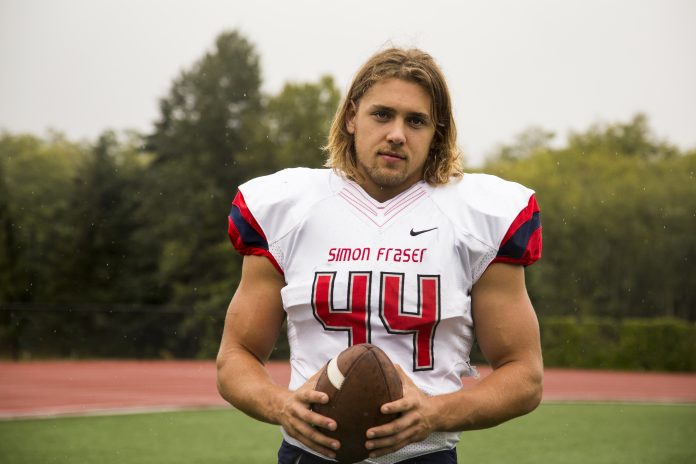
Litre ran for 648 yards last season, which led the team last season.

There’s no getting around it: last season was a tough one for SFU football. The team suffered a winless season, their worst showing in the NCAA era. However, senior running back Ante Litre is determined to help lead the Clan to victories this season.

“I want to lead the team to a few victories,” said Litre, who is a health sciences major. “Whatever that role entails, I’m ready to take it, [whether] that’s making a few special teams, tackles, or whatever the case is. I love winning, and that’s the most important thing when you’re playing football. Applying yourself to the team is what you gotta do.

“If you set team objectives, [and] you have all 11 guys on the field working towards the same objective, there’s nothing more important,” he continued. “Individual statistics will follow, but I try not to think about that. It’s always team first.”

Litre started playing football a year before high school, following the influence of his older brother.

“My dad came to Canada from Croatia when he was 28, my mom came here when she was three. We didn’t have any idea about football, we never watched it in the house growing up. So when my brother got into Grade 8, there was a letter sent out to all the newcomers to the school talking about the football team and how we would love to have your sons come out.

“From then on, that’s when the whole addiction to football in the family started. We watched my brother play that first year and [said] wow, this is an incredible sport.”

Litre then joined SFU out of high school in 2012, and needless to say, there have been some changes.

“My first year when I came to SFU in 2012, I came in a recruiting class that was almost 45 people-plus. The roster size was about 120. We had so many guys on the team that there were guys splitting lockers. Now, I got two lockers. [Laughs]

“When that roster size was that big, that made practices different. Because now all of a sudden everyone redshirting was on a scout team, and they were [playing against] the starting offence, so you had those reps against the first team for a full year. That’s an advantage you get with a 100-plus roster. But on the flip side, you get less coaching. Now, having this better number, I think we’re finding a happy medium.”

Moving into his senior season, Litre’s team has some positives. A big one is the return of head coach Kelly Bates and his coaching staff, the first time in a long time that the players have had coaching continuity heading into a season.

“Having a set of coaches who [know their] players, we’re  able to hit this season running as opposed to try and figure out who everyone is,” said Litre. “That was the biggest thing. A lot of times when a new coaching staff came in, a lot of guys looked at it as a fresh start.

“I love winning, and that’s the most important thing when you’re playing football.”

“Now, the coach has seen everybody, he knows who everybody is, and we’re able to plan for certain guys. The coaches have done a good job taking care of their guys, and it’s been going good.”

The other is that Litre has had time to adjust to the running back position. Formerly the fullback for the Clan, Litre was put into the position last season after injury, and quickly became a revelation; so much so that he will likely be the starting running back this year. It’s a position he didn’t think he would find himself in when he was first recruited to SFU.

“When I first came in, I thought I was going to be a linebacker for the next five years. In the spring camp, I was getting some first team reps at linebacker. And then halfway through camp, the head coach kind of caught me off guard, he comes up to me and says we have a need at fullback. And I just wanted to be on the field, whether it was special teams or whatever I could do for the team to help move it forward. So I said I would move to fullback if that’s what the team needed.”

After his SFU career is done, Litre’s dream is to go play professional football or to become an athletics director at a university. If he ends up being drafted, he’ll be following in the footsteps of someone he went to SFU with: Michael Couture.

“We’re all so proud of him for everything he’s accomplished, along with every other CFL alumni that’s been through here,” he said. “A lot of times our CFL alumni come back and they train with us in the weight room and stuff. [. . .] Having that in your face all the time, it’s definitely a goal you want to strive towards.”

For someone whose passion and dedication to the game is very evident, the team’s disappointing last season was for Litre the “most heartbreaking thing I’ve done.” However, Litre and the team are determined that it will push them towards success.

“As a group, we’ve all been through so much with the three head coaches, there’s nothing more we wanted to do than win. And we came short so many times, it took such an emotional toll on everyone. It left a scar on us through all of the off season. Watching an old game or something, [you’d] get super frustrated. All you want to do is get that first win.”

As the season enters its early stages, Litre and SFU will be looking to put the past behind them.

FUN FACT: Go-to touchdown  celebration?

“I usually look for Felix [Gacusana] or Evan Telford, they’re my [offensive] linemen. They’ll come give me a big bear hug. I’m not a dancer, I got no dances at all.”

Satellite Signals

0

Harbour Centre

Join Gail Davidson, a visiting lecturer at Harbour Centre, for an eye-opening lecture about the UN Convention Against Torture. Davidson, a human rights activist and founder of Lawyers’ Rights Watch Canada, will be discussing the Convention Against Torture, and Canada’s noncompliance with its principles since 2001. Attend this free lecture on September 9 at 6 p.m., as Davidson discusses solutions to engage civil society and enforce the convention.

Woodward’s

Love at Second Sight will be screening on September 8 at 7 p.m. at SFU Woodward’s. This 25-minute educational video discusses themes of self-acceptance and friendship, as we follow David Roche and Marlena Blavin in considering these topics with middle school children. From feelings of horror to humour, watch as these young students take a second glance at love and acceptance. The screening will take place in the Djavad Mowafaghian Cinema.

Surrey

Do you have a clean technology innovation to showcase? Join SFU Surrey at the Greater Vancouver Clean Technology Expo and Championship on September 28. All SFU students, faculty, and staff are invited to submit their clean technology research and innovations for a chance to win a $10,000-prize provided by Vancity Credit Union. Attendees can also enjoy SFU’s display, “Cleantech on the Plaza,” and SFU mechatronics professor Majid Bahrami’s Hybrid Atmospheric Water Generator (HAWgen) innovation. Last year, this event attracted over 500 attendees, so consider showing up early!

The student housing crisis that isn’t going away

5

Priced out of options

Moving is awful. So is not knowing where you’re going to live for the upcoming semester. Everything about student accommodation in Vancouver nowadays is just terrible.

Now, imagine you were being evicted from your affordable housing so that it could be demolished, and everything on the market was significantly higher than what you currently pay. Does that seem like something you could handle?

The residents of the Louis Riel House at SFU were faced with that exact dilemma last summer when their building was condemned due to mould problems. Through grit and negotiations, some of them received the help they needed.

A year has gone by, and there’s still a serious lack of affordable housing at SFU. In fact, the start of the fall semester marked a significant increase in the rent for each residence building.

This feature is here to remind us of what has already happened, and what housing situation SFU students will find themselves in for years to come.

The good, the bad, and the mouldy

Built in 1969, Louis Riel House has been home to graduate students and families for most of the university’s existence. The units included their own bathrooms and full kitchens. In the Louis Riel House, a strong sense of community developed. One resident wrote on the Louis Riel House community website that she and her neighbours had a great relationship, leaving their doors open so their children could visit and play whenever they wanted. As a home to individuals living with disabilities, Louis Riel made a university education that much more accessible. It was an old building, but for many, it was home.

Natalie Knight is an organizer for the Alliance Against Displacement (AAD), formerly known as the Social Housing Alliance. Knight was very familiar with the appeal of the Louis Riel House community. In an interview, she explained that a reason students, especially international students, came to SFU is that the university “offered family housing at affordable rent. It was on campus, it was family housing, and it was graduate student-focused.”

Over time, the waterproofing at Louis Riel, much like the rest of SFU, deteriorated. Tim Rahilly, vice-provost and associate VP students at SFU, explained in an interview that the university had seen that “there was an increase in the number of incidents of water ingress that occurred and we became concerned about that and the building systems in general.” Every time there was a leak, it carried the risk of mould.

The Alliance Against Displacement became involved when they were informed of the residents’ worsening situation.

“The administration it seems had essentially allowed the building to go into disrepair for a number of years, enough for the black mould situation to develop on a pretty massive level.” Residents were “pretty outraged,” Knight added.

Those living at Louis Riel House became increasingly worried about their health and safety — so much so that the SFSS and the TSSU got involved in late 2014. Any veteran student knows that mould has been a long-running problem in the university’s older buildings. The Louis Riel House was just the next beloved campus space to fall victim.

Rahilly conceded that mistakes were made in deferring maintenance. He pointed to the fact that for years, “rates that were being charged to residents did not cover the operating costs of maintaining the buildings.” He also pointed to a lack of public funding designated to support university residences.  

“That resulted in what we call deferred maintenance, and so it’s the students of today that in this case had to live through this,” said Rahilly. He also gave the example that because of the age of the building, it became increasingly difficult to replace things like the windows because they simply weren’t being made anymore. In order to prepare for the potential demolition of the building, the residence licence agreement was changed so that SFU could not guarantee that residents could stay in Louis Riel past August 2015. As Rahilly himself said, “perhaps we were remiss in not always bringing that [change] to everyone’s attention.”

After a comprehensive air quality assessment, SFU announced in March 2015 that Louis Riel was going to be closed later that year and demolished.

The residents didn’t take the news lying down. If Louis Riel was going to be closed, they needed help finding and paying for somewhere else to live. Residents held rallies on campus and garnered support from across the university community. Knight remembered how “the administration was blindsided by our organization. They didn’t expect residents to resist or protest.”

There is a long list of letters of support on the community website, including ones from the SFSS, TSSU, and 182 faculty members. Word of the conflict reached mainstream media, and the rest of the Lower Mainland began participating. Knight described their involvement as they “started coming to meetings, presenting [the administration] with petitions, giving them firsthand accounts, having residents come and speak at meetings.” During the negotiations, there were some accusations of SFU being arbitrary in who they would choose to assist.

Rahilly recalled that the AAD and residents were “super reasonable, very interested in the process, trying to be forward-thinking.”

The end result of the negotiations was that some residents received funding to help subsidize their rent. Knight was emphatic, adding that “[the funding] would not have happened without residents organizing themselves.”

The skeleton of the Louis Riel House is currently still standing, as crews remove dangerous materials like asbestos before general demolition can take place.

Demo-victions, displacement, and the disappearing rental market

If Louis Riel existed in a vacuum, the fallout might have been very different. But the reality is, in the Lower Mainland, it’s becoming increasingly difficult to find affordable places to live. After losing that building, many graduate students and families had to wade through a market with a 0.6 percent vacancy rate, according to The Georgia Straight, and no real affordable options for students with families.

The Rental Housing Index, a database and web tool established by the BC Non-Profit Housing Association and Vancity Credit Union, shows the Vancouver region is extremely expensive and overcrowded. According to the index, 36 percent of 18- to 29-year-olds are spending more than half of their income on rent. The average rental price for a one-bedroom suite in the region is $909, including utilities.

According to Knight and Rahilly, this is a new problem for Vancouver. Knight mentioned activists doing anti-poverty work in the 1970s, noting that homelessness wasn’t a problem. “Sure there was [sic] terrible conditions, there was poverty, but people had homes,” said Knight. As for young people trying to break into this kind of spiralling real estate market, Rahilly summarized his thoughts on the housing crisis: “If you didn’t get on that housing ladder in 1970, you missed out.”

Recently, The Globe and Mail published an article drawing attention to two SFU students who were homeless on campus because of housing troubles. Nicholas Ree and Cindy Kao weren’t able to afford rent, and so had resorted to sleeping at one of the SFU Vancouver campuses. Knight wasn’t surprised, confirming the age-old stereotype of graduate students staying in their offices when they’re “between places.” She added that compared to the alternatives, “it’s a safe, warm place to be.”

Who’s caught holding the affordable housing hot potato?

The province, after years of resisting pressure to intervene in the housing market, has applied a 15 percent tax on foreign home buyers in an attempt to slow the rise in housing prices. However, critics have claimed the tax, combined with unemployment, might affect the real estate market adversely. Legitimate foreign buyers who won’t leave their houses empty might also be affected.

The Canadian Revenue Agency has said it will add 50 more auditors to filter through income and real estate, a measure that has been criticized by NDP MLA David Eby as too limited and “frankly, a joke.”

Knight said this might just be a local obsession taking shape, rather than actually addressing the issue. She explained that foreign investment driving housing prices is “ingrained in large part through contemporary media coverage of the housing crisis,” but that it also reflects “a long history here of anti-Asian racism.

“The problem isn’t where the money is coming from, the problem is that we have an unregulated market,” she said.

Elsewhere in Burnaby, some tenants in affordable housing buildings have been evicted to make way for new apartment buildings. In July, Knight was arrested and later released without charges along with others when they occupied one such building in protest. The conflict echoes a squat at the Woodward’s building in Downtown Vancouver that happened over a decade ago: community members wanted to establish affordable, social housing in the then-vacant Woodward’s building.

There is a need for affordable student housing, but progress at SFU is slow and complicated. Rahilly explained that while SFU has plans to build more residences, it is difficult for the university to meet demand. He said that “you don’t want to overbuild. You know, if you have unused residence capacity, financially it’s very difficult.” They have to be “self-sufficient” because “there’s no fund, or the government doesn’t support us to build residences.”

Rahilly provided a document from the province advising that the university is only able to run a deficit “under extraordinary circumstances.” Correspondence from the associate VP finance, Alison Blair, explained that the province has denied SFU’s requests to borrow money for the past four years.

To replace Louis Riel, the university has been in talks with UniverCity to build “low end of market” apartment units, Rahilly said. He added that the proximity to the school and daycare would be a more desirable environment for families. In the meantime, he explained that SFU has around $11 million per year available in “need-based funding.”

Knight expressed some distrust of what the university’s future plans are and some reservations of what led SFU to close Louis Riel. “I do think they were conscious about it, to let Louis Riel go into bad shape so that they could tear it down and build something else,” she said.

Things aren’t fine

It is hardly controversial at this stage to say that rent and housing prices are too high in Vancouver. But the reason that a closure like that of Louis Riel hit us so hard is that there are so few places like it.

It is paradoxical that SFU’s stated mission is to “develop healthier and more vibrant communities,” yet the university allowed the mould situation to progress as far as it did. We’re left with a gap in the community, and everyone is passing the buck of whose job it is to fix it.

SFU is planning on building more residences, but Rahilly has made it abundantly clear that their hands are tied by the lack of funding. The province enacted a new tax that, according to critics, fails to address the real underlying issue. Cities are downplaying their role in planning their neighbourhoods.

At some level, most of us understand that we won’t get cheap housing. But the way things are now, it’s questionable whether we’ll be able to get affordable housing at all.

Let’s talk about bitches

0

Bitch. It’s a powerful word.

When you read the word “bitch” — or hear a classmate, a family member, or a friend say it aloud — how do you react?

Since bitch has never in my life been regarded as a socially acceptable or positive term to describe women, I’ve always had a particularly negative reaction to the word. Almost always, “bitch” is a slur, used to demean and degrade a woman for behaviour that society has deemed unladylike. I grew up immersed in a culture that finds no redeeming quality in a bitch, and any time I hear it directed at anyone — women in particular — I flinch.

Words are never inherently bad. They are neutral entities, with goodness or badness that is dictated by us. The fault in the connotation of the word bitch is the fault in our society for deciding that traditionally “bitchy” qualities are unseemly, especially in women. We warped the word for a female dog into a slur against women to satisfy a dominant, misogynistic culture.

Lately, there has been a surge online and elsewhere to reclaim “bitch” from its history of disparaging use, just as “queer” has been reclaimed (mostly) for the non-straight population. This is a step in the right direction because the way to decrease the negative connotations is to increase the positive ones. We need to change how people perceive, receive, and process the meaning of “bitch.”

Smile, bitches

The phenomenon of “resting bitch face” (RBF) is almost unanimously touted as an insulting critique of how women don’t automatically revert to a smile in a relaxed moment. It’s derogatory and horrible. Nothing screams the patriarchy more than a group of men calling a woman a bitch because she doesn’t smile enough for them. RBF reminds us why “bitch” is such a complicated word.

“Bitch” as a slur against women in power isn’t new. Women in roles of power, especially in managerial or supervisory positions, require their employees to do things within a certain time frame or with a high level of efficiency and quality. While this is commonly seen as perfectly acceptable, and even encouraged, in their male counterparts, it often results in women being called bitches for supposedly abusing their power. The process to reclaim hardworking bitches is already ongoing.

The problem is what bitch means to you is different from what it means to me.

Now more than ever, women are trying to embrace and disarm the firepower of such a linguistic move by calling themselves “bitches in charge,” “bomb-ass bitches,” and other variations. And it’s working. For me, someone who usually has a knee-jerk negative reaction to the word, I’ve been self-describing as a “badass bitch” whenever I’m on fire in the workplace.

The problem is that what the word means to me and what it means to other people isn’t always the same. The context in which the word is used also makes a great deal of difference. What comes across as empowering, laudable, and even encouraged in a women’s studies class turns menacing in a hurry in a dark alleyway.

So who can say bitch?

Then, of course, is the issue of who is allowed to use “bitch.” Only women? Only a certain subset of women? I’ve talked to a bunch of ladies, and the almost unanimous response is that straight men cannot and should not use the word at all, not even in the positive sense we currently see. “Men always use it in a shitty way, they shouldn’t be allowed to use it at all.”

Queer men and non-binary folks are a different story. Some of these people have also experienced the disgust, the shame, and the ridicule that come with being derogatorily called a bitch. So, many argue that we should consider the appropriateness of the term based on sexuality and experience. It’s an understandable response, but it doesn’t solve the problem.

This is not to say that only men use it negatively. It is so much a part of our culture, ingrained in our understanding of the world, that women use it to insult other women. The fact of the matter is that tone indicates intent, regardless of gender. Some of the older women in my life even use it as a teaching moment: “That woman is such a stuck-up bitch, you do not want to be like that.”

Ultimately, a lot of a word’s ability to inflict emotional suffering lies in the intent. The best way to speed up the process of the reclamation of “bitch” is to get men — queer or straight — and everybody in general to use it in a positive rather than a negative fashion. The faster we can influence and reshape our reaction to and our conception of bitches, the faster we arrive at a society where a bitch is first and foremost a successful, powerful, confident lady.

Parquet Courts lacks stylistic cohesion, but made for an interesting show

0
New York based band Parquet Courts stopped in Vancouver on August 27 at the Vouge as part of their latest tour.

Parquet Courts walks a fine line between being a post-punk revival band and a post-punk cover band. If the nostalgic post-punk elements were somehow more smoothly and completely integrated into the whole sound, then these guys would be in the clear. But the seeming lack of cohesive vision in the band’s flavour did not allow this to happen.  

Parquet Courts comes from Brooklyn, New York, and they exude the style you would expect them to have coming from such a stylish hometown. They brought the arty and jazzy cool of new wave New York bands such as Television and Sonic Youth. Experimental elements abounded: atonal flourishes, dissonant chords, and unconventional percussive parts that at times had a Frank Zappa vibe.

Unfortunately, there seemed to be a few different bands up there. One a Television cover band, another a Pavement cover band, and finally the actual band Parquet Courts. It was like the band couldn’t make up their mind as to who they were. Although the Pavement or Television fanatic would’ve been in their glory — at times if you closed your eyes you might feel like you were transported into an ‘80s New York club — ideally we want to see fresh licks from young talent.

But the saving grace was when co-lead singer Andrew Savage announced that they were about to play a few new songs. The first was “Human Performance,” the title track off their new album. That song was seriously good. The modernity of their sound promises a bright future for the band. And I have to say, Savage’s performance was absolutely captivating. After every song that he sang, I couldn’t help but turn to my friend, point to him, and say, “I like that guy.” He was punk, he had soul. He was versatile, he sang from a dark place and just unloaded all his emotion onto the audience in a flurry of flying spit.

In terms of skill, the whole band was great. While there was never anything super complicated about their arrangements, they played with an awareness of punctuation. Notes ended with an energy and polish that showed their skill and meticulousness. It’s clear that these guys are serious about their music.

NEW MUSIC FRIDAY

0

Follow The Peak on Spotify to stay up to date on New Music Friday.

“33 ‘God’” – Bon Iver

Jessica Whitesel: I am the first to admit that I am a huge Bon Iver fan and this song doesn’t change that. It is a little more uptempo than say “Skinny Love,” but that is not a bad thing. Neither are the smaller electronic flourishes that help to break up the backing track.

Jessica Pickering: I never really got the Bon Iver hype. Maybe I’m too high-strung to understand why anyone would want to listen to this. I honestly feel like I’m going to fall asleep because this song is too chill (which is a weird thing to complain about but here we are).

Sarah Finley: Bon Iver has a permanent place in my heart, perfect for autumnal cool breezes and falling brown leaves. Major piano chords combine with a more electronic-y vibe in this track to create a much more upbeat vibe than anything on For Emma, Forever Ago or his self-titled 2011 album.

Justin Stevens: If you can get over the chilling little voices that interject throughout the track, you get a curious masterwork on your hands. It’s unsettling but at the same time very beautiful. It feels like the best kind of dream: the one you can continue to find meaning from.

“Freedun” – M.I.A. feat. Zayn

JW: The song is pretty mediocre. While it is nice having a female rapper and male singer, it is not her best song. The rhymes feel forced, and her flow just feels off. It’s not so bad that it makes me want to scream, “Make it stop!” I don’t really want to seek it out to listen to either, though.

JP: M.I.A., I expected so much more from you! The rhymes aren’t bad but the delivery is weak. Also, why the hell is Zayn on this? He sounds so out of place with his whisper-singing. Both artists seem to have very different ideas of what this song is about and how it should sound.

SF: M.I.A. is perf for your female empowerment playlist, and this track is no different. Zayn’s backup vocals provide a nice complementary touch, combining with catchy percussion.

JS: I’ll give this song credit where it’s due: it actually made me laugh out loud. “I’m a swagger man rolling in my swagger van from the People’s Republic of Swagistan.” Ten points to Gryffindor for those lyrics.

“3 Wayz”– Ty Dolla $ign feat. Travis Scott

JW: “Z” is not how you pluralize things. “Z” is for the beginning of words like zoo and zebras. Aside from the “Z,” this is your typical Ty Dolla $ign and Travis Scott song. But it also sounds like it might have been a rejected T-Pain and Wiz Khalifa song so ¯\_(ツ)_/¯.

JP: It physically pained me to use a dollar sign as an “S.” The only people I have ever known to pull shit like that were in the seventh grade at the time. Grow up and make better music.

SF: This track is just . . . boring. We get it, you’re rich with an affinity for codeine, Henny, and three-ways. The lyrics are unoriginal, blurring together with every other marginally famous rapper’s.

JS: I get the feeling you have to be high to appreciate this track. Seeing as I’m not high, I just don’t get it. Those last 10 seconds were pretty good, though.

“Jesus Alone” – Nick Cave & the Bad Seeds

JW: This is not a song for everyone. It feels dark, foreboding, and like it is building to the first killing in a horror movie. But I like it. It takes a certain type of confidence to embrace a sound like this one and that is pretty great.

JP: I love creepy talking at the beginning of songs. No, really, it’s my favourite. And, as it turns out, it’s a reoccurring theme in this song. Fantastic. The line “You’re an African doctor harvesting tear ducts” is just a really fun addition as well. Bless the fire truck that just drove by and drowned out this song for a moment.

SF: Is this song on a soundtrack for a weird sci-fi movie? Coming in at just under six minutes long, this track is a time investment, and quite frankly, not a worthwhile one.

JS: Mix the voice of Johnny Cash with the otherworldliness of David Bowie and “Jesus Alone” is what you get. A nightmarish western-style tune that will leave you petrified forever.

“Make You Feel Good” –  Fetty Wap

JW: I know it is 2016, but like I am beyond tired and I felt like it was 2006. This is when it sounds like this song was recorded. While the backing track feels a little modern the uncredited female singer and auto-tuning just is a little bit old and overdone. Pass this one and listen to any song that survived your memory from 10 years ago.

JP: Yesterday I saw a gif on The Peak’s Twitter page that perfectly summarizes this song. I don’t even want to say anything else, I just want to link the tweet and have everyone go look at it so here it is, folks! Too lazy to click the link? It’s a dumpster on fire.

SF: The structure of this track leaves me entirely confused, with Fetty Wap only having one real verse in this track, sandwiched between two 30-second sections that I suppose could be described as choruses.

JS: I can remember a time when making fun of generic rap songs was fun. Now, it’s just downright depressing. Did I secretly become old and out-of-touch overnight? Is this what rap is now? By God, I think the hip-hop genre just had a fucking stroke.

“Timeless” – James Blake feat. Vince Staples

JW: I was all prepared to like this song until the weird noise in the backing track came in and it made me want to turn my alarm off. Once it stops it is OK again, but you are just waiting for it to start over again and then it just sucks.

JP: What is this nonsense? I thought the goal of music was to be enjoyable. Apparently these two would beg to differ. I’m just trying to picture what type of person willingly puts themselves through this.

SF: Complete with what sounds like a car alarm going off in the background, this track seems like nothing more than noise. It’s like James Blake and Vince Staples are trying to do an impression of Kendrick, but painfully and dramatically failed.

JS: Timeless? HA. I can’t decide if this is rejected cellphone alarm or someone trying to make a song out of a tornado warning siren.

“Send Them Off!” – Bastille

JW: I like Bastille — well, at least I thought I did. But they are just sounding same-y. This song just sounds like a moodier version of their last single “Good Grief,” complete with the weird old-timey movie clip at the beginning. I honestly was expecting more and I’m disappointed.

JP: I would like to personally thank Bastille for the first good song on this playlist. I love this song, which is good because I just downloaded this song as part of my pre-order of their new album. Ending seems a bit abrupt but other than that it’s one dynamite track (I just re-watched Wreck-It Ralph, please forgive me).

SF: My middle school angsty self feels represented in the lyrics here. My adult, university self can’t help but giggle at lyrics that bemoan a desire for their minds to be liberated. Gag.

JS: The horn instrumentals on this track are utterly bodacious. It made me want to grab a cape and spandex and wreck some bad guys. Unfortunately, once the actual lyrics hit the scene you can’t help but feel the song takes a step back from the potential intensity it offers. I’d wait for the inevitable spin class remix instead.

“I Get it Now” – Fjord

JW: This is a pleasant, electronic-infused indie-type track that is pretty low-key. But even though it is a good song it just is kind of boring and not very memorable. If it came on though I would happily listen to it.

JP: Holy shit, two redeemable songs in a row? Christmas came early this year. Don’t get me wrong, this song isn’t the best I’ve ever heard, but compared to some of the other garbage this week it’s fantastic. A tad repetitive but overall it’s listenable.

SF: Melancholy chords introduce the song, soon followed by equally melancholy lyrics. Echoey vocals combined with electronic instrumentals make this track land somewhere between sad and hypnotic — but good all the same.

JS: I got a crisp $100-bill that says this song will be featured in the next trailer for the Fifty Shades of Grey sequel. It checks the box of every generic steamy romance trailer prereq: sultry voice? Check. Melancholy instrumentals? Check. Completely forgettable lyrics? Double check.

“Ain’t My Fault” – Zara Larsson

JW: This song sounds like a Rihanna reject. But like 2008 or 2010 Rihanna. It isn’t special and it has been done before, but we are probably going to be hearing a lot of it so just be prepared for that. I am not ready and honestly it makes me kind of sad.

JP: Listening to this song is like listening to a really drunk girl at a party trying to explain drama: I just want to give you a glass of water and a piece of bread. I don’t even know what she’s saying anymore, she just needs to sleep it off.

SF: Beginning with a literal school bell ringing, Zara Larsson’s new track has me chronically cringing. Grossly repetitive and severely auto-tuned with weak bass drops scattered here and there. I couldn’t wait for it to end. Forever.

JS: Hey Zara, Rihanna called. She wants you to stop trying to mack her style. This instrumental is less what I would expect on a hip-hop single and more in line with the start screen for a shitty Kickstarter RPG made in under an hour. But all in all, call your teenage cousin up and tell her you found a track that’s as basic as her hairstyle.

“Rivals” – Usher feat. Future

JW: Oh Usher, your abs are so good but your music is so boring. You should just dance, and dance. Maybe just take your shirt off too, but for the love of God stop making music. You even made Future sound boring.

JP: Usher I thought I left you in 2010 where you belong. Just accept that you peaked (which is a miracle in and of itself) and quietly fade into obscurity like everyone wants you to. You’re almost 40 for God’s sake. Go play golf or something.

SF: Usher and Future pair to make — surprise — a song about relationships! Slow-paced in what I can only assume is an attempt to sound more romantic than overtly sexual, this track failed to impress. On an unrelated note, how long until Usher retires?

JS: This feels less like a love song and more like a drunken freestyle of Usher and Future fighting over a microphone. It’s quite possibly the laziest serenade I have ever heard. This couldn’t enchant the pants off a plastered housewife.

“Tomorrow” – Shakey Graves

JW: I really like this one. It’s just a nice track. It might not be super memorable but I really want to listen to more of their music. It kind of has a nice sort of indie-folk vibe, but more indie than folk. Also on a side note, all portraits should have flowers in place of faces it’s more fun that way.

JP: I am severely neutral towards this song. I think normally I wouldn’t like it but I’ve been so negative with this week’s playlist and I desperately want to add some positivity. So this is definitely a song and some people might like it, others won’t, and that’s all I have to say about that.

SF: I’m always here for some Shakey Graves. Aside from simply having cute album artwork, the one-man-band never fails to impress with slightly gloomy lyrics sung to upbeat instrumentals.

JS: Oh great, another whiny acoustic singer! As if we didn’t have enough of these assholes to begin with. Pass!

“Get Low” – James Vincent McMorrow

JW: In the spirit of the early 2000s (since that’s apparently where my mind is today) I was fully expecting this to be a cover of Lil Jon’s “Get Low” and even though this is a really good song, I just really wanted to hear him sing “Awww skeet, skeet,” but like my mom says sometimes life just sucks.

JP: This song could be worse, but it could be way better too. The nicest thing I can say about it is that it is not the worst song on this week’s playlist which earns the week of September 2, 2016 a massive and resounding yikes.

SF: Calm head-voice vocals + romantic lyrics + slow percussion + soft piano chords = a perfectly relaxing rainy day track. Bless these songs to pieces.

JS: After myriad forgettable tracks, this doesn’t quite reach the heights of memorable but certainly comes close. The electric guitar in this track is poignantly simple and the chorus is hauntingly addictive. While the song didn’t grab me, the artist has definitely garnered my attention.

Did I mention I’m queer?

0

[dropcap]G[/dropcap]rowing up, I was pretty queer for a straight girl.

When I was in high school, I always had a “gal pal.” At the time, I thought of them in the most innocent way: they were just girls I was unbelievably close with, girls I called my BFF, and girls I would make out with from time to time.

While I was in high school, it never occurred to me that I was queer. Looking back, I can’t believe it took me until my second year in university, until I was 20, to realize that I am.

In high school I wasn’t very open about the fact that I frequently kissed girls. I knew I liked boys, and that boys liked me too, and as far as I was concerned, that was enough for me to be “a straight girl.” This isn’t something I am proud of, but it’s something I’m now comfortable admitting.

I grew up in a pretty progressive household, and I feel infinitely lucky to be able to say that. My parents raised me on the idea that sexuality is fluid, that love is love, and that everyone can look past gender and just see beauty if they choose to do so.

Fast forward to my second year at SFU. I wish there was a moment I could point to that made me aware of my sexuality, but honestly I just woke up one day and knew that I wasn’t straight. Twenty plus woman-crushes are more than just a coincidence.

How does the straightest girl in a friend group tell people she’s not straight at all?

Even after I realized I was super queer, I didn’t talk about it for a year or two. At the time, I was dating a guy. And I told myself I couldn’t tell anyone this new fun fact about myself, but in particular him and his friend group. I didn’t feel comfortable telling them about this. My then-boyfriend and I had been together for well over a year, and his friends had become my friends, but I couldn’t help but feel that none of them would appreciate what I was telling them and the courage it required.

Honestly, I thought they would make jokes about it. And while I’m now in a place where I can joke about my sexuality, back then I was terrified of having people judge me, make fun of me, or worse, not believe me.

A very close friend of mine, who had no clue I was queer, once said in conversation that I was “the straightest person [she] know[s].” My chest got tight and I felt sick. How does the straightest girl in a friend group tell people she’s not straight at all?

In the beginning of third year, that boyfriend and I broke up. And it was honestly one of the most liberating experiences of my life. The breakup coincided with me jet-setting off to France for a year for a foreign exchange. In France, I began to feel more comfortable with myself. I made an awesome group of friends, people whom I knew loved me and would keep loving me if I told them I was queer.

I never quite mustered up the courage to tell them I was bisexual. I was always ambiguous when we talked sexuality, saying things like “everyone is at least a little gay,” and just hoped they would read between the lines. They would see me kiss girls at bars, and I even kissed some of them, so to a certain extent, they knew. But it wasn’t until I returned home from my exchange that I start owning my queerness.

When I got back from France, I looked for a new friend group, and I stopped spending time with anyone who didn’t make me feel good about myself. With my new friends, I remained very ambiguous about my sexuality.

But then I met someone who changed all of that. After months of chasing a girl I met at a bookstore, she finally became my girlfriend. But with this incredible woman came the moment where I had to start being more open about my sexuality.

Slowly, I told my friends, and while they were surprised, they were supportive. Same goes for my family. I even eventually told that group of friends from my first year in university.

There were moments of disbelief from some as I was coming out. And of course there were some awkward moments too.

But being out now, I have never felt more relaxed or more comfortable with myself.