Home Blog Page 805

TRUDUMP

0

A sad pile of luscious Liberal locks is single and ready to mingle. The Trudeau-Obama bromance was too hot to handle, but with Obama wanting to move on and “see other people,” we’re all left hanging in an uncomfortable limbo.

Thankfully, there is a new world leader on the table. He’s tall, orange, and kind of out of shape.

The Trudump ship is about to sail. So get on board, kiddos, this is a bromance that will go down in history. One is only left to imagine their first date . . .

5 p.m.

Trudeau waits eagerly at the door. His uncertainty about this date only rivals his uncertainty about keeping his campaign promises to amend Bill C-51, usher in a new electoral system that’s just and democratic, and end the extremely biased pipeline review process. This handsome stud just doesn’t know what he wants.

6 p.m.

Trump is late. He accidentally went to pick up Ivanka first, but then remembered she’s his daughter and he can’t date her. Honest mistake.

7 p.m.

Trudump arrives at the restaurant. After much back and forth, they both agreed upon a Mexican place, because who can say no to guac’?! Trump wonders if the cook is really sending their best tacos to the customers. Trump tries explaining to Trudeau that when the cook makes tacos, he keeps the best ones for himself and only sends the bad ones out to guests.

8 p.m.

Trudump finishes eating and decides to take a walk. A slight November breeze brushes past Trump’s cheek. “We need global warming,” he exclaims, looking passionately into Trudeau’s eyes, which are deeper than Trump’s list of tax-evading strategies.

9 p.m.

Trump walks Trudeau to his door. Trudeau thanks him for dinner, and stresses how glad he is that they have shared interests. Trudeau is a little nervous: he isn’t sure if he needs to grab him by the penis, or if he should wait for Trump to make the first move. To break the tension, Trudeau pulls friendship bracelets out of his pocket. “I <3 NAFTA,” they read in brightly coloured beads. Trump declines, calling him a “nasty man.”

10 p.m.

Trudeau sits alone in his room and reaches for the phone. Trudeau has been thinking long and hard if he wants to maintain this unfortunate, long-term partnership. He dials up the Queen. . . “Mummy, I’m ready to come home now.”

How to be an SFU gold digger

0

Post-secondary academics suck your wallet dry and flood your calendar with to-dos. But if you can make some time in your busy life to cultivate your gold-digging talents, you’ll be free of these earthly constraints. Here’s how to become a master!

Identifying your target

Like in 18th century France, clear markers divide SFU’s filthy rich and dirt poor. Let those signs determine who you get filthy with!

A limousine in the parkade is cause for investigation. A candidate who always looks well-rested clearly doesn’t pull all-nighters finishing papers; they earn As from TAs with their parents’ hard-earned C-A-S-H. If he looks like a milk-white prune, it’s a sign that he can afford to pay tuition for kicks, and Western society generously rewards having connections to elderly rich white men.


For a long-term investment, risk getting frisky with a starving med student! In 10 years, he’ll be rich, you’ll be next-of-kin, and your time with him will have taught you his testicles’ worth on the black market.

Luring them into your deep waters

Seduction’s surprisingly simple. With the confidence boost that comes from needing no real emotional attachment, you’ll obliterate hearts and bank accounts alike.

Don’t be scared to say hello. When they don’t recognize you, dispel awkwardness by reminding them of your name, your address, and their address; people love good listeners, and listening doesn’t get better than wiretapping calls to Panago.

Now, make conversation! Don’t ask about their job (they might be old money). Provide opportunities for them to talk about their possessions constantly, and discuss classes — it’s a great way to drop hints that you plan to use your English degree to become a trophy spouse.

Joining them in holy matri-money

Let’s capitalize on your chance to reinvent your relationship with capitalism. That means finalizing your relationship with your local money sink!

In tutorial (because if they’re still not devoted enough to coordinate their entire course schedule with yours, you’re not ready for this), ask your TA loudly and regularly about when your “term paper . . . proposal . . .” is due. Whenever you make eye contact, begin gently suckling a Ring Pop.

If all else fails, you’ll be in a common-law marriage after two years living together. Literally just move into their home — if they still haven’t caught onto your scheme, they’re not observant enough to notice or care about the extra freeloader; at least, not until you find their credit card number.


How Taylor Swift’s “Blank Space” predicted the Trump presidency

0

By: Vincent Justin Mitra, Peak Associate

Popular singer-songwriter Taylor Swift, known for songs such as “Love Story and “Shake it Off,” has been revealed to be gifted with powers of precognition beyond that of mortal man, after it came to light that she had warned the world of current president-elect Donald Trump in the lyrics of her hit 2014 song “Blank Space.” Here are just a few of the chilling lines describing our dark future.


“Oh my God, look at that face

You look like my next mistake”

This line, which appears early in the song, references a notable or otherwise shocking face. Throughout much of his time in the public eye, many remarks have been made about the face of Donald Trump, such as how it resembles a constipated jack-o’-lantern left under a barber’s chair. Swift then speaks from the perspective of the nation by declaring him to be America’s “next mistake.”


“New money, suit and tie

I can read you like a magazine

Ain’t it funny, rumors fly

And I know you heard about me”

These lines further clarify that she is talking about Trump by noting his love of suits. One is reminded of when, on the way to a baseball game, Trump wordlessly struck down his own son for wearing a jersey rather than a suit. Which is surprising: such a feat seems impossible for such a baby-fingered troll.  This passage also contains a reference to Trump’s failed magazine, Trump Magazine,  which shut down in 2009 and was not notable enough to even have a Wikipedia page (making it even less notable than the least notable Pokémon).

Boys only want love if it’s torture

Trump has mentioned multiple times to be in favour of torture methods like waterboarding, which suggests his love of torture is similar to his love for his daughter: vocal, public, and weirdly sexual. He mentioned he would also make the American military commit war crimes. This forcing will likely take the form of stomping his feet or, as a last resort, holding his breath.


“It’ll leave you breathless

Or with a nasty scar”

These lines predict the alarming spike in hate crimes that began on the day immediately following the election, surprising no one, due to the platform having been inspired entirely by the songs of Disney villains.


These excerpts are only a few of many hidden in the song; clearly Swift is the prophet of our time. Her warnings of other cataclysmic events, which are no doubt hidden in most if not all of her other songs, still remain to be seen. Does “Love Story” predict a soon-to-be-revealed love affair between Trump and his running mate Mike Pence? Is “The Story of Us” actually the story of the US? Was Back to December” a message to time travelers about the Electoral College? Only time will tell. After all, to quote Swift, “Don’t say I didn’t, say I didn’t warn ya.”

#YesWeChen prevails, Larissa voted in as SFSS president

1

The SFU undergraduate student body has spoken — well, some of it, anyways — and has elected Larissa Chen to become the official president of the Simon Fraser Student Society (SFSS).

With just over five percent of the student body casting a vote, Chen defeated opponents Deepak Sharma and Darien Lechner. This is Lechner’s second defeat in a presidential race this year, while Sharma failed in an attempt to reclaim the position he infamously resigned from back in June.

Of the 1,574 students who cast a vote for president, 55.8 percent chose Chen, making her the overwhelming favourite. Lechner — who was not present at the announcement  — came in second with 25.9 percent of the vote, and Sharma in third with 18.3 percent.

Chen seemed very grateful for the way the vote went, and could barely process the results herself.

“I think I am still in shock. I feel overwhelmed; the past few weeks have just been so overwhelming with support, so much interaction with people,” she said. “It was kind of interesting to step away from board and see the real world outside of board, and now I know what students think about certain things and how we can go about changing it. I am excited to incorporate this new mindset into board.”

Sharma was on hand at the announcement ceremony Friday morning, and while he was disappointed at not getting another chance at the presidency, he had nothing but kind things to say about Chen.

The biggest thing I want to say is thank you to the membership for giving me at least one opportunity to serve as president. Second time ‘round it didn’t work out, but I am very thankful that I was even given the opportunity to run again and additionally being proud that I did go through with it,” he said.

“That being said, I am very happy for Larissa, as you may have noticed,” he said, having hugged Chen upon the announcement of her victory. “I still think this was quite a positive campaign between both of us, and I think she is gonna make sure the board continues towards the success it has already had this year.”

Chen is eager to return to the board after resigning from her original position as VP student services to run for chair of the board of directors. She acknowledged that her time away from board gave her some perspective on how students view the SFSS, and noted that the student society is disconnected from students.

I am excited to work with the staff again and students again, and I think that the little period where I stepped away from the the board, it did give me a perspective of someone who is not so engulfed in this environment,” she said.

“Once you are in that environment, all you think is, that environment, that’s the norm, but it’s not the norm, it doesn’t have to be.”

Meanwhile, Thadoe Wai defeated Supreet Malhi for the position of environment representative, collecting 61 of the 91 votes cast in the race. He will fill a position that has been vacant since April, as there were no candidates in the general election for the role — a vacancy which was the original cause of the byelection.

“I am feeling elated about it, to be honest,” Wai said. “It was kind of nerve-wracking, I guess, although I’m pretty happy about the result.

“Next few months, to be honest it’s hard to say [what my plan is], but I do hope to start working together with people from my DSU [Departmental Student Union] as well as other people from the faculty and start forming a plan to help strengthen the faculty.”

It’s been a whirlwind year, but the dream isn’t over for PUP

0
PUP has had a busy 2016 and 2017 is all ready shaping up to look the same. After a short break for the holidays the band is heading out on a tour of Europe and the UK.

This has been a big year for Toronto-based punk band PUP.

Their second album — The Dream is Over — was released in May, and made the shortlist for the 2016 Polaris Music Prize. If that already wasn’t enough for one year, the band has also spent the majority of 2016 touring North America, Australia, and Europe.

The Peak spoke with guitarist Steve Sladkowski ahead of their Vancouver show, and he credited the band’s success to a mix of hard work, community, dumb luck, and determination: “I think we went all in from the beginning. We were gonna do whatever we needed to. When all of us were working, we were still playing three to five times a week. When it came time to go on tour and take that leap and quit our jobs, we were all willing to do it.”

Saying “yes” to any opportunity that comes up is one explanation for the band’s exhaustive tour schedule. “I guess part of the reason we spend so much time on tour is that we just wanted to do whatever sounded cool,” Sladkowski said, laughing. “Cool things just kept coming up and so we didn’t say no. That might’ve affected us a little bit in terms of burning us out a little bit, but this is what the four of us dreamed about when we started playing at 12, 15 years old.”

For a band that’s consistently on the road, maintaining relationships at home and keeping things as normal as possible is key. “You try as much as possible to bridge the gap between the touring life and the home life, if that makes sense?” Sladkowski said. “We all have girlfriends who are in Toronto whom we miss, obviously. We played in New York and Boston last month and a couple of our girlfriends were in Boston. It was like a big family affair. So you have little moments like that.”

Sladkowski also emphasized the importance of giving PUP’s fans the best possible experience at every show: “We might drink a bit too much, but it’s not a wild party every night. It’s more like after a show we’ll go to a hotel or a friend’s place and have a couple beers. Even our drinking is boring. But that’s how you’re able to maintain that standard.

“One of the most important things for us is the consistency of the live performances. This is still a job and you want to be good at your job, especially one like the one we have.”

Building a following in the United States is another reason Sladkowski thinks PUP has reached its current level of success: “We were very lucky to very early on focus ourselves on trying to build a following not only in Canada, but in the United States. We were also lucky to pair up with an American record label in Los Angeles called SideOneDummy Records.”

On the topic of the United States, it’s no secret that the recent presidential election results are on everybody’s mind. As someone who was touring the United States for much of this year leading up to election night, Sladkowski said he “wasn’t expecting it. But on the Monday before the election, we were driving through Pennsylvania, which was one of the states that swung for Trump. We probably went about 200 kilometres without seeing a Hillary Clinton sign.

“We only saw Trump signs, and there were a lot of hand-painted, home-made signs. We saw signs that said ‘Pray Before You Vote’ and that sort of thing. So, in terms of a visual sight test, that was when I sort of had this feeling in the back of my mind, like, ‘Something is going on here. . .’”

Sladowski was also able to observe the reactions of fellow Canadians towards Trump’s win. “There’s this smugness, this belief that somehow the decision-making in our country and the political zeitgeist of the country are not connected to the United States, rather than having empathy.

“But Toronto elected Rob Ford, and I saw signs in the suburbs of Toronto on the way back home that said ‘Canadians for Trump.’ This is not something that is contained just within the United States. It’s more important than ever to try and be open and empathetic and have conversations while also not losing sight of the fact that you have to stand up to hatred and bigotry and all that shit.”

In the wake of the election results, the band found a way to give back to communities in America. “We were able to make a donation to Planned Parenthood a couple nights ago from proceeds that we raised in Chicago. Our merch guy donated all of his tip money from the event in Chicago to an LGBTQ community centre in downtown Chicago. We’re trying to help however we can, whether that’s through donations or through moral support. We’ve made enough money in the United States and we work here a lot, so we felt like that would be an appropriate way to show solidarity with people that we love and friends that we’ve met here.”

On a lighter note, we also talked about the difference between music festivals and club shows. Sladkowski weighed the intimacy of club shows (“They’re sweaty, or at least our shows are, and there’s beer everywhere and people are having a great time. It’s kind of like human soup.”) against the opportunities to play with your idols at festivals.

He talked about a festival PUP played with the Smith Street Band in Tasmania in 2015: “It was in this little town of like a thousand people. We played in the hills of these mountains and we were playing as the sun was setting. So we were watching the sunset in the mountains in Tasmania playing this show, and you get those sorts of experiences that are kind of burned into your memory.”

After a whirlwind of a year, Sladkowski is ready for some downtime. “I think first and foremost we are all ready for some time off and a little bit of rest and relaxation over the holidays.” However, the downtime will be somewhat short-lived: PUP heads back to Europe and the UK in early 2017.

Sladkowski has his sights set on more new adventures, too: “We all really want to go tour Japan and South America and stuff and get culture shock. We would love to play in the Northwest Territories and the Yukon. So those are all things that are on the wish list right now.”

Fantastic Beasts lives up to its name

0
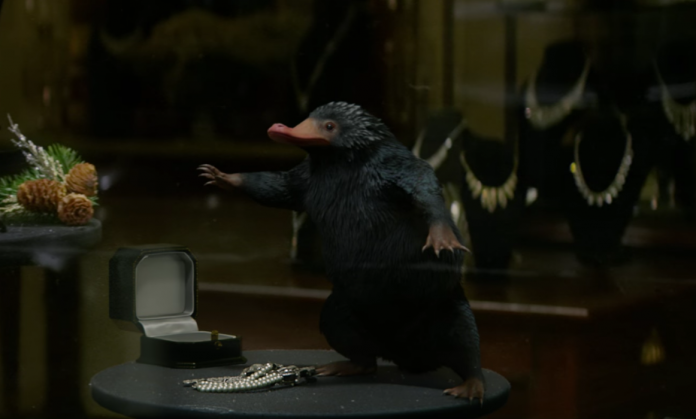
With enough personality to melt even the coldest of hearts the niffler is a scene stealer in a film fill with all manner of magical creature.

Nothing will ever give you goosebumps quite like hearing “Hedwig’s Theme” while the Warner Bros. logo comes into view. While much different from the original series, Fantastic Beasts and Where to Find Them definitely deserves the classic Harry Potter intro.

Fantastic Beasts, as you probably already know, follows Newt Scamander who has travelled to New York City with a nearly complete draft of the book that will make him famous. Once there, he runs into some trouble when he reveals his magic to a muggle (or no-maj, as the Americans say), is taken into custody by a member of the Magical Congress of the United States of America, and has to stay in an apartment with both the muggle and a witch who can read minds.

The movie starts with a cold open, which can lead to a bit of confusion in the beginning. It seems like this is done so the audience can experience the plot as if they are Jacob Kowalski, the no-maj whom Newt meets on his first day. Without the aid of a pre-existing book, viewers may find it helpful to familiarize themselves with the characters on IMDb first. Also, be on the lookout for a small Quidditch joke at the beginning of the movie (I wouldn’t have caught it without the members of the SFU Quidditch team sitting next to me laughing).

The screening I attended was standard IMAX and some of the scenes were a bit blurry. It became obvious that the film had been shot for 3D and certain shots did not work as a normal movie. I highly recommend seeing the film in 3D, or IMAX 3D if possible.

The highlight of the movie is by far the graphics. All of Newt’s fantastic beasts are gorgeously animated. Be prepared for the niffler to melt your goddamn heart. Also, Newt’s mating dance with the erumpent is one of the best comedic moments of the film, followed closely by the group encounter with a baby occamy. Kudos to all the writers and special effects artists who were able to give so much character to the beasts. Newt’s pets truly are the stars of the movie.

The storyline as a whole though was good. Slight references from the original series (such as a mention of Albus Dumbledore, one of Newt’s school teachers) help tie in this new series. According to J.K. Rowling’s Twitter, we can expect five Fantastic Beasts movies over the years. While this first movie definitely leaves a lot of questions unanswered (is soccer the no-maj Quidditch?), it’s hard to see how Rowling expects to drag out this storyline for four more movies.

For now, fans can wonder what the future holds for Newt, the American witch sisters Tina and Queenie Goldstein, and most importantly, Jacob Kowalski — the muggle caught up in the magical affair. What is for sure is that Eddie Redmayne was perfectly cast, and Dan Fogler was a great addition as Kowalski (if not a little strange for those of us who know him as Hutch from the 2009 Star Wars parody Fanboys).

Overall, the first Fantastic Beasts and Where to Find Them movie will definitely be a hit. With the same comedy, drama, and heart we’ve all come to expect from the Harry Potter world, Fantastic Beasts is a solid addition to the franchise we all love.

Holiday guide to Metro Vancouver

0

Enchant Christmas Light Maze and Market

Promising to be the world’s largest light maze, with hundreds of thousands of LED lights, illuminated sculptures, and a giant Christmas tree at the centre, Enchant has something for everyone — especially with the associated food trucks and Christmas market.   

When: November 25 to December 31, 4–10 p.m. (check website for ticket availability)

Cost: $19.95 for a day pass or $5 for market-only access

Where: W 1st Avenue and Crowe Street, Vancouver

More info: enchantchristmas.com

The 13th Annual Rogers Santa Claus Parade

Featuring over 50 marching bands, choirs, and floats, the Santa Claus parade is one of the largest fundraisers for the Greater Vancouver Food Bank. You’re welcome to head out early and claim a spot along the parade route, as well as decorate gingerbread men and Christmas tree ornaments, get your face painted, write a letter to Santa, and take a picture in the photo booth at the Coast Capital Savings Christmas Square.

When: December 4, 10 a.m. (Coast Capital Savings Christmas Square) and noon (parade)

Cost: Free, although donations to the food bank are encouraged

Where: The parade begins at Georgia and Broughton, then turns onto Howe, ending at Howe and Smithe. The Coast Capital Savings Christmas Square is on Robson between Howe and Hornby.

More info: rogerssantaclausparade.com

Yule Duel

In its second year, the Yule Duel pits top local choirs against one another to see who has what it takes to be a carolling champion. You are able to support your favourite choir by buying a badge with proceeds going to May’s Place hospice on the Downtown Eastside. A panel of local celebrity judges will pick the top choirs out of the ones with the most votes so that they can battle it out on stage for carolling superiority.

When: December 1, 6–9 p.m.  

Cost: Free, although it’s $5 to support your favourite choir

Where: Along Water St. in Gastown

More info: yuleduel.com

Lights of Hope

Entering its 19th year, St. Paul’s Lights of Hope will be lit up for the first time of the season with its traditional fireworks display and community celebration with food trucks, choirs, and hot chocolate. All of the lights in the display — over 10 km’s worth! — are donated and then hung by volunteers. Only a small portion of funds raised go towards the display and fireworks, with the majority supporting the foundation.    

When: November 24, 6 p.m. (community celebration and fireworks) and nightly through the holiday season (light display)

Cost: Free, although you can donate to St. Paul’s Hospital Foundation

Location: St. Paul’s Hospital, 1081 Burrard Street, Vancouver

More info: lightsofhope.helpstpauls.com

Canadian Pacific Holiday Train

In conjunction with local food banks in communities along railroads owned by Canadian Pacific, the Holiday Train collects food and monetary donations for them. Each stop lasts about 30 minutes and will feature performances of traditional and modern Christmas songs and a short presentation by local officials.

When: December 16 (Maple Ridge at 7:45 p.m. and Pitt Meadows at 9 p.m.) and December 17 (Port Moody at 4:45 p.m. and Port Coquitlam at 6:15 p.m.)

Cost: Free, but donations for the local food bank are strongly encouraged

Location: Across from Billy Miner Pub, Maple Ridge; Corner of Harris Road and Advent Road, at the railway crossing, Pitt Meadows; 300 loco Road, behind Arena and Rec Centre, Port Moody; Poco WCE Station, 2125 Kingsway Avenue, Port Coquitlam

More info: cpr.ca/holiday-train/canada  

Vancouver Christmas Tree Lighting

Vancouver’s roving Christmas tree is back. After being outside of the Vancouver Art Gallery and Jack Poole Plaza, the 2016 Christmas tree will be at Robson Square. The lighting celebration will feature photos with Santa, hot chocolate, cookies, holiday crafts, food trucks, and the nearly 6,500 LED lights on the tree.

When: December 2, 5–7 p.m., although the tree will be there through Christmas Day

Cost: Free

Location: Robson Square (Robson Street between Howe and Hornby)

More info: http://dailyhive.com/vancouver/vancouver-christmas-tree-lighting-2016

Burnaby Village Museum Heritage Christmas

Take a trip back in time with the Burnaby Village Museum’s Heritage Christmas. There are different events and performers scheduled throughout the season, some of which are: roasted chestnuts, BCR Brass Band, quilting displays, holiday singalongs, and much, much more.  

When: November 21 to December 9 (Monday to Friday: 1–5:30 p.m., Saturday to Sunday: 1–9 p.m.) and December 10 to January 2 (1–9 p.m. daily)

Cost: Free gate admission, carousel rides $2.60 each

Location: 6501 Deer Lake Avenue, Burnaby

More info: burnabyvillagemuseum.ca

Bright Nights Christmas Train in Stanley Park

Featuring over three million lights, Bright Nights Christmas Train is a beloved holiday tradition. The night train features a live performance to accompany the lights along the route. Santa will also be on location for photos, with all proceeds from the photos going towards the BC Professional Fire Fighters’ Burn Fund.

When: November 28 to January 1, matinée train 10 a.m.–2:30 p.m., night train 3–10 p.m. (night train runs until 11 p.m. December 16–26). Closed Christmas Day.

Cost: Matinée train $6 + GST, night train $12 + GST

Location: Pipeline Road, Stanley Park, Vancouver

More info: vancouver.ca/parks-recreation-culture/bright-nights-train  

Festival of Lights at VanDusen Botanical Gardens

VanDusen’s Festival of Lights features lights programmed to music, a carousel (one free ride is included in the ticket price), photos with Santa, Scandinavian gnomes and reindeer, storytelling courtesy of the Vancouver Public Library, and more. There are also opportunities to win prizes by sharing photos of your trip with #VanDusenFOL, or if your photo is in Jardins de Paris, #JardinDeParis.

When: December 1–15 and December 26 to January 2, 4:30–9 p.m. December 16–23 4:30–10:00 p.m. Closed Christmas Day.

Cost: $15.24 online, or $17.86 at the gate.

Location: 5251 Oak Street, Vancouver

More info: vancouver.ca/parks-recreation-culture/festival-of-lights

Canyon Lights

Featuring the world’s largest living Christmas tree (153 feet tall), interactive light displays, plus hundreds of thousands of lights spread throughout Capilano Suspension Bridge Park, it’s like you are in a winter wonderland. There are also indoor activities in the Winter Pavilion such as cookie decorating and Christmas card-making (by donation) if you get too overwhelmed by nature.

When: November 24 to January 8, 11 a.m.–9 p.m. Holiday events begin at 4:00 p.m. Closed Christmas Day.

Cost: $32.95 with valid student ID

Location: Capilano Suspension Bridge Park, 3735 Capilano Road, North Vancouver

More info: capbridge.com

World News Beat

0

US – Football player Mike Evans sat during anthem to protest Trump

Mike Evans, a wide receiver for the Tampa Bay Buccaneers, protested the recent presidential election of Donald Trump by remaining seated during the singing of America’s national anthem before the team played the Chicago Bears. Evans expressed his intent to continue sitting during anthems, explaining that he saw Trump’s campaign and the election result as a joke. His team delivered a statement to the public, saying that they respect the rights of an individual, but still encourage each other to give respect to the flag. Like Evans, other NFL players have also refused to stand during anthems in the past, such as to Colin Kaepernick, a quarterback for the San Francisco 49ers.  

With files from BBC Sport

INDIA – 100,000 students in Kashmir take exams regardless of long-term school closure

Kashmir students recently decided to carry on with their exams in spite of a four-month shutdown to their schools due to fires that have been described as “mysterious” by the BBC. With over 100,000 students taking these exams, security was in place, due to recent conflicts following the death of Burhan Wani, a well-known rebel. In addition to civil unrest in Kashmir, there has also been tension between India and Pakistan: India claims that Pakistan has incited the conflicts.  

With files from BBC News

MEXICO – Kidnapped priest found alive after suffering apparent physical torment

Father Jose Luis Sanchez Ruiz was discovered alive after being kidnapped in Veracruz and reportedly tortured by his captors. Ruiz, a Roman Catholic priest in Catemaco, was abducted due to his outspoken opposition of drug violence and corruption in his town, as per the statements made by Father Aaron Reyes. Roughly 30 priests have been murdered in Mexico within the last 10 years.

With files from BBC News

Vancouver residents share their unique stories at annual event

0

CORRECTION: In a previous version of this article, The Peak stated that Martin Meerman had won the Interesting Vancouver Prize. Robert Chaplin has won the Interesting Vancouver Prize. We regret the error. 

Interesting Vancouver! co-hosted by SFU Woodward’s Cultural Programs, invited 10 speakers to share their interesting and unusual stories with passion and humour.

Throughout the night, the lecture hall was filled with laughter. Robert Chaplin, an author, won the Interesting Vancouver Prize, for an individual or group in Metro Vancouver doing something particularly interesting.

Among the 10 speakers, aeronautical engineer, Martin Meerman was curious about how small he could make inanimate objects. When he had time away from his job designing satellites, he built miniature sculptures such as dollhouse furniture. He showcased a miniature portrait of president Lincoln, measuring in at under 0.001 mm.

Among these 10 speakers, a grief counsellor named Gaby Eirew described her work and experience of being a mom. She asked, “If you face the loss of one of your parents, especially when you are still children, what would you wish you knew about them?” She went to the street and asked over 100 people in Vancouver over the last five years.

She found people wanted to know what their parents would say about love, their favourite recipes, and what they felt guilty about. Based on the research she had done, she created an app called Record Me Now. This app is free, and designed for people to leave messages for their loved ones, to record their thoughts on life to be treasured after their death.

The night took a turn to the creative side, when Dusty Hagerud a puppeteer, explained his passion and artistry behind living in a world surrounded by puppets. “I am the only child in my family. You can see that.” He came to the stage with a witch puppet in one hand who is described as being based off of his grandmother.

Vanessa Richards, emcee and speaker at Interesting Vancouver, explained that Interesting Vancouver “is an opportunity to bring voices together, bring all kinds of voices together because this is the common breath we share.”

Gopa Biswas Caesar, an SFU student and attendee at the event explained that she often thinks of Vancouver as a “boring” place, but this event sparked her curiosity and she wanted to learn the ways in which Vancouver could be “interesting”. 

She mentioned that she really appreciated the variety of speakers at the event. “It is really uplifting to know there is a group of ordinary people in the Metro Vancouver from different backgrounds doing something extraordinary. ”

The secret life of a sessional instructor

1

Sessional instructors, also known as adjunct faculty, are every university’s secret. We know they exist, but we don’t know too much about them, what they do, or why job security in academia is such a large issue.

Don’t be surprised when I tell you that a significant portion of your courses at SFU might have been taught by sessional instructors. I’m taking four classes this semester, two of which are being given by sessional instructors. The Teaching Support Staff Union (TSSU) at SFU has reported that sessionals provide over 20 percent of undergraduate courses.

What is adjunct faculty?

Sessional instructors are, simply put, professors. But the thing is, they lack a certain status that comes along with the title of a regular professor — and they certainly lack some of the perks regular professors are given. The reason: SFU is taking advantage of sessional teaching contracts. As students who roam these concrete structures on top of Burnaby Mountain, there are many things we don’t think about because we’re too preoccupied with our lives; but unveiling the life of a sessional instructor makes for a good reminder that we should always be asking SFU to do better by its students and employees.

Why don’t we know about sessional instructors?

Universities are here to help us navigate our careers, educate us, and take all of our money, but there’s a lot going on beneath the surface that most of us do not know about.

We take multiple courses, earn our degrees within a minimum of four years and move on — but have you taken a moment to consider the people who help you get there? Have you wondered about the person who stands at the other end of the classroom? Their experiences, their lives, or even their official position in the university?

Sessional instructors stand at the middle of the hierarchy of the teaching faculty. They are often unsure if they will ever move up the ladder to become regular professors while they cling to their temporary teaching positions, hoping to be kept on in future semesters.

Many courses at SFU — varying from foundational courses such as FAN and FAL to graduate-level courses — are taught by employees who could easily be let go with just one month’s notice. This discrepancy isn’t widely talked about, because the university extracts the same amount of skills from sessional instructors as it does from a senior professor.

If little to no job security isn’t enough to turn you off, note that it’s common practice to also pay lesser salaries and provide minimal benefits.

Universities across the country, SFU included, profit from the short-term employment of sessional instructors, with no obligations to them as employees.

As Derek Sahota, chief steward of the TSSU, told The Peak, “all sessional instructors stay to teach, despite the difficulties, due to the hope and the dream of becoming a professor.” A hope, he said, that can cause a sessional instructor to be stuck in middle-ground hell for decades. Sessional instructors can be the heroes we need in the classroom, but most of them get the bitter end of the bargaining table.

SFU’s love/hate relationship with adjunct faculty

When I interviewed Sahota, it was early on in the semester and the Convocation Mall was full of new graduates going through their well-deserved ceremony. We met in the AQ and he shared with me what, in his opinion, it means to be a sessional instructor at SFU.

Sessionals have been a part of SFU’s teaching faculty for decades and have become an integral support system. Even though sessional instructors are meant to be one-off people covering for full-time professors in situations of emergency, some instructors at SFU might even teach up to 15–16 courses per year, Sahota added. The goal behind having sessional instructors then is no longer the reality for these educators. Universities are taking advantage of this position. Instead of using them as temporary substitutes, they are keeping instructors in the limbo of academia.

This out-of-sync working relationship is now leaving sessional instructors to reevaluate the power dynamics in their work environment. The nature of the work is precarious, to say the least, as their contract ends immediately after the four-month semester.

Accepting a job, fully aware that you may be relieved of it in a few months, and knowing that your job prospects will always be uncertain, is a burdensome load to carry. However, sessional instructors bear it nonetheless because of their love for teaching.

SFU hires sessional instructors who are competent and capable of replacing full professors. Adjunct faculty members have the same experience academically as a full professor, and are either completing or have newly pursued their PhDs. Sahota explained that they view the position of sessional instructor as a bridge to becoming professors, but soon realize that “there are no professor jobs” available to them.

When asked if there was any real opportunity for the university to do something about the lack of opportunity, Sahota was adamant there was.

“Of course, the lack of employment opportunities is a universal problem, but we feel that there are small ways in which SFU could provide safety nets to these instructors,” he said.

Sahota elaborated on the successes that TSSU has achieved in collaboration with the university to make sessional instructors feel more secure about their jobs. One of the mechanisms established recently through the collective bargaining process is the seniority system.

“Depending on the number of courses or semesters a sessional instructor has taught, they can gauge the probability of getting a course next semester.”

Universities across the country, SFU included, profit from the short-term employment of sessional instructors, with no obligations to them as employees.

To earn a sufficient and comfortable living, many instructors might teach multiple courses at various universities within a semester. Sahota described these instructors as “travelling professors,” who live and work out of their cars since they commute between different universities to teach.

Despite what may seem to be an unjust system, there is some light at the end of the tunnel for adjunct faculty. SFU has a policy in place that guarantees every sessional instructor to become a limited term lecturer — a more secure position — after teaching 16 courses within the duration of four years. This policy is another success story from the collective bargaining, Sahota said.

But, for many sessional instructors, it’s an arduous process to begin reaping any real success from their position.

Their side of the story

As Peter* sat down at the table across from me, he told me what it was like to be a sessional instructor here at SFU.

“I applied for the job out of a whim and was surprised when I got it,” he explained. He summarized how he had worked as teaching assistant and a research assistant at SFU, but was surprised that he was never actually interviewed for his new role.

“They didn’t interview me, they said I got the job and I was given the course details and asked to prepare for the course,” he continued. The casual manner with which he was hired is something Peter has reflected on over the years. As he suggested, the position might have been initially offered to someone else, but after they declined, the job fell right into his lap.

“I felt like I was hired based on a need rather than my credibility.” A common practice on the administration’s part is that sometimes sessionals only get notified about a course two weeks before they are to start teaching, and there are many ways this can go wrong.

Peter teaches on an average four courses at SFU and feels satisfied with his pay, which is more than the average of what other sessional instructors make at SFU, all thanks to his specific department.

Despite feeling financially secure at the moment, he mentioned that in the summer of 2015, when tensions between the TSSU and the university were at their highest, no sessional instructors were hired. He sighed, “I often feel insecure in my job and I’m terrified at the thought of losing it, because teaching is the love of my life.”

Echoing Sahota, it seems many sessional instructors are willing to take the risk if it means getting to do the job they love.

Among many shortcomings of his department, Peter seemed to be most disappointed by the lack of communication and encouragement.

“They would rather pay attention to a professor than to a nobody. [. . .] They really don’t pay attention to what I’m doing,” he said. He shifted in his chair and unpacked the idea for me.

Sessional instructors, he asserted, have to deal with anything that gets thrown at them. That ranges from being excluded in departmental meetings, to having no say over which courses they would like to teach, or having no say in the outline of the course. Sessionals enjoy minimal to absolutely no autonomy.

“In the seniority system, there are a lot of people above and below me and I do not know where I stand. And, if I were to make a mistake as an instructor, my department could implicitly get rid of me next semester. It’s because the hiring process is not transparent enough,” he said.

Sahota also hinted at this feeling of censorship, saying that “sessionals feel like they are forced to hide everything” in order to not risk losing their jobs.

Problems such as no benefits, crammed and shared office space, increased class sizes, and sometimes quality and quantity of teaching assistants only add to the stress experienced by adjunct faculty, according to Peter.

The precarious work for only passable pay has some wondering where the money goes. As Sahota suggested, most of the money earned through increased employment of sessionals goes to the middlemen: the people at the clerical and managerial levels of SFU, who aren’t instrumental to the university experience of a student.

As a sessional instructor who has to settle for less than what could have been, Peter is still cautiously optimistic. “I like to see big, I like to dream big, but I don’t get to teach big,” he said.

Often sessional instructors are seen as failed professors, but Sahota emphasized that this is not the case. “It’s a failure of the institution, not the failure of the sessional instructor.”

*Name has been changed to protect the anonymity of the source.