Home Blog Page 783

Allowed long passes blemish otherwise strong defensive game

0
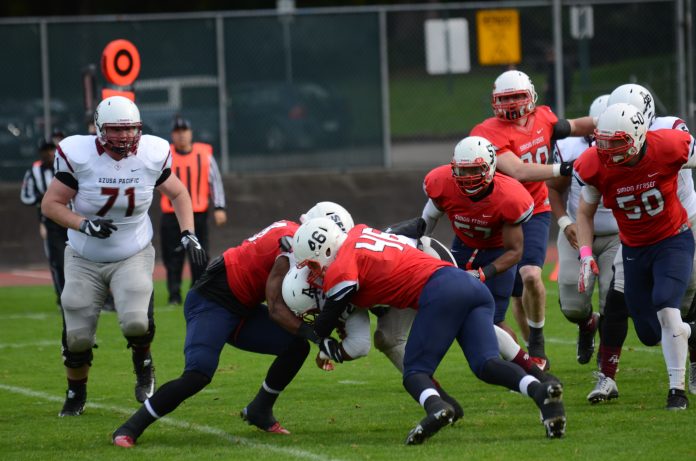
Gabe Lopes (#46) had a total of three tackles in the game. The loss leaves SFU 0–9 in the 2016 season.

In a mostly good first half, four 40-yard-plus passes against — including three that counted for a touchdown — led to SFU football’s downfall Saturday afternoon.

“There were four big plays in the first half where we had defenders in place to make a play and just were unable to make a play on the ball,” explained head coach Kelly Bates.

“I guess the good, if there’s a silver lining, is our guys were in the right spots, we just weren’t able to make a play when we needed to.”

To open the game, SFU’s offence put up a solid opening drive. Quarterback Miles Richardson threw a seven-yard pass to receiver Gavin Cobb in the first play of the game. Then two consecutive 20-yard-plus plays — running back Jalen Jana rushed it 23 yards, while Justin Buren received a 24-yard pass.

SFU had made it to Central Washington’s 17-yard line. They were unable to make up any more yardage, and had to kick a 40-yard field goal from the 23-yard line — they missed.

No points, but a solid start for an offence that has struggled all season.

But on Central Washington’s first play, Jesse Zalk received a 77-yard pass from quarterback Justin Lane. With that, they were up 7–0 — the seventh time in nine games that SFU surrendered a touchdown on the opposing team’s opening drive.

“They’re tough,” said Bates of those long passing plays allowed. “They really crush you from a psychological standpoint.”

The Clan didn’t allow another point in the first quarter — the next four drives they didn’t even allow a first down. On Central Washington’s next drive, SFU linebacker Justin Herdman forced a fumble which SFU’s Jordan Pugh recovered. In the fourth of those defensive stands, the Wildcats only needed five yards because of an SFU penalty, but were unable to crack the Clan defence.

Neither team allowed much on the ground game — there were only 99 rushing yards total, and SFU only allowed 67.

But on Central Washington’s first drive of the second half, they were once again able to exploit SFU’s defence on the passing game. A 43-yard and a 44-yard pass led to the Wildcats’ second touchdown.

By the end of the first half, SFU was down 27–0, despite a defensively solid first quarter.

In the third quarter, the Clan didn’t surrender a score, thanks to a Central Washington fumble recovered by Justin Herdman on the goal line.

The fourth quarter saw the Wildcats put up 14 more points. One touchdown came when a blocked punt put Central Washington on SFU’s 32-yard line, and they worked their way to the end zone. The other saw Central Washington again exploit the passing defence, needing only one play — a 57-yard touchdown pass.

“As always, the kids played very hard, their effort is never in question,” said Bates.

While it was another tough day on the scoreboard and the win column, a few good things were hidden by the 41-point loss.

The offence has had trouble, to say the least, but there’s been a consistency to the defence.

On seven drives, the Clan held the Wildcats without a first down.

Cobb had another good week on special teams with 141 yards on kickoff returns. Buren put up 99 receiving yards to lead the team on offence.

The Herdmans were solid as usual, with Jordan putting up seven tackles, while Justin put up eight and helped force two fumbles.

SATURDAY: The Clan has one more opportunity to get in the win column in 2016, and it’s at home this Saturday.

“[I] talk[ed] to the guys after the game and I want them to realize that there’s 14 seniors on this team that have one more opportunity to win a game this year, and every decision we make moving forward this week should keep that in mind, and these 14 seniors deserve a better outcome in their last game,” said Bates. “It really comes down to making sure we give our kids a good chance to win this last game.

“What’s impressive to me is that [the seniors] never wavered in their work effort, they’ve never wavered in their commitment to do whatever they can, even when they know we’re undersized, undermanned, underpowered, they continue to come out every day with an amazing attitude and work their butts off. That’s a testament to them and to their parents and people they’ve become.”

If there’s a team that SFU can win against, it’s Western Oregon.

The team sits fourth in the Great Northwest Athletic Conference with a 2–5 conference record and 3–6 overall. Aside from SFU, they have the worst scoring offence — putting up 20.7 points per game — and the worst scoring defence — allowing 35.1 points per game.

In their matchup earlier this season, SFU put up a good defensive performance, allowing only 13 points in the first half. SFU’s offence was stifled — the only score coming on a pick-six by the defence — and they lost 33–7.

But it goes without saying, it will be tough for SFU. The Clan has only scored in the double-digits twice, and while the defence has looked good, the team still allows on average 52 points per game. Their lowest score against is the aforementioned 33.

It’s going to be an important one for the SFU team, which Bates said feels a strong rivalry with Western Oregon.

“They’re a very physical team that come to play with their lunch buckets to play hard all day,” he said of Western Oregon.

Kickoff is at 1 p.m. at Swangard Stadium.

Why I’m voting for Larissa Chen for President

0

The byelection is a waste of money, time, and sleep for all involved. But it’s happening, which means we need an option that won’t generate even worse problems. Between born-again candidate Deepak Sharma; Darien Lechner coming in like a wrecking ball on Build SFU; and interim president Larissa Chen, the gal who’s worn authority for months now seems like the obvious choice.

Chen didn’t accept the presidency when she had the chance, and some would suggest that shows hesitancy and indecision unbefitting of a presidential figure. Whatever the case was then, it’s clear now that she’s pouring serious effort into this. She already knows the job, and yet another election approaches in four months; why waste time on acclimatizing another president, when we could give the current one time to actually accomplish things?

Chen’s shown a detailed plan including improving policies for handling sexual violence on campus, supporting clubs, and fixing the archaic laws governing the SFSS itself. What have we seen from the others?

Sharma’s sloppy. He made a spectacle of discussing his resignation on Facebook, only to submit his platform days late, because running again was a last-minute decision. If he wants influence over thousands of students, he should work double-time to prove that he won’t flake out again; instead, he’s looking increasingly unreliable.

Lechner’s passionate, but 99 percent of that goes into complaining about Build SFU levies; the other percent engenders dark and melodramatic buzzwords. His criticisms aren’t wrong, but as poorly as the project’s been handled, we need to pay for it. Anyone can complain about how the people in charge do things. That’s no reason to trust Lechner, whose political experience is minimal, above those people.

Chen’s a hard worker, considering how she’s juggled two different SFSS positions, and I can trust that more than anyone’s promises. She makes sense, and I think throwing that away to bet on people who’ve done little to convince us of their qualifications is a poor move.

Men’s basketball suffers “embarrassing” loss to Quest University

0
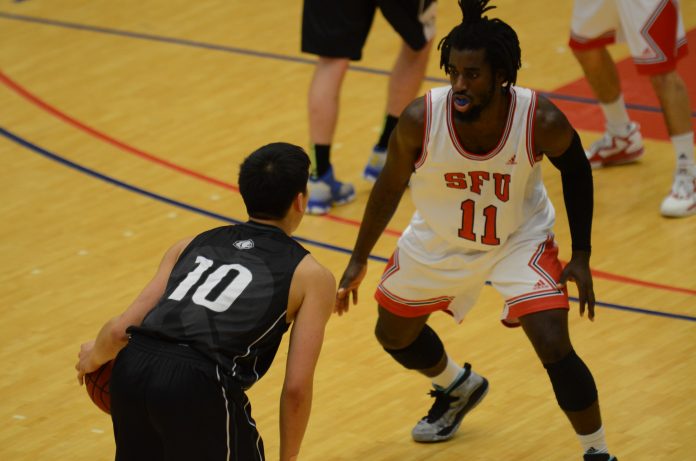
Kedar Wright (#11) led SFU with 22 points, going 9 for 17 in 25 minutes of action.

Head coach Steve Hanson was blunt after the game.

“We were terrible,” he said. “It was just an embarrassing loss.”

SFU lost by 24 points Saturday night. Other than the 27 seconds at the beginning of the game with no score, they had trailed the whole game. Worst of all, they did it against an opponent that should have been an easy win.

Quest University, where SFU lead assistant coach Sean Shook had spent the previous eight seasons as coach and athletic director, is a member of the PacWest conference of the Canadian Collegiate Athletic Association (CCAA). The two previous exhibition games against PacWest teams saw SFU dominate them 97–63 and 96–53.

That means no offence to Quest, which obviously played a very good game, and carried a lot of skilled players (Theo VandenEkart and Daniel Canzater would be good pickups, if SFU could just poach other players). But it would be like a National Collegiate Athletic Association (NCAA) Division I team losing to a Division II team, or an American Hockey League team beating a team in the National Hockey League. Not only beating but thoroughly dominating.

To add to matters, Quest only dressed seven players, and one player played three minutes — essentially, they played only six players in a sport which requires five players on the court. Five of those players were on the court for 30 minutes or more.

This was a team that SFU should have been able to beat, if only because they should have been able to exhaust them.

“We have some guys that they’re just [. . .] we thought we could walk on the court tonight and just play, and we can’t. We got our ass kicked in every component of the game,” Hanson explained. “I mean, the only positive [from] tonight is that it doesn’t count for much, but it shows a lot of our weaknesses.”

VandenEkart opened the scoring for Quest with a three-pointer. SFU didn’t score its first field goal until 3:38 into the game, when J.J. Pankratz scored a layup. By the 10-minute mark of the first half, SFU had only added six more points to the score, while Quest had cruised to a 28–10 lead.

While the last 10 minutes of the first half proved more equal — SFU put up 26 more points to Quest’s 27 to be down 55–36 at halftime — falling behind so early in the game proved deadly to the Clan, who were unable to go on any point runs of much substance.

Quest was dominant on the three-point line in the first half, going nine for 17 (52.9 percent). While they fell back down to earth in the second half, they still finished with a respectable 13 for 31 (41.9 percent). Meanwhile, SFU went an abysmal three for 27 (11.1 percent), with only one success in the first half.

The second half was closer, but even in second half scoring, SFU trailed five points.

Kedar Wright carried the offence for the Clan, with 22 points, and one of SFU’s three successful three-point attempts. Other than Wright, the only player to put up double digit points was Michael Provenzano, with 10.

“The only positive [from] tonight is that it doesn’t count for much, but it shows a lot of our weaknesses.”

Graham Miller, who stands at 6’7” and was a redshirt last season, showed flashes of what he could do with his size.

Andrew Williamson and Aleks Vranjes were “both hurt in practice,” and didn’t play Saturday, nor the game before against Columbia Bible College. By the end of last season, Williamson had become a valuable player who could chew up minutes and put up points. Vranjes is in his redshirt freshman season.

This was a tough loss for SFU. It marked the end of three games that should have been easy wins, and confidence boosters for a Clan team that only had two wins last season. From here, all of SFU’s games are against NCAA Division II opponents and will be much harder. An effort like this most other nights would probably result in a much worse deficit than 24.

“If we don’t come out ready to play next week, then we’ve got some issues, so we have to get better, and we have to get back to practice next week and learn,” said Hanson.

The focus in practice? “Competing and rebounding, that’s it.”

SFU was outrebounded by Quest 51–34. To quote an old sports cliché, it just seemed that Quest wanted it more, fighting for every ball.

If the Clan is to get a few wins this season, it will have be through outworking the competition — something that just didn’t happen Saturday night.

THIS WEEKEND: The Clan heads off to the Sodexo Classic in Seattle, WA for its first taste of NCAA Division II competition this season.

On Friday, the team takes on the University of Hawaii Hilo Vulcans. The Vulcans had an overall record of 9–15 last season, and lost in three appearances to Great Northwest Athletic Conference opponents. The Vulcans sat 13th of 14 teams in the PacWest conference — the NCAA Division II version, not the CCAA version — in scoring defence, and were fifth in scoring offence.

On Saturday, SFU faces the Humboldt State Lumberjacks, a member of the California Collegiate Athletic Association (also confusingly abbreviated to CCAA). Humboldt won its only exhibition game so far 121–56 against Future College. Last season, Humboldt placed fourth in the CCAA with a 21–9 overall record, and led the conference in scoring offence by a margin of 7.2 points per game.

Tipoff for both games is at 3 p.m.

Street performers deserve your respect and attention

0

A city isn’t merely defined by its location, or the high-rises cropping up against the sky as towering giants. Its unique identity goes beyond simple economics and infrastructure; it’s made by the mood and tone of the people who live, work, and create there.

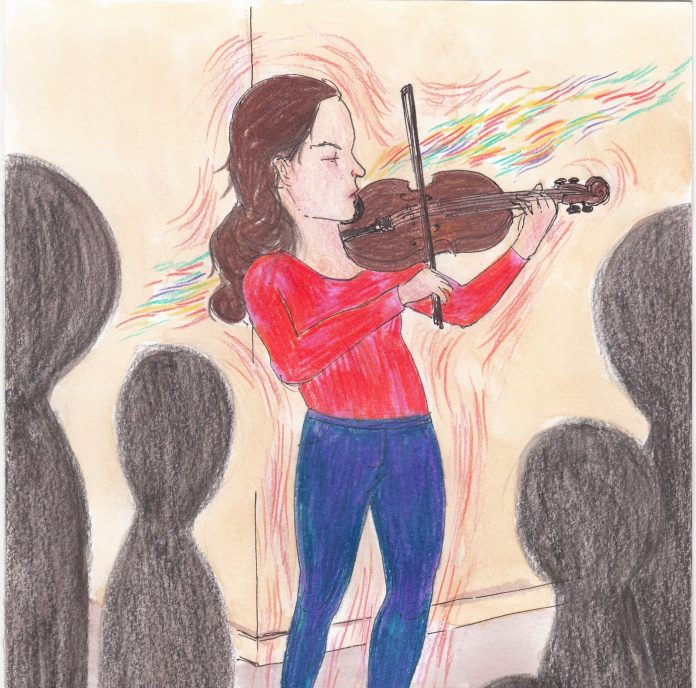
In cities like Vancouver, street artists are a prominent force in shaping their home’s overall atmosphere and reputation — in fact, they help drive our tourist industry beyond where it would otherwise be. Yet even here, they’re far too often ignored, and this is a reality that needs to change.

The City of Vancouver and its officials understand their importance, and encourage these performers to create their art within the parameters of various bylaws and regulations set out to ensure public acquiescence. What most people don’t consider is just how much effort goes into making this coexistence possible.

Nearly every spot involves paperwork and permits to perform there, although parks, Library Square, and certain community spaces allow musicians and other forms of street entertainers to forgo this hassle. Otherwise, performing takes money, effort, knowledge of the bylaws, and a refined and moving act.

This kind of investment illustrates the tenacity and dedication inherent to the characters of such artists. At the same time, it shows how much of a tragedy it is when they’re disregarded, or become the victims of disrespect and contempt. These precious people work hard to make strangers smile. It’s commendable that even when so many walk past uncaringly, these performers continue to celebrate and share life, passion, and art.

As forward-thinking students of a school already dedicated to creating an inclusive and supportive environment, we should be able to respect and appreciate all that a street artist puts into their work. Whether your interests fall in the arts or elsewhere, we all know firsthand what it’s like to put your all into your work and just hope that it pays off.

Yet, when heading out to Vancouver, many of us still tune them out, paying no mind to what they have to offer.

Street artists make their living creating something beautiful for others, hoping it will be appreciated enough to warrant the forgotten change in a person’s pocket. All they ask is that you enjoy their music, their dance, their art — if you enjoy what they do, let them know. If you find yourself pausing to listen for a moment, or smiling as you walk past, then drop in a coin or a couple dollars as a simple show of support.

Being an artist isn’t the easiest life, but it’s a life of creation and possibility. Street artists embody this reality. Realizing this, and knowing the smile that may flit across your own face as you hear them, find a way to show them what they do matters. Twenty-five cents in that battered suitcase to say you appreciate what they’re doing. Twenty-five cents to say thank you.

Squat while you poop

0

Sir John Harrington, godson to Queen Elizabeth, brought the modern commode from the drawing board to the plush rooms of Richmond Palace. It wasn’t exactly what you have in your powder room today, but he had the idea down.

But before Sir John and Thomas Crapper, another bright toilet tinkerer (yes, his last name was Crapper), worked out the contraption we all sit on multiple times a day, we emptied our bowels the old-fashioned way: squatting in appropriate and sometimes inappropriate locations.

Our lives forever became much more convenient. No more squatting in an inconspicuous spot behind a bush out in the cold or the hot sun, or using chamber pots! By the late 19th century, most homes in the developed world had sit-down toilets.

But Mr. Crapper and his colleagues definitely flunked Dark Ages anatomy, because they forgot to account for the meddling puborectalis muscle.

What’s the puborectalis muscle, and what’s it got to do with sitting on the commode? Let me explain.

How long do you spend on the toilet? Maybe you take some time to whip out a magazine or listen to a podcast. I know some of us even make phone calls on the can. But what if I told you there’s a way to speed up the whole process of taking a number two?

Asia’s been at it for years. Maybe that’s why their GDP growth rates are so high.

Modern conventional sit-downs on toilets kink the colon via the puborectalis muscle, which prevents the easy flow of faeces. Squatting, on the other hand, unkinks the colon. This unkinking opens the door to super-fast pooping sessions that may not last long enough for you to get through Ira Glass’ introduction to This American Life.

But before you hop on that toilet seat to experience autobahn-like colon expulsions, you should know that it can be dangerous. People have fallen and hurt themselves, especially on the mounting and dismounting. It’s best that you get a stool or a few phone books to mimic the angle that a squat on the ground would produce.

Happy speed pooping!

Pay attention to the SFSS or pay up

0

If you thought that election talk couldn’t get any worse, I’ve got some news for you: the SFSS is at it again, with another election in our midst.

On October 17, the upcoming Simon Fraser Student Society (SFSS) presidential byelection’s nomination period opened up, meaning that we’re in for another round of student elections to fill the presidential vacancy left by Deepak Sharma in June of this year. His departure is owed to what can only be described as a gross misunderstanding between himself and the SFSS.

A few months ago, we found ourselves in a similar situation: told to go out, vote, and make a difference in our school community. But making this “difference” ultimately just raised more questions and concerns about what goes on behind the closed doors of the SFSS.

Of the three candidates running, I feel that current VP student services Larissa Chen is by far the most qualified. In fact, she currently holds the position of interim president. Having already become familiar with the job, wouldn’t she be the best choice?

For reasons that haven’t been made known, though, Chen decided not to take the permanent position and to wait for a byelection. It’s clear that Chen’s serious about this presidency, too, because she resigned from her SFSS position in order to focus all of her attention on this byelection.

Here’s my question for the candidates: why? Why put us through this all over again, if doing so wasn’t even necessary?

There seems to be a disconnect between the SFSS, the Independent Electoral Commission (IEC), and the voting SFU public, which explains our apathy to the issues present in our student politics. During the first of three candidate debates, there were no SFU students present. Absolutely none.

This particular example of student complacency probably wouldn’t have occurred if candidate names were released as soon as the campaigning period opened up, and before advertising the debates. Who plans to attend a political debate without knowing who’s running?

I know that I’m in no position to point fingers about not caring, as I admittedly only voted in the last election because a WebSurvey was sent to my inbox. But the IEC’s approach seems very casual and haphazard, making it difficult for us to keep up or even begin to care.

However, we shouldn’t be so detached, because the reality is that the SFSS controls our student life and our money. This is our university experience that we’re talking about, and every time we don’t vote, we let the SFSS’ mistakes slip through unchecked.

We need to start asking questions, because approximately $10,000 was spent on this election in the spring. There’s potential for another large sum to be spent on an election that we could have avoided if the SFSS’ policies were made externally and internally clear, if those policies were followed, or if, failing that, Chen took the position when it was offered to her on a silver platter.

This byelection should serve as a wake-up call to all students to pay attention to what’s going on, get out, and vote. We need to be more critical of the issues so we can keep those who represent us accountable.

As much as you may roll your eyes at the sound of another election, on November 15, click that WebSurvey. There’s nothing much else we can do now with the impending election upon us, but we can make it known that we don’t want to see fumbles like this ever again. If we sit idly by, we’ll continue to let mediocrity take its course.

Everyone deserves HPV vaccinations free of charge

1

Are you a male who’s sexually active, straight, HIV negative, and not “street involved”? If you are, tough luck, because you aren’t eligible to receive the human papillomavirus (HPV) vaccine for free.

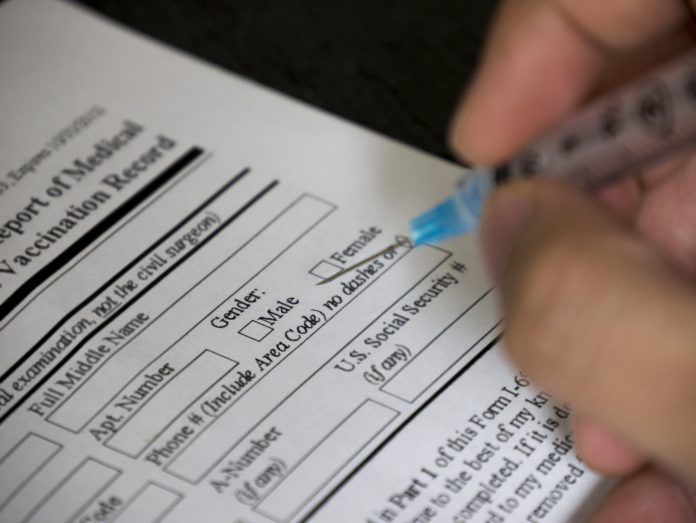
Under the current BC policy, you can get its cost covered if you are a female aged 12 to 22, or if you are a nine- to 26-year-old male at “increased risk” of HPV — for instance, if you “have sex with men [. . .] are street involved, [or] are HIV positive.” If you don’t fall into those categories though, you’re going to have to pay $300–450 to get the vaccine.

It makes sense when you consider that cervical cancer, which is most often caused by HPV, was “the second largest cause of cancer deaths in women” back in 2006, according to U.S.-based research conducted by the National Center for Biotechnology Information, when the free vaccination program started. Now, with HPV-caused cancers on the rise in males, it’s time to consider broadening our attention.

The Public Health Agency of Canada estimates that over 70 percent of “sexually active Canadian men and women” contract HPV eventually. While HPV is often harmless, every year sees cases of it leading to genital warts, lesions, and fatal cancers. Health organizations throughout Canada are recommending the HPV vaccine for people of all genders.

Why, then, are we not vaccinating everybody for free? The BC Centre for Disease Control’s official response seems to be that it is not cost-effective. However, the study they cite has its flaws.

The study was conducted in the United States, using data solely gathered from US research; while our countries share many similarities, that doesn’t necessarily make our populations interchangeable for research purposes. It was performed using simulated models rather than in any kind of real-life setting. Furthermore, it was based on vaccine prices from 2006, while the study itself was from 2009.

We live in a rapidly changing world, and the prices have undoubtedly changed within the last 10 years. So why isn’t there more Canadian research into the cost-effectiveness of the vaccine for men?

Perhaps because there isn’t even enough research on how many men actually have HPV. As acknowledged by the Public Health Agency of Canada, while female occurrence of HPV is well-studied, there’s “limited data on the natural history, epidemiology, and burden” of HPV occurrence in men.

The Public Health Agency of Canada cites a meta-analysis of over 40 different HPV studies that found estimates of HPV occurrence in men ranging from 1.3 percent to 72.9 percent. That’s a large gap, and before we can truly determine if it would be cost-effective to freely provide the vaccine to men, we need more concrete numbers as to how many men in BC are actually suffering from HPV.

It’s often said that by immunizing females, men will indirectly be protected from HPV. Yet, there was a study published just this year, looking at anogenital warts (AGW) as an indicator of HPV. The study showed that while the implementation of the HPV vaccination program for females in Ontario in 2007 has resulted in lower AGW rates in females, the incidence of AGW in males has actually increased since then.

Anyone can be a victim of HPV and its related cancers, and we should be prepared to service anyone whose quality of life could be affected by such a disease. If we’re going to recommend that everyone be vaccinated against HPV, we should likewise find solutions to provide proactive vaccination to everyone — not just certain parts of the population.

Vancouver transit is underappreciated

4

What is with this region and its hate for transit?

Yes, it takes 50 minutes to go from East Burnaby to the West End. You are traveling a long way. Ignoring the huge costs involved with owning and operating a vehicle, driving would only take 15 minutes less, assuming the roads are clear — and you’d have to find and pay for parking!

Maybe my transit tolerance comes from growing up in a small northern community. Travelling to the next significant town used to take anywhere between 45 minutes and an hour and a half. When I moved down here, that kind of travel was already part of my existence, so taking the bus never felt like an issue.

Maybe it comes from attending a university that has me travelling between three campuses. We have to go to classes in Burnaby, Surrey, and/or Vancouver. Transit is part of any SFU student’s reality, unless one can afford the huge costs of living on campus; even then, there’s no guarantee of having all your classes in Burnaby.

Maybe it’s simply that I am able to entertain myself by reading a book, sending emails, texting, or enjoying my podcasts. I’m OK with the time spent getting places.

Maybe it’s a culmination of any number of other reasons. Whatever it is, saying you don’t want to come out to visit me in Burnaby because it’s “too far out” is kind of being a jerk. Seriously, do you think you’ll turn into a pumpkin if you take too much time crossing the bridge?

When I hear, “I would come, it’s just that you live so far away, why don’t you come here,” it comes across as, “I’m more important than you and can’t be bothered to come see you, yet you can come see me, because your time is less important.”

Metro Vancouver has some of the best transit around. Could it use some improvements? Oh heck yeah: the SkyTrain could run later, if not all night; anyone who lives in Surrey has to deal with the ridiculousness of the system there; and if you live in East Burnaby and need to get to the airport, plan for an hour commute.

It sure beats where I grew up though. There, we only had two busses, north and south, that ran every half hour and stopped at 7 p.m. It beats what I’ve seen in Sydney, Australia, where the busses and the train compete and each charges you independently to use their services. It beats Toronto where train delays are part of your daily commute. It beats most of the transit in Central and South American cities I’ve seen, where you don’t always know where the bus is going, or how corrupt the driver might be.

Ask anyone not from Vancouver about the transit here. We are spoiled. We have a system that’s trying to do the best it can to serve a population that does nothing but dump on it. We have people who would rather drive because “I don’t take transit.” We have people who vote “no” on a tax that would have benefited the system even more, because they think they are sticking it to a corrupt system. We have people who don’t want to travel because it is too far.

I’m done listening to the complaining. We live in a massive city. Transit is part of it and travel is part of the price for it all. If you don’t like that, move to a small town and stay secluded, or stop your whining.

The biggest beefs in rap history

0

Kool Moe Dee vs. Busy Bee (1981)

The beef that started it all. Less a genuine rivalry and more a spontaneous rap battle, it started when rapper Busy Bee Starski shot a diss at fellow rapper Kool Moe Dee during a live set at the Harlem World club. Dee, one of the all-time rap legends, responded with an ice cold freestyle, including such dismissals as “You’re not number one, you’re not even the best / And you can’t win no real emcee contest.” There’s a reason you’ve never heard of Busy Bee before now.

UTFO vs. Roxanne Shanté (1984)

One of the weirdest rap beefs in history, it all started when rap group UTFO released a song called “Roxanne, Roxanne,” about a fictional girl who rejected their sexual advances. Up-and-coming MC Lolita Shanté Gooden decided to hit back with “Roxanne’s Revenge,” adopting the titular moniker. Then UTFO responded with a song featuring rapper Elease Jack, who also took on the name Roxanne. This eventually spawned a series of tracks from multiple rappers all about “Roxanne,” and the beef lasted from 1984 all the way to 1992.

Ice Cube vs. NWA (1990)

If anyone needed proof that Ice Cube was cold as ice, look no further. The rapper left the famous Straight Outta Compton group in 1990, citing poor management and bad finances. On their 1990 EP, NWA dissed the former member, saying that Ice Cube “couldn’t take” being in the group. Cube shot back in 1991 with “No Vaseline,” with lyrics so hardcore I can’t even mention them here. Cube’s solo career was ultimately successful, while NWA split soon after. Eventually they buried the hatchet, if the success of last year’s biopic is any indication.

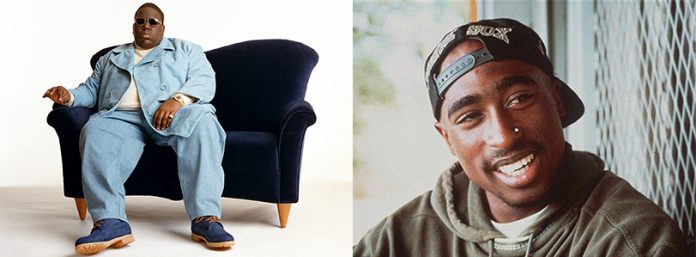
2Pac vs. The Notorious B.I.G. (1991)

The rap beef everyone thinks of first, Tupac and Biggie’s beef extended to a broader beef between East Coast and West Coast rappers in general. Both sides exchanged more than just disses, with tensions leading to robberies, shootings, and the eventual murder of both Tupac and Biggie. What most don’t know is that the two actually started as friends, before a series of missteps led them to become bitter rivals. While both ended up being remembered as rap legends in their own right, fights still rage over which one was the better MC.

50 Cent vs. Ja Rule (2000)

Before 50 Cent became one of the most famous rappers in the world with “In Da Club,” he was known as one of the hardest MCs in the game, having been an actual drug dealer in his teens. Before signing to Interscope, 50 became embroiled in a conflict with rapper Ja Rule. Apparently one of his associates stole Ja Rule’s jewelry, which led to a fight at a nightclub where 50 was stabbed by one of Ja Rule’s labelmates. The two came to blows several times afterwards — both lyrically and literally — and the beef never really subsided, with a series of tweets last year reigniting the fire between them.

Kendrick Lamar vs. everyone (2013)

I’m not going to argue here that Kendrick is the king — you should already know that. True to his status as royalty, Lamar used his guest verse on Big Sean single “Control” to call out all of his rivals at once, including Drake, Pusha T, Mac Miller, A$AP Rocky, and Big Sean himself, on his own song. Meanwhile, Lamar ranked himself along with the all-time greats, including Jay Z, Nas, and Andre 3000. While it was only a guest verse on another rapper’s single, Lamar’s call-out was arguably the biggest rap story of 2013, and became the most critically acclaimed verse since Nicki Minaj’s “Monster” verse in 2010.

Drake vs. Meek Mill (2015)

The best-known beef of the modern era, Drake’s rivalry with Meek Mill began last year when Meek accused Drake of using a ghostwriter for his raps. Several factors complicated the beef from the start, including Meek’s fiancée Nicki Minaj, who’s long been rumoured to be in a romantic relationship with Drake. For his part, Drake jumped on the beef right away, releasing diss track “Back to Back” which he later performed live behind a livestream of fanmade Meek Mill memes. In case there were any lingering doubts that Drake won, “Back to Back” was nominated for a Grammy, the first diss song to gain the honour. Can you imagine being the subject of a Grammy-nominated diss?


Don’t forget to check out our story on Drake vs. Kid Cudi to see where that beef stacks up against these legendary ones. 

Drake vs. Kid Cudi

3

Drake should win the beef

You were the man on the moon
Now you just go through your phases
Life of the angry and famous
Still never been on hiatus
You stay xann’d and perk’d up
So when reality set in, you don’t gotta face it
“Two Birds One Stone” – Drake

When I first heard the lyrics in “Two Birds One Stone” talking about Kid Cudi, I was surprised. It was a big shot, but I understand why Drake did it: he did it to finally put Kid Cudi in his place.

Drake says it perfectly when he says “You were the man on the moon, Now you just go through your phases.” Cudi has not been relevant since Man on the Moon. This is not debatable; “Day N’ Night” was a great song, but since then, he hasn’t put out anything that has really piqued any interest. Since his first album, each album he’s released has had a lower Metacritic score than Man on the Moon, with his most recent scoring an embarrassing 2.4 in the user score category.

Also, can we be sure that this is Kid Cudi who sent his tweet? (“@Drake Say it to face, pussy. You think it’s a game. I wanna see you say it to my face. I’ll be out soon. Promise.”) He’s in rehab right now, and likely doesn’t have access to a phone. So who’s tweeting this out for him? Perhaps it’s his manager, who tweeted out his thoughts earlier.

In any event, Drake has a history of coming out on the winning side of these things. He came out on the winning side against Tyga, basically ethering him with the line, “You need to act your age and not your girl’s age.” Drake of course destroyed Meek Mill with “Back to Back,” to the point where he still hasn’t really recovered.

Drake is essentially untouchable at this point. If he can win a beef when someone accuses him of ghostwriting, then he will easily destroy Cudi in an upcoming track. Plus, Cudi (or whoever has control of his Twitter account) has already deleted the tweet that clapped back to “Two Birds One Stone”, showing that he already regrets poking Drake.

Since Drake burst onto the scene in 2009, I don’t think there’s been another artist who has consistently put out such great tracks. Kid Cudi hasn’t released a good album since I’ve been in high school. Drake is at the top of his game right now, and it’s pretty clear that he will come out victorious in this one. – NB

Kid Cudi should win the beef

Let me start by saying that I think Drake is a better rapper than Kid Cudi.

True, both their most recent albums were disappointments — Speedin’ Bullet 2 Heaven was cheesy and unfocused, while Views was lazy and overstuffed — but pound for pound, Drake puts out better songs and better albums than his rival. This discussion is not about musical quality, or even vocal dexterity though. In fact, few rap beefs are.

Think about Jay Z and Nas. In 2001, the rivalry between two rappers culminated in a pair of diss tracks: “Ether” off Nas’ forgettable Stillmatic, and “Takeover” on The Blueprint, Jay’s undisputed best work.

You’d have a hard time arguing Nas was anywhere near as culturally relevant as Hov at the time: he hadn’t made a consistently good album since his legendary debut, while Jay Z had never been more popular, facing a massively public legal battle and still reaping royalties from “Big Pimpin’.” So Jay Z obviously won the battle, right? Wrong.

Not only did Nas’ body of work survive Jay’s — Illmatic is still a better album than anything Jay ever made — but he also fought harder and won bigger. “Ether” is the work of someone with something to prove. In fact, the track hit so hard that it almost shook Jay to tears during a radio session, and pushed him to rap about leaving condoms on the car seat of Nas’ kid. That’s the desperation of a man who knows he’s been beaten.

I’m not trying to say that the underdog always wins. In fact, Drake’s most famous beef disproves the theory: he consistently destroys Meek Mill, who is both a worse rapper and a worse disser.

But with Meek, Drake acted in defence. Kid Cudi, however, barely earned his diss, tweeting that Drake was using a ghostwriter — which the rapper himself has all but confirmed (sorry, Drizzy fans).

So how did Drake respond? By openly mocking Kid Cudi’s struggle with depression. Not cool, dude.

Rap beefs are nothing if not outrageous, and the most over-the-top tracks are often the best ones. But there are lines that shouldn’t be crossed. Jay shouldn’t have rapped about ejaculating in Nas’ jeep, Cam’ron shouldn’t have rapped about Stan Spit’s dead mom, and Drake shouldn’t have dissed Kid Cudi’s mental illness.

Drake lost this beef before it even began. Not only was his call-out an extremely low blow, but it further reinforced the problematic history of hip-hop refusing to acknowledge struggles with mental health. Kid Cudi may be a worse musician, but his open admission of his depression is braver than anything Drake has ever done in his life. – MJH


Want to know how this feud stacks up against some of the most legendary beefs in rap history? Check out The biggest beefs in rap history to find out!