Home Blog Page 775

Morgan Smith places fourth at NCAA nationals, earns all-American honours

0

Morgan Smith has added his name to the list of Clan wrestlers who have achieved all-American status. By taking fourth this weekend at 197lbs, he has become just the third Clan wrestler to earn all-American honours since SFU joined the NCAA.


Smith started the tournament well, taking down Terrance Fanning in a convincing 12–7 victory to start the tournament. After that, he lost a close match in the quarter-finals to Luke Cramer of Ashland. Holding a lead with just 13 seconds on the clock, Smith made a costly mistake that took him out of the championship hunt.


It is easy for any athlete to let an early loss affect the rest of their tournament, but Smith did not let that happen. He immediately bounced back with an 8–4 decision to clinch all-American status. He followed up that performance with a decision and major decision over Joe Gomez and Evan Ramos respectively. Gomez placed second at last year’s tournament.


In the battle for third place, Smith fell to Cramer once again, this time 5–2 in a tense match. That match ended Smith’s season, his best to date. He finished with a 34–7 record while placing fourth at the national tournament.


Most impressively, he did so on an injured knee.


“It was tough, especially when doctors tell you that you shouldn’t compete,” Smith said. “But I wasn’t going to let my season go to waste over something that is just painful, not debilitating.”


Toughness has never been an issue for Smith, who is known as one of the hardest working athletes in the wrestling room. After failing to qualify for the national tournament in back-to-back years, Smith was finally able to do so, and walk away with all-American status while doing it. Despite the change in results, he said he did not change his gameplan.


“I don’t think I did anything differently,” said Smith. “I just continued to try new methods and have stuck to my principles of hard work and innovation.”


For athletes like Smith, who are known to be hard-working and talented, finding success like this is only a matter of time. “It feels great,” he said about his success at the national tournament. “I think everyone should set a goal for themselves based on what they determine as success, and for me, it was to be an all-American. Now that I have been there and experienced how close I was to being a finalist, I can use that as motivation and knowledge to win it all next year.”


Most people would take a break after such a long, gruelling season. For Smith, the ending of his collegiate season simply marks the beginning of another season. “I’m taking this week off, and then training for the US Open and other freestyle tournaments this summer,” Smith said.


This was the final tournament of the season for Clan wrestlers. However, they will be active at the senior level in national and international tournaments coming up. The US Open will take place from April 27–29, and will feature some of the best international wrestlers from around the world. After receiving all-American status, Smith knows he can compete at that level.

The Peak’s March Madness preview

0

Round of 64 predicted upsets

East:

(12) UNC Wilmington over (5) Virginia:

After giving fourth-seeded Duke a scare last year, UNC Wilmington will be looking to make it to the round of 32. As a team that lives and dies by the three-ball with four players averaging at least 3.7 three point attempts per game, a hot night from outside the ark could be enough to pull off the upset.  

West:

(14) Florida Gulf Course over (3) Florida State:

“Dunk city” returns, who famously made it to the sweet 16 as a 15th-seed in 2013. Florida State is certainly the favourite, but this Eagles team could be better than the one that ruined everybody’s brackets a few years ago.

(10) VCU over (7) Saint Mary’s:

March Madness games always seem to turn out ugly, which fits much more to the play style of VCU than Saint Mary’s. This shouldn’t be considered much of an upset, it’s more just a bad matchup for Saint Mary’s who will have a hard time keeping their rhythm.

Midwest:

(11) Rhode Island over (6) Creighton:

Creighton losing point guard Maurice Watson Jr. with an ACL tear makes this a lot more even matchup than the seedings may convey. Rhode Island has won eight in a row and defends the three-point line exceptionally well, negating Creighton’s biggest strength.

South:

(12) Middle Tennessee over (5) Minnesota:

After upsetting Michigan State last year, Middle Tennessee is back and is another good pick for the 12 vs. 5 upset that always seems to happen. Reggie Upshaw and Giddy Potts both return to the bright lights of the tournament and will be looking to ruin more brackets.

(10) Wichita State over (7) Dayton:

I almost didn’t include this as an upset, because I actually think Wichita State should be the favourite in this game. Book this one.

Round of 32 most notable predictions

East:

(6) SMU over (3) Baylor:

Baylor’s zone is what makes them such a tough team to play against, however, SMU has faced very well against zone defenses this year. Just looking at the matchup, SMU should be a team that Baylor struggles against.

West:

(5) Notre Dame over (4) West Virginia:

West Virginia lives off of turnovers, but will be facing the team that converts the least percentage of turnovers per possession. Notre Dame is one of the worst matchups that West Virginia could face in this tournament, and should be able to deal with their press with ease.

Midwest:

(7) Michigan over (2) Louisville:

Michigan fits the narrative for the type of team that gives Louisville trouble. The Cardinals struggle against teams with an efficient offense, and Michigan ranks fifth in the country in adjusted offensive efficiency. It’s hard to bet against Louisville, but this matchup screams potential upset.

South

(10) Wichita State over (2) Kentucky:

I’ve gone back and forth over this one a lot. KenPom.com’s analytics have Wichita State as the eighth-best team in the country, and Kentucky as the fourth. While Kentucky will be favourited, I believe that Wichita State will be able to pull off the upset and prove it deserved a higher seed.

Sweet 16 Notable Predictions:

(6) SMU over (2) Duke:

Another two-seed that I have going down early. This isn’t anything against Duke, just me going with the hottest team entering the tournament. SMU has won 16 straight, 26 of its last 27, and is coming off winning the American Athletic Conference Championship.

Elite Eight:

(6) SMU over (1) Villanova:

The hardest part of creating a bracket is picking the team that “doesn’t belong” which makes it to the Final Four. Last year it was Syracuse as a 10th seed, the year before it was Michigan State as a seventh seed, the year before Connecticut and Kentucky faced off in the final as seventh and eighth seeds, and so on. This year I’m going with SMU, partly because they are coming into the tournament so hot and partly because of the difficulty of making the Final Four the year after winning the tournament for Villanova. Other teams that I want to put into the Final Four as sleeper picks are Michigan and Wichita State.

(2) Arizona over (1) Gonzaga:

This should be one of the best games of the tournament. On one hand, Gonzaga has played incredible basketball throughout the year, ranking as the number one team in the country using KenPom.com’s advanced analytics. On the other hand, they have never made it to the Final Four and always seem to burn people on their brackets. Flip a coin on this one — this was the hardest game for me to predict.

Final Four:

(2) Arizona over (6) SMU:

I still can’t decide who will win between Arizona and Gonzaga. Also, why is SMU even here? Let’s move on, this is impossible.

(1) Kansas over (1) University of North Carolina:

The battle of the one-seeds, I’m taking the Kansas Jayhawks. After exiting the Big 12 tournament early, the group simply has too much talent and time to not be able to put together a big tournament run. The only thing that may stop this is if Josh Jackson’s off-court issues continue into the Final Four, but even without him, they’re still so hard to bet against.

Final:

(1) Kansas over (2) Arizona:

Looking back at my bracket, there are so many things that I’m unsure about and have gone back and forth on while writing this. If Wichita State can beat Kentucky, why can’t they beat UCLA? Is Florida Gulf Coast really going to be able to beat Florida State? Will SMU be able to make it out of region with Duke and Villanova? Who will win between Arizona and Gonzaga? The impossible nature of predicting this tournament is what makes it so intriguing every year. That being said, however, I have not wavered from predicting Kansas to win it all. Frank Mason III is having an incredible season and can carry this team far by himself. Add in Josh Jackson and this just feels like a tournament-winning team.

To view my complete bracket, click here.

Women’s basketball season comes to an end with 77–64 loss to Cal Baptist Lancers

0

All good things must come to an end, and this saying is especially true in the sports world.


In the Sweet Sixteen for the first time since 2013, SFU was just one win away from the Elite Eight. Two days after pulling off the upset of the tournament, the Clan was looking to play spoiler once more — this time to the California Baptist Lancers.


After getting up to a 10-point lead near the end of the first quarter and looking in control, SFU faltered. They were outscored 23–6 the rest of the half, and although the Clan made things interesting in the second half by tying things up, the Lancers proved too much in the end.


The final score ended up being 77–64, ending SFU’s season four months and nine days after it officially began.


The game started out well for SFU. After trailing by four early on, the Clan went on a 23–9 run to take a 10-point lead late in the first, before the Lancers battled back to cut it to six. Ozi Nwabuko led the way in the first quarter, going a perfect 5–5 from the field and finishing with 10 points.


In the second quarter, the Clan only scored six points compared to Cal Baptist’s 17. The Lancers really turned it on near the end, scoring back-to-back threes that really put SFU on its heels.


SFU was down by seven, but there weren’t any alarm bells ringing yet. SFU was still shooting better from the field as well as from three-point land — the difference was Cal Baptist went 12–13 in free throw attempts. In contrast, SFU didn’t get to the line once.


The Clan came out in the second half determined, and did a great job drawing offensive fouls to start. A layup from Rachel Fradgley and a deep three from Elisa Homer brought SFU to within three. After that, Homer once again knocked down a triple to tie it at 44, before the teams traded baskets to tie it at 46.


For nearly two minutes after that, neither team scored — the game was up for grabs. Cal Baptist eventually took advantage, ending the quarter with five points and outscoring SFU 26–18 in the final frame.


Both teams shot exactly 37.1% from the field. However, what ended up being the deciding factor was the Lancers’ ability to get to the line. They scored 22 of their 77 from free throws, shooting at 91.7%. Compare that to SFU, who went only 5–8 from the line — a significantly lower 62.5% clip.


In the team’s final game of the season, it seemed fitting that SFU was led by players who will likely be leaned upon for next season — however far in the future that seems from now.


Sophomore Tayla Jackson had an incredibly efficient 15 points, two blocks, and two rebounds in 14 minutes played coming off the bench. Rachel Fradgley nearly had a double double, finishing with 12 points and eight boards in 17 minutes.


A senior next year, Elisa Homer played 34 minutes and had 14 points, including four threes. GNAC Freshman of the Year Ozi Nwabuko had 11 points, 10 of which came in the first quarter.


But for two players, this marked the end of their collegiate careers. In Ellen Kett’s final game, she played 39 of the game’s 40 minutes and had 3 points, 7 rebounds, 4 assists, and 2 steals — another typical all-around performance from her.


She will go down as arguably SFU’s best-ever player in the NCAA era — and one can certainly make the case perhaps one of the best in the whole history of the program.


Her records for most assists in a season and single game will probably not be broken for quite some time, if ever. Her passing ability made the players on the floor with her that much better, and there is no doubt she will be greatly missed next year.


And for Meg Wilson — not able to play in the game due to a finger injury — her versatility will need to be replaced. Sophie Swant seemed to be capable throughout the three games she started in her place, but that was a very small sample size. The Clan’s leading scorer and rebounder during the regular season, Wilson will leave some big shoes to fill for next year.


But for now, it is time to reflect on truly a season to remember for the women’s basketball program. Their 26 wins set a record in the team’s NCAA era, and was 10 wins better than the year previous. Although it is a bitter pill to swallow now, this year will be looked at fondly in due time from all involved.

SFU women’s basketball shock the NCAA by defeating Alaska Anchorage 80–70

0

At the end of the first half, the game was going as most people probably would have expected.


The Alaska Anchorage Seawolves were leading, but the SFU Clan was hanging around — keeping it close and by no means out of it.


What happened next, however, would have shocked nearly the biggest optimist.


SFU came roaring out of the break, outscoring Alaska Anchorage 25–7 in the third quarter. That proved to be the main difference, as SFU ended up winning 80–70 in front of a shocked home crowd for the Seawolves.


The magnitude of this win cannot be overstated. Alaska Anchorage was the number one seed in the West Region, and the number two ranked team in all of Division II women’s basketball. They had lost only one game before this all season and went the entire Great Northwest Athletic Conference schedule unbeaten, and was considered by many to be a pretty good bet to win the national championship.


Oh, and they made it to the final last year. Not only that, they were playing at home in this one, where they had only loss once all year — but that was against the University of Portland, a Division I program.


In fact, you have to go back to last season to find the last time Alaska Anchorage lost at home to a Division II program. Funnily enough, that was against Simon Fraser in the last conference game of the season. They didn’t have Meg Wilson available to play in that one either.


If we were to use a professional sports analogy to try and summarize this, this was like the Golden State Warriors blowing a 3–1 series lead — all condensed into one single 40-minute game.


At the start of it, the Clan gave up 12 straight points after getting an early lead. It looked like this would be a long night. However, SFU answered with eight points to put them within one.


Although the Clan kept it close in the second, the Seawolves always seemed to have an answer. Every time SFU seemed to get some momentum going, Alaska Anchorage was able to come back and stop it right in its tracks.


At least in the first half.


SFU was able to score seven points before Alaska Anchorage got on the board in the third quarter. The Clan was making nearly every shot — in contrast, Alaska Anchorage couldn’t get one to fall. By the end of it, they had a 12-point lead.


That lead shrunk to six halfway through the fourth before Sophie Swant and Ozi Nwabuko made back-to-back layups to put the lead back to 10. They didn’t look back after that.


Not only did SFU outscore Alaska Anchorage 53–35 in the second half, they were dominant doing so. They looked like a completely different team than the one that lost to Central Washington just over a week earlier.


In that loss, SFU shot just 27.1% from the field, way below their season average. In the two wins since, they’ve shot 39.7% and 45.6% — dramatically better performances.


A lot of that has to do with their three-point shooting. In the loss against Central, they shot a measly 15% from long range. Since then, they’ve shot above 40% both times. For a team that has built its reputation over the past couple of seasons as being great at three-point shooting, it’s a welcome addition back to their arsenal of weapons.


Leading the way with another dominant performance was Sophie Swant. She once again led the Clan in scoring with 18 points, breaking her previous season-high of 17 points set the game earlier. For all the concern following the injury to Meg Wilson, SFU seems to have found perhaps a replacement in the sophomore from North Vancouver.


Ellen Kett had a brilliant all-around game, finishing with 14 points, six assists, and two steals all while playing the entire 40 minutes. Rachel Fradgley nearly had a triple double, recording 10 points, 10 rebounds, and six assists. Freshman Tayler Drynan was a perfect four-for-four from the field, including going three-for-three from behind the arc.


Next Game: SFU will now play in the West Regional Final against the California Baptist Lancers. The Clan will be looking to advance to the Elite Eight for the first time in the program’s NCAA history.


California Baptist is the second ranked team in the west region, and have arguably had just as dominant a season as Alaska Anchorage. Like the Seawolves, they also went undefeated in conference play, and have lost only twice all year. In fact, since losing to UC San Diego on November 12, the Lancers have won 30 straight games.


These two teams actually played each other earlier in the season. In the first game for either side back on November 4, the Lancers came away with an 84–77 victory. Rachel Fradgley led the way for the Clan, scoring 20 points and snagging six boards in just 22 minutes of game time.


It’s another tough task for SFU. But after this game, I’m not ready to count them out until the final buzzer.


Tip-off is at 8:00 p.m on Monday.

SFU hockey ousted from BCIHL playoffs

0

For the second year in a row, the season for SFU hockey came to a premature end.


After a 6–3 loss to the University of Victoria on Friday night, the Clan needed a win to keep the season alive. In that game, SFU had a 3–1 lead before giving up five straight goals to lose 6–3. If they stood a chance of bringing the series to a third and deciding game, they would need to limit the Vikes’ opportunities to score.


Unfortunately that didn’t happen. The final score was 5–3 for UVic, sending the visitors to the BC Intercollegiate Hockey League (BCIHL) final against Trinity Western.


SFU came out roaring to start the game, scoring two quick goals within two minutes of each other to take a 2–0 lead. It was another two-goal lead like the night before, but the Clan looked to be in control.


However, that’s when it started to unravel. Defenceman Jayden Piatelli was assessed a 10 minute misconduct for a check from behind. UVic scored on the ensuing power play, then added a late goal with the man advantage to tie it at two.


The second featured two more special teams goals for the Vikes, including a back-breaking short-handed goal that gave them the lead. In the third, Jack Palmer scored to make it 5–2 for the visitors before graduating senior Jesse Mysiorek scored one late to give SFU three goals on the night.


Special teams were undoubtedly the difference in this one. UVic went three-for-four with the man advantage, and scored short-handed as well. SFU, in contrast, wasn’t able to score on three power plays. This was also in contrast to the night before, where except for an empty net goal, all of UVic’s goals came at five-on-five.


Over the series SFU gave up 11 goals — an uncharacteristically poor defensive performance.


The Clan also outshot the Vikes 47–22 in the game — a nearly two to one advantage — but wasn’t able to beat goaltender Zach Wear for more than three goals.


It’s another bitter pill to swallow for SFU after ending their season in the same way last year. They improved in the standings by five points this season, and finished with two more wins. They scored 12 more goals and, more impressively, conceded 31 less goals. Yet it was the same result come playoff time.


Perhaps the silver lining is that the vast majority of this lineup will be returning next season. Offensive players such as Adam Callegari and Brendan Lamont, captain Brandon Tidy, defensive stalwarts Mathew Berry-Lamontagna and Darnell St. Pierre will all be highly motivated come next season.


And with both Jordan Liem and Lyndon Stanwood back as well, the team’s defensive shell should be intact.


Unfortunately, we’re going to have to wait nearly a year to see if next year’s edition is any different. Because like it or not, their success will likely solely be judged on how far they can make it in the playoffs.

SFSS approves the creation of a stadium (this time for real)

0
This was the scene of the Board Meeting when the stadium was cancelled. The room was calmer today as the SFSS approved the project they originally scrapped.

It’s like the saying goes: if at first you don’t succeed in building the stadium that students voted for and have already started paying for, try, try again.

With a unanimous vote, the Simon Fraser Student Society (SFSS) has decided to move forward in approving a new version of the Build SFU stadium, a project which was originally cancelled seven months ago when its budget estimate was triple what they were expecting.

“On August 11, we cancelled the project for the reasons we mentioned before. The cost estimates were too much, and SFU wasn’t willing to contribute anything more than the million dollars,” said Arr Farah, vice-president (VP) university relations for the SFSS. “Athletes came and spoke about how the university had made a commitment and said that they would be able to cover the costs of the stadium and finance the project, which, to some degree, was news to us.”

With that contribution from SFU, the project — which is now more economically-friendly than the $30-plus million stadium originally tabled — had a better chance of succeeding. It took a lot of negotiating between SFU and the SFSS, but eventually the new plan was agreed upon.

“We kind of had [those conversations] throughout September and October. November and December were kind of a wash, because the university has a lot of VPs and people who need to be in the room for all these conversations, and they travel the world all the time for some reason,” said Farah. “But when we got to January, that was when the heavens were moved and things started to happen. And that was when SFU said they would be able to give us the $10 million without any sort of financing agreement, which would save us.”

Farah said he was sure students would want to know how the costs were reduced, and wanted them to understand some of the processes they went through.

“I think the biggest thing to note in that original cost estimate we got: the roof was $7 million. That’s, like, half of the cost of the new project, which is insane. There are things like the press box which are over $2 million, and these are huge extravagant items which made that cost go up so high,” he said. “It may not look as great as some people wanted, but it helps.”

Olivia Aguiar, the president of the Student Athlete Advisory Committee (SAAC), was also present in the room for the vote. She’s been present ever since a horde of student athletes stormed an SFSS meeting to voice their displeasure over the stadium being cancelled. In a word, she felt relieved at the steps taken today.

“I’m excited that since summer we’ve gotten to this point, because there were some pretty rough times in between. It’s nice to see that everything we had discussed had been taken into consideration, and that those discussions have occurred and now we’re back in a position where we’re up and running,” she said.

However, with how tumultuous everything has been, she isn’t willing to fully celebrate until she physically sees something happening.

“I think once I see the trucks on the field digging the hill and I see that ribbon being cut, I think at that moment I will realize this is actually happening,” she said, laughing.

Now it is SFU’s to approve, and that will take place at their next Board of Governors meeting which is currently scheduled for March 30. Should they approve it, a written agreement will come into place on April 3.

Pro Day a step towards dreams of professional football for SFU alumni

1
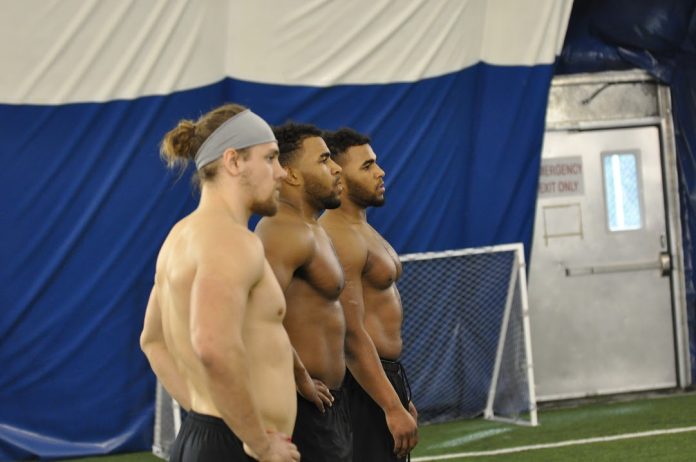
Running back Ante Litre next to linebackers Jordan and Justin Herdman. After declining an invite to the CFL Combine initially, Jordan will be heading there after all. Austin Cozicar / The Peak

For Jordan Herdman, it seemed like it was all on the line Friday afternoon.

Having initially declined an invitation to the upcoming CFL Combine on March 23-25 — a decision that didn’t seem to sit well with Geroy Simon, who was watching in official capacity as a BC Lions scout — this would likely be the last physical testing before the NFL Draft in April.

“Me and my agent came up with the decision that we felt like pro day was all we needed, so if you wanted to come see me, you would have to come out to my pro day,” said the two-time GNAC defensive player of the year.

It was a bold move, and one that could certainly backfire with a poor performance and with the message it sends CFL teams.

So it would come down to one pro day at the North Shore “Bubble” Complex in front of representatives of six teams, two of them NFL — the Atlanta Falcons and the Arizona Cardinals — and four CFL teams — the BC Lions, Calgary Stampeders, Montreal Alouettes and the Saskatchewan Roughriders. He, along with his brother Justin and fellow recent SFU alumnus Ante Litre, would be tested on a variety of combine drills.

So how did it go?

The results were mixed — at best — for Jordan. While he shot for a result between 4.6 and 4.7 seconds in the 40-yard dash, he put up a time of 5.03 seconds.

All three players struggled on the three-cone drill.

By Monday, the final test was no longer final. It seemed like the bold move had backfired. Jordan had reconsidered his decision, and was added to the list of players attending the CFL Combine.

The appearance at the time, however, was that the scouts were aware that Jordan and his brother show much better on game tape than they do in combine drills — they’re better in-game.

“These guys are not great testers, but their film and their testing numbers don’t really match up. The testing can’t be the only thing you look at with these guys. They’re not great testers, but when you see them on the field, they look fast, they play fast, and they play physical,” said the former BC Lions great, who is now working with the team in charge of Canadian scouting.

“Jordan and Justin, I’m sure they’ll tell you, that some of their testing numbers aren’t what they wanted them to be, but that’s sort of the way they are,” said SFU head coach Kelly Bates, who coached the Herdmans for two years. “What they are is when you put them on the field in a middle of the game is their speed changes, their anticipation, their instincts take over and that’s what makes them ball players. It’s nice to have these testing numbers, and it’s nice to do these testing events, but at the end of the day, the film doesn’t lie.”

And while it’s hard to get a read on what teams think, with the Atlanta scout — Shepley Heard, who is the Falcons’ western regional scout — running much of the drills and the day, it would seem that they must have had some legitimate interest before the event.

Now, Jordan will have one more chance to show that he can test well.

For Justin, however, the Pro Day was always intended to be just the first test.

“I just feel that I need to get my name out there and I just need to show whoever’s watching that I can play at a high level, that I’m just ready to compete,” said Justin. “Definitely need to work on my three-cone, need to work on that, noticed I stumbled. Definitely clean that up before the CFL Combine.”

Both of the Herdmans seemed to do better and feel more comfortable in the linebacker drills — the drills testing their ability in positional situations, rather than straight speed.

“I wanted to leave them with my positional drills, my movement skills, just the linebacker drills, because that translates most to what we do on the field,” he explained. “To leave them with that last impression that I can move well and I can explode [is important].”

All three players impressed on the bench press, with Jordan and Litre putting up 23 reps, and Justin putting up 20.

But the guy with the most to gain was probably Litre.

Litre was the only player of the three not invited directly to the national combine, but instead to the western regional combine on March 23 where he’ll have to perform well to earn an invite to the national.

With Jordan’s spotlight bringing NFL attention to the Lower Mainland, it was a great opportunity for the 5’11 running back — one he flew with.

Putting up a 4.63 second 40-yard dash, he seemed to leave an impression on the talent evaluators.

“Ante ran a little better than I thought he would,” said Simon. “He caught the ball well, you could see his natural skills as a running back. I’m not sure he’ll play running back in our league, but he’ll have an opportunity, I think, in this league.”

For Litre, it was the culmination of his work over the past few months. He had planned out his schooling so he would graduate in the Fall to dedicate his time to training, so he could make a full effort at chasing his dream.

“I knew I wanted to pursue a professional career, so that’s why I made those plans, why I made those arrangements, and saved up some money so I could train. That’s all I have been doing. I haven’t been in school, not focusing my energy on a job, because I basically got eight weeks to make my dream come true,” said Litre. “So I put all my effort, everything I can, so if it doesn’t work out, on my deathbed I’ll have the satisfaction that I gave everything.”

And he came in confident, knowing what to expect after attending an NFL Regional Combine in February, where he had felt he left a good impression.

“I didn’t make a single drop,” he explained. “I went to the guy running the regional combine and asked if I could take reps at receiver because the running back drills were done and he let me. So I got to work out in two positions, and overall, I think I stood out.”

For the Herdmans and Litre, it’s a long process to realize their dreams to become professional football players. And it means a lot of drills, and a lot of testing — a lot of not just focusing on football, but the combine. But it’s that work that will make or break their careers.

“Once this is all over, we’ll go back to football,” said Justin. “I can’t wait.”

Testing:

Jordan Herdman
Weight: 234 lbs.
Height: 5’10.6”
Hand Size: 8.2”
Arm Length: 30.25”
Wing Span: 74.25”
Vertical Jump: 28.5”
Broad Jump: 9’4”
40-Yard Dash: 1.60s/ 2.84s/ 5.03s (10yards/20/40)
Pro Agility: 4.67s
3-Cone: 7.69s
60-yard shuttle: 12.55s
Bench Press: 23 reps

Justin Herdman
Weight: 229 lbs.
Height: 5’10.6”
Hand Size: 8.0”
Arm Length: 30.25”
Wing Span: 74.25”
Vertical Jump: 28.5”
Broad Jump: 8’10”
40-Yard Dash: 1.65s/ 2.90s/ 5.09s (10yards/20/40)
Pro Agility: 4.77s
3-Cone: 7.63s
60-yard shuttle: 12.37s
Bench Press: 20 reps


Ante Litre
Weight: 220 lbs.
Height: 5’11.7”
Hand Size: 9.5”
Arm Length: 30.75”
Wing Span: 72.25”
Vertical Jump: 36.5”
Broad Jump: 10’2”
40-Yard Dash: 1.60s/ 2.65s/ 4.63s (10yards/20/40)
Pro Agility: 4.47s
3-Cone: 7.31s
60-yard shuttle: 12.09s
Bench Press: 23 reps

Français: SFU reçoit Le Printemps de la francophonie pour célébrer la francophonie à Vancouver et a l’étrangère

0

Le Bureau des Affaires Francophones et Francophiles (BAFF) à SFU est heureux de présenter leur 7e événement annuel, Le Printemps de la francophonie. L’événement a commencé vers la fin février et va continuer jusqu’à la fin du mois de Mars.

Le Printemps de la francophonie est composé d’une série d’événements incluant des conférences, des tables rondes, des projections de films, des activités culturelles, des rencontres informelles et des soirées. Le but de l’événement est de célébrer la culture et la langue française chez Vancouver, au Canada, et à l’étranger.

Le BAFF et SFU espèrent que les francophones et les francophiles de la communauté universitaire pourront célébrer la langue, la culture, et l’héritage national à travers de ses événements. Les activités auront lieu au campus SFU Burnaby et dans la région de Vancouver.

Jusqu’à date, il y avait des professeurs d’autre universités Canadiennes qui ont discuté des relations internationales, des relations autochtones, du hockey, et de la langue française à l’extérieure du Québec.

Pour trouver la liste des évènements qui auront lieu dans les prochaines semaines, visiter le site web BAFF.

English: SFU proudly hosts month-long event to celebrate francophonie

0

SFU’s Office of Francophone and Francophile Affairs (OFFA) is presenting the seventh annual Le Printemps de la francophonie. The event started late February and will continue until the end of March.

Le Printemps de la francophonie is a multi-part series that includes a speaker series, roundtable conversations, film viewings, cultural activities, casual gatherings, and parties. The purpose of the event is to celebrate French culture and language at home and abroad.

OFFA and SFU hope that francophones and francophiles alike will be able to celebrate language, culture and heritage throughout the speaker series and activities. Events are taking place at SFU Burnaby, as well as other venues around Metro Vancouver.

So far speakers have been notable professors from a variety of Canadian universities, who have lectured on issues such as international relations, Indigenous relations, hockey, and the role of French outside of Quebec.

For a list of upcoming events visit the OFFA website.

Gender disparities in engineering and computing science at SFU and its effects on female students

2

The contrast in male and female representation in some SFU programs is starker than many students might have thought.

For Melissa Mah, a fifth-year student in electronics engineering and co-president of SFU’s Women in Engineering, the disproportionate gender distribution in her program is most visually apparent in the classroom. “To this day, I’m still shocked walking into lecture halls or tutorial rooms and being able to count the number of females on my fingers. There are times when myself and another girl are the only females in the class,” she told The Peak.

Female enrolment in the faculty of applied sciences has been on the increase over the last few years, most recently peaking at a fifth of all students in engineering, according to data from the SFU’s Institutional Research and Planning. However, that still leaves the number of females in the faculty at only 20% in engineering, 18% in computing science, and 11% in mechatronics.

Students in engineering are not the only ones who have noticed this trend. Dawn Chandler, one of two co-presidents of Women in Computing Science, is a third-year computing science honours student. She expressed that being female in a male-dominated program can make the atmosphere uncomfortable when her classmates do not share her perspective.

“The lack of women in SFU’s [computing science] program creates an environment in lectures, labs, office hours, and clubs that is silently unwelcoming to female students,” Chandler said. “As someone who does not come from a mathematics or programming background, this alienation can feel especially strong.

“Some women don’t see that it’s a problem that there are so few females in computing science and they don’t feel uncomfortable or isolated, but obviously some of us do,” she noted.

Feeling like an outsider

Female students enrolled in the engineering and computing science programs at SFU describe problems they encounter being some of the few in their field, ranging from feelings of inadequacy to subtle discrimination at the university.

“Whether we choose to acknowledge it or not, there is still a stigma surrounding females in engineering,” Mah said. These societal messages can often mean that females feel that they are not living up to the standards of the industry and, based on their experiences, Mah and Chandler noted that this seems to be a prevalent issue.

For another third-year student in computing science, Camille Janicki, this is only compounded by her experiences in the classroom and day-to-day student life. Janicki, who is also involved with Women in Computing Science, felt student groups in the program were often dismissive of the call for increased diversity. “What is tough is that a lot of males in computing science don’t find it a problem,” she said.

“As a minority, you [are] forgotten about and shoved in the corner.”

The comments made by professors and students often make the women in the room feel excluded, according to Janicki. A lot of the time, she said, females in the class are ignored or feel they do not have any friends in the room, which affects project contribution and class participation.

Her male peers will frequently make jokes at the expense of women’s abilities in computing science, Janicki reported. “[It] was a joke, but it still has an effect because you have been told that you don’t belong in computer science,” she said. “I would say it affects me every day.”

According to Janicki, a number of her female friends have dropped out of the program as a result of feeling so unwelcome.

Slow to change

In recent decades, there have been a variety of initiatives aiming to support and encourage females in science, technology, engineering, and mathematics (STEM) fields. At SFU, one of these initiatives is an organization that operates through Westcoast Women in Engineering, Science and Technology.

SFU engineering professor Lesley Shannon is its chair, and told The Peak that steps have been taken to increase the inclusion of females in these fields. Part of her work includes reaching out to high school students and creating inclusive opportunities for professional development.

“What I am noticing is there is a better consciousness that we are doing a disservice to young women to not point these careers out to them coming out of high school,” she said, noting that skills such as engineering are in high demand. However, recruiting students to the program is not where the challenge ends.  

“We’ve done a lot in the Women in Engineering group and the Women in Computing Science group to build up support systems [because] when you lose women, you tend to lose them because they feel isolated,” Shannon continued. “If you think you are the only person in the room with your perspective and your issues, you tend to feel very alone and you don’t connect.”

The number of female students in the applied sciences has been trending slightly upwards at both the undergraduate and graduate levels. In the 2012–13 academic year, only 16% of computing science students were female, as were engineering students. In mechatronics, that number was only 9%.

However, the faculty of science has been faring well otherwise, with the number of females enrolled often narrowly outstripping that of males. Chandler speculated that this has to do with the culture and expectations that surround students.

“If you follow what your friends go into — depending on your demographic, whether you are male or female, what ethnicity your parents are — you will end up in approximately the same place,” she said.

For males that are good at math and sciences, it is likely that they will be encouraged to enter engineering, but females who are good at those things might be more likely to take biology along with their other female friends, Chandler continued.

“I think the big problem is girls just don’t see themselves doing [applied sciences] and, obviously, one reason for that is they lack role models,” she cited. The female representation among faculty members and lecturers is even lower compared to student enrolment in the applied sciences, based on information from the SFU website.

Transforming the demographic

Perhaps surprisingly, it was not always this way. The role of computing numbers was traditionally viewed as women’s work in North America and therefore women played an important role as computer technology emerged, Shannon recounted. Founder of the Women’s Studies program at SFU in the 1960s, Margaret “Maggie” Benston was also a professor of chemistry and computing science. However, the number of females entering computing science dropped around the time that computers began to be manufactured for home use.

Nowadays, a recent Statistics Canada report found that Canadian males exiting high school with lower math marks were more likely to enter the STEM fields than women with comparably higher marks. This, according to Shannon, comes down to the perceptions people have of traditionally male-dominated fields.

“What becomes the challenge is trying to change that messaging and that messaging is everything from parents to teachers to marketing and that leads us to where we are now,” she said.

“I just want everybody to feel confident and comfortable that they are making informed choices about what they go to study and that they will be welcomed into those programs and have successful careers because nothing about who they are is going to be prohibitive. And that sounds obvious. Unfortunately, we are not there yet.”

Compared to the industry, Shannon speculated that the university is slower to bring more females into fields such as engineering and computing science. In the field, female employees in the business side of technology and engineering companies often inflate their overall voice, but it takes time in academia for people to go through the extensive training required, she continued.

Regardless, she does feel that progress is being made. For students in these programs, it seems to feel like this progression is much slower.

Janicki said that the administration has not been doing enough to address the inclusion of female students at the classroom level and needs to work on discriminatory attitudes among the faculty.

For Chandler, the perception still exists that young females do not have the skills necessary in math or as logical thinkers to enter computing science. Similarly, they are often not pushed to try programming or engineering and simply do not realize that the opportunity is available to them.

To address these issues, the women’s groups in engineering and computing science run introductory programs on the applied sciences to help prospective students “realize that they are capable of studying it,” Chandler explained.

As for the work that Mah and her co-president Pooja Mahesh Kumar are doing with younger generations, they both believe that it is making an impact. “I see there being a rise in [the] female population within engineering programs in the future,” Mah said. “It’s very inspiring to know that the work you’ve done can impact and change the futures of others.”

In addition to cultivating support networks for women in their respective programs, the groups also aim to assist students — regardless of gender — through their initiatives. All this, they hope, so that the gender distribution in the applied sciences will gradually even out.

“Things are being done and the percentages are not as bad as they were 10 years ago, but progress is still very very slow,” Chandler noted.