Home Blog Page 776

Driverless cars may be in our future

0

By: Alex Smiciklas

With the recent announcement of Uber coming to Vancouver in as early as a couple of months, new opportunities also bring a changing landscape for the future of Vancouver’s transportation.

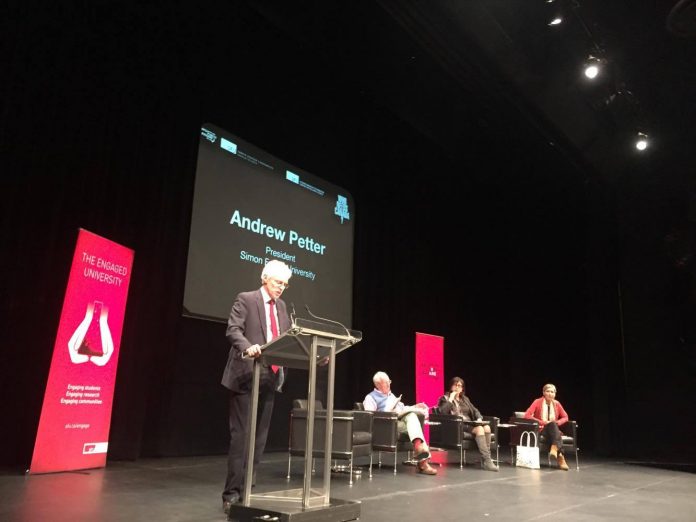
These changes were discussed at the ninth annual UBC SCARP symposium last month, where a particularly audacious standout was a session on transit and autonomous vehicles (AV), where employees of TransLink, Uber, and the City of Vancouver came together to discuss the excitement, fear, and unknowns about AV technology in our not-so-distant future.

According to The Future of Driving, a 2016 report from TransLink, fully-automated vehicles use sensors, communications, and computing to perform all the functions of driving. These vehicles operate without a driver in all conditions. The Society of Automotive Engineers produced a sliding scale, with level 0 being no automation and level 6 being fully automated to show how AV technology has and will continue to evolve.

At the highest levels, it’s said that complete automation would reduce the number of crashes and driving-related deaths, as well as remove the variables of disability or driving age. And while it wasn’t long ago that only the science fiction of the Jetsons could imagine a world of driverless vehicles, many experts are now saying we can expect them on our streets in under five years.

Paul Krueger, planner at the City of Vancouver, is concerned with the impact that this will have for cities. In the fall, the US government released a comprehensive policy document on self-driving cars that included safety, data sharing, and privacy, as well as developed jurisdictional boundaries for streamlined use across states. Canada is hot on the trail, and the province of BC is waiting for federal administration before giving the green light to putting AV projects on the ground.

“What’s missing is that there is nothing to discourage sprawling car-oriented communities or to encourage good urban planning. Cities and other levels of government will have to step up and fill the void,” Krueger said.

Some of these things, Kreuger imagines, would include higher emphasis on pickup and drop-off zones, encouraging a shared approach to AVs, and reallocating road space to make cities more vibrant and livable. “You might see fewer or narrower travel lanes, fewer or no on street parking,” he said. “This leaves more space for civic priorities like walking, biking, and public space, and smart infrastructure so everything can operate seamlessly together.”

Of the many trends in the automotive world, car sharing is at the forefront. Vancouver is a global leader in this field, with a quarter of all adults in the city holding at least one membership to programs such as Car2Go or Evo.

James LaPointe, senior planner of mobility and innovation at TransLink, points out that while AV technology will initially be a luxury few people can afford, he believes that the market will eventually drive down the price, and will be amplified further through these car sharing programs and ride-sourcing services such as Uber and Lyft.  “Mobility is becoming a commodity, the number of different forms of services coming to market, increasingly enabled by technology, are transforming mobility as we currently understand it,” LaPointe said.

Looking to shake up the roads is Uber, the ride-source tour de force which has finally announced plans to start rolling out its service on Vancouver streets by the end of the year. While the provincial government is promising policy to create a level playing field with existing taxi services, there is concern that Uber will be at an unfair advantage, and could even see the end of Vancouver’s robust transit system.

“Ride-sharing is complementary to public transit,” said Michael van Hemmen, Uber’s public policy manager of Western Canada. With the increase in reliability and outreach to city suburbs, van Hemmen believes that Uber serves as the first and last mile in someone’s travels. “We’re filling a gap in the transportation system, because most of these trips are taking place when transit service isn’t readily available,” he said.

There is also public concern over Uber’s ability to provide accessible service to all riders. “In Vancouver, taxis play a really big role in providing accessible transit service for people who have a mobility impairment. Taxis fill the gap for a lot of people,” said Krueger. A high percentage of available taxis in Vancouver are equipped to handle mobility impairment, and the drivers have received that training. When it comes to accessibility, van Hemmen doesn’t see Uber as a problem. “We don’t look at taxis as competition; we want to replace you driving yourself.”

In the end, AV use comes down to ownership. If Uber used AV technology on UberPools, which allows you to share rides with other passengers who are going in the same direction and split the cost, there would be fewer cars on the road and lower greenhouse gas emissions. Van Hemmen points out that cars sit unused 96% of the time, which takes up a lot of valuable space. AV could be beneficial to transit, too, as buses could be enhanced to improve safety and focus more on customer service.

One of the biggest concerns about this new technology is zero-occupancy vehicles.There’s a dystopian fear that zombie car fleets will wander the city, waiting for their owners to call them back to the grocery store where it dropped them off. Kreuger hopes that cities will implement mobility pricing, to discourage urban sprawl and longer trips with low occupancy rates. Likewise, But Van Hemmen believes there will be a collaborative solution to the inefficiencies of AV technology. “There will be a basin with human drivers for a very long time still,” he said, which will allow both ride-share services and transit to see the impact before integrating the AV technology in the most efficient manner.

While there is both unbridled enthusiasm and concerned skepticism with the not-so-distant future of AV technology, there are still many questions to be answered. One thing for sure, is that the City of Vancouver will work with transit and ride-share services to integrate as seamlessly as possible. “Our role as a transportation authority is to ensure that a lot of these services don’t hinder traffic congestion or price gouging,” said LaPointe on behalf of TransLink. AV technology and ride-share companies have the opportunity to provide ground-breaking new services to fill a gap where the government cannot. All it needs is for all parties to get along.

Green Party at SFU welcomes party leader Elizabeth May

0

By: Olivia Roberts

This past Friday, the SFU Greens hosted Green Party leader Elizabeth May, who is also the Member of Parliament for Saanich-Gulf Islands.

May discussed many topics, including: the organizational structure of the Green Party, her opinions on partisanship in politics and the resultant negative consequences for Canadians, electoral reform, and the recently approved Kinder Morgan pipeline — a pipeline that would notably flow dangerously close to the SFU Burnaby campus.

The Green leader also talked about the organizational structure of the Global Greens, the Green Party of Canada, provincial Greens, as well as Green parties all over the world. She emphasized that, while there was no legal binding between “Green organizations,” they were linked by their common six core values from the Earth Charter, “an ethical framework for building a just, sustainable, and peaceful global society in the 21st century,” initiated by the United Nations Commission on Environment and Development.

The six core values are: non-violence, sustainability, social justice, ecological wisdom, participatory democracy, and respect for diversity.

May then went on to address her concerns of the increasingly partisan political system in Canada; she suggested that while these concerns were amplified during the Harper government, they still remain today.

She echoed sentiments that she had described in her memoir, “Who We Are,” saying that former prime minister Stephen Harper viewed all “suggested improvements to legislation [as] partisan attempts to wound him,” a sharp contrast to what May described in her early years in government under the Mulroney government as “government, when government was working well.”

Addressing the “broken promise of electoral reform,” May called to attention Canada being one of the last modern countries to practice first-past-the-post electoral systems.

She asserted that many of Canada’s shortcomings in government were a result of the electoral system — the root cause of government hyperpartisanship, and tactical voting (which ensures that Canadians are unable to vote for the individuals they would prefer, but rather the candidate most likely to defeat the candidate an individual most dislikes).

May went on to endorse proportional representation, promoting mixed member proportional representation and single transferable voting.

As for the Kinder Morgan pipeline, May addressed the scientific and economic reasoning behind her opposition to the pipeline by declaring that not only would the pipeline be devastating for Canadian ecosystems, but would cause a net loss in Canadian jobs.  

She explained that while bitumen (a derivative of petroleum distillation), the resource that the Kinder Morgan pipeline would be transporting, is stable in its natural state, it is also solid, and thus cannot be transported via pipeline. Therefore, to transport via the Kinder Morgan pipeline, it must be mixed with a carcinogenic and flammable diluent, in order to flow in pipelines.

At the end of the pipeline, the diluent is removed, and the solid bitumen is shipped overseas for refining into crude oil, thus effectively moving jobs overseas that could easily be done in Alberta, if only there was a refinery.  

May argued that former premier of Alberta Peter Lougheed’s plan for a refinery (dating back to the 1980s) would not only cap global emissions, and curtail land disputes but also add many more jobs to the province than a pipeline ever would.  

As for what student activists can do to engage in the political landscape, May says to donate to environmental groups, and show up at protests, arguing that social media activism isn’t enough if we aren’t applying it to real world actions.   

Says Ian Soutar, Green Party BC candidate for Coquitlam-Burke Mountain, of the meeting: “If you’re sick and tired of being told that millennials are uninvolved and apathetic, this is exactly the kind of stuff that will prove them wrong.”

Talking fair trade at SFU

0

SFU has been a fair trade campus since 2012. This year, SFU Ancillary Services and the Canadian Fair Trade Network (CFTN) is hoping to educate students to be involved in the fair trade movement.

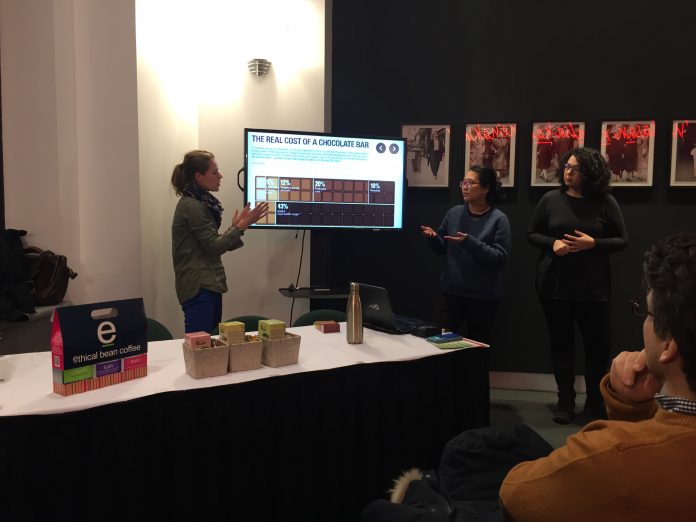
In order to further engage students on the topic of fair trade, students who were sponsored by SFU and the CFTN to visit some of the fair trade farms in Costa Rica last year led a conversation to discuss the future of fair trade at SFU Harbour Centre on Monday, March 6.

As The Peak previously reported, coffee, tea, and chocolate are some of the fair trade items that can be found on campus. The Starbucks franchise is one of the partnerships with fair trade on campus which provides fair trade espresso and one fair trade filter coffee, however, Tim Hortons at SFU has yet to provide a fair trade option.

Director of ancillary services at SFU, Mark McLaughlin, expressed at the fair trade event that SFU is currently working to change that, in the hopes of Tim Hortons providing at least one fair trade item such as sugar or coffee.

Students Sarah Heim, Prodpran Wangcherdchuwong, and Joana Bettocchi, who visited Costa Rica last year, presented some of their findings and conversations they had with some of the fair trade farmers while travelling the country for six days.

Wangcherdchuwong explained that fair trade “is not charity, they’re not saying, ‘Oh, you’re so poor, let’s give you money,’ but they are actually exchanging with them on a fair and equitable basis.”

Bettocchi added that fairly traded projects all have different standards, “but the movement is adapted to respond and assess those needs to make sure that in fact everyone is being treated equally.”

Heim explained from her analysis of the fair trade system that the process is very “democratic,” where each farm is not owned by a corporate company, but rather “farmers who own their land together and decide on where they’re money should go. . . they know best how to keep their land renewable and sustainable.”

Throughout the Teck Gallery at Harbor Centre, images from the students’ trip to Costa Rica expressed some of the positive aspects of buying fair trade products. Many images showcased families who are affected by fair trade and portrayed examples of farmers giving back to their communities.

The night ended with a discussion of the ways in which SFU could improve its fair trade initiatives on campus.

“So now we’re back,” said Wangcherdchuwong. “The reality is, what is a fair trade campus? That is something that we need to ask ourselves: what we are and what we can be” at SFU.

“All of the the dining services locations offered by SFU serve fair trade coffee, tea, and one chocolate bar option, if they have chocolate in that venue,” said Torrye McKenzie, fair trade programs coordinator for the CFTN. She added that the network is currently drafting new requirements for fair trade campuses, including silver and gold statuses which would include providing fair trade fruit and sugar at the silver level. “Fair trade cotton T-shirts at the bookstore and really engaging franchises such as Tim Hortons [and] Starbucks” would be at the gold level.

McLaughlin added that “we also need to ensure that we educate and mentor” students about fair trade to further ensure that students are making conscious decisions on the food and beverages they purchase on campus.

Nationally, McKenzie added that a new fair trade ambassador program is currently being developed with the CFTN and Association of Fair Trade which would “train anybody on the ground who’s interested in getting involved with fair trade in any capacity. . . anybody at any point in their life who is interested in getting involved.”

At SFU, McKenzie explained that SFU is also looking at sending students on another fair trade origins trip to Ecuador “where students can visit co-operatives for coffee, cocoa, etc. So if you are interested in travelling and getting a more enriched experience while you travel, it is definitely something to get involved with.”

While the night reminded the audience of the importance of understanding where their food comes from as part of a global movement, it also addressed that hired labourers for those who own fair trade farms may not be paid quite as fairly and equitably as the owners themselves. Sean McHugh, founder and executive director of the CFTN stated, however, that “there are new standards in place as a result of this criticism. . . It’s very challenging, a lot of these places are very remote, it’s a work in progress.”

Despite this pitfall Heim stated, “You can’t look at fair trade through a vacuum. If you look at fair trade next to conventional agriculture and our ways of buying and consuming, fair trade is one of the better options we have.”

World News Beat

0

By: Ana Maria Mejia-Morales

USA The CIA can’t keep their secrets

Documents released on Tuesday by Wikileaks describe the extent to which the the Central Intelligence Agency (CIA) has hacked TVs, smartphones, computers and internet routers. According to BBC News, experts have raised questions of the CIA’s legitimacy, including questioning their own security and transparency as an agency protecting the public.

With files from BBC News

USA Illegal immigrants in the US may have to separate from their children

In order to crack down on on the entrance of illegal immigrants into the USA, John Kelly, Homeland Security Secretary, explained that this could potentially separate children from their parents. Running from violence, most of the families who may arrive from Central America, could be detained when entering the border. Under these plans, children will be separated from their families and put in the care of the department of health and human services (HHS) whilst their parents are deported. However, according to BBC News, Democratic congressman Henry Cuellar explained, “Bottom line: separating mothers and children is wrong. That type of thing is where we depart from border security and get into violating human rights.”

With files from BBC News

Somalia Call for action as Somalia faces famine

UN secretary general António Guterres has called for action as Somalia is experiencing their third- biggest drought in 25 years, aggravating hunger and disease. It is calculated by the UN that food and water shortages have affected 6.2 million, and famine and a lack of clean water has caused many cases of cholera amongst the population. Nigeria, Yemen, and South Sudan are also amongst the countries where starvation has been confirmed. Guterres’ call for action arrives after he personally visited camps where people who have been displaced are living and are fleeing from al-Shabaab.

With files from Al Jazeera

Argentina #NiUnaMas (#NotOneWomanLess)

What started in Argentina as a march by women demanding the right to sunbathe topless last month has now rapidly grown into a general call for gender equality around Latin America. After the Ni Una Mas (Not One Woman Less) March took place in 2015 in the streets of Buenos Aires, the movement has rapidly grown all throughout Latin America. The region has an average of 2.5 murders per 100,000 inhabitants.

With files from BBC News

All systems go for second Annual Anatomy Fashion Show

0

On Saturday, March 4, SFU’s co-ed pre-medical fraternity Phi Delta Epsilon hosted their second annual Anatomy Fashion Show at Harbour Centre. Instead of designer clothes and shows, the models of this fashion show were strutting their organs.

Inspired by medical fraternities from the United States, the Anatomy Fashion Show featured a different body system painted on each model – from digestive to reproductive, muscular to skeletal. All money generated through the event was raised for BC Children’s Hospital and the local Children’s Miracle Network, the organization with which SFU’s pre-medical fraternity is affiliated.

Each system was introduced by a fun fact by the night’s master of ceremonies and committee chair, Monique Sekhon. Consequently, attendees not only got to examine the intricately painted muscle structures and veins on the models as they walked, danced, and cartwheeled down the runway; but they also learned that the right kidney sits lower in your body than the left kidney and that the uterus can expand up to 500 times during pregnancy.  

To properly showcase their painted organs, models had to bare quite a bit — walking the runway in little more than briefs and sports bras. While Monique noted that the revealing nature of the show led to some volunteers cancelling their commitments, it was an enticing prospect for other models, such as fourth-year molecular biology and biochemistry major Nathan Chatron.

Covered head to toe in paint showcasing the muscular system, he responded to the question of what led him to model for the show with a laugh: “To be honest and frank, I just work out a lot and it’d be kind of a shame not to model for the fashion show.”

The unconventional nature of the fashion show proved to be an interesting opportunity for the makeup artists, who were recruited from local beauty schools. “Painting for this event is definitely different [than] for a fashion show,” noted makeup artist, Raven.

The show also promoted other local forms of art through performances by contemporary ballet dancers from Pro Arté and contemporary dancer Alexandra Fontaine, as well as a set by local singer Argel Monte de Ramos during intermission.

Before and after the event, as well as during intermission, the venue was lively and warm. Huddles of event organizers in purple shirts could often be seen throughout the evening, especially in the back left of the room where the new fraternity recruits were stationed to help inform attendees on the Children’s Miracle Network.

Tiffany, Crystal, Kirat, Bob, and Mary were all recently initiated into Phi Delta Epsilon in January, and spoke about what being a part of the organizing fraternity meant to them: “When you enter university, you feel really lonely and it’s hard to find your niche or people who are passionate about what you’re passionate about. So this is what Phi Delta Epsilon is about — we’re all passionate about being pre-med students and giving back,” they commented.

Similar sentiments were echoed by the organizers backstage. After discussing some of the challenges about organizing such an extensive event with so many volunteers, Monique spoke about how the “team is pretty go-with-the-flow, able to take things, build resilience, and run with them.”  

While the first annual fashion show hosted in 2016 was a definite success — it was a sold out event — this year’s show was noted by organizers to be significantly smaller. The change in location from SFU Burnaby to a smaller space in Harbor Center, along with the fact that early March had a full event calendar, including Phi Delta Epsilon’s Dance Marathon, meant that this year’s event had to be a more close-knit affair. With the combination of tickets, raffle prizes, and donations, Phi Delta Epsilon aimed to raise a total of $2,000 for the event for BC Children’s Hospital.

By the end of the show, event chair Monique seemed pleased with the event’s turnout: “It’s gonna be a long takedown,” she laughed, “but I’m pretty pleased with how it went and how many people showed up.”

International Women’s Day Gala inspires SFU’s women in business

0

By: Mika Nuval

Young Women in Business SFU celebrated women’s accomplishments in pushing for social, economic, and political equality with the seventh-year return of their pillar event, the International Women’s Day Gala. The sold-out event at the Pinnacle Harbourfront on March 4 welcomed over 100 guests with the purpose of helping connect upcoming female leaders with established female powerhouses and business professionals in the Lower Mainland.  

Lori Joyce, most commonly known from the television show Cupcake Girls, spoke about focus and the importance on being your authentic self in building your own business. “Focus on what you can control, focus on what you can do and what your competitors cannot do, and focus on doing it right,” said the CEO of Betterwith Foods Inc.

In addition to an inspiring keynote, four diverse panelists from varying industries of health, technology, food, and social development talked about several concerns in finding your voice, finding the right support network, and creating your own path. “You have to nurture who you are outside of business and take care of what your spirit needs,” emphasized Shannon Bosa-Yacoub, a proprietor of Glowbal Group.

Nohemie Mawaka from Global Health, and TEDxSFU 2016 speaker, refused to let discrimination hinder her progress, quoting Shonda Rhimes, “‘I know that racism and discrimination exist; I just choose to not acknowledge it.’” She added, “It’s important to acknowledge it, but don’t let it hold you back.”

Both Shannon Juzenas, a software engineer at Google and Zoya Jiwa, founder of As We Are, also detailed their stories on their vulnerable moments. Laura Ko, a first-year attendee said, “Everyone had different stories and experiences, but they all had relevant and similar advice in a way.”

She added the importance of the panelists’ advice on embracing vulnerability, “All the speakers had a time of vulnerability when they faced obstacles, but they didn’t give up on what they were passionate about and stayed limitless. [That] really inspired me because I’ve definitely experienced those moments where it felt almost impossible to do what I wanted to accomplish.”

“IWD [International Women’s Day] was organized with the idea of empowering individuals and cultivating a collaborative community,” said Angela Sibia, the chair of the organizing committee.

“I wanted attendees to leave feeling inspired to take on the challenges that they didn’t dare dream were possible [and] to connect with a diverse group of female leaders from various backgrounds whose challenges resonate with those of our delegates,” Sibia continued.

“Hearing that such successful women felt the same way at some point motivated me to work harder and effectively collaborate with others instead of taking on everything on my own,” added Laura Ko.

It looks like there will be a new inspired generation of female leaders in the SFU community.

Mika is part of the Executive team for Young Women in Business SFU

What role does Canada play in the Middle East and the refugee crisis?

0

By: Ana Maria Mejia-Morales

As SFU’s Public Square Community Summit comes to an end, one last issue had to be discussed: the Middle East and the refugee crisis. This was the case last Tuesday, as award-winning Middle East correspondent for The Independent, Robert Fisk, Greek ambassador to the United Nations, Catherine Boura, and filmmaker Nelofer Pazira took the stage at Vancouver’s Playhouse to discuss this topic.

Fisk was the first to address the audience, where he mentioned the commonalities of this refugee crisis to the effect of the Israeli-Palestinian conflict, and questioned the involvement of the West as the root to the problem.

“‘Oh Canada, God bless you,’ we now say in Europe. A country which has rediscovered its heart and has resumed its peacekeeping duties and its care for the masses,” he said  raising the national pride in the room. Whilst rapidly bringing down the sentiment with hard-hitting reality, stating, “Although, even here in Canada I fear the contagion of Trump America and European nationalism has touched you.”

The UN ambassador for Greece delivered a speech describing the arduous trip refugees embark on, and the complex issue countries like Greece, Italy, and Turkey face when receiving refugees. A difficult position for Boura, considering Greece is one of the European countries most affected by the conflict as 7,000 refugees were arriving daily in 2015. Yet she explained, “Greek authorities and people knew the options were very little; one either saves those at risk at sea or you let them die.” They chose the latter.

Most unexpected was the account by filmmaker Nelofer Pazira, a refugee from Afghanistan, who at age 10 escaped her country and fled to Pakistan after 10 years of Soviet invasion. Arriving in New Brunswick later, her account was vividly composed of personal experiences, giving refugees a presence and a voice in the discussion.

As the speakers were able to interact with one another, several issues prevailed throughout the night. The inability of the worldwide media to present unbiased news due to their rhetoric, or as Fisk called it, “lies.” As well as the prevailing responsibility of the West and the constant questioning of what the international community can do.

Canada’s role was also questioned, asking “Who Needs Canada?” This was the topic of this SFU Public Square’s Community Summit. As Pazira explained “Canada can play a greater and better leadership role. We should be able to go out there and present ideas for not just saying we accept more refugees, but more idea[s] of sustainable possibilit[ies] of resolving the problems.”

Does the Middle East need Canada? This couldn’t be denied by anyone in the room. Yet, considering the country has been positioned 15th behind other industrialized countries accepting refugees according to the Organization for Economic Cooperation and Development, this leaves the country with a lot of room for improvement.

Fisk had more of a critical approach, differentiating Canada into two, “The actual population often thinks about the Middle East much more rationally, fairly, and with much more justice than the elites of your [governments] and our governments do.” Yet if the elites are the ones that govern the country, the question seems to change; does Canada actually want to help the Middle East?

Pazira clearly pointed to the actions that should be taken: “As individuals, we should not become complacent. Because its [the crisis] not only part of one society, it’s part of us as human beings.”

Men’s soccer edged out by Whitecaps FC 2 in six-goal contest

0

By: Craig Wright


SFU men’s soccer was unlucky to come away empty-handed from their meeting with Whitecaps FC 2 on Friday evening, as an entertaining affair on Terry Fox Field saw the visiting Vancouver side outscore their hosts 42.


Coming into the game after a 51 victory over the Fraser Valley All-Stars a week previously, the Clan was in confident mood. However, the Whitecaps represented a step-up in the level of opposition for coach Schneider’s side as their pre-season preparations continued.


The game started at pace, with both sides creating chances early on. A dangerous cross into the middle from SFU’s Marcello Polisi was cleared to safety by Sem de Wit, before Whitecaps midfielder Will Seymore produced a fierce half-volley that rattled the frame of the SFU goal from the edge of the penalty area.


The Whitecaps enjoyed the better of the opening exchanges, yet it was SFU who was presented with a golden chance to take the lead on 24 minutes. A shot by Adam Jones was fumbled by Whitecaps goalkeeper Sean Melvin, and the following scramble saw SFU awarded a penalty following a foul on Kyle Jones. However, Melvin redeemed himself by producing a terrific save to deny Kyle Jones from the resulting spot kick, diving low to his left to keep the teams tied.


Just five minutes later, there was another penalty for the crowd to get excited about. A Whitecaps corner was only half-cleared by SFU and de Wit was fouled in the act of shooting, leaving the referee little choice but to award the penalty. Thomas Sanner stepped up to drill his effort into the bottom corner and give his side a 10 lead.


SFU responded in the best possible way. Out of nothing, Mamadi Camara fashioned himself some space with a clever give-and-go move, before his first-time shot from 18 yards found the top corner to level the scores once more. The score remained at 11 as the two sides headed off at halftime.


Much like the first, the second half started at pace. Camara’s pull-back found Polisi in the penalty area, but the Coquitlam native scuffed his shot and failed to test the goalkeeper.


Both sides refused to give an inch, with the Clan and the Whitecaps equally as tenacious in their harrying of the other when looking to win back possession.


It took until the 69th minute for the deadlock to be broken, and it went the way of the Whitecaps. David Norman’s corner kick was headed in by Gloire Amanda, with Clan goalkeeper Victor Gouchee unable to keep the effort out, despite getting a glove to the ball.


Then, on 77 minutes, came the goal of the night. A hanging cross was watched all the way by Whitecaps winger Ryan Dhillon, who produced a superb left-footed volley from just inside the penalty area to leave Gouchee in the SFU goal with no chance. He took the score to 31 in favour of the Whitecaps.


To their credit, SFU continued to show the willingness and fight required to get back into the game. They were rewarded with their second goal five minutes from time, as Rahid Rahiem’s cross was headed back across goal by Dzenan Bezdrob to provide Riley Pang with the simplest of finishes and cut the deficit to a single goal.


However, it wasn’t to be for the Clan. As they went in search of the equalizer, the Whitecaps broke away to score their fourth goal, leaving the final score at 42 in the visitors’ favour.


Speaking after the match, head coach Clint Schneider commended his players for their effort on the night.


“I was proud of the way we responded after the missed PK and conceding the first goal. We don’t play teams that good usually, so it was a really good test for our guys. They’re a good side with a lot of really talented young players. At the end of the day, that’s the way the scoreline should read, but I was really proud of the guys tonight,” he said.


“We now know we’re good enough to play at the tempo required to win a national championship. We have the tools to do it. The young guys stepped up well and I’m excited about the future of this program — the future’s really bright up here on the mountain.”


SFU women’s golf finish ninth in Pioneer Shootout

0

By: James Matthews

An SFU program on the rise suffered their first setback of the spring this week. SFU women’s golf finished ninth in the Tim Tierney Pioneer Shootout. This followed an impressive fourth-place conclusion to their first action of the spring.

March 6 and 7 saw the Clan travel to Vallejo, California to play the tournament. Held on the Arnold Palmer-designed Hiddenbrooke Golf Club, the Shootout was not all iced tea and lemonade for the Clan as they finished in ninth place out of 14 teams. California Baptist University (CBU) is proving to be the team to watch this season. After winning their host tournament in February, CBU again secured the team victory.

For the Clan, the first round saw the team put up some high scores. Emily Leung’s 76 (+4) paced the Clan, with the rest of her teammates finishing in the 80s. Jaya Rampuri shot a 14-over-par 86, with Kylie Jack, Belinda Lin and Erin Farner putting up identical 87 (+15) rounds. Head coach Matt Steinbach alluded to the tough conditions that marked the round.

“That first day was a beast of a day. It was cold, there was rain coming in sideways, [and] there was sleet,” he explained. “The weather conditions made it tough and we didn’t handle it particularly well.”

After their first round of the tournament saw the team situated close to the bottom of the leaderboard, the Clan rebounded admirably in round two. The team knocked 24 strokes off their round one scores, good enough for the fourth-lowest team scorecard on the day. The quintet of Leung, Rampuri, Jack, Lin, and Farner all improved on their first round, with Rampuri leading the Clan with a three-over-par 75.

Leung, who was voted the 2016 Great Northwest Athletic Conference (GNAC) freshman of the year by GNAC coaches the year previous, is continuing her strong play. Showing no signs of a sophomore slump, Leung followed up a team leading 10-over-par tournament with a four-over performance in the Shootout, again good enough for the team lead and a 13th place finish.

“Emily is a world-class player. Her golf IQ is through the roof and she matches phenomenal skill and talent with a great work ethic,” said Steinbach

Next tournament: Yet another California tournament awaits the Clan. They will head this time to Chico to play the Interwest Wildcat Invitational. Steinbach mentioned he has yet to finalize his roster, but expects it to more reflect the opening tournament of the spring “with one or two players getting their first action of this semester.” Look for some different names to appear on SFU’s scorecard this time out. Round one tees off March 13.

Vancouver Voted Snowiest City By Local Residents

0
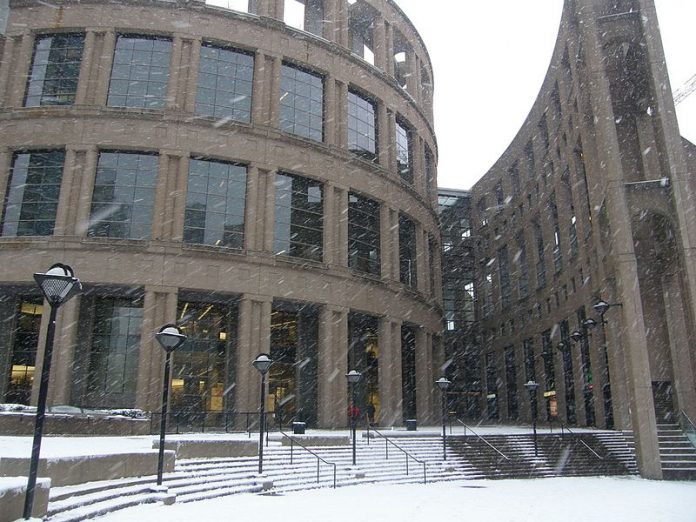
Photo by altoclef

By: Vincent Justin Mitra, Staff Writer

Following the recent snowfalls, Vancouver residents have voted the city as the snowiest city in Canada.

This comes in the wake of a four-month onslaught of snow that has left Vancouverites without warmth or shelter — other than the shelter of their own warm homes — and unable to attend their Moksha yoga classes, throwing their “centre” dangerously out of balance.

“It’s just too cold,” commented one resident. “I had to put on all three of my North Face jackets each time I wanted to go jogging this morning.”

Coffee shops, including Canadian treasure Tim Hortons, have also been impacted by the extended dip in temperatures. Recent studies have shown that purchases of iced coffee beverages in the Vancouver area have risen by 395%, five points higher than the seasonally expected 390%. “All these layers of warmth make me too sweaty,” explained one customer. “I like buying something that cools me down.”

Meanwhile the city continues to enforce their new “Hold the Salt” initiative, asking local restaurants to empty their salt shakers onto the streets to help the city’s lone, overworked snow plow. Residential roads and sidewalks continue to be mostly uncleared.

“This is unsafe! The city should do something about this,” said one resident about his own unshoveled sidewalk, as he stomped on it until it turned to ice.

Additionally, members of local hate groups continue to be rushed to hospitals to undergo treatment for hypothermia and exposure. According to witnesses, the individuals had spent several hours shouting at the sky in unprompted anger at the falling snow. One member was heard repeatedly insisting that he was “stronger than the weak leftist beta cuck snowflakes” shortly before passing out.

Meteorologists say that Jack Frost will continue nipping at our ankles, with forecasts calling for at least 28,000 acres of snow before the end of 2019, primarily focused on areas between where you are and where you need to be, and on the sidewalks of assholes.