

World News Beat

By: Ana Maria Meija-Morales
FRANCE – French candidate charged
François Fillon, candidate for the French presidency has been charged with embezzlement. The charge arrives after weeks of allegations of him paying his wife and children thousands of taxpayer’s euros for fake jobs. Fillon hasn’t stepped down in the presidential race, even after polls show his dramatic descent from front-runner to third place. The presidential race now puts centrist candidate Emmanuel Macron and far-right Marie Le Pen as the favorites amongst the French public. The polls indicate Macron will win the second round, yet analysts warn against early celebration after Britain’s EU exit vote and Donald Trump’s win.
With files from The New York Times and Al Jazeera
MEXICO – Skulls found in Mexico
Two hundred and fifty skulls were dug out in Mexico from what seem to be a drug cartel’s burial pits. The discovery was reported this week, yet the specifics of who discovered the bodies and how long ago are still unclear. Expecting to find more bodies, local authorities continue to dig near the city of Veracruz.
With files from BBC News
NETHERLANDS – Netherlands says ‘no’ to populism.
With populist ideals spreading around the world, the spotlight was turned to the Netherlands this past Wednesday as the Dutch headed to the polls. A relief was felt around the world as Prime Minister (PM) Mark Rutte was re-elected and far-right candidate Geert Wilders was defeated. The PM’s party won 33 out of 150 seats in parliament, making the party the majority. The focus remains in Europe as the French head to the ballots next month, as well as in Germany, where the right wing populist party Alternative for Germany (AfD) is running for seats in parliament.
With files from BBC News
KENYA – Kenya doctors end strike
After 100 days of strike, Kenyan doctors reached an agreement with the government concerning better working conditions and a rise in monthly salary. Doctors will now work for 40 hours per week, previously all doctors were on call, and according to BBC News, will be given an extra $560 to $700 for allowances. Patients have paid the largest toll during this time, many reportedly died due to the strike, and hospitals are now over capacity.
With files from BBC News and Al Jazeera
SFU NATO club makes groundbreaking partnership
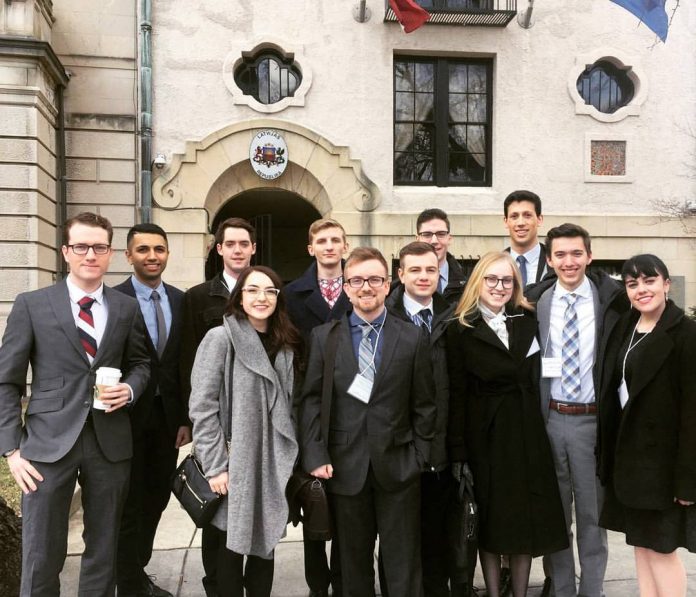
Last year, The Peak reported on SFU’s first Global Model NATO (North Atlantic Treaty Association) Summit. Since then, SFU students Jazlyn Melnychuk, and Cornel Turdeanu, vice-president and president of SFU’s Model NATO club, with the help of Dr. Alex Moens (a SFU political science professor), have created a field school and partnership with the NATO Defense College.
NATO was created in 1949 at the beginning of the Cold War. Canada is one of the 12 founding members of the political and military alliance designed to protect and secure these countries through military and political means. Melnychuk sums up the current work of the association, stating, “Article five of their treaty states that ‘an attack on one nation is an attack on all.’ Since 2010, they have had core tasks like co-operative security, working with non-member states [by] helping them increase their capabilities, and in Afghanistan, through crisis management.”
The model NATO SFU club works to simulate some of these tasks, where Turdeanu explains, “So, we have 28 different people, each gets a different country . . . so you have to represent your country very faithfully, looking up their position on different subjects like cyber security.”
The club has received many awards for their simulations, most recently in Washington, DC for the 32nd annual international model NATO conference. At the conference, Melnychuk and Turdeanu expressed the challenging nature of this prestigious conference, “We knew it would be high level, and it was. There were schools there, including the Royal Military College of Canada and the US Air Force Academy, so these guys really knew their strategy and international relations.” However, 12 members of the society brought home the Superior Delegation Award, along with three other individual awards.
31 SFU students will be heading to Rome and Brussels for the new field school this May and June, learning from diplomats and experts in NATO defense and security studies. “They must think we are the Harvard of Canada or something,” recalls Turdeanu, as he explains the unprecedented partnership with SFU.
The partnership with the NATO Defense College is the first of its kind in which students will be a part of a four-day model NATO simulation. Melnychuk explains the significance of the partnership, adding, “[the NATO Defense College] are the ones that actually teach people who go on to become diplomats in NATO and they run crisis simulations for people who are actually working in NATO. So, we are getting the real experience.”
“I think it’s going to be a historic moment for us as a school and I think it’s going to open the door for a lot more collaboration between SFU and NATO,” states Turdeanu, adding that both himself and Melnychuk have had great opportunities to meet with influential diplomats and generals so far.
Melnychuk adds that she hopes the field school will “set the precedent for actually expanding to other students and other Canadian universities in the future, to engage more students in NATO.”
The club continues their work by meeting once a month and practicing their simulations. More information can be found on their website.
2016–17 season one to remember for SFU women’s basketball
It truly was a season to remember for SFU women’s basketball — arguably the program’s best-ever in the NCAA era.
The team finished with a 26-8 record, 10 wins the better than the season before and one win better than the previous record of 25 set back in 2013. They also advanced to the Sweet Sixteen of the national tournament for the first time back in 2013.
“One of our goals was to try and get better everyday, and I mean in reflection, and you have to be happy being in the sweet sixteen,” said head coach Bruce Langford. “It’s better than a lot of people thought we would do. [. . .] [However,] when you’re that close and you have a few little things that could have gone either way, you kind of have a ‘what if’ feeling to it.”
The team started the season with a tough non-conference schedule, where SFU played against some of the best teams out of the Great Northwest Athletic Conference. They came away from it with just one loss, the first game against, ironically enough, California Baptist.
“I think they gave us a lot,” said Langford when asked if these early wins gave the team confidence. “More importantly they got us into nationals. The way that teams are selected are based upon the team’s record but also the team’s desire to go out and seek competition and play quality games.
“We went out and played the Pomonas, the Academy of Arts, the Cal Baptists [. . .] That put us in nationals as long as we didn’t have a brutal season. So, we were in nationals two and a half weeks before the season ended.”
Before the last two and a half weeks, SFU was 14–3 and looking like a team to be reckoned with.
In those last weeks, however, the team’s form started to slip a bit. The Clan lost three of the last five games, and looked like the team was in trouble heading into the biggest games of the season.
Langford didn’t see it like that.
“I think those things are very misleading,” he explained. “We lost to the second-ranked team [Alaska Anchorage] in the country in a game we were up by 10. We lost to the ninth-ranked team [Western Washington] in the country in a game we were up 10.
“We lost a game by one point at the buzzer [to Central Washington] that we should have won when we lost our leading scorer and rebounder in the first part of the game — to a team that won eight of their last nine games.
“It wasn’t disappointing. I thought it gave us good rest heading into regionals.”
The rest seemed to work wonders, as SFU looked like a completely different team in the West Regional tournament. They beat UC San Diego 69–65 before pulling off the upset of the tournament in defeating Alaska Anchorage 80–70.
“It’s a hell of an accomplishment,” said Langford on defeating the Seawolves. [. . .] Now, we’ve beaten them three times — in their gym — which is phenomenal. That’s unbelieveable, that team is really good. We took 1,700 people, who were screaming and yelling, to silence with four minutes left. It’s unbelieveable.”
Unfortunately they weren’t able to continue their run, losing 77–64 to California Baptist the following round. Both teams in that game shot 37.1% from the field — the main difference was the Lancers hit 22 free throws. SFU, only five.
Next Season
Looking forward, the team has some big holes in the lineup to fill, and none are bigger than the one Ellen Kett leaves. The team captain and starting point guard led the team in minutes per game (33.7), three-point shooting percentage (.431), and free throw shooting percentage (.840).
She also led all of Division II in assists with 262, and assists per game with 7.7. She will likely go down as one of the best players SFU has ever had in the NCAA era.
“I think she ranks up there,” said Langford on where Kett ranks amongst the best of the program’s history. “I think she’s a player who got better every year and had the right attitude about getting better and fixing her weaknesses.
“She couldn’t shoot a free throw two years ago; she led our team in free throw shooting this year. Three years ago she couldn’t shoot a three, and last year she almost led the nation in three-point shooting percentage. [. . .] So, I think she ranks right up there amongst our people who continually worked on their game to try and improve it.”
Needless to say, finding a replacement won’t be an easy task. But perhaps that player is Tayler Drynan. In her freshman season, she played mostly with Ellen instead of replacing her — especially near the end of the season. She showed flashes of brilliance, but that was in limited minutes.
“She has to, because Ellen won’t be here,” said Langford when asked if she can replace Kett. “Tayler Drynan has an awful lot of offensive skill. She has to be able to defend. She needs to get stronger, she needs to work on her quickness, and I think she wants it and will step up to it.”
Another big loss will be Meg Wilson. The Clan’s leading scorer and rebounder during the season, she provided a well-rounded game that allowed her to be used in all situations.
When Wilson was Injured in the game against Central Washington, Sophie Swant slotted into the starting lineup and was one of the main reasons the team went on the run they did. She had 17 and 18 points in the first two games of the regional tournament — both were season highs at the time.
While I’m sure the coaching staff would have loved to have Wilson available to them, it gave an opportunity for Swant to audition for a starting role for next season — and she ran with it.
“If Sophie was to dedicate and devote herself to basketball in a way that she could, her potential is extremely high,” said Langford. “Her ball-handling skills aren’t very good, if she can make that better that would be be unbelieveable. If she played a little more basketball that would improve her basketball IQ.
“She’s got room for growth, but she’s got a lot of potential.”
Redshirt junior Elisa Homer will not be returning next season to start pursuing her future career in business. The two redshirts from this season — Jessica Jones and Claudia Hart — are both expected to play “significant roles” next season according to Langford. Ozi Nwabuko, after hitting a bit of a slump down the stretch, should have a better, more consistent year next season.
The program has three verbal commitments for next season, but aren’t expected to jump in and be big contributors like this year’s class.
“I think this year’s class will come in and have a chance to grow,” said Langford on the potential new players. “One of them is a very good athlete, one of them is a very tenacious rebounder, [but is] coming off knee surgery. I think they will come in and fit.”
In all, the future for SFU women’s basketball looks bright. If the freshmen from this year’s class, such as Tayler Drynan and Ozi Nwabuko, can improve and replace key contributors like Ellen Kett, there should be no reason why there would be a drop off.
Peak Sports Challenge: Penalty Shootout with Adam Jones
On this week’s Peak Sports Challenge, our Sports Editor, Nick Bondi goes up against Adam Jones. Last season in men’s soccer, Adam took home the award for GNAC Player of the Year.
Music by
Rock Angel by Joakim Karud https://soundcloud.com/joakimkarud
Creative Commons — Attribution-ShareAlike 3.0 Unported— CC BY-SA 3.0
http://creativecommons.org/licenses/b…
Music provided by Audio Library https://youtu.be/K8eRXvLL7Wo
SFU swimming deliver standout performances at NCAA Championship
The swim team had a successful weekend in Birmingham, Alabama, where it took part in the NCAA championship. When talking to head coach Liam Donnelly, he said that, “On the men’s side, we scored more points overall, and placed higher, than was predicted by the incoming rankings.” Similarly, on the women’s side, the team “improved our rank and total points from last season.”
The standout performers for SFU at this year’s competition were Adrian VanderHelm, Mackenzie Hamill, and Jessie Gibson. They all had multiple all-American honours, which is given when you place in the top eight at the Championship.
On day one, VanderHelm beat the previous SFU record (1:47.07) for the 200-yard individual medley (IM), which he set last year, with a career-best time of 1:46.05. On day two, VanderHelm destroyed his ranking of 15th to finish second in the 400-yard IM with a time of 3:48.07. This time makes him the third-fastest swimmer in that event in NCAA Division II history. He would go on to finish with four all-American swims.
Hamill finished third in the 1000-yard freestyle on day one of the tournament, swimming a 9:05.80 in the morning heats. He went on to pick up his second all-American honour later in the Championship, when he raced a 4:27.18 in the 500-yard freestyle. He also finished fourth in the 1650-yard freestyle with a time of 15:17.58. He would end the Championship with four all-American swims and three new SFU records.
Also finishing with an all-American honour for the men’s side was SFU junior Tim Woinoski. He finished sixth, right behind Hamill, in the 1650-yard freestyle with a time of 15:26.89.
For the females, Gibson (who was competing in her first NCAA Championship) was the top performer with two all-American swims. She finished fifth in the 100-yard butterfly with a time of 54.36 in the finals. She also placed fourth in the 200-yard butterfly with a time of 1:59.63. This time makes her the first woman in SFU history to swim under the two-minute barrier in this event.
When asked about what these all-American performances mean for the program, coach Donnelly responded with: “The all American level is the focus of our preparation. The swimmers that perform at this level had trained hard and competed at a high level with consistency throughout the year.”
Even with the team’s great performance, coach Donnelly was not surprised, saying, “We were expecting strong, consistent, and competitive performances throughout the meet.” Even with 20 new NCAA records and improvements across the events, the Simon Fraser swim team was still able to reach their goal of “[moving] up competitively.” The team moved forward from their ranking coming in, and should be happy with the results.
But even coach Donnelly had to admit that VanderHelm’s 400-yard IM race could not be expected, saying, “Perhaps Adrian moving from a 15th place ranking to finish second with the third-fastest time in NCAA Division II history is a touch surprising — but we knew he could do well in the event.”
Clan track and field team impresses at NCAA Division II Championship
Simon Fraser enjoyed a successful weekend at the NCAA Division II Championship in Birmingham, Alabama over this past weekend. They left the competition with a total of four all-American honours from Addy Townsend and Vladislav Tsygankov, with Paige Nock and Ella Brown both coming very close to adding to the total. Competitors are given all-American honours when they finish top eight in a Championship event.
“[I’m] really happy with the team’s performance,” said coach Brit Townsend regarding her thoughts on how they performed, “We had a pretty young team, and they were there focused and ready to compete.”
In the 800m, Townsend had a career-best time of 2:08.38 and finished fourth. This was the highest place for any Simon Fraser athlete at the competition. She also was part of the Clan’s 1200m distance medley relay team in which they placed sixth with a time of 3:29.45. Joining her on the team were Paige Nock, Chantel Desch, and Alana Mussatto.
When asked about how she felt about her daughter’s performance, coach Townsend responded with, “Obviously I’m proud of her, but she really earns it, she works day in, day out.” She continued, “She does all the little things she needs to do to be able to perform: she watches what she eats, she recovers properly, [and she never misses a run]. For her to run personal-best performances in all three days was really special.”
Nock just barely missed grabbing all-American honours individually as she ran 4:48.31 (the exact same time as her personal best) in the women’s 1600m. This placed her at ninth in the event, just one spot away from all-American.
Also coming close was Ella Brown, who placed 13th in the triple jump with a distance of 12.02m. This distance was a bit under the 12.14m she jumped at the Great Northwest Athletic Conference championships a few weeks ago.
For the men, Tsygankov, a junior, became the first Simon Fraser male to ever take home double all-American honours. The way he did it, however, was even more impressive. Between competing in the long jump, Tsygankov crossed the track to compete in the 400m and raced his way to the final.
He would finish the 400m with a personal-best time of 48.39, taking seventh place and all-American honours, after similarly taking seventh place and an all-American finish in the long jump.
With only one senior on the roster, the experience the track and field teamed gained at this competition is valuable going forward.
Coach Townsend is positive about that future, and said, “I’m excited because we had a lot of people on the bubble [. . .] so it just shows we are raising our level of performance to be able to compete in NCAA. [. . .] Our next step is, those who are very close, we need to make sure that they get there.”
She also added, “The experience they get at an event like this, just learning to be composed and be able to get everything out of yourself that you’ve been training for [. . .] can be a challenge in your first time there, but now they’ve had the experience.”
The track and field team will next compete in the dual meet with UBC starting March 25 on Terry Fox Field in Burnaby. Coach Townsend and the team are also focused on the Stanford Invitational and San Francisco State Distance Carnival, which will both be taking place March 31–April 1. The Simon Fraser track and field team will be trying to reach national standards at these meets.
For Talor Mykle-Winkler and Soroush Jafary, SFU rugby is like family
By: Craig Wright
With SFU’s prowess as Canada’s NCAA team well-documented, it can be easy to forget that a number of different university sports teams call Burnaby mountain home. One such group of athletes, SFU rugby, is looking to make their mark on a regional level in 2017.
A sport that has seen Canada feature on the world stage, rugby still faces a fight for attention on domestic soil, battling with football, soccer, and hockey amongst others for column inches and public attention. So how did Talor Mykle-Winkler, a third-year prop forward for the SFU women’s team, come to find herself involved in the sport?
“I started in high school because my dad played rugby,” said Mykle-Winkler.
“It’s a lot of fun. You don’t really need much equipment, and it’s a sport pretty much anyone can play, regardless of body size or how fast you can run — there’s a position for everyone.”
Like Mykle-Winkler, men’s team flanker Soroush Jafary found himself picking up an oval ball in high school.
“I fell in love with the sport,” he said. “Rugby is a tough sport; it’s all about intensity and determination. What attracts me the most about rugby is that it challenges me not just physically, but mentally.”
While not currently under the umbrella of the NCAA, the carrot of joining the university’s elite sporting program is a tantalizing one for SFU rugby. Jafary believes that making the step up could be the key to taking the Clan to the next level.
“Playing a varsity sport provides an athlete with a higher level of competition. There are SFU students who are currently playing for other rugby clubs in the Lower Mainland. If we can provide them with the opportunity to choose their classes earlier than other students, or offer them athletic scholarships, they will be more interested to play for their own school.”
For Mykle-Winkler, the lack of recognition for the SFU rugby program, both in and outside of the university community, is one which clearly irks the third-year. However, she prefers to instead focus on the benefits of being a part of the club.
“I feel like we’re in a league that has good competition, so I feel good with where we’re at,” she said.
“Knowing it’s a sport that anyone can play, it does kind of suck when people don’t know there’s a team up here. I’ve talked to people who were like, ‘Oh, SFU has a rugby team? I didn’t know that.’ So it’d be nice to be more well-known, but at the same time there’s a lot of support both from within the club and from the alumni of the club.”
As touched on by Mykle-Winkler, the club’s alumni are a major part of the continued success of the program. It’s a connection that both she and Jafary acknowledge as a key part of the club’s identity.
“It’s really nice to have that alumni connection,” said Mykle Winkler. “It’s a really tight-knit community and club.”
Jafary agreed, stating, “The alumni are this club’s most loyal supporters. They are great role models for current students and we continue to benefit from their skills and experience.”
On the pitch, it’s been a successful start to the 2017 campaign for the men’s team, as they sit second in BC Rugby Division III after three wins and a draw from their opening four matches. It’s a fact made all the more remarkable after a disrupted preparation for the season due to the heavy snowfall experienced in the area in January and February.
However, the team adapted, as Jafary noted, “We have been unlucky with the weather. We spent a lot of time in the gym to maintain our fitness level when the outdoor fields were not available,” said the fourth-year.
For the women’s side, the format of the league is slightly different, as Mykle-Winkler explained,
“Our league is broken into semester[s] — the first half of the league is in first semester, and the second is in the spring. There’s been some delays and cancellations because of the snow, but we’re underway again now.”
The weather was the least of the concerns for the women’s team, however, as they had to contend with the loss of their new team kit.
“Over the summer, we’d just got new jerseys from donations by sponsors and alumni. A car got broken into and they all got stolen,” said Mykle-Winkler. “Thankfully we managed to replace them — we had a fundraiser and got the money we needed.”
So what are the aims for the remainder of the season for the club? For Mykle-Winkler, it’s a fairly simple goal.
“Last year we dropped down a division [from the Premier Division to Division I], so this year we don’t really want to be losing — we want to be competing amongst the high-level Division I teams.”
It’s a similar story for Jafary, who added, “I think we are all aiming to win the league this year. However, my main goal as a senior student is to lead the younger players to work harder on the field and manage their time better off the field.”
With a strong club behind them and a group of enthusiastic and committed players, it certainly seems like both Mykle-Winkler and Jafary are in a pretty good position to achieve their respective goals in 2017. One thing is for certain though — if they don’t, it won’t be for a lack of trying.
Fun Fact:
What was the last song you listened to?
Mykle-Winkler: “Umm [. . .] It was ‘Back in My Arms Tonight’ by Nathan Bonnes”
Jafary: “J.Cole’s ‘Change’”
Peak Speak: What Category Would You Add to The Oscars?
On this week’s episode of Peak Speak, we ask students what awards category they would include in the Oscars.

