Home Blog Page 769

Men’s wrestling finishes 1–3 at Tracy Borah Duals

0
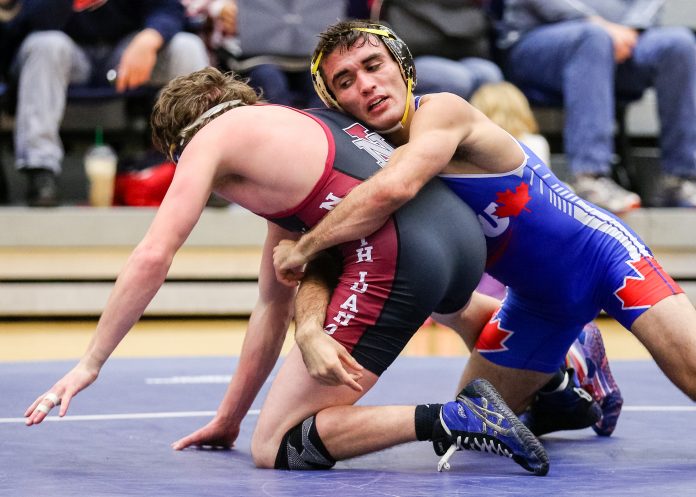
Cruz Velasquez (right) finished with a perfect 4-0 record.

The SFU Clan men’s wrestling were on the road once again last Saturday, travelling to Colorado to wrestle at the Tracy Borah Duals at Western Colorado State University. The Clan had a disappointing team result in their first meet for the second half of the season, dropping three of their four duals to return home with a 1–3 record on the weekend.

When asked about their performance, head coach Justin Abdou made it clear that he was proud of his team’s performance. “[The] guys competed hard, despite the fact that we were competing with a depleted lineup where we were forced to start a freshman with very little experience at 165 lbs,” he said, adding that they “beat New Mexico Highlands and were very close with Western State and Colorado School of Mines.”

The Clan certainly were competing with a depleted lineup. Due to injuries, they were forced to automatically forfeit 141lbs and 149lbs respectively, surrendering six points to the other team for each weight class. Because of these forfeits, a lot of the matchups were closer than they may look on paper. Despite the disappointing result, they still managed to find some bright spots after the weekend.

“It was a great weekend for Velasquez and Molle, who both went undefeated,” Abdou said. “Morgan Smith also had a dominant tournament with his only loss coming up against a ranked Division I opponent.”

Smith has not lost to a Division II opponent this year. If he continues at this pace, he will be a force late into the season. Meanwhile, Velasquez finished the tournament without giving up a single takedown. His defence and toughness has won him his fair share of matches this season, and he has been one of the Clan’s most consistent performers.

These individual performances are impressive and are a key driver for the team in this second half of this season. Smith, Molle, and Velasquez all hope to be competing at the National Tournament along with their other teammates at the end of the season. Results like these will do well to build momentum over the next few months.

SFU will settle down for a week as they do not compete this weekend. This gives them time to work on any issues Abdou saw over the weekend, as well as take care of themselves.

You can look for them to get back on the mats against Warner Pacific on January 21 in Portland, Oregon.

SPOOF: McFogg the Dog: Mascot of the Year

0

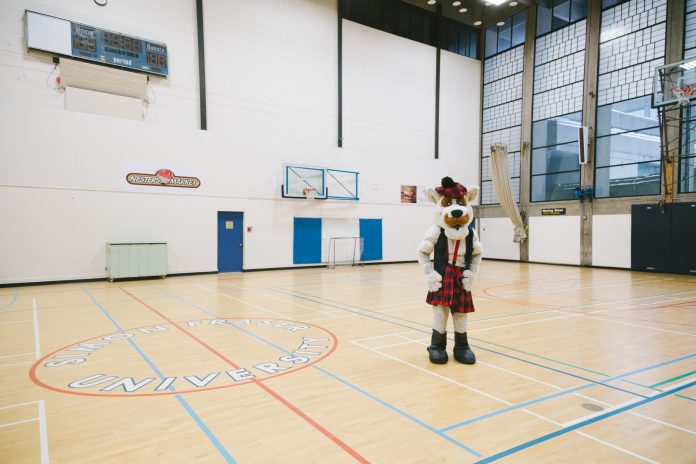
McFogg the Dog, mascot of the divided students of SFU. We take a look at his impact within the SFU community.

Featuring: Ashley Fraser,Max Hill, Andrew Latimer, Edna Batengas, Tamara Connor, Alex Bloom.

Created by Adam Madojemu and Alex Bloom

Women’s basketball continues torrid pace with pair of road wins

0
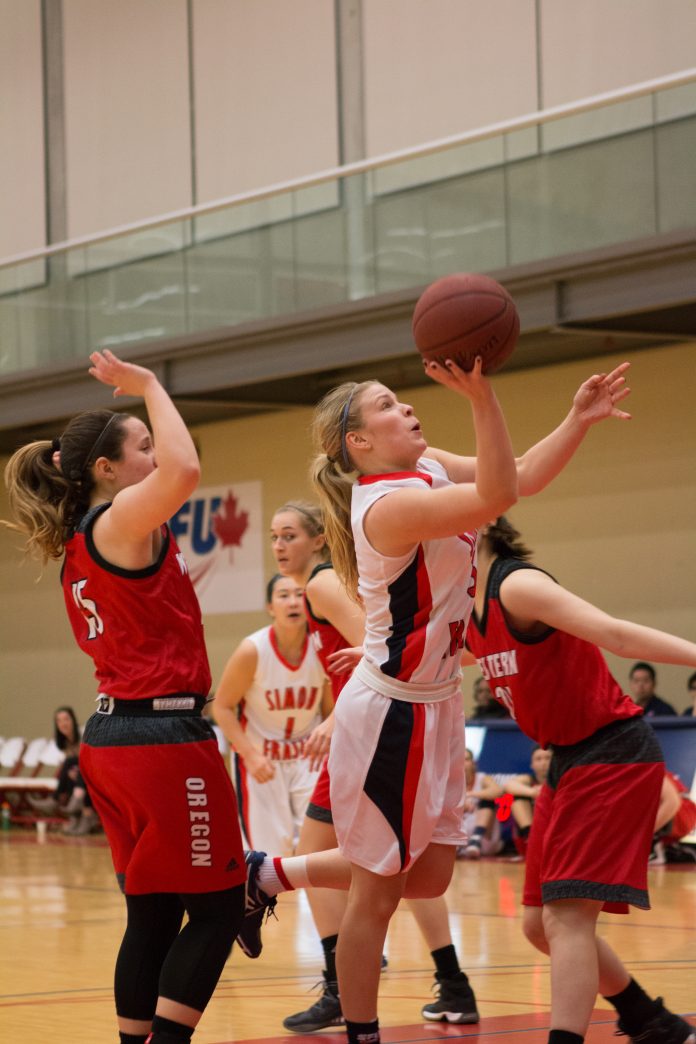
Ellen Kett (centre) had 22 points, 8 assists, and 4 steals in a 101-89 victory against Northwest Nazarene.

The past two games for SFU women’s basketball have been indicative of their entire season to date — finding different ways to win every night. Led by newly named Great Northwest Athletic Conference (GNAC) player of the week, Ellen Kett, the Clan defeated both Central Washington and Northwest Nazarene on the road. Their overall record improved to 14–2, and 5–1 within the conference.

The first game against Central Washington displayed SFU’s resilience and defensive prowess. After trailing 21–14 early in the second quarter, things could have gone south quickly. But the Clan scored 63 points the rest of the way, including 22 in both the third and fourth quarter to get SFU the victory. What made it more impressive was Central Washington is third in scoring defence, giving up an average of only 60.9 points per game.

“We changed our defence, partly to get them more thoughtfully into the game, which I was hoping would help us offensively,” said head coach Bruce Langford on the adjustments made early in the second quarter. “I thought that helped, and we started to take our shots. [. . .] Once we started to think a little bit, we got better. We started to work hard and took over the game.”

The second game was extremely high in scoring, with SFU putting up over 100 points for the first time in nearly two years. After scoring 33 points in the opening frame, a quarter in which Langford said the team “could have had 39,” SFU held their own against the second ranked Crusaders offence to win 101–89.

“There’s nobody who has that versatility to them. It’s huge for us. She makes everybody on the floor better”

– head coach Bruce Langford on point guard Ellen Kett

“We were shooting extremely well, running our offense very well — we were four for four from three,” explained Langford on the hot start. “We were very efficient, and that continued through most of the game. We tried to sub a lot, and it hurt us a bit defensively, but didn’t hurt us that much offensively.”

Ellen Kett led the way for the Clan in both contests. The senior from Melbourne, Australia did it all in both games, and has arguably been SFU’s most consistent player all season. She leads SFU in minutes played, three-point percentage, rebounding, and steals.

“I thought Ellen Kett was outstanding,” said Langford. “She did it all. She rebounded, took a couple of charges, she had some great assists. I thought she was very good.

“There’s nobody who has that versatility to them. It’s huge for us. She makes everybody on the floor better. She’s very consistent.”

If there’s an area that is in need of improvement, it’s the team’s three-point shooting percentage. Throughout the years, SFU has been one of, if not the best three-point shooting team in the GNAC. Last year, they were first; the year before, third. Ellen Kett last season had the second-best three-point shooting percentages in all of Division II women’s basketball, with 49.5%.

This year has been a different story. They’ve struggled mightily early on — the team was dead last up until very recently. However, with talented shooters such as Kett and Elisa Homer on the roster, SFU likely won’t be that low for long, according to Langford.

“It’s always been one of our strengths. We always take the most attempts or second-most attempts. But per percentage of baskets, we’re always leading,” he explained.

“This year, Ellen came out very slow from the three, Homer came out brutally from the three, and others did not shoot the three well. [. . .] But Ellen’s started to shoot the ball much better and Homer has started to shoot the ball much better. I think our percentage will come back to normal.”

Ellen Kett led all players in minutes played over the two games, averaging 35.5 minutes per contest. Elisa Homer was second with 28.5. But perhaps one player to watch, in terms of playing time, going forward is Tayla Jackson. After playing a season high 21 minutes against Cal Poly Pomona on November 26, she hasn’t had over 20 since, and only played six and nine minutes against Central Washington and Northwest Nazarene respectively.

Part of it is illness — she missed the game on December 29 against Western Oregon because of pneumonia and is still “coughing and hacking like mad,” according to Langford — but part of it is finding her role with her new team after transferring from Division I Cal Irvine.

“I think she’s coming along, but she’s struggling mentally and physically with her health and with her role — in terms of where does she fit, how does she get comfortable, [and] how does she get minutes to get comfortable,” said Langford.

“I think she’s putting too much pressure on herself. I think she’s overly focused and concerned about making mistakes and trying too hard almost. She has a style of play that should have more success than what she’s having this year.”

THIS WEEK: SFU plays the first two games of a four-game homestand against Seattle Pacific and Saint Martin’s, both starting at 7 p.m. in the West Gym. The game against Seattle Pacific is likely to be the tougher test, as the Falcons have one of the stingiest defences in the GNAC. They allow only 52 points per game on average, one of only two teams in the conference to average under 60 points.

“I think one of things is we have to read what they’re doing at any given time of how they’re switching screens and handling screens, and how smart we are playing off of that,” said Langford on how to break down their defence. “Executing will be crucial.”

And although Saint Martin’s is something of a middling team — they’re not in the top half in most major statistical categories and are ninth in the GNAC — they are the top three-point defending team in the conference, something that could challenge an SFU team that, as coach Langford explained, loves to shoot the three.

Clan blow 22 point halftime lead to lose 88–83

0
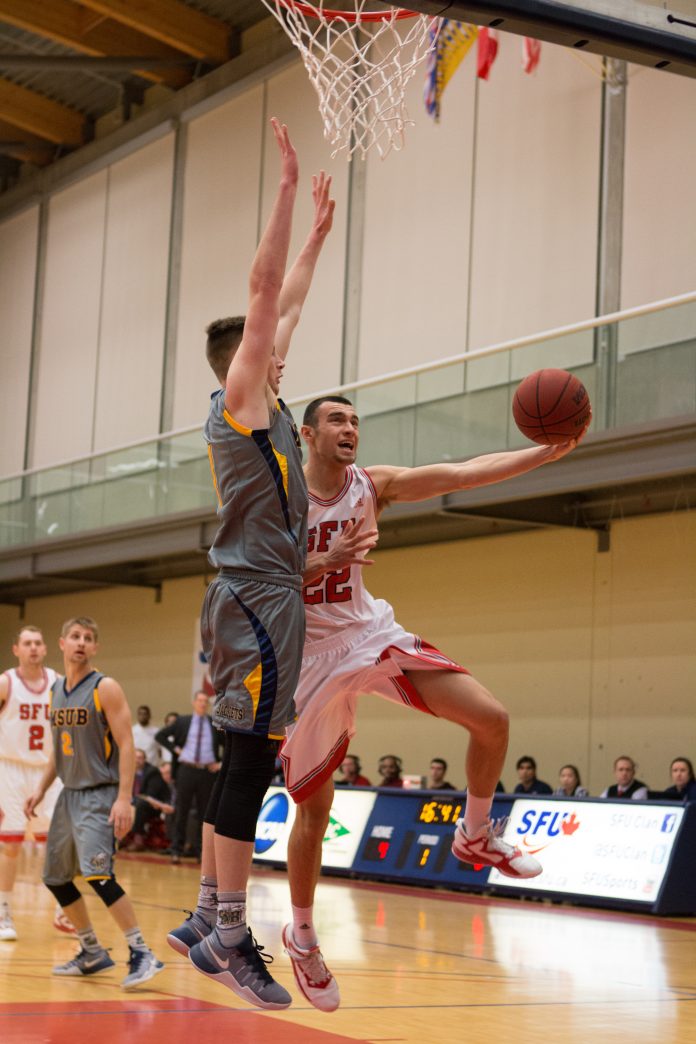
JJ Pankratz (right) played a season high 36 minutes against Alaska Fairbanks, finishing with 19 points and 3 steals.

Well, at least it was an entertaining finish.

But the 225 fans in attendance — the ones cheering for SFU — probably would have preferred the dull march to a 20-plus point victory that seemed guaranteed at halftime. Instead, SFU gave up a 22 point halftime lead and surrendered 60 points in the second half to a team that had seemed utterly defeated in the first.

What had seemed like an easy victory earlier in the game became an 88–83 loss to the University of Alaska Fairbanks Nanooks Saturday night in the West Gym.

While the Nanooks seemed to score on nearly every drive, nearly certainly drawing a foul if they didn’t, SFU seemed rattled, missing shots they normally would make. On a free throw attempt when the game was tied 78–78, when SFU needed to score pretty much every drive to keep up with Fairbanks, Kedar Wright went 0 for 2. In the last few minutes, it seemed like SFU couldn’t buy a three.

“We were just getting frustrated with what we were doing, and shots weren’t going down as we wanted it to go down,” said freshman Othniel Spence.

Was the collapse a matter of confidence? Head coach Steve Hanson didn’t think so.

“I don’t think it has anything to do with confidence. It’s just that good players step up when it’s time to step up,” he explained. “We knew they were going to push back and play with some pride, but we just had chances to seal it.”

Instead, he pointed to the team’s rebounding.

“The biggest thing was defensive rebounds. We were terrible. They must’ve had 20-plus points off of defensive boards today,” he said. “Rebounding is just effort, it has nothing to do with height or talent, it’s just effort. They out-willed us down the stretch and that’s what better teams do.

“Rebounding is the game of basketball. We’re not very good at it right now.”

SFU were out-rebounded 36–28, and they only recorded eight in the second half.

After recording a below average 47 points the previous game, however, the game started off great for the Clan. JJ Pankratz, who shared the team lead in points, opened the scoring. Before long, SFU had built a sizable lead.

“Everything was going our way,” said Hanson.

There were some fun plays. On one, Spence stole the ball, ran end-to-end, and nearly dunked it, only to be swatted. However, Wright was able to get the two points on the rebound. Hidde Vos was able to sink a buzzer-beating three to end the half, and put SFU up 50–28.

“They out-willed us down the stretch and that’s what better teams do”

– Steve Hanson, head coach

All signs pointed to the Clan getting their first conference win of the year. It was the most dominant performance fans had seen all year, outside of maybe one of the exhibition wins — and even then, were on pace for a better offensive game than either of those results.

But the feeling was instantly different in the second. Fairbanks started the half with a seven point run. SFU went 2:15 without a point in the half, and didn’t make a field goal until 3:26 in.

By the 10-minute mark, Fairbanks had cut the SFU lead to seven. The Nanooks tied the game with 3:48 left. After that, the game was a nailbiter.

Fairbanks only missed three free throws (16 for 19, 84.2%). One of those missed attempts came in one of the two attempts they got for Tyrell Lewin’s technical foul for language.

After Fairbanks had taken the lead, SFU couldn’t keep pace offensively. With 1:05 left, Tyrell Lewin’s two free throws put SFU back within one, but by then, the game was in the Nanooks’ hands.

With the score at 84–83 after the Nanooks collected an offensive rebound with 32 seconds left, Michael Provenzano had to take a foul to stop the clock. Fairbanks was successful on both attempts. By then, a three point lead was too much to overcome, and Alaska sunk two more free throws to win by five points.

“We’ve got to be a lot tougher. I mean, a lot of the habits we’re seeing in the games are what we’re letting slip in practice everyday, so we have to be more disciplined in practice,” said Hanson.

Pankratz and Provenzano shared both the lead in minutes and points with 36 and 19 respectively. Pankratz also led in rebounds with seven. Wright followed with 16 points.

Graham Miller and Aleks Vranjes were both not dressed. Miller has not played a game in the four-game homestand, while Vranjes has missed the last three. Bowen Bakken, Vinnie Safin, and Bongani Moyo were dressed, but did not log any minutes. Bakken and Moyo have not come off the bench in the last three games, while Safin had played Thursday night.

NEXT WEEK: After completing a four-game homestand, SFU now goes on the road to Oregon, where they will look for their first conference wins against Western Oregon on Thursday and Concordia on Saturday.

“They’re going to be tough. They’re two very tough places to play, two teams that we can definitely compete with, and it’s frustrating. And we wanted to go into those road trips with some momentum, I thought we built some in the first half today, and just couldn’t toughen up at the end,” explained Hanson.

Last year, SFU’s only conference win came against Concordia on the road, a 90–70 result, and were competitive in a 76–72 loss at home. Concordia sits only two spots ahead of SFU in the Great Northwest Athletic Conference, and that should be a winnable game. Concordia is in the midst of a three-game losing streak.

First, SFU will face Western Oregon. SFU also fared better against Western Oregon on the road last season, falling by a score of 76–67 (at home, they lost 90–67). The Wolves are slightly above average defensively, but are ranked ninth in scoring offence — a good bet is that the winner’s score will be in the 70s.

Tipoff is at 7 p.m. for both.

SPOOF: Famous Feuds of 2016

0

alishalee-topfeudsof2016-4

SFU Exams vs. The Snow

What’s this? What’s this? What the fuck is this?! Snow is a big cock-slap in the face, and Metro Vancouver had that frozen dick whap her right on her pink cheeks this winter. SFU felt the whiplash of the cock-slap over the exam period — cancelling and rescheduling a plethora of exams because of the road conditions. The SFU exams tried their best to fight back, but no one gave a shit because what big nerd would try to save exams. That icy cold dick got them walkin’ side to side, because the sidewalks were a fucking sloshy disaster.

alishalee-topfeudsof2016-1

Egg vs. Avocado

The modern piece of art had a burning inner feud in figuring out its identity. “Am I an avocado or an egg?” it asked itself everyday while staring out into the void that is the AQ pond. After years of struggling with this internal split, the piece of art went on a life-changing journey backpacking through India — rediscovering itself along the way. By the end of the trip the piece of art had understood that it identified as neither an egg nor an avocado, but instead, as a hexahedron. Unfortunately, no one has bothered to ask the statue how it identifies, because that would be “too PC” according to right-wing groups on campus, so it just adds its identity to its growing list of fears — alongside being fucked on by horny first-years.

alishalee-topfeudsof2016-7

Student Athletes vs. SFSS

There’s a list of words that’s always fun to use in stories: Heteronormativity, problematic, using horde to describe a group of people. Imagine how delightful it was to cover when a horde of student athletes swarmed the SFSS over their problematic handling of the Build SFU stadium (Heteronormativity will have to wait another day). The student athletes said that it was wrong for the SFSS to cut the stadium with no warning during the exam period on Twitter. The SFSS said. . . well, they need to be better at saying things. This went on for a while with secret meetings, passive-aggressive jabs, and Darien Lechner asking point blank if anyone else thought that Marc Fontaine didn’t really know what he was doing. The Build SFU debacle is far from over, but 2016 is the year where the SFSS turned some of its biggest “yes” votes into their biggest enemies.

alishalee-topfeudsof2016-6

Admin vs. PR

You’ve all heard the story: Nice boy comes to SFU, reveals that he isn’t so nice, sexually assaults multiple students on campus, and is dealt with appropriately by both the school and law enforcement because this is a fucking crime. Oh wait, that isn’t the version you heard? If SFU administration had their way, you would have never heard about it at all. We get it, it’s hard to attract students if you have an alleged rapist on campus. I bet it’s even harder to attract students when your own professors say that SFU administration must be held accountable for their lack of transparency. But hey, at least the gondola idea is out there again, right? And SFU got named the top comprehensive university? Let’s just focus on that because that is the kind of stuff that makes you SFU. Just please ignore the fact that you are nothing but $tudent$ to the $FU administration.

alishalee-topfeudsof2016-5

John Flipse vs. The Economy

If there’s one thing we know about university students, it’s that they hate drinking. They especially hate drinking with their friends, and especially at a place they’re already at. So it makes sense that the pub has lost $3 million over the past eight years. They definitely won’t do it during the summer months, doubly so if you have a nice patio that gets relegated to only being open two months of the year. And if by some miracle you manage to get them into the pub, they definitely won’t want to eat, so don’t bother having the kitchen open the entire time. (And don’t even get us started on expecting your employees to just come back after laying them off for the summer and then being unprepared to handle when they found new jobs.) There’s just no way to fix this! There is literally nothing that John Flipse could do to revitalize the pub. It’s that damned economy, that’s why it’s losing so much money.

alishalee-topfeudof2016-2

Deepak vs. Deepak

It’s one of the best literary devices of all time: man vs. himself. Deepak Sharma. . . who is he? Does he know? Is he a student president? Just a student? (Survey says: no.) Just someone who got caught in the wrong situation at the wrong time? Maybe none. Does he wake up in the middle of the night in a cold sweat, stare longingly into the mirror and think, “What happened? We had it all.” Of course, the story was then made complete with him running in the byelection. We saw peak Deepak when he asked if any candidate would step down after winning their title. Was this a meta reference, acknowledging that we had a new Deepak? A kind Deepak? A better Deepak? SFU didn’t think so, as he came last in the polls. Maybe 2017 will be the year one side of him takes over, but until then, the enigmatic Deepak vs. Deepak feud was one of the best in 2016.

SPOOF: The Short List

0

Larissa Chen

It has been an incredible feat that while she was initially elected as VP student services representative, Larissa Chen quickly rose to her new title as Simon Fraser Student Society (SFSS) president when Deepak failed to enroll in class for the summer 2016 semester. Her spritely spirit continues in her role as president (while taking a full course load), mostly educating students on what the SFSS actually is and what the next great acts will be at the SFSS Spring Kickoff. How does she do it? Coffee, and lots of it. She may be small — she is so “short,” in fact, that this is exactly the reason why she was awarded a spot on our “short” list.

Deepak Sharma

If SFU were a region in Pokémon, its legendary would be the steel/ghost type Deepak Sharma. Sharma proved difficult to catch, and when finally caught was relegated to a box in favour of a stronger, more well-understood team that was proven in battle. While defensively strong and notoriously hard to knock down, Sharma also disappeared for months only to use Phantom Force to reappear and run again for SFSS president. He might have taken a knockout blow from Larissa Chen, but Sharma might come back yet again. After all, it is hard to keep a legend down for very long — even if he only comes back in story form.

Andrew Petter

Andrew Petter is the eighth president and vice-chancellor at SFU. Notably, he can be congratulated for leading SFU into its next 50 years following last year’s 50th anniversary. He  welcomed the likes of Canada’s Prime Minister Justin Trudeau following the grand opening of a new building to house the new environmental engineering program. He can also be commended for his impeccable timing in objecting to the Kinder Morgan Trans Mountain expansion on the day it was approved. By far though, his largest accomplishment, which puts him on our shortlist, is his commitment to SFU’s strategic vision of being a leading and “engaged” university. Indeed he is the most “engaged” president SFU has known, and has been quoted saying “engaged” a whopping 1,200 times this year.

John Flipse

The universally loved and hated food and beverage services manager for the SFSS. He is the man who is responsible for running the only bright spot on Burnaby Mountain — the Highland Pub. But just as students were getting ready to celebrate and bask in the few rays of sun that hit the fortress that is SFU, he cruelly pulled away the only watering hole for students (as only a dictator can). After citing “budget shortfalls,” the Highland Pub was shut for the summer session. How an establishment that serves alcohol can close on a university campus is beyond this writer, but it was back in the fall and with its return Flipse introduced a whole new language for overworked Faculty of Arts and Social Sciences students to study — menu English. However, students will continue to support this dictator so long as he keeps the taps flowing.

SPOOF: SFU’s Firsts and Lasts of 2016

0

Firsts

March 13 – First time president Petter emerged from his office after five months of hibernation

1

April 21 – First time the Highland Pub shockingly announced they were running a deficit

2

June 3 – First time an SFSS president had to resign due to not being a registered student

3

July 6 – First time Pokémon had the chance to earn SFU degrees

4

August 4 – First time we had real and accessible frozen yogurt via Menchies (inb4 Yeti Yogurt because fuck that place)

September 1 – First time the Tim Hortons at West Mall decided to go with a modern one-line ordering system

5

December 18 – First time people realized that having a university on top of a mountain may have been a bad idea

Lasts

6

January 10 – Last time inviting someone for “avocado and chill” on campus was innocent

April 21 – Last time any of us had to subject ourselves to the Highland Pub

June 30 – Last time we had to hear the ridiculous idea of a gondola going up Burnaby mountain

August 31 – Last time there was any hope of a stadium on SFU’s Burnaby campus

8

October 7 – Last time an SFU student was able to say their grad class was from the shittiest year ever

November 21 – Last time we had to hear about how much Darien hates Build SFU

December 19 – Last time a blood ritual was performed to summon the 135 at its scheduled time

SPOOF: The Mascot of the Year

0

It’s midday on Burnaby Mountain and the air is thin and frosty. With the exam period over and the new semester still weeks away, few of the university’s nearly 30,000 students remain on campus, with most students in residence having gone home for the holidays. The quiet is only broken by the occasional howls and pants of SFU’s beloved mascot, McFogg the Dog.

Inhabiting the offices of SFU’s athletics department, McFogg remains on campus throughout the dead of winter, waiting to serve the school once again when varsity sports return after the holiday break.

By all measures, 2016 was McFogg’s year. In a tumultuous and often hopeless time in human history — one characterised by war, political turmoil, and the always encroaching spectre of death — our mascot has been a shining beacon of light, filling students’ hearts with a much-needed sense of joy and camaraderie.

The laundry list of accomplishments for McFogg this past year is, to say the least, impressive. McFogg competed in the Olympics held in Rio, Brazil, earning gold medals in cheerleading and personal grooming. He led protests against the election of Donald Trump in the United States and police violence against Sioux peoples at Standing Rock. His meeting with Prime Minister Justin Trudeau made headlines for months and resulted in McFogg becoming a member of the Order of Canada.

This was also the year McFogg released his New York Times bestselling memoir My Tartan Heart, which is slated to be made into a feature film by Steven Spielberg in 2017 with Chris Pratt in the starring role.

McFogg also had his fair share of run-ins with fellow college mascots, including a much-publicized feud with Albert E. Gator from the University of Florida as well as ongoing competition with his long-time rival, UBC’s the Thunderbird. All of this coincided with a whirlwind romance with film star Scarlett Johansson, which ultimately ended with McFogg being forced to put his career before his heart.

img_3358

McFogg sat down with PEAK and in this exclusive interview we got his views on the big questions, and learnt more about the most outstanding mascot in a generation.

Growing up in a small, one-story dog house not far from Burnaby Mountain, McFogg never thought he would one day become the mascot who changed the way the world cheers for collegiate sports. In the late ‘80s, his parents left Scotland with nothing but the fur on their backs to try and build a better life for McFogg. His humble background, and at times trying family situation, helped shape the fierce Scottish terrier we see before us today.

“Growing up, my mother used to say to me that ‘the good dog always barks twice’, but I wanted to know what happens when the dog barks three times, or even four,” McFogg says. “As a pup, I wanted to know how far I could push the bone.”

Today, McFogg is met with a very different life circumstance. A series of accomplishments and a growing fanbase has helped McFogg establish a network for him to keep the success going. “I think what defined my 2016 was the non-profit I established. ‘Go Fetch’ is less than one year old, but the organization is already helping pups in urban areas get the tools they need to be successful in whatever career path they choose, be it in mascoting, acting, or medicine.”

With his new foundation, McFogg is hoping that all doggos out there feel they can reach for the stars.

“The life of a university mascot always spoke to me. The road trips, the walking, the jumping up and down. . . I never thought I would be here today, though. I never thought me, McFogg, could be the good dog,” he adds. He points to well known mascots like the A&W Bear and the Kool Aid guy as some of his early inspiration.

It’s every mascots dream to pick McFogg’s brain on what makes a great mascot. As he describes it, an excellent mascot is someone who forgets that they are a mascot at all. “The creative process is so simple, it ends up being extremely complex,” McFogg explains.

“I think what makes me a good mascot is that when I get in front of a crowd, I can’t remember why I’m there or even who I am sometimes. . . I just want to make folks smile and see a victory for the SFU Clan.

“Being a mascot is a social life as well as a professional one,” McFogg notes. There are frequent large gatherings of mascots, both from collegiate sports and from the corporate sphere. “The Pillsbury Doughboy is the life of the party. That guy gets lit,” he adds.

When asked about some of the controversy currently plaguing SFU athletics, as well as some of the hot losing streaks, McFogg declined to comment, adding that “ [he] isn’t here to get political, just wag his tail and cheer for his team.”

However, McFogg did add that “it’s total garbage” to get students to vote yes for a stadium and student union building only to demolish the dreams for a new athletic facility so soon after the special general meeting.

“I love SFU,” McFogg reflects. “I couldn’t leave no matter how much money other schools offer me.” Looking forward McFogg is hoping to find someone to start building a family life with, “I’ve been so focused on who’s throwing the ball, I forgot to find someone to just hold my heart.

“I want all aspiring mascots out there to know that you have what it takes and it will be hard but in you, deep down, you’ll find the energy to cheer loud and keep the wave happening in the crowd for hours. Just go for it”.

NFL Blitz with Jason Romisher: Wild Card Edition

0
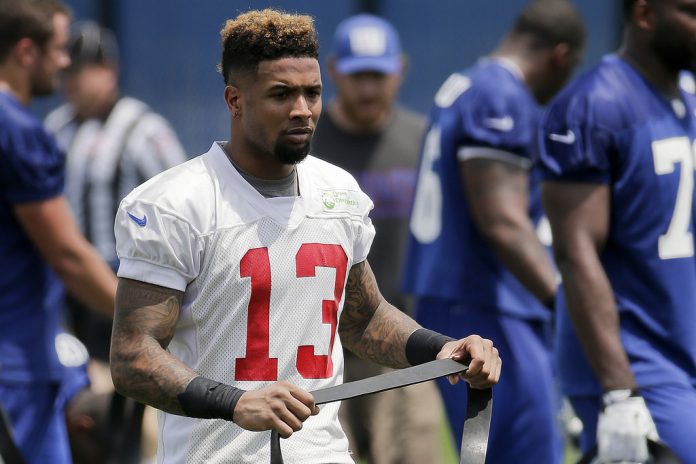
Odell Beckham Jr. is poised to have a big game this weekend against a shaky Packers secondary.

2016 will be remembered as the year of the rookie quarterbacks (QBs). The Rams, Eagles, Cowboys, Patriots, Bills, Browns (2), and Raiders all employed rookie QBs at one point or another this season. For the Raiders, their rookie, Connor Cook, will make history this Saturday as the first quarterback to have his first start be in a playoff game. The National Football League (NFL) in recent years has become a quarterback driven league.

With the exception of the Broncos (2015) and Ravens (2000), every team that has won the Super Bowl has had an elite or very capable starting quarterback. As such, the heavy favourites in the AFC are the Patriots and Steelers with Tom Brady and Ben Roethlisberger. Brady and Big Ben have six Super Bowl titles and nine Super Bowl appearances between them. Oakland, Houston, and Miami have backup quarterbacks forced into action due to injuries, and Kansas City is helmed by the capable if unspectacular Alex Smith.

The National Football Conference is a different story. Green Bay (Aaron Rodgers), New York (Eli Manning), and Seattle (Russell Wilson) all have Super Bowl winning quarterbacks. The other QBs are all legit talents such as Atlanta’s Matt Ryan whose outstanding season may garner him the MVP award; Detroit’s former first overall pick, Matthew Stafford, who has a 5000-yard passing season to his credit; and the great unknown, Dallas’ Dak Prescott, the rookie phenomenon who led the Cowboys to a sterling 13–3 record. Hopefully this will be a “wild” wild card weekend.

Oakland (12–4) @ Houston (9–7) Saturday 1:35 p.m.

Houston has the privilege of hosting the Raiders despite their record because they won the American Football Conference (AFC) South, which was by far the worst division in football this year.  Led by Jadeveon Clowney, the Texans’ defence played very well as a unit this year despite losing former NFL defensive MVP JJ Watt to a season ending injury. The Texans also have a good running back in Lamar Miller, and one of the best receivers in football in DeAndre Hopkins. They also went out in the draft and grabbed a major speed threat to complement Hopkins in Will Fuller. Despite these weapons, the Texans sported one of the worst offences in the league. This was due in large part to the poor play of free agent signee Brock Osweiler. Osweiler got a big time contract after playing decent football last season for the Broncos. However, late in the season he lost his job to backup Tom Savage. Savage suffered an injury last week which thrusted Osweiler back into the spotlight.

The Raiders meanwhile, are underdogs in this game since injuries to starter Derek Carr and backup Mitch McGloin have left them relegated to playing third string rookie Connor Cook. The Raiders have a good offensive line, an explosive running back in Latavius Murray, and two 1000-yard receivers in Michael Crabtree and Amari Cooper. They also have one of the best pass rushers in the league in Khalil Mack. Cook played well last week in limited time against the Broncos, who still sport an elite defensive unit. He also was praised prior to the draft by former Raiders coach and quarterback guru Jon Gruden as the best quarterback in this year’s crop.  Cook fell to the fourth round despite many draft experts thinking he was the most pro-ready quarterback. Cook was a three-year starter at Michigan State and played in several big time games during his college career. The Raiders are far and away a better team than the Texans, and Cook will make enough plays to get them the win and the road “upset.”

Prediction: Raiders 24 Texans 16  

Detroit (9–7) at Seattle (10–5–1) Saturday 5:15 p.m.

The Lions limped into the playoffs with a three-game losing streak and made it only because Washington blew it and lost to the Giants last week. Detroit is a mediocre team that won the majority of their games in close fashion by overcoming fourth quarter deficits. They have a good defence, which is not great, and an offence which is devoid of big time playmakers.  They are also going to one of the hardest places to play in all of football.  

Seattle is undefeated in the playoffs at CenturyLink field and is a squad with a tremendous amount of post-season experience. Since 2013, Seattle has the most playoff wins in the NFL. The team still has a good defence which fell back a bit this season from elite status and is missing injured safety Earl Thomas. Offensively, their patchwork offensive line did not play consistently this year and the team has really suffered from the retirement of Marshawn Lynch. Russell Wilson is a special talent though, and will get the ball to his playmakers. Look for a big game from receiver Doug Baldwin and a double-digit win by the Seahawks in what should be a lopsided game. The Seahawks also signed Devin Hester this week to return kicks. Hester is one of the most prolific punt and kick returners in NFL history and will hopefully have some magic left for Seahawks fans.

Prediction: Seahawks 30 Lions 18

Miami (10–6) at Pittsburgh (11–5) Sunday 10:05 a.m.

The overwhelming consensus is that the Steelers are the only team in the AFC capable of beating New England and as such they should dominate the Dolphins in this matchup. The Steelers have reeled off seven straight wins and will have star running back Le’Veon Bell healthy for the playoffs for the first time in his career. With All-Pro wide receiver Antonio Brown and with quarterback Ben Roethlisberger starting his 18th playoff game, the Steelers have an edge in both skill and experience.

The key sticking point to this sentiment is that the Dolphins crushed the Steelers 30–15 earlier in the season in a game which saw their running back Jay Ajayi sprint to one of his three 200-yard games this season. They also sport a fierce pass rush led by former BC Lion, Cameron Wake, and league bad boy Ndamukong Suh. The Dolphins are quarterbacked by a capable backup in Matt Moore who played well down the stretch, but will be making just his first career playoff start.  One key factor is that the warm weather Dolphins will be travelling to Pittsburgh in the dead of winter where temperatures are expected to be -13 degrees Celsius with the windchill; advantage Steelers. The Dolphins have demonstrated that they have the team to beat Pittsburgh, but not on this day.

Prediction: Steelers 28 Dolphins 13

Game of the Week and Upset Special

New York Giants (11–5) at Green Bay (10–6) Sunday 1:40 p.m.

The football gods have brought the world a trilogy between these two storied franchises. In both the 2007 and 2011 seasons, the Giants went to Lambeau as underdogs and pulled off the victory en route to their two most recent Super Bowl titles. The 2007 season was the last in Green Bay for Brett Favre, and the 2011 season saw the Packers get thumped 37–20 despite a 15–1 record and being the consensus Super Bowl favourites.

Once again the Packers are favoured at home against the one team they did not want to play. The Packers looked in trouble of missing the playoffs after a lackluster 4–6 start to the season.  Quarterback Aaron Rodgers confidently boasted that his team could “run the table” which they promptly did. Rodgers has been outstanding during this stretch with 15 touchdown passes and zero interceptions. His top receivers, Jordy Nelson and Davante Adams, have also played very well of late. The Packers have converted wide receiver, Ty Montgomery, into their new running back after injuries to Eddie Lacy and James Starks. Montgomery is an x factor due to his ability to catch the ball out of the backfield.

The Giants meanwhile, like their past two Super Bowl teams, are built on defence. This year’s edition is led by pass rusher Olivier Vernon and a pass defence which yielded a whopping 17 interceptions. On offence, they will need a great performance from Eli Manning who has the ability to shine, but also make critical errors. Manning does have one of the best receivers in football in Odell Beckham Jr. who will undoubtedly be heard from in this game one way or another. The Packers have a shaky pass defence and that is not the way to win in January. The third time will not be the charm for the Packers as their nemesis knocks them off to the dismay of the Lambeau faithful.

Prediction: Giants 27 Packers 26  

SFU releases sexual violence policy draft for feedback

4

On Wednesday, January 4, SFU released a draft of its sexual violence policy for feedback. All post-secondary institutions across BC will be required to implement a final version of these policies by May 2017.

The Peak spoke with former VP academic and provost, Jonathan Driver, and Advisory Committee member and graduate student, Charis Lippett, about the new draft policy and the process that was necessary to create it.

Driver stressed that many groups throughout the SFU community had been involved in providing insight into the policy, including both a working group and advisory group along with advice from universities across Canada.

Lippett, who advised the working group draft the new policy, explained that “this policy addresses sexual violence on campus that has been a cultural epidemic of late. . . [it] directly addresses not only where the university stands on sexual violence and zero tolerance policy for sexual violence, it also outlines the rights and responsibilities of every SFU community member that is involved” in cases of sexual misconduct on campus.

In the policy the word “sexual misconduct” is used as an umbrella term and is defined under item 3.6 as a term that:

“encompasses a broad range of sexual behaviour, whether physical or psychological, that is committed, threatened or attempted against a person without the person’s consent. It varies in severity and takes many forms, including but not limited to: sexual assault, sexual exploitation, sexual harassment, stalking, indecent exposure, voyeurism, and the distribution of sexually explicit photographs or videos of a person without their consent and with intent to cause distress. Sexual Misconduct is used in this policy as a synonym for Sexual Violence.”

Lippett stressed how important it was to ensure that both gender-inclusive and sex positive language was implemented into the policy. Indeed, the draft document outlines its intentions in its preamble and defines who is part of the SFU community — more specifically, students, both undergraduate and graduate, employees of the university, sexual misconduct survivors, and respondents.

Breaking down the draft policy:

The Central Resource Office

The draft policy explains that the process through which a survivor may file a report of sexual misconduct will be done through one central office. Dr. Jonathan Driver hopes that this will “minimize the amount of times that a survivor would have to repeat their story” to the university. In order to reduce the stress that may be placed on a survivor, the policy describes a new Central Resource Office that will be the one place that the SFU community can go to file reports of sexual misconduct, where an investigation may take place accordingly.

Driver explained that the university “ha[s] a lot of people who provide assistance and support to students already” including “campus security, health and counselling, the people in residence, and one of the roles of the Central Resource Office will be to make sure that everybody is coordinated and everyone is on the same page” in regards to ensuring that sexual misconduct is adequately addressed.

Driver further stressed the importance of language and names used in creating this central office for the SFU community. While the name of the resource centre is intended to be obvious to the SFU community, both Driver and Lippett explained the triggers that may occur in directly labelling a resource centre as a “sexual violence centre.”

It is something that both of them hope the next month’s input from all members of the SFU community will aide in providing possible suggestions of names for this office along with any other concerns over the policy.

Creating a consent culture through education and training

Lippett described the new draft policy as “a great description for change, but it’s going to take all of us to step in and to create a consent culture at SFU.”

Throughout the policy an intention to provide education and training to inform the SFU community is illustrated in its call “to provide and strongly encourage training for all members of the University Community to reduce and prevent Sexual Misconduct and respond appropriately to the needs identified by survivors.”  In section 5, the role of education is addressed, including an annual education plan for the university community:

“[. . .] that may include a combination of campaigns, on-line and in-person training sessions, workshops, print and on-line [sic] resources, programs and other events on a range of topics related to: a. reducing, preventing and responding to Sexual Misconduct; and b. providing support for survivors and other members of the University Community who have been impacted by Sexual Misconduct.”

Driver explained that the Central Resource Office will work with many groups across campus to “ensure that information about preventing and responding to sexual misconduct is embedded in a whole variety of things.” He used examples of educating the community in various locations including during student orientation, new orientations for employees, or in student residences.

Lippett added that the process of developing this policy always “focused back on having a trauma- informed, survivor-focused, intersectional policy.”

After a report has been filed, what happens?

Survivors have the option to file a report with the Central Resource Office in order to begin an investigation, depending on the nature of sexual misconduct (section 7.5). If a report is filed and the investigation leads to disciplinary action against the perpetrator, Driver explained that “The survivor will not necessarily have all of the details of the complete outcome of an investigation because we are required to also protect the privacy of a perpetrator as well, and so therefore, some aspects of this may be considered private and confidential information”.

At any point, if such restrictions are ignored or violated the survivor will be able to get in contact with their officer in charge of the case. However, the survivor will not be able to directly appeal the outcome of disciplinary action.

What happens when someone outside the SFU community offends on campus?

The draft policy covers the resources available and process that will occur in the event of sexual misconduct between two members of the SFU community. As mentioned previously by The Peak, however, if a member of the SFU community has faced sexual misconduct on campus by someone outside the university, the ability for SFU to intervene falls out of its jurisdiction and the process of filing a report falls beyond the university.

However, Driver added that SFU “ha[s] policies that allow us to ban people from campus; we can get court orders and things like this to ban people off campus.” He explains that if this situation was to occur “we would obviously do our best to work with other organizations to ensure that the person responsible was held to account and we could certainly prevent them from coming on campus.”

Now what?

“It would be foolish to say, a policy has been published so now we can sit back, because everything is done. It’s not. Everyone needs to take responsibility to create a consent culture” said Lippett and thanked all those who have commented, suggested, and informed the advisory committee so far.  

Now, the policy is available to be reviewed and provide input. Both Driver and Lippett underscored the importance of providing feedback on the draft policy, either through the Town Hall meetings on January 17 and January 18 (students only), or online through the sexual violence policy website.

To read the whole policy click here.

Driver explained that while the draft policy is being finalised and will be presented at the Board of Governors meeting in March, it is important that the community knows there are still resources, other policies, and support for those affected by sexual misconduct.

Options at SFU to seek assistance or report sexual misconduct:

Campus Security: 778-782-4500
Personal Security: 778-782-8473 or [email protected]
Health and Counselling Services: 778-782-4615
Police: 911
SFSS Women’s Centre: 778-782-3670
Out On Campus: 778-782-5933
SFU Employee and Family Assistance Program: 1-800-663-1142
Women Against Violence Against Women (WAVAW)
24-hour crisis line: 604-255-6344
                  Toll free: 1-877-392-7583