Home Blog Page 638

World News Beats

0

North American eastern seaboard hit by windy arctic conditions

Blizzard conditions and a deep freeze hit the east coast of North America this week, leaving behind at least eighteen dead. The cold temperatures coupled with strong winds caused widespread power outages, school closures, icy roads, and hindered flights in the eastern United States and Canada’s maritime provinces. Florida, Georgia, North Carolina, and Virginia have all declared states of emergency. Tallahassee, the capital of Florida, experienced its first snowfall since 1989. Temperature records were broken as the region reached -40°C in some places. The blizzards are powered by a drop in barometric pressure called a bombogenesis or a “bomb cyclone.”

With files from Reuters.


Security flaw found in almost all electronic devices

Security flaws have been detected in microchips designed by tech companies Intel, Advanced Micro Devices (AMD) Inc., and ARM Holdings. This affects almost every modern computing device. “Meltdown,” the first flaw affecting Intel chips, allow hackers to pass the hardware barrier to potentially read a computer’s memory and steal passwords. The second flaw, “Spectre,” affects Intel, AMD, and ARM chips and allows hackers to potentially trick applications into giving up information. The companies have been working on updates to fix these issues. The tech industry has been aware of these problems for months and hoped to solve them before details became public to prevent exploitation of the vulnerabilities.

With files from Reuters and BBC.


Cuba and EU agree to major economic deal

The European Union (EU)’s top diplomat, Federica Mogherini, met with Cuba’s foreign minister Bruno Rodriguez to ratify a major accord which could help increase economic ties between the two political bodies. The accord, known as the Political Dialogue and Cooperation Agreement, is hailed as a new chapter in EU and Cuban relations which will help to increase co-operation, trade, investment, and political dialogue. Diplomats have noted that the symbolic deal coincides with Castro’s plans to retire in April, which may have presented new opportunities to the EU. The EU first started lifting sanctions and negotiating the agreement in 2015–16.

With files from Reuters.


Former Peruvian president leaves hospital after controversial pardon

Peru’s former president Alberto Fujimori left his Lima hospital to the cheers of supporters late Thursday, January 4, after being pardoned by President Pedro Pablo Kuczynski. Kuczynski said that the pardon was for “humanitarian reasons” despite promising during his election not to do so. Fujimori was pardoned days after Fujimori’s supporters in government abstained from a vote on Kuczynski’s impeachment based on corruption charges. The pardon is widely controversial as Fujimori was sentenced to twenty-five years for human rights abuses. While some Peruvians credit Fujimori for aiding the Peruvian economy and defeating Peru’s guerrilla fighters, others condemn him as a “criminal against humanity” and the pardon sparked large protests in Peru.

With files from AP News and France24.

Men’s basketball lose 54–69 to Western Washington University

0
N'Kosi Kedar Salam has scored 26 or more points in each of his last three games. (Photo courtesy of SFU Athletics)

After a heartbreaking, last-second loss to Northwest Nazarene over the weekend, the men’s basketball team went back at it on Tuesday night as they hosted Western Washington University (WWU). While things did not go as planned in a 69–54 loss to the visitors, it’s important to consider that the Clan was facing off against the best the Great Northwest Athletic Conference (GNAC) has to offer, and that there were some positives to take away from the game.

For one, Simon Fraser got off to a great start. After the teams traded baskets at the beginning of the first half, the Clan got up to as much as eight points by the 13 minute mark, as the team went up 19–11 aided by a 17–6 run. As good teams do, however, WWU bounced back, erasing the deficit before going on an 8–0 run to take a 33–25 lead. The teams would go into halftime with a score of 36–32 for the visitors, with SFU providing good competition to such a strong opponent.

At this point, SFU’s N’Kosi Kedar Salam was leading the game with 14 points on 6–11 shooting. He also had two of the Clan’s three three-pointers, as the team went 1–5 from behind the ark apart from him. For Western Washington, Deandre Dickson had an efficient 12 points on 6–8 shooting.

In the second half, Western Washington showed what makes them such a strong side. They dominated the Clan on the boards and all around the court really, with the biggest case of this being a 13–0 run that gave the visitors a 22-point lead with just under six minutes left. They would ride this lead to eventually win 69–54, winning the second half 33–22 after a close first half.

Rebounds were certainly the difference in the second half, as the Clan got outrebounded 31–12 after keeping the rebound battle close in the first half (19–17). In fact, Western Washington had more offensive boards in the second half (13) than Simon Fraser did in total. Dickson was once again dominant on the inside, with 10 rebounds in the half, six of which were offensive boards.

For SFU, Salam continues to be a bright spot, scoring 26 points on 11–22 shooting with two threes in the contest. Apart from Salam, the Clan shot a dismal 13–44 from the field. Salam has now scored 26 points or more in each of his last three contests, with a career-high 40 points against Central Washington being the highlight. For his efforts, he was awarded the United States Basketball Writers Association’s Division II Men’s National Player of the Week.

With the loss, Simon Fraser are now 2–5 in GNAC play this season, although two of their losses came down to the wire. SFU will next travel to Montana to play against Montana State on Thursday night at 6 p.m. This will be a good contest for the Clan, as the Yellowjackets have a similar GNAC record at 2–4.

SFSS fall kickoff concert sees impressive profit

0
Photo courtesy of Simon Fraser Student Society

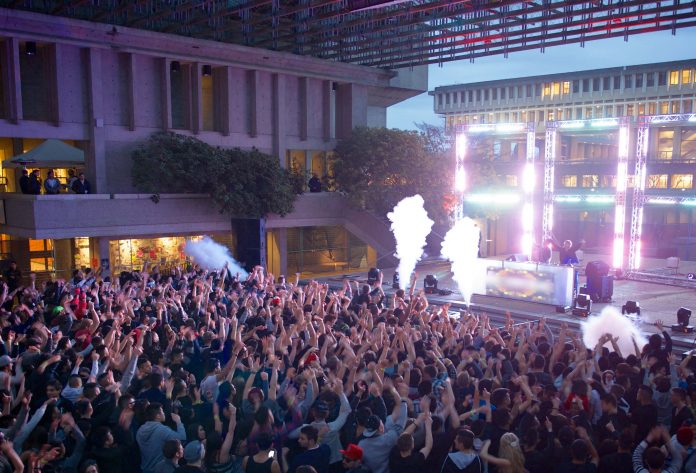
After finalizing its expenses and revenues, the fall kickoff concert hosted by the Simon Fraser Student Society (SFSS) in September 2017 saw no monetary losses. In fact, it had the highest attendance in the student society’s history, making it the most successful kickoff concert to date.

The fall kickoff concert is the largest event organized by the student society at the beginning of the academic year. The event was formed back in fall 2013, and its purpose is to foster a sense of community and school spirit amongst Simon Fraser University students, according to Alam Khehra, vice-president of student life.

In summer 2017, the SFSS Board of Directors projected that the event would see an approximate deficit of $14,000 incurred by the student society. However, after finalizing its expenses, the fall kickoff concert made a profit of $9,712 with more than 2,600 individuals in attendance. “This is the first concert in SFSS history to have more than 2,100 attendees,” rejoiced Khehra.

The 2017 fall kickoff concert generated a revenue of $131,638 and saw a total of $121,926 in expenses, which is greater than its original budget of $111,400, according to a draft financial report provided to The Peak.

Khehra also explained that the vision for the 2017 fall kickoff concert was different compared to previous years in that it was less electronic dance music (EDM)-centric and more hip hop and rhythm and blues (R&B) focused.

The students were also vital to the concert’s success according to Khehra. “Students were active in promoting this concert to their channels and our marketing efforts came across to students,” he explained.

With regards to the leftover profit, the student society intends to invest that money back into other events, according to Khehra.

“This means that the Events Committee has much more financial freedom for more events, and more so, free events [for] students including carnival[s], destress events, free snack days, and much more,” he said.

In its original agenda, the 2017 fall kickoff concert was supposed to have an after-party but due to safety concerns the party was cancelled. Khehra noted that since the after-party was booked at the Diamond Alumni Centre, this added another layer of complexity to the management of the event. “[In the future,] I would definitely do the [after-party] in the pub as it is right beside Convocation Mall,” stated Khehra.

He concluded with a positive note by saying students enjoyed the concert and saw the value in it. “Tons of students recognized that the [SFSS] were trying really hard to shift the school’s social culture . . . For students to see internationally renowned acts at a low cost, be with their friends, and for some even meet the artists is an amazing experience that I’m very proud of our team could provide for our school.”

Peak Speak: Favourite Part of 2017?

0

What Grinds Our Gears: Nesters Market

0

You know those moments when you’re on campus, you’re super busy, and you need groceries? Or the times when you need a quick snack after class? It’s too bad that Nesters is so damn expensive that you regret needing anything at all.

I, for one, live on campus, so it really makes me upset when I feel like I can’t shop there without draining my bank account dry. Chocolate bars, oranges, flash cards — you name it, it’s way overpriced. Even when it’s just cheap shit that you can buy anywhere else.

I know that the store has to make a profit and pay its employees, but it’s really messed up and unfair. Being so busy, I have no time to go elsewhere, and thus no choice but to go there for cripplingly expensive food. They’re 10/10 for exploiting students who don’t have the time, energy, or mental capacity to shop somewhere else.

PEAK SPEAK: What was the best part of 2017?

0

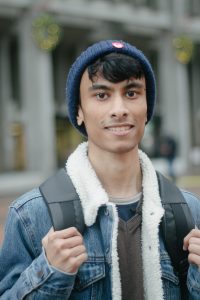
Intra Nilroy

First-year engineering

“My favourite moment in 2017 was the SFU holiday video which I did with my friends. I enjoyed it a lot.”

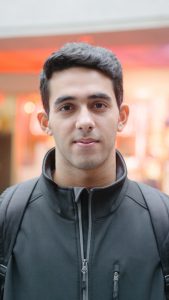
Zubair Shibly

First-year engineering

“The best thing about 2017 is that it’s over.”

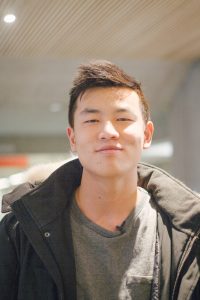
Sun Chang

First-year engineering

“So, my favourite thing about 2017 was [. . .] spending time with friends and family because they supported me throughout the year, and I’m looking forward to 2018 with them again!”

Fatima Hassan

Second-year criminology and psychology

“So, my favourite part about 2017 would be starting the new year here in Vancouver. I moved here last September, and that was my favourite part.”

Vanessa Nethania

First-year business

“My favourite part of 2017 is that I got to live in Bali for four months and travel everywhere, and that’s amazing!”

Shahvir Sarkary

First-year business

“The best part about 2017 was I started working out and yeah, that’s about it.”

Mykhailo Novytskyi

First-year business

“For me, the best part about 2017 was that I started learning Italian.”

Rare but there: Good news from 2017

0
2017 was mostly bad, but not all bad

Similar to how I don’t talk about the bangs I had in eighth grade, as a little old lady I will most likely refuse to talk about the maelstrom that was 2017. The bad, the ugly, the confusing, and the horrifying have jumped to our attention throughout the year, but a few good things did happen. Here are seventeen pieces of good (or at least entertaining) news to boost your morale and make you a little bit more optimistic for 2018.

  1. In the last six years, the tiger population within Royal Manas National Park in Bhutan has doubled.  
  2. Canada passed Bill C-16 to protect Canadians against discrimination based on gender identity and expression.
  3. In a feat of human ingenuity, Carter Wilkerson managed to have a Tweet retweeted 18 million times and earned a year’s worth of free chicken nuggets from Wendy’s.
  4. NASA has found the largest amount of earth-sized planets which are outside of our solar system but within a habitable zone (far enough yet close enough from a star to maintain liquid water and possibly sustain life). Thomas Zurbuchen of NASA’s Science Mission Directorate has stated, “The discovery gives us a hint that finding a second Earth is not just a matter of if, but when.”
  5. Beyoncé and Jay Z welcomed twins Sir and Rumi to the world.
  6. As if Beyoncé weren’t doing enough to keep us afloat, it was announced that she will also star in Disney’s The Lion King remake as Nala. Beyoncé joins Donald Glover (Simba), James Earl Jones (reprising the role of Mufasa) and Chiwetel Ejiofor (Scar) in the film’s star-studded cast.
  7. Smith College (Massachusetts) has opened its doors to students at the University of Puerto Rico affected by Hurricane Maria. For one semester, Smith College is offering affected students a full ride including tuition, room and board, application costs, as well as financial aid to help students afford travel, textbooks, and other school-related costs.
  8. Doctor Who cast Jodi Whittaker as the first female Doctor in the show’s history. She is the fourteenth actor to take the role of the quick-witted, regenerating, time-traveling alien. Whittaker made her first appearance during the Doctor Who Christmas special.      
  9. The BC provincial government banned the trophy-hunting of grizzly bears. Though meat hunting will still be allowed outside of the Great Bear Rainforest and the details are still blurry, it is a step in the right direction for conservationists and the Indigenous nations protesting grizzly hunting on their traditional land.  
  10. Italian astronaut Paolo Nespoli became the first person to contribute to Wikipedia from outer space.
  11. Trans women are taking names in American politics. On November 8 Danica Roem unseated a transphobic lawmaker to become the first openly-trans person to serve in a state legislature, while Andrea Jenkins became the first openly trans black woman elected to public office.
  12. The United Nations announced that the global total percentage of protected seas has risen to 12.7% in 2017. 3.6 million square kilometers of ocean are now designated Marine Protected Areas. For perspective, that is an area larger than India.
  13. Women in Saudi Arabia are now allowed to drive. Saudi feminists and activists have celebrated this step towards women gaining their independence. Some women have already stepped up to become the first female chauffeurs and taxi drivers in the kingdom.
  14. The World Health Organization has announced that HIV/AIDS is no longer the leading cause of death in Africa.
  15. Patty Jenkins’ Wonder Woman became the highest-grossing superhero origin movie in cinematic history. She is the first woman to direct a superhero film, and the most successful woman to ever direct a live-action film, breaking one of many glass ceilings in Hollywood. Other movies that made waves in 2017 include Star Wars: The Last Jedi, It, The Fate of the Furious, Guardians of the Galaxy Vol. 2, and Beauty and the Beast.
  16. You’ve probably heard of the aurora borealis, but a new kind of aurora has recently been isolated and named Steve. It gets better as astrophysicists might actually keep Steve’s name if their current theories on its nature pan out, as it could serve as an acronym for Strong Thermal Emission Velocity Enhancement.  
  17. Though not all survivors of sexual harassment or violence receive the support and justice that they deserve, TIME has made The Silence Breakers Person of the Year. To celebrate survivors who were able and willing to make their stories heard, TIME has said, “They’re part of a movement that has no formal name. But now they have a voice.”

BC government asks for feedback on sexual misconduct policies

0
Image Credit / Maxwell Gawlick

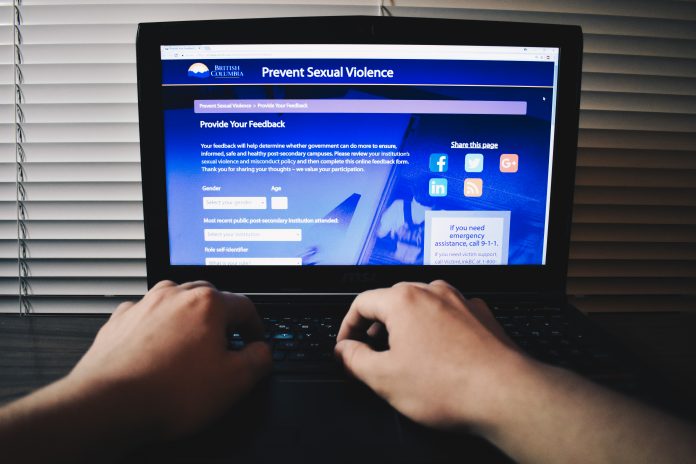
BC’s Advanced Education, Skills, and Training minister Melanie Mark has asked post-secondary faculty and students for feedback on the sexual violence and misconduct policies at their institution. The feedback period will run from now until the end of January 2018, and is facilitated via an online feedback form.

BC became the second province — after Ontario — to have mandatory sexual assault policies at its public post-secondary institutions after years of claims that sexual assault allegations were mishandled by staff and faculty. Experts have deemed these policies as good starting points for students who feel like they have been victims of sexual harassment or assault by peers or faculty, outlining options for taking action against their perpetrators.

“I want to use feedback to ensure we have a strong policy framework in place that centres on the health, safety and well-being of our post-secondary community.” – Melanie Mark

As of May 2017, all public post-secondary institutions in British Columbia were instructed to have a sexual misconduct policy in place outlining the definition of “sexual violence and misconduct” and how the staff plans to handle the situation if a complaint is brought up. The policy must be made available online for public viewing. On May 19, the Sexual Violence and Misconduct Policy Act (SVMPA) was passed into BC’s legislature as a formal law.

According to the SVMPA, the sexual misconduct policies at each post-secondary institution must be revised every three years, or immediately if directed to do so by a minister. The institution must consult with students and factor their opinions into the review. After, the institution will determine if the policies require amendments. If amendments are required, they have to be made under law.

Mark released a statement on December 4, referring to the SVMPA as a “first step” to a larger vision for post-secondary institutions: “Moving forward, I want to raise awareness of the policies and ensure the policies are effective in protecting our students, faculty and staff. I want to use feedback to ensure we have a strong policy framework in place that centres on the health, safety and well-being of our post-secondary community.”

The move to address sexual misconduct policies in BC coincides with SFU’s internal efforts to update its own Sexual Violence Misconduct Prevention, Education and Support policy (SVMPESP), a revised version of which was released in March 2017 following the alleged mishandling of sexual assault cases in 2016.

The revised SVMPESP explicitly defines terms associated with sexual assault such as consent, survivor, and sexual violence and misconduct, as well as the actions that fall under each term. Under clause 8.0, if a survivor chooses to report their assault to the university, they are then given different options to start an internal process. They are promised full confidentiality during the process.

To access the feedback form to comment on SFU’s sexual assault and prevention policy, visit https://engage.gov.bc.ca/preventsexualviolence/feedback/

With files from CBC News.

SFU through 2017, a review of the ups and downs

0

SFU wrote a sexual violence policy

It’s great that SFU finally has a comprehensive policy on sexual violence, both to keep students safe and to hold SFU more accountable when they fail to maintain that safety. It’s progress towards truly creating a genuine consent culture on our campuses and it establishes zero-tolerance clearly.

However, we should make sure we do not become complacent. We should continue to explore further ways to improve our policies and otherwise address sexual violence on campus. During the draft stage, for instance, a Peak editorial suggested mandatory sexual misconduct education for all students. Whether or not you agree with that particular idea, continuing to innovate and research in this regard is critical.

We should also remember that SFU still has a ways to go as far as their ability to take initiative on this kind of issue. Let’s not forget that SFU didn’t create a policy until after Bill M 205 forced all of BC’s post-secondary institutions to do so. Moving forward, let’s strive to be better at handling these sensitive crises without being forced to do so.

But regardless of what the impetus was, the fact that we have the policy and the Sexual Violence Support and Prevention Office now is 100 per cent an important step forward. Keep it up, SFU.

The SFSS changed their election and referendum policies

When the SFSS introduced their revamped election policies, there were positives and negatives. It was great to hear that the Independent Electoral Commissioner (IEC) would be working harder to boost voter turnout, and that there would be better, more consistent disciplinary measures in place to deal with candidates who broke rules.

On the other hand, one Peak article notes that many of the IEC’s powers have been taken by the SFSS themselves — which is counterproductive to the lack of conflict of interest that having an independent electoral commissioner is meant to accomplish. It’s also disappointing to see that all-candidate debates will only be held at one campus now, though this is understandable if turnout has been bad over the years.

On the whole, the policies do some important work, but there are some tangible design flaws here nonetheless.

The world talked about the SFU Clan

The story behind the petition to stop being the SFU Clan went viral. Locally and globally, several news sources got in on the coverage. Do we have a duty to pay attention to the American cultural context of “clan,” especially as a school that plays in the NCAA? Or would changing our Clan name merely set a bad precedent for allowing hate groups to co-opt and control language through fear tactics?

I would personally suggest that we owe it to the thousands on thousands whose lives have been influenced by the Ku Klux Klan to change. “Holocaust” used to just refer to destruction by burning or nuclear power; the R-word used to be a normal word for talking about decreased speed. But there’s a reason we’ve mostly ceased to use words like these in common discourse.

Either way, I am pleased that we had the discussion. What I do wish is that the conversation had ultimately been more productive. Despite the media firestorm, I don’t feel that SFU Athletics has really responded. Choosing to keep the name is understandable, but “exploring our strategy and approach in how best to move forward” seems to have amounted to “wait for people to forget this.”

The saddest part of all is that everyone seems to have overlooked the fact that, well, forget the Clan: our entire school is named after a massively colonialist prick.

Highland Pub closed and SFU took over Food and Beverage Services

When the Highland Pub closed, it was a . . . I don’t want to say “nail in the coffin” for campus life, because SFU campus life has been dead for so long that its intellectual property is public domain and the carrion beetles have moved on to the next dietary craze. But it did remind us that we were losing yet another vestige of the university experience. (Personally, I was more upset to lose Higher Grounds. The Italian sodas were bomb and the baristas were great.)

I would have loved to see those services remain in student hands, even if it meant an overhaul was still in order. Student-run food and beverage services have great potential to, well, stay relevant to students, and harkens back to SFU’s very anti-authoritarian roots. It even gives back to the student community in a very real way by providing jobs.

But with all the money the Highland Pub lost, I can understand what led to the decision to transfer Food and Beverage Services to SFU. Not because I blame the student-run component for the lack of success — I don’t, to be clear — but because, from the SFSS’s and SFU’s point of view something clearly had to change. All I can hope for is that the changes SFU brings are for the better, and that we get a cafe and pub that does a much better job of engaging students.

SFU and reconciliation

This year, SFU has had ups and downs in the journey toward reconciliation. In April, they tried to can the Aboriginal University Transition Program. On the other hand, they brought it back after being petitioned. They’ve also taken on the SFU Aboriginal Reconciliation Council’s calls to action, to be implemented over a three-year timeline.

Because the process of reconciliation is such a continuous matter, and because the witnessing ceremony to confirm SFU’s acceptance of the calls to action has only just happened, it would be remiss to offer any sort of definitive evaluation. What can be said is that SFU has made progress, and the hope is that they continue on this trajectory.

Cool stuff you can buy from the new TransLink store

0
Illustrations by Janis McMath

While you were waiting in the snow for a bus that would never come, TransLink was devoted to coming up with a way to improve their service — and now their work has finally come to fruition. The TransLink merchandise store (https://translinkstore.ca) we’ve all been waiting for has opened. The new store features many classic items such as ugly-ass $60 bus print pillows, and a poster of a bunch of words in semi-fancy type. TransLink obviously has a great grasp on what is trendy and cool, and they are set to release the following items on this list in the near future in hopes of scamming even more tourists.

  1. TransLink scale model skytrains, passengers, and track set
    Model only; not suitable for children . . . because it sucks
    $250.00

    Each cart links together and breaks down just as often as the real thing!

    Use Bluetooth® controllability to run your skytrains on multiple tracks from station to station — or run your trains on one track if you want your passengers to overcrowd! Tracks come with real malfunctioning switches! Additional “shut-down” function to simulate the patented TransLink Complete Computer Melt Down® which stops all the trains for eight hours and forces the passengers to walk on the track down to the refuge of shuttle buses! Skytrain model dimensions are 6″ L x 1.5″ W x 1.5″ H.

    No refunds on this item.

  2. Bus baby onesie, sky blue
    $16.95 
    A classic 100% cotton onesie that reads, “You never gave up your seat for my mom when she was pregnant, so now I’m going to shit myself on transit!” Available in six-month, 12-month, and 18-month sizes.                                                                                                                            
  3.  System map pencil case
    $10.95

    A pencil case featuring a downtown Vancouver system map on one side, and a Surrey system map on the other side so you know exactly what routes to take to avoid Surrey. Constructed from neoprene material. Size: 9″ x 4″.

  4. Skytrain beach towel
    $38.50

    Finally, an opportunity to wipe your ass on TransLink. Features double-shearing for extra softness and 100% cotton. 35″ x 60″.

  5. “Please move to the rear of the bus” button
    $6.00

    Drive your friends and family wild with this classic line heard on routes all over Metro Vancouver! Perfect for children that love to button mash and all of those family members of yours that love subjecting people to extreme psychological pain.                                                                                                                               
  6. Unisex classic “gag” T-shirt
    $27.00

    Featuring the classic gag “I paid the $5 Canada Line YVR AddFare and all I got was a regular ticket at an increased price!” Crew neck T-shirt constructed from 50/50 organic cotton and recycled poly. Comes in blue and white or yellow and grey. Made in Canada.                                                                                                                                                                         
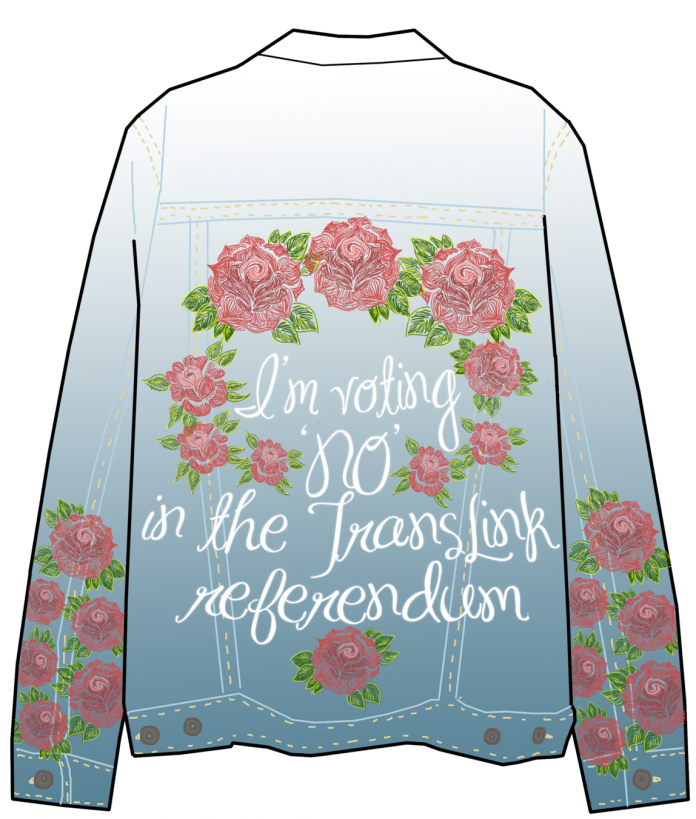
  7. Unisex stylish jacket with slogan, “I’m voting ‘NO’ in the TransLink referendum!”
    $125

    For all you rebels out there, here’s a jacket to show off that you actually have an opinion on a political issue for once. This is a pricey jacket which costs roughly what we asked for from one household in the referendum so it’s really odd that you’d buy this jacket from us, but hey, some of you pay $65 dollars to a corporation for an anti-corporate message on an OBEY sweater — so we thought we’d take a shot at selling political ideologies too. Comes in black or blue. Made in Canada.

    On backorder.
                                                                                                                                               
  8. TransLink policeman cap
    $16.00


Perfect for kids! When you wear this cap, you can pretend that you’re a real police officer the same way TransLink cops pretend that they’re real police officers! Suitable for ages two and up. Made in Canada.