Home Blog Page 623

SFU women’s basketball fall short against Northwest Nazarene 76–67

0
Only seven players dressed for the Clan in the loss. Kelsey Nikl / The Peak

On Thursday night, the SFU women’s basketball team played host to Northwest Nazarene, the second place team in the Great Northwest Athletic Conference (GNAC), in the second part of a double header for the SFU basketball teams. The Clan played admirably throughout the contest, but were unfortunately not able to keep up with the Nighthawks as they showed why they are one of the most dominant teams in the conference.

The teams battled back and forth in the first quarter, as neither team could push much in front of the other throughout the frame. After being down by seven points with less than a minute to go, the Clan put up a quick 8–0 run to end the quarter and give themselves their first lead of the game. After assisting a basketball with six seconds to go, Tayler Drynan then stole the ball off the inbound pass and hit a buzzer beater three to end the quarter. This basketball gave the Clan a 17–16 lead heading into the second.

After the teams traded baskets for the first few minutes of the second, SFU regained momentum, and led the game from the 3:52 minute to the end of the half, after nearly three minutes without a basket. The team’s would go into the second half with a score of 35–32, in a game where SFU was in great position to pull of a major upset.

As good teams always seem to do, however, Northwest Nazarene bounced back.

The third quarter was far from ideal for the Clan, as they were outscored 29–13 in the frame. Much of the damage came during a 16–2 run for the visitors, in which SFU couldn’t buy a bucket or seem to get a stop. A pair of free throws by Sophie Swant at the end of the quarter stopped the bleeding, but it seemed all but too late. The teams head into the fourth quarter with a score of 61–48 in favour of the Nighthawks.

While the Clan bounced back in the fourth, it was too little too late. The team cut the deficit to single digits just a minute and a half into the frame, but were unable to sustain any major run for the rest of the game. A three-pointer by Jessica Jones gave the team some hope as it cut the lead to seven with under a minute to play, but some free throws down the stretch by Northwest Nazarene put the game out of reach. SFU would eventually lose 76–67.

Four Clan players had 14 points or over, as Swant and Drynan lead the team with 16 points, and Jones and Tayla Jackson pitched in with 15 and 14 points, respectively. Coincidentally, all four players took 11 shots from the field in the contest.

Only seven players dressed for the team on the evening, as Nicole Vander Helm sat out with an injury.

With the loss, Simon Fraser is now 6–11 in conference play this season, and 11–14 overall. Their next game is on Saturday night as they host Central Washington on Pink Night, in support of breast cancer awareness. Tipoff is at 5:15 p.m.

SFU men’s basketball win 10th game of season with largest win in SFU NCAA history

0
N'Kosi Kedar Salam averaged 20.4 points per game in the 2017-2018 season. Kelsey Nikl / The Peak

On Thursday night, the SFU men’s basketball team had everything going their way as they hosted the University of Alaska Fairbanks Nanooks. Shots were falling, the defence was stellar, and the Clan won the rebounding battle, an area where they’ve struggled all season. N’Kosi Kedar Salam out-did what we’ve come to expect from the Great Northwest Athletic Conference’s (GNAC) leading scorer, and Jordan Muir-Keung contributed one of his strongest games of the season. Eventually, the Clan would win 83–51, in a game in which they dominated from start to finish.

Forward Tyrell Lewin scored the first basket of the game 30 seconds in, and the Clan had the lead from then on. The team pulled away by the nine-minute mark in the first half, as they took a 13-point lead off a fastbreak layup by Salam. SFU would hold a double-digit lead for the rest of the game, in what was undoubtedly their most impressive performance of the season. The teams would go into the break with a score of 41–31, after a last second three-pointer by Alaska’s Davis Kimble.

At this point, Salam and Muir-Keung had already made a major impact in the game, leading the contest with 14 and 11 points each, respectively. Salam did it on 6–9 shooting from the field, while Muir-Keung was a perfect 4–4 from the field, including three three-pointers. The team as a whole was shooting lights out, going 16–29 from the field (55.2%) and 7–13 from three (53.8%).

We have seen many games this season in which the men’s basketball team has had a solid first half, but struggled in the second. The difference in this one was that they put the pressure on their opponent even more in the second.

The Clan put the game away by the 14:23 mark in the second half, after Salam hit a three to give the team a commanding 21-point lead. As the final score suggests, the team never looked back from there, having a dominating 30+ point lead for long stretches of the game, where they won by 32 points, 83–51.

As we’ve come to expect, N’Kosi Kedar Salam led the game with 31 points. He currently leads the GNAC with 21.1 points per game. Muir-Keung also built on his strong first half, finishing the game with 19 points.

With the blowout victory, SFU made history, as it is their largest win in the team’s National Collegiate Athletic Association history. The win becomes more impressive when comparing where the two teams are in the standings, as Alaska entered the game in sixth place in the GNAC, a playoff spot. The Clan, on the other hand, now sit at 4–13 in GNAC play this year, only above of the winless Concordia University Cavaliers. SFU is now 10–15 overall this season. If anything, this win shows that the Clan are able to play competitive basketball in the conference, and could of been looking at a playoff race if they were able to pull off a few more wins in close games this season.

The team will next play on Saturday as they host University of Alaska Anchorage in their last home game of the season. The game is also Senior Night, where Salam, JJ Pankratz, and Iziah Sherman-Newsome will be honoured for their time in the SFU uniform. Tipoff is at 7:30 p.m.

Board games for bored university students

0
Illustrations by Reslus

Are you the type of student that naturally procrastinates by any means available when you have an assignment due the next day? Are you willing to do really boring activities you normally wouldn’t ever do just to forget about work? If so, these games are for you!

UniverCity


It’s like Monopoly, except you don’t own any properties or have any buildings, so on almost every square you land on you end up owing someone money. It takes about four turns around the board till you’re completely broke. Landing on the bookstore square even once can almost completely clear out your bank.


Guess Who???

Similar to normal Guess Who, except with more question marks and uncertainty, since you’re trying to guess who the random person who just approached you is. Does he . . . have a psychology textbook with him? Is she . . . wearing a faculty sweatshirt? Is that the guy I sit next to in my 8:30 a.m. tutorial whom I never speak to?

Battlebus

Think your traditional game of Battleship, except your pieces are the buses and your opponent has pieces symbolizing sudden snowfalls, car accidents, and faulty engines — all designed to make you late for your midterm.

Cards Against Humanity: University Edition

Includes clever cards like “My most recent breakdown was caused by________,” “At my 9:30 lecture I saw________,” “I’m in debt because_______,” “Tuition fees are due ______,” “Microwavable burritos,” “I’m so exhausted,” “$4,500,” and “The cute girl in my biology tutorial I’m too scared to talk to.”

Partying and Studying

Take your typical game of Snakes and Ladders but replace ladders with studying and snakes with partying (or Netflix, more likely). You can climb the ladder and get closer to your goal, via studying, or you can sink further from your goal of graduation with constant snakes — AKA partying (or bingeing Stranger Things season 2).

Participation

Similar to the classic Operation, except it’s you trying to get a word in at your tutorial. Every time you go to raise your hand or open your mouth to get those precious participation points, some eager freshman classmate interjects. Bzzzzzt! 0/10 for participation.

Clue: Ultra Hard Stats Lecture Edition

You’ve missed quite a few classes this semester already — so now, the week before the midterm, you have to put all the pieces together. There are giant gaps in your knowledge, which your teacher will sometimes hint at . . . but you’re still mostly in the dark. Can you discover the answer to all these stat riddles??? The solution: you, in your room at 3:30 in the morning, sobbing over your textbook.

Mastermind: Steven Soderbergh

0
(Photo courtesy of Claudette Barius)

Looking for a director whose movies are worth watching repeatedly? Try Steven Soderbergh. He is known for his heist films that offer hilarity, complemented by unassuming intellect, and original storytelling. His recent heist film, Logan Lucky, benefits from its quirkiness, and from its unusual casting that works surprisingly well. Soderbergh also provides an Ocean’s Eleven flair through the film’s clever dialogue, plot, and energetic music to evoke the story’s fast-paced thrills.

     Soderbergh came to prominence with his Ocean’s trilogy. The Ocean’s trilogy demonstrated Soderbergh’s keen eye for detail. His visually appealing camera angles and vibrant dialogue between characters entices you to follow all the immense twists and turns in the series.  However, this trilogy has yet to falter because of the forthcoming sequel, Ocean’s 8, which will have an all-woman leading cast, to be released this year on June 8. Soderbergh is only a producer for Ocean’s 8, but the movie will most likely carry over his unique style from his previous heist films.

     Soderbergh also delivers suspense and horror in Contagion. He explores disease as not only a threat to people’s health, but also a psychological catalyst for the moral compromises in the story. Chilling dialogue amplifies the ominous tones of the narrative’s equally unsettling, yet believable reality.

     Whether it’s his Ocean’s trilogy or Contagion, Soderbergh continues to amaze us with his genius. Make sure to catch his other films that demonstrate his superb directing skills, such as the action spy thriller Haywire and true stories: Erin Brockovich and The Informant!

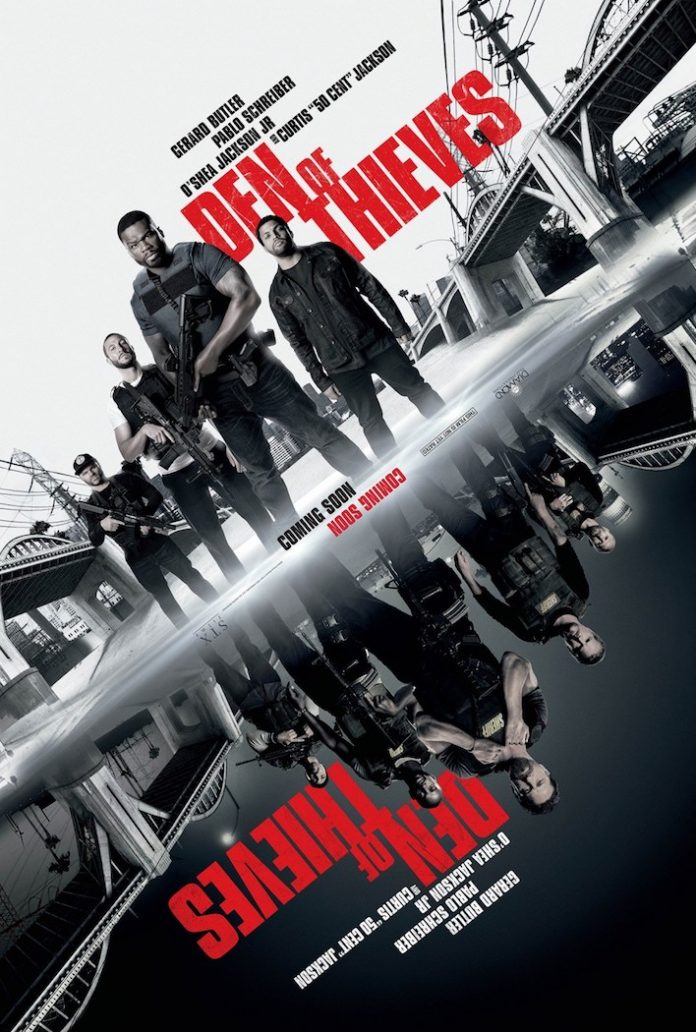
Den of Thieves delivers loud noise, awkward scenes, and nothing more

0
(Image courtesy of STXfilms)

There are certain films you should steer clear of every year. Den of Thieves is one of those films. This recent heist movie was not as good as I thought it would be, even with its minor nuances. Its shortcomings were a reminder that your expectation of enthralling action story can easily fall away and never return.

     The main premise of the film was undermined by unanswered questions and irksome situations too convenient to believe. The film’s climactic heist had cliche twists similar to Fast Five, resulting in a lack of any surprising intricacies. Even the build-up to that heist was painfully gradual. The narrative structure was impeded by irrelevant scenes and plot points that sadly amounted to lifeless filler content that harm the movie’s overall quality.

     The beginning hit hard and fast with a thrilling action sequence, but the middle dragged on, especially when the story digressed and examined the family lives of some characters. Uncomfortable comic relief in some scenes, coupled with unwanted drama in others, were almost unbearable to watch. With awkward timing and delivery that offered nothing to the film, these scenes could have been omitted entirely. Instead, they destroyed the startling momentum that the movie’s intense start worked so hard to achieve. The story failed miserably to surpass gritty heist films that have come before, such as The Town and Triple 9.

     Gerard Butler was passable in this film, but he could have been better. Butler’s performance as a hard-boiled, chain-smoking Los Angeles sheriff, gunning after the film’s thieves, was hindered by his character’s immature behaviour and uninspiring dialogue throughout the film. Many other characters were two-dimensional. A small role from rapper 50 Cent (whom I haven’t seen since his cameo in Spy) barely registered in an already shallow plot. There were some good moments in this film, but not enough to save it from the story’s simplicity and predictable ending. For instance, an interrogation scene between Butler and newcomer O’Shea Jackson Jr.’s characters rebuilt the momentum after the film’s first action scene, but it was lost again as the narrative progressed into its climax.

     The action in Den of Thieves is good, if you don’t mind the loud gunfire in the film’s shootouts that disorient you rather than providing captivating action scenes. What you see is what you get: an unimpressive bank robbery film that, together with dry characters and a simple plot, offer no breakthroughs for the heist genre — only loud sprays of bullets and lacklustre twists.

Unaired Shark Tank pitches

0
Illustration by Janis McMath

We’ve all seen Shark Tank, a show which features entrepreneurs pitching their business ideas and products. Some of  the entrepreneurs are lucky enough to catch a shark to invest — others are eaten alive for their nonsensical ideas. During the latter, viewers often cringe at their TV screens while thinking, “Could any idea possibly be worse than this?” The answer is YES — there are worse ideas. Pitches and products so bad, they were untelevised. The untelevised pitches have been leaked for the first time, revealing a new low of idiocy and ridiculousness. This is our list of the top five worst pitches of all-time . . .

DIY Condom Kit

A new study reveals that 80% of women think DIY skills are the sexiest skills a man can have. Now, with our product, you can simultaneously demonstrate your handy skills while turning her on with our DIY Duct Tape Condom Kit. Kit includes duct tape, scissors, and comprehensive instructions in Swedish.

Excuse-a-Day Calendar

Is finding a way to lie to your spouse or partner the only thing holding you back from cheating? Here’s the easy fix: a calendar that features daily excuses to cleverly and persuasively conceal your infidelity.

HomeTone by RingTonez.com

Our ringtones are edgy, unexpected, and will remind you of home — literally. Select your ringtone from an assortment of noises we’ve collected from your everyday home appliances, such as the hum of a refrigerator, the buzzing of a microwave, the drip of an icemaker, and the rattle of a washing machine.

Feminist-Free Beer

Are you a self-described misogynist? Do you have a rigid sexist mindset? Do you enjoy offending women? If you answered ‘yes’ to any of these questions, our feminist-free beer is perfect for you! Similar to how a diet-soda has zero calories, this alcoholic beverage contains ZERO remnants of feminism — so you can rest easy knowing the whole process, from brewing it to stocking it on shelves, was done by a chauvinist just like you!

iCrack

We all know seeing a cracked screen makes asking the question “what happened to your phone?!” irresistible to the majority of the population — despite the appearance or stature of the phone owner.  So, if you’re ugly (or simply have trouble starting conversations) try iCrack — the regular phone with the screen pre-cracked! You’ll see the exponential difference in the amount of people approaching you for conversation.  Cracks come in small, medium, and large.

Stuff we like and don’t like

0
(Elena Hsu / The Peak)

Stuff we like: Call of Duty: WWII Prop Hunt

Prop Hunt is a special game mode offered in Call of Duty: WWII that allows players to play hide-and-seek as mundane objects in their regular match maps. In each round, one team is assigned various objects: such as trees, signs, statues, or furniture. The other team is made up of regular soldiers and must shoot down any objects that appear out of place. Every thirty seconds the hidden objects whistle to hint to their location. The props are also armed with flash grenades and the ability to change objects two times in order to outmaneuver their opposition. Don’t see the appeal? Well, I spent hours laughing as I watched army men chase and attempt to shoot down a tree that was jumping and spinning away. This mode was a temporary feature but it will be returning February 20–27 so don’t miss your chance to play!

Stuff we don’t like: Rotten Tomatoes critic reviews

Many people enjoy looking up critic reviews prior to watching a film, but lately I’ve discovered the great discrepancy between the Rotten Tomatoes’ critic reviews and their user reviews. Some people believe that the critic reviews are more accurate because they are written by people who watch tons of movies for the purpose of reviews, but as an avid moviegoer myself, I find the user reviews are typically more valuable to read. Perhaps this bitter response to Rotten Tomatoes is just in defence of The Greatest Showman. That movie deserved more than a 55% score, thank you very little!

SFU works to incorporate more fair trade products

0
As of January 31, all bananas sold on campus are fair trade. (Photo credits / Andres Chavarriaga)

A fair trade social held on January 24 was SFU’s latest development in the campaign to make the university a sustainable consumer. The event was held at the Halpern Centre and highlighted the impact SFU has made over the last five years as it strives to become a silver fair trade campus.

Event attendees enjoyed fair trade snacks such as cupcakes, ham, fruit, vegetables, and red and white wine as Torrye McKenzie, program manager of the Canadian Fair Trade Network, spoke towards recent and upcoming SFU-related movements in the fair trade campaign.


SFU goes fair trade

This past summer, the Canadian Fair Trade Network released new standards for fair trade certification, including a silver and gold tier. Following the announcement, SFU declared its goal to become a silver fair trade campus. To that end, SFU became the second Canadian university to carry fair trade bananas, after University of Concordia, on January 31. Fair trade bananas are sourced from plantations that have been evaluated to provide protection of workers rights, wages based on the fair trade minimum price as opposed to market fluctuations, environmentally sustainable operations, and investment in community projects.

The opening of Starbucks on campus was a major step towards SFU’s fair trade certification in 2012. Despite the added protections upon coffee farmers’ wages, “the price of a cup of coffee didn’t go up a cent,” emphasized McKenzie as she addressed the common misconception that a fair trade campus would mean higher prices for students.


The Tim Hortons dilemma

Another coffee chain on campus, however, is proving to be a hurdle for SFU’s goal to reach silver fair trade certification. Tim Hortons, a popular food option on campus, does not offer any fair trade certified coffees.

Mark McLaughlin, SFU’s chief commercial services officer, Ancilliary Services, and other staff involved with SFU’s fair trade campaign have been in discussion with the franchise to discuss the incorporation of at least one fair trade coffee option. Barring an agreement, it was emphasized at the fair trade social that Tim Hortons will most likely be shut down, as a coffee vendor on campus without fair trade options would prevent SFU from reaching silver fair trade certification.


Next steps

McKenzie spoke towards SFU increasing integration of fair trade products on campus moving forward. Harbour Centre will also act as host for the sixth annual National Fair Trade Conference.

A significant portion of student involvement in the fair trade campaign comes from SFU’s fair trade ambassadors. At the beginning of each academic year, SFU recruits five students passionate about sustainability, who represent and share events promoting fair trade at SFU.

Judge Rosemarie Aquilina’s sentencing of Larry Nassar was within her judicial rights

0

Larry Nassar was a respected, world-class American sports physician. Parents were eager to take their blossoming athletes to him, some of the country’s greatest female gymnasts, for treatment of varying aches and pains. Now, he will spend the rest of his life in jail for sexual assault of children as young as six years old, under the guise of medical treatment.

The trial and the sentencing

Rachael Denhollander was the first victim to come forward, speaking about the abuse she suffered at the hands of Nassar, “At age 15, when I suffered from chronic back pain, Larry sexually assaulted me repeatedly . . . He did this with my own mother in the room, carefully and perfectly obstructing her view so she would not know what he was doing.”

One by one, other victims of Nassar stepped forward, including Simone Biles, Gabby Douglas, McKayla Maroney, Aly Raisman, Jordyn Wieber, and many others. Complaints against Nassar date back to 1997. All were shrugged off.

Kyle Stephens described how she was abused by Nassar from a young age, him exposing himself to her and masturbating in her presence. She was too young to understand how wrong it was. Elite gymnast Mattie Larson describes purposefully injuring herself in order to avoid going to national training camp, where she knew Nassar would be.

Over the course of the trial, a total of 156 victims spoke, recounting abuse they suffered at the hands of Nassar. Nassar himself also addressed the court, in the form of a letter written to the judge early in the hearing, saying, “I was a good doctor, because my treatments worked and those patients that are now speaking out were the same ones that praised and came back over and over. The media convinced them that it was wrong and bad. Hell hath no fury like a woman scorned.” As the trial continued, he changed his tune, suddenly apologizing to the victims. He also claimed he feared the impact hearing victim statements would have on his mental health.

The Michigan judge, Rosemarie Aquilina, appeared disgusted at his words. “You may find it harsh that you are here listening, but nothing is as harsh as what your victims endured for thousands of hours at your hands. Spending four or five days listening to them is minor, considering the hours of pleasure you’ve had at their expense, ruining their lives.”

Larry Nassar was sentenced to 40 to 175 years in prison for the sexual abuse of more than 150 female athletes.

Judge Aquilina wasn’t about to let Nassar get away with rape

For Nassar to claim himself to be a “good doctor” is an insult to doctors everywhere. To then imply that his patients came back again and again because his so-called “treatment” was so effective is repugnant. How exactly, Mr. Nassar, is unlawfully penetrating patients and masturbating in front of them so effective?

To even think that he could be exempt from hearing victim statements — statements recounting the abuse he put them through from as young as six years old — due to his fear that it will negatively affect his mental health?

Excuse me if I don’t shed any tears for serial child molesters.

Aquilina’s fierce outpouring of compassion and support for sexual assault survivors is unfortunately rarely seen in media reports of cases like this. We more often see ludicrously lenient sentences, such as the case of Brock Turner serving only three months in jail for sexual assault of an unconscious woman. Robin Camp’s statements to sexual assault victims regarding “keeping their knees together” also spring to mind.

When we’re so used to abusers getting away with heinous crimes and a victim-blaming mentality in the judiciary, anything out of that norm can feel shocking and radical. However, not everyone is praising Aquilina — while some of those concerns are certainly valid, Aquilina’s actions overall were commendable.

Aquilina’s conduct, for the most part, did not overstep the bounds of justice

It is interesting how when discussing a white male rapist, we hear cries of impartiality and the female judge being mean or harsh, but when disproportionate amounts of marginalized populations are being sent to prison, the critics seemingly fall silent.

Citing quotes like “it is my honour and privilege to sentence you” and “I’ve just signed your death warrant,” critics claim that Aquilina went beyond her role as a judiciary, threatening her impartiality, and therefore, justice in general. Public defender Rachel Marshall expressed concern “when judges use individual cases to send a broader social message” and become advocates. Many were concerned it could lead to a retrial.

“Bottom line,” says David von Ebers, a senior legal editor for Thomson Reuters Practical Law, via Twitter, “If you think the Nassar judge’s comments were inappropriate or even unusual, you should go down to 26th and California in Chicago and listen in on sentencing hearings in murder cases.”

Stephen Gillers, a professor at New York University and an expert in legal ethics, notes that in 1994, the Supreme Court ruled that “a judge can, upon completion of the evidence, be exceedingly ill disposed towards the defendant, who has been shown to be a thoroughly reprehensible person.” I think it is safe to say Larry Nassar meets these qualifications. We have seen frank opinions and emotionality from judges in previous cases, and it’s alright to do so, as long as “the judge’s opinion is drawn from the relevant facts in the case, and not extraneous factors, such as the race of a defendant.”

In a similar case, that of Penn State football coach Jerry Sandusky, Judge John Cleland gave him 30 to 60 years in prison for the abuse of ten boys. Judge Cleland had some scathing and emotional words to share, too: “You abused the trust of those who trusted you. These are not crimes against strangers, they are much worse. The crime is not only what you did to their bodies, but your assault to the safety and well-being of the community in which we all live.”

However, implying that she would wish sexual violence upon Nassar himself is not OK

Aquilina did make one worrisome comment: “Our Constitution does not allow for cruel and unusual punishment. If it did, I have to say, I might allow what he did to all of these beautiful souls, these young women in their childhood, I would allow some or many people to do to him what he did to others.”

The implication many have read into this statement is that the judge’s “do to him what he did to others” was referring to Nassar being raped. It might even “act as an incitement,” one Fortune article argues. “There’s a risk that inmates in the Michigan prison system will hear that remark and feel empowered to act on it . . . corrections officers might interpret it as a suggestion that they turn a blind eye to Nassar being assaulted.”

Admittedly, I was cheering on Aquilina as I read through recounts of her giving victims opportunities to speak and her very appropriate sentence, but at this particular comment, I found myself having to take a step back. Nassar is a sicko and a monster, but does anyone deserve to be sexually assaulted? The entire trial was condemning rape . . . but it’s OK as a punishment and retribution? It’s OK for rapists to be raped as punishment?

The veiled comment was uncalled for and unnecessary. The concept that there are possible justifications for sexual violence, under any circumstance, is dangerous. A better message would be that rape is never, under any circumstances, OK.

Legal experts supporting Aquilina agree that though the comment was unadvisable, and most likely came from the emotional testimonies and the realization of the depth of Nassar’s heinous acts. Luckily for the victims involved, this conduct will not likely raise any legal issues.

Despite concerns, Aquilina’s actions have shifted neither focus nor support away from the victims

Critics feel the judge, through this comment and her harsh conduct throughout the trial, was drawing attention away from the issue at hand and the women who had come forward. However, I don’t believe Aquilina’s comment or any of her behaviour took away focus from the victims. In fact, I respect her fierce compassion for the victims.

That she allowed each and every one the ability to speak for themselves demonstrates her commitment to those survivors. The judge is being praised by victims, their families, and observers of the case alike, being called an icon and an activist.

Denhollander even took time to thank Aquilina: “I do want to thank you, first, Judge Aquilina, for giving all of us the chance to reclaim our voices. Our voices were taken from us for so long, and I’m grateful beyond what I can express that you have given us the chance to restore them.”

Aquilina not only empowered the victims through letting them speak, but was also reportedly kind and compassionate to each and every one, inspiring them with powerful rhetoric, “Leave your pain here, and go out and do your magnificent things!” She made sure the focus remained on those most important: the women present, the survivors of `assault.

We need more judges who have positive influences on the lives of victims and survivors. I strongly feel and hope that sexual assault victims who watched the trial will feel a little bit better about the justice system, and feel inspired and strengthened by the fantastic women who took part.

If Larry Nassar meant to embarrass or mock women through his “hell hath no fury” comment, it didn’t work. Let it be a message to all scumbags and abusers like Nassar: your time is coming. When it does, you’ll be very, very sorry.


Canada’s youth summer jobs program is right to uphold the right to abortion

0

Growing up in a Christian household, I always appreciated my family’s ability to place Canadian values and identity ahead of their religiosity. My grandfather always told the story of his cousin’s coming out later in life, and how it taught him to adopt and respect the laws of our liberal democratic society, even if they contradicted his Catholic upbringing.

While my grandfather’s changed attitude about homosexuals was not state-imposed, it certainly was more in line with Canadian values. It is a facet of our culture that I’ve always admired: a commitment to shared values that supersede our backgrounds.

While this mindset is shared by most religious people in our country, there are still those who believe their private views should warrant special treatment from public resources. I was amazed to find that the narrative of Christian victimhood still alive and well in David Millard Haskell’s CBC News article about the federal government’s youth summer jobs program.

This program offers funding to various companies, businesses, and other workplaces, so that they can afford to take on more student employees during the summer months. One of the government’s recent adjustments is that, to apply for the grant, you have to commit your institution to respecting the Canadian rights outlined in our Charter. This is stated to include reproductive rights: in other words, you have to respect a woman’s right to an abortion.

Haskell’s argument is that abortion is not a Charter-promised right. Therefore, by restricting grant funding to institutions who support women’s reproductive rights, the Canadian government is overstepping their bounds. Haskell claims that the requirement “shows a complete lack of awareness of what it means to be ethical.”

But Haskell’s argument fails to understand that the Charter of Rights and Freedoms is not the only enforceable and recognized legislation of Canada’s federal government. For example, it is equally valid to say that there is no Charter right protecting access to nursing services. However, as it is a provision covered in the Canada Health Act, it would be reasonable for the federal government to ask grant applicants whether or not they agree with medical patients having rights to nursing.

Perhaps the use of the term “right” is the point of semantic confusion for Haskell; regardless, access to abortion is also covered by the Canada Health Act. Haskell is unequivocally wrong in saying that no legislation has covered abortion since the decriminalization in 1988. Abortion is “medically necessary,” which renders it protected under the Act, and abortion clinics are considered hospitals for providing the service.

The Canadian government’s requirement in regards to the youth summer jobs program is also in line with typical grant requirements. For example, the Canada Service Corps — Projects for youth-serving organizations grant shares similar requirements. The grant is also ongoing, and details ineligible candidates as those “that do not respect existing individual human rights in Canada, including the values underlying the Canadian Charter of Rights and Freedoms (Charter) as well as other rights. These include reproductive rights . . .”

Other grants include preferences for Indigenous, Inuit, and Métis recipients, or LGBTQ+ focused projects, both of which could be considered politically or ideologically motivated, but are nevertheless accepted. Government grant programs are also only temporary, and are therefore likely to reflect the agendas of the ruling parties. To compare a single grant program to the suppression of Christians in the Roman Empire, as Haskell does, is at best gross hyperbole, and at worst insidiously misleading.

Finally, no institution is coerced into applying for government grants, as Haskell’s analogy would imply. Neither are they entitled to receive those grants. If your institution chooses to privately hold beliefs contradictory to Canadian law, it should be of no shock to you that it is ineligible.

This entire issue is to make a mountain out of a molehill. It is uncontroversial in 2018 for the Canadian federal government to require support for reproductive rights. According to Pew Research Center, only 26% of Canadians believe abortion is immoral compared to 49% in the United States, with the remainder believing it to be moral or not a moral issue at all. It is clear that Canadian values, as a reflection of popular opinion, favour access to abortions. Christian ethics are irrelevant to the requirements of government grants: they are, and should be, based on Canadian law and values.

To allow institutions that oppose abortion access to government funding would be privileging religious organizations over their non-religious counterparts. Such a decision would be antithetical to our secular society. With the non-religious demographic in Canada tripling in size from 2001–11, and in some provinces reaching nearly 50%, religious arguments will continue to lose merit in our discussions about ethics, especially as it relates to governance.

Arguments like those of David Millard Haskell don’t deserve our sympathies. They ask for special treatment under the law that should apply to all Canadians equally. Our country’s freedom of religion is no excuse to oppose our laws.