Home Blog Page 561

World News Beats

0


Airport in Libya shuts down due to rocket fire

In Tripoli, Libya, the city’s sole airport, Matiga airport, closed again amidst rocket fire less than a week after it reopened. The rocket fire did not harm anyone or damage aircrafts.

The attack demonstrated the divide among the opposing factions in the city. Rival groups have attacked the capital as it is a source of funds and business.

Following the bombing, the Matiga airport has transferred all its flights to the city of Misrata’s airport.

Prime Minister Fayez Seraj had noted that the “instability in the streets” is hindering the country’s ability to hold elections.

With files from Reuters.


Former Brazilian president pulls out of latest presidential election

Former Brazilian president Luiz Inácio Lula da Silva, who appeared to be winning the Brazilian presidential race set to be held in October, has pulled out. Now his Workers’ Party will support Fernando Haddad, Lula’s running mate, as their presidential candidate.

Lula announced his decision from his detention cell with a letter. The Brazilian Superior Electoral Court had ruled earlier that Lula was “ineligible” to run due to corruption charges, leading to his incarceration. Lula has denied all such charges.

Lula was the presidential race’s front runner as future voters recalled how Lula saw Brazil through a period of economic growth during which Lula’s government helped many to escape poverty.

With files from BBC News and Reuters.


Spanish government votes on what to do with Franco’s remains

The Spanish Parliament has approved the exhumation of Francisco Franco’s body from the Valley of the Fallen Spanish Civil War monument. The vote passed with 176 in favor, two against, and 165 abstaining.

This decision has split the country’s people. Franco’s surviving family is petitioning against the decision, while Spanish Prime Minister Pedro Sanchez had made it one of his first acts in June when he became Prime Minister. Sanchez hopes the exhumation will “redress the rights of the victims of Francoism.”

Around 500,000 people died in the Spanish Civil war, which saw Franco gain control of Spain until 1975.

With files from Reuters and El Pais English.


Indonesia declares health emergency on the Island of Lombok

On the island of Lombok in Indonesia, tests have shown rising malaria infection rates after earthquakes in July and August.

Following the earthquakes which destroyed their homes, many residents were living in tents, becoming susceptible to infection. At least 128 people are currently believed to have been infected.

The local government has called on the regional and central government for mosquito nets as a preventative measure, and for help with testing and emergency services. Government officials are worried about what will happen during the imminent rainy season, as malaria mosquitoes breed more easily in wet environments.

With files from Reuters and Channel News Asia.


Vancouver records multiple measles cases

1
(Valentin Flauraud/Reuters)


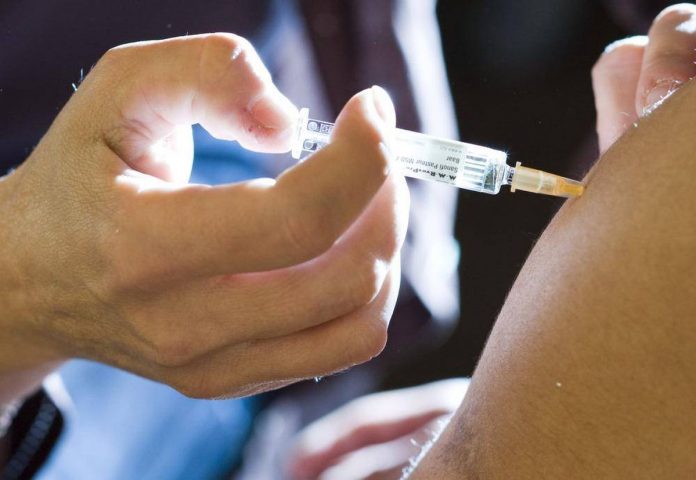
Health officials from Vancouver are urging individuals across the city and its surrounding areas to update their measles, mumps, and rubella (MMR) vaccination doses, after reported cases of measles have gone up in Vancouver.

Vancouver Coastal Health (VCH) released a public health bulletin after an individual who attended Skookum Festival at Stanley Park on September 8 had been identified to be suffering from measles.  The individual is also identified to have used public transit, attended a community block party, and visited various other locations, between September 8 and 11, where he may have exposed others to the highly infectious disease.

Individuals may have been exposed to this disease on Saturday, September 8 when the individual had attended the Skookum Festival at Stanley Park between 5 pm to 1 am. The affected individual had also taken the Aquabus from Olympic Village to Hornby Street on the same day at approximately 3pm, and the Canada Line SkyTrain from Vancouver City Centre to Broadway-City Hall Station earlier in the day between 11pm to 1am.

Those who have visited the the Outdoor Community Block Party at 1188 Quebec Street, between 1 pm to 3 pm, on Sunday September 9, could have also been exposed to the infection by this individual. Additionally, on Sunday the individual had also used the Main Street bus from Terminal Station to Broadway between 3 pm to 5 pm. Furthermore, residents near Noodlebox Mount Pleasant on 2511 Main Street in Vancouver from 12pm to 6pm, on the same day may have been exposed to the disease.

The Peak reached out to Tammy Nazaruk, Associate Director of SFU Health Services,regarding any reported cases on SFU campuses. Nazaruk told The Peak that “currently, we are unaware of any measles cases at SFU. Our clinic is prepared to manage anyone presenting with suspect measles.”

Nazaruk further added that If any student  has been exposed to measles or have a fever and rash, they should call the SFU clinic ahead when seeking medical care, following which the clinic can then prepare for the affected student’s visit, having taking precautions to reduce exposure to others.

Measles is a highly infectious and communicable disease that spreads through air. VCH stressed that, for full immunization, an individual needs two shots of the measles vaccine. Anyone who was present in the aforementioned areas at the specified date and time and has never received two shots of the vaccine, or has not been immunized by having the disease before, should check in with their doctor immediately, stated VCH.

In case of possible exposure between September 8 and 11, an unimmunized individual is projected to develop symptoms between September 15 and 29.

“If you were born before Jan. 1, 1970, you are likely to be immune. If you were born between 1970 and 1994, or grew up outside of B.C., you may have received only one dose of the MMR vaccine and require a second dose to be fully protected.” – Vancouver Coastal Health

Vancouver has been recording repeated alerts about potential measles exposure over the last month at locations including BC Ferries sailing, an outdoor community pool in New Westminster, the Vancouver International Airport, and Maple Ridge Secondary School.


With Files from The Vancouver Sun.

SFU Quidditch offers an untraditional athletic outlet for SFU students

1
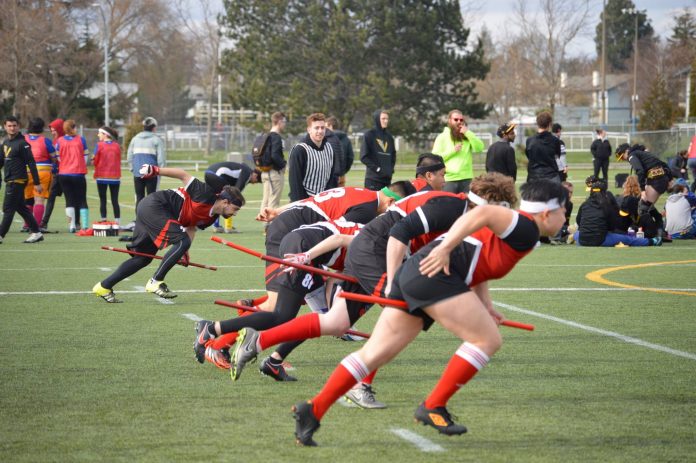
SFU Quidditch performing the "Brooms Up" routine to start a game at the National Championships in 2017. (Photo courtesy of Jessyka Schwandt)

What do you do during these first few weeks of school when you’re slightly affronted that you still haven’t received your Hogwarts letter? You play quidditch.

SFU Quidditch, an SFU sports team that has been around for five years, is “a very dumb game that we all love playing,” for “people [who] appreciate running around on a broom for fun,” says Nathan Ross, long-time member and president of the team.

The official game differs from the one in the books by J. K. Rowling in a number of respects, the most obvious difference being that players don’t fly! Instead, they run around with brooms between their legs, which also adds to the competition during the game – if a player dismounts at any point, they must run back and touch their respective hoops.

Similar to the books, there are three Chasers on the team who have to score a point by getting a Quaffle into the hoop; meanwhile, two Beaters run around to try to dismount players from their brooms; the seeker has to catch the Golden Snitch, which, seen as a small flying object in the books, is instead a third party neutral to both sides, almost like a referee in gold clothes. Seekers have to try to catch the Snitch’s tail in order to win the game.

The SFU team competes with other teams, including other university teams such as UBC and UVic, the regional teams in Edmonton and Calgary, and the Vancouver local team. They also sent players to join the Calgary Mavericks during the national championship, where they came in second overall.

The game is an amalgam of elements from a number of games – handball, dodgeball, football, track and field, soccer, rugby, and basketball. It’s a fully co-ed game, which has huge appeal. The team has open practices, meaning that if someone shows dedication, Ross is willing to train them; and the team is always looking for new recruits.

According to Ross, there is a lot of traction for quidditch in Vancouver. People want a team sport without the pressure, to play a game that they love without being yelled at for every mistake, especially if they’ve been burned by such behaviour in the past. quidditch is attractive because it’s a fun and open community, a game where you get out what you put in, and “it’s easy to create that open, friendly atmosphere at SFU Quidditch.”

Ross joined the team because they came to SFU as a huge Harry Potter fan, someone who stood in midnight release lines for the books. They comment that SFU can be socially isolated, and classes don’t do much to help alleviate that. The team at SFU Quidditch is very tight, and even when Ross isn’t feeling the game, it’s the sense of community and friendship on the team that makes them want to go.

People don’t come to quidditch because they’re a great athlete and they’ve been playing the game their whole lives. “People come because they’re looking for something dumb and fun to define their university experience,” said Ross.

SFU Quidditch can be found on Facebook here and on Twitter here. Their website can be found here. 

The inaccuracies in medical shows make for good TV, but its ability to misinform is a frustrating cost

0
Photo courtesy of ABC

We live in the day and age of hypochondriacs, WebMD self-educated “doctors,” and self-diagnosis. It is no surprise that medicine-based television has skyrocketed in popularity; Grey’s Anatomy enters its fifteenth season at the end of this month. Medical shows have only expanded in volume, from TLC reality show Dr. Pimple Popper to the more fictitious and comedic Scrubs.

Aside from shock value, a lot of these shows share a general dramatization of every possible event. The makers of shows like Grey’s Anatomy defend their accuracy by stating thatn scripts are written with physician help to assure authenticity. While there’s some authenticity in the practice of certain procedures, and surgeries, the overall show is riddled with inaccuracies.

Television shows like Grey’s Anatomy, The Resident, and Scrubs feed on drama and comedy. These portrayals are what remove the reality from the show. Instead of following realistic hospital procedure and structure, residents and interns ignore the chain of command. Instead, hospitals and medical offices are presented as if personal relationships run the hierarchy — something that would never occur in a real hospital.

Despite the chaotic personal lives of on-screen doctors, the worst inaccuracies of the show come from diagnosis. Here is where the real problems begin. Given that we live in a society with information so readily available at our fingertips, a deep fear of the unknown and a desire to constantly solve problems alone, the inaccuracy of diagnosing patients on television can cause a lot of misinterpretations.

It’s certainly bizarre to think of medical shows as a source of medical knowledge. But medical dramas like Grey’s Anatomy are a lot of people’s first exposure to medical possibilities. For example, if you feel unwell, you don’t immediately see a doctor, you typically wait a day to see if it clears up. If you can’t afford the time to see one, then you’re left to your own devices to stew in the information you have available to you.

Shows like Grey’s Anatomy feed on hypochondriacs and those who seek to self-diagnose by finding life-threatening medical mysteries in everyday symptoms. A headache becomes a brain tumor with no other signifiers but mood swings; suddenly being moody with headaches is warning of an inoperable tumor. The dramatization of symptoms encourages viewers to dramatize their own symptoms or in the case of self-diagnosing — leads viewers to mismatch their symptoms with the patients in the show.

Does this make medical comedies and dramas horrible? Certainly not. Shows like Grey’s Anatomy need certain inaccuracies to foster drama for entertainment value, adding to the tension and fun. Without these discrepancies, shows like Grey’s Anatomy, The Resident, and Scrubs would not have gained popularity. But these flaws are significant, and it shouldn’t be taken for granted just how problematic their presentation of science can be. People are free to enjoy these shows, but ultimately need to think of them as the fantasy that they are.

What Grinds Our Gears: SFU Mail

0
Image courtesy of Outlook / Microsoft

I appreciate the attempts to keep SFU platforms up-to-date and relevant, and SFU Mail is really cool in some ways, but I really don’t know why we needed it. With SFU Connect, I wasn’t completely satisfied, but I was at least content. Our mailing client knew what it was about, and it stayed in its lane as serviceable milquetoast.

But SFU Mail, summoned forth because (tl;dr version) too many professors got flirty with Microsoft Outlook, is a little prettier than its predecessor yet overall somewhat annoying. I keep running into mild login problems, and when I google SFU Mail, the login page isn’t the first hit the way it was with SFU Connect. Also, the name is less creative . . . maybe we should calling our sports teams the “SFU Players” (which, by the way, would still be a better name than SFU Clan).

SFU Mail should have been to SFU Connect as Charizard is to Dragonite in the “before versus after she contours” meme. Regretfully, SFU Mail is more akin to Handsome Squidward — called by a word traditionally denoting attractiveness, but in fact conspicuously disturbing in face. It is like a Picasso-painted landscape borne from the love affair of two other Picasso-painted landscapes who, like Melissa Hastings and Jason DiLaurentis of Pretty Little Liars, hooked up without knowing they were secretly half-siblings and not just awkward next-door neighbours.

SFU to offer transit service across puddles

0
Illustrated by Carolyn Yip

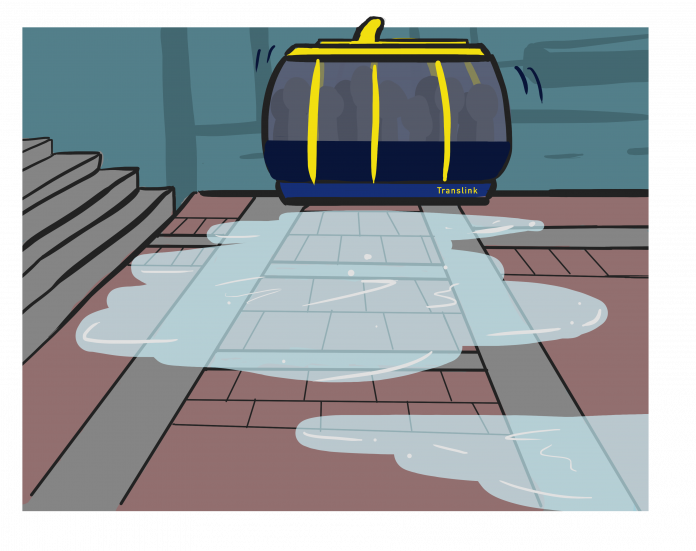
We all know what’s coming: rain. As the fall semester comes into full swing, prepare to embrace soggy shoes, waterlogged socks, and cold feet. This year, however, all is not lost. SFU’s Safety and Planning Committee is developing an initiative to help students cope with the puddles plaguing the Burnaby campus.

According to the committee, the project is an recent revitalization of SFU’s gondola plans. A mini-gondola line will be placed at either end of major puddle sites (such as those below and around the Rotunda), allowing students to traverse the bodies of water one at a time. Trip duration is estimated to be three to six minutes for smaller puddles, and upwards of 15 minutes for larger ones.

SFU president Andrew Petter commented on the traverse speed in an interview with The Peak: “Engagement in the pursuit of dry feet cannot be rushed.” Petter declined to comment on the project’s technical plans, instead repeating this mantra for the duration of the interview until the reporter left out of sheer frustration.  

The committee also noted fees for the service. The project will be paid for by a mandatory premium now included in tuition for all SFU students, an additional fee equal to the cost of the U-Pass. In addition, SFU students will be charged a fare each time they use the service, payable in the form of loose-leaf textbooks, lecture notes, or blood sacrifices.

Despite the scant information provided, high cost, and the utter impossibility of such a project, polls show that SFU students are overwhelmingly in favour of the service. In fact, a study done by SFU’s psychology department proved that most students, upon hearing the word “gondola,” experience a powerful rush of elation, leaving them woozy, out of breath, and slightly lightheaded afterwards. The study also proved that students are incapable of doing background research when voting on such an important matter.

Construction of the gondolas is expected to begin fall 2025, and last approximately 15 years.

SFU Senators discuss admission cut-offs, finances

0
(Photo from Peak archives)


On September 10, SFU Senate met for the first session of the fall semester this year. As the academic governance of SFU rests with its senate, the session focussed on issues that impact both teaching and research in the university. Some of the highlights of the first fall open session of Senate are listed below:


English language admission requirement to undergraduate studies raised

Revisions were made to the English language admission requirement for the undergraduate program. The senate introduced and carried the motion to increase the English language admission cut-off to 70% for incoming undergraduates, effective fall 2019. The change is with regards to grade 12 results and equivalent. Senator Daniel Leznoff stated that “this change was long overdue.”

“The revision to English language admission requirement is long overdue.” – Senator Daniel Leznoff

Senate did not provide any insights into how the new cut-off was decided on.


University and senate membership

President Andrew Petter announced that the fall session welcomed 5,125 new undergraduate students and 1,500 graduate students into the university this year, from 45 countries.

The senators also discussed the need to recruit more members of the university, both faculty members and students, into Senate.


Clarification on June Senate session issue:

The senators briefly reflected on an issue from the June senate session pertaining to SFU’s biomedical physiology and kinesiology (BPK) course BPK 326 Functional Anatomy. The question raised in the June session was if BPK 326, which is offered only to students majoring in the subject due to limited resources, could be offered to non-major students in a less resource-intensive form given its high demand among students. The senate announced in the current session that in lieu of BPK 326, minor and non-major students are offered BPK 325 Basic Human Anatomy, and BPK 326 would continue to be restricted to only majors.


2018 financial report

The Senators reviewed the 2018 financial report at the meeting. According to the report, the university’s revenue has grown by 5.2% to reach $724 million from $689 million of 2017. The report also stated that SFU’s expenses grew by 3%, which were fully covered by the institution’s revenue.


Board Shorts: a recap of the rotunda space discussion

1
(Chris Ho/The Peak)


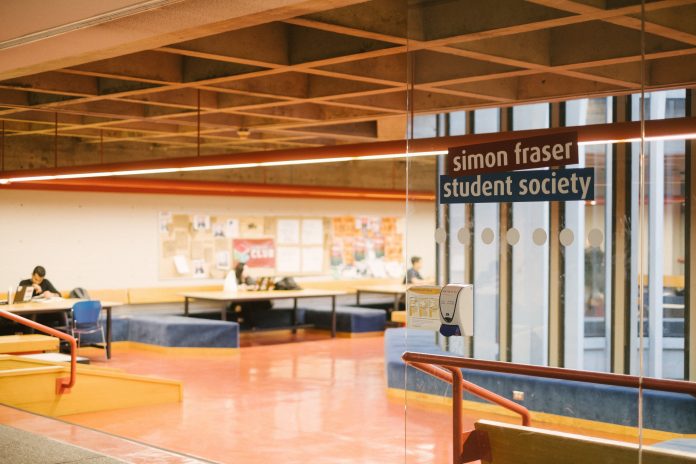
At the latest Simon Fraser Student Society (SFSS) board of directors meeting, the organizations operating within the Rotunda attended and discussed concerns regarding space in the Student Union Building (SUB).

Groups represented at the meeting included the Simon Fraser Public Interest Research Group (SFPIRG), the First Nations Student Association (FNSA), Students of Caribbean and African Ancestry (SOCA), campus radio station CJSF, and the mental health advocacy group Hi F.I.V.E.

SFSS vice-president external relations Jasdeep Gill began the conversation by stating that the current board “remain[ed] committed” to the shared-space model of the SUB which the 2017–18 board of directors had decided upon. Under this model, four of the SUB’s organizational suites would be split among various clubs. The society has not yet disclosed further details on how this model would work.

In light of the SUB’s delayed opening, Gill said that the society was willing to extend the Rotunda groups’ current subleases. The original eviction date indicated by the subleases was December 14, 2018.

“We would like to see if there’s anything that we’ve done that hasn’t been appropriate, and address those concerns directly,” said Gill.


Claims of institutional racism addressed

Computing science student and SFPIRG board member Adriano D’Alessandro expressed that SFPIRG seeks a sublease extension, SUB space, “accountability from the board to the students,” and acknowledgement of “how institutional racism has impacted these issues.”

“We’ve been out there talking to students everyday [ . . . ] we’ve collected 1,200 signatures, which is more than most of you were voted in on in terms of votes,” he said, referring to SFPIRG’s space campaign. SFSS president Jas Randhawa obtained the highest number of votes in this year’s election for the board of directors, being voted in by 1,206 students.

Vice-president student life Tawanda Masawi responded to the mentions of alleged institutional racism.

Addressing SOCA president Giovanni Hosang, he called SOCA’s approach “both unacceptable and unprofessional” and “misrepresent[ative] of our black community here at SFU.”

“Bringing forward illegitimate claims of racism minimizes instances of actual racism.” – Tawanda Masawi, SFSS vice-president student life

SOCA had recently published public letters to the SFSS, SFU, and students in which the organization condemned the student society for their conduct during space negotiations, calling it a “textbook example of institutionalized racism.”

“If you have claims of racism, I think you need to address them professionally and the SFSS will address any claims of racism accordingly,” said Masawi.

“I think there is a lack of understanding of what institutional racism is,” responded Hosang.

“Institutional racism is the collective failure of an organization to provide appropriate and professional services to the community of color. [ . . . ] It’s the [ . . . ] policies and others that disenfranchise people of colour, that most disproportionately affects people of colour,” said Hosang. “Right now, evicting a black student group on campus is the definition of institutional racism.”

Hosang also noted that in 2016, an anti-racism policy was repealed within the SFSS.

The policy, “AP-5: Anti-Racism” in the SFSS Policy Manual in effect in 2011, officially “recognize[d] racism as a form of discrimination” and committed the SFSS to maintaining racial and cultural diversity.

AP-5 was repealed during a policy overhaul in a 2016 board meeting. An analogous policy was not included in the current SFSS board policies.

“If the SFSS refuses to make amends for this situation, we call on all the board of directors to apologize and resign,” said Hosang. “This is an embarrassment [to] the SFSS. You need to remove the CEO as the CEO of the SFSS. [ . . . ] You all need to do better.”


Objections to the shared-space model of the SUB

“I’m seeing a shared-space model as problematic,” said Steven Hall, a FNSA member and double-major student at SFU. Previously a Langara College student, Hall recounted Langara’s conversion of their LGBTQ-dedicated space into a shared space, where the school had students “rip everything out” that related to the LGBTQ+ community.

“If we’re going for a shared model, I have seen it and I’ve witnessed it. It doesn’t work.” – Steven Hall, FNSA member

SFSS applied sciences representative Kia Mirsalehi acknowledged that the SFSS had failed to adequately communicate with the groups present, but noted that the the board had not yet decided the details of the shared-space model.

“When we have 300 clubs and 50 student unions and only four spaces, [ . . . ] we need to take a look at it and, instead of giving one of our four rooms to one of our 300 groups, try to look at how to most effectively share,” Mirsalehi said.

Mirsalehi also stated that the “attacks against Martin [Wyant],” the SFSS CEO, were misinformed, as Wyant was in favour of giving SFPIRG and CJSF space. “The board was the people that went and disagreed to it,” he said, referring to the student representatives.

Kalamity Hildebrandt, SFPIRG director of research and education, did not consider bookable, shared space a viable model for organizations that work with marginalized groups.

“Bookable space doesn’t work for an organization with staff, [or] an organization that has to do ongoing, deep, meaningful work where there has to be continuity and equipment,” said Hildenbrandt. “Could the SFSS function, with its staff, using bookable space?”


Hildenbrandt urged the board not to represent “some sort of mythical, typical student,” but to “identify what sections of the student body face systemic marginalization and to take proactive steps to make sure those students’ needs are met.”

“If you’re not doing inclusive governance, you are by definition doing oppressive governance.” – Kalamity Hildebrandt, SFPIRG direction of research and education

“It is near-impossible anywhere in this city to have your cultural event without fighting the system,” said Shaneza Sharmila Bacchus, SOCA member and Burnaby campus employee. “To tell people on campus, ‘oh, you can find space somewhere else, you can operate outside of campus’ . . . you’re silencing them and you’re sending them into oblivion.”


Problems negotiating with the SFSS

Jesse Wentzloff, CJSF public affairs and talk coordinator, called CJSF’s space negotiations with the SFSS “entirely one-sided.”

“We’ve been sent messages of when a meeting is and not told what it is, what is going to happen during the meeting except on very short notice,” he said.

Multiple speakers brought forth concerns regarding the three-days notice they had been given for the current meeting.

Hildebrandt and Hall mentioned that many mebers of their respective groups were unavailable at the scheduled meeting time.

“For you to send a formal report three days before we have to present is unacceptable,” said former SOCA executive Stanley Rasahi. “How are we supposed to prepare and actually give you our grievances? ‘Cause there aren’t just grievances that have just happened over three days.”


Moving forward

“It’s a challenging thing to have this conversation,” said vice-president university relations Jackson Freedman.

Freedman felt the meeting would prompt a larger conversation among the board members in the following weeks. “We’re developing a model; we want to see what we can do to make this as effective as possible,” he said.

“It has clearly been found out today we don’t have an effective model for SUB space.” – Jackson Freedman, SFSS vice-president university relations

Freedman noted that there was room for further consultation with the groups, and that the conversation would continue in the following months.

Vice-president student services Samer Rihani commented that, following these discussions, the starting point for reopening negotiations would be to revisit the current subleases in the Rotunda.

“We can’t wave our wand and promise you guys a billion things and sign a contract [ . . . ] we cannot promise to jump right to the SUB because we haven’t gotten there yet,” said Rihani. “We can at least build a relationship within the Rotunda; let’s see where a positive relationship gets us from there.”

Hosang urged the board to not leave the decision to the following year’s board. “If you think the next board should take this up again, it’s emotionally draining on us to come again and explain,” he said.

“A lot of board members have been telling me on the side that this is a separation between personal and professional, but that’s not it for us. It’s our identities, it’s our very existence,” said Hosang.

Political Corner: Sweden’s election is making the country look eerily familiar to political climates elsewhere in the world

0
Photo by TT / Montage

Sweden held their national elections on Sunday. Early exit polls from the election are showing strong gains for the Sweden Democrats — a nationalist party that is strongly against immigration, and partially founded by individuals with neo-Nazi ties.

Currently, Sweden is governed by a coalition between the Social Democrats, Left, and Green parties. While they most likely will continue to govern the country (exit polls show that they are in the lead with 28% of the vote), it will be in the form of a minority government. A minority that could see the Sweden Democrats become the official opposition.

In the past, Sweden has been known to have a very strong position on protecting human rights, a prime example being that they took in a huge number of refugees at the height of the Syrian Civil War. If the Sweden Democrats take the position of official opposition, many fear that the country’s position on human rights will become more nationalistic.

One of the Sweden Democrats’ main campaigning points was to limit the levels of refugees being admitted, as well as being significantly more selective in the immigration process. This, coupled with their desire to promote a Swedish Brexit (Swexit), has made them a polarizing party that potentially will gain the ability to promote their agenda following this election.

Seeing Sweden’s potential shift in government is another example of an unfortunate trend in politics. Nationalistic parties are gaining more traction and the results are quite simply unnerving. First, Donald Trump won the United States election on a campaign of anti-immigration and nationalistic pride. This was followed by Brexit, another political movement fueled by nationalistic feelings. Now, we are seeing Swedish politics take on the same tone, and one cannot help but wonder how much farther the trend will go.

Going undercover with the raccoons

0
Illustrated by Cora Fu

SEPTEMBER 4, 2018 – DAY 10: They have accepted me as one of their own

The raccoons still have not seen through my disguise. I credit, of course, my own terrific arts and craft skills in creating the realistic paws, mask, and tail, and my many months of rigorous training. Hours of late-night binge studying in the W.A.C. Bennett Library and excessive consumption of caffeine have finally made me nocturnal. My extensive knowledge of foraging on campus for affordable food and textbooks has made me a capable scavenger.

SEPTEMBER 5, 2018 – DAY 11: The benefits of dumpster-diving

The group has moved westward, and infiltrated West Mall. I have proved myself to be an asset to the team on account of being large enough to easily set off the automatic door sensors granting the group access into the building.

With its typically long line-ups and frequently distracted customers, Tim Hortons and its surrounding trash receptacles, in particular, have proved a valuable scavenging ground. The best part? I got to try everything on their menu, and I didn’t even spend a single cent.

SEPTEMBER 9, 2018 – DAY 15: Crisis averted

We’ve been caught on video! Whilst completing a raid near Maggie Benston Centre, a few rather excited-looking students (likely delirious from sleep deprivation) managed to catch us on their smartphones.

Rudely, the students proceeded to verbally insult my group and I, drawing sarcastic connections between our lifestyle and their habit of eating junk food. The group leader was absolutely disgusted by their behaviour and moved to attack, but I managed to defuse the situation and convince everyone to retreat before any blood was spilt or smartphones destroyed.

SEPTEMBER 10, 2018 – DAY 16: Ah, to be young and in love

While traveling down a particular section of SFU’s underground parking, our group came across two students arguing over a parking spot. The group paused out of curiosity and as the only “raccoon” who spoke fluent human, I was sent to investigate.

The first student seemed to be waving their arms in an aggressive fashion, and used a few choice words to indicate that they were, in fact, the first to reach the spot. The second more calmly suggested that, as their car was already taking up most of the spot, the first person should let it go. Both froze suddenly, and I realized that my rather bulky fake paws made a horribly loud sound on the concrete.

I expertly dived behind a parked car, but failed to conceal my artificial bushy tail. Upon seeing the tail, the students tones both softened and one commented on my expert tail craftsmanship. They took a few pictures and commented on the cuteness of the group, and of myself in particular. Afterwards, the two parted ways amicably and exchanged social media contacts as the second student had snapped a photo of my tail. I am confident that they will be seeing one another again soon.

The other raccoons do not seem to understand — and refuse to support — my new business idea of student matchmaking services.