Home Blog Page 493

Political Corner: Liberals left holding the bag in breach-of-trust trial

0
The Mark Norman controversy is only a symptom of a larger problem with procurement in Canada. Photo courtesy of Sean Kilpatrick via CBC

On May 8, Crown prosecutors announced that they were going to stay the breach-of-trust charge against vice-admiral Mark Norman. This appeared to put an end to the legal drama which has been with Norman since January 2017 when he was originally suspended from his position as vice-chief of defence staff.

Norman was charged with the breach of trust on March 9, 2018, following allegations that he had leaked cabinet documents to both CBC and the CEO of Federal Fleet Services, a division of Chantier Davie Shipbuilding. The agreement in question was made by the Harper government in July 2015 to temporarily allow a non-military vessel to be converted into a resupply ship.

Less than a month after being sworn in, the Liberal government put the Chantier Davie Shipbuilding agreement on hold. This was quickly followed by the leaked documents which began Norman’s legal troubles.

As Norman begins talks to return to his former job, Ottawa is beginning to decide on who to blame for the two-year legal drama. With the federal elections racing towards us, the Conservatives are looking to place the entirety of the affair on the shoulders of the Liberals. However, it is important to remember that it is really procurement policy from the Harper government that started the entire issue.

Canada has always had a problem with procurement, the process that the government uses to acquire military equipment. That’s because nothing has been set up to see that the procurement process goes on when there is a change in government. Not only has this left the military with a lack of modern equipment, but it also leaves room for governments that make poor policy moves to shift responsibility for their actions onto subsequent governments.

Currently, the Liberals are dealing with the fallout of the poor policy choices of the Conservatives and the chaotic trial of Mark Norman. With the 2019 elections quickly approaching, voters need to recognize the fact that while the chaos unfolded during the Liberals’ term, they were not the agents of said chaos. Going into the elections, every voter needs to decide what parts of the Liberals’ term will guide their votes.


More than RuPaul: East Vancouver’s drag spectacular Man Up

0
Mx. Bukuru (@caillou.sexy.ass.cousin), SFU theatre alumni, onstage with Belladonna VonShade (@belladonna_vonshade) at Man Up May Musicals Saturday May, 25

While mainstream drag culture is infamous among intersectionally-minded queer audiences for being oblivious to passive culture appropriation and transphobia, Man Up has made their name in hosting a damn good party that comes with social awareness. From posting their accessibility info online to running a Buddy System which is “a grassroots effort to combat rape culture and enhance the safety of our queer events,” it’s clear that they are a space where everyone can party safely.

Man Up is a multi-gender East Van drag show run by queers for queers. Each month, they put on a show with a different theme, this past Saturday being May Musicals! month. The show is put on at the Warehouse at East Side Studios, a large open-concept space that is equal parts cozy and grungy. There are retro couches, pool tables, and arcade video games, as well as a large stage and dance floor.

The Warehouse is a newly opened space, made to fill the gap in queer spaces left by the Cobalt. When the Cobalt shut its doors in 2018, Man Up came close to ending as they couldn’t find a venue that fit their needs. Determined to keep the show going, Man Up partnered with the Eastside Flea, who recently purchased Eastside Studios in Strathcona, to solidify a new home. A new queer party and arts space was born, The Warehouse (also known as Eastside Studios).

Man Up has an eclectic cast of performers each month, and they make sure to always have some experienced performers and some new talent. Drag here isn’t bound to the gender binary here either. Performers of all genders and sexualities grace the stage every show, from queens to kings to self-identified “Drag Things.” The variety of performances that Man Up offers is so special because it showcases the differences in life experiences that the performers have. It makes it easy to find someone you relate to on stage, which makes the art that much more engaging.

This type of drag feels much more intimate than big shows like RuPaul’s Drag Race, which, while very fun, can alienate us from the performers themselves and turn drag into a highly edited and corporate machine. At Man Up, the crowd’s excitement to see drag performers that are just like them is infectious, and the performers feel just as excited to be performing. All of this makes for an exciting and familiar atmosphere, a place where you know you are welcome no matter what to come party.

Now that season 11 of RuPaul has come to an end and crowned a winner, there is no better time to get out and, as described on Man Up’s Facebook page, enjoy your local “multi-gender drag spectacular and queer dance party in East Vancouver.”

Still your mind, steal your gut, open your heart: Iron Peggy premieres at the Children’s Festival

0
Iron Peggy’s performers from left to right: Taran Kootenhayoo, Deneh’Cho Thompson, Adele Noronha, and Raes Calbert. Image by Farah Nosh.

“They fought so we could be who we are meant to be. We have to stand up for who we are, and for those that came before us. We have to stand up for each other. It’s something worth fighting for.”

~ Peg, Iron Peggy

Over one hundred years ago, the First World War saw over 600,000 Canadian men and women enlist to fight overseas. Part of this number were more than 4000 Indigenous people. The number is a conservative estimate, as the government at the time only recorded Indigenous soldiers who had status even though status people were not the only ones fighting. Approximately a third of all Indigenous people in Canada aged 18–45 fought in the war, participating in all major battles such as Vimy Ridge and receiving many medals for bravery and heroism.

In Métis playwright Marie Clements’ new play, Iron Peggy, these soldiers are remembered and highlighted as Clements brings them back to help give a young girl courage and strength. The show stars Peg, played by Adele Noronha, a young South Asian girl being bullied at her boarding school. The play opens by pulling us into her world, where she is alienated by everyone in her life from her father to her classmates to the school administration. When she hears the cold news of the sudden passing of her only solace, her grandmother, Peg becomes lost in grief and doesn’t know where to turn.

Here, we meet the three little Indigenous toy soldiers, who come to life after she falls asleep. Peg learns about the bravery and importance of Indigenous soldiers in the war, and about how to stand up to her own bullies, as they inspire courage in her through their stories.

The show premiered last Tuesday, May 28, at the Vancouver International Children’s Festival in front of an audience of young schoolkids and the public. The play was commissioned by the festival, in conjunction with Boca del Lupo and Clements’ Red Diva Projects, through funding from the Canada Council for the Arts’ New Chapter Program.

The show also incorporates video and animation into the live performance. Along with lighting and other technical directions under the artistic direction of Sherry J. Yoon, this helps convey how big and scary seemingly insignificant problems are when you’re young.

The protagonists are all inspired by real-life soldiers including Anishinaabe WWI veteran Francis “Peggy” Pegahmagabow (for whom the protagonist is also named), played by Deneh’Cho Thompson (Dene). Pegahmagabow was actually Canada’s most decorated First Nations soldier enlisted with the 23rd regiment, a fact unknown to most Canadians. The other two soldiers are also inspired by real, decorated Indigenous soldiers: Henry Louis Norwest (Métis), played by Raes Calvert (Métis), and George McLean (Okanagan), played by Taran Kootenhayoo (Denesułįné & Stoney Nakoda).

It is these people that Clements wants audiences to know and learn more about. To feel inspired by them. To remember and find strength in their strength as we fight our own battles, especially children who feel lost and helpless like the protagonist.

This is Clements’ first show intended for children and young audiences. She does an expert job in presenting a serious yet accessible show that includes plenty of comic relief without pandering to the audience or upstaging the purpose of the show. The show is about bullying (and racialized bullying), fear, loneliness, and the power of fighting for yourself and those you love.

And sitting in the audience, you could feel the kids responding to it. Throughout the show, they were wholly engaged with the characters onstage, and gave the actors a huge round of applause at the curtain call.

A multimedia production, Iron Peggy is a captivating, informative, and inspiring show that celebrates the heroes we can’t forget to remember.

Though the play’s Vancouver run ended on May 31, they have a study guide available online where you can learn about the show and the history. The show is also set to go on tour, although dates are yet to be announced.

What SFU Needs: An actual central cafeteria

0
Do you want to eat at Mackenzie Café like a peasant? Illustration by Tiffany Chan/The Peak

Let’s face it, every cafeteria at Burnaby campus looks sad. Aside from The Study, there’s no place that’s Insta-worthy, or somewhere you’d want to hang out. It’s hard to ignore the major flaws that every eatery on campus has.

WHAT WE LACK:

1) A spacious area, like the Dining Hall but even bigger;
2) A modern and hip space, like The Study but not as niche and won’t charge you $17;
3) A variety of seating options like Mackenzie, but less crowded and less fluorescent lights;
4) Another place accepting meal plan dollars that doesn’t keep res kids apart from other students like the Dining Hall’s $10 cover charge does, and;
5) a place with even more food options than Cornerstone, but inside one central building.  

WHAT’S THE VISION: It shouldn’t be this hard to have a decent cafeteria. Enter SFU’s new cafeteria, working title: The Gondola! Like a mighty savannah, every university needs a watering hole. Picture a huge hall that’s large enough to fit SFU’s growing community, FIC kids and all! Featuring chic seating that hasn’t already been here for 10+ years, and as a bonus, reasonably priced food options. This is a space worthy of our Insta-stories. It makes students whine that there are too many places to eat. Finally, we have someplace everyone can congregate to have lunch, hang, and just chill. Unlike the Dining Hall, you don’t need to pay a cover charge. Unlike Mackenzie Café, the chairs aren’t ripping open. And unlike the MBC Food Court, you have plentiful options and don’t feel depressed by sitting here.

WHY WE NEED IT: No SFU student should have to make multiple commutes to find more than five options for their lunch. We need one, central building for a variety for every kind of diet. And yes, the Student Union Building (SUB) will open “soon,” but it’s not the kind of dedicated eatery we need. Currently, the SUB will have a 250 sq. ft community kitchen (read: not a cafeteria). With a commuter campus like SFU, a new cafeteria could finally help foster a community here. Finally, we’d have somewhere we could feel proud to hang out in.

More food options in more interesting spaces equals less grumpy students. SFU needs, nay, deserves a vast, central cafeteria. Now more than ever, we need a large, inclusive space where any SFU student can feel proud to eat at.


Out on Campus launches a new campaign that seeks to protect its trans members

3
Onosholema Ogoigbe

#WeJustNeedToPee is a new poster campaign launched by Out on Campus that, as the posters read, seeks to “express a message of support and solidarity to our trans students, staff and visitors.” The campaign was put forward by Ashley Brooks, the current coordinator for Out on Campus, with help from volunteers and the queer student community.

Posters are put up on the walls of gendered washrooms across campus with a message to the campus community that says, in Brooks’ words, “ . . . trans people exist in these spaces, please don’t endanger them.”

According to Brooks, the campaign was inspired by a similar campaign at Anglia Ruskin University, where he had previously worked as an associate lecturer and senior technician. During that 2016–17 campaign, a picture of the poster went viral on Twitter and the story was carried on Gaystarnews and a number of other LGBTQ+-focused news outlets.

SFU’s own poster campaign was intially intended as part of the program of events for Out on Campus’ International Transgender Day of Visibilty, but according to Brooks, the timeline didn’t quite pan out due to SFU’s facilities blanket rule of not allowing posters in the washroom.

“[OOC] pushed hard for the posters to go up and that was unfortunately helped by an incident that happened at Harbour Centre,” Brooks said. “During Trans Day of Remembrance, there was an event that was happening and unfortunately someone was using one of the men’s washrooms and was harassed in that space.”

“That fed into the work we were already looking to do.”

Brooks told The Peak that the aim of the posters and the campaign is to encourage people to be kinder to each other, educate the campus about the transgender community, and provide a welcoming environment for them. As an accompaniment to the posters, Brooks mentions that there is a communication toolkit presently being developed.

The toolkit, according to Brooks, is essentially “a schedule of social media posts that [will be sent] out to campus partners.” The posts will discuss the posters’ presence, asking people to contact Out on Campus if they see that a poster has been removed or vandalized, and address myths about transgender peoples’ use of gendered washrooms. One of the aims of the toolkit is to create a large enough online presence to potentially persuade SFU to let the posters stay beyond the approved timeline of six months.

According to Brooks, “[There] is a real need to make this a permanent fixture and so anything that anyone can do to use the hashtag to share pictures that they’ve taken of these posters on display will really help to boost the profile of the campaign to make people aware of it.”


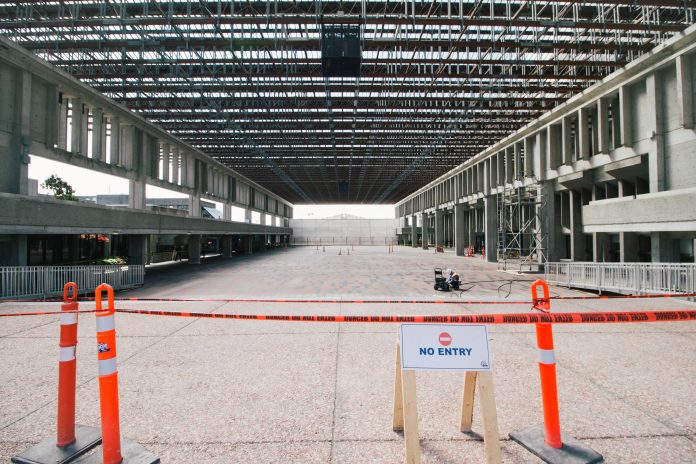
Convocation Mall’s floor will be ready for convocation

1
Andres Chavarriaga/ The Peak

Construction in and around Convocation Mall is on track. The Peak reached out to James Bremner, the project manager, who confirmed through email what was previously reported in March by The Peak.

This means that the floor in front of the stage will be completed, and convocation ceremonies will not be disturbed. However, it had been previously stated that the stage would be under construction and temporary tiles would be installed. According to Bremner this is no longer the case, with construction on the stage now slated to begin after convocation.

According to Bremner, the stairs leading down into Freedom Square and Convocation Mall will also be open in time for the ceremonies. However, Bremner notes that the landings will have temporary tiles and will be finished in July.

Students worried about lost photo opportunities may be relieved to know that the north side of the Academic Quadrangle (AQ) plaza will be “generally” open according to Bremner, though he notes that the east and south sides will still be under construction.

Additionally, the area under construction between Convocation Mall and the Rotunda will not be finished.

“This tent and site fencing around [the area] will remain in place during Convocation and will have SFU Branded Regalia [sic] installed on it to improve its visual appearance.”

Bremner also stated that construction around the area will not be occurring during the ceremonies, though some construction work may be taking place elsewhere.

“There will be some construction work occurring [on the southern side] of the AQ as this will not effect [sic] the convocation ceremony,” writes Bremner.

The construction occurring around campus will impact the route taken by the procession of graduates. Kris Nordgren, assistant registrar of senate and academic services, outlined the changes.

“Normally the procession would exit the AQ (3000/main level) up the staircase to the outside (AQ 4000 level) and follow the path to the pond, and down the stairs to Convocation Mall,” Nordgren wrote.

Instead, the processions will now take a slightly longer route. Graduates will walk from Blusson Hall to Strand Hall, exit, and use the Strand Hall pathway to walk on the main path through the AQ and into Convocation Mall.

For students that may have questions or concerns, Bremner writes, “it is best if they contact Student Services as they are best placed to help with queries related to the Convocation Ceremonies.”

What Grinds Our Gears: There’s no excuse for people who still don’t know how to recycle

0
Photo by: Gudrun Wai-Gunnarsson / The Peak

I’m a strong believer in taking steps to save the environment. Not everybody is so proactive and I get that — we all have different life circumstances and beliefs. However, I do believe that if there are easy things you can do to help out our planet, you should do them. This includes recycling properly.

The bins at SFU and many other locations have clear instructions on what sorts of things go where. Yet an incredibly large number of people still refuse to recycle properly, and this is evident from the sheer amount of incorrectly sorted trash.

People are being lazy and throwing their trash in just one bin instead of sorting it out. Coffee cups, for example are often thrown in the landfill bin without apparent regard for the fact that both the lid and the paper sleeve are often marked as recyclable, depending on the cup and brand. It literally takes less than 20 seconds to sort them. Why would anyone not take the time to recycle properly?

What’s worse are the people who have just one item and still can’t be bothered to put it in the right bin. On countless occasions, I’ve seen plastic bags in the compost bin or juice bottles in the garbage.

Do you care so little about the environment, your future, and the future of others that you can’t spare a few seconds to sort your trash? By not doing your part, you are contributing to the catastrophic effects of climate change, resulting in the endangerment and extinction of thousands of species — including us! Do your part to prevent the destruction of our planet and start recycling properly!

Need to Know, Need to Go: June 3–7

0
Still from the Because We Are Girls courtesy of Baljit Sangra.

Reel Causes: Because We Are Girls

Update: Check out our review of the film and evening here.

This week, Reel Causes — a film society dedicated to promoting and screening films for social justice and stimulating conversation — will be screening the 2018 documentary Because We Are Girls at the Djavad Mowafaghian Cinema. Previously screened at DOXA Documentary Film Festival, the film is an emotional and nuanced documentary about the impacts of sexual abuse on an Indo-Canadian family in rural B.C.

Vancouver-based filmmaker Baljit Sangra follows three sisters as they come forward about the abuse they experienced as children in order to protect the next generation of young women. The film is an empathetic look at the complicated, and retraumatizing, process of coming forward about sexual abuse, the power of unconditional love, and the importance of healing together.

A post-film discussion will be had after the film with the filmmaker and the sisters with a counselor from Family Services of Greater Vancouver. The cause being specifically highlighted this evening is Family Services of Greater Vancouver, which seeks to support and strengthen families as well as fight violence against women and youth.

Because We Are Girls is screening Thursday, June 6, at the Djavad Mowafaghian Cinema in SFU Woodwards. Tickets are $10 in advance and $15 at the door.

Emerge Festival Showcase 2019

The Emerge Festival is an annual festival in the Downtown Eastside to celebrate and showcase DTES Small Arts Grant Recipients. The festival features group art exhibitions, readings, workshops, and screenings from artists whose work and selves are based in the community.

On Wednesday, the festival begins at the Vancouver Public Library’s nə́c̓aʔmat ct Strathcona Branch with “Writers Read,” an evening of new local literature of all genres. On Thursday, June 6 the multidisciplinary showcase “Screening, Songs, & Spoken Words” is being held at SFU Goldcorp Centre. “Filmmakers, Musicians, Singers, and Storytellers” will be performing and screening their films, free to the public.

Finally, from Friday through Sunday, the group art exhibition will be shown at the BC Artscape Sun Wah Centre. If you are looking for ways to support your local community or find new artists to put on your radar, look no further.

Writers Read is Wednesday, June 5, at 6:30 p.m. at nə́c̓aʔmat ct Strathcona Library. The showcase is Thursday, June 6, at 8 p.m. at SFU Goldcorp Centre for the Arts. The group exhibit opens June 7 at 6 p.m. at the BC Artscape Sun Wah Centre. Each event is free to the public, but you can see the schedule and donate at vancouverfoundationsmallarts.ca

A category of its own: Tanya Tagaq’s Split Tooth

0
Tagaq poses with her acclaimed new novel. Photo courtesy of Penguin Canada.

Before it was even officially released, Tanya Tagaq’s debut novel Split Tooth was already on the longlist for one of Canada’s most prestigious literary awards, the Scotiabank Giller Prize. The Inuk musician had already made a name for herself as an accomplished experimental vocalist and throat singer over the last two decades, and her first book was highly anticipated.

The story itself is an enthralling, though often difficult, narrative. The prose beautifully weaves together the stories, imagery, and emotions of life as a young Inuk girl in the North. The book is a complex and sensitive narrative that calls into question what love, pain, and purpose really mean. However, I would give a content warning for the story because this sensory writing can become quite graphic as the narrative describes abuse and trauma.

To describe Split Tooth using the terminology of the Western literary canon is impossible, and wouldn’t really make sense. The book is neither a memoir nor fiction, neither fantasy nor realism. It’s something entirely different that can’t be approached, explained, or understood like traditional English forms of storytelling.

This does not make the book daunting, but rather exciting. I listened to the book on Audible and the moment I finished it, I went searching to find and read the printed version for a new experience of the same story. One of the very first things I noticed about this book was the way that Tagaq uses and pays attention to the opportunities and strengths offered by these different mediums of storytelling, written and oral. You almost need to read the book twice to fully appreciate Tagaq’s talent as a storyteller.

The audiobook is read by Tagaq herself and her training as a singer is clear as she performs each section — not reading a book but telling a story. She changes and morphs her voice and breath as she reads, even incorporating vocalization and throat singing at the end of each chapter — something entirely exclusive to the audio version.

In the printed book, it’s clear that visual aesthetics and tactility have been deeply considered. Jaime Hernandez’s illustrations picture the chapters, the page edges are red, and the hardcover is softly textured — making the reading a more visceral experience.

Overall, Split Tooth is a stunning book of prose that explores the depths of human experience and beyond. Penguin Randomhouse, the publisher of Split Tooth, describes it best: “Haunting, brooding, exhilarating, and tender all at once, Tagaq moves effortlessly between fiction and memoir, myth and reality, poetry and prose, and conjures a world and a heroine readers will never forget.”

Among its other nominations and wins, Split Tooth is nominated in the category of Published Prose at the Indigenous Voices Awards this year. You can also purchase a hardcover copy on Burnaby campus at Iron Dog Books (which will return to UniverCity on June 12).

Distance education classes deliver subpar instruction for additional fees

0
There’s no reason why an online class should cost more than an in-person one Photo courtesy of helloquence via Unsplash

I have taken two classes through the Centre for Online and Distance Education (CODE) over the course of my degree, and I don’t intend on taking any more. The quality of instruction was poor, there was little help available, and overall they did not justify the additional costs associated with the courses. All told, the CODE classes did not meet my expectations.

In my first CODE class, we ended up having to figure out the material ourselves. Each week, we covered two very detailed chapters of the textbook and the only “teaching” we were provided were 20–30 minute lecture videos on Canvas which consisted of diagrams from the textbook. On top of that, we could only purchase the latest edition of the book because the page ranges we were told to read were based on the latest edition. There was no way to even save money buying used books.

During my second experience with CODE, my tutor marker was unavailable to meet in person (claiming it wouldn’t be fair to other students) and the class recordings were out of date. Additionally, the class required the mandatory purchase of an online access code in order to pass, which cost about $50 USD. Without it, I would have failed the course as it was a requirement to take the quizzes. All of these things made the class not worth the price I had to pay.

According to the SFU website, CODE charges a $40 supplementary fee for each course offered. When asked what this fee covered, Kanthi Jayasundera, CODE’s acting director, cited online course development, software licenses, copyright fees, and technical support.

CODE classes should not cost more than regular classes. Instead, they should cost the same because of the lack of support available from instructors/TMs who “teach” CODE courses. With all the extra expenses in mandatory textbooks and online access codes, as well as how outdated the material is, having to pay basic administrative costs as well is irritating.  

If I am going to be teaching myself without any support from the tutor marker or instructor, I don’t want to be paying more than I would for a regular class where these services are provided. I want to be taught just as well as in-person classes by being provided more lecture material, resources, and up-to-date information. I want free optional videos and readings for complex topics. I want my instructor or TM to actually be available at some point in the week if we need extra help. In short, I want my money’s worth!

Most students take distance education courses to make their lives easier, but CODE classes make our lives harder with the additional expenses and lack of resource support.  

The university recently voted to increase tuition, adding to the financial burden of students. If SFU is going to raise the price of our education, they need to be conscientious of whether they are delivering the education we are paying for.

As it stands, CODE classes are way too overpriced for the services we’re actually getting.