
Home Blog Page 475

Meet Alex Mac-Queen: How a local hypebeast paid his tuition by reselling Balenciaga sweaters

0

The resell game among SFU students has always been quite strong in the textbook department. But who could anticipate the winning strategy of selling bougie clothing pieces from one’s closet to pay off tuition? 

I make my way into a 4,000 square ft. walk-in closet, with walls painted a shade of red deep enough to rival SFU’s new logo. I’m here to sit down with Alex Mac-Queen, an eighth year undeclared student at SFU, to learn his Master Plan™ to evade student loan debt. 

“You should close your mouth or one of my stag beetles ($89,000) might fly in,” Alex greets me with a once-over of my outfit and a slight frown — he might have noticed the beat-up Air Jordan 1s I found in a dumpster. He led me further into the room, strutting brand new spiked Louboutins ($1,600), which looked like they could hurt if they kicked the right area. We settled down on a roll arm sofa next to his pet chimpanzee, and the first question to roll off my lips was, of course, about his tuition.

“As an international student, my tuition costs upwards of $10,000, my right hand, and the virgin blood of a first year,” he explains.

Alex normally receives financial help from his father, but as he quickly elaborates, Mr. Mac-Queen was recently displeased with his son’s extravagant spending habits at Holt Renfrew; apparently, the credit card statements from these “casual shopping trips” were causing his father heart palpitations. Alex initially panicked, but his distress quickly ceased after pacing back and forth inside his closet — an exercise he often practices for mindfulness — that soon led to his eureka moment.

There are several streetwear resell groups on Facebook in Vancouver, and Alex figured that with a blend of aggressive bartering and high quality photos from his Instagram, @hypebeast_juul69, he could sell enough designer pieces to pay off his fall tuition. 

“The most grievous decisions had to be made!” Alex bawled, wiping his tears with a Gucci handkerchief ($175). I consoled him with a pat on the shoulder, being careful not to wrinkle his Valentino silk shirt ($1,150). 

Alex broke down the numbers in his quick math resale valuation of clothing pieces he sold: 

  • A red Balenciaga logo sweater ($1,190)
  • A Supreme x Comme des Garçons collaboration box logo hoodie ($700)
  • Balenciaga Triple S sneakers ($900)
  • Off-White x Air Jordan 1 Retro Highs in the “UNC” colourway ($2,500)
  • A Bape camouflage shark hoodie ($750)
  • an Off-White belt ($300)
  • A Raf Simons ‘I Love NY ’sweater ($1,200)
  • A Stone Island puffer coat ($1,600)
  • A pair of Yeezy Boost 700 ‘Wave Runners’ ($550)
  • A vial of Mac-Queen-original tears from after Kanye West’s concert ($250)
  • A classic Burberry collared shirt ($700). 

After writing down these mind-boggling numbers, I added them up to reveal a grand total of $10,640. Alex had made enough to not only pay his tuition for the semester, but also cover the cost of a new gold-encrusted Juul. 

Out of all the pieces, it was hardest for him to part with the Off-White Jordans, as he enjoyed “flexing on the new kids,” while strolling along Cornerstone. 

“It’s such a clean colourway by my guy Virgil,” he gushes in admiration, referring to the designer Virgil Abloh, who worked on Off-White’s collaboration with Nike. Alex gets up to gesture at a shrine in his closet dedicated to Abloh, complete with incense and a signed shoebox. 

I asked Alex how it felt to pay off his tuition on his own. Before answering, he takes a long puff through his brilliant, glittering Juul. 

“It was extremely bittersweet,” he murmured, the most softly — and candidly — he’s spoken yet. “But I decided to reward my dedication to myself by buying another Supreme hoodie.”
SFU Snap has so much potential, but its bugs need to be fixed first

0
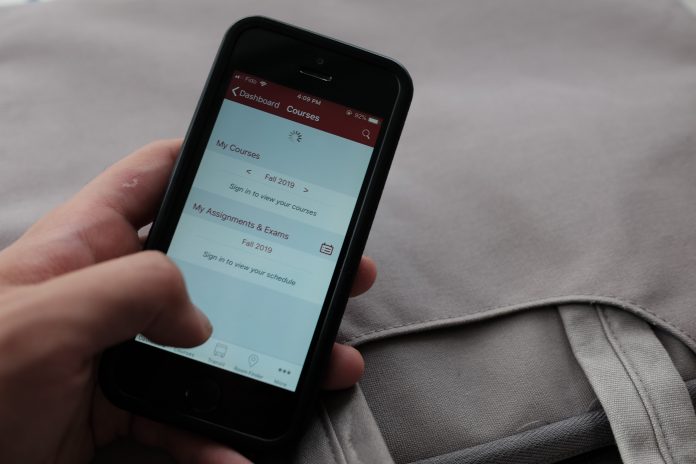
Oh snap, the SFU Snap app just crashed on me again. Photo: Chris Ho/The Peak

Oh, SFU Snap. 

This app tries its best, but has fallen short so much that it’s often my last resort instead of being my go-to app for SFU content. I want to be able to check my class locations and exam times without the app loading like a snail. My Gen Z attention span cannot wait for it to finish before hurriedly loading go.sfu.ca and wondering why I didn’t do that first. That’s the problem — SFU Snap is not reliable enough to be used as a one-stop app for the variety of purposes the student community needs.

In the three years I’ve been at SFU, every time I’ve trusted Snap I’ve been betrayed by the app crashing or not loading at all. To be fair, this is probably because signals don’t travel well in some areas of our beloved concrete campus. In the past, the app would constantly boot me off, so staying logged in was a pesky issue too. SFU Snap’s unreliability has definitely prevented it from being the useful app that it clearly wants to be. That being said, it has been slightly more reliable this semester, so that’s something.

There is still room for improvement, however. Take the Room Finder feature. I’d like to be able to scroll or zoom in and out on the map to view different parts of the campus, and I can’t do that. This seems to be a recent problem for other students too, based on some reviews on the app page. This feature should be better optimized for more cell phones. I’m sure it would be super helpful for freshmen to be able to quickly find their room while running late for class, especially since the Burnaby campus can be intimidating to navigate with all of its weird basements and interconnected modules.

And wouldn’t it be neat to have some sort of event page on the app? In an ideal world, this app would be the first thing we check to know if there’s anything going on around campus. We can already check for severe weather through the app to keep from being trapped on campus, but it’d be cool if the app also showed events that were happening in that day, too. 

If SFU Snap showcased school events, it could have the potential to create more of an engaged school community. It would give all students, no matter where they are on campus, a surefire way of knowing when something neat is happening.

This might be a bit ambitious for an already buggy app, however. As it is, I just want SFU Snap to work properly. All the features they have are great and helpful, but I only notice this when the app isn’t crashing on me. All I can really do is continue giving feedback and hope it steadily improves before I graduate.


What grinds our gears: Lengthy introductions are a mind-numbing way to waste class time

0
Pleased to meet you… and you… and you. Photo: Chris Ho/The Peak

Hello, my name is Nicole. I’m in my fourth year. There’s nothing particularly interesting about me. My major is “very little patience for this activity,” with a minor in “let’s just start the lecture already.”

I get that the first week of classes can be a bit of a slow start for students and instructors alike. No one particularly wants to jump right into things after those cozy few weeks of relative freedom from academia. I can even sort of understand the logic behind doing a round robin of all the names in the class, simply as a warm-up exercise to make sure that no one has completely forgotten how to interact with other humans while they’ve been away.

But do we really need to get into groups and interview a complete stranger about their fourth cousin’s cat Myrtle? Are the individual presentations on student biographies strictly necessary? Could we not just give our names and majors and go home an hour early with the time we save?

Or better yet, could we skip the introductions altogether? It’s not a very organic way to meet or get to know someone, and I’m sure a solid half of the students introducing themselves are either going to drop the course or vanish before the midterm anyway. 


Mysteries of the AQ pond’s Koi fish revealed

0
We dem koiz | Photo: Chris Ho / The Peak

 “The [AQ] Pond was not intended for fish”

SFU’s Academic Quadrangle (AQ) reflecting pond is a place for contemplation, deep reflection, and asking philosophical questions. However, it is mostly the site for wondering about the mysterious fish that sometimes grace the pond’s waters.

Photo: Chris Ho / The Peak

Where do the fish disappear to in the winter? Who takes care of the fish? Where do the fish come from? I always had numerous questions that no one seemed to know the answer to. When curiosity finally got the best of me, I decided to put my investigative journalism skills to use. After sending countless emails that went unanswered, I was finally directed to SFU’s Animal Care Facility Department, and then to Bruce Leighton, the aquatics technician in charge of caring for the fish. 

“The pond was not intended for fish,” Leighton states in an email interview with The Peak.  “The goldfish were abandoned pets from the students. The koi were a gift from an alumnus.”

Leighton elaborates, “Some of the biggest koi are over 50 years old. They reproduce in the spring and the goldfish are presently egg laying in the lily plants. The eggs adhere to the vegetation and hatch in 3-4 days. There are about 20 large koi and almost 1000 goldfish (not counting the 2 mm long newly hatched). This year we also found a large catfish in the pond.” 

A catfish is not the strangest thing to be found in the pond: previously, there have been cases of plastic chairs being abandoned there, and in October 2017, a car drove into the AQ reflecting pond. It has also become a rite of passage for SFU students to accidentally fall into the pond or perform stunts, such as the Engineering Science Student Society’s annual charity fundraiser, the Polar Plunge. 

In a Peak article written by Leighton back in 2008, he described finding “goldfish of every sort, a long eel-like catfish, and two large red-eared slider turtles.” Other finds included “trout, salmon, stickleback, a pair of black crappies, and a large oscar [fish] that had pigged out on all the young goldfish that year.” 

Photo: Chris Ho / The Peak

As interesting as it is to hear that goldfish and the catfish are thriving in the pond, in 2014 the Burnaby Now and The Peak wrote articles addressing the illegal dumping of unwanted pet fish into Burnaby lakes and ponds, including the AQ pond. It is important to be prepared for the responsibility of taking care of your pet and to remember that dumping animals puts the pond’s current residents at risk for disease and overpopulation. Rather than paying the $2,500 to $250,000 fine, don’t buy a fish if you are not able to care for it. 

According to Leighton, the SFU Animal Care Facility feeds the AQ fish until mid to late November, depending on the weather. The appetite of koi fish vary seasonally, but usually eat things like insects, algae, shrimp, store-bought fish food, and more. After this point the fish are largely dormant and have overwintered in the pond for the last 30 years that I have been caring for them.”  The fish ‘disappear’ again in May when the pond is routinely cleaned and the fish are moved to SFU’s Aquatic Facility for a few days to receive a health check and, if needed, treatment for fungus infections. 

And don’t worry! The fish do not freeze in the winter! 

According to Leighton, “We have never had any ice related mortalities, and these species produce natural antifreeze in their blood at low temperature that protect them from freezing.”

Photo: Chris Ho / The Peak

So what are the real dangers the koi fish are up against? Well, predators! Like seagulls, osprey, herons, kingfishers and possibly raccoons.

While plastic debris has only occasionally been removed from the mouth and gills of fish, Leighton states he has only encountered one koi fish death that was a little fishy. A necropsy revealed a number of cigarette butts in one fish’s gut. 

Overall, students should remember that the pond should never be used as a replacement for a trash can. There are trash and recycling receptacles located conveniently throughout campus so that our lovely reflecting pond can remain a happy home for all of our fish friends. 


“Things found in the AQ Pond” 

According to Leighton, these are “all the flotsam and jetsam of university life.” 

  • Running shoes (feet not included
  • One “really boring” diary
  • Three hockey pucks
  • 13 ducklings plus a female mallard
  • One hearing aid
  • An “alarming” number of condoms, tampons, and liquor bottles
  • A five pin bowling ball
  • Two pairs of glasses
  • A copy of Tess of the D’Ubervilles with an inscription that read, “She should have kicked him in the strawberries

Dear Professor, give us a heads-up on what we’re signing up for

0
Photo courtesy of Nikko Macaspac via Unsplash

Many professors have a “tough shit” approach to complaints about course workloads.

If you want to do well in your studies, you have to sacrifice sleep, your social life, showers, and a small chicken. When did this become acceptable?

All those readings, lab reports, worksheets, and weekly quizzes that we have to rush through add up at the end of the week. At first glance, the syllabus doesn’t look like that much, or so we’re led to believe — only five chapters to read and two worksheets to do weekly! But when you factor in that this is the same logic professors use for almost every class, it gets very overwhelming very quickly. Add the fact that many students have to take four or more courses a semester to remain in their program or to maintain scholarships, and things like “self-care” and “mental health days” quickly get the chop.

It would be wonderful to be able to plan ahead during the course selection process, for the particular kind of workload we’ll be facing over the next semester. Instead, students are pretty much going into each semester blind, wondering whether or not they will succumb to the homework monster before finals roll around. We have no way of knowing how to balance the work until we’re already drowning and four weeks behind. This needs to change.

Professors could warn students ahead of time about the type of workload their class requires. I don’t like having to bust my ass every week only to have my professor tell me that the weekly workload for the course is just “the bare minimum.” Yes, I know that during the first week of a semester you can drop a class if the syllabus is wack. However, if you’re banking on that one class (especially if it is required for your major) and everything else is full, well, you’re kinda screwed. You either have to suck it up or completely rework your entire schedule and scramble to find some lighter classes that fit.

If syllabuses — or at the very least working drafts — were published during the course selection process, students would have a warning that the class is a “full-time” commitment ahead of time. That way, if a course looks like it will require seven hours of homework every week, students could make informed decisions in the planning process instead of desperately asking in group chats for an easy “GPA booster.”

With all of that being said, I think it’s time professors became a little more mindful about how full our plates can get. If it is necessary to keep that seven hours of “recommended readings” on the table, then at least give us a heads-up before we start making our commitments.

Seven TOTALLY accurate Netflix documentaries about SFU airing this September

0

It’s that time of year again. As the leaves prepare to brown and the SFSS prepares to host yet another overpriced fall event that completely fails to reflect SFU’s uptight, bland culture, Netflix is premiering dozens of fresh new series. But where Fall Kickoff will almost certainly fail, Netflix might succeed: among these new releases are a plethora of groundbreaking documentaries about the totally, obviously, definitively authentic experience of attending SFU.

Here’s The Peak’s compilation of bios for our top seven anticipated Netflix shows airing this September!

Fraser Riverdale

When a corpse turns up in the AQ reflection pond, four absurdly hot SFU students are left to solve the school’s darkest mystery yet: which sicko was left in charge of feeding the koi fish on Labour Day weekend?

Dropshadowhunters: The Mortal IAT Students

An ordinary IAT student learns that she’s descended from a long line of Adobe Creative Suite pirates, tasked with hunting down professors who care more about themselves and their design research than their students’ education.

American Horror Story: The One Canadian NCAA School

Haunting, eerie, and wicked, this anthology series documents the cursed lives of a football team that hasn’t won a game since the time of the Salem Witch Trials. 

C•L•A•S•S•M•A•T•E•S 

Six students who happen to sit together in tutorial come together and learn about life, love, and the irritating leather-jacketed man who can’t stop arguing with the TA.

How to Get Away with Murdering the Students Who Take Up Entire Cafeteria Booths

Five criminology students and their professor find themselves at the heart of a homicide case that went down right here in Mackenzie Cafe.

Grey Concrete is the New Black

She belongs at SFU, not UBC. It’s just too bad . . . that’s exactly what all the other newly enrolled students have to say for themselves, too.

A Series of Unfortunate Midterm Grades

Three young scholarship students try desperately to avoid losing their tuition money to the greedy and obsessive Professor Olaf and his plots to have them expelled through poorly written multiple choice exams.

Honorable mentions

13 Reasons Why The SUB Still Isn’t Finished

Shane the Dank Memes Virgin

Brooklyn Ninety-Five B-Line

You-Pass

The Chilling Adventures of Maggie Benston

Is first past the post really the best for Canada’s voting system?

0
First past the post works best when there’s only two parties involved, so why are we still using it? Photo courtesy of Parker Johnson via Unsplash

Introduction and conclusion by Winona Young, Head Staff Writer

When it comes to politics, should we be deciding who to vote for based on the lesser of two evils? According to Andrew Coyne of the National Post, we shouldn’t be. Coyne argues that first past the post (FPTP), a system in which the candidate with the majority vote wins, isn’t effective when more than two parties exist. 

The Peak’s Editor-in-Chief, Gabrielle McLaren, and Opinions Editor, Nicole Magas, discuss Canada’s voting system, the pros and cons of FPTP, and more. 

NM: Canada has something special here with our electoral system. The thing is designed to only support two majority parties, and yet we’ve got all sorts of outliers and challengers of different sizes and strengths who have real chances of winning elections, at least at the provincial level. On the federal level things are a bit different, of course, but I think if we fail to place our vote with the people and the policies we legitimately want to see in power, then we are putting ourselves at the mercy of parties that don’t need to progress beyond opposition to their next closest rival. 

GM: I used to work as a tour guide on Parliament Hill and spent a lot of time talking to people about the Westminster parliamentary system. As you and the article both mentioned, it’s an old system. You can usually understand it by placing it within its context. That being said, it isn’t incapable of supporting anything other than FPTP. So to me, this discussion can’t exist outside of the question many provinces (but famously not our federal government) have been asking: what’s the alternative to FPTP? I don’t want to use the strawman argument that FPTP should stay simply because of tradition, but seriously, what is the alternative? Nothing put forward seems to have impressed voters in recent referendums.  

NM: Maybe the reason why voters haven’t been impressed by alternatives is that the status quo benefits the two majority parties so well that there’s little incentive to explore an alternative in any meaningful way. I tend to hold fairly progressive political ideas, but the pace at which our political system currently moves is painfully slow. This is especially obvious when compared to how quickly our society is changing — from internal forces like social change movements to external ones like climate change. In order to move forward, we have to have a sense of faith that the vote we cast will go toward the change we want to happen, not just against the change (or lack thereof) that we don’t want.

GM: I’d disagree with that; the parties that have put forward reforms stood to gain. Take B.C.’s 2018 referendum: 61% of voters wanted to keep FPTP despite how hard the NDP ran on electoral reform. Honestly, it’s hard to blame everyday voters when the other systems offered were confusing alternatives poorly explained in official documentation. Electoral reform is complicated and messy, and its proponents have failed to surmount that. For now, it might be more productive to address other structural barriers that small parties (like the Green Party and, God forbid, the Peoples’ Party) face — the way parties are funded, for example, or the quantitative barriers to official party status.  

NM: Yes, and faced with all this confusion, it’s easy to understand why some voters naturally want to go with the tried and true. Although this, too, is how majority parties gain through uninformed or under-informed voters. Of course, I would like to see more structures in place that would allow smaller parties a fairer chance in federal politics, but I can’t see any real change happening if we’re forced to always vote on the lesser of two evils, so to speak. I don’t foresee either of our two federal majority parties jumping at the chance to enact even small changes to our political system. Maybe this is something that could be started at the provincial level, but as for myself, I’d prefer the opportunity to vote federally for an alternative that has a fighting chance while I’m still young enough to actually read the names on the ballot!

GM: Provincial politics are a woefully underrated place for change. Tommy Douglas kickstarted the NDP and this neat little thing called “universal health care” in good old Saskatchewan. Provincial governments also arguably have more time and resources to dedicate to a portfolio like this in the first place, since they can focus on getting a smaller population of ducks in a row. To me it just makes more sense to start change on a smaller scale — especially if we’ll be wading in uncharted territories — whether that’s electoral reform per se, or other changes that will empower voters and equalize the power dynamics of our parties. Besides, if the provincial level is really where smaller parties are going to start breaking through and having the most influence, the culture there will be better suited to reform. I can still hold onto my dream of PM Elizabeth May and her all-female cabinet, led by Justice Minister Jody Wilson-Raybould and Finance Minister Jane Philpott, though. That, you’ll have to take out of my cold, dead hands. 

Closing thoughts:

With FPTP being a foundation for the electoral system (and an antiquated one at that), the system ought to be challenged as Canada has more than two parties. How can we claim that the current system treats all candidates equally if such a system puts smaller parties at a disadvantage? 

Begrudgingly, FPTP still is the foundation of the Canadian electoral system. And it’s understandably difficult to imagine a voting system without it. Not only are voters still in favour of it, but the question remains: what possible alternatives can Canadians even consider? Perhaps shifting the focus for radical electoral reform to smaller changes, like provincial elections, may stand as Canada’s best fighting chance to enact smaller, more effective solutions.


Your weekly SFU horoscopes: September 9–15

0
An illustration of a girl with long flowing hair. Astrological signs and stars shine around her.
ILLUSTRATION: Marissa Ouyang / The Peak

Aries

Falling asleep on Burnaby Mountain is risky this week. You might find yourself sleepwalking across campus while dreaming of Build SFU manager Clark von Taine. Right when he faux-affably giggles at your incredulity before purring, sotto voce, “Don’t ask me when the SUB will be finished,” you’ll be wide awake on the cold hard floor of Menchies, drenched in vanilla fro-yo and cheesecake bits. 

Taurus

Time for a social media cleanse. And it starts with forgetting your SFU computing ID and password for Canvas and SFU Mail. No need for that death-dealing energy. How dare SFU expect you to just be available at any time to respond to their warnings about sending a collection agency to get what’s left of your tuition payments?

Gemini

Cuffing season is approaching, and it’s time you got on the dating scene. But this week you might realize that, like Angelica Schuyler, you’ll just never be satisfied with the lazy minds in this city. Just fall in love with your split personality. All your date nights will be half as expensive, and you’ll never be better informed on how to write your partner the perfect sext. 

Cancer

Friends are letting you down this week, rejecting your nurture and your affection. Fine. Stop opening your heart to the ungrateful. Start opening your heart to roundworm eggs.

Leo

Bae’s going to find time to buy textbooks this week. But will bae find time to sit silently in your bedroom and fantasize about your huge scholarships while waiting for you to come home from buying your textbooks? Even I can’t answer that. Only time, and your lover’s Snap Maps location, will tell. 

Virgo

Now that we’re right in the thick of #VIRGOSZN, your fraudulent tendencies are wildly out of whack. This week, will you come clean to the public about how you lied about your CGPA on your TA evaluation sheet last semester? Or will all the lies snowball until you find yourself in a two-year-long relationship with a local crime family heir who thinks your first name is Edith? 

Libra

Felicitations . . . you are perfectly emotionally balanced this week. You’re actually really stable.  And it’s been days since the last time you felt a strange murderous impulse after a bus driver told you to wait for the green light before tapping your Compass Card. But careful, now — next week is the first week of fall, and you’ll be back to eating seasonal depression for lunch like the rest of us. 

Scorpio

Repeat one mantra and one mantra only to yourself this week: it’s not homicide when the victim is someone who drives around the parking garage with no muffler on their car.

Sagittarius

I know what you’ve been Googling in your downtime lately: “is it bullying to tell my roommate that they smell like raccoon sperm?” The answer is yes. But you and I both know you still owe them the deep, dark, fertile truth. 

Capricorn

This week will be all about confronting things: Your past. Your loved ones. Even your rising certainty that the returning president of the SFSS is actually just an android decoy double sent by Microsoft. Face your troubles with integrity . . . Or disassociate from your inner turmoil and buy a new sweatshirt-lanyard combo from the bookstore.

Aquarius

The hot gossip is pretty bland this week. Heal the lack of toxins in your life by taking things into your own hands. Message all of your friends with a retelling of your favourite poor personal choice from the last month. When they disbelievingly ask you whether you’re really trying to start a rumour about yourself, leave the group-chat after sending a GIF of Emma Stone dressed in a black corset top and sunglasses from Easy A.

Pisces

This week is about — you guessed it — finding potential partners to fix with your love. For this reason, you need to stay away from campus. Otherwise you’ll feel a strong urge to put on a hardhat and get working on the edgiest, most tragic love interest of all: the very building of SFU itself. Get out while you still can, or you’ll be smothered by SFU’s love, as well as its broken wreckage once the Big Quake hits.

“God is all you need,” professor tells class after refusing to hold office hours

0

BURNABY, BC — An English professor at SFU has opted out of his office hours, telling students that the only man who can help them succeed is Jesus Christ. 

Cliff Westwood, chair of the university’s English department, welcomed hundreds of students last Tuesday to ENGL 477: Typical Literary Analysis in all its Florid Outdated Eurocentrism. Explaining that he had found his office hours “not very fruitful” in the past, Westwood declared that he would schedule no office hours at all this semester. 

Instead, he urged students to attend church with their families on Sundays, should they start to struggle in his class.

“The students of this century are lost,” Westwood told The Peak. “They love hard work, meticulous notes, and review sessions with their professors. But they’ve forgotten the most important elements of success: family values, thoughts, and prayers.”

ENGL 477 is renowned for its extreme difficulty. But Marnie Sword, a fourth year English major formerly enrolled in 477, explained to The Peak that the challenge comes mostly from Westwood’s rules about which reading editions students use. Reportedly, he insists that the class study works by the likes of Mark Manson, Dale Carnegie, and Logan Paul, only translated into fifth-century Anglo-Saxon. 

“If he finds out you watched the YouTube video instead of reading his favourite edition . . .” Sword began, before trailing off. “Well, expect some bitchy comments on your essays, is all I’m saying. Last year, he wrote on my term paper that my citations were messier than J.K. Rowling’s Twitter activity.”

“It was the first time he’d ever interacted with me.”

Another bottleneck for the students is the course’s unique grade curve. Last spring, not only was 70% of the class curved down to a failing grade, but the top 10% of students’ marks were curved below the next 20%. Many found the distribution impossible to read, even with the diagram Westwood drew up for the class. 

While speaking to The Peak, Westwood produced a photocopy of this drawing. He explained that his grading curve is shaped like the fruit from the Tree of The Knowledge of Good and Evil, and not, as some students theorized, Adam’s supple, God-given cheeks.

Though Westwood acknowledged that not every student had a church to attend or a family to attend it with, he felt there was “minimal cause for concern.” 

“They might miss out on the full experience,” he shrugged. “But Jesus is always watching. Yes, even when you’re in the washroom, angry about your low marks and drawing hurtful cartoons on the stalls of me being intimate with McFogg the Dog.”

Ultimately, Westwood defended his choice, saying that anything that got even a single student closer to God and graduation was worth the ire he faced.

“What if the cure for academic probation is trapped inside a mind that doesn’t have access to Christianity?”

Westwood concluded the interview by condemning the “salacious sin” he considers inherent to ordinary, office-hour-accommodating academic culture.

“Staying up all night to write essays for your TAs? Revolting,” he declared. “Look, at your age, there’s only one person you should be up all night for, with, or in any type of ‘course’ with: your lawfully wedded, God-fearing, equally sexually repressed spouse.”

What Grinds Our Gears: Respect thy neighbour, noisy dorm residents

0
Just because we share a wall doesn’t mean I want to share your music. Illustration: Anthony Liao / The Peak

Dear rude neighbour: of course we all love our music, buddy. But while we’re at it, can we show our neighbours in the cramped dorms some respect by loving our headphones, too?

Living in these tiny concrete jails is a nightmare on its own, now add neighbours whose music can be heard from space and we’ve got ourselves a recipe for disaster. Alexa, stop that shitty playlist or I’ll go nuts.

It’s not just music, either. It’s also 10 people talking loudly at 3 a.m. I’m all in for parties, but not when it’s midterm week. There have been days when I’ve almost slept at the library at night just so I can avoid the noise, even though I’ve got a room on campus.

When I have friends over, I remind them that there are people living next door so that they’re not too loud. It’s a simple request and they always understand. But hey, as proven by my gracious former neighbour’s lack of manners, common sense isn’t really all that common.

It is very important for everyone in residence to remember that we live in a shared community where we have to be mindful of other people’s needs. We can’t do anything about construction noises while SFU is expanding residence, but what we can definitely try to do is keep personal noise levels to a minimum.