Home Blog Page 471

Student subscriptions: What services and apps SFU students are using their little money on

Photo by Sharon McCutcheon / Unsplash


Amazon Prime Student | $3.99 per month | Online delivery store

Prime is a service that supposedly allows subscribers to receive extra fast shipping on items to their home. However, it’s not as good in Canada as in the United States where you can get same-day shipping on nearly anything you can think of. There’s far fewer same-day shipping items in Canada, as the norm seems to be two days to a week. However, you can still get decent deals.  Amazon Prime includes: Prime Music (sucks in Canada), Prime Video (not bad, some decent content), and Prime Reading which has a small library of free books that rotates every month (actually pretty good). Despite the Canadian benefits being subpar compared to United States, the student rate for Amazon Prime is only $39 per year (or $3.99 per month). With prices like these, it makes the subscription worthwhile. -— GK


The Economist Magazine  | $64 per 12 weeks | Economic magazine

My friends often ask me why I pay for my news. But in this world of post-truth, fake news, and the ever-growing reliance on social media networks for news, it is more essential than ever to support trusted journalism. I’ve been subscribed for well over a year and my knowledge in world news and global issues has reflected this. What’s truly great about The Economist is their analysis of global issues and their prediction of possible outcomes or consequences. It really allows the reader to open up their perspective to issues around the world and break out of your bubble. The subscription also includes access to digital editions of the magazine that I read on my iPad, as well as a daily early morning email called The Economist Espresso that delivers the day’s top stories in a summarized paragraph to your inbox. — KJ


FocusMate | $5 per month | Social study tool

Think wholesome ChatRoulette. FocusMate is a tool I’ve used to help me stay focused on my school work. It is essentially co-working with someone over video for 50 minute sessions, where you each discuss your goal for that specific session, and then you proceed to work on that goal, without talking, until the end of the session when you check in on your progress. It revolves around a calendar where people can book sessions requesting a partner, and someone else can come and book that session with you. You can book them in advance so as to plan your day, as the external pressure of an ‘appointment’ you have to keep is what gets you at your desk, rather than procrastinating. The service has a free tier (three sessions per week) and a paid tier at $4 USD/month (unlimited sessions). For me, this service has a magic to it that few other focus/productivity tools I’ve tried lack, so it was obvious that it was worth it. — GK


Headspace | $17.99 per month | Meditation app

I’ve downloaded my fair share of apps to add to my therapy; journaling apps, mood tracking apps, encouraging apps that have a game feature included (these ones were weird but oddly common), etc. Headspace is a guided meditation app I’ve been using for several months so far, and I’m fairly happy with it. It has guided meditations for about everything you can think of — flight anxiety, burnout, how to forgive yourself . . . just about anything really. Headspace has the guided meditations in different lengths (3 minutes, 5 minutes, 10 minutes, 15 minutes). Each meditation topic, take for instance, “Managing Anxiety,” has sessions designed to be done in a certain time span, that can range from 10–30 days. In the throes of my undergraduate telenovela of a life, the guided meditations have been a really helpful way to center myself. — WY 


Maclean’s Magazine | $26.20 per year | Canadian news magazine

I truly enjoy being subscribed to The Economist, but something was missing — a Canadian element. With the upcoming federal election on October 21 looming nearer, I wanted to access articles by Canadian journalists providing their insights on this country’s present issues as well as their coverage on the party candidates. This subscription covers 12 physical print issues that are sent to you monthly. But as a perk, you’re also able to access their weekly digital issues on your tablet. I’d recommend this subscription for anyone wanting to read about issues across the country as Maclean’s is able to provide that focused insight! — KJ


Marvel Unlimited | $12.99 per month | Comic book collection 

I’m hooked on superheroes; particularly the Marvel Comics Universe franchise. I stumbled across this subscription feature of Marvel when searching for comic series publication dates so I could hunt them down at my local library. However, some series are so limited and rare that either libraries don’t have them, or you’d have to spend a fortune at the comic store. Marvel Unlimited is a yearly subscription that allows me to access tens of thousands of digital comics to read via my iPad, iPhone, or laptop. Whether I’m interested in delving into the origins of Wolverine, catching up on Miles Morales and his Spidey adventures, or brushing up on the latest and greatest of Ms. Marvel, this annual subscription is worth your money if you don’t want to break the bank on physical comics. — KJ


Nintendo Switch Online | $4.99 per month | Online gaming platform

My go-to self-care routine often involves some kind of Nintendo video game. Nintendo Switch Online is a service that allows you to play games online. It allows me to play Splatoon 2 against others, a game in which you play as cool-ass squid-human children who are shooting coloured ink at each other — sort of like a Nintendo-y take on Halo or Call of Duty. There’s other great perks too, including cloud save backups, and access to a library of classic Super Nintendo and NES games. If you’re a 90s kid, these are all the awesome games that you grew up like Super Mario World and The Legend of Zelda: A Link to the Past.  At just five bucks per month, Nintendo Switch Online is a bargain. — GK


Shudder | $5.99 per month | Horror movie subscription 

I’m a horror movie buff — supernatural horror to be exact. Netflix used to be my go-to for horror, but most of their new releases have been international and subtitled, which hasn’t been great for me, a person who needs to multitask while watching movies in order to get anything at all done. I grabbed a free trial of Crave and found their horror content surprisingly contemporary and top-tier, if somewhat limited. The problem with Crave is that their catalog doesn’t update very regularly, their platform is full of bugs, and they only keep partial seasons of TV shows. At the moment, my go-to for horror is my Shudder subscription through Amazon Prime, which is an additional purchase on top of Prime. Their catalogue tends toward older or B-movie horror films, but they are just weird enough to keep me coming back for more. Horror fans, if you need to put your $5 anywhere, I recommend Shudder. — NM


YouTube Red | $17.99 per month | Online video streaming platform

Not to flex, but I haven’t watched an ad on YouTube since 2017. It’s refreshing to briefly live in an online platform free of ads. My favourite feature is that users can download any YouTube video onto their phone. This feature clearly understands my poor impulse control, and prevents me from running up my data bill every month watching random videos on my daily commute. And the videos you’ve saved last — I still have videos from December 2018 on my phone. There admittedly are other benefits, like having access to all of YouTube Originals, which, okay? But to me, no ads and all of my favourite videos on hand are more than worth the $18 I could easily blow on a Cornerstone meal, any day. — WY 

Transphobic vandalism in SFU washrooms

1
The Transgender Pride Flag

Content warning: the following article discusses themes of suicide and contains triggering transphobic slurs and images of vandalism. The Peak has chosen not to publish photos of the transphobic vandalism.

Ongoing transphobic and homophobic vandalism in SFU’s washrooms has caused escalating concern for LGBTQ2+ community members and allies. This is an ongoing issue that was previously reported by The Peak.  

In June of 2019, Out On Campus (OOC) launched the #WeJustNeedToPee poster campaign, reaffirming transgender students’ right to use the bathroom that corresponds to their gender. Ashley Brooks, OOC’s coordinator, described it as “a positive campaign reminding our campus community to be respectful of trans students in these spaces and reassuring our trans community that they have a right to feel safe on their campus.” 

However, as stated by to Brooks, OOC has been “Receiving reports of posters being torn down and defaced.” Brooks reports that “until recently, this vandalism had been relatively minor.” However, recent cases have been extreme and concerning to many in the campus’ community. According to Brooks, the vandalism on the posters consisted of things such as a swastika, the word ‘FAG,’ and changing of the #WeJustNeedToPee hashtag to #WeJustNeedToKYS — with KYS standing for ‘kill yourself.’ 

Other vandalism on the posters say, “a person [is] going to hell if they don’t repent.” One says, “#MakeStraightGreatAgain.” Others, “#UseTheHandicapBathroom” and “#CisgenderPride.” 

Brooks has been working with the Human Rights Office, Campus Public Safety, the Student Conduct Office, Canadian Union of Public Employees (CUPE), the Teaching Support Staff Union (TSSU), and the police to monitor the situation. 

Additionally, Brooks states “Seeing a swastika is disturbing enough – especially since Canada recently added a neo-Nazi group to its list of terrorist organisations – but seeing it alongside an encouragement to suicide is mortifying since trans folks are already three times as likely as cis[gender] people to attempt suicide. This is truly a stain on our vibrant and diverse campus community and a stark reminder of the need for safer spaces for marginalised groups.” 

There are only a limited number of washrooms at SFU that are gender-neutral, and thus reliably safe for transgender students to use. In most cases, these are the single-use accessible washrooms. OOC has published an online package called “Trans and Gender Diverse Guide to SFU.”

 Brooks adds, “if you’re ever in a washroom wondering if somebody else belongs there in there, they likely know better than you do.” 

If you have questions or need assistance, visit Out on Campus in the Rotunda or email  [email protected]. For Health and Counselling Services, visit the clinic in the Maggie Benston Centre, Room 0101 or contact them at 778-782-5781. Students can also volunteer with OOC to help them replace defaced posters. 


Event hosted at SFU Harbour Centre includes guest criticized for transphobic views

3
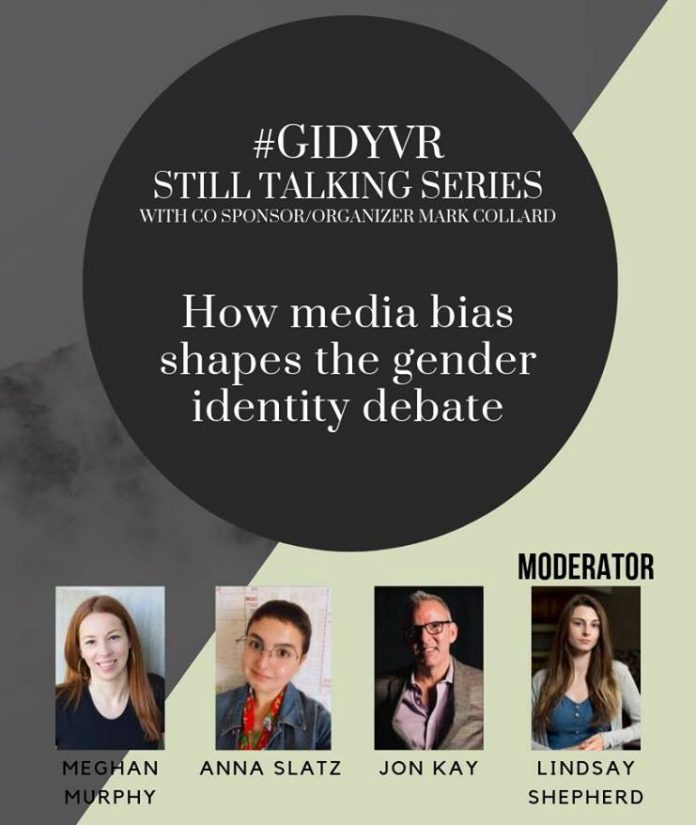
A screenshot of the poster for the transphobic event

An event being held at SFU’s Vancouver campus has caused controversy among the LGBTQ2+ community and allies. The event, titled “How Media Bias Shapes the Gender Identity Debate,” has raised concerns due to some speakers’ associations with transphobic discourse. 

One of the speakers in particular, SFU alumna and founder of the website Feminist Current Meghan Murphy, has been notorious for her recent involvement in several controversial events. Murphy advocates for a gender essentialist point of view that sees gender as inflexible and determined by the genitalia that one is born with — a view that would deny the existence of trans and gender divergent individuals. She was also banned from Twitter for the use of transphobic language.

In July 2019, Murphy spoke at a sold out event at the Vancouver Public Library while protesters marched outside. VPL was subsequently banned from attending Vancouver Pride, deeming the event to be “Transphobic hate speech.”

Other speakers include similarly controversial speakers such as: National Post columnist Jon Kay, SFU alumna Lindsay Shepherd, and journalist at The Post-Millennial Anna Slatz. The event is organized by SFU professor of archaeology Mark Collard.

Many social media users spoke out against the event and SFU for hosting it. June Scudeler, assistant professor in the First Nations Studies and Gender, Sexuality, and Women’s Studies (GSWS) departments, tweeted: “Hey, @SFU, the eventbrite page for the transphobic event is still up. This is not the ‘engaged university’ I want to work at.” 

Another user @lardandsabia tweeted “Hurts to know @SFU will host a GIDYVR panel. Gender identity is NOT a debate, but MM [Meghan Murphy] continues to spread transphobic hate speech under this thin veil. SFU, you’re willing to ignore BC Human Rights Code and make your trans community members question their safety to host this? #SFU.”

The event was  taken down from Instagram, though the Facebook page remains up.

Following the eruption of controversy, SFU made an official statement which said: “Universities operate on the principle that freedom of expression is a core component of intellectual inquiry and central to the pursuit of knowledge. As such, we support the right of faculty and other SFU community members to engage in free speech within the limits of the law.”

Additionally, the statement claimed that SFU does not endorse the views expressed, and that SFU is “Deeply committed to equity, diversity and inclusion.” Moreover, SFU supports “The right of trans community members to define their own gender identity and be respected in that choice.”    

The GSWS department has also released a statement that they are “Profoundly disappointed by those who use the language of feminism to justify exclusion and discrimination on the basis of gender identity or expression. We affirm that trans people are exactly who they say they are.” The statement mentions that the department will sponsor an event that “Supports and uplifts trans communities” in response.

The Peak reached out to Ashley Brooks, coordinator of Out on Campus, campus’ LGBTQ2+ resource centre, for comments. 

“The event should really not be taking place at SFU,” Brooks stated. “[SFU needs] to think very carefully about how they’re defining legitimate intellectual inquiry [ . . . ] This is more fundamental than debating big societal issues, we’re debating personhood here.

“It’s even worse that recently SFU put on display a transgender flag [in] August [ . . . ] those are more than pretty flags, they mean something. 

“Trans students need to see more than a commitment to display[ing] a flag or creat[ing] a mural celebrating gender and sexual diversity [ . . . ] You cannot be up for debating the legitimacy of people’s identities while also championing those identities — it is a complete contradiction.” 

Brooks adds, “It is above and beyond negligent to be discussing the legitimacy of [people] who attempt suicide as a result of those identities around three times as much as cisgendered people do.” 

Brooks suggests that for SFU, the consequences may include: SFU being uninvited from Vancouver Pride and damage to the school’s relationship with its LGBTQ2+ students and communities.


Your weekly SFU horoscopes: September 30–October 6

0
An illustration of a girl with long flowing hair. Astrological signs and stars shine around her.
ILLUSTRATION: Marissa Ouyang / The Peak

Aries — March 21–April 19

You might be bored to hot tears by this week’s class presentation. Channel your crazy into charity for once, and go take over the entire show from your bleary-eyed, orally challenged classmates. Scrap their original dull presentation topic and instead dictate to the class the full timeline of CupcakKe’s bizarre online breakdown-takedown against Camila Cabello and Shawn Mendes.

Taurus — April 20–May 20

You thought you’d glowed up so hard over the summer. I’m sorry to tell you that that was just the vitamin D and the warm lighting. The October rain and the nutritional wasteland of your palate are soon to wash away the glamour, revealing your real idiot mountain gnome complexion.

Gemini — May 21–June 20

This week, remember: lovers are like pumpkin spice. Their supposed identities are a front for an unstable mix of five different personalities/herbs, but we indulge in them anyway. Then we snort puka shells with the VSCO girls.

Cancer — June 21–July 22

You’ve buried your most embarrassing memories for years under layers of neoliberalism and the power of positive thinking. Now would be a good time to harvest those memories and pour them into your art. Let the shame of buying $6 chicken strips and fries from the caf’ for a grade 8 charlatan who never BBM’d you back flow through your synapses . . . let it define the nuances of your sham answers to SFU’s latest enter-to-win student experience survey.

Leo — July 23–August 22

Don’t think you owe anyone explanations or justifications this week. Just be you. And if that ends in mortgage broker fraud, so be it.

Virgo — August 23–September 22

It’s time. Pack up the summer outfits and stock your closet with an armoury of plaid buttoned tops and worn jeans. Dressing like a scarecrow until December could convince some wizard somewhere to magick you a brain for the semester. 

Libra — September 23–October 22

Someone’s going to cross you this week. Don’t engage. Just stop what you’re doing, pucker up,  and post a selfie to your Snap Story captioned “~if that’s your man then why did he write his SFU ID number on my pumpkin cream cold brew?~”

Scorpio — October 23–November 21

Don’t go thinking you can trust anyone with the knowledge that the SFU online library reserves have one (1) digital copy of the textbook everyone’s put off buying available — especially not in fall semester. They’ll all betray you in the end. Yes, even Phillippe with the stubbly serrated jawline.

Sagittarius — November 22–December 21

Remind yourself . . . everything you do has a consequence. You can’t just knock back nine Mike’s Hard Lemonades in a dark corner of the Robert C. Brown maze, solve the spider-in-the-urinal problem, and then put on a cute sweater in the morning and move on. 

Capricorn — December 22–January 19

Your sapiosexuality is going to be hard to satiate this week. Your crushes, rather than be characterized by the imagined lines borne of your anguished mind, will actually open their mouths . . .  “Game of Thrones earned all nine of its Emmys.”

Aquarius — January 20–February 18

Don’t obey the impulse to get a full-body spray of pesticides done in lieu of renewing your vaccines. Yes, you might be a healthy snack for now. But what works for the mushy apples coming into season on your senile grandfather’s probably ill-gotten land is unlikely to work for you. 

Pisces — February 19–March 20

Tie-dye your thrift shop purchases this week using red wine, scotch, and curaçao. It’s time your extended family learned your true colours at Thanksgiving.

Closure cravings: My life of starting and ending romances just for the post-relationship coffee dates

0

My heartbeat was frenetic that morning. It shook the blood in my veins as I gripped my phone. I’d contracted a heinous bout of emotional stability. Now, the hunger for relationship turmoil screamed through my every waking moment. But please don’t worry — I’m a highly evolved creature, adapted to the inhospitable edge of valid coping mechanisms. 

Adrenaline was high and blood sugar levels were low, and that could only be rectified by one event: a high fructose, hazelnut caramel syrup-saturated coffee date with my recent ex-boyfriend.

My phone jumped with his incoming text.


I really think it would be easier if we could talk about what happened in person yk? 

What about coffee tomorrew? 

*tomorrow lol


I grinned manically. 

It was Closure Time. 

There’s great artistry in the emotional gratification of painstakingly chronicling every mundane misdemeanor my ex and I made against each other throughout our torrid, Tinder-based, three-week-long relationship. A coffee shop is the ideal destination: it’s private enough that you can each lie about deleting the other’s nudes out loud, but it’s also public enough that the caffeine catalyst will escalate petty insults about each other’s music tastes into a fight that ends with you stealing their headphones when they depart. Oh, that rush . . . Norepinephrine . . .

Closure of this calibre cannot be desperately gleaned somewhere as simple as the Cornerstone Starbucks. After all, my accusation that you didn’t like the name of my cat (Dromedary) could be interrupted by a crim student accidentally lusting over a serial killer out loud. 

No, what I need is the burning filament of an incandescent lightbulb to highlight my glistening eyes, along with a plethora of succulents lined up on an unsanded pinewood shelf to witness our fractured hearts. 

I wasn’t the amateur closure-coffee dater I was when I first began orchestrating my breakups to ascertain chaos and caffeine. I let my break-ups ferment now, age like wine. Nothing is worse than a purely amicable send-off from which neither partner can indulge in the added weight to their emotional baggage. 

Only once, shamefully, was I outmaneuvered. The boy escaped to a soul-searching backpacking trip of trendy hostels in Japan before I could schedule anything. In my defence, he was a Cancer. 

I could already taste the fair trade matcha latte, dripping down the back of a throat tightening with emotion. And if this date tomorrow was bland, well — I glanced down at my phone, relishing in the fresh Tinder notifications — there would be a new break-up just around the corner.

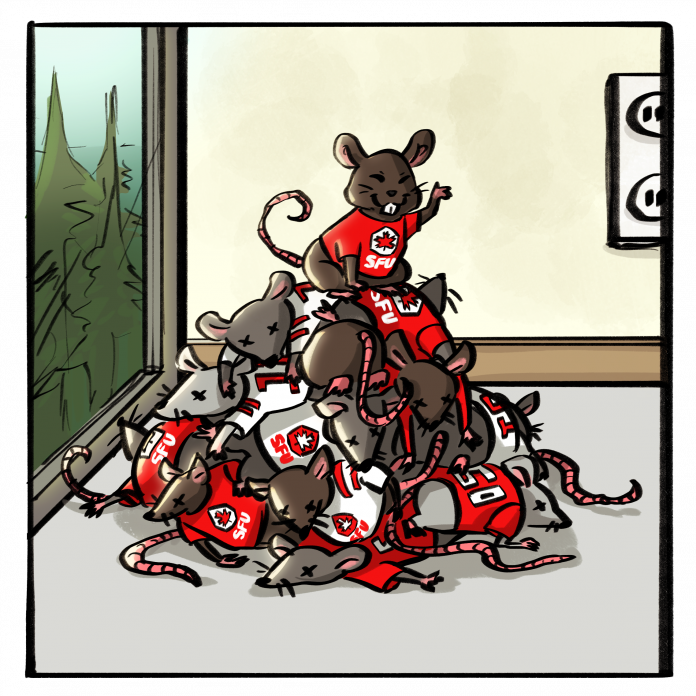
SFU Hockey riots after pile of dead rats in Residences is prioritized for NCAA accreditation

0

The NCAA National Committee has released their list of sports programs that will receive NCAA accreditation for the 2019–20 athletics season. Among the notable additions to SFU’s already strong slate of NCAA-competing programs are the school’s Quidditch team, its board games club, and — to the surprise of some in the athletics community — a pile of dead rats that was found in the Burnaby campus student residences.

While SFU now boasts an even broader range of NCAA-accredited athletics programs, the Men’s Ice Hockey team was omitted for the eighteenth year in a row. It’s unclear what the hockey team might do to secure the institutional backing required to make the jump to the NCAA, other than switch sports altogether or become a heap of deceased rodents.

Following the accreditation announcement, reports surfaced on social media of a rowdy group of incensed athletes loudly occupying Convocation Mall. While the cause of the riot was initially unclear, a handful of students, barricading themselves in the W.A.C. Bennett Library, shared live tweets of the proceedings. The posts referred to puck-shaped holes in the Maggie Benston Centre windows and anti-SFU chants echoing off the concrete walls. 

Shortly after the National Committee’s accreditation announcement, a press release from the pile of dead rats indicated that, though the team of rodents possesses multi-sport athletic abilities, they will compete in the Division 2 GNAC rat basketball conference. 

“While the NCAA did give us the option of fielding soccer, basketball, and ice hockey teams, we’ve settled on the Division 2 GNAC rat basketball conference. We’ve chosen not to ice a rodent hockey team due to embarrassment for, and fear of backlash from, the SFU hockey community,“ a spokesperson for the pile of dead rats said in a follow-up interview with The Peak.

On the heels of the NCAA’s accreditation announcement, the SFU Board of Governors released its newest budget update. The document indicates that while the board’s annual transfer to the SFU Hockey club will hold steady at 12 secondhand bath towels and one three-day-old fruit platter per annum, it has indeed allocated funds in its yearly budget for a new rat basketball arena. Their new arena, like most other buildings on campus, has an expected completion date of January 2038.

Month of Welcome is about more than just free stuff

0
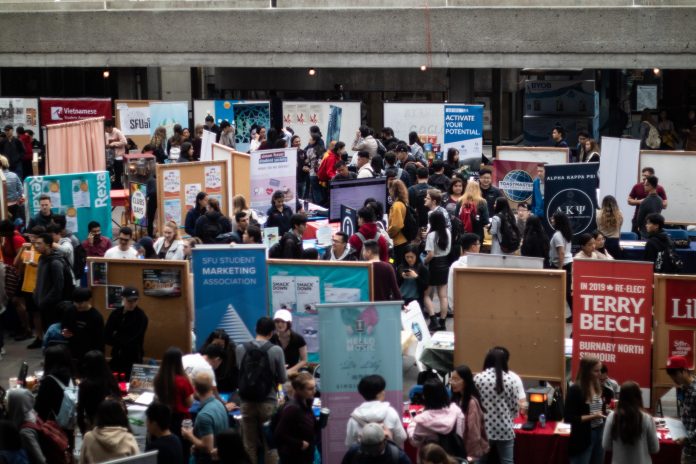
SFU offers new students lots of untapped resources. Photo: Zeh Daruwalla/The Peak

Month of Welcome is an exciting time for students. With an abundance of resources, freebies, and activities being thrown their way, it’s one of the only times students can freely enjoy university without drowning in assignments, exams, and other commitments. In organizing the Resource Fair, BBQ, and fun activities, SFU excels at providing students the support they need to begin university. However, the onus lies on students to take advantage of this time to be well prepared when school starts.  

Two of the most common complaints I have heard from SFU students is that SFU is an anti-social, commuter campus, and that SFU does not care about its students enough to provide them with adequate resources. The extended Month of Welcome challenges those criticisms, providing students an opportunity to build social connections, and giving students a chance to talk to campus partners about available student supports. If, after all this, students still feel that they haven’t been given a proper orientation into the university, it’s because they haven’t fully taken advantage of the Month of Welcome.

SFU holds a Resource Fair during Month of Welcome on all three campuses: Burnaby, Surrey, and Harbour Centre. Despite this, many students are still clueless about the services SFU offers and subsequently complain. However, students are partially to blame for this lack of knowledge. Instead of complaining, students should understand what resources SFU has to offer by talking to the representatives present at each SFU student service tables.

Unfortunately, one of the problems during the Resource Fairs is that there ends up being longer lines for the free items and shorter lines where there are none. As someone who helped out during the Month of Welcome, I saw most SFU services offering freebies to attract attention, but individuals would come, grab the freebie, and leave without trying to understand the value of the resource. To get the most out of this orientation time, students need to focus on more than just swag, and actually engage with the valuable information offered at each table. 

Just as with the rest of one’s time at university, no one is going to chase new students around and tell them what to do and when to do it. Nobody will hold their hands and force them to make friends, build connections, and form the support networks they will need. The most SFU can do is put the tools in front of new students; they must be responsible for their own well-being. Students are paying for these resources, so why not take full advantage of them? 


Election Rundown: Trudeau’s talk of opioid crisis solutions is a vote grabbing technique

0
British Columbians want real solutions to the opioid crisis. Photo: /The Star

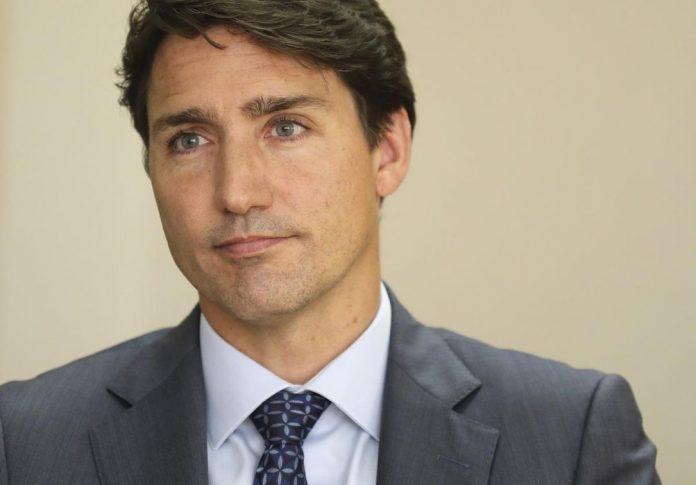
On Friday August 30, Prime Minister Justin Trudeau met with Vancouver mayor and former New Democratic Party MP for Burnaby South, Kennedy Stewart. The two met on the front steps of Vancouver City Hall and proceeded to speak about what they have planned for the future of Vancouverites and Canadians more generally. Their main talking points included battling the opioid crisis, new housing developments, and extending the Millennium Line division of the SkyTrain down Broadway Street.

However, one thing to keep in mind is that all this hyped-up rhetoric is a by-product of election season, a political strategy to secure votes. Voters should remember not to be swayed by the staging of high-emotion issues when weighing the candidate they believe best represents their interests. 

Aside from Trudeau’s photo-op with Mayor Stewart, in which he made brief statements about where the money will be invested, his re-election platform more generally gives no explicit indication as to where the money is intended to be allocated. Given that this is such a pressing matter, would it not be important to clearly lay out to voters what the federal government has planned moving forward? 

Considering the significance of the effects of the opioid crisis across Canada, and particularly in British Columbia, Trudeau’s focus on this issue makes him appealing to some voters. Trudeau says his government plans to continue to work toward a solution to the epidemic through legislative change and further investing in border security, safe injection sites, and resources for first responders. Part of this plan includes working with international partners.

The federal government says that they are exhausting all options when it comes to finding a solution to the crisis, and part of that involves a  $100 million investment, nation-wide, to fund the battle against the opioid epidemic. This is a significant amount of money, and it could potentially provoke a favourable change. 

In British Columbia alone, opioid related deaths rose from 1,007 in 2016 to 1,546 in 2018. Both local and federal governments acknowledge that this is a public health crisis. However, previously implemented solutions appear to not have been very effective, given that opioid related deaths in Canada increased by over a thousand in two years. 

Admittedly, it would be expecting too much to anticipate a positive change in such a short time period, however, the opioid problem is getting worse. Trudeau’s promise of continued investments now, when he had years to address this beforehand, can be interpreted as political rhetoric exclusively designed to attract votes. If Trudeau is genuine about resolving this issue he should be more inclined to employ bold strategies. Decriminalization of illicit drugs has been proposed, but Trudeau and his party are not in favour of this. It might be wise to reconsider if they plan on capturing British Columbian votes come October.    


The US’ response to the Saudi oil strikes makes little political sense

0
The damage to the refineries was relatively minor. Photo: /Reuters

On September 14, a drone strike critically damaged two of Saudi Arabia’s oil manufacturing infrastructure. The attack was allegedly carried out by Houthi rebels, a group that appeared after the Arab Spring and are fighting for freedom in Yemen. They are currently engaged in a proxy war against the Saudi-led coalition in Yemen.

This attack halted production of 5% of the global oil exports. While there were no casualties reported — and it is expected that the kingdom of Saudi Arabia will have both refineries back online by the end of September — a global market panic has set in.

However, despite the dip in oil production resulting from these strikes, the panic is not related to oil prices, which are expected to calm down. The panic is instead related to the potential of a new war between the United States and Iran. 

Iran was drawn into this issue after Saudi officials claimed that the drones used in the attack were launched from Iran, north of the kingdom. Officials further claimed that the weapons were the type used by the Iranian government. After hearing these accusations, the United States came to the defence of their ally, suggesting that the attack was the Saudi’s “9/11.”

The United States is obviously not located in the Arab Peninsula. Moreover, the attack was not as bad as it was initially thought to be. So why is the White House comparing it to “9/11,” an attack that killed approximately 2,753 people? There are implications within that statement, the biggest being a precedence for military action in the region which could potentially make the humanitarian catastrophe in Yemen worse. 

If this were to happen to a close US ally like Canada, the President’s reaction would make a bit more sense. However, Saudi Arabia is not a close ally in the traditional sense, so the hyperbolic jump to Saudi Arabia’s defense is puzzling — especially as it only draws the US into further conflict in the Middle East.


What Grinds Our Gears: Stop making us pay for access codes and broken web content

0
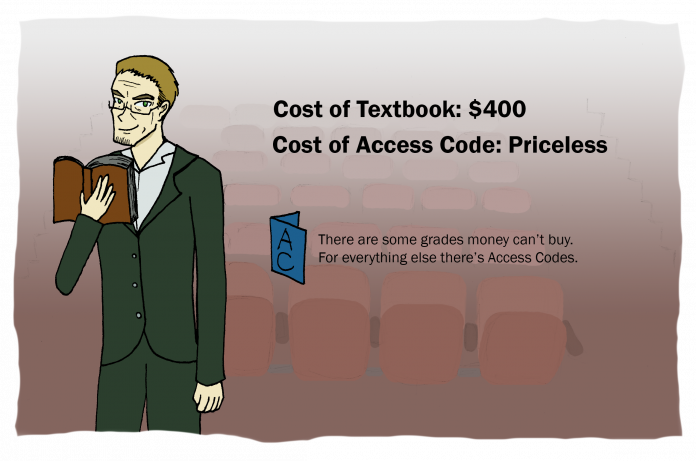
There’s no reason for digital information to cost as much as a textbook. Illustration: Alice Zhang/The Peak

As students, we already have a lot of expenses at SFU. Between just tuition and textbooks, we’re dropping over $2,000 per semester at least — more for international students. But another expense that you don’t expect until it smacks you in the wallet are access codes for certain courses. 

Particularly people in the sciences, students will be familiar with a course requiring you to use your instructor’s code and an access code from the bookstore to sign in to an online site for assignments and practice. 

The problem with this is that even if you have the material from a previous course like biochemistry (MBB) or bought the books secondhand, you still have to buy the codes again — in some cases costing $80 or more. And even if you already had access to a site from a previous course, the website may say that it’s expired, requiring more chats with customer support. 

I’ve personally had several different providers of access codes (Wiley, Cengage, Pearson Masterings, Webassign). With them comes no shortage of issues: connecting, downed servers, browser support and cache problems, weird marking systems and, recently, an overcharge of $481.36 for a $125 code and textbook package . . . 

It’s a pain to constantly deal with all of these different sites, pay extra fees, and fiddle with tech issues — all for information I may already have! At the very least, enrolling into a course should grant you automatic access to all the necessary online materials, without the need for extra hoops to jump through.