Home Blog Page 453

Hot campus cocoa

0
Photo taken by Meera Eragoda

Lower Mainlanders, we were not made for the snow. The week I wrote this, getting to campus was an intimidating prospect. If not the ever-looming threat of being stranded on the mountain, there was also the uncertainty of whether or not to make the trek to campus — only to have your professor cancel class at the last minute because they also (fairly) don’t want to deal with the snow. We were like fragile drooping houseplants in non-ideal conditions. But what better way to perk us up during these trying times than with the warm hug of some hot cocoa? I’ve tried lots of hot cocoa from as many different places as I could so you can have your Goldilocks moment with hot cocoa — without having to face three bears.

Blenz Coffee:

Photo taken by Meera Eragoda

I had fairly low expectations for this one, but the Blenz hot chocolate actually made me feel like Archie (from the comics, not the TV show Riverdale) whenever he walks by a pretty girl. It spun my taste buds around and literal heart emojis may have emerged from my mouth. Hot chocolate could not have described a drink more clearly. It was rich, thick, warm, and very chocolatey. I chose dark chocolate, but milk chocolate would be a lighter option for those not as willing to drown their mouth in so much intensity. There is also a white chocolate option.

Price: $4.99 (including tax)

Available: Vancouver and Surrey campuses

Rating: 8/10, Willy Wonka chocolate rivers


Tree’s Organic Cafe:
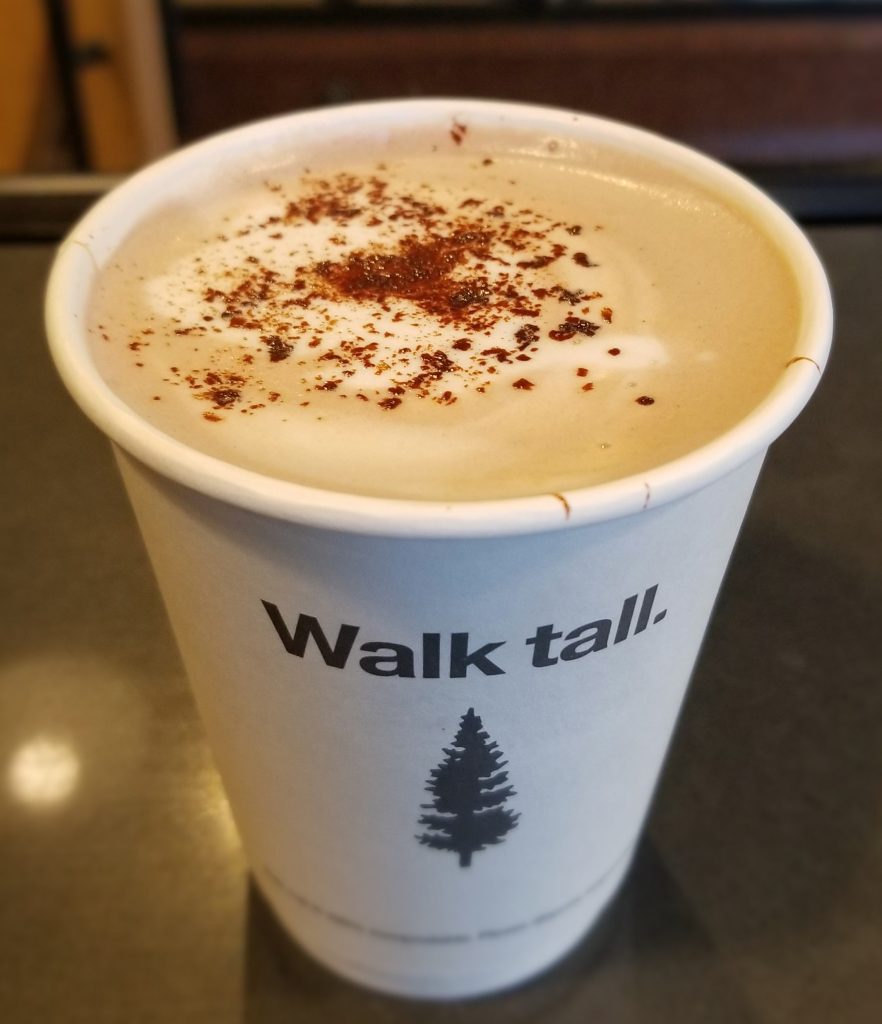
Photo taken by Meera Eragoda

Tree’s hot cocoa is sweet — but not too sweet. It’s chocolatey, creamy, and has a nice little frothy layer on top. It’s maybe a little too overpriced for what it is, but if you’re feeling like treating yourself after a particularly exhausting day, or if you’re expecting to  need some chocolate courage to face your day, this might not be a bad place to do it at. Bonus: the cup tells you to “walk tall” and haven’t we all, at one point or another, needed our beverage to make us believe we’re ents?

Price: $4.10 (including tax)

Available: Vancouver campus

Rating: 7/10, cute, encouraging messages


Starbucks:
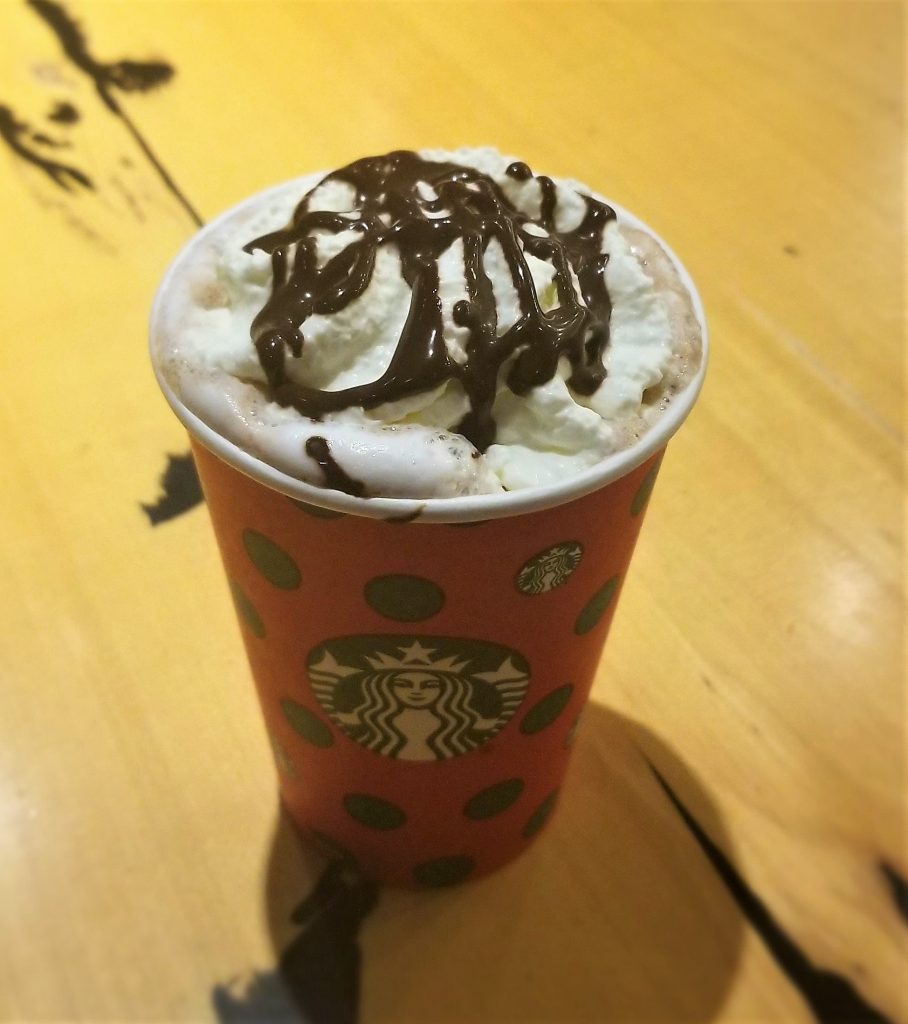
Photo taken by Meera Eragoda

Can we be real for a moment and recognize that Starbucks drinks are literally just different flavours of syrup? No shade here, I love me a peppermint mocha in the winter, but their hot chocolate is just chocolate flavoured syrup. Perfect if you have a super sweet tooth, but you may want to get it half-sweetened, if not. The whipped cream and chocolate drizzle on top add a nice creaminess and real-chocolate taste to it; if you’re not lactose intolerant, I would highly recommend adding.

Price: $3.83 (for the tall size, including tax)

Available: Vancouver, Surrey, and Burnaby campuses

Rating: 5/10, syrups with a side of milk


Cartems Donuts:

Photo taken by Meera Eragoda

I don’t think it should come as a surprise that Cartems does hot chocolate well. This was my favourite because it’s not overly sweet, so the chocolate really does shine through. It was creamy, milky, and the dusting of cocoa on top adds a nice bit of bitterness to it that made it a more complex hot chocolate than the others. I recognize that this is going to be most appealing to people who tend to find drinks at all the other places on this list just a little too sweet. Luckily, if this is not you, there are opportunities to satisfy your sweet tooth with one of their delicious donuts after (the Earl Grey is a classic).

Price: $4.45 (including tax)

Available: Vancouver campus

Rating: 9/10 cocoa dustings


Renaissance Coffee

Photo taken by Meera Eragda

If you’re on the Burnaby campus, this one’s for you — especially if you don’t feel like waiting in line at Tim Hortons. This is the second cheapest option on that campus, and, like everything else at Renaissance, it’s decently solid. Honestly, Renaissance is like the dependable, reliable friend that everyone always takes for granted. The hot cocoa is more chocolatey-sweet than syrupy-sweet (I’m looking at you Starbucks), and the whipped cream on top is nice and light, which works for it. The drizzle they add makes the drink taste kind of caramely which is a pleasant twist.

Price: $2.75 (including tax)

Available: Burnaby campus

Rating: 7.5/10, light, fluffy whipped cream clouds


Tim Hortons

Photo taken by Meera Eragoda

Ok, this may be controversial, but Tim Hortons has a good classic, hot cocoa. When I say classic, I mean like the stuff you would make for yourself at home with a store-bought mix. It’s got that nostalgic, no-fuss feel — and in a world where you never know if things are as they seem, isn’t it nice to have something that represents itself as purely as Tim Hortons hot cocoa? It’s not trying to be anything fancy, but that means it’s not trying to swindle you either. It’s the cheapest option on this list and I’m not mad about it. Are you?

Price: $1.88

Available: Vancouver, Surrey, and Burnaby campuses

Rating: 9/10, basic b’s

Political Corner: World leaders can’t continue to shrug off wildfires while courting Big Coal

0
The Australian wildfires have razed the continent, killing humans, animals, and whole ecosystems. Photo: Getty Images

Last year, the world watched as forest fires in the Amazon led to some of the worst environmental damage the world has seen in recent decades. Throughout all of the devastation, there was a hope through multinational cooperation that we would never have to witness destruction on that level again. Yet less that a year later, Australia is battling approximately 135 separate bushfires in its southeast, including one “megafire.”

The bushfires did not come out of nowhere. Although Australia experiences annual seasonal bushfires, the fires this year are larger, more numerous, and subsequently harder to deal with. This is in part due to rising temperatures and more frequent droughts that have increased the vulnerability of their ecosystem to fires. 

Worsening weather patterns is a result of the willful ignorance of global politicians. Throughout 2019, the Australian prime minister and his party fought against bills that would have lowered Australia’s emissions in favour of protecting the coal industry. The United Nations has also been critical of Australia’s process to limit their emissions, and stated that the country was one of the G20 nations in need of improving their numbers. 

Right now, the Australian bushfires feel like a distant tragedy, but the experience of losing everything to fire is not a distant feeling for many residents of BC. In 2017 and 2018, the province fought several devastating forest fires that cost taxpayers millions of dollars. While 2019 saw fewer fires than the past two years, there is no guarantee that 2020 will follow suit. The reality is that extreme weather events are becoming the new normal.

As weather patterns become harder to predict, we find ourselves in a dangerous middle ground between trying to stop the planet from warming further, and adapting to what changing climate throws us — like devastating fires. This does not mean that we stop fighting climate change. There has to be continued urgency in pressuring policy makers to develop plans that have a real impact on curbing CO2 emissions, and halting more devastation.


Comparing GPAs is a recipe for dissatisfaction and unnecessary stress

0
GPA-envy doesn’t have to define your university experience. Illustration: Ashley Yien/The Peak

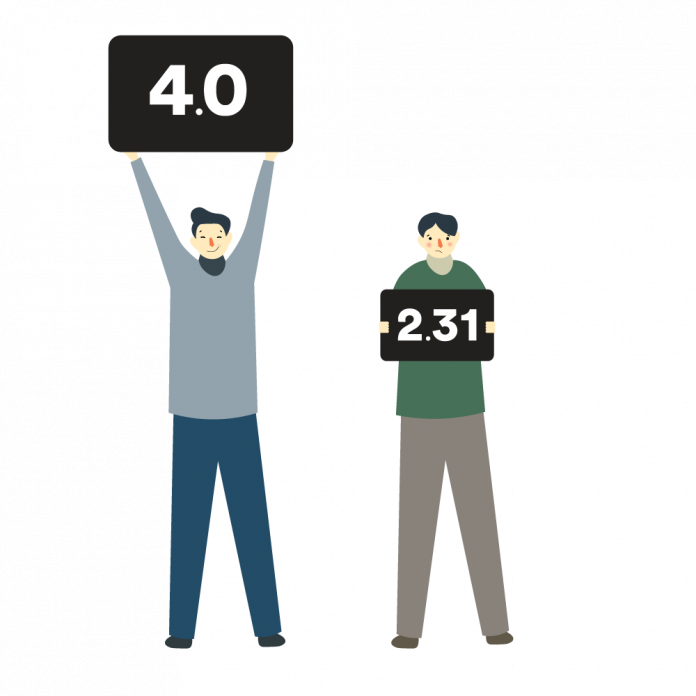
Success in university shouldn’t be interpreted as a zero-sum game where students are indirectly encouraged to compare grades. Extreme academic competitiveness is evident in some departments more than others, but wherever it goes it creates an unnecessarily harmful competitive atmosphere, which can lead to student stress. Instead of comparing GPAs with peers, students should recognise that there are other, equally valid ways of measuring success.

Before disregarding this somewhat obvious stance that students are stressed about their grades, hear me out: I’m not going to spew some nonsense on how grades don’t matter. They absolutely do. What I’m saying is comparing grades with peers shouldn’t be the only way students measure success. Success has many layers to it, but by insisting on comparing GPAs, one is limiting oneself to a narrow definition of it.

My department has a policy of curving grades, which means that only a fixed percentage of students can get As, Bs, and so on. This can make it especially hard to not be competitive, because the grade one gets is essentially also based on others’ performances. While competition is not inherently unhealthy, this form of direct comparison can be discouraging. It’s important to remember that students have different levels of capabilities, and different strengths and weaknesses. This grading system shifts the focus from trying to do the best one can, to trying to do better than one’s peers. In classes like these, I found myself worrying too much about how my classmates were doing in their exams, which ended up negatively impacting my mental health. 

I had to remind myself that success cannot possibly boil down to just my GPA. There are a range of other measures of success that a university student can look to, in order to be satisfied with their experience at SFU. Learning new skills, trying something new, learning to set realistic goals, learning to be kinder to oneself, etc. are also equally valuable take-aways from university.

One of my personal goals has been to step outside of my comfort zone and make use of the many opportunities that SFU provides. For example, I opted for some electives that seemed really interesting to me, even though I could have taken the easy path of choosing “GPA boosters” that would play to my strengths. I don’t know a great deal about Canadian history since I’m an international student, so last year I took a Canadian labour studies elective to learn more about it. It was a little daunting as I saw other students quickly connect the dots, while I had to spend more time doing some research on my own to fully understand the content. It turned out to be a great learning experience — one that encouraged me to challenge myself more often, rather than give into the GPA rat-race.

Even though grades are an important part of the whole university experience, it is not the only worthwhile aspect of it. GPA isn’t the be-all end-all of your post-secondary journey. That’s why students should consider making a personalised list of goals that are more meaningful to them than a simple grade comparison — or at least find meaning in their own grades and not others. In the end, your success at university cannot and should not be defined by other people.


What SFU Needs: A dollar store that actually sells things for a dollar(ish)

0
Why buy two items for $50, when you can buy 40 for the same price? Illustration: Nicole Magas/The Peak

All too often I find myself in need of a random niche item, only to realize that the nearest dollar store is at the bottom of the mountain. The SFU community provides several convenience stores, grocery stores, and retail shops — but not a cheap variety store. What gives? Where’s our dollar store?

What We Lack:

A store on campus that sells inexpensive items. Not SFU branded. Not super high quality. Just dirt cheap and easily accessible. Things like:

  1. Cheap school supplies. No store on campus sells poster boards, glue, tape, etc. for less than extortion prices. 
  2. Low-cost kitchen supplies. What do I do if I urgently need a colander at a moment’s notice? My dinner depends on it! 
  3. Inexpensive cleaning supplies. Some of us are OK with the off-brand selection. Let us have it!
  4. Cheap hair ties and other everyday items essential for classes, tests, and labs. It doesn’t have to be fancy, it just has to function. 
  5. Those cheap, wonderful, dollar store decorations. Some student clubs are using lined pieces of paper to decorate their events. Let’s have the cheap holiday decorations to finally entice more than two students to attend a party.

The Vision:

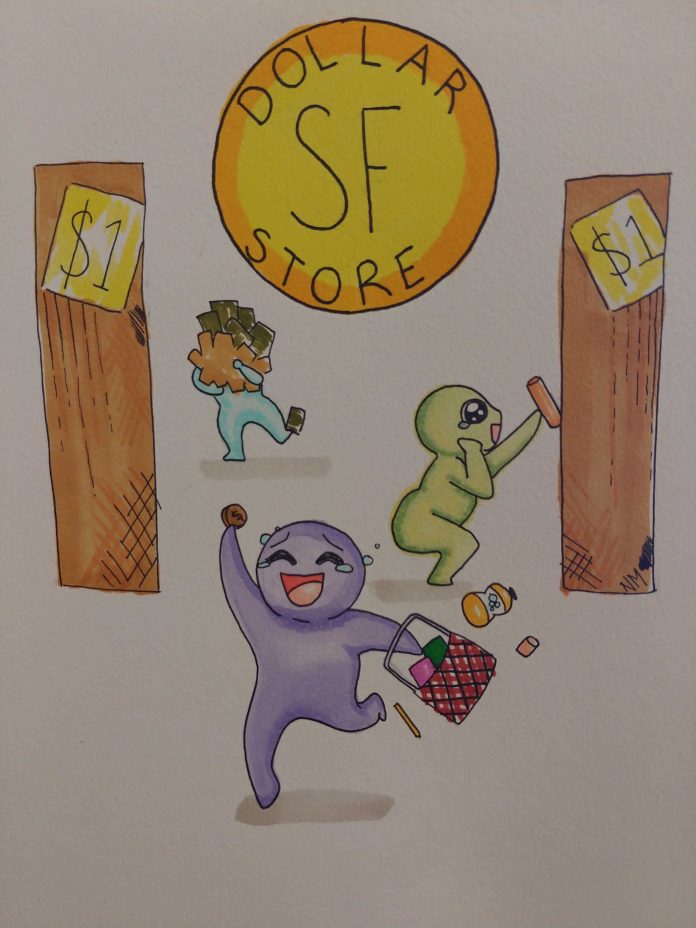
Imagine walking to Cornerstone and seeing the bright neon lights of Student’s Frugal (SF) Dollar Store, a majestic wonderland where a plastic broom or a scented candle is only a dollar. Finally, broke students will have access to basic necessities that are actually affordable on a student budget. Whether it’s garden wire, glitter, fake flowers, or a kazoo, the SF Dollar Store is a student’s one-stop shop for all random, cheap item needs. Having a social event? No one does snacks or environmentally disastrous disposable plates and plastic foil decorations like the SF Dollar Store. Forgot you have a poster-project due tomorrow morning and can’t decide between saving your GPA or paying rent? The SF Dollar Store is here to help!  

Why We Need It:

Part of what makes a university a community is providing access to services that acknowledge all students’ needs. Dollar stores recognize that not everyone has the money to pay for high-end, sustainable products. By situating a dollar store within the heart of the UniverCity community, SFU can acknowledge and help mediate the economic struggle many of their students face. The bottom line is we are broke af, and not everything on campus needs to break our bank accounts. 


So SFU has a new president — what’s the big deal?

0
joy johnson shot for royal society

It’s no big secret that I’m something of a pessimist. Give me a sunny day, and I’ll point out the clouds in the distance. Introduce me to a stunning new fantasy series, and I’ll give you my five-point thesis on how the author is probably a mess. The world is full of open sewers waiting to plunge the overly-optimistic waist-deep into cesspools of disappointment. But you can’t watch your hopes and expectations plummet below the ground if you never held them that high to begin with, right?

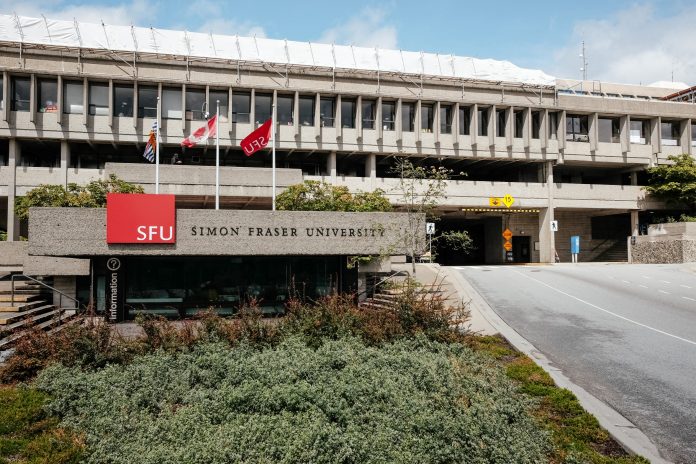
I look at the appointment of a new president at SFU in a similar light. In the midst of the fanfare, the exposés, and the proverbial confetti and doves that greet Dr. Joy Johnson as she ascends to the mighty throne at the top of the mountain, I have to ask myself: why? Why is the appointment of a new president such a big deal? 

It’s not as though Petter is leaving in disgrace, or that Dr. Johnson dueled him to the death for his position in a long succession of ruthless blood contests. I have to believe, as my pessimism demands, that nothing fundamental will change at all for us peasants tending our fields of term papers with this shift in administration. 

It’s not that I believe that either Andrew Petter or Joy Johnson are bad people or bad administrators. Far from it. I have no doubt that Dr. Johnson will do her duty to the university admirably — which will likely mean that tuition will continue to rise, construction will stretch out in perpetuity, and the President’s Honour Roll reception will still consist of mediocre food, a pat on the back, and an ask that students pay for even more bloated university experiences. 

It’s simply how the university as an institution is currently built to function — namely as a business, with all its analogous clients and shareholders. And as part of the day-to-day bureaucratic functioning of the institution, it doesn’t really matter who is at the head, so long as all the bureaucrats down the line remain and continue to do their jobs. 

From reading Dr. Johnson’s introduction and listening to her priorities, nothing sticks out as alarming, but neither does anything stick out as ground-breaking either. I am as puzzled about what SFU’s commitment to “engagement” actually means when Dr. Johnson reaffirms it — as when Petter did. What does “enhanced learning environments” entail when, for the third year in a row, I’m taking classes amidst a cacophony of construction noises and chemical smells leaking from sites? Does a commitment to “equity, diversity, and inclusion” mean that the year-long debacle over finding the Rotunda groups permanent spaces is finally going to be resolved? Does Indigenization mean more Indigenous content in class syllabi that feels rushed and trite rather than actually meaningfully integrated? Will Dr. Johnson’s past success increasing research income for the institution mean financial relief for the international students who were hit with a 20% increase in tuition?

In the end, I don’t see how this change is that big of a deal. I can’t read the future, so I don’t know how Dr. Johnson’s tenure as SFU’s tenth president will play out. My gut says that any real change that comes out of this will be modest, and isn’t likely to impact the majority of students significantly, if at all. But I’m a pessimist. I can’t be disappointed if I don’t hold my expectations too high.

But I can also be pleasantly surprised if my low expectations are exceeded.


The current SFSS Board must be held accountable for its concert inflation

1

Editor’s note: The author is active in student politics, and is currently advocating for a forensic audit of the 2019 Fall Kickoff event.

Fall 2019’s Kickoff, for those who attended, was pretty fun. New artists were brought in, a new venue was tested, and there were even some food trucks. It also had a record-shattering deficit four to five times more than the average. The budget — which was poorly debated and hastily approved at the Board table, as previously reported by The Peak — was significantly higher than previous years. The event undersold tickets by almost half (1,200 down from a target of 2,500), leaving the SFSS in the red to the tune of $105,995. 

During one of their meetings last November, I asked the Board to conduct a forensic audit to investigate the event. Why? Because you don’t lose that much money, say “lessons learned,” and move on to the next project. An independent investigator conducting a forensic audit would be the only way for students to know what really happened to their money.

What is a forensic audit? It’s a focused investigation into spending to see if any financial mismanagement, fraud, or negligence occurred. Some members of the Board have said that the event was simply more expensive due to a different location. Looking at the budget, final report, and meeting minutes, there are too many questions and too much concerning behaviour to take their word at face value. A full forensic audit is necessary, both to keep the current (and outgoing) Board accountable and to prevent future SFSS events from squandering student funds. 

On November 29, the SFSS Board was presented with a two-page report on the concert. It contained a basic event and budget summary. It was both wholly inadequate and misleading. Three paragraphs of text were allocated for an event that took months to plan and cost over $178,000. It stated the deficit was $45,000. However, the SFSS also contributed an initial $60,000 in a 14-minute-long emergency meeting in August, bringing the actual total closer to $105,000. 

This figure doesn’t include board, admin, and staff costs. Calculating the true losses for this event is therefore much more difficult. With a budget they’d never seen before, the Board majority decided to shut down questions and rushed through a motion to add $60,000 of student money to a one-off event. I consider this negligence is reason enough to have a forensic auditor investigate. 

To put this into perspective, the SFSS will have spent more to cover the losses for the concert than they did last year for the whole of the communication office ($103,000), Women’s Centre ($93,000), Out on Campus ($73,000), or Surrey campus office ($55,000). That includes staff, events, and program costs. The SFSS will have spent more on this concert than they did on accessibility funding ($1,600), the Food Bank ($29,000), the Advocacy Committee ($12,000), Membership Engagement ($17,000), and student bursaries ($10,000) last year combined — with $30,000 left over. It really shows how warped the SFSS’s priorities have become that a one-day event is more important than a year’s worth of programs, events, and advocacy. 

So, why a forensic audit now? Why spend more time and money when the SFSS already has annual audits? In sum, the annual audit only looks at the finances of the SFSS as a whole, and provides summary information. The 2019–2020 annual audit will be the next Board’s burden to carry, and students won’t see it until next fall. Many of the Board members who worked on the concert now won’t be on the Board after April. 

Meanwhile, a forensic audit conducted this term would dig deep to verify what happened and why — it would look at who negotiated the prices, signed the cheques, and made the decisions to see if any policies, bylaws, or laws were broken. Students deserve to know how and why their money was mismanaged. The annual financial audit won’t bring justice; a forensic audit will.

The Board is charged with managing the fees you paid to them, and in this case, they did a poor job. You deserve to know why and what changes need to be made for this to never occur again. 

So, I ask all of you to call, email, and talk to Board members to demand they hire an independent investigator to audit this event.


2010s at SFU: a decade in review

0
The SFSS will be offering emergency financial aid to students

As we say goodbye to the previous decade and welcome a new one, let’s take a look back at some of the crucial events that have taken place at SFU over the last ten years.

2010: Andrew Petter is elected as SFU President and Vice-Chancellor

The name Andrew Petter may be familiar to any SFU student who’s been attending the school in the past decade. Currently in his tenth year as President and Vice-Chancellor at SFU, Petter took the leadership in 2010, following the footsteps of Michael Stevenson who likewise held his position for ten years. Formerly the NDP cabinet minister, Petter expressed large plans for the university’s future when he got the job, including the expansion of the Surrey campus, the incorporation of new faculties — such as the faculty of environment and faculty of communication, art, and technology — as well as the development of the Woodward’s campus in Downtown Vancouver.

2011: Simon Fraser Student Society (SFSS) holds a 94-day lockout

In the summer of 2011, the SFSS’ Board of Directors locked out their unionized workers for 94 days, halting the bargaining process to reach a collective agreement with the Local 3888 of the Canadian Union of Public Employees (CUPE). Barry O’Neill, president of CUPE BC at the time, explained that “The SFSS politicians want to lay staff off, cut wages by up to 40 per cent, and replace experienced staff members with untrained volunteers.” The move to lock these groups out of employment was led by former SFSS president Jeff McCann whose decision left many services unavailable to students, including the Women’s Centre and Out on Campus.

2012: CUPE and TSSU join forces in job action

After two long years of demanding increased wages, yet still having no collective agreement with SFU, members of the CUPE Local 3888 joined together with the Teaching Support Staff Union (TSSU) to put immense pressure onto the university. A unanimous vote was reached in May to pass a motion to conduct a strike vote. The strike vote resulted in 90% of members voting in favour of taking job action. The two unions formed picket lines in front of SFU buildings, preventing any paid employees from entering their workplace. 

2013: Physical altercation creates conflict within SFSS Board members

Internal issues within the SFSS arose when environment representative Monique Ataei reported a case of physical assault by member services officer Moe Kopahi, urging for Kopahi’s resignation from the SFSS. The October incident was recounted in a Peak article, where Ataei recalled borrowing Kopahi’s phone to make a call. After changing his mind due to privacy reasons, Kopahi allegedly snatched his phone back from Ataei, striking her face. In the midst of the conflict, Ataei brought up concerns regarding safe working environments, indicating that she has personally felt scared in the office before. The incident was opened up a year later, reported in a later Peak article that it was “accidental in nature and did not involve any violation of SFSS policies.”

2014: Students vote “YES” for Student Union Building (SUB) plans to proceed

The SUB project was finally approved at the 2014 SFSS Annual General Meeting (AGM), where over 400 students showed up to vote. This had been an ongoing plan by the Build SFU project since 2012, with its construction estimated at a total cost of $65 million. There were 328 votes in favour of this special resolution and only 26 oppositional votes, signaling strong student support for the SUB. 

2015: . . . Or not? Students reject pursuit of loan for SUB and Stadium projects

Another round of voting was held at a Special General Meeting (SGM) in 2015, as students expressed their concerns regarding the lack of  accommodation for all SFU students in the previous meeting. This time, over 630 students came to the SGM, in which the final decision was to deny the pursuit of a loan for the SUB, as well as the Stadium projects planned by Build SFU. 

2016: Deepak Sharma resigns as SFSS president

It came as a huge shock to the SFSS when elected president Deepak Sharma was forced to resign from his role, only a month after the Board of Directors took office in May. The SFSS revealed that since they had confirmed Sharma’s failure to meet membership eligibility status, his position has since been left empty. This left former VP of student services Larissa Chen to take over the role of SFSS president until an official re-election was to be held in October. 

2017: SFU begins its journey to reconciliation 

A traditional witnessing ceremony was held in Convocation Mall, led by Coast Salish First Nations members, to commemorate the beginning of SFU’s long journey towards reconciliation. This event took place after receiving a final report from the SFU Aboriginal Reconciliation Council (ARC), outlining how SFU may direct its $9 million reconciliation fund for the years to come. The report emphasized the expansion of Indigenous spaces on campus, providing more support for Indigenous students, as well as developing a curriculum that offers Indigenous-related course material.

2018: Jas Randhawa is impeached

More trouble regarding the SFSS presidency came up in 2018, when former president Jas Randhawa was impeached from his position. At the time, Randhawa leaked a recording to The Peak of a meeting he had with the executive members of the SFSS Board of Directors. The recording revealed various accusations made against him, including allegations of physical assault, and failure to acknowledge and address complaints of sexual misconduct from other Board members. It also revealed immense pressure from within the SFSS for Randhawa to resign from his role, with certain directors even drafting him a resignation letter. His final fate was met, however, at the AGM where a two-thirds majority was reached in favour of his impeachment. 

2019: SFSS Board rejects motion to house Rotunda groups in new Student Union Building

A motion was brought forward regarding the inclusion of permanent spaces for SFPIRG, CJSF, SOCA, and Embark — independent student societies and a student club currently housed in the Rotunda —  in the new SUB. Unfortunately, the motion was then denied. The motion, which was initially proposed to the SFSS Board of Directors by SFSS president Giovanni HoSang, would have housed the Rotunda groups in the SUB. The SFSS Council has condemned this decision and threatened to put forth a referendum question for the upcoming SFSS election asking students if they would like to grant permanent space to Rotunda groups. 

Board Shorts: January 8 2020

1
Image: Irene Lo

Motion passed to fund SFU’s Got Talent event organized by Peak Frequency 

Kayli Jamieson and Tony Yu, co-presidents of SFU Peak Frequency, presented their intended budget for SFU’s Got Talent 2020 at Wednesday’s board meeting. 

Last year’s approved budget for the event — which will be held for the third time this year — was $3829.68. This year, they are asking for an approved budget of $3756.25. Yu noted that this year, they are hoping for an attendance of 400 people. 

According to their Facebook page, “SFU Peak Frequency is a music club which aims to bring students together of all music genres to share their passion and enjoyment through musical events.” 

Jamieson noted that the event “encourages [student] engagement in campus activities [ . . . ] it also showcases cultural, musical, and artistic talents of SFU students.” Entrance to the event is free. 

The motion to approve the budget was passed. 

Sylvia Ceacero, Executive Director of the SFSS, said that she looks forward to attending the event for the first time. 

SFPIRG presentation on fee change proposal

Simon Fraser Public Interest Research Group (SFPIRG) board members Ana Lozitskaia and Simran Randhawa delivered a presentation requesting that a referendum question be put forward at the next SFSS General Elections to increase student member fees. 

Their proposal explains that they would like to increase student fees from $3 per semester to $5.50 for students taking more than 3 credits, and from $1.50 per semester to $2.75 for students taking 3 credits or fewer. 

Their proposal states that “SFPIRG needs additional revenue to maintain current levels of programming and services, to expand and enhance the organization’s scope and capacity, and to adjust for the inflation that has occurred over the last 25+ years.” 

The board will vote on the motion at the next board meeting. 

Discussion in response to SFSS Council letter condemning board’s SUB decision

Gabe Liosis, SFSS Council Liaison to the Board, spoke up at the meeting to discuss the letter that council had written to the Board in December. The letter urged the Board to reconsider their decision to not house Rotunda groups in the new Student Union Building (SUB), and told the board that Council “will consider putting the matter to referendum for Spring 2020.” 

“At the last board meeting I asked that the Board acknowledge that the letter was received and to make a commitment [ . . . ] that the Board would take further action regarding that letter and I hope that will happen later today during the discussion item,” said Liosis. 

Giovanni HoSang, president, opened the floor for the Board to discuss their response to the letter. 

Business Representative Andrew Wong began by saying “I acknowledge that [the Rotunda groups] provide viable services to students, but I’m still standing firm on my decision.” He agreed that it is fair for council to put forward a referendum question. 

Jennifer Chou, Arts & Social Sciences Representative, expressed that her support for the Rotunda groups has not changed. 

VP External Relations Jasdeep Gill said that it would be ideal if an alternative could be reached before the election, however “if it comes down to it I think that the council has the right to go to referendum with this.” 

Applied Sciences Representative Nick Chubb said, “I think that they’re totally in their rights to have a referendum, we can’t really stop them.” 

Shina Kaur, VP University Relations, noted that “I still support that the groups should get space in the SUB and I think that the council putting forward a referendum question is a great idea.”

Osob Mohammed, Health Sciences Representative, said, “I think the most diligent thing to do would be to respect the council’s wishes to reconsider the motion, but if we’re not ready or willing to do that if council wishes to put it to a referendum then I am agreeable to that.” 

Ceacero addressed the board members on the topic, asking them to “Explain to me why the Board would forego its [ . . . ] obligation to put the referendum question forward itself.” She noted that the Board putting forward the referendum question would demonstrate leadership and responsibility. 

Ceacero added that “There may be another proposal that could be possible, but I haven’t had the chance to fully explore this with other individuals, but there is work that could be done.” 

Adulthood 101: Staying on top of your work this semester

1
Illustration credit, Tiffany Chan

Having started the new semester, students are slowly getting back into the swing of things — meaning that all-nighters and last-minute cramming sessions are just around the corner. Although stress is an inevitable part of university life, it can be greatly minimized through careful planning and organization. With that in mind, here are some tips and tricks to help you stay on top of your work and make this semester as bearable as possible. 

Write down everything you have to do. 

Trying to remember everything you need to get done is a stressor that everyone can live without. Over the years, I have developed the habit of writing down important deadlines, events, and tasks I have to complete. I find that sticky notes are the most valuable, especially for particularly important deadlines. You can write the things you need to get done on these sticky notes and stick them where you’ll constantly see them: on your wall, your desk, laptop, hell, even your mirror works! Writing everything down can be more reliable than memory alone. You can refer back to a visual overview of the things you need to finish, making staying on top of your work much easier. 

How Peak employees follow Vivien’s advice:

I really like using a paper planner because I think the physical act of writing tasks down, as opposed to putting a reminder on my phone, helps me remember what I need to do more effectively. I check my planner every morning to set goals, and then check them off throughout the day! It’s really nice to have something that can physically show the things that I’ve gotten done throughout the day, especially when my work can be very digital. — KC

REMINDERS ARE MY SAVIOUR! The Reminders app on my iPhone (I’m sure there’s a similar kind of app available on Android) literally keeps me from forgetting all of the little, or big, tasks that I have to complete. It’s literally just a digital notepad that can give you a notification about a task, sync to your other devices, and keep your head from swirling with all of the things you need to do. Despite its simplicity, it’s a vital part of my attempt to be an adult. — MC

Develop a routine.

Granted, it’s impossible to stick to a routine 100% of the time; however, that doesn’t make them useless. Creating a general weekly schedule that details when you’ll be studying, when you’ll have free time (this is important), and when you’ll be working, provides a helpful guideline that keeps you on track. Planners and Google Calendars are quite popular and are both good tools for planning out your week. Personally, I use a dry-erase weekly schedule. I have one on the wall in front of my desk that details each day by the hour. Having my schedule right in front of me is useful, as it serves as a constant reminder of what I should be doing at what time. By creating set times for each of these activities, I find it easier to stay on top of my work, while maintaining a balanced lifestyle. 

How Peak employees follow Vivien’s advice:

When I had trouble with school because of a concussion, routines kept me and my poor bruised brain functional. What helped the most wasn’t working in short blocks of time, but creating bigger patterns so that I didn’t get overwhelmed if something wasn’t done in an allocated 2-hour span, or if something came up. I would physically get up and go to a coffee shop near Nanaimo and Hastings when I needed to get something written; I would sit at my desk at work if I was going to have to analyze documents; most of my honours work happens at a spare desk in our living room; I would pick a day to get through my readings in as long bursts as I could manage to say “I will work on this today” instead of saying “this has to be done today”… It meant that my routine had room for me to fail and flounder, which made it safe and easier to stick to. Building patterns about when your brain should do the thing helps your brain do the thing. — GM

Building patterns about when your brain should do the thing helps your brain do the thing, and that’s what the Pomodoro technique is based off of. All Pomodoro really does is set you up to work for a set period of time, take a short break, work more, take another break, work more, and then take a longer break. By creating clear “work” periods and clear “rest” periods, it creates a miniature routine for your brain and attention to follow. You can find timers built for Pomodoro online. — GM

Make goals for what you want to get done.

This is probably the technique I utilize the most. Every night I like to plan out what I want to get done the following day. These goals by no means have to be crazy; the purpose of goal setting is really just to make sure you’re completing what you need to get done to minimize those 2 a.m. caffeine-driven work sessions. 

How Peak employees follow Vivien’s advice:

The Student Learning Commons (SLC) at SFU has a handy tool online called the Assignment Calculator. Basically, it helps you break down an assignment into tasks and create a schedule to finish it once you punch in start and due dates for it. — GM

I use the SMART (Specific, Measurable, Achievable, Relevant, Time-based) technique to make goals. This way, I end up being more productive in the day. For example, my goal would be to review chapter two for an hour’ instead of ‘study for the midterm.’  — LM

I start every week by creating a checklist of all the tasks I need to complete for that week alone. Ordering them chronologically (from the earliest to the latest deadline), I can keep track of which one to prioritize first. A bonus to this method is the motivation you gain to complete the list as soon as you slowly check off each task. — KR

Learn to say no. 

I’ll admit it: this is definitely one of the things that I struggle with the most. I find it terribly difficult to say no when people tell me to help them edit their papers, have lunch, or take that extra shift at work. This is true even when I have 50 exams to study for, 60 chapters to read for my accounting class, and three J.K. Rowling-length novels to write. It makes me feel bad when I say no. I feel like I’m being a big Debbie Downer or an unhelpful friend when in reality I’m just an adult with commitments.

We’re only human and have only 24 hours in a day, we can’t expect ourselves to be able to do everything. Learning your limits and exercising your right to say no can tremendously reduce the chances of getting overwhelmed. Plus, if you really think about it, it’s better to say no to someone than to accept the task and end up doing a shitty job in the end. 

How Peak employees follow Vivien’s advice:

I used to be terrible at saying no. If someone needed help and I technically had free space in my schedule, shouldn’t I have been available for them? But the reality is, it’s not just time and energy that’s involved in doing things for other people, but also emotional labour. If I’m not in a good place emotionally or mentally — either because I have too much on my plate, or too much on my mind — regardless of how much “free time I have” I’m not going to be much of a help to someone else. Plus, I’m definitely not improving my situation either. When in doubt, fall back on airplane wisdom: in case of emergency, don your own oxygen mask before assisting others. — NM

Put your devices away. 

Put down your phone. Stop binging your Netflix show. Close your laptop, Park Jimin can wait. If you really think about it, a lot of the stress you experience (for my friends and I, at least), comes from having to finish a task last minute. We lead busy lives, so when we have some downtime, rather than spending all of it binge-watching Friends, try to get some of your work done so you don’t get overwhelmed when your life gets extra busy. Starting early not only ensures you’ll get everything done on time, but also makes the task less taxing, and allows you to do a better job, too. 

How Peak employees follow Vivien’s advice:

I have a free app on my phone (and a Chrome extension on my computer) called Forest. The app/program that lets you set a timer and, until your time’s up, you can’t leave the screen you were working on or the Forest app. If you outlast your timer, Forest plants a tiny tree in a digital forest for you — which provides cute virtual motivation and literally forces you not to goof around with your electronics. — GM 

I use a free app called Cold Turkey. You can set the websites that you go to when you procrastinate — I usually put down Twitter and Facebook here —  and then the app blocks you from being able to access them. I can also set a timer for how long I want to work. This is very helpful because I do much of my work on my computer, so I can still type and do research on it without being distracted. — KC


DEAR PEAKIE: Talking over the cold, homicide, and fake news

0
Chris Ho

Dear Peakie,

How can I stay warm on campus? I literally wear so many layers and the cold mountain still freezes me to the bone.

From, MD


Hi, MD,

Layers are useless and untrustworthy. Just look at onions. No matter how many layers you peel away, it’s still an onion and you still cry about that fact. So my advice to you is to invest in a solution that has few to no layers at all — a fluffy blanket, a large suitcase. Wrap yourself in your chosen item, and let yourself be carried from place to place by someone with even fewer layers, like a 20-year-old frequent patron of The Pint. 

Love, Peakie

—

Dear Peakie,

I’m in an assigned group project with a girl I’ve had beef with since first year. How do I make it through this class without having to bury a body while STILL upholding a high standard of excellence in this group presentation from hell?

From, NM


Hi, NM,

I don’t know why you would bury a body when everyone knows the correct disposal method is to dissolve the flesh in a pit of lye. It even said so on Riverdale. This tells me that you don’t have to do anything to make it through this class without murdering a classmate. I mean, even if you tried, you just wouldn’t have the ingenuity or education to succeed. 

Maybe if you spent more time following your internal directive to overwork yourself and cover for everyone else’s incompetence without ever vocalizing your own psychological needs, and less time being all weird and judgy and homicidal, you would have no trouble maintaining your high standard of academic excellence.

Love, Peakie

P.S. Peakie doesn’t condone violence. Dear God, take your revenge fantasies to Reddit or something. 

—

Dear Peakie, 

I got stuck in a ditch while trying to walk down Gaglardi. I’ve called 911 several times but SFU Security hasn’t found me. How do I look sexy as a snow mummy so the archeologists of the future know how fine I was while alive? 

Sincerely, Tell My Mom I Love Her.


Hi, Tell My Mom I Love Her,

This story sounds kind of like something that didn’t happen. Hear me out. First of all, if you were really trying to contact SFU Security, 911 is absolutely not the number you would call. So that makes me question whether you even attend this school. Second of all, if you were REALLY a snow mummy trapped in some derelict ditch on Gaglardi, you would NOT have the Internet connection required to send me this question. I can’t even get a good signal in The Peak office — probably because said signal is being blocked by my coworkers’ airborne vape cloud of secrets and disgusting lies. Third of all, if you loved your mother, you would be safe from snow mummification because you would have worn your winter jacket before leaving the house this morning, like she raised you to do.

Love, Peakie