Home Blog Page 429

“We are open for business”: SFU co-op adapts to a COVID-19 summer

0
Photo Courtesy of the University of Victoria

Written by: Zach Siddiqui, Humour Editor

Over the past few months, the COVID-19 outbreak has caused complications for SFU co-op programs, including cancelled and postponed placements. 

Angelica Baniqued’s lab-based co-op term was at first delayed indefinitely, leaving her in a dilemma of whether or not to enroll in courses for the summer. A BPK student, Baniqued’s problem was compounded further by the question of whether or not she would be able to take out student loans. 

“I was having problems with paying for my tuition, because usually I sign up for loans,” said Baniqued. “But I [couldn’t] do that since they think I’m in a co-op term. [I was thinking,] they’re not going to grant me the funding because they think I’m earning money.” She described investigating her financial options as “really going in a circle”: her advisor, when told of her worries about loans, suggested Baniqued apply for aid through SFU’s Financial Aid Office, while the Financial Aid Office directed her to apply for loans. 

Ultimately, Baniqued contacted her employer and they agreed to postpone her eight-month co-op to a September–April term, an outcome she felt “really happy” about. 

Rashid Barket’s co-op has also undergone changes. Barket, a fourth year mathematics and computing science major, is set to start his term interning at a financial services company, which was shortened from May 11–August 28 to June 15–July 10. He will be working from home with a company-issued laptop, which he lamented could make it “much more difficult to reach out [to peers and mentors at work] when needed.” He also pointed out the difficulty spike in learning on the job.

“Usually, onboarding takes about a week or two to get settled in,” said Barket. “Since my internship is only four weeks, I don’t really get that luxury and am going to have to be really on top of my work to stay caught up.”

Despite these challenges, he praised his employer for their overall handling of the circumstances, describing them as “really receptive to the adapting environment,” such as by keeping up regular communication with Barket and providing ample on-boarding materials. He ultimately advised prospective Fall 2020 co-op students not to give up on doing a work term. 

“We are open for business,” said Muriel Klemetski, Director of Work Integrated Learning at SFU, in a video interview with The Peak. “Co-op is still alive and running. We have many students that are interested in obtaining a co-op work term for the summer, and we still have employers that are recruiting and hiring.”

Numbers are down compared to last summer in terms of how many work placements are running, Klemetski said. Compared to 1,646 work terms from Summer 2019, she confirmed in a follow-up email that 975 work terms have been confirmed for Summer 2020 so far, as of May 28. However, the co-op program expects the latter number to rise as they “are still scheduling interviews for another ~50 work terms.”

Despite this, the director stressed that the co-op program is continuing to secure placements for students, many of which are now being done remotely. In particular, to adapt to current financial strains on employers, the co-op office has introduced “more flexible measures” for employers in terms of how many hours and weeks co-op students would be required to work. 

The typical supplementary content of a co-op — workshops, info sessions, meetings with employers, etc. — have all also been transitioned to digital, and students have responded well to the remote approach, said Klemetski. 

There is “not a lot happening” in terms of international co-ops, Klemetski noted, with the exceptions being, of course, for students who can work remotely. 

“International students have been dramatically impacted,” Klemetski acknowledged, “but we’re doing the best that we can in respect to ensuring that the opportunities are still there, and then ensuring that the students are safe.”

As far as accommodations for students whose co-ops are mandatory for their degrees, the co-op program is aiming for them to be able to postpone their placements to Fall 2020 or Spring 2021, and have also reached out to faculty about the possibility of creating more research roles for students at SFU itself. As a “last resort,” they are considering offering exceptions to the rule against ending one’s degree on a co-op term.

Klemetski noted that the current priority is assisting students who are already close to graduation. Despite this, she stressed that they are “looking at [co-op students] on a case-by-case basis” and encouraged any student with concerns to reach out to their co-op advisor.

“Students should not be penalized because of COVID-19,” she concluded.

Both students interviewed in this piece expressed that they were left to work somewhat independently when applying for and securing a placement. Barket expressed that he originally found his internship “on his own, no co-op support.” Baniqued expressed that negotiating a solution with her employer to the current COVID-19 complications was “fully up to [her],” with the co-op office advising her to contact and work with her employer directly. 

Asked about what sorts of behind-the-scenes work the co-op office does, Klemetski said that the co-op office is heavily involved in the job creation aspect, developing many of the available co-op positions with the employers.

In a follow-up email, Klemetski reported that in the 2019–20 school year, out of 4096 co-op terms worked by SFU students, 94% were terms developed by the co-op office. The other 6% were “self-directed” terms students found and developed for themselves. 

Got a story to tell about your co-op experience? Reach out to [email protected].

Monday Music: Sappy songs for the sapphic soul

0
"Monday Music" in giant yellow block letters with a red background
Monday Music: your weekly themed playlist. Image courtesy of The Peak.

By: Molly Lorette, Peak Associate

All of the Monday Music for the Summer 2020 semester is now be available on The Peak’s Spotify Playlist, Monday Music Summer 2020. Don’t forget to follow thepeaksfu on Spotify to listen more easily!

With Pride Month finally upon us, there’s no better time to celebrate queer artists and songs with queer themes! Personally, as a wlw (women-loving-woman), there’s nothing I love more than a good bop that I can project all of my yearning onto. 

Interestingly, whether it was a lack of content available to me or a lack of awareness, I can’t recall a lot of explicitly queer songs being mainstream when I was a baby gay back in 2013. Luckily, there seems to have been a refreshing surge of talented LGBTQ2+ artists hitting the radio to spread all of that healthy gay propaganda assisting the ever famous agenda!

 In celebration of both the upcoming 51st anniversary of Stonewall (which Pride Month is held in commemoration of) and the continuing vitality of all those sweet gay tunes, here are a few of my favourite bops to yearn to. 


“All the Things She said” – T.a.t.U

Courtesy of Universal Music Russia.

This song’s lasting presence on my Pride playlists owes itself primarily towards my personal nostalgia. Russian duo T.a.t.U’s hit sprang onto the music scene back in 2002, and stirred plenty of controversy in 2006 with a suggestively lesbian music video in which two school-aged girls develop feelings towards one another. While the video certainly has its fair share of issues in the way it heavily sexualizes lesbianism, the song itself admittedly has a special place in my heart due to it being the first gay song I ever came across. I can quite viscerally recall a younger me jamming out to this song and wondering what the heck the lyrics meant. Just you wait, kiddo.


“All I want is to be your girl” – Holly Miranda

Courtesy of Dangerbird Records, LLC

As a hopeless romantic, I’ve had my fair share of unrequited crushes and nights spent yearning. This singer-songwriter bop perfectly captures those imagined scenarios with fantastical lovers embarking on indie-movie worthy adventures by one another’s sides. Coupled with dreamy guitar and echoey vocals, this jam is perfect for thinking about your crush and wondering who will make the first move when you’re both too shy to approach your romantic feelings towards one another. Yes, I’m definitely speaking from my lived experience of being a massive chicken when it comes to expressing my feelings.


“Girls” – girl in red

Courtesy of AWAL Recordings Ltd

Recently, this song has been making its rounds on popular social media app, TikTok, and for good reason. Norwegian-born Marie Ulven has become well known for her self-produced bedroom-pop music relating to both queer themes and mental health. “Girls,” in particular, stands out to me as a quintessential coming out song, where the singer remarks on her feelings towards the same sex as well as her doubts towards her sexuality being a “phase” or a “choice”. Recently, after several of her fans criticized straight couples using her music in their videos, she tweeted: “ [ . . . ] feelings are universal. music doesn’t have a sexuality. YES i like tits but jeez MY BOPS ARE FOR EVERYONE.”


“What’s it gonna be” – Shura

Courtesy of Polydor Records.

This absolute banger has made it onto this playlist after I discovered its music video several years ago on Tumblr. It explores tropey high school characters and unexpected romantic feelings complicating situations. Like “All I want is to be your girl,” this song explores the inner daydreams about our crushes, and the frustration associated with being in limbo when you don’t know the other’s feelings. For the sake of not spoiling the music video, I highly recommend that you check it out for the equivalent of a cheesy coming-of-age show compacted into four short minutes. Seriously. Netflix, get on it. 

The People’s Co-op Bookstore is a Commercial Drive gem that needs to be protected

0
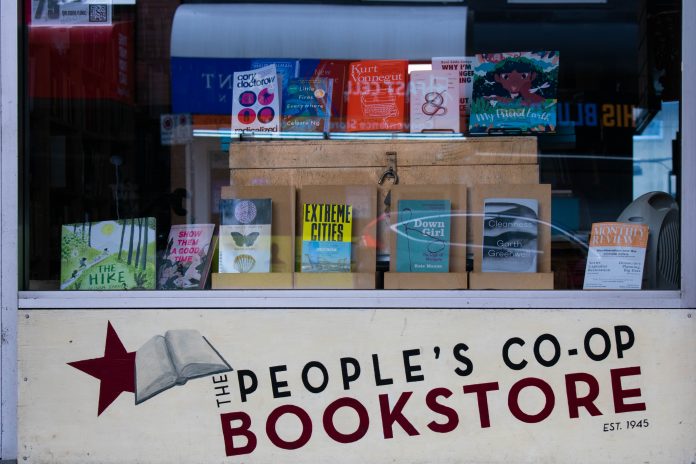
Nearing their 75th anniversary, the People’s Co-op Bookstore is fighting to save the space they’ve occupied on Commercial Drive for the last 36 years. PHOTO: Courtesy of Maxwell Gawlick.

By: Meera Eragoda, Arts & Culture Editor

Let me start by declaring that I love independent bookstores. They have always felt more personal than going into big-box stores like Indigo. Usually, there are only one or two people working — call me biased, but in my experience, they usually have more time to chat about books. So when I heard that The People’s Co-op Bookstore (TPCB), located on Commercial Drive, had started a GoFundMe in order to save their business, I was saddened because of TPCB’s unique nature. TPCB’s struggle not only highlights the precarity many businesses are facing during the COVID-19 pandemic, but also the struggles independent bookstores face — even during non-pandemic times.

The GoFundMe was launched on May 1 (International Workers’ Day) with the goal of raising $75,000 by the end of June, in time for the 75th anniversary of the bookstore. TPCB is the oldest independent bookstore in Canada and one of the oldest in North America. It was founded by social, political, and labour activists. As board chair, Laurel McBride, explains to me over the phone, “progressive values and a strong connection to the labour movement has been a thread that’s been consistent through time [ . . . ] A real coalition effort [ . . . ] is still very much at the root of the Co-op.” This political spirit is certainly visible in the store which is filled with left-wing titles and vintage pamphlets, though it carries more mainstream titles as well. McBride is careful to emphasize that the store is a space for all readers.

TPCB is not just an independent bookstore, it is a co-op — a term that when used in relation to a business, makes me figuratively clap with glee. Co-op (short for cooperative) is a business model where people like you or I can buy a yearly membership fee, collectively own the business, and help inform the goals of the business. On the whole, it’s a more egalitarian and less exploitative model than traditional capitalist businesses.

When I ask McBride about the benefits of running TPCB as a co-op, she says, “What’s really unique about cooperatives is the democracy that’s inherent in that structure. The people who use the store have a say in how it’s run, and each year you get the opportunity to come out and participate in that democracy.”

Currently, the whole operation is volunteer-run. Prior to the pandemic, TPCB employed one full-time staff member, but had to let them go. One of the goals they have for the GoFundMe is to bring them back and to increase their paid labour. McBride elaborates, “We want to be able to pay our workers what’s a fair wage and [ . . . ] to be more responsive to what people’s requests of us are and be able to order the books that they want to be in the store. Sometimes we’re having to pick and choose what’s possible.”

McBride stresses that the goal of the GoFundMe is to be able to cover the costs of rent on Commercial Drive, and keep up with the “[changing] nature of the Drive” in order to provide a space for all readers to gather for another 75 years.

She goes on to explain the importance of preserving both independent bookstores and co-ops. “Independent bookstores play such a vital role in our community. In terms of who benefits, the community [does] when independent bookstores flourish.” McBride emphasizes that community mentalities are particularly beneficial for the Co-op, especially “in 2020 when we’re fighting tooth and nail to hold onto democratic principles and more egalitarian ways of organizing who holds the wealth.” On this, she stresses the importance of buying local and putting money back into the community, stating that this notion is something “we need more of.”

Speaking on the community value, McBride says, “It’s a place to buy books but it’s also a place to gather and discuss, and become exposed to new ideas and issues, to learn [ . . . ] we [provide] spaces for published and unpublished authors to read their work [ . . . ] We’ve had other [events] that are less directly connected to books but are more community oriented like jazz nights.” She expands, “It really just depends on who’s around, what ideas they have, and their capacity to carry them out. I think what’s interesting about the Co-op is that we’re open to people proposing events and ideas and it’s quite a collaborative place in that nature.”

Spaces like this are becoming rarer in a rapidly gentrifying city. Luckily, McBride seems quite heartened by the response to the GoFundMe. So far, TPCB has reached 20% of their goal. As McBride says, the response they’ve received “speaks to the role the bookstore plays in the community and the place it has in people’s hearts.”

If your values are the people and the free exchange of ideas, TPCB is definitely a business worth supporting. You can help in multiple ways: you can donate to their GoFundMe, buy a membership, buy a book, donate some books, and share their campaign on social media. Check out their GoFundMe page for more ways to help or just for an in-depth dive into their history. Additionally, TPCB is open Thursdays to Sundays from 11 a.m. to 6 p.m. for in-person perusing.

The Half of It showcases marginalized perspectives and conveys the tragedy and joy of relationships

0
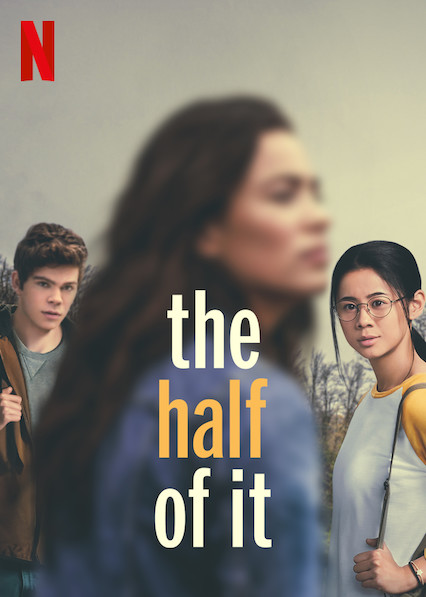
Courtesy of Netflix.

By: Kate Olivares, Peak Associate


Time and time again, we are shown that coming-of-age movies have so much more to offer beyond love triangles between straight white teenagers (looking at you, John Hughes). There is so much space for other stories to be told within this genre, from different perspectives on class, race, gender, or sexuality. In
The Half of It, Netflix’s latest coming of age comedy-drama, we are treated to a sweet and refreshing take on friendship, love, and expectation. 

Paul Munsky, a sweet jock, approaches Ellie Chiu, an introverted straight-A student, to help him write a love letter to the beautiful Aster Flores. Unbeknownst to Paul, Ellie is also in love with Aster, and her ghostwriting duties for Paul start to take on a life of its own. As Paul and Ellie grow closer as friends, Ellie’s own feelings for Aster begin to intensify and further dictate her actions. She begins to blur the lines between ghostwriting Paul’s letters to trying to get closer to Aster through Paul as a medium. How long can she keep all of these secrets? 

With the backdrop of this classic coming-of-age kerfuffle, the film explores exciting themes: queer love, the immigrant experience, and the evolving nature of language and communication. Queer girl stories are grossly underrepresented in the coming-of-age genre, but this film portrays this one beautifully. Ellie’s feelings for Aster are handled respectfully, and her unlikely friendship with Paul is a delight to witness. Lastly, the understated cinematography is fantastic. Small-town Squahamish, the movie’s setting, is green and crisp. 

However, because the movie explores such a wide range of complicated themes, not all of them get their due course, or are given the time to develop and get resolved. For such a loveable friend character, Paul’s dreams and motivations fade into the background in service of concluding the main story. Moreover, it was disappointing to see that Aster isn’t given the time to be interesting in her own right. The extent of her depth is expressed through being smart and philosophical behind her pretty face. This is not necessarily a bad thing, but because Ellie and Paul both transcend the tropes of coming-of-age characters (Ellie is quiet and shy, but queer; Paul is athletic and ditsy, but kind) it was disappointing to find nothing more behind Aster’s character. She is beautiful, smart, and that’s pretty much it.

There have also been thoughtful criticisms from some parts of the Asian queer community on how the film perpetuates rape culture. I want to respectfully engage with this point, beginning with the non-consensual romantic acts. It is a sad reality that stolen kisses and surprise touches are normalized in our culture’s idea of romance. These little acts of normalization can perpetuate rape culture, and they should be abolished. However, I do not think that these non-consensual acts ultimately convey love in this movie. The film itself clearly rejects the identity of a love story. It illustrates that love is messy and difficult, and during its emotional climax, the characters come to the painful realization that all of their ideas surrounding romance and partnership are skewed and wrong. With the exception of one instance, the film does not reward these problematic displays of romance, but condemns them. 

On the whole, this movie is beautiful, compassionate, and smart. It makes it clear that there are infinite ways to portray Asian stories, and we must demand to see more of them. It absolutely deserves to place among other Netflix darlings like To All the Boys I’ve Loved Before. My parting plea is for you to watch it, and join me in anticipating what writer-director Alice Wu will do next. 

Vancouver’s underrated, hidden art gems are well worth visiting

0
PHOTO: Courtesy of Vancouver Biennale.

By: Devana Petrovic, Staff Writer


The Granville Loop Tunnel Street Art Gallery

PHOTO: Courtesy of Stephanie Brook.

Location: Granville Loop Park

Artists: Alternating local artists 

The Granville Tunnel Street Art Gallery is a hidden exhibit found in the dark pedestrian passway under the Granville Street Bridge. Created by Stephanie Brook in 2018, this project has engaged local street artists in temporarily muralling the tunnel walls. Chosen artists are given a year to display their work before they are painted over, allowing for new local artists’ murals. 

Growing up in that neighborhood, the Granville Street underpass always had a gloomy reputation for being constantly trashed and poorly lit. Since the project’s appearance, the dirty grey walls of this unpopular tunnel have become vibrant with colour, creativity, and artistic expression. Projects like this reflect the changing essence of the South Granville area, where there is a growing interest in displaying public art. Murals in particular are progressively occupying several walls of this neighborhood. 

Maintenance of the underpass has significantly improved since this project came into action. Plus, passing through a sketchy underground tunnel has never been more intriguing. 


Blanketing The City Part I: The Pillars of the Granville Street Bridge

PHOTO: Courtesy of Rachel Topham.

Location: Under the Granville St. Bridge, Granville Island 

Artist: Debra Sparrow 

In collaboration with the Vancouver Mural Festival, this mural is part of a larger project known as Blanketing The City, where traditional Coast Salish textile patterns are muralled onto large, visible, and heavily-trafficked surfaces, such as this one that stands proudly on the pillars of the Granville Street Bridge and in the centre of Granville Island. 

The mural celebrates the resilience of Indigenous people — its vibrant colours and eye-drawing location serves as a reminder for both locals and tourists of the people who’s land we are on. It is a commemoration of Coast Salish culture in one of the most touristic spots in Vancouver that honours the strength of all Indigenous people in preserving their traditions. Tourists swarm to Granville Island all year round to experience what Vancouver has to offer, and Sparrow’s piece is a bold public display of the reappearance of Coast Salish cultural appreciation. Frankly, this is exactly what Granville Island needs more of. 


Paradise Has Many Gates

PHOTO: Courtesy of Vancouver Biennale.

Location: Vanier Park

Artist: Ajlan Gharem

This piece, located in Kitsilano’s Vanier Park, overlooks the West End and its mountainous background. Paradise Has Many Gates was launched for the 2018–20 Vancouver Biennale exhibition and is by Saudi Arabian artist, Ajlan Gharem, who created the transparent chain-link mosque to promote Saudi contemporary art around the world. 

The Kitsilano area is generally quite lacking in artistic diversity, particularly in contemporary artworks of this sort, and is also scarce in any representation of Islamic culture. Therefore, it seems an unlikely location to find such a piece. Yet, with its interesting concept, it certainly draws people to investigate and learn more about the artistic purpose behind it. 

If anything, this piece has given the people of Kitsilano something to admire and think about. 


The Present Is A Gift

PHOTO: Courtesy of Drew Young

Location: 22539/2549 Main Street

Artists: Drew Young and Jay Senetchko 

A Vancouver Mural Festival piece, this mural is found on two large surfaces of a building in the Mount Pleasant neighborhood. With its colourful complexion, vast circumference, and wholesome message, this artwork is impossible to miss. 

The mural consists of two portraits of neighborhood residents: a young girl who was born and grew up in the neighbourhood, and an optometrist, who has been working at the local optometrist office for over 60 years. The mural represents the heart and soul of the Mount Pleasant area: the community and residents themselves. 

The Present Is a Gift is a beautiful landmark for this neighborhood and is worth taking a couple minutes to admire if you ever stumble across the piece.

Student criticism of SFU’s Town Hall is misdirected and unproductive

0
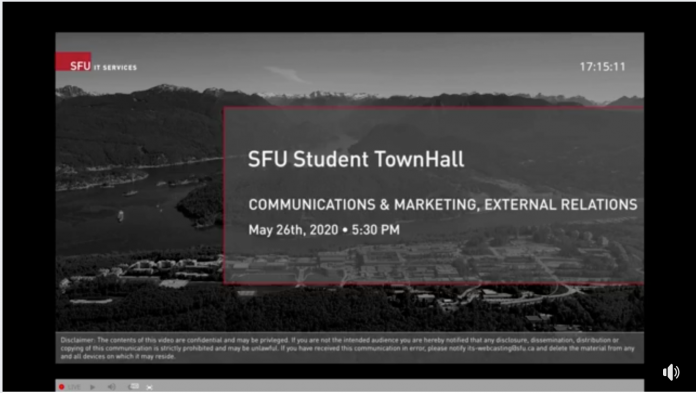
Answers from the livestream were reasonable given the situation we're in. Screenshot: Nicole Magas/The Peak

By: Nicole Magas, Opinions Editor

On May 26, SFU Student Services hosted an hour-long virtual Town Hall to address some of the most prevalent student concerns about the university’s response to the COVID-19 pandemic. Judging from the comments on the live stream alone, one would think that university administrators suggested that students just get over it and dump wads of cash into the AQ pond. And it may just be because my brain capacity for outrage has utterly short-circuited due to the ever expanding game of apocalypse bingo that 2020 is turning out to be, but I can’t help but feel that student criticism of the Town Hall has been a combination of uncharitable, unreasonable, and a bit misdirected.

Like any other liberal university student, I have a healthy skepticism of power and authority. It just comes with the territory. I have been critical of the university administration in the past, and I remain, as a general rule, doubtful of its motivations and decisions. And certainly pandemic times aren’t any excuse to blindly accept that those in power are doing everything correctly, or even for the good of everyone involved. However, the reality of our current situation does call for realistic expectations that I think a lot of current student criticism — although well meaning — simply lacks. So forgive me for giving the university administration the benefit of the doubt here, but I think Andrew Petter’s introductory statement was about as honest as anyone could possibly be right now:

“While we don’t have the capacity to solve all of these problems, we do have the capacity to help where we can.”

And it was clear from the answers that were given over the next hour of the Town Hall that the university is trying to help — insofar as it has the ability to do so — as many students as it can. At the very least it is aware of its students’ concerns, and is willing to consider them. It can’t fix every problem that may occur in any conceivable situation. It can’t even really do much to address all the substantial difficulties that groups of students are experiencing; counter to how it may seem as we shell out thousands of dollars in tuition every four months, SFU is not sitting on a vault of liquid assets that can be shifted in a heartbeat to provide instant relief to students. That’s just not how lumbering businesses like universities work. It sucks, and I don’t think that this is how the system should be, but we can only work with what we’ve got at the moment. SFU has 30,000 students, and administrators at the very top have to make decisions and answer questions with an amorphous, generalized Student Body™ in mind.

This isn’t a satisfying thought by any stretch of the imagination, I get it. And I understand the desire to lash out at what feels like vague answers that seem intended to dodge responsibility in a crisis. But criticizing the university for not issuing sweeping mandates on how all instructors ought to accommodate their students, for example, fails to recognize that top university administrators have to produce policies that are vague or generalized enough to leave room for reasonable flexibility lower down the chain for any sort of situation that may arise — especially in this dynamic environment. In essence, students are asking top levels of university administration to have more consideration for individual student needs, while at the same time criticizing them for “vague” responses that give room for more specialized services to do just that. 

And I want to be clear that I don’t wish to paint student activists with a malicious stroke any more than I wish to do the same with the administration. We’re all angry, frustrated, scared, and uncertain right now. Student activists are doing their best to advocate for their fellow students and that is more than admirable. But all of us also have to make sure our expectations are reasonable, and that our frustrations are being channeled in the right direction, in places that can actually help. 

So while I applaud those students who have been vocal about their concerns and have made student hardships known to university administrators, the critique of SFU’s reasonable response is misguided at this time. More focus is needed at the lower level, through democratic action in classrooms, meetings with department heads, advocacy through the SFSS, and recourse via the student Ombudsperson. These are the people who actually have the power to address more nuanced issues, and through whom collective student action will yield the most productive results.


Board Shorts: Friday May 29

0
Image: Irene Lo

Written by: Paige Riding, News Writer

COVID-19 Survey Report and conversation with SFU administration discussed

At the end of April, the Board circulated a COVID-themed survey that, as of now, has received around 2,500 responses from students (approximately 10% of SFSS undergraduate member representation, according to Mohamed). 

Mohamed iterated student concerns around unstable internet in the wake of an online semester, financial strain for students with dependents, the lack of funding from the Canadian government for international students, and more. 

On the matter of students’ mental health, the report showed that around 50% of students reported new or worsening issues surrounding this matter. 

“A lot of instructors were actually not acting in ways that were compassionate of their students and the situation that students were going through,” added Mohamed. 

With this information, representatives of the Board went to the SFU administration. They were met with unfruitful discussions, according to Mohamed.

This survey will be posted on SFSS social media for further input from undergraduate students. The Board hopes to converse with the Senate around these matters.

Student COVID-19 Town Hall to occur

The SFSS plans to host a Town Hall to allow students to ask questions regarding SFU’s COVID-19 policies and protocols. For those unable to speak during the event, their questions can be asked ahead of time. Additionally, for those unable to attend this Town Hall, future meetings will be organized, according to Balqees Jama, At-Large Representative. ASL interpretation and closed captioning will also be offered.

The Board also discussed the SFU-held Student Town Hall from a couple weeks ago.

Jama noted that, “Students were not given a genuine chance to raise concerns at the Town Hall or ask critical questions due to the lack of live participation from students. 

Building on this, Jama remarked: “We need to demonstrate that the SFSS is here for you. And we are actively, every day, for hours upon hours, still working to make sure that all of our students’ academic needs are met — especially our most marginalized right now.” 

Board discusses establishment of new BIPOC Committee

VP Student Services Matthew Provost proposed the establishment of a new committee for BIPOC (Black, Indigenous, people of colour) students on campus. The proposed committee will focus on matters of “equity, diversity, and inclusion,” and “would help support initiatives and guide the work of the Board of Directors and the SFSS to properly support those in the BIPOC community.”

Provost hopes to see the Board “take this as an opportunity to work together on initiatives for the betterment of building community between the SFSS and the BIPOC community.”

While there are groups like Students of Caribbean and African Ancestry and the First Nations Student Association on campus, Provost noted that “there is still a disconnect between how we properly support these groups, as well the greater BIPOC community and other smaller clubs and DSUs on campus.

“I feel this is important in terms of work this Board advocates for, as well as initiatives that the university is standing by, such as reconciliation [ . . . ] decolonization, and indigenization”.

This proposal will be voted upon at a later meeting.

The Board established new terms for First Year Engagement Committee at SFU

Certain Board members proposed new terms of reference for a committee focused on first-year students.

“It would make recommendations to the Board on initiatives, events, advocacy [ . . . ] and then the Board would take those recommendations and do with [them] as [they] think best,” VP University Relations Gabe Liosis explained.

The terms, unanimously agreed upon by the Board, explain that the committee’s deliverables will be “to provide the Board with formal recommendations and reports including but not limited to: engagement initiatives and results, community building events for students, and first year advocacy.”

The Board votes to increase funding to the Living Personal Truths Award

The Board unanimously agreed to allocate an additional $11,645 to the Living Personal Truths Award. According to the university’s website, the award “is given to a student in any faculty who has demonstrated a significant contribution to reducing discrimination and/or increasing awareness of sexual orientation and gender diversity”.

This increase will bring the lump sum to $20,000.

SFU students create organization to help frontline workers

0
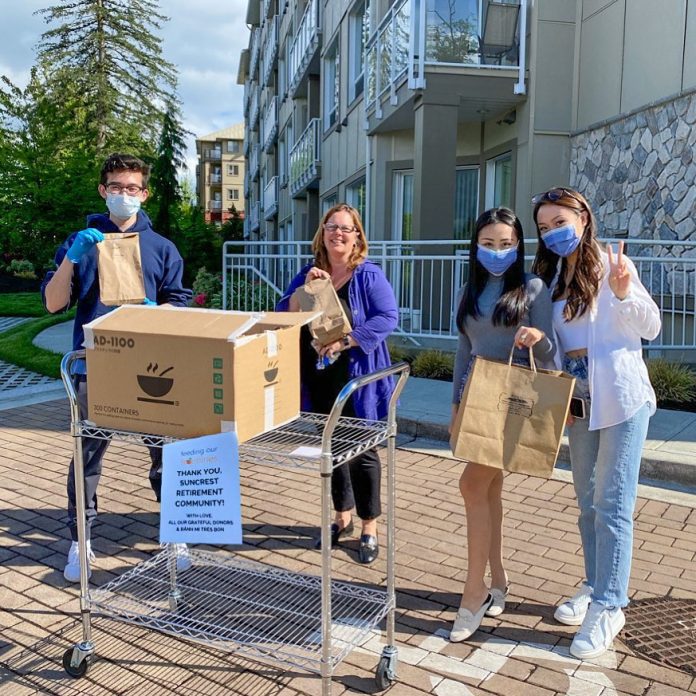
Delivering meals to workers at Suncrest Retirement Community. Photo courtesy of Feeding Our Frontlines via Facebook

Written by: Winona Young, Peak Associate

A group of SFU students have partnered with UBC students to launch a charity organization that provides free meals to healthcare workers. Feeding our Frontlines (FOF) collects donations online to buy meals from local restaurants to be distributed to frontline workers in the Lower Mainland. 

The initiative began in a humble group chat between friends in Vancouver. Now, by partnering with businesses in Calgary, Toronto, and Montreal, this initiative aims to empower Canadian businesses nationwide. 

Feeding Our Frontlines was launched in early May by a group of Vancouver-based students, Patrisse Chan (UBC), Eunice Wu (UBC), and Zoey Li (SFU). According to Li, the three friends launched the initiative during the exam season of the Spring 2020 semester. 

The Peak interviewed three students involved with FOF via email: Zoey Li, Brian Chua, and Jeffrey Leung. 

The idea for FOF arose when Chan spoke with a local restaurant owner in her podcast, Rise Regardless. Chan noted that the restaurant owner in question, despite their difficult times of business, still fed frontline workers. 

Li told The Peak, “Patrisse then reached out to Eunice and I with the model of getting donations from the public to buy meals for frontline workers, thereby supporting BOTH the local restaurants from going under and healthcare workers.”

Since FOF’s launch on May 5, by networking with over 40+ restaurants from all over Canada, and working with various businesses in Vancouver, the initiative has seen immense growth. According to Li, as of May 29, FOF has officially raised $10,000 CAD. 

“I really can’t describe the feeling in words but this is just an overwhelming amount of joy!” she said. 

According to the Feeding Our Frontlines site, 100% of the donations go to the local businesses. No commission is taken whatsoever by FOF.

Eateries like Bao Down OV, Steve’s Poké Bar, and Sal y Limon are some of the many BC businesses working with FOF. 

Li acts as their product designer, helping design not only the website, but also the donation process. Whereas Leung, the software developer, works on the website overall. Chua acts as the group’s outreach coordinator, organizing the communications between healthcare facilities and restaurants. 

When asked why they had joined, each student reiterated their desire to help.

As Chua said, “I learned that support for local businesses has been long overdue,” he said. Chua told The Peak of how after constantly seeing negative news stories, FOF felt like a “welcome change” to him. Leung also echoed this sentiment. 

“I joined Feeding Our Frontlines to make a difference in a crisis. Not everyone is lucky enough to be safe at home,” he said. 

Leung also recognized  the disparity among people in terms of workload during the pandemic, particularly with regard to healthcare workers.

“We are creating a platform for sharing kindness, and that is invaluable,” he said. “It inspires me every day to know that I can make a real difference in helping empower frontline and restaurant workers under immensely difficult circumstances.”

Moving forward, Li mentioned how FOF has recently partnered with COVIDHelp Vancouver. Together, FOF would help deliver meals to immunocompromised peoples whose dietary needs cannot be met by local food banks or other means. 

Chua encouraged that any person interested in aiding their initiative to visit their site, www.feedingourfrontlines.ca

Students raise concerns over use of proctoring software during remote exams

5
Photo: Maxwell Gawlick / The Peak

Written by: Michelle Gomez, News Editor

With SFU’s switch to remote learning during COVID-19, the use of proctoring softwares for online exams has become more common. It has also caused controversy amongst students; the Simon Fraser Student Society has asked SFU to prohibit the use of these softwares for exams. Proctoring softwares are used to monitor students during exams through recording them, visually and audibly.

An email sent last week to students in MATH 155 announced that they will be required to download a proctoring software for their final and at least one of the midterm exams. The email noted that student’s computers must have a functioning webcam and microphone to record both video and audio. It also stated that all screen activity and any internet traffic will be captured. 

May 25 was the last day to drop classes with a full refund. The email was sent to the class on May 25 at 11:31 p.m. 

A post about this in an SFU student group on Facebook has received much attention, and has mostly been met with criticism regarding privacy issues. 

MATH 155 student Brandon Pereira discussed the matter further in a phone interview with The Peak

“It’s going to be used for the duration of the course which means that it will be present on your computer for a long period of time [ . . . ] if it’s there for a long time and it does have access to your internet traffic and your audio and microphone then that does present some problems.” 

He also said that a main concern is that this was not communicated to students at the start of the course, noting that “it’s a shock.” 

Pereira explained that a group of students from the class have brought the issue to the Ombudsperson, who is currently in communication with the math department and looking to find a resolution. On June 1, the class received a follow-up email noting that the class would no longer be using the software, and that they are working on an alternate solution. 

Chair of the Department of Mathematics Tom Archibald said in a video interview with The Peak that there has been “a very severe spike” in cheating in math courses since SFU has moved to remote learning. 

According to Archibald, questions for entire exams would appear on Chegg.com an online platform that provides users with math solutions and online tutoring within moments of the exam start. 

Archibald noted that in the worst case in the math department since remote learning, one third of a class of over 100 students were caught cheating. 

On the issue of cheating, Perreira said, “They’re trying to crack down on it [cheating], so I understand that, but I don’t think that the way they’re going about it now with this software is necessarily the best way to go about it.” 

When asked if the software is able to collect information outside of the duration of the exam while it is installed on the computer, Archibald responded, “I do not know, I have not used any of this software, I have not even ever seen any of it.” He added that they would not be interested in using a software that collects personal information. 

Archibald also stated in an email to The Peak that SFU’s policies regarding proctoring software “are in the process of being formulated at the senior admin level.” 

The Peak reached out to the professor of the class, who did not respond by the publication deadline. 

What Grinds Our Gears: Giving attitude to workers is a non-essential service

0
I need six feet of distance from your attitude, Karen. Illustration: Tiffany Chan/The Peak

By: Juztin Bello, Copy Editor

I’m standing in line outside of a restaurant waiting to pick up some food my family ordered — making sure to be six feet apart from those around me, of course. Suddenly, a woman — a typical Karen — comes stomping to the makeshift front counter (cutting in front of everyone who has been waiting, mind you), and decides to complain to the clearly stressed attendant trying to organize customers and workers alike. The woman begins yammering about the food in her bag being “disorganized” and “sloppy,” and demands compensation in the form of a new burger. She follows this, of course, by critiquing the work ethic of the establishment.

Now, I just have one question, specifically to this woman but also to the world broadly: where do you get off? Where do you get off yelling about a trivial thing like your food being a bit messy when these workers are doing their part in the midst of a pandemic? Where do you get off thinking that you’re so entitled to tell someone that their service is poor when, frankly, their service has been anything but? Where do you get off implying to a worker they’re not doing their best, when all they can afford to do right now is just that? 

Don’t get me wrong, there’s really no appropriate time to yell at a customer service representative, but to think now of all times it is acceptable to do so is absolutely absurd to me. These people are risking their own safety by continuing to work and providing you with your trivial items that you don’t need. 

Those working to get food to people who could really just cook something at home don’t deserve any sort of resentment right now. They’re doing their part, and if you’re someone who feels entitled enough to complain about your food, or your late package, or anything similar, you can do your part by easing off of these essential workers. There’s a reason we’re referring to them as essential — and frankly, that attitude of yours is the least essential thing right now.