
Home Blog Page 427

The culinary arts are more than just a hobby

1
Illustration: RESLUS

Coming from a household of cooking snobs, where the kitchen is one of the most crowded spaces in the house and family dinners consist of unwanted culinary feedback, it’s not surprising that I have always left the cooking to my more ambitious family members. But after two months of cooking show clips circulating my YouTube watch history, I’ve discovered a love for cooking when I least expected it: during a global pandemic. 

Back when the world wasn’t fearful of COVID-19, I purely relied on leftovers from my mother’s hearty Balkan dinners and Subway sandwiches; clearly, I’ve never been a meal prep kind of gal, let alone interested in experimenting with my culinary skills. But with an unholy amount of time on my hands and bounds of inspiration for recipes, I’ve found myself in the kitchen a lot lately. 

Initially, I started cooking pasta and stir fry dishes, mainly pushing every possible variation with the ingredients directly available to me and the very basic skill set that I possess. I have since gravitated towards more complex plates, where I’ve enjoyed pairing various proteins and vegetables with different spice combinations: salmon dishes, classic chicken and potatoes, and barbequed meats, just to name a few. 

On weekdays, everyone in the house is busy working from home, so I have been able to snag some kitchen time without getting in anyone’s way. Cranking up some tunes and whipping up a mean bowl of spaghetti bolognese has been a great way for me to unwind and destress. I’ve appreciated the level of focus required in cooking, as it has helped me mentally regroup myself and centre myself on a calming activity. 

Surprisingly, it has become more than just a hobby and form of stress release, but it has also rekindled my appreciation for traditional Serbian cuisine and brought me to studying recipes of my past relatives. I have found the most comfort and intrigue in learning to recreate the familiar dishes of my childhood: gibanica (filo rolled cheese pie), goulash (beef stew), and sarma (minced meat cabbage rolls) are some of the Slavic favourites. These foods that once made me feel outcast and different as a child, are now flavorful relics of my cultural heritage, and recipes that I aspire to perfect. 

In sharing this newfound hobby with my mother, she dug out my grandmother’s old recipe notebooks, in which every possible family recipe is scribbled across several pages. Unleashing all these culinary family secrets has given me a long term goal with cooking, which goes past any other hobby of mine. Once I figure out how to read my grandmother’s messy cursive Cyrillic, I am hoping to acquire the skills necessary to execute these dishes, and also pass them down to future generations. 

Learning to cook has bestowed several challenges for me: overcooking, undercooking, breaking cooking vessels, and setting off the fire alarm. It’s highly likely that I will only be cooking for myself for a while. Nonetheless, I have great amounts of respect for every family dinner my mother has single-handedly cooked and arranged. 

Although, I am most definitely still a less than amateur cooking enthusiast, uncovering my love for the culinary arts and elevating how I express my love for food, has been incredibly therapeutic and the perfect distraction. Not only have I expanded my knowledge and flavour palette, but I have acquired a newfound understanding of my own ethnic cuisine. 
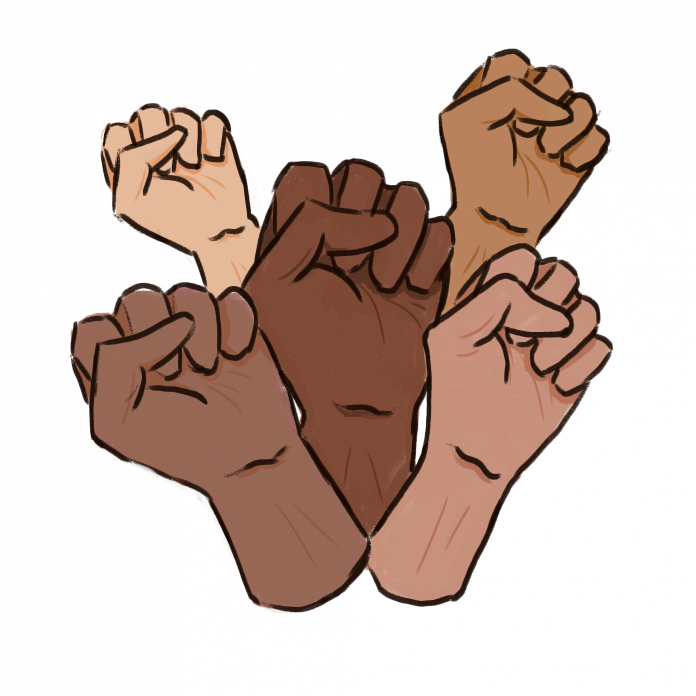
Opinions in Dialogue: Systemic change can’t happen without racial solidarity

Everyone has a role to play in fighting racism. Illustration: Shaheen Virk/The Peak

Introduction

2020 has been a difficult year for a number of racialized communities. The pandemic spread of COVID-19, which precipitated violent anti-Asian backlash and which disproportionately affected Black communities, and the murder of George Floyd that sparked a world-wide resurgence of Black Lives Matter protests and activism are the two most recent examples. As racialized groups fight against systemic and individual racism for the right to exist without fear of violence, a recurring conversation on the need for solidarity across race has emerged with a call to stand up for each other’s causes.

In this special Opinions in Dialogue segment, Peak editors Kelly Chia and Meera Eragoda discuss the issue of solidarity and complicity amid systemic oppression, and how the battle against racism can’t be won without supporting one other.


Meera: As an intersectional feminist who belongs to the South Asian community, the recent murders in the US are highlighting both the lack of acknowledgement of racism within Canada and the perpetuation of anti-Black racism from within the Asian community itself. I’m floored by the hypocrisy of some Asians I know who are posting their support for Black Lives Matter, but who I’ve heard perpetuating covert and casual racism, and making comments that are anti-Black and anti-Indigenous. It is a problem that many Asians seem to be depicting racism as a US-only issue while ignoring the rampant prevalence of the same attitudes in Canada — especially toward Black and Indigenous communities. If we expect solidarity from these communities, we need to give it in return. We also need to stop contributing to their oppression.


Kelly: As a Chinese person, I can speak for how my family and I trivialized racism towards Black people. We referred to Black people as 黑鬼, or black ghost. We also correlated Black communities with high criminal activity. While I have since educated myself on my racial biases, many older parents like mine are reluctant to unpack their racism. I think this comes from a place of fear; to doubt these ideas and investigate why they existed would mean we have to be vocal about our politics. This scares my parents — many East Asian households strive to embody a “model minority,” but understand that this status is fragile. The fear of disturbing the “peace” — even if the peace is one that silences other marginalized groups — has encouraged my family to only speak up politically if they feel safe. 

The rise of COVID-19 has made the fragility of this mindset and the model minority myth even more apparent. Here in Vancouver, violence and racism against East Asians, including the Chinatown lion statues being defaced and instances of verbal and physical assault on public transit, have sharply increased. For the first time, I’ve felt a small portion of what it’s like to be a Black or Indigenous person in Canada every day. Being a “model minority” doesn’t protect you when systems of powers can attach fearful labels to your race just as easily as they elevate you. 

Now that racialized hurt is fresh in my community’s mind, I want to encourage them to stand up for those who face this sort of abuse on a day-to-day basis. We can only understand a fraction of what Black and Indigenous people face, and they are impinged by more institutional barriers than we understand. Speaking up for other minorities against an oppressive system will not harm, but rather help, all of us.


Meera: I think it’s really important that you bring up the model minority myth. Sarah SoonLing-Blackburn explains how the model minority myth depicts Asians as hardworking individuals who have achieved their level of success by following the rules and embodying the “pull-yourselves-up-by-your-bootstraps” immigrant striving. The insidiousness of this myth is that it presents us all as a monolith and erases our intra-group experiences. However, ultimately the creation of this myth in the 1950s was meant to divide us from Black communities, and continues to divide us from other racialized communities today. The perpetuation of this myth uses us as a tool against them to point to why they aren’t successful, while permitting willful ignorance of the systemic and explicit racism that’s targeted at them. 

Buying into the individualistic narrative of “well, if we can do it, they must be able to do it and if they don’t, it’s because they’re lazy or they’re criminals” erases how these communities have and continue to be violently overpoliced. It erases their history of displacement at the hands of colonial powers and minimizes their experiences both past and present. I think the danger of buying into the model minority myth is that it allows us to believe that we can achieve whitedom. 

In addition, the model minority myth evolves depending on who politicians upholding white supremacist beliefs choose to demonize. Not long ago, Sikhs, Muslims, and many other South Asians started to be reclassified as terrorists. In reality, as the vile COVID-19 racism and other racist actions have shown, we will never be accepted into whitedom, and it’s not something we should even want to strive for. We betray ourselves and each other when we side with oppressive forces, and we need to start undoing our internalized white supremacist beliefs.


SEE MORE: Allowing the RCMP to recruit on campus undermines reconciliation efforts


Kelly: I think you’ve illustrated why it is important to not ignore the institutional barriers Black and Indigenous people grapple with. I want to emphasize why East Asians should not be apathetic to these struggles. To say that speaking up for Black people is the least we can do does not measure it: my parents were able to immigrate to Boston in the ‘70s because Martin L. King helped sign the Immigration Act in 1965 in America. Our rights to build a future away from home were founded on the backs of the Black people who fought for them. 

We’re also no strangers to appropriating Black culture for our benefit — I initially adored Crazy Rich Asians because I saw my Singaporean culture reflected in a sensational movie, but Awkwafina’s blaccent (the imitation of Black language or speech) left a poor taste in my mouth. In an article about Awkwafina’s history as a “culture vulture,” Alysia Stevenson notes that Awkwafina’s “blaccent” faded proportional to her fame and success — a very common trend for people adopting then dropping Black culture when it’s no longer beneficial in privileged social circles. There is so much privilege in being able to adopt, to profit from, and to drop Black culture — especially because we don’t experience the institutional barriers that Black people do.


Meera: Lilly Singh’s appropriation of Black culture also comes to mind here with her also doing blaccents. The problem with her profiting off this appropriation and using it to further her success, is that Black people still face prejudice for their accents and culture. In fact, one of the reasons George Zimmerman — the man who gunned down Trayvon Martin in cold blood — may have been acquitted is because one of the Black witnesses faced linguistic discrimination for speaking AAVE (African American Vernacular English). There’s something fundamentally wrong about using someone else’s culture while being complicit in their oppression. 

And complicity really is the word. In the George Floyd case, the white cop killed him but the Asian cop looked away and did nothing to stop it. Yes, we as Asian people didn’t construct these white supremacist systems, we’re not the ones who hold power within these systems, and we still face plenty of discrimination within them. But when we call the cops on Black and Indigenous people, we are knowingly or unknowingly putting their lives in danger. As Hasan Minhaj recently said while addressing fellow Asians, “America’s story didn’t start when we got here. When you become an American citizen you don’t just get to own the country’s excellence. You have to own its failures. That is the deal.” Same with Canada. You can’t live here and not care about Indigenous rights and sovereignty, and you can’t not care about police brutality. That’s the deal. We need to be like the Rahul Dubeys, David Chois, and Ruhel Islams of this world.


Kelly: To reiterate your point about complicity, we simply can’t pretend that these aren’t our issues to fight for as non-Black people of colour. Black and Indigenous people shouldn’t have to keep explaining to us why they deserve to live too — it is on us to educate ourselves and the family members who are stubborn in their ways of thinking. I found Letters for Black Lives helpful: it is one of many resources available that explain the Black Lives Matter movement, and has been translated into many languages if you have difficulty communicating with your loved ones. 

Over the last week, I’ve seen many of my peers stay silent because they think nothing they do will matter. We have to encourage them to speak out, and to educate them on why these protests have reached the heights that they have. The reaction to Floyd’s death was a catalyst to hundreds of years of violence towards Black people. It is a strong reminder to us here in Canada to be more vocal against the police-instigated murders committed against Indigenous and Black folk that continue to be swept under the rug.

In fact, we inflict the most harm when we are silent in the wake of other minorities being hurt. It allows police brutality to be normalized. We may not be the attackers, but we are still the ones who are silent while the murderers get away, and that really is the harm of complicity. We signal to oppressive systems of power that we will continue to tolerate their violence for fear of being hurt ourselves, and that we have no power to fight back. 

But that powerlessness is a lie. Putting pressure on city officials through protest has resulted in the majority of the Minneapolis City Council voicing support to disband the police department in favour of a community-based safety program. Charges for Derek Chauvin and his accomplices have been upgraded. A bill that criminalizes aggravated chokeholds has been passed by the New York Assembly. 

Our solidarity has sparked meaningful changes, and we need to continue speaking up and educating ourselves about injustices to our fellow marginalized communities. 


For further reading on the history of Black and Asian solidarity from a feminist perspective, check out this reading list.


Canada isn’t the moral haven some want to claim it is

1
Statues like that of George Vancouver shows that Canada has its own history of problematic icons. Photo by: Zhatt, courtesy of Wikipedia

A few weeks ago, #MeanwhileInCanada was trending on Twitter with people comparing the anti-racism protests (fronted by George Floyd’s murder) to the supposed non-existence of similar racialized police violence in Canada. The hashtag has since been rightfully flooded with the many valid examples of Canada’s long and continuing history of racist violence and oppression, which should be realized and understood by everyone.

Recent examples of this violence just in the last month have included the suspicious death of Regis Korchinski-Paquet, a Black woman, in Toronto after police were called to her apartment. Indigenous woman Chantel Moore was also shot and killed in New Brunswick by police during a “wellness check.” And these are just the recent ones. Black Lives Matter protests in Montreal have shown that Canadian police are not above tear gassing and pepper spraying peaceful protesters.

The most blatant example of Canada’s racial injustice is the fact that, like the US, as settlers we are living on stolen land, a product of the centuries-long history of colonial violence and assimilation. This includes the creation of the RCMP, which from its inception was meant to police Indigenous people. This practice continues in the sheer amount of unnecessary force and unlawful trespass from the RCMP that occured when the Wet’suwet’en people were defending — and continue to defend — their land in northern BC from an unsanctioned pipeline.

I could write an entire A to Z encyclopedia on this topic and only cover a fraction of Canada’s racism. The point is that rhetoric like “At least that’s not us” and “Things are different in Canada” does nothing but ignore the deep systemic racism that lies in Canada’s roots. It is there, and it is real. It’s just hidden underneath a country-wide marketing campaign that began with the 1971 policy that posited Canada as a magical and multicultural place. Just as the US brands itself through the idea of “freedom,” Canada brands itself as “multicultural” to hide its current and continuing history of racist transgressions. This erasure of violence and discrimination in this country is in itself yet another thing to add to Canada’s list of systemic racism. 

One could argue that the aforementioned incidents of police brutality are perpetrated by only a few “bad apples.” But that not only ignores the centuries of colonial oppression, it also denies the statistical data that says Indigenous people make up 5% of the population but represent 36% of people killed by the RCMP, or that Black citizens in Toronto are 20 times more likely than white citizens to be killed by police.

Arguing that “Yes, there is racism here, but it is less than in the US” excuses the racism that we have. To compare two countries’ “levels” of racism is to permit one “level” simply because it is lesser. No amount of racism should be acceptable in any country. We are no better than the US just because our history of racism is guised under a thin veil of carefully branded multiculturalism. We are no better just because maybe the police shoot fewer bullets at civilians. Both countries are built on racism and continue to run on it and there should be no rationalizing for that.

The strong solidarity for the Black Lives Matter movement across borders over the past few weeks solidifies this connection. The outpouring of support both on social media and in protests shows that people recognize the systemic seeds that were planted long ago and continue to grow in both countries. We need to continue this solidarity for people to recognize that racism doesn’t stop at a border — if anything, borders only perpetuate it.

Dismissing the US as the only place where racism happens ignores its real and continuing history in Canada. We do not have the moral high ground over the United States, or any country for that matter. I encourage you to educate yourself on the realities of Candadian history and find ways to fight the roots that still strangle people of colour, especially Black and Indigenous people, so that here in the north we can truly be strong and free.


National security law for Hong Kong approved by China

0
Photo: Tyrone Siu / Reuters. Protestors gather in Hong Kong on May 24, 2020.

China has approved a new bill to criminalize secession, subversion, terrorism, and foreign interference in Hong Kong. The law has yet to be drafted, as the process is expected to take a few months. Carrie Lam, the Chief Executive of Hong Kong, stated that the new bill will “ensure prosperity and stability to Hong Kong.” 

The new law was met with harsh criticism upon its proposal earlier in May. Critics of the new law worry that it will effectively end the “one country, two systems” framework that guaranteed Hong Kong’s autonomy after the handover to China in 1997. 

Days after the drafted bill was announced, thousands of pro-democracy protestors took to the streets to protest the proposed security law. According to the Hong Kong Police Force, protesters were violent towards officers. The protests resulted in the use of tear gas and water cannons by Hong Kong’s Police Force, who also stated via Twitter that they “express the strongest condemnation against the riotous acts.”

Lam also noted that the new law “will not affect one country, two systems” and will “protect the rights” of Hong Kong citizens. However, some expressed concern under the belief that their freedoms will be limited. Pro-democracy activists, such as Joshua Wong, have condemned the bill, publicly stating that it is “just the prelude to more oppressive controls.”

The national security bill comes after a year of political unrest in Hong Kong, and Lam stated that it would only affect those involved in terrorism or subversion. While she stressed that Hong Kong’s freedoms will remain, she also stated that “rights and freedoms are not absolute.” 

Back in 2003, Article 23 of Hong Kong’s mini-constitution held a similar sentiment, however, it was never put into place due to an extremely unpopular response — half a million protested against it. 

There was also public dissent against the drafted bill in Vancouver, as hundreds went to the Chinese Consulate to protest. Regarding the proposal, Prime Minister Justin Trudeau has stated that it is “important for the Chinese government to engage in constructive conversations with citizens of Hong Kong.” Canada, the US, the UK, and Australia signed a joint statement condemning the law of breaching the Sino-British Joint Declaration — an agreement between Britain and China that allowed China to take back Hong Kong, under the condition that it would remain “unchanged,” including Hong Kong’s high degree of autonomy. However, these concerns have been dismissed by China as mere “meddling.” 

A number of Canadian universities, including the University of British Columbia (UBC) and the University of Toronto (UofT), have faced backlash for posting job listings for the Hong Kong Police Force. The advertisements posted positions inviting those who have the ability to “take command of a situation” to apply. In a joint statement, activists wrote that the listings are “complicit in human rights violations in Hong Kong by aiding and abetting perpetrators of state violence,” and called for the postings to be removed. In response to the critique of these listings, some universities, such as UBC and UofT stated that it is the choice of the student on whether or not they wish to apply. Others, such as McMaster University have removed the advertisements. 

Lam has stressed that Hong Kong’s freedoms will remain intact and that those who are concerned about the new proposal should wait until the details are released. 

Creative Writing minor to launch at SFU this fall

0
Photo Courtesy of SFU Department of English

On the evening of May 25, around 50 attendees joined together over Zoom to celebrate the upcoming launch of SFU’s new creative writing minor. The program, available starting this fall, will eventually replace the Creative Writing Certificate previously offered by the English department.

David Coley, Associate Professor and Undergraduate/Associate Chair in the English department, spoke with The Peak over email about what the minor will entail and how it differs from the preceding certificate. As well as the change in the number of credits needed for completion and specific courses being required for the minor, Coley emphasized two defining differences from the certificate.

“The minor is significantly more streamlined and flexible than the certificate, meaning that students who don’t necessarily want to be English majors but do want to study Creative Writing can do so more easily.” Additionally, those in English programs can choose to take these creative writing courses as part of their major or minor.

While the certificate made studying creative writing outside of the English program possible, the courses and prerequisites, according to Coley made it “harder than it should have been”. 

Coley noted that the second difference from the certificate is “the introduction of the gateway course for the minor, English 272” The second-level required course titled “Creative Reading” will be the first second-level creative writing course at SFU. According to the professor, it will introduce the creative and critical model at the center of the Creative Writing program.

David Chariandy, Clint Burnham, and Steve Collis, SFU’s permanent creative writing faculty, will also be joined by visiting faculty member Carleigh Baker for the upcoming year. 

“Carleigh is a wonderful writer and a wonderful teacher, and we are extremely lucky to have her join us,” wrote Coley. “She will offer a different critical and pedagogical voice for our students, one that complements and augments our permanent creative writing faculty.

“Taken together, these faculty members are an extraordinary group. Our department and our students are fortunate to have gathered them all under one (currently virtual) roof.”

The faculty, along with some students and alumni, all read excerpts of their own creative writing during the soft launch. There were various poems and prose read aloud in the Zoom party. Chariandy presented a book prologue. Student Alyssa Bridgman presented poems written on an unconventional surface — leaves. 

“The model we’re pursuing is unique in that it focuses on the intersection of critical thought and creative practice. This creates a richer intellectual and practical working environment for our students,” Coley said.

When asked what he would say to anyone interested in the creative writing minor, Coley said such students should “take advantage of it while you have the opportunity. The new minor, the new gateway course, the brilliant addition of Carleigh as a visiting faculty member, the ongoing presence of our writer-in-residence program — there is a lot of energy in the creative writing program and in the English department as a whole.”

“You will not BELIEVE what my 5-year old succulent did today!”: a plant mommy blog

0
Photo courtesy of Stephanie Harvey via Unsplash

Hey fellow Succies! I hope you like that name I’ve coined for all you fellow plant mommies!

Wow! Today has been a stressful week. My succulent turned 5-years old and the house was in chaos trying to organize a celebration for her! She never ceases to amaze me in regards to how much she can do at such a young age; I know that her development is far beyond any other succulent who has ever lived to be 5 years old! 

I know you’ve all been enamoured with my little sweet succulent and alllllll the splendid things she can do, I decided to keep track of it all for the next week and share it with you!!!

Day 2

My succulent drank up two full litres of water today! Talk about a thirsty girl!

Day 3

When I went to water my girl today, she said “thank you mommy, I am so thankful for you!” That’s pretty impressive for a 5-year old! I’ve read many plant development books and the expected age for a succulent to start talking is… never… so my girl is way ahead of the game!

Later, my amazement was quickly dashed when my girl was missing! I left the room for a moment and when I came back, the sill where she usually sits was empty and my succulent, vanished!

She re-appeared a few hours later, back on the sill, after giving me a terrible scare! Dave must have taken her out for a little while without letting me know!

Day 4

Today I woke up to my succulent having made me breakfast in bed. I’ve never even taught her how to use the stove! A culinary protege! She even made me a mimosa because mama needs her juice!

I went outside after breakfast to get the paper and found one of my outdoor succulents torn up from the roots and laying on my porch doormat… Who did this? A raccoon? A squirrel? I carefully planted this succulent back in the rock garden. 

Later, I added yummy fertilizer to my succulent’s pot, temporarily moving her into a different planter. When I went to transplant her back into the original pot, she stood up, looked at me, and said, “It’s okay mommy, I do it, you work too hard for me already” and she walked her little plant legs right up to the other pot and plopped herself right back into the new soil!

I can’t believe how thoughtful my girl is!

Day 5

I woke up first thing this morning and found a card… from my succulent! 

Dear mommy, you’re the best! I sure hope nothing bad ever happens to your garden…. Love, your indoor succulent.

I couldn’t believe it! My succulent knows how to read and write! I was so excited that I barely picked up on the thinly veiled threat!

Day 6

It’s the middle of the night… I saw my succulent stalking around the house with a shovel and a hand rake… Something strange is going on…

Day 7

Today I woke to scratching on my bedroom door. It was my succulent, still holding garden tools! I asked if she wanted some water and she said “Mommy you’re so thoughtful, and you work too hard, so I already got some water for myself!”

That’s when I heard flowing water… I ran to the bathroom to see…

…all my outdoor succulents floating in the overflowing bathtub, and everyone knows that succulents cannot be overwatered!!! I look at my girl who is standing in the bathroom doorway… She looks at me, “Mommy, I want all of your love. There can only be one.”

Wow… you will not believe what my 5-year old (succulent) did!

CONFESSIONAL: I just can’t stop ending Zoom calls!

0
Illustration of a closed envelope, with the text, “Confessionals”
ILLUSTRATION: Marissa Ouyang /The Peak

It started a few months ago, when everything ended. Face-to-face interaction, that is. I thought it was finally over, that I was free from the paralyzing prison of others’ eyes and the mortifying ordeal of being seen. But alas, for me to keep “participating” in society, people have to look at my face. 

It was May, and I was in my first class of the semester. All those countless people were constantly staring at me. Those bitchy resting faces . . . my true nightmare. I mean, if I were really digging so desperately for attention, I would have posted an update on the delayed progress of the SUB. But when we all began awkwardly waving our goodbyes at the end of class and I saw the “host has ended the session” message, it was pure relief. 

Suddenly, my nerves were replaced with straight butter. But not like that “real” shit — more like the free movie-theatre kind, the kind that dribbles out of the dispenser like apple juice. Sheer indulgence, it was, in the idea that I could now sit in a dark room amongst greasy food while doing nothing but watching YouTube videos on why the world isn’t round. 

Ever since that day, I’ve been sending out meeting invitations to chase that runaway feeling. I even changed my social media handles to match my meeting ID. I wait at my computer all day for people to join my call, I turn my camera on, I let them greet me first so I’m hit with that crippling fear of being seen. Wait a second so it really sinks in, then end the call. It’s one big juicy cycle of anxious release that I keep reaping serotonin from like a nervous farmer.

I knew I was obsessed when I realized that I couldn’t stop thinking about that little red button. It’s the only thing that’s providing me some sort of relief now that I can’t blissfully ignore the people trying to get me to join a club in the AQ. It’s gotten so bad that if I see a red button I’ll just press it. Whether it’s on the television remote, an unsaved Word document, or my snooze button, that sucker is going to be slapped.

I have to go now. I have 10 people waiting to join my meeting and I need to get through all of them before they lose their patience and leave again. But please, if you see a meeting ID or a link to join a Zoom call, help a person out and give me your face so I can be free of it.

Your weekly SFU horoscopes: June 8–14

0
An illustration of a girl with long flowing hair. Astrological signs and stars shine around her.
ILLUSTRATION: Marissa Ouyang / The Peak

Aries: What is with your urge to fight everyone around you? Sure, you’re the shark in an ocean of guppies and all, but don’t forget the Finding Nemo mantra: fish are friends, not food. I doubt those around you like being called guppies, too. Sheesh. They’re butterflyfish, at worst.

Taurus: Make like a bull and charge forward this week, right through the walls you built up around yourself. You only created them to stop people from seeing you for the vulnerable creature you are: a person who really just misses the old Webkinz site.

Gemini: Which iconic Katy Perry lyric do you relate to most from her 2008 single “Hot N Cold”? Wait, don’t bother guessing. I’m pretty sure it’s all of them.

Cancer: I have good and bad news for you this time around. This will be a week of near-euphoric highs, but with those, you may feel the lowest of your dreary lows. But if we’re being honest, you’re really just an emotional wreck and all things hit you very hard all the time. This week is not different.

Leo: Work smarter, not harder, this week. Negative people around you might try to tell you about the insufficiency of playing Nintendogs rather than walking your dog or laying in the Corpse pose for a bit and calling it a great yoga session. Spend all that time you’re saving telling them they’re wrong and you’re right, like always.

Virgo: Perfectionism is, paradoxically, a flaw. You can keep trying to make everything around you adhere to your belief system. But by the time you’re finished, your typed-out, unsent comment to the group chat will be lost to a new subject, one that isn’t post-postmodernism.

Libra: Remember: as the middle sign of the Zodiac, you thrive in finding balance in life, Libra. Nah, not spiritually or physically or anything. You just chug a bunch of water after eating a three-course meal at 2 a.m. It’s all about balance.

Scorpio: Spend time learning more about your world. Hurt your own feelings by reading your favourite snack’s ingredients. Read a spam email and maybe even click its link to a free Bahamas trip for an exciting opportunity. Ask your family if they ever cheated during game nights and exile them accordingly.

Sagittarius: How have your friends responded to that hobby you persistently talk about? Hate to bear bad news, but their nods of interest aren’t what they seem, just as your determination to work at something until you see results isn’t quite working out. But keep insisting it is, I guess.

Capricorn: Try refraining from using a sarcastic remark to answer those around you this week. Who knows? You might actually hear someone else’s perspective in its entirety before you try proving it wrong. It’s simple quicksand logic — I know you love logistics. Appear harmless until it’s too late.

Aquarius: “Okay, boomer,” you’ll proclaim wittily into the internet abyss this week. You’ll then proceed to snuggle into your knitted blanket with your chamomile tea, furrowing your brows at the 12-year-olds on TikTok making more money than you ever will.

Pisces: Life is a marathon, not a race, Pisces. Take this week to collect yourself before running to help friends that wouldn’t do the same. It’s the martyr archetype you know well. Don’t say The Peak didn’t warn you.

Man texts “I miss you” to favourite public washroom, promises to hang out soon

0

PORT MOODY, BC — On Saturday, Walter Tangke, a sociology major at SFU, decided to take a moment to check on his favourite public washroom over text message.

“Miss ur porcelain [sic],” he typed. “Ur invisible toilet paper. being able to shower the seats without being the one to sit in it later.”

Tangke has not seen his favourite washroom in months, given its location on Burnaby Mountain. Its best qualities include its janky tap, which used to give his critical thinking skills a much needed workout, along with its cracked mirror, which prevented him from having to ever confront himself physically or emotionally. He especially loved drying his hands on each stall’s heartwarming permanent-marker cartoons about communism and the Pusheen cat. 

Tangke is excited that British Columbia has finally moved into Phase 2 of restarting the province.

“Just really gotta stop by a few other places first,” he explained. “My favourite booth at Cactus Club, my favourite power outlet at the mall. But I swear I’m gonna hit up my OG room soon.”

Tangke noted that their friendship was “tumultuous,” with the washroom often giving him the cold shoulder, or as he put it, the cold seat. They had remained in each other’s thoughts throughout quarantine, though, with Tangke often flashing back to their 15-minute dissociation sessions together as he sat bored on the toilet. 

Tangke’s text to the washroom comes after 10 years of promising to organize his middle-school reunion.

“We are open for business”: SFU co-op adapts to a COVID-19 summer

0
Photo Courtesy of the University of Victoria

Over the past few months, the COVID-19 outbreak has caused complications for SFU co-op programs, including cancelled and postponed placements. 

Angelica Baniqued’s lab-based co-op term was at first delayed indefinitely, leaving her in a dilemma of whether or not to enroll in courses for the summer. A BPK student, Baniqued’s problem was compounded further by the question of whether or not she would be able to take out student loans. 

“I was having problems with paying for my tuition, because usually I sign up for loans,” said Baniqued. “But I [couldn’t] do that since they think I’m in a co-op term. [I was thinking,] they’re not going to grant me the funding because they think I’m earning money.” She described investigating her financial options as “really going in a circle”: her advisor, when told of her worries about loans, suggested Baniqued apply for aid through SFU’s Financial Aid Office, while the Financial Aid Office directed her to apply for loans. 

Ultimately, Baniqued contacted her employer and they agreed to postpone her eight-month co-op to a September–April term, an outcome she felt “really happy” about. 

Rashid Barket’s co-op has also undergone changes. Barket, a fourth year mathematics and computing science major, is set to start his term interning at a financial services company, which was shortened from May 11–August 28 to June 15–July 10. He will be working from home with a company-issued laptop, which he lamented could make it “much more difficult to reach out [to peers and mentors at work] when needed.” He also pointed out the difficulty spike in learning on the job.

“Usually, onboarding takes about a week or two to get settled in,” said Barket. “Since my internship is only four weeks, I don’t really get that luxury and am going to have to be really on top of my work to stay caught up.”

Despite these challenges, he praised his employer for their overall handling of the circumstances, describing them as “really receptive to the adapting environment,” such as by keeping up regular communication with Barket and providing ample on-boarding materials. He ultimately advised prospective Fall 2020 co-op students not to give up on doing a work term. 

“We are open for business,” said Muriel Klemetski, Director of Work Integrated Learning at SFU, in a video interview with The Peak. “Co-op is still alive and running. We have many students that are interested in obtaining a co-op work term for the summer, and we still have employers that are recruiting and hiring.”

Numbers are down compared to last summer in terms of how many work placements are running, Klemetski said. Compared to 1,646 work terms from Summer 2019, she confirmed in a follow-up email that 975 work terms have been confirmed for Summer 2020 so far, as of May 28. However, the co-op program expects the latter number to rise as they “are still scheduling interviews for another ~50 work terms.”

Despite this, the director stressed that the co-op program is continuing to secure placements for students, many of which are now being done remotely. In particular, to adapt to current financial strains on employers, the co-op office has introduced “more flexible measures” for employers in terms of how many hours and weeks co-op students would be required to work. 

The typical supplementary content of a co-op — workshops, info sessions, meetings with employers, etc. — have all also been transitioned to digital, and students have responded well to the remote approach, said Klemetski. 

There is “not a lot happening” in terms of international co-ops, Klemetski noted, with the exceptions being, of course, for students who can work remotely. 

“International students have been dramatically impacted,” Klemetski acknowledged, “but we’re doing the best that we can in respect to ensuring that the opportunities are still there, and then ensuring that the students are safe.”

As far as accommodations for students whose co-ops are mandatory for their degrees, the co-op program is aiming for them to be able to postpone their placements to Fall 2020 or Spring 2021, and have also reached out to faculty about the possibility of creating more research roles for students at SFU itself. As a “last resort,” they are considering offering exceptions to the rule against ending one’s degree on a co-op term.

Klemetski noted that the current priority is assisting students who are already close to graduation. Despite this, she stressed that they are “looking at [co-op students] on a case-by-case basis” and encouraged any student with concerns to reach out to their co-op advisor.

“Students should not be penalized because of COVID-19,” she concluded.

Both students interviewed in this piece expressed that they were left to work somewhat independently when applying for and securing a placement. Barket expressed that he originally found his internship “on his own, no co-op support.” Baniqued expressed that negotiating a solution with her employer to the current COVID-19 complications was “fully up to [her],” with the co-op office advising her to contact and work with her employer directly. 

Asked about what sorts of behind-the-scenes work the co-op office does, Klemetski said that the co-op office is heavily involved in the job creation aspect, developing many of the available co-op positions with the employers.

In a follow-up email, Klemetski reported that in the 2019–20 school year, out of 4096 co-op terms worked by SFU students, 94% were terms developed by the co-op office. The other 6% were “self-directed” terms students found and developed for themselves. 

Got a story to tell about your co-op experience? Reach out to [email protected].