Home Blog Page 414

Man plays hide-and-go-seek with memories of times he was wrong

0
Photo by Fábio Alves on Unsplash

Written by Zach Siddiqui, Humour Editor

VANCOUVER, BC — An SFU student has been sighted in the downtown core playing hide-and-go-seek. When asked who was “it,” he explained that he was trying and failing to track down his memories of the times in his life where he’s allegedly been wrong.

“It’s real weird,” Bob Nockschuss, the student in question, told The Peak. “I just can never figure out where they’re hiding! I hate it, I haven’t won a game in years. People say I haven’t won an argument in all that time, either, but I just don’t know how that could be true.”

Despite the latest round of hide-and-go-seek starting several minutes ago, Nockschuss has yet to uncover his eyes and start looking.

“It’s not time yet, I’ve been personally counting. Numbers don’t lie,” he insisted, pausing from his repeated mantra of “98.”

Many of his friends, enemies, and unfortunate seatmates on buses have tried to offer him helpful hints on where to find his missing memories, to no avail.

“I remember he once tried to convince me that mail-in voter fraud was the biggest threat to the American people and that we couldn’t let it take root in Canada,” says Polly Ticklyware, who then sent articles explaining that Canada already has mail-in voting and that fraudulent voter mail barely ever happens in the US. 

“He does seem to have changed now, even if he denies that it ever happened. But later, when I told him he’d probably find the memories hiding somewhere in our last few texts, his eye rolled back and he started yelling ‘ready or not, here I . . .’ over and over until I walked away.”

“Basically, at this point, the idea that I’ve ever even been wrong in the first place is something I’m expected to just believe people about,” Nockschuss concluded. “And I do not know where I could possibly find out for myself, especially not now that most of my social interactions are publicly recorded in date-marked Tweets and comments online. 

“And that is all really, really hard on me.”

Students heartbroken to realize it’ll be illegal to have terrible Fall Kickoff party this year

0
Photo: Chris Ho / The Peak

Written by Paige Riding

This week, students took a moment away from studying to process a big epiphany: thanks to the COVID-motivated ban on large gatherings in BC, overwhelmingly underwhelming events like the annual Fall Kickoff are officially illegal. Marking the third consecutive year in which Fall Kickoff has been derailed, ruined, and/or hosted in a parking lot, students from all over the world have come together to reminisce on Fall Kickoff, in memoriam. 

Would the SFSS have even wanted to host Fall Kickoff this year anyway? Are these students’ memories and claims even true? Does it matter? Who knows and who cares? The Peak reached out to six students to submit their reflections on the annual budget hemorrhage.

6Nicole, fourth year English

“Fall Kickoff always really got the school spirit going for the year. It meant posters tastefully plastered on every surface on campus. (Those posters made the coal mines we traverse to go to class feel like home!) It meant clogging social media with its promise of an artist that will give you that coveted “yeah, I AM Indie” pass. And it meant that that artist would inevitably have a name that sounded like my 2011 Roblox username. Without that Nickelback electronic cover band’s cover band to give me meaning in September, what will I do? Where will I be?”

5Jessica, second year labour studies

“I still remember those volunteers with the fun shirts. Tabling amidst blaring music as their bones screeched the stories of their underappreciation . . . Take a flyer. Please. Just take it. Wherever those magnificent bastards are now, I hope they’re OK and getting the goddamn respect they deserve.”

4Janet, third year political science

“Fall Kickoff is more than the general consensus that it isn’t that great anyway. For one thing, it is followed through with, unlike the results of many student surveys that reveal actually crucial university-related concerns. Fall Kickoff is how the Simon Fraser Student Society says, “We love you. We hear you. We just don’t care that much.” And I just don’t know if I can come to terms with the risk of being listened to this year.”

3Amanda, third year contemporary arts

“The question was on my mind for a while.  What does the pandemic mean for the future of the beloved failed money gra— err, guaranteed leech of fund— uh, the concert resulting in no audit despite a $105k defici— you know, the event? And I mean, if you really think about it, COVID-19 made the most out of a horrible time for us. Three ruined Fall Kickoffs in a row? It’s brave . . . It’s performance art . . . It’s pandemic.”

2Layla, second year communication

“It’s still fresh in my mind: the lonely 144 bus driver wheeling you up the mountain slope, the huge speakers echoing in the emptiness of a school that truly can’t afford them, the hungry, vastly underwhelmed customers pawing at the poke shop’s closed doors at 1 a.m. It was the epic end of summer event you absolutely had to pass up on.”

1Dani, first year undeclared

“I heard a rumour that this year, they would have given away door prizes to every tenth attendee. The biggest gift basket would have contained a single empty Menchies cup, one of the chairs that’s always stored and thus unusable from the James Douglas study space, and a Student Union Building puzzle with three missing pieces to keep up the theme. But you didn’t hear it from me.”

The SUB at SFU | Minecraft Build

0

Resources for low-income students

0
Photo: Government of BC

By: Devona Petrovic, Staff Writer


  • Government Aid: Canada Emergency Student Benefit (CESB), Canada Emergency Response Benefit (CERB)


The Canada Emergency Student Benefit (CESB) is available to post-secondary students and recent graduates who are permanent residents or Canadian citizens, and have been financially impacted by COVID-19 circumstances. One eligibility period is four weeks, for which eligible students will receive a $1,250 payment. Students can only apply for one period at a time and must reapply when the next period becomes available. More information on eligibility, as well as directions for applying can be found on the Government of Canada website

The Canada Emergency Response Benefit (CERB) is for employed and self-employed Canadians, whose ability to work has been impacted. It provides a payment for every four week period from May to August 2020 if students are eligible: this includes students that have lost their jobs due to COVID-19 or are unable to start an intended position, or are international students whose jobs have been involuntarily terminated due to COVID-19. Application and eligibility details are also available on the Government of Canada website. 

Note that CESB is intended for students who do not qualify for CERB, so students can only receive one of the two. 


  • SFU Urgent Response Fund 


SFU’s Urgent Response Fund is available to undergraduate, graduate, International, and domestic students who are currently enrolled in classes. Students can request funds for immediate support for things like covering rent, or flights back to their homes. To request the emergency financial aid, students can call Financial Aid and Awards (778-782-6930) or can reach out via email for more detailed information ([email protected]) as well as to arrange a virtual appointment with a student services case manager.


  • Food Bank Program


The food bank service is available to SFU students who are struggling to maintain food funds. It is only available to undergraduate students, and is still operating with strict COVID-19 measures. Details are available on the SFSS page, where a survey can also be found to process a request.


  • SFU Aboriginal Emergency Assistance Program


Students seeking funding from the Aboriginal Emergency Program will need to contact administration at the Indigenous Student Centre to learn eligibility and how to apply for the funding.


  • Food Hub (SFU x SFSS)


SFSS has recently launched a food hub for SFU students who need assistance in meeting their grocery needs. The service operates every Wednesday from 12:00 p.m. to 3:30 p.m. at the SFU Burnaby Forum Chambers: Maggie Benston Centre. To receive a free bag of food, students have to register one week in advance. For more information and to register, visit the link here


  • GSS Emergency COVID-19 Relief Fund 


The Graduate Student Society at SFU has established an Emergency COVID-19 Relief Fund for graduate students. The fund includes a transit subsidy, emergency grocery card, and family subsidy. 


  • BC Temporary Rental Supplement (BC-TRS) Program


BC Temporary Rental Supplement (BC-TRS) Program is providing temporary support for renters impacted by COVID-19 by covering part of rent payments for low and moderate income renters. Payments for those found eligible are made directly to landlords and is up to $500. The program has been available since April, but has been extended throughout July and August as well. 

To find out if you’re eligible for the program and to apply immediately, visit the BC-TRS page on the BC Housing website. 


  • Vancouver Tenants Union 


The Vancouver Tenants Union offers resources for tenants in Vancouver, including contact information for legal assistance, advocacy services, and support groups. They also provide information, news, and updates on tenancy laws and policies in the Lower Mainland. A more comprehensive list of specific resources can be found on their website. 


  • SFU C19 Coalition 


SFU C19 Coalition has a resources page on their website, like their wiki page which is regularly updated for things like student supports, healthcare and counselling, and housing and renting.  The SFU C19 Coalition also provides information on how students can receive support as SFU students. 


SFU alumni creates puzzle swapping app for change

0
Photo: Magda Ehlers / Pexels

Written by: Madeleine Chan, Staff Writer

Founded by SFU alumni Eric Smith, JigSwap is a mobile app in the making that will allow users to trade completed puzzles with people nearby. 

Smith stated in an interview with The Peak that he came up with the idea for the app during the COVID-19 pandemic.

“It was the beginning of quarantine and I found myself bored and not knowing what to do. So I decided to solve a thousand piece Harry Potter puzzle, and after completing the puzzle I came to the realization that I had to tear it apart and put the pieces back in the box, I couldn’t frame it, it took up a lot of space [ . . . ] I thought puzzles deserved to be solved more than once.”

He described that through the app people can upload a photo of their “recently completed puzzle, [ . . . ] see all the puzzles in your neighbourhood that are nearby,” and “request to swap with someone.”

“It’s kind of like Tinder, but for puzzles.”

Smith mentioned that this reduces the personal cost of buying a new puzzle and also reduces the environmental impact from manufacturing new puzzles. 

“I think in today’s society we are so quick to go on Amazon and Walmart to buy new, but I don’t think we should be doing that. I think we should be supporting local and encouraging more sharing within the community.”

Once the company becomes profitable through ad revenue, Smith plans to donate partial proceeds to organizations that help autistic communities, including SFU’s Autism and Developmental Disorders Lab

“It’s kind of like Tinder, but for puzzles.” -Eric Smith, founder of jigswap. 

“It’s something that’s near and dear to my heart because I have an autistic family member and he is a passionate puzzle solver himself.”

The puzzle piece was first claimed as a symbol for autism in 1963 by a board member for the National Autistic Society in London due to their belief that people with autism “suffered from a ‘puzzling’ condition.” It has since been criticized by people with autism for improperly representing them and being a prop for corporate advertising. 

Smith noted that the puzzle piece has been recognized as “a very ableist symbol” but that its symbolism can also be a “very powerful way of raising awareness.”

“I didn’t want my company or the puzzle symbol to symbolize autism because a lot of autistic people reject the symbol. However I did want to start a conversation, raise awareness of autism, and hopefully focus more on autism acceptance [ . . . ] I think it’s a really important conversation for neurotypical people to have.”

Smith continued: “And some autistic people have no issue with [the symbol]. At the end of day, I think to support and properly represent autistic people, I would encourage others to ask them what language and symbols they prefer using.” 

Long term, Smith hopes that the app will “connect the puzzle community around the world.”

“I would love to see it downloaded in several different countries where no matter what city you are in you can log on to the app and easily see a puzzle that’s nearby, maybe within walking distance, and who knows? Maybe people can end up making really good friends through a shared love of puzzles.”

Smith anticipates that the app will be ready to launch by August 15, but could be ready sooner. More information is available at www.jigswapapp.com.

Your weekly SFU horoscopes: August 3 – 9

1
An illustration of a girl with long flowing hair. Astrological signs and stars shine around her.
ILLUSTRATION: Marissa Ouyang / The Peak

Written by Paige Riding, News Writer

Aries: Is your love language “Acts of Service?” Or are you the only Aries on the face of the Earth who likes when their partner randomly compliments them instead of showing their affection in the form of cute little errands like bank robberies?

Taurus: You’re holding out for your cottagecore dream. You want it all: the pollinator-friendly plants, the jams and jellies, the hand-knitted quilts. But no one warns you about the Shrek-style outhouse you and your lover will have to use out in the middle of nowhere. Well, now somebody once told you.

Gemini: You look for love in all the wrong places. Yeah, you frequent dating apps or whatever, but I mean the really bad places: you find a really hot person following a person your uncle’s cousin’s grandson follows on Instagram, and then you accidentally like their photo from 2016. Nice job.

Cancer: You live in a state of longing. You want what you can’t have — at least, your wallowing self-pity makes you think that. This week, I invite you to look past your gloomy reflection to the person you can become: still sad, but maybe with a pet goldfish to keep you company.

Leo: Being drunk apparently makes you better at speaking another language. Slam down a few drinks, mix in your unwarranted self-confidence, and you’ll be bilingual in no time. Then you can whisper foreign sweet-nothings to Siri at four in the morning.

Virgo: You hate seeing your friends change personalities around their significant others. Just roll your eyes and participate in whatever source of escapism suits you this week. LARPs? Video games? Books? Maybe just staring at yourself in the black of your screen monitor wondering where you went wrong?

Libra: How many throwback R&B love songs will you listen to while you lie in bed questioning why Cupid has spared you all this time? Remember: if you don’t include some Usher in there, no DJ will have you falling in love.

Scorpio: Whoever is meant to be in your life will gravitate towards you. If you think it’s happened already, just know we all hate you. If it hasn’t, well, don’t feel too bad: even if the perfect person found you, adding the six-feet social distancing rule to your already intimidating presence isn’t a recipe for success, anyways.

Sagittarius: Sag, you can’t keep complaining that your loved ones are sucking the life right out of you. You’re the one who keeps handing them biodegradable straws. Get a hold of yourself. At least hand them a metal one that doesn’t get soggy in two minutes.

Capricorn: You may not be the most approachable. You may not be the most charming. You may not be the most relaxed. You may not be the best at flirting. You may not be the most kind-hearted. But.

Aquarius: The last time anything expressed their love for you was that one singing card you got. It had puppies on it and everything. And you did what you always do: when something opened up to you, your face curled in confusion and you tossed it away with no remorse.

Pisces: Love would find its toxic little way to you if you would actually talk to your crush instead of dreaming about them and calling that ‘making your move.’ Nobody can read your mind besides other Pisces, and you and I both know that that combination would be disastrous.

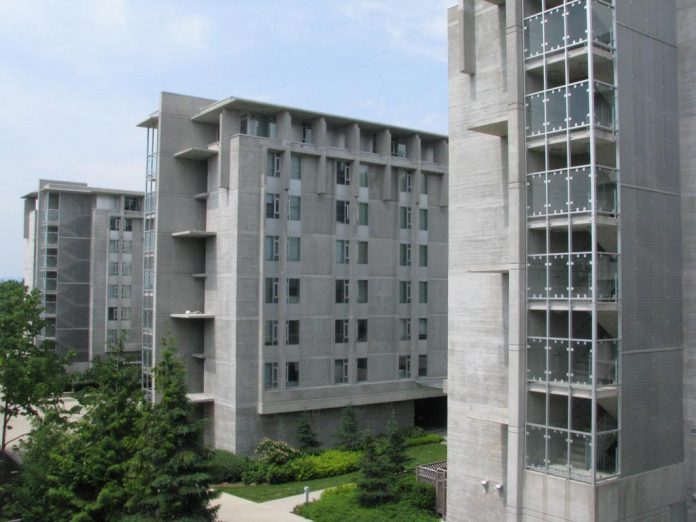
Residence and Housing prepares for another school year of distanced education

0
Photo courtesy of SFU Guest Accommodations

Written by: Paige Riding, News Writer

The new school year brings in new and returning students from around the world to SFU Residence, but this year’s proceedings will not be the same as those of the past. 

Residence and Housing Communications representative Leon Kalligerakis elaborated via email on what SFU plans to do for its current and newly arriving residents in the Fall 2020 semester. They are following guidelines from the Provincial Health Authority and operating with limited services and at limited capacity. The summer term had just over 500 students living on campus. For the fall, Residence anticipates 800 or more students.

“Fall-term occupancy is likely to be approximately 50% of normal levels in buildings with shared washroom and kitchen facilities and higher in buildings with self-contained suites,” begins Kalligerakis. “All incoming residents have expressed a need to be living on campus for the fall term.”

With strict social distancing rules, there will be restrictions with off-Residence guests and the amount of residents in any one area at a time. Residence Life staff, those on the front lines ensuring the safety of residents, will have online orientation and will offer no in-person events.

Zoe Woods, Director Residence and Housing, spoke about Residence Life staff in an emailed statement to The Peak.

“Residence Life staff remain a vital link in our community and keep us connected to the pulse of our residence halls. We are so fortunate that they choose to call SFU home and continue to live and work within our SFU residence community.”

There is enhanced cleaning in “high touch areas” in living quarters like shared bathrooms and kitchens, and on door handles and elevator buttons. For those seeking support, the Residence and Housing office has newly installed plexiglass at the front desk, has heightened its cleaning procedures, and limits the amount of people inside at any one time. They encourage residents to phone or email for help whenever possible.

According to Kelligerakis, housing works with various SFU partners including Health & Counselling, Fraser International College, Campus Security, and International Services for Students “to offer support and resources to current and prospective resident students.” Kalligerakis also commended the efforts of Facilities Services working behind the scenes to keep spaces functional and clean for those on campus. 

With move-in scheduled for the first week of September, residents must reserve an appointment time over the three-day move-in period to head to their new dorm. 

“This will help to ensure that we are continuing to provide a safe environment during move in which includes social distancing measures,” the email continued. Students will receive information about moving in and COVID-19 measures implemented. Residence will continue updating their website and social media channels around new procedures as they develop. During move-in days, signs and staff will be around to guide residents where to go.

Residence and Housing’s website notes that, should a second wave occur any time during the school year, they will “encourage students to move out as early as they can, if this option is available to them, to reduce the risk of possible community transmission for health reasons.” This echoes what happened during the Spring 2020 semester; as the pandemic resulted in the province’s quarantine orders, Residence and Housing offered partial refunds for students who moved out before the end of their terms.

More diversity is needed in university leadership

0
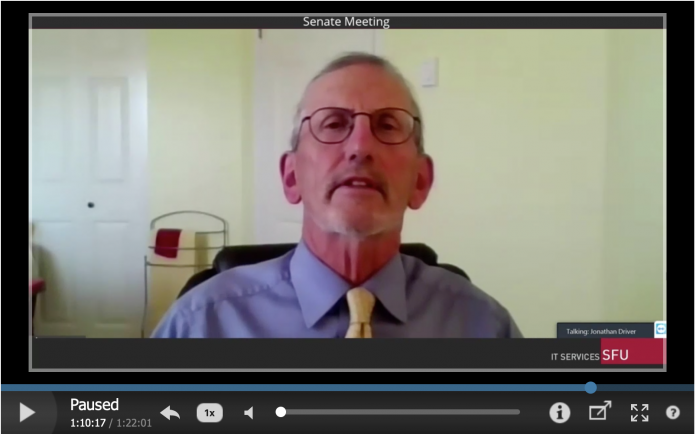
More diverse perspectives are needed for SFU leadership. Screen shot by Nicole Magas, via SFU IT Services

By: Miriam Abel, and WeiChun Kua, SFU Students

During SFU’s July 6 Senate meeting, Vice-President, Academic and Provost pro tem Jonathan Driver made an inappropriate remark as part of the apparent “roasting” tradition for President Andrew Petter’s last term at SFU. Driver joked that now would be the time for some “light-heartedness,” and read a series of fake questions that would be asked at the next senate meeting — one of which questioned if SFU would build a pipeline through Convocation Mall. The obvious sarcasm was meant as a joke, but left discomfort and disappointment with concerned students.

Student groups like the Simon Fraser Student Society (SFSS) and Graduate Student Society (GSS) have organised against the Trans Mountain Expansion (TMX) project due to safety concerns, environmental hazards, and the threat to Indigenous sovereignty. The SFSS has also recently reaffirmed its opposition to the Trans Mountain Pipeline Expansion. In the past, President Petter has publicly stated that the risks to students’ safety posed by the expansion are “unacceptable,” “significant and deeply concerning.” The university later sent a letter to the federal government expressing its objection to the project. So why are decision-makers such as Driver, who seem to understand the risks posed by the pipeline, making jokes that effectively minimize the severity of the problem? 

By joking and laughing about the problem, the university administration has made it clear it does not take our concerns seriously. How shall we feel as students if our efforts to oppose the pipeline are being mocked? How shall we trust them with our safety if they joke about it directly to our faces?

The inappropriate joke also downplays the way pipeline projects harm reconciliation with Indigenous people. Pushing pipelines through unceded, stolen lands always diminishes Indigenous rights and sovereignty, and such a joke contributes to the colonial violence that the university and its students must oppose in the pursuit of reconciliation. Is an administration that jokes about the expansion really taking reconciliation seriously? 

The timing of the joke also came concurrent to Canada’s recent Supreme Court decision to dismiss the Squamish Nation, Tsleil-Waututh Nation, and Coldwater Indian Band’s leave to appeal their challenge of the expansion in February. According to Chief Leah George-Wilson of the Tsleil-Waututh Nation, this was a “major setback for reconciliation.” The lack of awareness of both the inappropriateness and timing of the joke is an indication of SFU’s lack of true commitment to reconciliation. The university cannot forget on whose lands it is situated, and so must commit to more than mere land acknowledgements — it must embody reconciliation in all of its words and actions. As noted by Anishinaabe legal scholar Ashley Courchene, until the university administration addresses its complicity in acts of colonial violence, “any attempt to Indigenize or decolonize academia will only wind up as a dead-end.”

As long as the university continues to put white men in positions of power and leadership, it can never truly address systemic racism and white supremacy at SFU. There are simply not enough diverse perspectives at the table to emphatically say, “this is wrong.” There seems to be some “progress” in this regard, however, as a new wave of leadership is coming to SFU with the appointment of Joy Johnson as the next President, Catherine Dauvergne as the next Vice-President, Academic and Provost, and Tamara Vrooman as the next Chancellor. We should be hopeful that the new leadership will employ an intersectional lens in the decision-making at SFU. However it is important to note the whiteness that persists in academia. All three appointees held high positions as Dean, CEO, or Vice-President in their respective jobs — all in fields in which Black, Indigenous, and People of Color (BIPOC) often face barriers entering. 

Dr. Malinda Smith, who was recently appointed the new Vice-Provost Equity, Diversity and Inclusion at the University of Calgary, suggests that white women have gained a critical mass in academia. In the quest to achieve equity, Canadian universities have employed a “women first” strategy, because the hiring of white women is seen as more achievable than the hiring of BIPOC — while still checking off diversity boxes. The vacancy of Joy Johnson’s former position of Vice-President, Research and International is a perfect opportunity for SFU to appoint a Black, Indigenous, or Person of Colour. This would be a significant and much needed step in addressing whiteness in academia. 

While students are still actively engaged in anti-pipeline activism, the university seems to have stepped away from this particular battle — such that this still very serious topic is the subject of a joke for top university officials. This is why having an all white-run administration is problematic — from their privileged perspective, they simply do not see how and why this is such an important issue to students and Indigenous activists, and Jon Driver’s throw-away joke is proof of this.


New Vancouver museum to highlight Chinese-Canadian history in BC

0
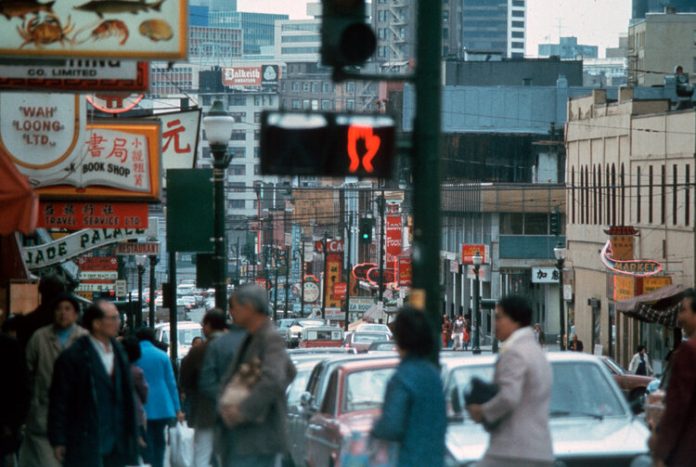
E Pender Street in Chinatown, 1979. Photo: Paul Yee accessed via City of Vancouver Archives AM1523-S6-F70-:2008-010.0450

Written by: Gurpreet Kambo, Peak Associate

The provincial government has announced $10 million of funding to be put toward the development of a new museum dedicated to documenting the history of the Chinese-Canadian Community in BC. The museum will include multiple physical locations across the province, with the main hub in Chinatown, as well as an online portal. 

“We’ve been working closely with the community for years and it has told us how important this museum is for everyone in BC. We are at a critical point when it comes to conversations about race, inequality and injustice in this province. Now is the time to come together to share the stories about how our province got to where it is — and to have conversations about where we want it to go,” said Premier John Horgan in a press release. 

Chair of the Chinese Canadian Museum Society Grace Wong told The Peak in an interview, “We’ve heard from so many people that it’s a really meaningful idea [ . . . ] It certainly resonated with me in terms of the importance of having a place that could both share that history, share the stories.”

When asked about her personal favourite stories in Chinese-Canadian history, Wong said, “I find very touching stories of the people that basically enlisted and went to war for Canada, even though they had no status, and they were fundamentally not really particularly welcome.” She explained that this eventually resulted in the right to vote for Chinese-Canadians. 

A representative from the BC Ministry of Tourism, Arts and Culture elaborated on the types of stories that the museum will be highlighting in an email interview with The Peak

The Chinese roots in BC go far beyond the gold rush and railway narrative. For example, Indigenous peoples and Chinese migrants worked cooperatively in many regions of BC, living shared experiences of marginalization.”

According to the representative, the museum will start with a temporary exhibit called A Seat at the Table in Vancouver’s Chinatown. This exhibit is meant to highlight the contributions of Chinese migrants to BC, and in particular, will focus on the Chinese restaurant and food industry. 

“A close look at the food industry reveals the impact of racial discrimination on Chinese Canadians, but it also tells us much about their ability to resist, organize, seek justice and thrive,” they said.

SFU Morris J. Wosk Centre for Dialogue has also been involved in the initiative. In early 2019, the Centre worked with MLAs George Chow and Lisa Beare to organize multiple community consultations and dialogues in the early planning stages of the museum. Over 500 people attended the eight sessions that were held, and 64 local students and alumni were hired to help facilitate the sessions.

Dr. Robert Daum, Fellow, Diversity & Innovation, SFU Centre for Dialogue told The Peak in an interview, “Meaningful public engagement is in our DNA at SFU [ . . . ] Chinese-Canadians have played a profoundly important role in the history of our province. The province wanted to seek authentic public input about how to do justice to the many important stories of Chinese Canadian individuals and families, the historic sites and artifacts, the achievements and tragedies that are part of our collective history over the past 250 years.”

He added, “It was a deep privilege for everyone involved [ . . . ] to be able to collaborate in supporting the establishment of a new provincial museum.” 

A Seat at the Table is scheduled to open in mid-August in Vancouver’s Chinatown. A larger exhibit at the Museum of Vancouver will be unveiled in the Fall. 

Applications open for new post-secondary BC Access Grant

0
Photo courtesy of the Province of British Columbia, via Flickr

Written by: Michelle Gomez, News Editor

Back in March, the provincial government announced the new BC Access Grant for students studying at BC post-secondary institutions, starting fall 2020. As of mid July, applications are now open.

The grant is needs-based, and will provide funding to low and middle-income post secondary students. The amount granted to each student will depend on family income. Those applying for student aid will automatically be assessed for the grant. 

In addition to providing funding to full-time undergraduate students, the grant will also be offered to those in diploma and certificate programs, and to part-time students. According to a provincial government press release, this will almost double the number of students who are eligible for funding. 

The Alliance of BC Students, a coalition of student associations across BC, told The Peak that they have been consistently advocating and campaigning for needs-based grants from the provincial government since their founding in 2013. 

“The establishment of the BC Access Grant is the culmination of years of student advocacy. We were so happy to see our many years of hard work pay off!” said Grace Dupasquier, Chairperson of the Alliance. Dupasquier also noted that this grant is even more important in the context of COVID-19, “with so many students and their families now in precarious financial situations.” 

This grant will replace the BC Completion Grant, the BC Completion Grant for Graduates, and the BC Labour Market Priorities grant “to provide up-front financial support to students when they need it at the beginning of studies.” These programs will be discontinued as of July 31, 2020.