Home Blog Page 396

What Grinds Our Gears: Packaging that is unnecessarily complicated to open

0
PHOTO: James Yarema / Unsplash

For the past few years, my hands and wrists haven’t been doing too well. Due to a mixture of overuse, hypermobility, and a small frame, my hands have become significantly weaker, lost some of their fine motor skills, and have posed a series of challenges to my daily life. One of these challenges is the struggle to open things that, to me, were not previously difficult to open. I don’t just mean pickle jars and excessively sealed packages — I also mean pop cans, twist tops, and cereal boxes.

The thing that is so frustrating about packaging is that I shouldn’t need an exuberant amount of strength to open a jug of orange juice. I understand that the twist-and-pop cap is supposed to indicate that a product is still fresh, but the juice boxes that flip open with the little plastic-peel off are truly much easier for me. Why is there so much unnecessarily tight packaging, that when I’m left home alone, my meal options have suddenly become limited to avocado toast? (I mean, I have a few more options, but still.) 

I recognize that I’m privileged to only be experiencing this in the past few years, when there are others who have likely been struggling with this for their whole lives. However, I’ve found it increasingly concerning that companies don’t seem to take into consideration the amount of assistance that one may need to open their products — whether that be food, cosmetics, or other essential items. So, I’m asking everyone to look critically at the products they consume and consider whether their design is accessible, because not everyone has the same abilities, and I guarantee that there’s an alternative.

Senate Report: November 2, 2020

0
Photo from Peak archives

SFU reopens some Athletic & Recreation programs 

During the question period, Senator Colin Percival asked if there were any plans to reopen Athletic & Recreation programs. Vice-President, Academic and Provost pro tem Jonathan Driver responded by stating that the gym and pool were open through appointments, where other safety protocols — such as sanitizing stations — are in place as well for students who live on residence and staff and faculty who work on campus. Following the BC health orders announced on November 7, SFU Athletics & Recreation announced that the Fitness Centre and Aquatics Centre reopened on November 12. Consult with the SFU Athletics & Recreation website for updated safety protocols.

President Joy Johnson added that some of the SFU athletics teams — such as football, soccer, and track and field — have been training on campus and discussions are currently underway regarding whether athletic competitions will be available next term. She also recognized that athletics includes the additional challenge of athletes having to travel across the border.

Expectations for professors regarding remote course delivery

Senator Lyn Bartram posed a question about how professors are expected to deliver courses to students who are working from home all around the world. 

Bartram expressed that for the first time, she had to describe whether her course would be taught synchronously or asynchronously. She recognized that some students will be joining from outside of the lower mainland, but that with some aspects of the course requiring real-time communication, Bartram felt that she’s teaching two courses with the blend of synchronous and asynchronous components. 

Bartram added it now takes two to three times more effort to deliver a course, not taking into consideration the time it takes to prepare. 

Driver responded by stating that SFU is currently working with the faculty association on this issue. Professors who are pre-tenure (meaning that they have not been offered a permanent contract) have been given flexibility so they can delay tenure. Delaying tenure, however, means that professors can be terminated without justifiable cause. Senator Rob McTavish commented in the chat that delaying tenure for professors who are pre-tenure is a difficult decision, as it can have long-term consequences on salary and pension. 

There are options to modify study leave plans and performance review processes, and there is a review occurring of support that has been implemented at the faculty level, which includes financial assistance to hire more teaching assistants, among other accommodations. 

President Johnson responded that there is recognition for professors who have gone above and beyond and that the workload has increased for everyone during these difficult times. 

Senator Pablo Nepomnaschy spoke to the impact that COVID-19 has on research, and agreed with Senator Bartram that teaching online takes three times the amount of effort. In addition to this, professors who work abroad or at field schools have seen a negative impact on their research as they can no longer travel. Professors explained that this problem also extends to their graduate students and that there needs to be a solution.

Postponing external reviews for 2020–21 academic year

Senator Wade Parkhouse explained what an external review consists of. The purpose of external reviews are to assess the strengths and weaknesses of each academic unit, gain the perspective of external experts, and support future planning. Academic units are reviewed by external reviewers not only from Canada, but across North America. This usually includes a social event, in-person meetings with faculty members, and a review of documents and reports. All units were allowed to delay the review, except for the units who postponed the reviews in the previous year. Geography and Physics would go forward in 2021, most likely later in the year. 

Top Ten ways to help lockdown go by quicker

0
Very calm, very cool. Nothing wrong here. Illustration: Siloam Yeung / The Peak
  1. Hit up your ex

Since dating your ex ended up being a waste of time despite your initial thoughts, inserting yourself back into their life during lockdown truly lives up to the “unprecedented times” we’re currently in. You want “unprecedented?” Try giving the guy with poor morals and worldviews (and an even poorer hairline) who broke up with you over the phone another chance. Now that’s unprecedented. Just remember to cut things off once lockdown ends, because as self-inserted Presidential-elect Kanye West once said: “keep your love lockdown.” 

2. Maximize on sleeping

Parents may often warn you that by sleeping in ‘til noon, you’re “wasting the day” or “lazy” and “a total waste of human life, Jared. Also, when are you going to find a job so you can move out of this house, for Christ’s sake?” But don’t listen to them (unless you’re Jared). Sleeping is a perfect way to help time move by faster, since your unconsciousness inhibits you from noticing how slowly the days go by. All of those useless hours can instead be spent dreaming about a blissful, COVID-free life — or they can be an endless array of anxiety dreams triggered by your reluctance to confront problems with your mental health that you should really deal with and talk about. But that’s an awake you problem! Sweet dreams! 

3. Lay in bed and rotate through the same five apps, day in and day out

If this feels like a very specific callout, I’m here to tell you it is. As you’re reading this, you’ve just closed Instagram to look at Twitter, even though you just closed Twitter to look at Facebook and then went right to Instagram. I’m looking right at you, lying in the darkness on your side with a pillow between your legs and/or nestled between one arm and your head. Your iPhone screen and cheap lights you ordered because everyone on TikTok had them illuminate your face. Oh? Did your attention span just subside and you no longer want to look at Twitter? Close that app and go back to Instagram, you coloured-haired, validation-craving Tumblr dweeb.

4. Sell your soul to Chronos, God of Time

People who say you can’t buy your way out of a problem have clearly never considered how expensive a human soul is to beings who see humans as expendable. No, not your fabricated Tesla and Amazon capitalist overlords; I’m talking about actual gods. Take that expensive soul of yours and offer it up to Chronos, God of Time. Ask him to bestow onto us measly mortals the gift of moving forward to a time beyond lockdowns and plagues. Hopefully, if he’s kind, he will comply with your weak demands. And if he looks anything like his depiction on the hit Canadian cartoon Class of Titans, tell the God of Time that my soul and body are ready for him, anytime. 

5. Attempt time travel

Anyone who said you can’t learn anything from TV and movies is, frankly, a giant LOSER and probably a nerd — unlike you. Take some inspiration from the classic time-travel trope to fast forward right to when lockdown is over. You could try driving a car super fast to replicate Back to the Future, cryogenically freeze yourself like Fry in Futurama or Walt Disney (look it up), or pray that whoever is controlling the simulation decides to pull an Animal Crossing-style time travel. Just don’t make that stupid fucking “where are we, more like when are we” time travel joke when you eventually succeed — you don’t need need to travel forward in time to know the joke didn’t land. 

6. Run absurdly fast around the entire Earth

Not to get scientific on main, but technically the way we tell time is because of the Earth rotating, right? So who’s to say that if you run super fast around the world, you can’t help speed up rotation and thus make time go by faster? Just strap on those gym shoes unused during and before this quarantine began, stick your arms backwards Naruto-style for speed, and fucking book it. And before any of you flat Earthers come for me, maybe take that energy you use to argue about the shape of our literally proven-to-be-round planet and worry about flattening a different curve. 

7. Just like, start a hobby! 🙂 

TBQH, why try any of this other junk when you could just start a hobby! 🙂 It’s like, so cooky to get caught up in something like knitting and using it as a replacement for stitching together a personality 😀 Isn’t it so quirky to just get into arts and crafts, or like, baking just for fun?! :3 Oh, and then starting an Instagram account for your hobby because you think people actually care? :} Or is it, like, just actually super juvenile and an unrealistic practice that people who jerk it to 5 Minute Crafts on YouTube preach as being self-care because they think they’re better than you? :] Oh, and you should totally like, start an Etsy or advertise your stuff on Facebook Marketplace too, capitalism is sooooo cute right now. :*

8. Change the date on all of your devices

Let’s get honest for a second here: time is just a concept. You’re telling me that randomly twice throughout the year time moves backwards an hour and then miraculously an hour forwards? Why can’t we just pull the same shit with lockdown? That’s right, it’s because that’s what the man says. It’s all Big Business brainwashing us. Be complacent no longer! Just move your calendars forward to lockdown’s end, throw the first authority figure that classic middle finger, and light a cigarette as you kick-flip and ride your skateboard into the night. But then again . . . what does “night” even mean . . . 

9. Begin your character-development training arc to trigger a time-skip 

A classic anime trope, if you want to speed your story up a bit, just go off to train off-screen for an unspecified amount of time and come back when lockdown is over. Your muscles will be unrealistically bigger, your hair will be spikier, and your latent abilities that will help you defeat the forces of evil will be awakened. Also all of your friends’ will have grown at least three cup sizes — just roll with it, it’s for the fans. Just don’t be alarmed by your friends, allies, and enemies suddenly looking dramatically different — they changed illustrators between the lockdown and somehow expected you to accept it and not notice. 

10. Wear a fucking mask and stay inside

Alright, no more beating around the bush. You want this pandemic to end so you can go back to breathing down people’s necks on the bus while you refuse to put your backpack on the ground? You want to start catching people’s spit in your mouth while you dance to an over-saturated EDM song at The Pint? Try staying inside and actually following the rules, Khymberleigh. And if you absolutely must go outside (for valid reasons such as work or your education, not to hook up with Cradley AKA the guy who still visits his high school even though he graduated five years ago), wear a fucking mask.

Plot-heavy porn soars in popularity as the pandemic leaves population lonely

0
PHOTO: Charles Deluvio / Unsplash

VANCOUVER, BC — A wholly baseless study done by two horny dudes on Reddit revealed that their equally horny online friends recently started searching for porn with painfully lengthy intros “just to feel something” this past week.

u/gumcuzzler69 and u/asunamorelikeassuna teamed up to deliver this breaking news that no one asked for with a sample too cheap and unethical to pay for their porn, starting with a thread on the notorious social media site.

“yall what is it with the horrid acting at the start of this video that gets me off. there sitting on a couch breaking the 4th wall every 20 seconds by staring at the camera while talking to each other. ,, i miss talking to people” one friend wrote on the page.

“ya i feel u sometimes i watch videos with a girl in a laundry machine in the thumbnail not to watch them smash but just cause i know the two actors will prolong the agony with the ‘oH no I aM StUcK’ and then i think about my ex who did my laundry sometimes. and then i go, ‘maybe I should call her,’” replied another.

Seeing this trend, the two Reddit users asked around and discovered a correlation between the loneliness and the length of the porn videos watched. 

When they asked if live cams that involve watching and interacting with sex workers was on the table, a whopping 99.4% of respondants said “no” and that “bro those cost money idgaf.”

Instead, participants reported scouring free sites on Incognito mode, checking the length of the video for promising plotlines that promised some sort of lengthy introduction.

“It’s fake, fabricated, false, but hell, it hits the spot. Yeah, twink, you struggle to open that pickle jar. I also struggle. It’s like I’ve found a new, relatable friend. The sex is a bonus or whatever, but those moments before when I hear someone talking . . . It’s like they’re talking to me,” wrote u/horndogcorndog22. 

It’s like that Rihanna lyric that says, “sticks and stones may break my bones, but discussions between BDSM actors in sweaty pleather surrounded by a nine-person crew in a poorly decorated staged home excite me.”

Listing gender on official documents is pointless

0
Bureaucratic practices are useless enough anyway. PHOTO: Sharon McCutcheon / Unsplash

If you’ve ever downloaded your advising transcript from goSFU, whether to help with advising or just to weep at the slow decline of your GPA, you may have noticed that it lists a gender. This is the same with any driver’s licence, passport, or other official document that may be used for identification. However, this facet of identification is not 100% accurate and shouldn’t be the standard to include on these files.

First, I don’t see how having one’s gender on SFU’s advising transcripts helps anyone. For starters, it is more difficult for non-cisgender people to be properly identified, as it cannot simply be changed with a few clicks on goSFU. It also insinuates that gender is of importance to a student’s value and assumes that it is important for advisors to consider in their evaluations. Other categories like projected academic level and total units accumulated that are specific to a student’s studies are necessary, but an arbitrary gender category is not one of them.

The same irrelevancy goes for identification issued by governments. Typically, citizens have only had the option to designate themselves male or female, if they have a choice at all. This enforces the idea that there are only two genders that exist. Though, in 2018, the BC government allowed an “X” designation to be allotted for driver’s licences and BC services cards instead of the standard “M” or “F.” While this was definitely a great step towards inclusion of non-cisgender people, it still recognises the gender binary as the norm, and all other gender identities as “other.” This isn’t an ideal way to include non-binary identites and it would be better if the category was abolished entirely.

Gender on identifying documents may be there to aid in confirming one’s identity, but it leaves out one very big point: that one’s gender identity does not necessarily correlate with one’s appearance or biology. For example, a person who identifies as female, but wears clothes that are typically thought to be “male” may not be recognizable as the “F” on their ID. In addition, someone who has not or cannot go through the arduous process of changing their ID could be stuck with the letter they were assigned at birth. Relying on attributes like height and eye colour that aren’t based on an outdated system of gendered perceptions would be more ideal for truly being able to confirm someone’s identity.

For some gender non-conforming people, having their true gender listed in an official way may be wholly validating, and I would not want to take away from that. However, eliminating the category of gender entirely in an official capacity makes it so that they are not listed as an incorrect gender from birth, and loosens the tight grip the gender binary has on the populace. If not for inclusion’s sake, then for accuracy of identification.

MAGPIE Research Group discuss research on COVID-19 data and models

0
IMAGE: United Nations COVID-19 Response / Unsplash

Dr. Caroline Colijn, Dr. Jessica Stockdale, and Dr. Paul Tupper from the MAGPIE Research Group featured as the guest speakers for the November 5, 2020 Cafe Scientifique hosted on Zoom. Dr. Colijn, Dr. Stockdale, and Dr. Tupper are researchers that work on “forecasting [COVID-19] cases, estimating how well distancing measures are working or not working, and how much change we need to make to get cases back in decline,” as introduced by moderator Cynthia Henson. During the event they focused on sharing their COVID-19 data extrapolations, models, and challenges they face in their field. The Peak previously had the chance to speak with Dr. Colijn, in which she spoke on projecting trends in COVID-19 using mathematical modelling.

READ MORE: “BC’s COVID-19 health policies are being informed by SFU professor’s research”

At this event, Dr. Colijn noted the importance of analyzing the extrapolations — which estimates the growth of cases assuming nothing else will change — of where BC’s COVID-19 cases will end up if public behaviour stays constant. They noted that they prefer to analyze their models as extrapolations instead of forecasts or predictions of what the future may hold. Dr. Stockdale said as estimating public behaviour is difficult, they don’t refer to their data as forecasting because of the many factors that could influence the movement of the curve, such as change in public policies, public health orders, or a change in public behaviour.

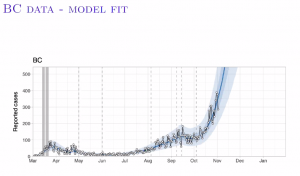
According to Dr. Colijn, BC worked hard to flatten the curve of cases when the pandemic began. As the cases started diminishing, BC started reopening: now their data shows an extreme second wave of cases that is larger than the original wave. Dr. Tupper noted that they can “predict things about the virus, but predicting policy maker’s behavior and public behavior [is] really hard to do.”

Image Courtesy of MAGPIE Research Group

Dr. Stockdale elaborated on some of the challenges they face when analyzing their data. Researchers need to “balance picking a model which is complicated enough that we think it’s really representing what’s happening in the real world, but also simple enough that we can be confident in our estimates and also that it’s interpretable” for the public or fellow researchers.  

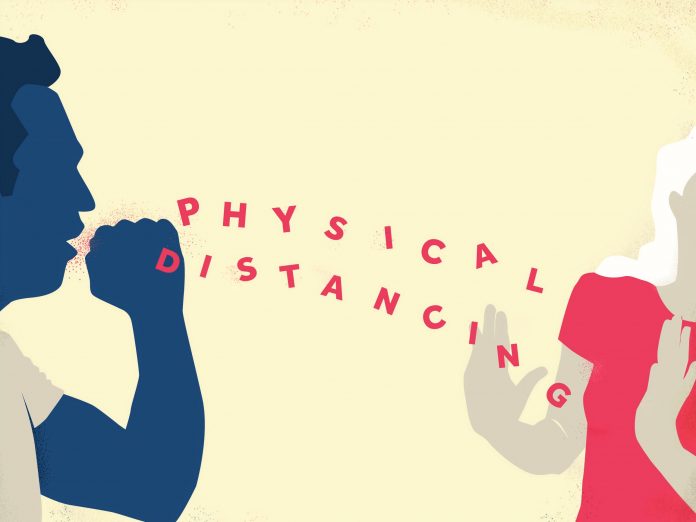
During the question period, some asked about the danger of asymptomatic carriers. Nearly 20–40% of adults and 40% of school-aged children are infected with COVID-19 and never develop symptoms, according to Dr. Colijn and Dr. Tupper. They added that it’s difficult to have concrete numbers, as they don’t know the rate of false-negatives. These carriers spread the virus to others in the community. Dr. Stockdale commented on the importance of physical distancing in these scenarios. She stated that “the people who are physical distancing are less likely to go out and see people, so they’re less likely to get infected [therefore] if a social distancing person does get infected, because they’re seeing others less, they’re less likely to pass on that infection.” Dr. Colijn also said that social bubbles of six people are extremely helpful in slowing the spread of the virus.

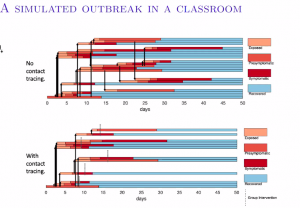
Discussion also took place around the COVID-19 cases in elementary schools. Dr. Tupper concluded that “it seems that ventilation is very important” alongside the wearing of masks and physical distancing to keep cases low. Dr. Tupper presented models that show lowered predicted COVID-19 cases when intervention and testing happens in the classroom compared to the natural flow of infection with intervention and testing. He stated the projections concluded that contact tracing and close monitoring “[reduces] the size of the cluster” by less than 50%. 


Image Courtesy of MAGPIE Research Group

Furthermore, Dr. Colijn elaborated on their future work in “[understanding] something about local transmission” and the diversity of the genome sequences found all over the globe. Her example was that if two colleague’s virus genome sequences are not similar enough then they can conclude that they haven’t infected each other. According to Dr. Colijn, they can use that data to “really improve the monitoring and control of transmission” by separating which strains are increasing and which are falling away. Dr. Colijn noted that the end idea “would be to [ . . . ] trigger action to look for strains that might be escaping a vaccine.” 

Dr. Colijn further explained that “as far as we know right now, the diversity of the virus isn’t suggesting that we need different vaccines for different places” or different strains and that COVID-19 is mutating at one-third the rate the flu does. 

Dr. Colijn concluded by noting that for more information she recommends watching the documentary Totally Under Control. She “found it to be like watching a very slow and fascinating trainwreck.”

Student swears by swimming in dense scholarly articles for quarantine workout

0
PHOTO: Nikko Macaspac / Unsplash

When this pandemic started, I really didn’t go out and move around as much as I used to. With half the population deciding to take up running or biking for the first time in their lives during this ample opportunity to spread their little spitties everywhere (why did so many people do that? Imagine voluntarily running at all, not to mention now?), I didn’t love the thought of going out. Now here I am, eight months later, and I’m absolutely shredded. Want to know how I did it?

By sitting on my ass. 

Desperately trying to get through a single sentence in my assigned article readings.

I should clarify; when I say shredded, I mean it. My eyes are destroyed from all this blue light I’m glaring at. Thanks to my professors opting for four times the amount of readings now that we’re online (makes sense to me), I can’t focus three feet in front of me. I don’t need to, though. All I need are the articles to keep me in tip-top shape. 

The process is simple. I open yet another photo-only PDF, sigh as my warm-up because that means no hunting for the answers to this assignment, then prepare to get lost. Totally lost. Wholly lost. Why-the-shit-are-the-sentences-so-long-and-complex lost. Then the blood really gets pumping. Or boiling. Or both.

Nothing hits like a sentence with more commas than my grade 10 papers when I just discovered what FANBOYS are and absolutely ran with them. Like a relay, the sentences will continue trudging along, heading in one way and then the next, so utterly and wholly bewildering you will find yourself hunting for the end of the sentence in preparation, then losing your spot because you didn’t put your fingertip on the right word or you swore you would remember but then got lost somewhere on line 14 and had to blink your sore eyeballs, and—

You get it.

It’s a foolproof way to exhaust any motivation you had to do well in the course — possibly even your life! The jargon forces you to leave the PDF to look up various definitions, adding a bit of spice in the mix. By the end of it, you’ll reach your fullest form. Having 23 articles to get through may be a temporary problem, but the knowledge you absolutely will not pick up from wasting your time trying to decipher these things lasts forever.

Why risk heading to a gym or the outside world when that one oddly specific multiple choice question from that one article you swear you read that one time makes you sweat enough? Are these sentences dizzying enough for you, yet? And this piece isn’t even peer-reviewed! Trust the scholars dedicating their lives to having their abstracts alone sourced by students because they saw the first main sentence and dipped. They know what they’re talking about. At least, I think they are?

The Bright-er Side: Greater understanding from professors has been amplified by the pandemic

0
ILLUSTRATION: Siloam Yeung / The Peak

Remote learning has been good at times, but the transition has also been stressful at times. Many of my online classes now have discussions on Canvas which require an extra effort to formulate ideas that wouldn’t be present in in-person classes. This, on top of extra smaller assignments, a pandemic that doesn’t show any sign of abating, tumultuous politics in North America, and dealing with personal issues, is less than ideal.

These past two semesters, however, I’ve been lucky enough to have professors who are understanding of all of the above. The transition to online learning hasn’t been easy on many of them either, but their willingness to accommodate students’ struggles shows that the pandemic hasn’t hardened all instructors. 

When I talked to one of my history professors last semester about missing a couple of discussions, he not only told me not to worry about them, but also that I didn’t need to do the upcoming one. This semester, I asked my labour studies professor for a 24-hour extension for an assignment and was granted an extra week. This professor also told our entire class that he wouldn’t be taking marks off for late assignments and that people don’t need to stress about handing them in on the same day.

Many instructors have also amended their curriculum to include less stressful assignments (or at least not stressful in the same way). A class that I was going to take last semester had changed an assignment from a very research intensive paper to an account of life under COVID-19. This flexibility allowed for students to only recount their own experiences and not have to worry about having to source information from libraries and navigate archives virtually.

Even though some of these allowances are pretty minor things, having instructors be so flexible is beyond important for students’ well-being and I’m incredibly appreciative. As the talking point goes, “we are in unprecedented times.” For instructors not to recognize that and be a little less understanding when setting deadlines and assigning work adds more stress on students. I know it’s not always possible to be flexible but more professors should be trying where they can.

SFU Stadium Project delayed to early 2021 following initial delays

0
PHOTO: Gudrun Wai-Gunnarsson / The Peak

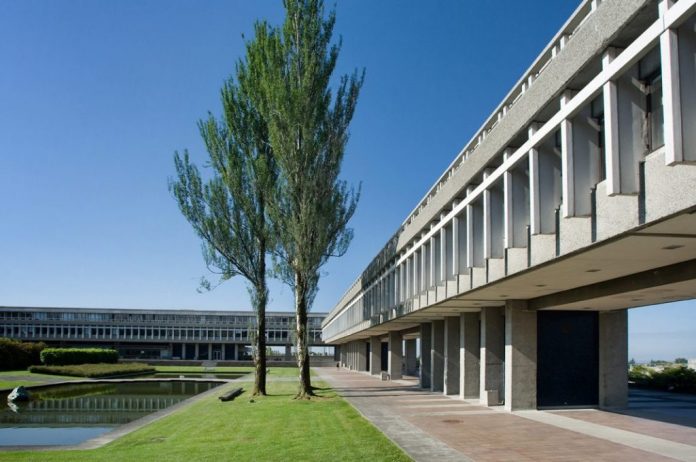
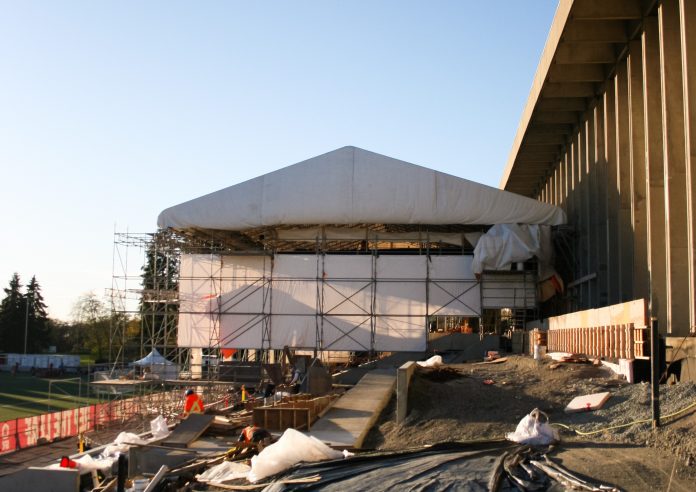
The previously anticipated SFU Stadium Project has been delayed after an update from senior director of Athletics & Recreation, Theresa Hanson. “We expect the stadium completion in early 2021,” Hanson said. The Peak had previously reported on the delay announcement in August 2020, in which it was anticipated the project would be ready by November 2020.

READ MORE: “SFU Stadium Project delayed to November 2020”

In an email interview with The Peak, Hanson said, “The SFU Stadium Project is well underway and progressing nicely. The unique, cantilevered roof canopy is in place, and is a beautiful feature of the stadium.” She added that “the seats will be arriving [on] campus shortly and are expected to be in place by end of November/early December.” The stadium will seat 1,800 spectators. The press box, football locker room, and other amenities are also being worked on as the project continues. 

Given the green light to begin construction in December 2018, the Stadium Project was most recently anticipated to be ready by November 2020, after a delay that urged the construction to be done by Summer 2020. Due to delays surrounding COVID-19, the project’s completion has been postponed again. The pandemic has “impacted the delivery of some materials, as well as the speed of work onsite,” Hanson said.  

The NCAA Division II fall championships sports of football, men’s and women’s soccer, volleyball, and cross country were cancelled in late August, and competitions across all varsity sports have been suspended until January 7, 2021. 

“At this time, the NCAA Division II winter championships sports of basketball, swimming, wrestling and indoor track and field are scheduled for March 2021, and we expect to make a decision regarding winter sports participation within our GNAC conference before the end of November.

“Football, soccer and track and field [teams] have been training on Terry Fox Field throughout the stadium construction,” Hanson explained. “For varsity competition, we are setting our sights on full stadium usage for the fall 2021 seasons, if the current public health situation allows for that.”

“We are exploring options to share a look inside the new stadium with our community in the New Year,” while adhering with physical distancing guidelines and limited attendance. 

To keep up with Terry Fox Field and the construction site, there is a live webcam on the SFU website that showcases the progress and is updated every 15 seconds for 30 minutes. 

Multitasking helps students tune in, not out

0
PHOTO: Gudrun Wai-Gunnarsson / The Peak

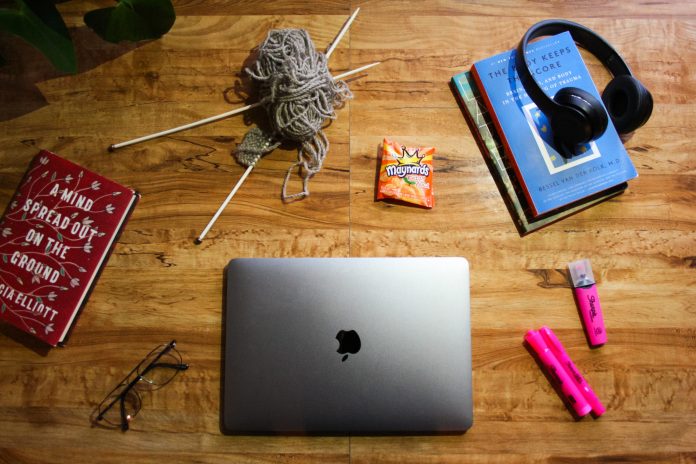
Before the pandemic forced us all to watch our professors struggle with technical difficulties through a screen, we were doing so in-person. Even then, I was one of those students who looked like they were never paying attention. I would be balancing two screens and a journal on my desk while listening to music through my headphones. While I understood the perception that I wasn’t paying attention, it was one rooted in a lack of empathy and a misunderstanding of what differing learning styles can look like. Professors should promote a diverse learning environment, instead of punishing anyone who learns differently from the norm.

Every student knows their own learning style best. For example, journaling helps me get out any intrusive thoughts that affect my ability to focus and music prevents any auditory distractions. Despite this, once in a while professors would ask me if I was listening during lecture or advise that I listen more. It became common enough that at the start of the semester I would go to office hours simply to disclose how difficult it was to focus without the help of my practices, and to ensure them that I was listening and not being disrespectful. Not only did I have to take the time to go to every professor’s office hours — which is a nightmare for someone with anxiety — I was also put in a position where I felt I had to justify my preferences. Often, it would result in disclosing my disabilities, when I wouldn’t have done so otherwise. I ultimately learned less from the class and lost potential office hours to help, which wouldn’t have happened if the professors were understanding from the start. 

Now with remote learning I find myself in the same situation, where professors are being more strict about “being present.” Some classes mandate that cameras remain on and that students don’t distract others in front of them by doing anything other than taking notes. Beyond not respecting the privacy of students’ homes, this practice is simply unrealistic for people who rely on focusing in other ways. 

Being at home creates a more distracting learning environment than ever, therefore, attempting to focus requires greater work. Disincentivizing personal practices that help students focus is absurd and prevents students from learning, as opposed to promoting their learning. In this remote learning environment professors consistently ask students to be patient, which is reasonable. But this request is hypocritical when professors do not have the same patience for students trying to learn in the best way they know how.

Not to mention that a practice does not have to be aimed at a disabled student to be ableist. While mandating that students’ cameras are on and that they avoid being “distracting” does disproportionately affect disabled students, it also affects abled students. Everyone has accessibility needs when it comes to learning. Some of which include dividing your focus with things like knitting, listening to music, writing, drawing, stimming, and crafting, to name a few. Denying students their accessibility needs not only prevents students from learning, but is discriminatory. 

Whether in-person or online, professors should teach from the standpoint of universal design, which provides all students an equal opportunity to learn. By having a flexible learning environment that accommodates all individual learning styles, not only will students be less distracted, but they’ll be able to learn and address their individual accessibility needs. When professors extend the same patience and respect they expect in return it promotes a more diverse learning experience that everyone can find value in.