Home Blog Page 366

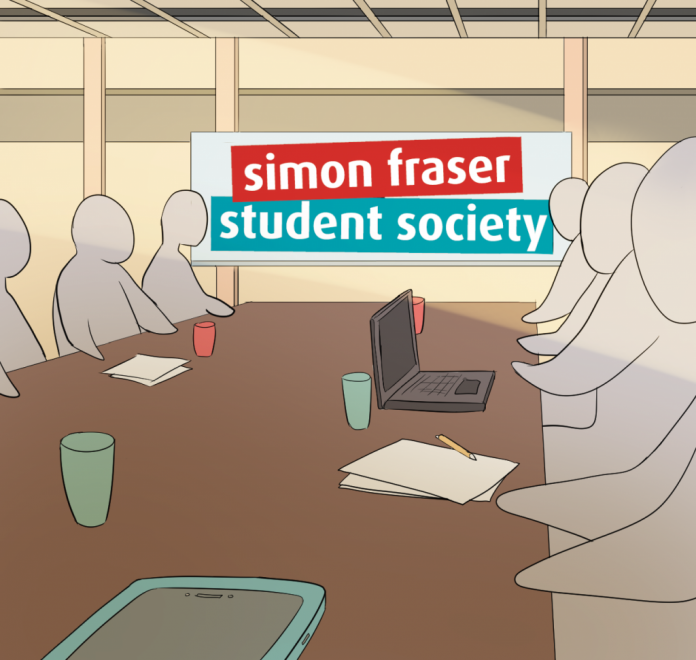
Board Shorts — April 30, 2021

0

The Board finalizes new Student Union Building (SUB) leases to student groups

The Board discussed a motion to approve lease agreements for space in the SUB to key SFU groups. This includes the First Nations Student Association, Students of Caribbean and African Ancestry (SOCA), CJSF Radio, Embark Sustainability, and Simon Fraser Public Interest Research Group. 

This comes after conversations beginning in 2011 for space on campus for Rotunda groups.

At-large representative and SOCA member Balqees Jama recalled being informed by the Simon Fraser Student Society (SFSS) in 2018 that SOCA was being evicted. “There was so much stress and taxation on our health,” she said. SOCA launched the Black Spaces Matter campaign calling on the SFSS to give them back their space “so that Black students are not rendered homeless and without a safe community.”

Jama said, “It’s a part of the restorative justice that we have been talking about this year.” She added she is “relieved and emotional” to see the leases being finalized.

Vice-president student services Matthew Provost said, “This has been a long time coming.” He said the SFSS evictions were “a very difficult time for a lot of community members” as SOCA was not the only Rotunda group to be evicted from their space.

The leases with these groups were first proposed in March 2020. The Board voted unanimously to approve the lease agreements, giving Rotunda groups and SFU organizations space in the new SUB. SFSS president Osob Mohamed noted it was a historical moment.

Board approves living wage model for 2021/2022 members

The Board approved a change in the wages model for the incoming Board of Directors and Council members. This recognizes the amount of time dedicated by non-executive councillors, council vice chair, and executive officers and compensates them based on living wages. 

Mohamed said due to the increasing cost of living, “working-class students are just not able to put in large amounts of time uncompensated into anything.”

The motion compensates the executive officers $2,100 per month starting May 1, 2021 and $2,340 per month starting May 1, 2022 to accommodate the increasing cost of living. Council vice chairs will receive $525 per month in 2021 and $585 per month in 2022. The non-executive councillors will receive $350 per month in 2021 and $390 per month in 2022. This amounts to an increase of roughly $15.20 per year in 2021/22, and $16.90 a year in 2022/23 in tuition costs for students.

“When we talk about systemic equity or removing systemic barriers for people to get involved in things, this is a prime example,” said Jama. She noted many people at SFU would be interested in contributing to the SFSS but cannot afford to because they need a higher income. 

BIPOC committee at-large representative Marie Haddad noted the SFSS has a responsibility to support students on campus. “When we call on marginalized students to take space in governance, [the SFSS is] also called on to make that space adequate for those students.”

The SFSS has not updated their compensation model since 2008. 

The motion passed unanimously.

2020/2021 Year-End Review 

Mohamed presented the Board Year-End Review, showcasing what the Board of Directors accomplished throughout the pandemic. Mohamed touched on academic advocacy, equity and social justice initiatives, and financial aid advocacy. 

Mohamed said they “have seen some major wins” this year. She noted the new elective grading scheme was passed in the Senate because of their work. Mohamed also noted their student affordability project as a key area of success. This group was created to help prepare for the financial burden that accompanies post-secondary school. It also extends beyond tuition to rent, cost of living, and other costs.

Mohamed noted that the 56 virtual events held were a “key facet of the SFSS this year” in creating a community amidst the pandemic.

A goal of the SFSS this year was to “see improved transparency, accountability [ . . . ] and democratic, member-driven budgeting and major decision making,” said Mohamed. “Those pieces are the foundation of the SFSS.”

McFogg the Dog, Take The Wheel: an SFU-inspired playlist

0
Image Courtesy of @SFU Twitter Account

After a full year of online learning, I find myself missing the prison-like architecture of campus and the ambiance of non-stop construction. If you’re unlike me (good for you) and find construction noise to be the most annoying sound ever, here are some songs you can play to mask it when we all go back to in-person school.

“Money” by Pink Floyd

Image courtesy of Harvest Records and Capitol Records

From parking fees to spending an inordinate amount of money at Cornerstone Starbucks, campus is a place where monetary transactions happen more frequently than educational exchanges. The lines, “Money / It’s a crime / Share it fairly / But don’t take a slice of my pie,” reflect the administration’s willingness to line their pockets by increasing tuition, forcing students to spend money they would have otherwise used to pay rent, buy groceries, and purchase a Nintendo Switch solely for Pokémon Snap. 

“Can I Believe You” by Fleet Foxes

Image courtesy of Anti-

When the song opens with, “Can I believe you / Can I ever know your mind,” I immediately have mental flashbacks to an email I received a couple months ago regarding the creation of the Equity, Diversity, and Inclusion subcommittee. For a committee with such goals of diversity and decolonization of the education system, three out of four members on the committee are white women. So again, I must ask: “Can I believe you?” when I see LED screens advertising the school’s commitments to equity on campus.

“Plot Twist” by Sigrid

Image courtesy of Island Records

I am not alone in thinking that SFU’s record of repeated delays in building the Student Union Building and the SFU Stadium gave me trust and commitment issues. Listen to Sigrid’s lines, “I thought you were someone to trust / you’re the best lie I’ve ever heard” as you avoid walking into a jackhammer for a building that was supposed to be finished three years ago. 

“It Be’s That Way Sometime” by Nina Simone

Image courtesy of RCA Records

Our online learning adventures might soon be over, but our struggle with SFU’s host of technical problems will surely continue. Find yourself getting irritated when goSFU or Canvas crashes for the nth time? Channel some of Nina Simone’s spirit and think, “Don’t let the problems of this world drive you slowly out of your mind / Just smile, look at the problem and say it be’s that way sometime.” If that doesn’t work? Take another page out of Simone’s book and evade arrest for unpaid taxes by moving to Barbados and shacking up with the Prime Minister. 

“Jesus, Take The Wheel” by Carrie Underwood

Image courtesy of Arista Records

Heading back to campus means another readjustment period riddled with anxiety and stress. In moments like this, Carrie Underwood’s encouragement to let Jesus take the wheel comes in handy. SFU’s Jesus, McFogg the Dog, will be at the receiving end of the request, “Jesus, take the wheel / Take it from my hands / ‘Cause I can’t do this on my own” come final season when we’re all back on campus and reeling from being ill-adjusted after a full year of Zoom.

The Trans Mountain Expansion Pipeline

0
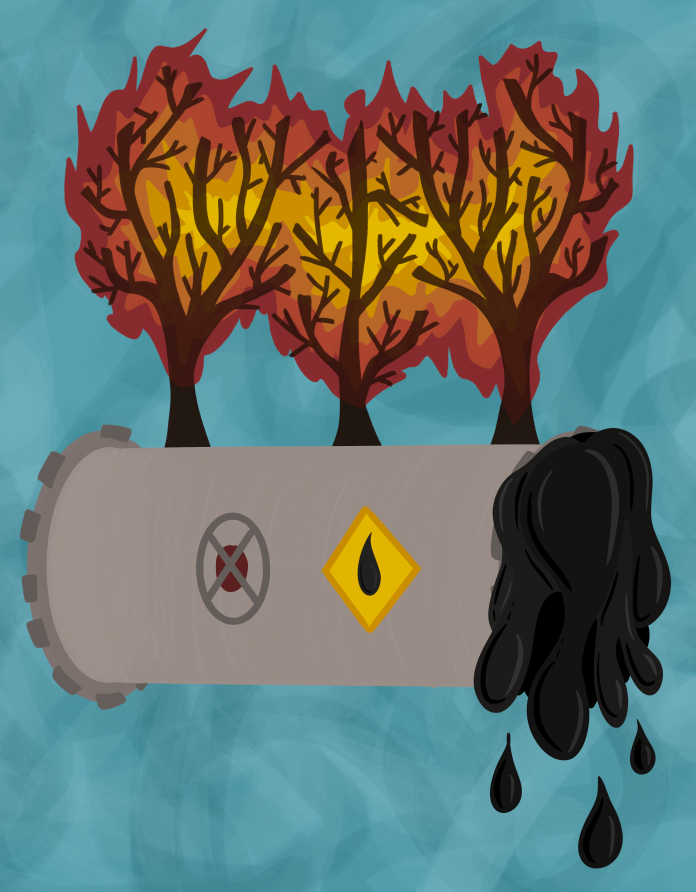
ILLUSTRATION: Alyssa Lalani / The Peak

What is the Trans Mountain Expansion Project?

The Trans Mountain Pipeline is a pipeline built in 1953 that transports crude oil, semi-refined, and refined products from Alberta to BC. It is the one of the only pipelines in Canada that can carry both refined products and crude oil in batches. These different products can be either blended together or pumped individually, depending on what is requested by the shipper. These products can be broken down into four different product types.

Product Type Example Description
Refined petroleum Gasoline or diesel Refined
Synthetic crude Processed bitumen (asphalt) Semi-refined
Light crude Conventionally sourced crude oil Unrefined
Heavy crude Diluted bitumen Unrefined


According to the Trans Mountain Project Overview, The Trans Mountain Pipeline expansion (TMX)  is “essentially a twinning of this existing 1,150-kilometre pipeline between Strathcona county (near Edmonton), Alberta, and Burnaby, BC.” This new pipeline will be able to transport anywhere between 300,000 to 890,000 barrels of crude oil a day. 

The purpose of this expansion is to keep Canadian oil in Canada rather than transporting it to our neighbours in the United States. The Project Overview states, “Everyone will benefit [from the expansion]. Workers will benefit during the $12.6 billion construction project. Oil producers will earn more revenue for their product. Government will collect more tax revenue from oil. These revenues contribute to services that benefit all Canadians.” 

So what’s the big deal?


Danger to SFU Students and Burnaby Mountain Residents

First, any student who attends class on Burnaby Mountain should be concerned. In one of SFU president Joy Johnson’s statements, she said, “[T]here are significant safety concerns about risk of fire, release of toxic emissions, and potential blockage of the only evacuation route from SFU’s Burnaby campus in event of a fire and/or tank explosion at the tank farm.” 

A tank farm is where crude oils and refined products are distributed to local terminals. These terminals are the Parkland refinery and the Westridge Marine Terminal. Essentially, it is the end point of the pipeline and it is where these materials are stored until they are sent off. Currently, the tank farm on Burnaby Mountain has 13 tanks, and this expansion will add 14 new ones.

Once the tank farm expansion is complete, this will place the tanks only two hundred meters away from the Gaglardi Way/Burnaby Mountain Parkway intersection. It’s important to note that this intersection is the only vehicle emergency access and egress route for SFU Burnaby campus.  

This “expansion” of tank farms is really just squeezing in larger tanks between the already existing ones. This means that any existing buffer space that was built originally to prevent the spreading of a potential fire from one tank to another will be compromised. 

Additionally, what Johnson’s statement does not say is that this tank farm is located only 700m away from the SFU campus. The Trans Mountain Expansion Project (TMEP): Evaluation of Risks to SFU written in 2016 states that “spilled or leaked product will flow downhill, and/or be absorbed into the ground, and will not have a direct effect on SFU which is at a higher elevation than the pipeline or tank farm.” However, the statement goes on to say that SFU could be affected by fires, explosions, or airborne emissions resulting from a leak or spill.

Meanwhile, the Burnaby Fire Department has also been concerned with the risks associated with the proposed pipeline and tank farm expansion. Their report concludes that “closer spacing between tanks on the post-expansion site would make it easier for fire to spread if human error or a natural disaster such as an earthquake set off a blaze.”


A Step Backwards in Fighting Climate Change

Canada will not be able to meet its 2030 Paris Agreement emissions target if we keep investing in industries with high emissions, which is exactly what the TMX pipeline is. In an open letter from the David Suzuki Foundation, they state that “expanding the pipeline and tripling the bitumen carried will increase carbon pollution from the oilsands, already Canada’s fastest-growing source of emissions. It will also hinder progress in provinces that have invested billions to support pricing carbon pollution and shifting to clean energy.”

Additionally, pipelines can break, leak, and rupture. In 2007, there was an oil spill in Burnaby. This was just one of the 15 different spills that has happened in the last 15 years. While most residents were able to return within a day, others were not able to return to their homes for months. 

While Trans Mountain says that “no spill is acceptable,” there have been a reported 84 spills since the pipeline’s construction back in 1953 which is over a spill a year. It’s also important to note that this report has conveniently not been updated since May 2019. 


Impact on BC Indigenous Communities

Trans Mountain assures, “As a result of our Indigenous Engagement Program, we have received support from many Indigenous People along the Project corridor including Letters of Support from many Indigenous communities located close to the right-of-way and potentially impacted by the Project.” However, members of Indigenous communities around BC seem to disagree. 

The Tsleil-Waututh Nation, who are located around the Burrard Inlet where the pipeline terminates, discovered there was a “79% to 87% chance of a spill in their waters over the next 50 years if the project is built.” This level of risk is why they, and over two-thirds of Indigenous communities impacted by the TMX pipeline, are against the expansion and have not given Trans Mountain permission to build through their territory. 

In an interview with Kamloops This Week, Coldwater Chief Lee Spahan said his community near Merritt will “continue to push back against the planned route for the pipeline, which it says puts its aquifer at risk, the sole source of drinking water for the First Nation.”


BC Wildlife At Risk

The Trans Mountain pipeline expansion has already been put on halt because of the discovery of an Anna’s hummingbird nest — though this only applies to a 900m section of the proposed pipeline route where Trans Mountain was currently clear-cutting trees. These birds are protected under the Migratory Birds Convention Act along with other birds such as sparrows and woodpeckers.

While these tiny birds have made the news, another species that will be impacted are killer whales. Currently, the southern resident killer whales in BC are endangered while the northern ones are considered threatened. Additionally, many other marine mammals live in the Burrard Inlet. Not only will an oil spill be detrimental, but just the increase of underwater noise because of the increased tanker and tug traffic in the Burrard Inlet will have a major impact on these species.

These orcas rely on sonar to communicate and hunt for food, and this increase in underwater noise can disturb their senses. The increase in underwater noise will make it more difficult for these orcas to survive and fast-track them to extinction. Additionally, an oil spill in the Burrard Inlet would kill a large majority of the salmon population that make up a large portion of the orcas’ diet. 


The Big Deal

The Trans Mountain Pipeline Expansion will harm multiple communities and ecosystems. It is endangering already endangered species and also putting literal lives at risk. I’m not sure what other reasons you are looking for but at the end of the day, is benefitting our economy worth all of this risk?

Looking for what to do next? Check out Students Against TMX for updates on the TMX Pipeline and calls for action.

goSFU releases statement; tearfully claims it’s trying its best

0
Screenshot courtesy of goSFU

This week-old semester has possibly been the longest of my life. People have been bullying me about the way I look, and yes, sometimes I can be a little slow, but why can’t anyone cut me some slack? Everyone expects me to be able to do everything all of the time! 

This week was a little hard for me. I would personally say it’s classic beginning-of-semester burnout, but apparently everybody needs me to work properly to check which grades you can beg your professors to bump up from last semester or to see how much you still owe in tuition this semester (probably a lot). Nothing at SFU is beneficial to you — the administration, mySchedule, Health & Counselling — so why do you expect me to be helpful?

Anyway, so what happened was this: I was overwhelmed by the number of people checking me out. The last time I received this much attention was when everyone was trying to take a P grade last spring!

People — or websites — are allowed to have hard days. Also, it’s not like I was super easy to access in the first place. People have to put in my URL over and over again, sometimes have to use different browsers, and they always have to clear cookies. I’m not sure why someone wouldn’t want some cookies, so I feel like I’m doing you guys a favour. You already know I’m having a hard time because of my looks — by the way, if someone could tell me where I can find software-safe sunscreen, that would be greatly appreciated. It’s Hot System Summer!

It took me a while to get back up because I was in a bit of a difficult place emotionally, but the lesson here, in my opinion, should be that everyone needs to back off! I’ve never been super helpful anyway, so I’m not sure why you’re all expecting that now.

The Bright-er side: Pandemic binge-watching is an unlikely learning opportunity

0
ILLUSTRATION: Siloam Yeung / The Peak

Since the start of the pandemic, I have been on a never-ending streaming service marathon. From binge-watching corny shows like Emily in Paris to National Geographic documentaries, I have surpassed my personal preferences as well as any genre boundaries I once had. Taking in all this media and art over an extended period has been the most unlikely of learning tools. 

Sure, binge-watching may be a form of survival through the current state of the world but it also teaches us things about ourselves and the world, whether we are actively aware of it or not. When we relate to characters or situations — it makes us feel less alone — especially when we are physically isolated. 

I recall getting into Broad City during early quarantine, not expecting that I would relate so much to one of the main character’s struggles. The show’s references to a condition I have experienced gave me a different perspective and outlook on how to deal with it — something I had previously been unable to see for myself. Seeing ourselves represented on a screen when watching a documentary, or even rewatching a comfort show for the millionth time, can be both healing and insightful. Whether or not we intend to learn through watching a true-crime docuseries, or want to distract ourselves with a period drama full of historical references, we may gain knowledge in unanticipated ways. Just think about all the pop culture and movie references in Community; it would be impossible not to learn anything. 

Some folks unequivocally see screens as the root of our problems. But the reality is that contemporary shows and films can be the first place we see stories represented that we didn’t see in classic literature or our classrooms. They can connect us personally and show us something bigger than ourselves. At a time when we cannot travel, connect with others in the same way, or experience the world in the way we might normally, binge-watching Netflix or Crave may be one of the few portals in which we can have those experiences and learn through an accessible medium. Besides, who has the attention span to read through a textbook anymore? 

So while I can’t say Emily in Paris taught me very much, or probably anything at all, there are still shows like Broad City and Russian Doll that have taught me valuable personal lessons. If anything, at least I am now aware that Japanese snow monkeys bathe in hot springs together during the winter. Thanks, National Geographic. 

Comics

0
ILLUSTRATION: Sara Brinkac / The Peak

The Pass/Fail option should be used warily

1
The P/CR/NC option was introduced for elective courses. PHOTO: Getty Images / ISTOCKPHOTO

When the Pass/Fail (P/F) phenomenon was first introduced in March 2020, students were relieved to have their term marks hold less weight amidst the online learning switch. 

As of March 2021, SFU has passed a different option for students. The Pass/Credit/No Credit (P/CR/NC) grade system option can be used on elective courses that are not a requirement for your program. It is applicable for up to 12 units throughout Spring, Summer, and Fall 2021. If students choose to use the option it will not impact their GPA, but students are encouraged to speak with an advisor to see what option best suits their needs.

With SFU issuing the option again, students should be aware of the work ethic implications that may follow with its potential overuse. The P/CR/NC option can impede the student body’s ability to navigate what works and what doesn’t in their academic career. For some students, there’s a possibility it could dilute the seriousness of poor academic performance and contribute to an unsustainable, nonchalant attitude about studying which cannot be maintained. 

To clarify, this stance is not negligent to students who have experienced circumstances beyond their control. With SFU’s diverse student body, many have experienced unique struggles — like international students being separated from their families and those facing job loss and other mental health-related struggles. It is important to understand that it is not shameful to use these options. However, I want to emphasize the grey areas in their usage. 

The P/CR/NC option is advertised by SFU as beneficial for students wanting to expand their course choices, without the burden of worrying about course performance. However, students must still be focusing on meeting learning objectives. An overreliance on the P/CR/NC option could be treated as an excuse to disregard the learning opportunities available in courses outside of program requirements (such as in writing, quantitative, and breadth courses). 

Being in my final year at SFU, I was shocked to discover that some graduate programs disregarded Spring and Summer 2020 marks, due to the P/F being a popular pandemic-integrated system among universities. The transition to online classes was so delayed I had already submitted my final assignments. My efforts to maintain my GPA were disregarded due to the use of the P/F option. I am concerned that with SFU’s continued use of these options, some of my other course marks may also not be considered. Furthermore, students in difficult situations may be unaware of the exceptions that apply with using these options.

All students need to be wary of the new P/CR/NC option, particularly if they are working towards a post-graduate degree. The formative years of in-person university instruction allow students to develop study habits and attitudes applicable for continued academic and professional success. Although remote learning has had its challenges, there are resources for students to get back on track, and reap the benefits from attending university.

Contract Worker Justice campaign seeks progress after meeting with SFU president

0
PHOTO: Gudrun Wai-Gunnarsson / The Peak

SFU currently hires their food and cleaning service workers through the third-party company Chartwells Canada. It has been a month since the Contract Worker Justice campaign sent an open letter to president Joy Johnson and vice-president finance Martin Pochurko asking them to end the contract and rehire workers directly. Representatives sat down with the administration in a meeting to discuss the campaign’s goals. 

In an interview with campaign co-founder John Calvert said initially ending the contract and “bringing the work back was not something that [Johnson] could see doing in the immediate term.”

In a subsequent interview, Calvert told The Peak he had received a letter from Johnson following their meeting. “The tone of the letter that we received was a bit different from the tone of the meeting.” 

Johnson’s letter suggested “that [SFU] begin work on a case for change in the Fall of 2021, when we have more information about the university’s financial outlook.”

Calvert found that although Johnson is “not committing she will actually bring back the work [ . . . ] it’s more positive than we had originally assumed from the meeting.”

The letter from Johnson stated that, in the fall, SFU will look to “document costs, benefits, potential savings [and] required support structures.”

“Justice may cost a little bit of money, but at the end of the day we want justice,” said Calvert.

When he described his initial meeting with Johnson and Pochurko, Calvert said they declined to consider the initiative at the time. He felt a contradiction between Johnson’s claims to support equity, diversity, and inclusion (EDI) and reluctance to hire food and cleaning service workers directly. Especially “given the nature of the workforce we are talking about,” he said.

“If the university is really serious about the EDI that it’s been promoting, then this is an important element of that because we’re looking at two groups of employees that are primarily women, racialized, low-paid, and arguably very vulnerable,” said Calvert. 

Despite this observation, “there is no data regarding the diversity of these workers, since they are not direct employees of the university” as previously reported by The Peak.

Unlike other staff at SFU, contracted workers don’t receive a living wage, extended health benefits, or an appropriate health and dental care plan, according to the campaign’s open letter. The letter also claimed they have insufficient vacation time and no access to SFU facilities. Further, the campaign said the nature of contracted work means workers have little job security each time the contract is re-tendered. 

“As long as the injustice is there, we have a reason to continue fighting,” said Calvert.

In an email statement to The Peak, Pochurko said, “We appreciate and understand the desire to improve working conditions and economic inequities for workers in the SFU community.

“Replacing services or changing a service model needs to be considered with care and attention, inclusive of the unions representing these workers and must balance concern for tuition increases and the university’s multi-year recovery from the pandemic,” said Pochurko. 

“From the viewpoint of those in the campaign, this is an encouraging step,” said Calvert.

Calvert reported that the campaign has seen support through over 800 signatures on their open letter — many of which are from faculty members. 

They continue to pursue their objective, and recently met with the mayor of Burnaby, Mike Hurley, who “indicated that he is highly sympathetic to what we were trying to achieve and also pointed out that he has been doing the same thing in Burnaby — bringing back in-house some of the contracted work.”

SFU staff and students can respond to the campaign’s Google form to get in touch or email them at [email protected]. They are active on Facebook, Twitter, and Instagram.

SFU’s use of outsourced labour leaves workers vulnerable to exploitation

0
SFU’s cleaning and foodservice contract workers are experiencing job insecurity. Photo courtesy of SFU Contract Worker Justice Coalition

Earlier in April, the Contract Worker Justice campaign sent out an open letter to president Joy Johnson regarding the school’s use of third-party companies to hire campus personnel. This includes food service workers and cleaners. Since contracts are renewed periodically, there is no safeguard against massive permanent layoffs, which is what happened to the contracted workers at SFU during the lockdown phase of COVID-19. When these companies look to cut costs, they do so through workers’ wages and benefits. SFU’s decision to outsource its labour creates an environment in which workers are exploited. 

SFU’s use of cheap and outsourced labour makes it a substandard workplace. The use of companies such as Chartwells Canada and Best Service Pros Ltd. creates “downward pressure” for workers since SFU is primarily interested in selecting the least expensive companies. Yet instead of saving money, SFU is misallocating its funds. Third parties also take a cut of the money, which could be used for workers’ wages if they were employed by SFU directly. For context, the living wage for Metro Vancouver was $19.50 per hour in 2020, yet the highest paid contract janitorial worker only makes $17.93 per hour. It is hypocritical of SFU to claim that it is making an effort towards equity while ignoring the basic living standards of the people who maintain our campuses. 

Another consequence of using outsourced labour is the lack of job security for workers.  Because the workers are under contract, SFU cannot redirect them to other parts of the school for other assignments, a solution used by UBC and UVIC since their workers are hired in-house. This proves that contracting workers is an inefficient labour approach. Since SFU locked itself down to contractual terms and conditions, this leaves no alternative path when it comes to deploying workers as needed.

The open letter makes a point regarding the racialized and gendered representation of the contracted workforce, which consists primarily of women, immigrants, and people of colour. Extensive research has been done on the vulnerability of immigrants to discrimination in the workplace and has shown that migrant women are disproportionately affected by such discrimination. Through its use of contract workers, SFU creates a space for the marginalization of the people who are already vulnerable.

SFU prides itself on establishing performative gestures, like the Equity, Diversity, and Inclusion subcommittee. Meanwhile, its workers are expected to provide services in return for low wages and a lack of benefits and job security. Between the school’s daily operations and its promise of an equitable workplace for everyone, SFU’s actions don’t match up with its politics. 

Another effect of outsourcing is the lack of benefits accessible to contract workers. Because contract workers are not technically SFU staff, they are not eligible for extended health care benefits, and their sick leave and parental leave days are abysmal in comparison to workers of the same positions at UBC and UVIC. SFU chooses to do the bare minimum for the people who contribute to its daily operations just to save money. 

The issue of contract workers goes beyond that of money. SFU has the opportunity to prove that it can support its community and do the right thing when it comes to justice and ethical labour standards. To address the issues of outsourced labour, SFU needs to take an active role in the employment of janitorial and food service workers.

It’s time to get rid of academia’s grind culture

0
Students’ health is more important than their academic success. PHOTO: Marvin Meyer / Unsplash

These days, students are expected to prioritize hard work over all else. We grind all day, stay up late working, and skip meals to finish assignments. We are taught to give up everything for our grades, even our personal lives and health. The culture that encourages these habits at best interferes with maintaining a healthy learning environment, and at worst is incredibly dangerous for our well-being.

Valuing labour over learning is a threat to academia because it creates busy work at the cost of learning. SFU cannot claim to be a comprehensive or engaged university while favouring unattainable exam standards over applying knowledge in meaningful ways. The use of the GPA system creates a competitive environment for students, particularly through curved grading, and deprives students of collaborative learning opportunities.

It is unreasonable to expect students to thoughtlessly regurgitate lecture material into assignments for the sake of completion when understanding course content should be the focus. Quantifying learning in the form of repetitive assignments reduces its quality drastically. This standard only leaves students exhausted and without the critical thinking skills we expect to develop in university. 

Valuing our labour over our health is a threat to student lives. A North American psychology study on post-secondary students found that about 64.5% of students experience “overwhelming anxiety” and about 44.4% of students are “so depressed that they [have] difficulty functioning.” Expecting students to constantly prioritize grades and work well beyond what is healthy can place a dangerous amount of stress on students both mentally and physically. It is problematic that we are taught that neglecting our health for hard work is an achievement. 

We need post-secondary institutions to prioritize learning opportunities over assignments, and we need support from our professors and administrators to change this culture. Administrators need to adjust the grading scale to be more consistent and more reasonable for the average student and recognize that our GPAs are not worth the loss of learning. Compassion from professors needs to increase, and workloads need to be more reasonable. We cannot sustain the current standards and still consider our education to be comprehensive, and we cannot accept that neglecting our needs is the best path to academic success.