





Editor’s note: Previously, this article stated Gildersleve served on the Board in 2014. It has been corrected to 2015. Further, it was stated that Gildersleve ran with the SFU Progressives in 2019 — however slates were not allowed at that time. This has now been removed. Lastly, the elimination of positions was in the 2020/21 Board year, not 2019. This has now been corrected.
The Simon Fraser Student Society (SFSS) has a long history, originating in the 1960s. Vice-president, internal and organizational development Corbett Gildersleve said in an interview with The Peak that the SFSS is “there to advocate on behalf of students for pretty much everything from academic to financial to mental health, physical health, and social needs.”
He explained the SFSS’ ability to take action for students has fluctuated over time. With a consistently high turnover rate of Board members, “you get periods of more progressive activism, and then it goes eventually down into more centrist [leadership].” Gildersleve described these periods as business-oriented.
The origins of the SFSS began with progressivism and social advocacy. Gildersleve noted the SFSS was involved in protests, sit-ins, and a tuition wall. “Activism is part of the SFSS, from the start.”
In 1966, then-SFSS President Shook wrote a letter to Martin Luther King Jr. in 1966, asking him to speak at the institution. SFU recently released Martin Luther King Jr.’s response from their archives.

In response to the archived letter, some students commented on the noticeable shift of student activism from its origins in the 1960s to present day.
SFU student Saif Sunesara commented on Facebook, “Now students are scared to raise their voices because most of them are international students.” Students of Carribean and African Ancestry president Balqees Jama responded, “very valid. domestic students have to work in solidarity with international students to advocate.” Among lack of social advocacy, SFU students exhibit extremely low election turnout rates for SFSS leadership roles.
“The reason why [international students] are marginalized is because SFU and others, for years, really didn’t care about their positions. They were taking the whole student body — the general concept of the majority — but there’s no real student body,” said Gildersleve. He noted that within, the last few years, the SFSS has shifted back into more progressive social advocacy for students.
“You always have to ask for more than some people think is reasonable, but reasonable is subjective,” said Gildersleve.
When Gildersleve realized he wanted to get involved with the SFSS, it was a “changing moment.”
His first year as a board member of the SFSS was in 20154. During this time, he saw a change in their policy governance. Previously, the SFSS had been functioning on a model where an executive director had exclusive power and oversaw all management. Gildersleve reported this was not efficient for students “wanting to make change, or wanting to work on things themselves.” He said students ran campaigns, but found later on they didn’t have official power, for things such as increasing grants.
The Board terminated faculty and at-large positions in 2020/21 of their member positions, and 5 of their management positions. The budget was allocated to student advocacy positions such as campaign mobilization and equity officers for racialized, neurodiverse, and LGBTQIA2S+ groups.
Gildersleve said he has seen the SFSS begin to advocate for marginalized student groups during his time, for instance, when the SFSS board had declined former Rotunda groups spaces in the Student Union Building (SUB).
The SFSS now aims to take a stance on international issues, said Gildersleve. This includes the the Board releasing a statement supporting Palestinian liberation.
“To be an advocate you have to take a stance [ . . . ] If you’re not willing to take a stance, you can’t actually advocate for your members.”

I have a few small grocery stores close to where I live — not small like that Safeway without a decent bakery section, or even the Buy-Low Foods you can fully explore in a few aisles. I mean the kind of small where the employee stocking the shelves also runs the cash register and the company uniform is whatever they decided to wear that day.
I was drawn to one by the surprisingly affordable produce laid out in front and was surprised by the products offered inside. Rather than being faced with eight different types of peanut butter (almost all of them identical, and yet somehow lacking crunch without added sugar), the shelves were stocked with ingredients I’d never seen before. Cactus slices in oil; more types of pickled foods than I’d ever imagined; arrays of spices (I’d had no idea you could buy whole curry leaves); and fruits, vegetables, and meats I’d never seen before in grocery chains.
It brought to mind a conversation I’d had with a friend a long time ago. She’d been doing policy work, trying to protect the exact types of stores in which I was now standing. She’d emphasized how much of a culture is drawn from the foods we eat. More than just a food source, a culture’s recipes provide a link to peoples’ histories, and their sharing has offered a way to connect with elders.
There are plenty of discussions around the importance of food to culture — to the point where several culinary practices have been recognized on UNESCO’s Intangible Cultural Heritage of Humanity list, and such practices are formally studied under the field of food anthropology.
Of course, central to a recipe is the ingredients used. Standing in the local grocer, surrounded by unique ingredients, really drove home the number of foods people have learned to use and the number of recipes that exist beyond what can be made with foods bought from the common supermarket.
As customers migrate from local grocery stores to supermarkets, small store owners are forced to either close or raise their prices — making specialty ingredients less accessible to those that would be looking for them. With the erosion of food culture, the history that can be passed between generations is reduced, and so too does the richness of the cultures that make our city so vibrant.
When you next find yourself out shopping for groceries or looking for a way to add a bit of variety to your pantry, stop by an independent grocery store. They play an important role in the cultures that surround us and would really appreciate the financial support.

ARIES: Isn’t it weird that Aries sounds like Ares, the Greek god of war? And that you’re at war with literally everyone you meet because of your incredibly over-competitive nature? Wow. What a strange coincidence. I’m sure those things are completely unrelated.
TAURUS: You are indistinguishable from a cat. You sleep a lot, love snacks, and scream constantly for attention. I’ve never been more jealous.
GEMINI: Download the Eat, Pray, Love soundtrack. Buy more lemons. Figure out what movie had Amanda Bynes and Colin Firth as a daughter-father duo and rewatch it. Write horoscope for Gemini. Wait, sorry, that’s my to-do list. You can do it too, if you want.
CANCER: Some people say it’s good to express your emotions. Others say that, if you’re going to talk about how you feel, it should be to a therapist and not to the cashier who asks “how are you?” strictly as a courtesy. Please listen to the latter. This message was sponsored by Sandra, an employee at the West Mall Centre Tim Hortons.
LEO: Take a long, hard look at yourself in the mirror. No, not that long. Not that hard either! This was supposed to involve you contemplating your flaws and self-centred tendencies, not you admiring yourself! Stop!
VIRGO: Sometimes you just need to scream at the top of your lungs until your voice gives out and your neighbours call the police because they think you’re getting murdered. This wouldn’t happen as often if you just dealt with your emotions like a normal person, but here we are.
LIBRA: Take the road less travelled. The road less travelled, in this case, is getting a post-secondary education without resorting to exploiting your natural creativity in order to make resin decor. Seriously. If you need some cash, sell your body or something. The world does not need more glittery pyramids.
SCORPIO: For a water sign, you can definitely be a little fiery. And you’re just as grounded as the earth signs. Not to mention how you can keep up a conversation just as well as any air sign . . . You know, I’d go as far as saying you are the Avatar, master of all four elements. Not just because you’re versatile, though. It’s also because you embody a 12-year-old.
SAGITTARIUS: It’s time to make like a 2012 Instagram influencer and give in to your wanderlust. Explore your surroundings! Journey to your laundry room and wash your clothes. Take an unexpected detour to your kitchen and go on the adventure of scrubbing your week-old dishes! Anything can be accomplished if you put your mind to it.
CAPRICORN: You feel so overwhelmed. You’re way behind on laundry, just drowning in schoolwork, and you have to cope with Riverdale coming back next week. Throughout the hardships, just remember: Pitbull, your fellow Capricorn, has both been there and done that.
AQUARIUS: You’re the main character, Aquarius! However, you’re not the main character of a glamorous yet relatable coming-of-age film. You’re the main character of a 1980s after school special. Remember to say NO to drugs offered by a menacing peer who exists solely to coerce you into illegal activities. Or say yes. I’m not your boss.
PISCES: Try something new this week, Pisces. Survive only off of Cheetos. Switch up your wardrobe. Live out your life’s dream of adopting dozens of cats, only to have them all fight over who gets to devour your dead body after you pass away from malnutrition (because you were only eating Cheetos, remember?).

Dear SFU students,
It is I, the famous SFU Avocado. I’d like you to know that, lately, my life has been peaceful. Since most students have not been here for about a year and a half, I just get to relax, sit on a nice hill by myself, and maybe say hi to Terry Fox’s statue once in a while. People can just walk up to me and admire themselves in my handy-dandy reflection! Or they can check out their outfits, read, scroll on their phone . . . really, anything you can think of.
But there’s something approaching that plagues my stony head each and every day . . .
The Fall 2021 semester, or, as I’d like to think of it, the “fall” of my space of sanctity. The slow but steady stream of university students will return, and they will return horny. I do not know how, but they always do. As soon as the sun sets, everyone looks at the statue with an indent and thinks, “Ah, yes. I too would like to be dented.”
Indeed, I am the place to mount on the mountain. The place where people make some “guacamole.” The Academic Quad-reliever. I’ve thought of many puns, and I have seen so much sinning.
Really, I’m not even an avocado! I think I’m an egg? Maybe? Either way, that really doesn’t help the conception jokes, but conception jokes are all I know, dear readers.
I was built for something more noble than a quickie. Okay, fine, I’m not sure what my true purpose is. But that’s why you’re on campus! Aren’t you supposed to figure these things out? Maybe you can look me over quickly and write 1,500 words about why my reflection is, in itself, a deeper reflection of the student body?
Instead, I am looking at too many student bodies. And maybe all I reflect is your sins.
So I beg you, dear readers. Please consider anywhere else: your house with your spying parents, the paper-thin walls of your dorm, the library where you can get screwed by both your work and your partner— alright, yeah, I understand why you would come here. But I do not condone it. I’d just like one more semester where I can stand erect against the fog in peace.
Sincerely,
A tired Avocado
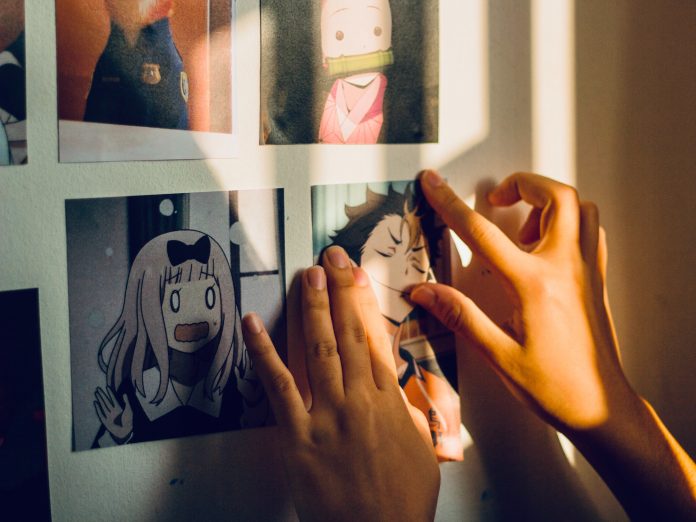
The act of “cringing” at someone for their actions, appearance, or behaviour is just bullying for miserable adults.
Cringe culture is a harmful, low-brow form of “humour” exacerbated by the internet and its users hiding behind screens. It involves harassing someone because their happiness or experiences seemingly affect you — when they really don’t.
When people vocalize how enjoying certain content makes someone “cringe,” those unnecessary comments can harm the person who is just trying to live how they want to. This culture of embarrassing someone in the name of “humour” needs to die.
If you have an instinct to cringe when you see someone wearing an anime shirt or dancing in a social media video, you should consider what drives this bitter reaction. When you see self-expression in any form, why do you think your first response is so negative and self-centred?
The answer often lies in internalized instincts of othering — we want to fit in, to be accepted by the greater majority, so we purposefully distance ourselves from “the other.” Herd mentalities, or prioritizing acceptance from the majority (usually at the expense of another) only perpetuates this othering. When we see a person with less popular interests, be it loving K-pop, boasting heavy piercings, or anything in between, often we act on internalized othering instincts and distance ourselves from people expressing themselves how they wish.
With cringe culture, many of us don’t realize just how destructive this othering can be. This culture disproportionately affects groups already shamed for other parts of their identities, causing further discomfort where there should never be any in the first place.
Instead of celebrating differences through self-expression, cringe culture promotes sameness. Blatant ableism, sexism, homophobia, and racism run rampant and appear to be excused through the internet’s sardonic and excluding nature.
Isabelle Ford for the Toronto Star speaks about finding fellow LGBTQIA2S+ community members on TikTok, an app often targeted by cringe culture. Despite its reputation for being a site of “bad dancing and lip syncs,” TikTok and similar platforms “provide resources, encouragement, and guidance,” connecting people through common interests. As the pandemic leaves us curled up alone in our beds on our phones, sites that provide comfort in lonely times should never be something to cringe at, but rather something to celebrate.
The Autisticats, a blog run by four people with autism, says cringe culture is “fundamentally ableist.” They highlight an ironic pattern of othering, where neurotypical people “have repeatedly ostracized, abused, and excluded autistic people,” thus driving autistic people out of dominating social groups. Neurodivergent people then discover “internet-based fandoms” where “everyone’s a weirdo and it’s okay,” finally finding places where they will not be ostracized. These social groups, however, get co-opted by neurotypical people, where they once again become the targets of harassment for not “being part of the [neurotypical] in-group.”
Cringe culture targets people just trying to find what makes life more enjoyable. I encourage you to think before vocalizing how someone else living their life makes you feel. If you see cringe culture running rampant online, try supporting the target and encouraging them to enjoy what they like. If you have the energy, call out those perpetuating cringe culture and point out how harmful it is for their target and even the perpetuator.
When we head back to in-person classes this fall, I hope those happily bearing their favourite anime shirt or showing off a BTS enamel pin on their bag don’t send you into cardiac arrest. Better yet, I hope the time spent in isolation relatively distanced from judgment inspires you. Use these last weeks before classes return to explore your interests on a deeper level. Really consider what brings you joy, and also what you can do to help foster another’s joy instead of hampering it.
We’re all guilty of partaking in cringe culture, myself included, but that doesn’t mean we need to carry this ingrained hatred with us from here on out.
After a year of getting out of bed, changing out of my pyjamas, and opting for a slightly nicer pair of sweats to walk three steps to my desk to attend my Zoom lectures, I’ve been able to live my dream of not having to think about putting together full outfits every day.
Upon SFU’s announcement to reopen campus, this dream quickly turned into a nightmare. I realized I would have to turn on the part of my brain that is receptive to actual style. With a few key concepts to keep in mind, I have faith that we will be returning to campus fashionably. . . late to our 8:30 a.m. classes.
Feel good, look good
When it comes to styling outfits, my golden rule is to always wear your clothes — don’t let your clothes wear you.
We should not have to squeeze into our pants or feel suffocated in our button-ups when clothes are made for us to wear. After exclusively wearing oversized clothes for the past year, the last feeling I want is one of discomfort.
Truly wearing your clothes means finding pieces that compliment your body in a way that makes you feel comfortable and confident.
Sizing variation among stores can make this idea hard to grasp, as their systems provoke expectations and insecurity among shoppers. It’s confusing to be a size medium in one store but an extra small in the next. However, size numbering is merely a guideline, not something that needs to be strictly followed throughout all stores.
It’s common for sizes to vary among different brands — extremely annoying, but common. That just means you’ll need to brave the storm of blouses and trousers to find out which option feels the best on your body.
Once you find a piece that hugs and loosens in all the right spots, the fitting room battle between yourself, the fitted tees, and the relaxed tees will have been well worth it.
The “don’t let your clothes wear you” rule applies to fitted and relaxed items, but sometimes we also need to emulate our oversized work-from-home sweatpants to take steps in that direction.
The sweat set trend
What a time to be alive — we live in a period where sweatpants are trendy?! This used to be a strange concept to me. Growing up, my mom used to tell me wearing sweats in public would make me look messy and unpresentable, so I never dared to step foot out the door in them.
However, matching sweat sets have become a trend among those working from home for the past year. They’ve even found their way onto high fashion runways. I’m sure the thought of this shakes my mother to her core, but this is the perfect scenario for us as we transition our pandemic outfits to function in the real world.
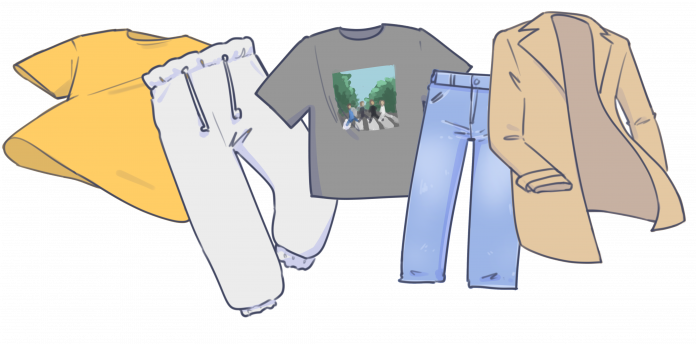
Pairing a matching oversized sweatshirt or a fitted T-shirt with your sweatpants can easily elevate a casual look. A fitted T-shirt will give you more of a silhouette under all the extra fabric, which balances the outfit’s proportions.
On the other end of the fit spectrum, you could opt for a matching oversized sweatshirt. Personally, when I’m trying to look a little more put together, I prefer crewnecks over hoodies. I think eliminating the drawstrings and kangaroo pocket cleans up the look a bit more.
Putting on a sweatshirt to complete the set doesn’t exactly scream that you are dressing to the nines, but monochromatic outfits can make you look like you put more thought into your look.
Both options add intention and effort to your appearance — this can make a look go a long way. It tells the world that you chose comfort, but you were still thoughtful in coordinating your clothes.
Comfortable classics
If you’d prefer to move away from sweats, you can remain casual by opting for basics such as jeans and a T-shirt. For the look I have in mind, the denim is specifically a loose straight fit. Found in thrift stores and across retailers such as H&M, straight-fit jeans can be the most comfortable yet flattering fit of jeans to exist.
A straight-leg jean could range anywhere from ankle length to a “’90s straight-fit,” in which the denim stacks at the top of your shoe. Any option within the range works for this look as long as you’re comfortable.
Mirroring the sweat set trend, the same sentiment goes for the top to pair with the jeans. Get the look by shopping for fun and unique T-shirts at your local thrift store.
The next best thing after thrifting is to join me in wearing band tees of musicians I have never listened to. I’m a simple girl. I see a T-shirt of four men walking across a street and I wear it — and no, I can’t name five songs by The Beatles. And I will live a happy life without that ability.
Outerwear essentials
If all else fails, we are returning to campus in the fall, which means layering season. A statement coat or jacket is the most simple back to school outfit fix and the best way to dress up your look.
I consider coats and jackets to be the most important part of a fall/winter outfit since it covers 70% of your body. Wearing a monochrome base underneath a longline coat or standard jacket is a simple but effective fall style that gives the illusion of effort.
Since we go to school on a mountain and in a city known for its constant rain, we need to be realistic about the jackets we’ll be wearing on campus.
Uniqlo’s Ultra Light Down collection is my go-to for a surprisingly affordable and warm water-repellent jacket. To add more depth to your outfit, this can also be a great layering piece under a coat for the one day out of the fall and winter months without rain.
A long line trench coat or cocoon coat transforms an otherwise stuffy, all-black, three-layer outfit into a relaxed yet elegant silhouette.
With a double or single-breasted closure at the front, and typically finishing at the knee, these coats make a polished addition to any outfit. For more dimension, you can step away from the monochrome to wear a contrasting sweater underneath.
Styling yourself in this can launch you into a day full of romanticizing your life as the main character. Sip on a latte while sitting pensively on Burnaby Mountain, completely disregarding your seven assignments due at midnight. Your head is empty, word count is at two (and that’s just your name), but you look good in your coat. Who could ask for more?

Content warning: mentions of homophobia
Vancouver’s earliest pride protest was on August 1, 1973, when the Gay Alliance Toward Equality (GATE) held a picnic and art exhibit. Vancouver’s first pride parade took place in 1978.
Vancouver refused to grant GATE a permit to host a pride event for years until Mike Harcourt, the 30th premiere of BC, was elected into office. He was elected after promises to the LGBTQIA2S+ community — including making a proclamation for the LGBTQIA2S+ community and granting their parade permit.
After his election, a new municipal government was formed in Vancouver and GATE received a permit to hold their first official pride parade. He declared the week of August 1–7 Gay Unity Week. Vancouver then held Canada’s first lesbian pride march on May 16, 1981.
“Pride did begin from protest,” said SFU professor of gender, sexuality, and women’s studies, Jen Marchbank, in an interview with The Peak. She recalled her time living in the UK, when she went to London to “march in the pride parade, and it was very much a demand for equal rights.” In the following few years, “all of a sudden, there was a party atmosphere,” she explained.
“In my lifetime [ . . . ] it has evolved from a parade into a spectacle and into a celebration.” During this time, Marchbank said she has seen laws change as rights for the LGBTQIA2S+ community progress in Canada.
The legalization of same-sex marriage was first introduced in Canada in 2003 when Ontario and BC became the first provinces to legalize it. These were the only places in the world where same-sex couples who were not residents could still marry.
On June 28, 2005, Bill C-38 gave same-sex couples the legal right to marry throughout Canada. The Bill became law in July 2005 when it received royal assent.
Canada was the fourth country to make these advancements, following the Netherlands in 2000, Belgium in 2003, and Spain earlier in 2005.
The Canadian Encyclopedia estimates that public support for same-sex marriage went from 41% in 1997 to 74% in 2017.
“There still is a need for pride — not just to celebrate their existence, but to build community, to convey to those who are not part of the LGBTQ community that we’re here, we’re not just to be tolerated, we are a part of everyone’s lives.”
In 1985, the Equality for All report was released by the Canadian Parliamentary Committee on Equality Rights. Their report found high levels of discrimination against those in the LGBTQIA2S+ community. The recommendation was for Canada to make discrimination based on sexual orientation illegal. This recommendation wasn’t accepted for another 10 years.
Marchbank cautioned some pieces of history are misrepresented. Bill C-150 was the federal bill that decriminalized some sexual acts such as sodomy — oral or anal sex between gay men. Prime Minister Pierre Trudeau “very famously said ‘the state has no place in the nation’s bedrooms,’” Marchbank explained. She explained this Bill is often cited as one that decriminalized homosexuality, but “it did not [ . . . ] All Bill C-150 did was decriminalize certain acts between consenting adults over 21 — given that the age of consent for heterosexual relations was about 14.”
She also highlighted the importance of understanding intergenerational effects of Canada’s institutional discrimination — such as the Cold War purge of LGBTQIA2S+ individuals. The purge consisted of government institutions spying on their workers to fire those who identified as part of the LGBTQIA2S+ community during a time when communism and homosexuality were seen as “character weakness.”
There is lasting discrimination, stigma, and “intergenerational effects of the purge. Maybe someone in their 40s wasn’t purged themselves, but maybe their uncle was,” said Marchbank. “You might not be able to discriminate against people [directly] in Canada, but we have people living who have memories of discrimination.”
She said she personally felt these effects at the age 23, when she chose not to pursue a career in diplomatic services because a “statement that was made said ‘homosexuality either declared or otherwise is barrier to employment.’
“It’s our responsibility in our current pride — not just festivals, but in our community — to remember whose shoulders we are standing on,” said Marchbank.
Elective grading system extension to Spring 2022
Senator Elizabeth Elle brought forth a motion to extend the pilot elective grading system pass/credit/no credit to the Spring 2022 term. It had previously been approved for the Spring 2021, Summer 2021, and Fall 2021 semesters.
The briefing report stated this “will allow the Registrar’s Office to have sufficient data to inform a full analysis of the program.” They will use this data to determine if the elective grading system will become a permanent system at SFU.
Past registrar Kathryn Verkerk noted the data analysis will look for “how many students opted into the program,” which programs used the grading system most, and how this affected students’ academic performance, among other things.
When asked about whether the system could be expanded to core courses, Verkerk said it will be “available for departments to opt in for required courses.” This means the program plans to stay consistent with its pilot.
Elle noted they are looking to “hear the student voices” in their consideration of whether this remains beneficial. Senator Daniel Leznoff said the “cost of doing this is exceptionally low. I think the benefits are very high.”
This motion passed unanimously.
Delayed start of Spring 2022 and Summer 2022 semesters
Senator Stephen Spector, the chair of the Calendar Committee, proposed a motion to delay the beginning of the Spring 2022 and subsequent Summer 2022 classes. The motion suggests beginning the Spring 2022 semester on Monday January 10, 2022 instead of the original Wednesday January 5, 2022.
Spector explained this is needed to allow instructors and students more time to prepare after New Year’s Day because both Christmas and New Year’s Day fall on Saturdays. This includes grade processing.
Spector noted this would reduce instructional days from 63 to 61 and extend the exam period to April 26, 2022.
The motion also moved the Summer 2022 semester courses from May 9, 2022 to May 10. This reduces instructional days from 63 to 62.
The motion passed unanimously.
Senator Matt Martell questioned if the Senate should consider moving towards a 12-week schedule instead of 13 weeks. As an instructor, he finds he is left with 12 instructional days and is then forced to rearrange his teaching schedule to accommodate the shrinking semesters. He said switching to 12 week semesters would allow SFU to adjust the course hours accordingly.
“It may be time to revisit how we are delivering our 39 hours, as students don’t get their full money’s worth in terms of course hours,” said Martell.
President Joy Johnson said the Senate would not be discussing that matter at this time. Spector noted the Calendar Committee is aware of this concern and in the coming weeks would discuss the 2023 schedule.
Joy Johnson updated Senate on reconciliation efforts
Content warning: mention of residential schools
“We as a university have been working towards reconciliation across our three campuses,” announced Johnson to the Senate.
In light of news of the mass graves being recovered under residential schools, Johnson acknowledged the responsibility the university has to support Indigenous communities.
Her update to the Senate mentioned the SFU flags have remained lowered, the university is working with host nations to enter into a “memorandum of understanding,” and they are exploring ways to “continue our path and deepen our relationships with our local First Nations.”
The Senate proposed a working group to establish a new Indigenous leadership position. The working group is being co-chaired by Squamish counselor, spokesperson, and SFU alumn Chris Lewis and vice president, academic and provost Catherine Dauvergne.
Johnson also reported they are currently examining ways in which the university can financially support Indigenous students.

Ghana is the world’s second-largest producer of cocoa. During a state visit to Switzerland, one of Ghana’s most important trading partners, Ghana informed Switzerland they would no longer export cocoa to them. Instead, Ghana plans on expanding its domestic chocolate-exporting industry to further industrialize the country.
“There can be no future prosperity for the Ghanain people in the short, medium, or long term if we continue to maintain economic structures that are dependent on the production and export of raw materials,” President Nana Akufo-Addo stated.
“We intend to process more and more of our cocoa in our country with the aim of producing more chocolate ourselves.”
In an interview with the BBC, Alan Kyeremeatan, Ghana’s Trade and Industry Minister said, “It only makes sense that the most important commodity in our country [ . . . ] should become the target for a major programme of industrialization.”
The global chocolate industry is worth nearly $140 billion US — yet many Ghanaian cocoa farmers make less than $1 a day. As stakeholders, cocoa farmers generally only have a share of less than 7% of the global supply chain for chocolate.
General Secretary of Ghana’s Agricultural Workers Union (GAWU) added, “The government of Ghana must transform [the] cultivation of cocoa, its harvesting, and processing to generate more revenue from cocoa production.”
Former Swiss president Simonetta Sommatuga said, “It is obvious that Ghana is increasingly striving to process raw materials in addition to extraction of them; that way, more added value remains in the country, which is a very understandable desire.”
Sommaruga noted that “relations between Switzerland and Ghana have for decades been characterized by mutual respect.”
Ghana is a part of Switzerland’s State Secretariat for Economic Affairs economic development cooperation plans which aim to assist middle income countries and countries with transitioning economies.
Switzerland’s two main objectives for Ghana are: “building strong and accountable institutions that deliver effective public services,” and “improving the competitiveness and diversification of the economy.” These objectives have the goal of making Ghana more noteworthy in the global chocolate industry.
In 2019, Ghana said they would process 50% of their cocoa crop locally in partnership with China, who established a $60 million processing facility. This was to “boost the country’s exports, improve value addition, and cocoa consumption locally.”
Ghana processes roughly 30% of its cocoa crop and plans to expand its growing domestic chocolate industry. However, this does not come without its structural challenges — which Akufo-Addo pledged to address.
In an interview with the BBC, Nana Aduna II, a Ghanaian cocoa farmer said, “The equipment to make chocolate is very expensive.” This includes refrigeration systems as chocolate melts easily due to Ghana’s tropical climate.
“Plus, we don’t have a local sugar industry and we don’t have a local dairy industry,” so these resources must be imported from elsewhere, driving up the cost of production.
In addition, high interest rates on bank loans are another obstacle for non-commercial chocolate producers, as it hinders business growth.
However, there are factors positioning Ghana to expand its chocolate-exporting industry.
Akufo-Adda plans for Ghana’s chocolate-exporting industry to be kickstarted through his One District One Factory programme that aims to provide the necessary infrastructure for agribusiness, including processing plants in some of the country’s more prominent cocoa-growing regions.
Ekow Dontoh, a commodities expert said, “It has become easier for the private sector to invest in food processing, [which] is a welcome move.” In addition, big tax rebates are available for processing companies that will set up in Ghana’s free zones, “designated areas to encourage economic activity.”
Currently, there are several domestic chocolate-exporting companies in Ghana, including artisanal companies such as ‘57 Chocolate and Golden Tree, as well as larger exporting companies such as Fairafric.
“We are determined in Ghana to ensure the succeeding generations of Ghanains do not become victims or pawns of the international economic order, but her beneficiaries,” Akufo-Addo said. He envisions “a Ghana which has discarded a mindset of dependency, aid, charity, and hand-downs — and is charting down a path of self-reliance.”

Simon Fraser University’s independent student newspaper since 1965.
For advertising inquiries: [email protected]
For promotional inquiries: [email protected]

Simon Fraser University’s independent student newspaper since 1965.
For advertising inquiries: [email protected]
For promotional inquiries: [email protected]