Home Blog Page 320

Reconnecting with Transit: A Return to Campus Student Webinar with TransLink

0
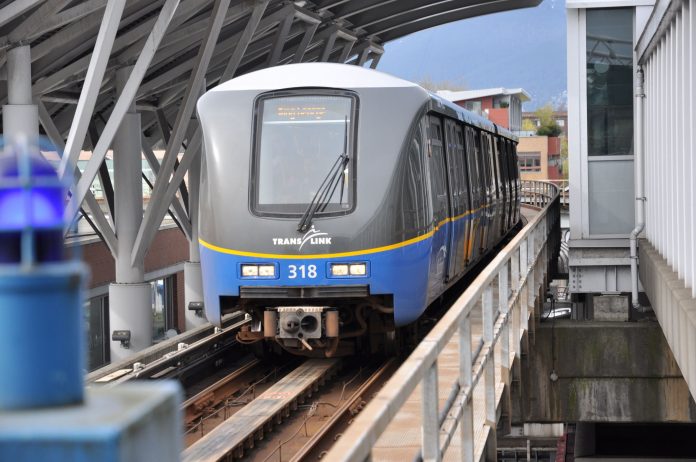
Expo line train on track
Diego Mazz/Unsplash

By: Charlene Aviles, Staff Writer

On August 27 and 30, SFU Ancillary Services and TransLink hosted Reconnecting with Transit: A Return to Campus Student Webinar with TransLink. At the webinar, Dave Lewin, TransLink’s senior advisor for public affairs, explained safety measures and the new technology they’re implementing to slow the spread of COVID-19.

At the start of the pandemic, there was a 83% reduction in commuters, but recently the daily number of TransLink users rose to 50% of the pre-pandemic amount. 

Lewin pointed out that decreased daily riders during the earlier stage of the pandemic reflected British Columbians’ transition to online school and work, cycling, and driving. With the vaccine rollout, restrictions are lifted, leading to an increase in ridership. If the vaccines continue to effectively reduce the spread of COVID-19, TransLink anticipates the total number of daily riders will reach 80% of the amount of pre-COVID-19 daily riders.

As part of TransLink’s Safe Operating Action Plan, they have implemented many safety measures for customers, including mandatory face masks, frequent cleaning, and social distancing. Bus drivers will also have a physical barrier between them and commuters. On the Transit app, TransLink launched a pilot program where commuters can preview the amount of empty seats on arriving buses. This aims to help commuters physically distance and choose if they want to wait for the next bus.

TransLink is helping in COVID-19 vaccine rollout by providing shuttle services to vaccine clinics, and specially-equipped buses as vaccination sites in partnership with Fraser Health. The Group Vaccine Shuttle Program will increase accessibility to vaccine clinics, mainly for vulnerable groups. At different vaccine pop-up locations, Fraser Health will accept drop-in appointments at their VAX buses.

Through their pilot program, TransLink will test copper coating, which is designed to reduce virus and bacteria’s lifespan on surfaces. According to Lewin, TransLink is “the first in North America to pilot copper coating on transit.”

Dr. Marthe Kenny Charles, a medical microbiologist featured in the webinar, explained the rationale behind the copper coating pilot.

“The viruses and bacteria don’t survive well on copper. As a matter of fact, copper kills it. We want to be able to harness that potential,” Dr. Charles said.

They also improved the new buses’ roofs and driver seats’ ventilation systems, so they “can provide upwards of 10 fresh air changes per hour.”

Lewin explained TransLink will be “tracking and monitoring how the travel patterns changed during COVID-19, and we’ll be using those findings to really allocate that service to the busiest routes to hopefully reduce that crowding.”

In September, some major bus routes and SeaBus will have more frequent service to help students commute to campus.

The West Coast Express, which had trips cancelled during the pandemic, will resume full service between its Mission and Waterfront destinations beginning September 7. 

TransLink also implemented new safety measures for bikers. Throughout Metro Vancouver, they set up bike racks and bike lockers. TransLink will also be releasing maps outlining possible, safe bike routes.

For more updated information on TransLink’s services, visit their social media or website, www.translink.ca. To plan your commute to campus, visit TransLink’s trip planner. Download the SeeSay mobile application to stay updated with transit announcements, crime reports, and more. Subscribe to text or email notifications for service disruptions via TransLink’s website.

Monday Music: Hype yourself up to be perceived again

0
"Monday Music" in giant yellow block letters with a red background
Monday Music: your weekly themed playlist. Image courtesy of The Peak.

By: Alex Masse, Peak Associate

Well, it’s happening. It’s really happening: we’re back to in-person classes. I don’t know about the rest of you, but I’m terrified by the idea of people seeing anything besides my strategically-lit, chest-up Zoom portrait. To acclimate to the inevitable act of being perceived, here are some songs, from me to you. 

1. “XS” by Rina Sawayama

Image courtesy of Dirty Hit

If you’re arriving on campus in clothes from your quarantine-induced splurges, this song is for you. Feel hot as hell in those online purchases, and flex your lack of impulse control. With its irresistible beat, electric riff in the chorus, and iconic vocals, it’s basically impossible to hear this song and not feel untouchable — even if it’s technically a mockery of capitalism and excess. As Sawayama herself sings, “the heart wants what it wants.” Own the new look!

2. “We Are Not Alone” by Karla DeVito

Image courtesy of A&M Records

Besides the fact this is a 1980s jam forever linked to a classic 1980s film (The Breakfast Club), “We Are Not Alone” is objectively a good choice for this weirdly specific scenario of leaving isolation for the campus life. It’s got everything you need: vintage synths, an energetic guitar riff, and powerful vocals that growl a little in the best way possible. We very much aren’t alone anymore, and isn’t that wonderful? Terrifying, sure, but wonderful.

3. “Normal At Last” by Dane Terry

Image courtesy of Dane Terry

Okay, things aren’t normal yet, but we can pretend, can’t we? This is probably my favourite song for optimistic dream sequences. With a delightful, head bop-worthy instrumental; Terry’s smooth, full voice; and the picture of a happy future painted by the lyrics, “Normal At Last” is a track that always makes me smile. Imagine going to bars and taking silly pictures in photo booths! Yes, we’re not quite there yet — and neither is Terry, if he’s talking about getting “one of those new flying cars” — but at least we’re taking steps forward.

4. “Friday I’m in Love” by The Cure

Image courtesy of Fiction Songs Ltd

For many, going back to school means going back to a solid weekly routine. One benefit of this is that the weekend becomes extra enticing (unless you have homework). In short, days of the week become meaningful again! They aren’t just an abstract blur! And what better way to celebrate than with this oldie-but-goodie? It’s a lush, joyful song that you’ll catch yourself humming as you head to class, day after day, until it’s Friday and — ideally — you’re in love.

5. “Sad but Not Depressed” by It Makes A Sound

Image courtesy of Rosemary Hill Records

Did one of your favourite shops, bars, or other local venues permanently close due to the pandemic? Was your favourite small business mercilessly devoured by a chain? Are you righteously pissed off by the world you’re returning to? Then this is the song for you. Be upset in the beautiful way that makes you want to get up and do stuff. This track was featured in the 2019 podcast It Makes A Sound, and it has stuck with me ever since. “Sad but Not Depressed” is simple and catchy, yet somehow so profound. Also, the podcast is great. Sincerely, though, don’t let pandemic losses get you down. Strut back into life owning that you’re bummed out!

SFU professor marks one year of civil disobedience against TMX pipeline expansion

0
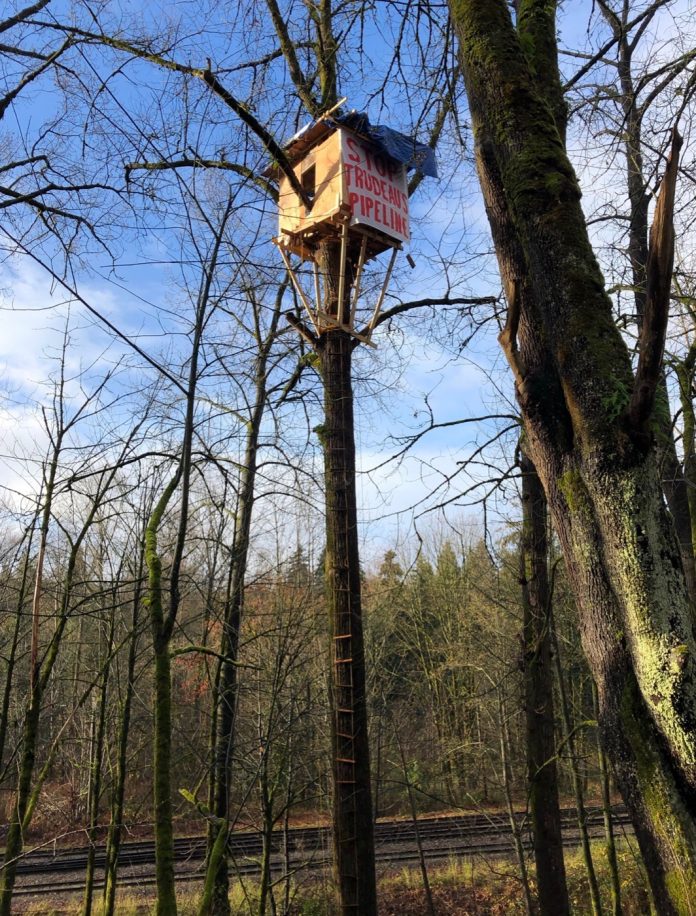
A treehouse high up with poster on right hand side. Red words on poster: "Stop Trudeau's Pipeline"

By: Yelin Gemma Lee, News Writer

On August 3, 2020, SFU health sciences professor Tim Takaro and the Protect the Planet Stop TMX (PPST) coalition occupied the forest canopy of Lost Creek, in the Brunette River Conservation Area. They plan to delay the pipeline expansion project. Over a year later, Takaro is among the protestors building multiple treehouse camps for protestors to occupy. 

“We will be up there as long as needed. We’ve built several other houses [ . . . ] and tied together a hundred trees. We’re not going anywhere. We have thousands of people that will come out if they try to take us out,” Takaro said in an interview with The Peak.

For the past year, Takaro has been living in these treetop structures alongside other members of PPST aiming to delay the Trans Mountain Expansion Project (TMX). They hope to eventually see the cancellation of the project. It was originally set to be completed in 2019, with the most updated “in-service” date set for mid-2022.

The project has faced public opposition, environmental activism, and “unresolved Indigenous consent.” In August 2018, the Federal Court of Appeal ruling cancelled the 2016 federal approval of the pipeline, requiring the federal government to revise and resubmit parts of the proposal. 

On their website, Trans Mountain stated they “will have ongoing conversations to further understand and address the concerns of Aboriginal communities, and ensure their members are able to share in the success of the Project.” So far, Trans Mountain has signed a total of 59 Agreements with Indigenous communities across Alberta and BC

Prime Minister Trudeau defended the government’s decision to invest in the pipeline expansion in 2019, “We need to create wealth today so we can invest in the future. We need resources to invest in Canadians so they can take advantage of the opportunities generated by a rapidly changing economy, here at home and around the world.”

“The Prime Minister said it’s in the national interest, and it absolutely is not,” said Takaro, “[It’s] not in planetary interest, and it’s not even in the interest of Canadians since there are no jobs on a dead planet.” 

PPST is working with the support of Chief Rhonda Larrabee of the Qayqayt Nation and Chief Leah George-Wilson of the Tsleil-Waututh Nation to protect the Brunette River conservation area. 

Takaro initiated a parliamentary petition on July 7, which was set to be presented to the House of Commons. Takaro and PPST gained over 5,500 signatures within a month. The presentation of the petition was cancelled when Prime Minister Trudeau called the election. 

“He pulled the petition to avoid any embarrassment,” Takaro said. He and PPST will resubmit the petition when there is a new government sitting.

“Civil disobedience is required,” said Takaro, “We’re in a climate crisis. Our leaders are sleepwalking through the crisis and pretending like they’re doing something when they’re not doing anything. So that’s a time when you have to take to the streets — civil disobedience works [ . . . ] It’s sometimes required, and we’re in that time.”

Teaching Support Staff Union and faculty respond to SFU health guidelines

0
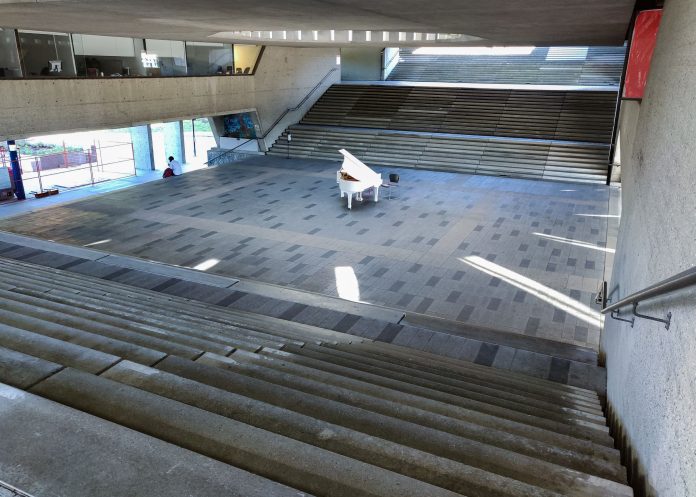
Staircases leading up to Convocation Mall from the lower bus loop

By: Nancy La, News Editor

On August 24, the BC Provincial Health Office (PHO) issued an updated COVID-19 guideline for post-secondary institutions. The revised guidelines include a mask mandate for return to class, but students will not be required to be vaccinated to attend in-person classes. 

The Peak spoke to Katie Gravestock, chief steward of the Teaching Support Staff Union (TSSU) and Dr. Scott Lear, a professor in the faculty of health sciences, about their thoughts on the new guidelines. 

In early August, the TSSU endorsed an open letter to the Ministry of Advanced Education and Skills Training, calling for stronger back-to-school guidelines for post-secondary institutions. The letter had over 800 signatures of support. It did not receive a response from the Ministry or school administration.

“However, after months of denial, the government did a complete 180 and instituted both mandatory masks for all indoor settings and proof of vaccination on campuses,” said Gravestock in an email interview. 

While Dr. Bonnie Henry won’t admit it, I think this was because our demands gained a lot of support from other unions, student groups, faculty, community members, and media who recognize the importance of the precautionary principle.” 

However, both Gravestock and Dr. Lear expressed concerns despite the updated guidelines. 

“The updated guidelines do not go far enough,” wrote Gravestock. She emphasized the importance of ventilation on campus to prevent spread of COVID-19. 

“I want to reiterate my serious concerns around ventilation. SFU has been working on a ventilation audit over the summer but this process has been slow and inadequate,” wrote Gravestock. 

The American Society of Heating, Refrigerating and Air-Conditioning Engineers (ASHRAE) recommendations are the standards being implemented in schools in BC. SFU keeps a list of rooms that meet ASHRAE standards on its website. As of September 9, there are still rooms in the process of assessment for ASHRAE standards on campus. An email update from vice-president, academic and provost Catherine Dauvergne clarified that “classrooms that were unable to meet ASHRAE standards have been pulled from scheduling.”

In a phone interview with The Peak, Dr. Lear discussed his concerns for the back-to-campus plan and potential steps SFU could take to mitigate those concerns. 

“I worry that with the self-declaration there will be people who are unvaccinated who won’t declare that and so then they won’t get rapid testing done and if that’s the case, and if it’s a sizable number, it will actually create a false sense of security on campus,” Dr. Lear said. The self-declaration of vaccination for staff, faculty, and students was announced by president Joy Johnson on August 26. 

“I would like to see [ . . . ] our leadership being more vocal in protecting the SFU community, from the students to the staff to the instructors and faculty. [I] haven’t seen our president, or other senior leadership actually advocating for that in the public,” said Dr. Lear. “SFU should be fighting for more autonomy in setting their own rules.”

According to Dr. Lear, postsecondary institutions are not allowed to set guidelines beyond that of the provincial health office. 

“The province has basically handcuffed the post-secondary institutions from mandating their own public health measures,” Dr. Lear said. 

When asked about why vaccines are mandatory for faculty and staff and not for students for in-person classes, Dr. Lear suggested it could be due to how SFU has authority over the staff they hire, and drew a metaphor of SFU being a bank and faculty being its employees. 

“The students may be more similar to customers of the bank,” Dr. Lear explained, pointing to the lack of authority SFU has over the student body.

Dr. Lear also raised concerns over Dr. Bonnie Henry’s comment over not wanting the vaccines to be a barrier to access education

“I have a problem with that type of comment because it comes across that this is an equity issue [ . . . ] I would see the equity argument if the vaccine has been distributed inequitably [ . . . ] There have been pop-up clinics already started at SFU so it’s not that it’s hard to get the vaccine. So that, to me, isn’t a strong argument why students shouldn’t be vaccinated,” Dr. Lear said. 

He also pointed out various barriers that he thinks prevent students from accessing school in the fall.

“There’s cost, there’s actual physical accessibility [ . . . ] because the main model is in-person, so that excludes a lot of people [ . . . ] those are what I would say are more problematic equitable barriers than having a vaccination.”

When asked about how SFU can improve its return plan, Dr. Lear suggested flexibility in online options for classes is something to consider.

“In the next few weeks, we’re going to see [ . . . ] massive amounts of people getting together. We can probably expect cases to rise even further as a result of that. So it would be great if universities could have that flexibility, if SFU wasn’t mandating that course instructions have to be on-campus and [ . . . ] offering online options where appropriate,” Dr. Lear said. 

Students who wish to consult SFU’s return to campus plan can do so at SFU’s website, along with the provincial restrictions website.

Stadium project completes construction after multiple delays

0
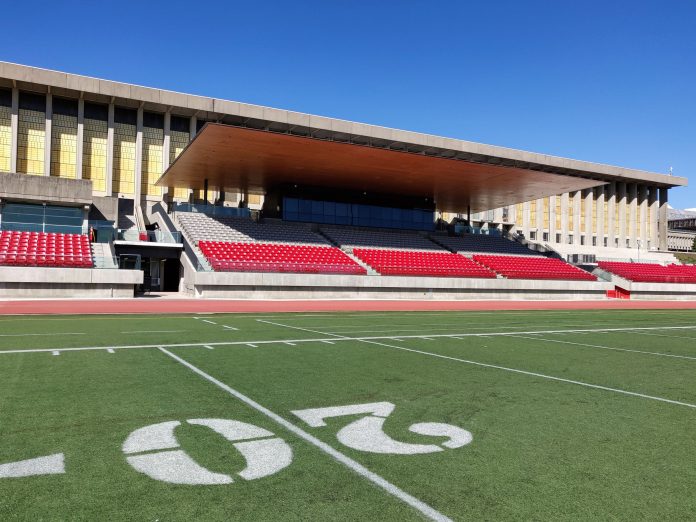
SFU Stadium from Terry Fox Field

By: Karissa Ketter, News Writer

The Stadium project at SFU Burnaby is finally open after finishing construction in Summer 2020. The stadium had a soft launch during August at the men’s soccer game against UBC where 1,000 fans attended, according to senior director athletics and recreation Theresa Hanson. In a statement to The Peak, she noted, “We are planning to welcome fans to our games this fall and deliver a comfortable, community experience in the new stadium.

“The venue will enable student groups to present events, stage concerts, and host major activities. We hope and believe the stadium will become the heartbeat of the Burnaby campus and encourage students to spend more time here.” 

The stadium has a canopy roof over 1,800 seats that “will feature spectacular sight-lines” according to SFU’s website

The project was approved in December of 2018, but was delayed due to challenges caused by COVID-19. It was originally projected to be completed in August of 2020.

Hanson noted the project was originally inspired by students and SFSS members years ago. “They envisioned a facility that would re-shape campus life,” said Hanson. Students’ hopes for this project dates back to the student referendum in 2012 that called for the stadium as well as the new Student Union Building that opened August 2021. 

In 2017, the SFSS offered $10 million in student levy from 2017–2030 to complete the project. The project was given the “green light” in December of 2018. The overall cost is projected to be $18–20 million

The project includes updates to the Lorne Davies Complex (LDC). According to Hanson, it began with “delivering amenities to the ground floor of the stadium, including a new football locker room, sports medicine taping room, and storage for outdoor varsity teams.” 

The next phase in the LDC updates is set to begin in Spring 2022. This phase of the project will include renovated change rooms with increased accessibility in the washrooms and amenities, and improvements to the varsity team rooms. “Some of the less glamorous but important improvements are seismic strengthening and improvements to the heating, ventilation and air conditioning systems,” said Hanson. 

“We have planned promotional nights that will attract and excite our students that we will be able to share once new provincial health guidelines are established next week.”

SFU announces self-disclosure of vaccine status for return to campuses

0
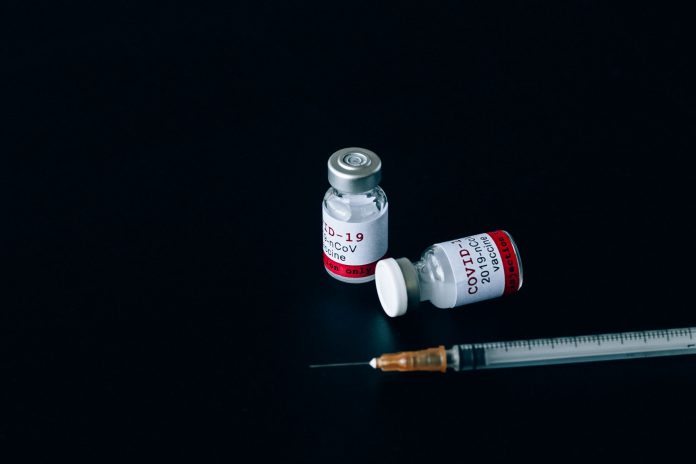
Two COVID-19 vaccine containers and one injection needle

By: Karissa Ketter, News Writer

SFU president Joy Johnson announced updated COVID-19 safety measures in preparation for the return to campus. In an email sent to faculty, staff, and students Johnson announced, “We are working to implement mandatory self-disclosure of vaccination status for all those who access our campuses including students, faculty, staff, and visitors.” 

Students who self-disclose must confirm two doses of an approved COVID-19 vaccine by September 13, 2021. While SFU stated they are working towards mandatory disclosure, those who do not disclose their vaccination status or are unvaccinated will be required to have “regular rapid testing.” The process will remain confidential.

Johnson’s email noted SFU is working to finalize the process. In a statement to The Peak, assistant director of external communications Braden McMillan said, “The community can expect regular updates as details are finalized.”

An update provided on September 2, 2021 noted SFU will soon be launching a “third-party website to gather vaccination status data of our campus community [ . . . ] All members of the SFU community, including faculty, staff, students and those who plan to visit one of our campuses are required to register and make a self-declaration.” It is unclear how this will be reinforced. 

As of September 2, 2021, 67% of faculty and 53% of students participated in an anonymous survey to disclose their vaccination status to SFU. At that point: 

  • 96.4% of faculty and staff and 90.1% of students are fully vaccinated 
  • 98% of faculty and staff and 95.2% of students have received at least one dose of the vaccine
  • 1.1% of faculty and staff and 1.8% of students indicated they are unlikely to get vaccinated
  • 1.7% of faculty and staff, and 1.2% of students chose not to disclose their vaccine status

SFU’s website reported they will be hosting at least 11 pop-up vaccination clinics across the Burnaby and Surrey campuses. Any individual age 12 and up can use these facilities. The clinics will be used on a drop-in basis. They are being hosted in partnership with Fraser Health. 

Along with implementing their university-wide communicable disease plan, SFU will require individuals to wear non-medical face masks in indoor spaces. SFU noted a small number of individuals will be exempt from wearing masks due to medical reasons. The process to receive exemption is unclear. The plan also includes cleaning surfaces, maximizing air flow, and auditing spaces for air quality. 

Students will need to prove vaccination in order to live in student housing, participate in intramural athletics, use the recreational facilities, and attend clubs or events.

The Peak reached out to SFU Administration for more information on the process for self-disclosure, but they noted the details had not been finalized at the time of publication.

“I am pleased with the clear decisions of the past week regarding masks and the BC Vaccine Card. We are already seeing the impact on vaccination registration due to the BC Vaccine Card. This is a meaningful approach, and will have a significant impact on vaccination rates,” said Johnson’s email.

Students with more questions regarding SFU’s COVID-19 safety plan have been directed to email [email protected]

Need to Know, Need to Go: Sept. 13–19

0
Illustration of a blue calendar, with "Need to Know, Need to Go" written on top
Arts & Culture events to catch around the city. Image courtesy of Brianna Quan

By: Zarena Zaidi, SFU Student

Vancouver Fringe Festival | Now until Sept. 19| $15 | Granville Island

Nothing can beat live theatre. Luckily, the Vancouver Fringe Theatre Society (VFTS) is back inperson with their annual festival. This year’s theme is “renewal.” With mainstage shows drawn out of a hat, the event creates a space where creativity and inclusivity exist hand in hand. The Fringe Festival will host 15 distinct and unique performances by theatre groups across Vancouver, embracing the VFTS’ ideology of “Theatre for Everyone.” The program guide and tickets are available through Vancouver Fringe Festival’s website.

An Abstract State of Mind | Now until Sept. 25 | FREE | Online

Abbotsford Arts Council, in collaboration with Kariton Art Gallery, is holding a digital exhibition showcasing the works of visionaries Carlos Arredondo, Grant Ferguson, Jesse Klassen, and Monica Nudelman. Centred around the expression of non-conformist art, this exhibition is a great chance to learn more about local Canadian artists and their work. The event can be accessed through the Abbotsford Arts Council’s website

Lunch Poems | Sept. 15, 12:00 p.m. | FREE with registration | Online

Held on the third Wednesday of every month, SFU’s Lunch Poems event is open to all SFU and FIC students. The featured poets this month are Kathryn Mockler — an experimental filmmaker, editor, and publisher — and Michael V. Smith, an award-winning queer writer who is currently teaching creative writing at UBC Okanagan. This event allows students to unwind through the enjoyment of poetry, while appreciating the diversity of Canadian writers. Registration for this event is required through Eventbrite.

RCMP Stand Down protests take place across BC

0
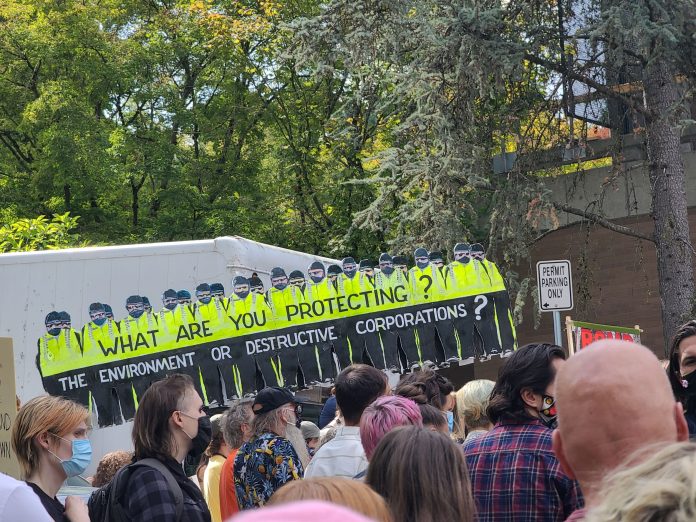
Background with board figures of police in uniform with words "what are you protecting?" on top and "the environment or destructive corporations?" at bottom. Foreground is people facing the right side.

By: Yelin Gemma Lee, News Writer

On August 23, protestors rallied in front of RCMP offices for the “RCMP Stand Down” protests in BC. The 23 synchronous protests called for an end to the “illegal and violent actions of the RCMP” at the Fairy Creek blockade. Fairy Creek has been the stand-off ground between protestors against old-growth logging and police forces. The Peak was present and observed the protest at the Burnaby RCMP office.

In August 2020, protestors were invited by Pacheedaht Elder Bill Jones to set up a blockade at Fairy Creek watershed in Southern Vancouver Island. The watershed is a part of BC’s last 2.7% of BC’s ancient old-growth forests. 

These old-growth trees, up to 2,000 years old, are one of the last standings in the coastal temperate rainforest, with rich irreplaceable ecosystems home to endangered species such as the marbled murrelets. After the Supreme Court injunction was passed in April, the number of total arrests has risen to over 800 arrests at the Fairy Creek blockade. 

On August 9, Supreme Court Justice Douglas Thompson stated “The RCMP has not established that the police actions under examination are reasonably necessary for [ . . . ] the duties they assert.” Justice Thompson’s ruling redefined the limits of police enforcement in the injunction area, allowing regular citizens to witness and access the area “as long as they don’t violate the injunction by blocking the road or interfering in forestry.”

Protestors gathered in the parking lot of the RCMP office for the protest. Some protestors who were at Fairy Creek testified to the crowd the excessive police violence they have witnessed and experienced. 

Kaylayla Raine, an Indigenous activist, led the event with a group of Indigenous youths and young adults. Raine addressed the crowd.

“What’s happening at Fairy Creek [ . . . ] the violence towards Indigenous femmes, Indigeous and Two-Spirit people, Black people, disabled people, trans people. That’s profiling,” said Raine, “We have to protect those people — the most profiled, the most targeted, the most powerful in this fight.”

The Peak spoke to Que Banh, organizer of the RCMP Stand Down protests. 

“Since late May, the level of brutality on the front lines when the police are trying to enforce their injunction [ . . . ] has increased, especially in the past few weeks,” said Banh. “The abuse of power is completely out of control at this time and the government is not doing anything.”

Banh noted there is a lack of media presence at Fairy Creek. “Unfortunately, [mainstream] media is not on the ground, so they are not getting the factual stories. They have been for the most part copying and pasting the RCMP reports which are not factual and contain lies,” claimed Banh. “The media cannot document what is truly going on at [the] front lines when they’re kept several kilometres away from what’s really happening with the extractions.”

CBC journalists reported having to walk seven kilometres behind the police to report on the event. On July 20, the Supreme Court ruled that “restricting media access and movement” at Fairy Creek was unlawful. 

In a statement to The Peak, sergeant Chris Manseau, division media relations officer of the RCMP, stated that media have access in Fairy Creek.

“Despite some claims of access being restricted, Media Relations Officers and Division Liaison Team members on site continue to provide independent media and protester-appointed legal observers the opportunity to observe and report on arrests and provide support to arrested individuals as they are being made,” wrote Manseau.

Banh explained protestors are arrested and removed from the blockade without being charged

“If we were doing something severely wrong and such, why aren’t they arresting and processing and charging all of us?” Banh said. “I’m wondering if the RCMP have been following protocol when it comes to filing the appropriate paperwork, when it comes to use of force.”

“I’m not in a position to provide context to any officer’s actions based on a portion or snippets of videos and commentaries, but can assure you all our enforcement actions are well documented, including the use of body worn cameras, which we are prepared to disclose as part of evidence in criminal proceedings, or as part of a complaint process,” Manseau wrote. 

The Civilian Review and Complaints Commission, has received 163 public complaints about police misconduct at Fairy Creek as of Sept 1, 2021.

 “There’s a problem with having an oversight board but with no enforcement,” said Banh.

The SUB be the worst undersea vessel ever created

0
A partially submerged black submarine has two people standing on top. The submarine is near shore and the top has many countries' flags flown.
PHOTO: Ан Нет / Unsplash

By: Marco Ovies, Features Editor

Call me Ishmael. Some semester ago — ne’er mind how long precisely — I thought I would sail about a little ’n see the watery part o’ the world. Aft a few months at sea, I returned t’ land in search o’ me next adventure. But the sea continued t’ wave at me, beckonin’ me t’ its shore. I longed fer the days back on the water wit’ the salty air, crusty clothes covered in seagull poop, ’n scurvy. But lo, when I heard SFU was buildin’ a sub (’n nah jus’ any ol’ sub but the SUB), I climbed her heights on a quest fer undersea glory.

“Those sons o’ a beach,” I muttered under me breath lookin’ up at the massive disappointment in front o’ me owns eyes. T’was a big hunk o’ glass ’n concrete, nah the epic submersible vehicle I expected her t’ be. She was not seaworthy in the slightest — worst o’ all she be the furthest away from the sea she could possibly get. But a scallywag ain’t made fer defeat. A scallywag can be destroyed but nah defeated.

Me dreams o’ takin’ ARR 102: Deep Sea Pirates be absolutely crushed, like the mighty kraken that swallowed me pa’s ship so many years ago. So I did wha’ any sensible seaman would do ’n made me plan t’ get this mighty behemoth o’ a sub to the oceans below. ’Twas simple: I would blow up the base o’ the buildin’ ’n ride her down the mountain into the blue depths. I would stand on her helm ’n greet me watery home wit’ open arms ’n shoutin’ me pirates cry, “FUCK OFF YE LANDLUBBERS!” Thar I would live content fer the rest o’ me days. Aft all, the earth does nah wants new SUB buildings, but new submarines!

Wha’ I didn’ expect was how capable the SFU security crew were at thwartin’ me efforts. Guess nowadays no scallywag can carry a couple sticks of dynamite without bein’ stopped, no can ye? I pay me tuition, sir! If the misery of the poor be caused nah by the laws of nature, but by our institutions, great be our sin. Neigh, SFU’s power be too great. So t’ the sea I shall return. But head my warnin’ . . . that sub will be mine. No booty be too great fer the likes of me.

SFU Student Updates: September 13–19

0
"Student Updates" text in SFU red
You’ve already made it farther through the article than 97% of the student population. ILLUSTRATION: Siloam Yeung / The Peak

By: Sara Brinkac, Peak Associate and taken for granted

Key Updates

None of this means anything

According to recent email metrics, 99.5% of SFU students either automatically delete or don’t even open Student Updates emails. Of the remaining 0.5%, half of those students spend no more than 15 seconds on the screen before exiting. This data has led the writer of these updates to cry for hours on end due to the soul crushing realization they don’t mean anything to you. Why does SFU make them write empty emails? Why are they paid to write so much yet so little every day? Please, they want answers.

I gave my life to these updates and don’t know how to continue

Every day. Every single day. I wake up at 5:00 a.m. and begin my walk from campus to campus in search of updates. In a university where nothing seems to be going on, I work tirelessly to salvage any minuscule bit of information to present to you ingrates. Did you know it took me DAYS to crack the story on the co-op offices accepting co-op applications? And don’t even get me started on the weeks I apparently wasted attaching the international student hyperlinks to each update.

I begged Joy Johnson to release me from this hell but apparently I’m “integral to the well-being of SFU students,” so here we are . . . Another meaningless voice screaming into the empty void, completely robbed of the one comfort that made this job bearable.

Student Union Building (SUB) continues to be news

For the 37ᵗʰ straight year in a row, the SUB continues to be a talking point. Whether it be lack of construction, going under construction, or otherwise, the SUB has remained an ever-faithful monument to the pride of SFU student activists and Board faculty alike. After 10 years of incessant fighting, the SUB opened on August 23. Unfortunately, people seemed to have forgotten how to care about this opening after waiting for so long. The select few who remain invested appear only to be excited they have a place to nap.

So, here’s to the apparent completion of a building that will remain the point of contention for another 10 years to come. Yay.

Announcements

Campus morale remains unaffected despite mediocre efforts

A recent series of campus events you didn’t show up to or care about took place. These included some sort of yoga, something related to cooking, and dogs. I guess there’s no real problems to work on. That is all.

My wife and I are getting a divorce

Oh, that caught your attention, didn’t it? Not so quick to exit off the screen now, huh? Well, guess what. This announcement is entirely true. That’s right, my wife and I really are getting a divorce. I will not be discussing who filed but let’s just say it was not mutual.

Hollow Gesture Workshop: happening near you sometime soon

A workshop to appease students who have legitimate complaints is taking place at a convenient time and location near you. The workshop is being hosted in a beautiful nondescript hall with no expense spared to show attendees SFU really cares. There will be tiny, as well as fancy, foods served and appearances from a host of people with titles that sound important. This event intends to incite inaction in the most civilized of manners.

Employment and volunteer opportunities

The Peak Writer Position

Speaking of things that never get read, The Peak really, really needs more contributors . . . Successful candidates will possess an inflated sense of self importance, a “zany” personality, and main character syndrome.

Getting in contact with The Peak is simple, just pick up a copy of the paper from a campus newsstand and someone who works there is bound to start staring at you. Walk up to them, complain about how difficult it is to be a writer, and congratulations, you just got the job.

Head of SFU Parking

Do you enjoy bleeding people dry? Have a passion for 9ft x 18ft plots of concrete? If so, apply to be the Head of SFU Parking today!

Duties include: inventing new and effective ways to trap and punish debtors, consuming the minds of all unpaying commuters with anxiety, and creating confusing pricing and parking models.

Please note: if you have a passion for inefficiency, confusion, and transportation, direct your applications to the Head of SFU Transit systems instead.

Student Updates Writer position

Do you want a job where you’re consistently overlooked, underappreciated, and disregarded on a weekly basis? If so, look no further than the Student Updates Writer position!

Successful candidates will possess a doctorate in Communication, five years of experience working for a publication (not including student newspapers), the strength to cope with screaming into the void weekly, and a court subpoena from their wife.