Home Blog Page 318

Zoom is distorting your self-image

0
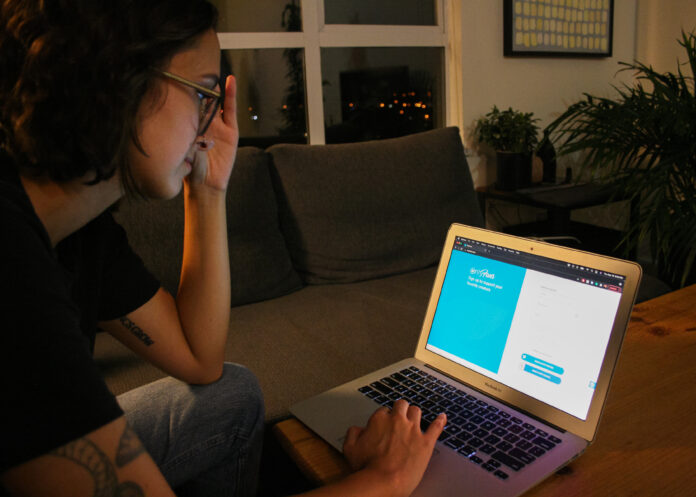
Distance from webcam and low light can affect how you look over Zoom. PHOTO: Chris Montgomery / Unsplash

by Victoria Lopatka, Staff Writer

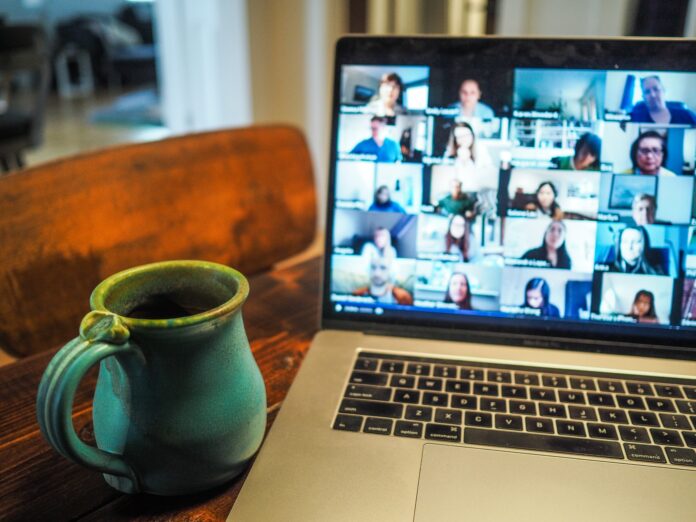
As COVID-19 numbers began to rise in March 2020, school, work, and social events suddenly went remote, converging on one app: Zoom. After nearly 18 months of Zoom, some users are beginning to notice an unexpected consequence of using the app. Staring at their own faces all the time is making them dislike themselves. 

This phenomenon has been coined “Zoom dysmorphia” by dermatologist and Harvard Medical School professor Dr. Shadi Kourosh. Since March 2020, Dr. Kourosh began to notice crowds of patients coming into her office complaining about their noses, wrinkles, and sagging skin, citing video-conferencing as the source for their negative self-image. 

To explore how video-conferencing apps like Zoom are making some people dislike their appearances, we have to go back in time to when people primarily saw themselves through a mirror. 

A 2011 study on body dysmorphic disorder (BDD) suggests “mirrors can act as a trigger for individuals with BDD [ . . . ] by an increase in self-focused attention and associated distress.” Researchers compared participants with BDD and participants without BDD, finding both groups experienced self-focused attention and distress when staring in a mirror for a long period of time. Fortunately for everyone, there is no mirror in front of us when we’re going about our daily lives. But, there are smartphones and laptops equipped to capture our image at any time and place. 

Before Zoom dysmorphia existed, we had Snapchat dysmorphia. Snapchat is an app that allows users to send temporary pictures and messages to each other, which, once viewed, disappear. Some users enjoy taking selfies on Snapchat because it offers a wide variety of face filters, many of which include skin-smoothing and eye-widening features. As Snapchat grew in popularity and use, plastic surgeons noticed patients increasingly asking to look more like their filtered Snapchat selfies — this led to the birth of the phrase “Snapchat dysmorphia.” 

After seeing themselves with a filter on, some patients felt their natural appearance was unacceptable and imperfect. Now, in 2021, we have Zoom dysmorphia. While there is some overlap between Zoom dysmorphia and Snapchat dysmorphia, the key difference is that Snapchat users are aware of the filters being applied over their faces, while “Zoom dysmorphia is unconscious.” Users see an idealized version of themselves on Snapchat, while on Zoom, users see an “exaggerated perception of a physical flaw.” 

“[People] are not looking at a true reflection of themselves. They don’t realize it is a distorted mirror,” Dr. Kourosh said, noting factors like angle and distance from the camera can have a distorting effect. 

According to a study published in the International Journal of Women’s Dermatology, “A portrait taken from 12 inches away increases perceived nose size by approximately 30% when compared with an image taken at five feet. With webcams often recording at shorter focal lengths, the result is an overall more rounded face, wider set eyes, broader nose, taller forehead, and disappearing ears obscured by cheeks.” 

Zoom’s chief technology officer also noted Zoom struggles in low light environments if your room is dark, it’s likely having an unflattering effect on your on-camera appearance. In addition, Zoom captures us in poses and expressions we generally don’t see ourselves in: bored or concentrated, and face-to-face with others. 

New research suggests “the up-close interaction of a tool like Zoom can trigger the same physiological reaction as a threat or attack,” like if someone were to stand nose-to-nose with you and invade your personal space. If Zoom calls make you anxious or uncomfortable, this is another potential reason why. 

The difficulty here is many users do not realize any of this is occurring, so we’re left thinking we naturally look the way our Zoom self-view says we do. This may have several negative effects on Zoom users, including self-consciousness, a lack of focus during calls, negative thoughts about one’s appearance, and even the development or worsening of body dysmorphia. For example, “an analysis of Google trends during the COVID-19 pandemic showed an increase in search terms such as ‘acne’ and ‘hair loss.’” Staring at your own face all day can make you especially self-conscious and stressed. This stress can then lead to acne and hair loss. 

So, why not just look away? Well, if you find it difficult to look away from your image on a Zoom call, you’re not alone. In an interview with MBG Lifestyle, psychotherapist Dr. Annette Nunez said humans are “constantly thinking” — and many of our thoughts tend to be negative. “Sometimes instead of focusing on the meeting, you’re actually doing self-talk, focusing on yourself and identifying all the negative things that are wrong with you.”

Living in a “society that’s hyper-focused on physical appearance” means many of these negative thoughts are about physical appearance. For women, specifically, “body dysmorphic disorder [ . . . ] is on the rise during the pandemic and worsened with the use of video-conferencing.” 

For those who already have body dysmorphic disorder, Zoom calls can be a source of anxiety, providing opportunities to compare themselves with others and worry about their physical presentation. And these problems follow us beyond the “end call” button. In an article by Wired, it was reported three out of 10 study subjects were “[planning] to invest in their appearance as a coping strategy to deal with returning to in-person events,” expressing concerns about weight, skin appearance, and others.

Zoom will likely be a part of our lives for a while, so it’s important to try to cope with Zoom dysmorphia. If you are struggling with Zoom dysmorphia, here are some tips to help you deal with it:

If you can’t see yourself at all, then you’re less likely to scrutinize or get distracted by your appearance. 

If you find your attention wandering away from the purpose of the call to your own image, try your best to re-focus on the purpose — this may include tactics like taking notes on what’s being discussed, doodling while you listen, and using fidget items. 

Seeing dozens of photoshopped, filtered images of attractive, happy people can fuel negative thoughts about your appearance especially when you begin comparing the Zoom version of yourself to them. 

  •  Fill your social media feed with realistic images

Many people are not represented by mainstream media — seek out accounts that display those who look more like you. For example, if you’re someone who has acne, try following Instagrammers with acne who do not edit images of their skin. 

Dr. Nunez recommends noting negative thoughts that pop into your head during Zoom calls and exploring the patterns you see. You can also challenge these thoughts: Is this something only I notice about myself because I look at my own face so often? Where did I learn that these characteristics are objectively bad? Is this really true? What qualities do I like about myself? 

It can be tempting to spend a lot of time looking into the mirror and pick at things we don’t like, but this will just make you feel worse about yourself. Go do something you enjoy instead. 

If Zoom dysmorphia is negatively impacting your life and making it more difficult for you to engage in lectures and/or meetings, then it may be a good idea to seek extra support: talk with friends, family, or a therapist. SFU students have access to support through SFU Health & Counselling services or through MySSP.

 

SFU’s vaccine declaration survey is ineffective at protecting students

0
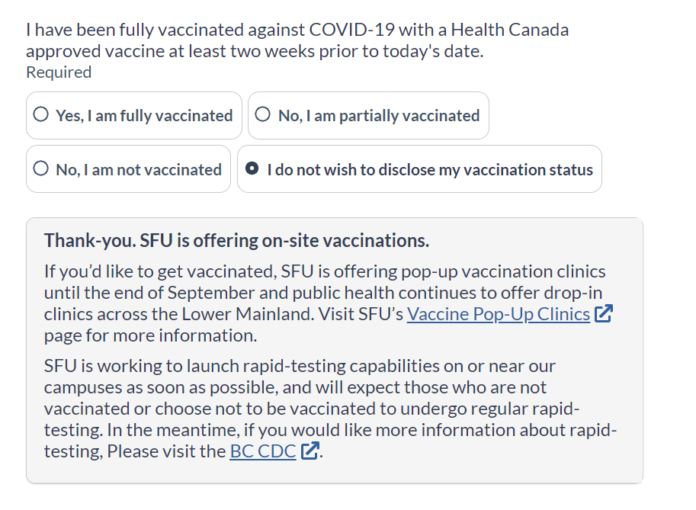
Having the option to not disclose your vaccination status defeats the purpose of a declaration survey. PHOTO: Lubaba Mahmud / The Peak

by Michelle Young, Copy Editor

On August 26, president Joy Johnson released an announcement stating SFU is “working to implement mandatory self-disclosure of vaccination status for all those who access our campuses.” In the next sentence, she wrote there would be regular rapid testing “for those who are not vaccinated or choose not to disclose their vaccination status.” But if students can choose to not disclose their status, how in the world is it mandatory? This is only the beginning of what is an unclear and poor method in assessing SFU’s vaccination rates. 

Students deserve to have an understanding of how COVID-19 may spread on campus, and they can’t do that unless SFU implements a better way to assess how many students, faculty, and staff are truly vaccinated. 

Upon taking the survey, I was shocked to see that SFU does not ask for proof of vaccination in it. While SFU stated they “may” ask for this in the future, the process should have been polished before the semester started.

As of now, there is nothing stopping anyone from lying about their vaccination status. Those who take the survey simply need to check a box that states their claim is true. This relies on all students and staff to truthfully declare whether they are vaccinated, which doesn’t give me much faith in the accuracy of the results. 

So far, it seems as though someone who didn’t want to be bothered with regular rapid tests could simply indicate they were fully vaccinated, and that would be the end of it. No follow-ups, SFU would just leave them to roam the university. This would create an immense false sense of security on campus. Even though the preliminary results from the survey demonstrated vaccination rates upwards of 90%, they could very well be much lower, because currently, there’s no way to tell whether the results are accurate.  

It is also unclear how SFU is mandating the “required” survey. Are they simply stating it’s mandatory without any enforcement? I haven’t seen any indication of consequences put in place for those who don’t complete it. For those who glaze through the mass amount of emails SFU students send to students, I wouldn’t be surprised if some had never heard of this at all. Coupled with the murky idea of what “mandatory” means, this method of assessment is currently filled with loopholes. 

Supposedly, those who don’t disclose their status or are unvaccinated will need to complete “regular” rapid testing. However, there is no information on how often this will be. Testing does not prevent infection, and COVID-19 is most contagious a few days before symptoms. Frankly, I cannot imagine staff or students wanting to go through the hassle of daily rapid tests. Even more confusing is how SFU will mandate these tests when the surveys are anonymous. 

SFU’s attempt to grasp our vaccination rates is messy and poorly executed. While SFU stated more information would be coming soon, we’re already a few weeks into the semester. Students are in classes, interacting with one another, and we don’t even have a clear sense of how many people are fully vaccinated. As of the first week, only about 50% of students had disclosed their vaccination status, and this is under the assumption they were all truthful.

SFU could add more steps into the survey — such as asking for proof of vaccination. They should also ensure the survey is completed by not solely relying on the community to do it themselves. I’m no expert in SFU’s IT systems, but I wonder if they could have required disclosure during course registration. However, weeks into the semester, vaccination rates are still unclear. After over a year of mandatory COVID-19 rules being outright ignored, I don’t understand how they ever thought this was a sound idea. 

Food for Thought: Mooncakes and the importance of reunion

0
Person in thinking pose with a thought bubble overhead featuring an image of a mooncake
A coveted Mid-Autumn Festival treat. Illustration: Alyssa Marie Umbal / The Peak

By: Nancy La, News Editor

While others anticipate fall as the time for pumpkin spice lattes, September brings me a whole different reason to be excited: the Mid-Autumn Festival. This year, it is on September 21. When I was growing up in Vietnam, the Mid-Autumn Festival was a big deal: kids running around on the streets with their own homemade lanterns (mine was Hello Kitty-shaped), pomelos being offered in shrines, and of course, a giant family dinner followed by the consumption of mooncakes. 

There are various explanations for the origins of the festival, and different southeastern countries have varying origin stories. Being Chinese Vietnamese, my experience with the festival has elements of both cultures. My father explained for Chinese people, the Mid-Autumn Festival is a celebration of the summer harvest, and to give thanks to the moon goddess, Chang’e, in hope she will bring more prosperity in the coming year. The festival also symbolizes familial reunion. According to my father, the saying 人月兩團圓 “people and the moon are both reunited to form a complete circle” — is iconic for the festival. 

In Vietnam, the Mid-Autumn Festival is seen as a children’s festival. There are street parades with lion dances, and various figurines made out of rice paste called tò he are sold as gifts — these, unlike mooncakes, are not edible, as I have found out the hard way.

For both Chinese and Vietnamese culture, the essence of the festival is the mooncakes. The classic version of the mooncake includes lotus seed paste, cured egg yolk, and lots of lard. Despite their heavy ingredients, mooncakes are not greasy or cloyingly sweet, since you are supposed to slice them into small portions and share with family and friends. Pu’erh tea is served alongside the cakes, because the strong and smoky flavours of aged tea leaves cut through the fat coating your tongue from the mooncake. Now you can have another slice without being overwhelmed. 

Besides the classic lotus seed paste filling, there are also mooncakes with nuts and ham, or the newer versions of mooncakes made out of glutinous rice which are meant to be eaten cold. These “snow skin” mooncakes can have fillings like red bean paste, cheese, or fruits. I’ve even had one filled with durian and salted egg yolk. 

No matter what kind of mooncake is eaten, the quintessential spirit of reunion and giving thanks are what make the Mid-Autumn Festival the highlight of September. With the past year and a half being as difficult as it was, sharing (or in my family, fighting over) slices of mooncake with loved ones is a treasured experience.

Vancouver International Flamenco Festival showcases the beauty and complexity of flamenco culture

0
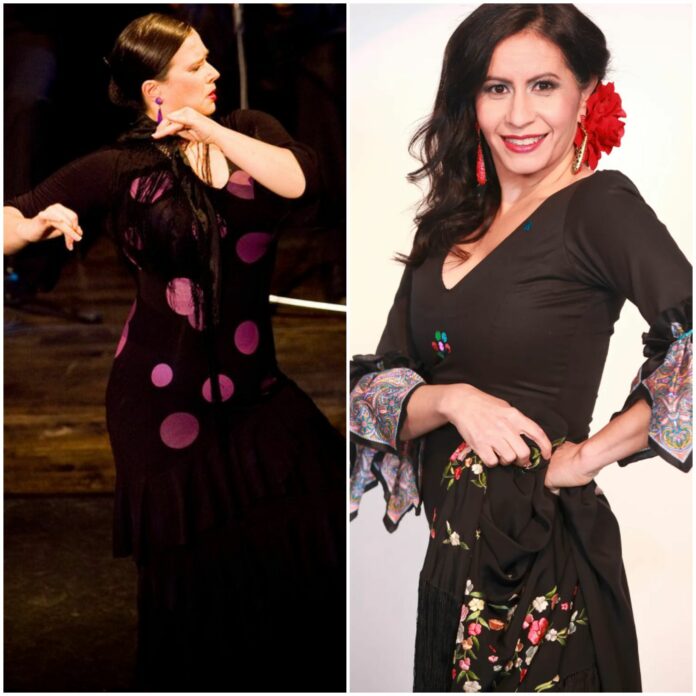
Bonnie Stewart (left) and Jafelin Helten (right) in flamenco dance poses
Flamenco is more than dance — it embodies singing, rhythm, and culture. Photos courtesy of Tara McGill and Jafelin Helten

By: Charlene Aviles, Staff Writer

Get ready to transport yourself to Spain, because the Vancouver International Flamenco Festival (VIFF) is back. In an interview with The Peak, two of this year’s performers, Jafelin Helten and Bonnie Stewart, described their love for flamenco and its unique history.

Growing up, Stewart tried different dance styles before discovering she was most passionate about flamenco. In her 32 years of experience with the genre, Stewart gathered knowledge about flamenco history. Through oral tradition, the art form spread throughout Spain. Between the 9th and 14th centuries in Spain, flamenco developed through cultural influences from the Moors, Roma, and Sephardic Jews.

Helten, who sings flamenco and Latin music, said a performer’s job goes beyond just singing or dancing.

“Learn about history a little bit, where [flamenco] is coming from, and acknowledge the culture. Respect the culture to the maximum, because you don’t want to see anybody destroying your roots,” she said.

To preserve flamenco’s rich cultural history, Helten draws inspiration from her travels in Spain, where she further immersed herself in flamenco culture. 

Similarly, Stewart reflected on Spain’s flamenco history, explaining how different styles are more common for specific celebrations or regions. In Andalusia, for example, Catholics sing religious flamenco songs or saetas during Holy Week. And in Seville, Andalusia’s capital, the sevillana — a style characterized by folk songs, simple rhythms, and pair dancing — includes flamenco influence.

At VIFF, representing the diversity in flamenco and “the form’s universal message of humanistic tolerance” is paramount. This year’s performances, taking place online and in-person, are no exception.

For Helten, the most important part of performing is to “connect and give everything you have to the people [ . . . ] through song.” She explained flamenco is more than dance, because it brings those in the audience together.

Looking back on her flamenco journey, Stewart emphasized the importance of teamwork. She explained balance among performers is important to the performance’s success.

“In the schools, they teach choreography, but choreography is not you. Choreography is the technique that you have to follow [but] technique will never overpass feelings,” Helten said.

She added choreography should be used as a guide but should not restrict dancers’ creative freedom.

Stewart recognizes there’s a learning curve in flamenco dancing, but recommends other dancers be patient, especially when practicing dance techniques.

“It’s like buildinga house on a sound foundation. The foundation is your technique, and that’s what will sustain you and hold you,” Stewart said.

For more information on VIFF’s programming, visit their website.

Monday Music: Songs for the descent into cuffing season

0
"Monday Music" in giant yellow block letters with a red background
Monday Music: your weekly themed playlist. Image courtesy of The Peak.

By: Sherine Jeevakumar, SFU Student

Lamenting the end of summer and with it, your summer fling? Curated to the cozy fall season, these tracks are sure to help you prepare for the upcoming cuffing season. Here’s to a journey from bittersweet goodbyes to serendipitous beginnings.

“Yesteryear Dreamscape” by Project Paradox

Image courtesy of Paradox

The opening of this song breathes nostalgia, while also signalling a wistful closing. Nearly angelic-sounding synths evoke a feeling of hopefulness for the beginning of something new. While parting ways is often difficult, this song reminds us to look forward to the changes that come with the seasons.

“Tonight You Are Mine” by The Technicolors

Image courtesy of 8123

Brimming with optimism from beginning to end, this track reflects the acceptance that comes with moving on. The bold rhythm and audacious in-your-face vocals work together to create a song that has you feeling like you can take on the world (and win).

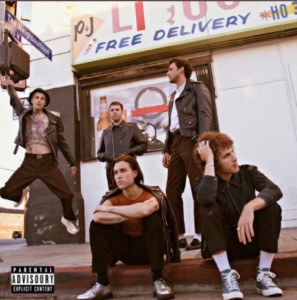
“Nervous” by The Neighbourhood

Image courtesy of Columbia Records

This song flawlessly gives life to the initial bout of nerves that accompany the start of something new. Lead singer Jesse Rutherford singing, “Maybe I shouldn’t try to be perfect,” succinctly articulates the internal conflict of trying to stay true to yourself while trying to catch the eye of that special someone. As the chorus swells, a smooth beat kicks in, and the listener feels both seen and comforted, making this track a wonderful choice for those snug fall nights.

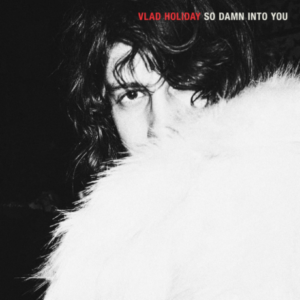
“So Damn Into You” by Vlad Holiday

Image courtesy of Vlad Holiday

“So Damn Into You” is an ode to the staggering feeling of being taken by surprise in the best way possible. Vlad Holiday croons, “It started with a bang / Don’t know how you got me so messed up / But baby, I won’t ever get enough, oh / Cause I’m so damn into you.” Combined with dreamy instrumentals, this creates a sense of warmth, pining, and passion —  concluding our descent into cuffing season.

The BC vaccine card and verifier app are simple but effective tools to fight the pandemic

0
Digital vaccine cards are a quick and easy way to check people’s vaccination status. PHOTO: Government of BC

by Rastko Koprivica, SFU Student

On August 23, the BC government announced that proof of vaccination will be mandatory for “people attending certain social and recreational settings and events.” The new proof of vaccination, called the BC vaccine card, can easily be obtained through the BC government’s website. Globally, there have been concerns about digital vaccine cards, but the BC vaccine card and its verifier app are working great so far. They have the potential to move us towards stage four of the province’s restart plan because they are designed to both protect privacy and be user-friendly.

Businesses have to use the verifier app to check their customer’s vaccination status. I personally tested the app using the source code posted on GitHub, which “hosts collections of code for projects.” 

On the user interface front, the app is fairly simple. After launching the app, the user is greeted with a reminder to allow permission for the app to access the phone camera in order to scan the QR codes of vaccine cards. Upon scanning the card, a colour-coded result appears with the name of the person on top — green for fully vaccinated and blue for partially vaccinated. The name can then be verified using a secondary ID such as a driver’s license to prove that the QR code belongs to the person.

On the technical side, this is where things get interesting. The app can function without the internet. It makes no contact to government servers to verify vaccine cards in a cloud database. Instead, it reads the QR code which includes name, date of birth, immunization dates, vaccine brands, and immunization provider, to determine eligibility for vaccination status. Not requiring an internet connection is great for accessibility since the app will theoretically always be able to work.

Since an internet connection isn’t required for verification purposes, the government will not be able to track what venues and businesses people go to. This also lowers the risk of a hacker intercepting personal information because of unsecured Wi-Fi. 

People may speculate that anyone can make their own QR code and bypass the need to get vaccinated to enter certain spaces. However, all vaccine card QR codes follow the SMART Health Card standard. This means it alerts the user of the app of any false QR codes, so people cannot forge them to get into restricted spaces.

The only issue I have with the process is there is no app to store the vaccine QR codes on mobile, unlike in other jurisdictions like Quebec or Manitoba. The BC government suggests the public save the QR code to their camera roll. This is tiresome since people would have to scroll through their camera roll or carry a piece of paper. The app should have a designated space to save the code so that everyone can easily access them.

Nevertheless, the BC vaccine card is turning out to be a great motivator for people to get vaccinated, with vaccine registrations climbing with the implementation of the app. It is a fast, easy, and privacy-friendly app that will help us to leave the pandemic behind us.

“Blue Bayou” is a beautiful film that confronts a cruel reality

0
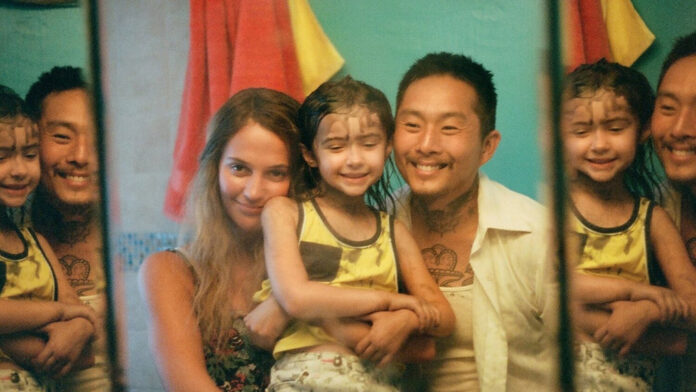
A mixed race couple with their young daughter. The family stare into a mirror, smiling.
The cast delivers on an emotionally impactful story. Image courtesy of Entertainment One Ltd.

By: Sara Brinkac, Peak Associate

Selected by the Cannes Film Festival and premiering September 17, Blue Bayou is the fourth feature film from director, writer, and star Justin Chon. In a recent interview with Kodak, Chon said, “The experience was pure. Everybody involved [was] in it for the right reasons and wanted to make a beautiful film.” That sentiment is abundantly apparent when watching this film. 

Blue Bayou tells the story of Antonio LeBlanc (Chon), a Korean adoptee who has lived in Louisiana since the age of three. However, due to neglect from his adopted parents and cruelly opportunistic law officials, LeBlanc faces deportation to Korea. Throughout the film, LeBlanc deals with constant financial stress, on top of caring for his pregnant wife, Kathy (Alicia Vikander), and stepchild, Jessie (Sydney Kowalske). The audience also learns he has a haunting past he must come to terms with. 

Chon based Blue Bayou on the unrepresented stories and realities that exist for American adoptees today. The truth that many adopted people have fallen victim to racist American policies that prey on loopholes in the legal system is a necessary and timely message. However, to the film’s disservice, Chon dresses this emotional story with heavy handed sentimentality. 

The film is scattered with scenes of forced connection between Antonio and Jessie, and conflict between Kathy and Jessie’s biological father, which is only exacerbated by the uninspired dialogue. The viewer is constantly removed from the story because they become aware of the film forcing an emotional hand. When characters act the way they do for no viable reason except to drive the story forward, the film loses its impact.

That being said, the film is not a complete write off. Blue Bayou still handles the core of its social commentary with care. It uses our knowledge about societal injustice and adds to the conversation about racial inequality rather than regurgitating familiar information. This creates a lessened, but still emotional, ending that leaves the viewer thinking about the society they’re living in. 

Although the subject matter seems to overshadow most reviews of this film, I believe its cinematic atmosphere is hugely admirable. Chon worked with cinematographers Ante Cheng and Matthew Chuang to create a beautiful visual landscape. By shooting on film (rather than digitally) they were able to create a textured picture with grain and damage to the film strip. This made the picture — and bayou particularly — both visceral and tangible to the audience. The colours and light captured on the film strip created the perfect warm, southern Louisiana atmosphere. Blue Bayou is a fantastic reminder of how powerful shooting on film can be.  

Although Blue Bayou has its faults, it still remains a timely and poignant film from an underrepresented community. What Justin Chon has achieved is no small feat and should be treated with respect. With a growing trend toward home viewing, Blue Bayou is a film that deserves to be watched in theatres. Its use of surround sound to compliment the haunting score, and the ability to see the beautiful texture of the film on the big screen, adds an irreplaceable and unforgettable impact to the story.

Need to Know, Need to Go: Sept. 20–26

0
Illustration of a blue calendar, with "Need to Know, Need to Go" written on top
Arts & Culture events to catch around the city. Image courtesy of Brianna Quan

By: Sara Wong, Arts & Culture Editor

So Damn Proud | Sept. 20, 22, 24 | $19 for students | Annex Theatre

So Damn Proud is the opening production of Indigenous-led theatre company Holy Crow Arts. Written and directed by Holy Crow’s founder Justin Neal, the show is about an up-and-coming dancer, Joanne, who unexpectedly ends her career early. Through comedy, drama, mystery, and more, the audience discovers how Joanne’s estranged brother, Joe, played a role in this life-altering moment. Tickets for So Damn Proud are available via Eventbrite or at the door. Visit the Annex Theatre’s website for updated COVID-19 safety protocols.

Harvest Moon Showcase | Now until Sept. 24 | FREE | Online

Part of the Matriarchs Uprising festival, this multidisciplinary exhibition features Indigenous artists Raven John and Jeanette Kotowich, among others. Each of their pieces is a work in progress and represents the exploration of a relationship between land, culture, and history. Additionally, the showcase includes a “Talking Truths circle” with all of the artists. For more information about the Harvest Moon Showcase, check out their Eventbrite page.

Word Vancouver | Now until Sept. 26 | FREE | Online

Word Vancouver’s goal is to promote diversity and inclusivity in the literary arts community. Their program ranges from drag storytelling to a panel discussion on how anthologies contribute to climate action. The festival is also supporting authors with book and poetry launches. Attendees can check out Iron Dog Books for copies of all the featured works in this year’s festival. Visit Word Vancouver’s website for more event details.

Mid-Autumn Festival activities | Sept. 21–26 | By donation | Dr. Sun Yat-Sen Classical Chinese Garden

In Chinese culture, the Mid-Autumn Festival has been celebrated for over 3,000 years. Traditional activities include composing moon poetry and making mooncakes, both of which are on the garden’s list of special events. The program also features live opera, storytelling, and the debut of Look Towards the Sun — a collaborative exhibition between Chinese-Canadian artist Lam Wong and Cowichan and Syilx First Nation artist Lawrence Paul Yuxweluptun. Check out the garden’s website for more information on these activities and their COVID-19 safety protocols.

BC Culture Days | Sept. 24–Oct. 24 | FREE | Online and in-person

As part of a nationwide effort to uplift the arts community, BC Culture Days’ lineup has over 100 activities to choose from. The entire list can be found online and includes helpful filters for determining topics (e.g. nature, new media), accessibility, and languages spoken. For an even more curated list, check out the Ambassadors series, RE:CONNECT. These events are hosted by nine local emerging artists, who were selected by Culture Days for their respective creative disciplines.

Canadians with disabilities deserve to vote without barriers

0
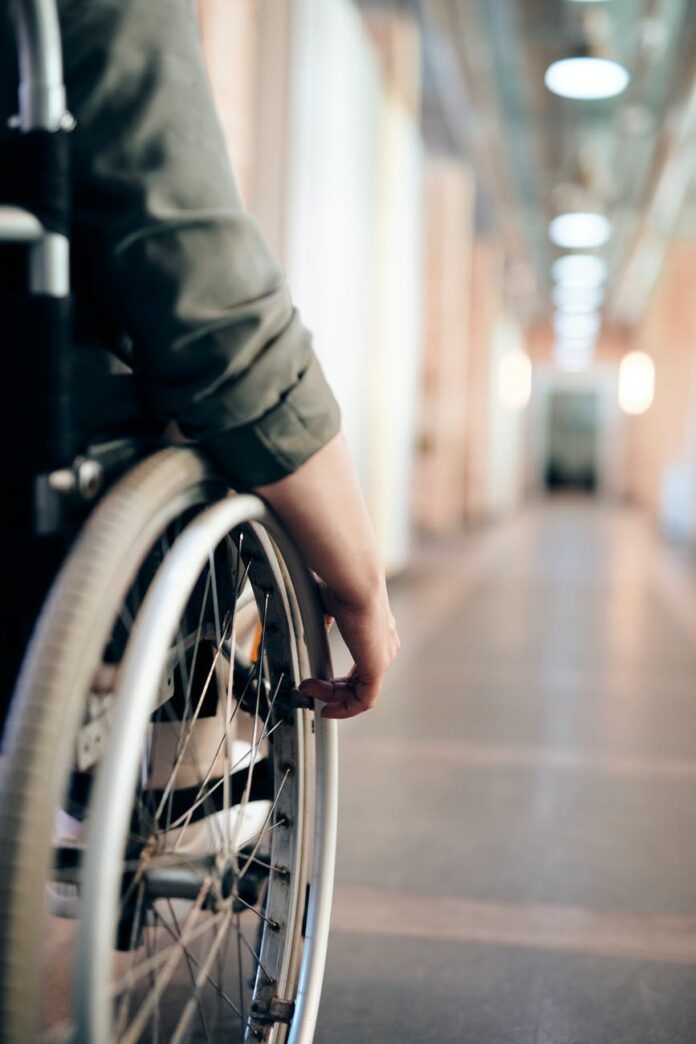
We need to devote more resources to confront ableism in the voting process. PHOTO: Marcus Aurelius / Pexels

by Luke Faulks, SFU student

For Canadians with disabilities, no election is without challenge. Nevertheless, voting access strategies during COVID-19 have produced some meaningful results for citizens with visual or physical disabilities.

Among the many inadvertent lessons of the COVID-19 pandemic, however, is the realization that increasing the availability of alternate forms of voting helps to drive participation of citizens with disabilities. According to data compiled by Rutgers University, the 2020 US election saw an increase in turnout of “5.9 points relative to the 2016 election, which was slightly more than the 5.3 point increase among citizens without disabilities.”

Over the last year, democracies have stumbled into several partial solutions for disability voter access. 

For the first time in Canadian history, this system includes online registration for everyone to vote by mail, thereby preventing the necessity to travel or enter a building. The process of casting a ballot by mail itself offers voters with disabilities a chance to avoid casting a ballot at a polling place that, once again, may not meet their mobility needs. At present, however, voting by mail is not a guaranteed service for all elections. For example, a 2021 byelection in the City of Burnaby, voting by mail was not an option provided.  

The secret ballot process, an integral part of democratic elections, poses problems for people with visual impairments. In a polling station, a sighted friend is sometimes asked to walk a visually impaired voter through the options at hand, then mark the voter’s choice down. Advocates argue “the sighted assistant may try to take advantage of the situation and influence the disabled voter.” The Canadian National Institute for the Blind (CNIB) says voting in Canada will not be “truly accessible” until voters with visual disabilities can “independently cast” their ballots. 

A 2015 report by Elections Canada identified 350 out of 661 polling locations lacked wheelchair accessibility. While these locations were temporarily fitted with ramps during the election, a BC Disability Caucus representative argued some ramps were installed at a 45-degree angle, making them unscalable. 

For starters, Canadian voters with disabilities can be well-served by maintaining the expanded vote-by-mail system. In the US, states concerned with increased voter turnout in the 2020 election driven partially by mail-in voting, have introduced voter suppression bills that, among other tactics, “shorten the window to apply [and] deliver a mail ballot.” By going in the opposite direction, By widening the time in which mail ballots can be applied for and sent in, Canada can help promote a service that supports voters with disabilities. Ensuring consistent access to mail-in voting, during, and post-pandemic can help support voters with mobility issues.

During the 2017 BC election, Elections BC, in partnership with the CNIB, launched an assisted telephone voting program aimed at voters with “vision loss, a disability, or health condition.” Around 1,000 British Columbians who fit the criteria voted by phone in 2017. During the 2020 provincial election, the number shot up to approximately 1,900. 

In 2020, officials expressed concern that “ineligible voters [ . . . ] could tie up phone lines” if trying to vote by phone. However, this could be solved through a more robust phone voting system to promote participation by visually and mobility impaired voters. This may mean adding more volunteers and for election officials to guarantee access to voting by phone. The process of voting by phone, paired with online registration for all voters, offers a potential new tool for visual impared voters to independently cast their ballots. 

Expanded registration options, lengthening voting by mail deadlines, and voting by phone have been tools adopted to reduce voters’ potential exposure to COVID-19. Devoting resources toward creating an equitable system for voters should remain a priority after the pandemic is over. Moving forward, we cannot disregard voters with disabilities.

The OnlyFans explicit content ban further stigmatizes sex work, despite reversal

0
Sex workers are not disposable — they deserve to be treated with respect. PHOTO: Gudrun Wai-Gunnarsson / The Peak

by Victoria Lopatka, Staff Writer

OnlyFans is a subscription-based platform with “130 million registered users and over 2 million creators.” Users pay for subscriptions that give them access to creators’ photos and videos. Though OnlyFans is not explicitly for sexual content, the platform has become synonymous with such content in the public eye. On August 17, OnlyFans shocked users and creators by announcing it would ban “sexually explicit content,” but after a few days of backlash, they reversed the ban. The ban and unban was not only a slap in the face to individual adult content creators who built OnlyFans up to what it is today, but it strengthened stigma around sex work.

When asked about the reason behind the initial ban, Tim Stokely, CEO of OnlyFans, told the Financial Times, “Banks have refused to work with the company due to ‘reputational risk,’ alluding to [ . . . ] users who sell explicit content.” This refusal manifested in transactions being flagged and rejected by banks. Stokely framed the ban as protecting creators from not getting paid properly — but if they’re banned, they’re not getting paid at all, Mr. Stokely.

Adult content creators put OnlyFans on the map next to other big players in the porn industry like Pornhub, making it a household name for anyone looking to make or purchase adult content. 

But OnlyFans repaid such creators by introducing guidelines that would drastically affect their income. These guidelines stem from concerns about profit and the stigma around sex work  —  the tired, old argument that sex work is “immoral,” “dirty,” and “not real work.”  Sex work isn’t dirty because sex itself isn’t “dirty,” and it is definitely real work as it involves both emotional and physical labour, just like other professions

For those who have their own negative beliefs on sex work, we get it: you watch adult content, but for some reason, still hate adult content creators, and were jumping up and down in excitement about the idea of hundreds of thousands of creators being laid off. 

If you think “selling your body” is an “immoral” concept found only on OnlyFans, I hate to be the one to unpack what athletes, firefighters, military personnel, and personal trainers do with their bodies for their paychecks. Put simply, people have a right to bodily autonomy, and they should be able to exercise this right in all careers.

How much collateral damage is acceptable in such a rebrand before consumers and viewers begin asking some hard questions? OnlyFans is important, both as a means of income for creators, and a place of rebellion against stigma and anti-sex-work sentiments. During the COVID-19 pandemic, many have turned to the site to keep afloat financially. Sites like OnlyFans can also push back against a society that stigmatizes and excludes sex workers, normalizing sex work as a real job option. 

We cannot pretend things are fine just because the ban was reversed. Creators lost subscribers, income, and peace of mind. Imagine if your boss told you that you were going to be laid off then a few days later said, “Never mind, you can still work here for now.” You would likely feel unappreciated, insecure, and disposable.

If OnlyFans cared about its adult content creators and saw them as a valuable asset, this flip-flopping wouldn’t have occurred. Adult content creators on OnlyFans deserve respect, and they should be seriously considered during major decisions.