Home Blog Page 20

Queerness, death, and resistance in What Happened to the Wolf?

0
This is a poster of What Happened to the Wolf?
IMAGE: Courtesy of Fatty Gangster Production and Thudra Film Production

By: Thwin Than Thar Nway, SFU Student

Content warning: Brief mention of suicide and homophobia. 

War doesn’t just destroy homes, take lives, or displace millions. In Myanmar, the civil war has also tried to silence the soul of the country: its songs, its art, and, especially, its media. In 2021 — the same year the military junta staged a coup and plunged the country into violence — What Happened to the Wolf?, directed by Na Gyi, was set for release. Sadly, due to the director and lead actor’s dissent against the junta, it never reached the domestic audience on the big screen. It is now a symbol of resistance, not just because it explores mental health and queerness, but also because it was one of the last films produced before the military government retook power. Whilst the people of Myanmar never saw the film, it won international awards and is now premiering around the world.

Organized by the local Burmese community at the UBC Robson campus, many from the diaspora in Metro Vancouver crowded around the university theatre. I was greeted warmly in the usual Burmese manner as soon as I arrived. It was easy to feel welcomed when faced with Burmese hospitality. 

The movie follows Wae (Paing Phyo Thu), a young woman with a terminal illness, and Moe (Eaindra Kyaw Zin), who was admitted to the hospital after attempting to take her own life upon discovering she had lung cancer. Eaindra Kyaw Zin’s role holds special meaning for Burmese audiences. A household name to many over the past decade, her portrayal of a queer Burmese woman adds a powerful layer to the film. The absence of an identity for queer Burmese women makes the sapphic representation in the film feel even more significant. In the Burmese language, there isn’t even a word for queer women and most common terms are used for all 2SLGBTQIA+ identities or are slang terms that err on the offensive. Although many queer Burmese men have historically used such slang to refer to themselves in the face of legal adversity and social stigma, queer women in the country do not even have such linguistic freedom, having no equivalent — even if they were slang — descriptions for them. 

In a country where freedom of expression comes with the threat of persecution, What Happened to the Wolf? is a rare expression of Burmese art and queerness, full of beautiful shots that capture a time before the military’s reign of terror.

On the screen, YangonMyanmar’s main port and its former capital — unfolded with its gleaming glass towers jutting up beside older colonial relics, a visual echo of a country caught in transition. This rapid modernization of Myanmar during its brief democratic period is reflected in the characters as well, who can be seen styled in traditional Burmese longyi (လုံချည်) alongside co-stars dressed in Westernized clothing. The movie showed frames of Yangon as well as the beautiful rice fields and familiar highways in its suburbs. For many in the audience who have fled their homelands and uprooted their ancestries for considerably safer lives abroad, this was more than just a movie setting. It was a glimpse into a Myanmar that once felt within reach.

Wae and Moe’s bond unfolds slowly, often through shared music on a yellow Walkman, which becomes a recurring splash of colour that signals warmth and joy. A yellow detail subtly in nearly every scene they share, despite a quiet bloom in the shadow of death. Nevertheless, Burmese humour weaves through the heaviness, the script occasionally inciting laughter from the audience amidst heavy conversations. As the film progresses, death’s looming presence begins to soften into something acknowledged and no longer paralyzing. During shared moments of music and warmth, we see room for connection, choice and love even in the face of loss. 

In a country where freedom of expression comes with the threat of persecution, What Happened to the Wolf? is a rare display of Burmese art and queerness, full of beautiful shots that capture a time before the military’s reign of terror. The success of this controversial film symbolizes the soul of Myanmar and the fight of its people, a spirit that has been beaten, but never faltered, even in the face of violence and death.

Survivor of Nagasaki bomb speaks on nuclear weapon abolishment

0
This is a photo of Kuramori Terumi speaking with some people at the front of the presentation room.
PHOTO: Peace Boat

By: Noeka Nimmervoll, Staff Writer

Content warning: graphic descriptions of bodily harm, death, miscarriages, and sickness.

On July 21 at the Harbour Centre, SFU International Studies hosted a lecture on building a future free of nuclear weapons. The event highlighted the collaborative efforts of Peace Boat and Mines Action Canada to educate people on the realities of nuclear war and push governments to choose peace. The lecture featured a speech from Nagasaki atomic bomb survivor Kuramori Terumi, who spoke on her experiences from the time of the devastation and its ongoing aftereffects. The Peak attended the event to learn more. 

Rika Watanabe, the international coordinator of Peace Boat, explained that they are a Japanese non-governmental organization that uses a 2,419-passenger boat to promote peace internationally. Their global voyage allows hibakushas (atomic bomb survivors) to share their stories. Mines Action Canada is a non-governmental organization who works to end the use of weapons that cause sweeping damage, including nuclear weapons. 

This is a photo of all the people from Peace Boat and Mines Action Canada who gave the presentation. One sign they’re holding says “Peace Boat: Time for Peace,” and another smaller sign reads, “Bravo!” It appears some people attending the event also joined in for the photo.
PHOTO: Peace Boat

Paul Meyer, adjunct professor at SFU, also provided context for the event. “There are approximately 12,000 nuclear weapons still extant in the world, any one of them with a capacity for devastation far greater than the bombs that were dropped on Hiroshima and Nagasaki,” he said. The death toll for the Hiroshima bomb was approximately 80,000 from the explosion, with thousands dying shortly after from radiation poisoning. This bomb, dropped by the US on August 6, 1945, killed approximately 140,000 people by the end of the year. Three days later, the Nagasaki bomb was dropped, taking another 74,000 lives. 

The Bulletin of Atomic Scientists notes that “any nuclear explosion creates radiation, heat, and blast effects that will result in many quick fatalities.” Nuclear weapons can cause extensive damage, including severe burns, the disfigurement of skin, and organs that hang out of the body. Exposure to nuclear bombs is also characterized by prolonged suffering from “radiation-related cancers and other illnesses” across generations.  

Terumi shared a personal testimony as a hibakusha, translated from Japanese to English by Kaya Nagayo. Although she had no memories of the bomb itself, being only one year old when the bomb dropped, she was surrounded by the aftereffects long after the explosion. 

“I do not want anybody else to experience the suffering, the sadness, the tragedy of atomic bombs. We hibakushas know the horrible nature of radiation. I want to continue to tell the world about the truth of this awful radiation.” — Kuramori Terumi, Nagasaki atomic bomb survivor

Terumi shared how her father came home safely on the day of the bombing. However, in the following days, he helped clear the debris and aided many injured people at the epicentre of the bomb. “Ten years after the bombing, my father contracted a lung disease,” she shared. Her father was later diagnosed with cancer and passed away. 

Following his death, Terumi and her family suffered through poverty. For Terumi’s older sister, the physical effects of the radiation and the societal stigma of being a hibakusha affected her significantly. “She repeatedly went through miscarriages. Her body was unable to produce children, and unbeknownst to me, this older sister had been forced to get a divorce,” Terumi said. Their father’s same symptoms from the bomb later befell her older sister and Terumi’s older brother, and they passed away. 

This is a photo taken during the presentation, when Paul Meyer is speaking.
PHOTO: Peace Boat

“I do not want anybody else to experience the suffering, the sadness, the tragedy of atomic bombs. We hibakushas know the horrible nature of radiation. I want to continue to tell the world about the truth of this awful radiation,” said Terumi, in the final moments of her speech. 

Meyer highlighted that due to the current “upsurge in geopolitical tensions,” it is crucial to illustrate the devastation of these events to the public, especially the younger generation. “80 years after those terrible events, memories are faded from public consciousness.”

Peace Boat and Mines Action Canada have worked together for around “eight years as part of the International Campaign to Abolish Nuclear Weapons,” which works for the implementation of the Treaty on the Prohibition of Nuclear Weapons, shared Erin Hunt, executive director of Mines Action Canada. In 2017, this treaty was adopted by the United Nations. However, neither Canada nor Japan are currently part of it.

Terumi called for everyone in the audience to help “advocate so that nuclear-armed states will get rid of their nuclear weapons so that the governments of countries like Japan, like Canada, will sign the Treaty on the Prohibition of Nuclear Weapons.”

SHOWSTORM: An interview with Etchos

0
This is a sourced photo of a TV in static against a yellow background
PHOTO: Courtesy of Kamaya Atterberry

By: Noeka Nimmervoll, Staff Writer

On August 6, Vancouver-based Filipino artist Etchos will debut SHOWSTORM at the Vancouver Black Library, accompanied by Couch Jams. The project is a live multimedia performance of Etchos’ new extended play (EP), performed alongside a screening of an original four-episode miniseries. SHOWSTORM is a crowdfunded project centering themes of immigration, growth, and survival, from a passionate artist sharing her journey and growth with people in hopes that it speaks to them too. This event and the series are set to be vibrant experiences full of memories — ones to be remembered, and ones to be made. The Peak sat down for an interview with Etchos to hear more from the artist herself.

The following quotes have been edited for concision and clarity. 

What was the inspiration for SHOWSTORM?
In the beginning of the project, I always kept telling people that it is a marriage of both of my loves, which is music and acting. I’ve always loved how TV shows extended backstories and how you get to know a character because they explain it through the TV show. Sometimes people put out music, and it’s up to the listeners to interpret it. But I thought, you know what, I can format it as a TV show, and explain what inspired these songs.

You are a Filipino artist with an immigrant background. How does this influence your work? 
In the beginning, there was a lot of insecurity because I’m an immigrant. But now looking at it, you are powerful because you’re an immigrant. So I think there’s a lot of things like that in SHOWSTORM as well, where I felt so alone and then I just turned the tides around.

I want this to be out because I want people to know that it’s OK. Not in an, everything’s gonna be OK, type thing, but as in, you’re not alone.

How would you describe your sound? Who are some of your musical inspirations?
I would describe the sound as . . . a blend of soul, ballads, and R&B. I listened to a lot of Cleo Sol. So a lot of the writing echoes in how she writes as well. I think a lot of Adele as well. A lot of Whitney Houston. The Power Diva, Alto Belters are my source of inspiration when the music gets into production.

PHOTO: Courtesy of John Stolze

What will the upcoming event be like for the attendees? 
There is going to be a DJ spinning as guests are coming in, as well as somebody will have their art exhibited. For the show itself, the idea is that the episode plays out, and as the credits roll, the screen goes off, and then lights fade in on the band, and then I perform the track live as the credits are rolling. 

What is one aspect of being an artist in Vancouver that people might not know about? 
We need more community. We need more. I feel like my artistry would not be as successful if I didn’t have people around me. I think that’s one thing people should realize. It’s not a lone journey. Sometimes when I get into my feelings, I just realize I have not been spending quality time with people who actually keep me grounded.

What do you want to express through SHOWSTORM?
When I started to watch TV shows, I started to realize that, wow, I’m not alone in my struggle. To my home, to my family, the feelings that I felt were so foreign to them, and nobody understood. But when I started to watch TV shows, it all made sense. I want this to be out because I want people to know that it’s OK. Not in “an everything’s gonna be OK,” type thing, but as in, you’re not alone. 

Get tickets for SHOWSTORM on August 6 on Eventbrite.

Vancouver to transform Science World into giant soccer ball

0
A beautiful look over Vancouver’s waterfront. However, instead of the usual ball of Science World, it has been replaced with a . . . soccer ball?! The soccer ball reads the word “FIFA” on the top.
IMAGE: Gudrun Wai-Gunnarsson / The Peak

By: Lucaiah Smith-Miodownik

The City of Vancouver has been selected to host several FIFA World Cup games next summer. Exciting, right? In preparation for the ball-tastic event, FIFA created a list of demands the city must implement as it prepares for the influx of players and fans, with various beautification initiatives and possible city road closures proposed. Recently, FIFA president Gianni Infantino added one more requirement: The giant, orb-like structure sitting atop Science World must be transformed into a soccer ball. The Peak corresponded with Infantino, Vancouver mayor Ken Sim, and several city locals for more information.

“It just makes sense,” Infantino said. “When you think of soccer, you think of soccer ball. You literally need a soccer ball to play soccer, so it’s perfect.” Infantino detailed the cognitively laborious process of coming up with such a groundbreaking concept. “This is a result of countless hours spent in the pitch room brainstorming ideas,” he said. “For a while, it was tough. We just kept thinking and thinking in circles. Then it came to us. The answer was circles.” 

When asked to describe the project, Sim said to “imagine a soccer ball in your head. That’s basically what this will look like.” Regarding increased costs the project may incur at taxpayers’ expense, Sim did not appear worried. “It’s not really an issue,” he said. “We’ve actually been doing a great job of cutting costs this year. Freezing supportive housing and getting rid of the city hall gym have provided us with a hefty ball budget. In fact, we’ve actually been looking at other circular objects we can turn into soccer balls, too. So far, the Bloedel Conservatory and Gastown Steam Clock are possibilities.”

“Some estimates actually project that the ball will help boost the local economy,” Sim added. “The aerodynamics of soccer ball-shaped objects has a neurological effect on the brain that encourages people to spend more.” The Peak was unable to independently verify this claim.

The Peak spoke with a local youth soccer team to see how the next generation of players felt about the project. “I like soccer ball. Soccer ball good,” said one boy, age five, whose name has been withheld for privacy. “Me too,” echoed his friend.

“You know, I’m actually somewhat concerned about the socioeconomic impact of this initiative,” explained another girl, age three. “What does this signal about the city’s priorities? We have citizens in dire need of support, and here the mayor is agreeing to turn our science center into a giant fútbol. Is that really the most optimal move? His statements are simply fallacious. Anyways, no more questions, please. I have some delicious Play-Doh waiting for me at home.”  

While construction on Science World is slated to begin soon, city officials assured the public that the museum would remain open in the meantime. In fact, rumour is that a new, ball-themed exhibit will be rolling in soon.

Student files claim related to 2024 SFSS annual general meeting

0
This is a photo of the outside of the Student Union Building at the SFSS Burnaby campus. The photo is a close up of the doors. Above the doors the sign reads “Student Union Building, Simon Fraser University”
PHOTO: Afsaneh Keivanshekouh / The Peak

By: Corbett Gildersleve, News Writer

On May 27, Jim Nosella, a sustainable energy engineering student, filed a claim against the Simon Fraser Student Society (SFSS) with the BC Civil Resolution Tribunal (CRT) concerning how the SFSS conducted their annual general meeting (AGM) last year. The CRT is an online tribunal that allows people to submit claims without having to obtain a lawyer and go to court. 

During the meeting, a disagreement arose between Benjamin Tischler, the 2022 vice-chair of Council, and previous SFSS president Emmanuel Adeboyega around whether three bylaw motions could be voted on, as the meeting took longer than 30 minutes to reach quorum

Quorum is “the minimum number of members that must be present in order for a meeting to be considered legitimate.” According to bylaw 4.4, if quorum has not been reached “within 30 minutes from the time appointed for the AGM,” 20 members total can make quorum and the meeting can deal with items listed in bylaw 4(3) a–f. Bylaw changes are not included in this.  Ultimately, the three bylaws motions were voted on and passed during the AGM. 

Nosella told The Peak that this issue was “raised by multiple members, myself included, during the AGM.”

Nosella brought this issue to the CRT to request that the bylaw changes be suspended and revoted at a future AGM that meets the quorum requirements. 

According to the claim, the AGM in 2024 was scheduled to start at 5:30 p.m., but by 6:15 p.m., quorum had not been reached, and the meeting was not called to order until 6:33 p.m. As such, Nosella claimed the bylaw motions should not have been voted on. He told The Peak that this issue was “raised by multiple members, myself included, during the AGM.”

The SFSS was provided the claim on June 25, and on July 10, they responded to the claim, saying that they disagreed with Nosella’s interpretation of that clause: the bylaw “does not impose a requirement for the AGM to meet quorum at a certain time.” At the time of writing, Nosella awaits the arbitrator’s decision on who is in the right.

Five SFSS full-time union staff receive layoff notices

0
This is a photo of an empty SUB hallway that features the “SFSS Admin Offices” room. Next to the room is a big bulletin board with about 30 neatly lined-up posters and a big red number 3 to indicate the level of the SUB.
PHOTO: Audrey Safikhani / The Peak

By: Corbett Gildersleve, News Writer and Hannah Fraser, News Editor

The Simon Fraser Student Society (SFSS) has initiated staff layoffs, with five out of eight full-time union positions affected as of July 25. All the positions either support student activities or the SFSS’ operations, and do not include SFSS executives. The positions are also represented by CUPE 3338, a non-profit union organization.

The affected positions include the student advocacy coordinator, campaigns and mobilization coordinator, communications coordinator, one of the member services coordinators for clubs, and the member services coordinator for student group events. 

According to the SFSS website, 18 full-time positions are currently filled. Laying off employees from eight of these positions would mean cutting nearly half of the full-time staff. The Peak spoke with CUPE 3338 president Shaneza Bacchus to learn more.

Bacchus said CUPE received notice from the SFSS of the layoffs on July 7, but the SFSS did not specify which positions would be affected. The reason given was “budgetary constraints and the viability of the SFSS.” The Society’s 2024–25 operating budget indicates their total revenue was about $3.1 million, while their total expenditures were about $4.1 million. This puts the SFSS in a deficit of approximately $1 million. 

Bacchus replied to the notice the next day, saying the union would consult CUPE’s national group. CUPE also wanted to schedule labour adjustment planning meetings with the SFSS. These meetings require the Society and the union to review the financial situation, who would be affected, and develop a plan that oversees the layoffs, according to section 54 of the BC Labour Code. Additionally, that section sets a 60-day period to develop this plan before layoff notices go out. 

On July 16, Bacchus met with the SFSS to discuss the notice for layoffs, which was issued while the two groups were bargaining around their collective agreement. This agreement sets the working conditions, wages, benefits, and other matters between the two groups. The current agreement expired in August 2024 and is still in force until a new one is agreed upon. 

During this meeting, the SFSS specified that eight positions were being laid off, and CUPE responded that bargaining and the layoff process can’t happen at the same time. “It’s acting in complete bad faith to issue a notice of layoff with bargaining (already) scheduled,” Bacchus said. She explained that the same people being laid off would also discuss moving forward through bargaining: “It’s not going to be productive or efficient.” Referencing CUPE’s recent news posts, up to two of the union’s members could be removed. 

CUPE asked the SFSS to proceed with one process or the other, but the SFSS moved forward with both. 

The next day, Bacchus said the SFSS started issuing notices of layoffs to affected staff without informing the union ahead of time. She sent the SFSS an email stating that they were “aghast that this decision was made,” and that the SFSS “did not treat the impacted individuals with the basic dignity and respect by scheduling face-to-face meetings.” 

“An employer still has limitations. They can’t just do what they want, and how they want, when they want.” — Shaneza Bacchus, president, CUPE 3338

Bacchus then received a tip an hour later that the SFSS scheduled face-to-face meetings with those staff without union representation. 

According to Bacchus, she and Bridget Barker, CUPE’s vice-president and lead steward, went to the Student Union Building to stop this. “We confronted the operations [Patience Okuku] and HR [Chandra Trinh] leads firmly for their entire handling of the notice of layoffs. They denied the meetings happened. We then met with impacted staff briefly outside of the restricted staff area because they were in shock,” Bacchus said.

“An employer still has limitations. They can’t just do what they want, and how they want, when they want,” she said, concerning the whole process. “It’s operating so fundamentally backwards.” 

The Peak reached out to the SFSS about the reasoning behind the layoffs, the timeline and process followed, their compliance with the Labour Code, and how these changes will affect bargaining and the Society moving forward. They stated Council “is limited in the information it can share at the moment, and we will be sharing more once things are better solidified.” 

For now, they said, “the Board of Directors approved layoffs in accordance with article 37 of our collective agreement,” and, as Bacchus mentioned, that “this decision is part of a broader strategy to address financial hardship and budget constraints” for the Society’s sustainability. The SFSS emphasized their commitment “to working collaboratively with CUPE 3338, and to upholding our collective agreement, ethical standards, and equity commitments in all decisions affecting staff and students.”

On July 23, the union filed a group grievance with the SFSS for the notice of layoff, stating six areas where the collective agreement was violated. Grievances under article 41 of the collective agreement are any issues with how the agreement is interpreted and/or followed. These are first handled between the union and the SFSS, and if they’re unable to resolve it, it can proceed to arbitration. At the time of the interview, Bacchus said the union is trying to schedule meetings with the SFSS around this.  

Under the current SFSS-CUPE 3338 collective agreement, permanent staff have a few options when presented with a layoff. They can take a severance payout or “bump” another staff member with lower seniority. 

“If more members take the right to bumping, then that can take additional weeks to implement [ . . . ] and that staff person would then go through the layoff process,” stated Bacchus. “It’s such a ripple effect.” 

A guide to selling your U-Pass

0
Two individuals in an alley. They are exchanging a compass card for a wad of cash.
ILLUSTRATION: Cliff Ebora / The Peak

By: Noeka Nimmervoll

Hey, kid. Yeah, I’m talking to you. Do you want to make money off your U-Pass? I bet you do. You don’t go to class anyways, huh? Well, listen up. Here’s my tried and true method for selling your U-Pass. Everyone tries to sell their card, and hardly anyone wins at the game. Here’s how to scam the system — super easily. 

I give this advice to my kids at least once every semester (I’m an SFU dad), and you know what? They wouldn’t know what a good idea was if it hit them like a bullet train. So, I’m sharing it with kids (you) that will probably be way smarter than my two brats. 

Anyways. Here you go. 

Find the handsomest man with a mohawk and reflective sunglasses to make a commercial for you. Get him behind the camera, tell him to act sexy (he’ll find that easy), and make him read this pre-written script:  

“Hey, cheapskates! You want a motorcycle? I’ve got something totally better. A multi-modal, sexy, and totally rad Tokyo-inspired train-and-car share network to get you to your ultimate destination. Open air for all you nature freaks or AC options for sexy people, on a mad range of vehicles that sports epic views. For unlimited use with a one-time-a-month flat rate, you can have access to over 2,250 pieces of transportation, akin to limousines, to get you where you want to go — while being the place to be. Leave your name, social insurance number, and credit info in the comments so I know where to find you.”

He might be a little older than the target audience, but don’t be put off or anything. It’ll definitely add to the charm of the ad. When you post it on Tik-Tak-O or whatever, it’ll go totally virus

Then, get him to do a backflip off a skateboard that’s on fire. Pretty sure all the kids think that’s super rad right now. I know Benson Boone is totally hot right now, so I’m pretty sure that would be the sickest ending to this video. 

If this Freddie Mercury look-alike can’t do a backflip, it’s probably because he’s sore from going to the gym that morning, so maybe just edit that in. This should be a piece of cake for you with all that new teknologeeca. Awesome. Then, post it with some cool hashtags like #rad.

Within a few minutes of being posted online, you should get something like 2,000 comments and, like, shares. They’ll be all begging for you to choose them as the buyer of your U-Pass-loaded compass card. Sell it to all of them for $100 a month or a Rolex. Then, leave the country — the feds will definitely be on your ass for this, so leave everything and make sure to burn your computer and stuff so it can’t get traced back to you. 

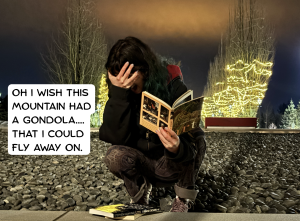
I used this method back on the mountain in ‘06 and it was pretty easy. I was surprised it worked so well. Honestly, I spent all the cash on getting drunk. I don’t even remember how I got there. 

Anyways, let me know if anyone tries this out. 

The Peak does not condone any criminally cringey behaviour. Any actions taken by individuals are solely at their own risk. Any criminal proceedings that may be influenced by this piece are not connected to The Peak in any way.

Crip Trip: a road trip against institutionalization

0
This is a poster of Crip Trip
IMAGE: Courtesy of Catapult Pictures

By: Yildiz Subuk, Staff Writer

Crip Trip is a docu-series about two friends and filmmakers, Frederick Kroetsch and Daniel Ennett, who set out on a road trip from Edmonton to New York. Ennet, a multidisciplinary artist and disability justice advocate, is a quadruple amputee trying to find full-time employment to avoid institutionalization. The series follows them on their trip as they meet other disabled people across North America who are facing issues regarding care and mobility

The docu-series aired this year in April. Despite its comedic undertones, the series is raw and infuriating. Instead of focusing primarily on the specifics of disability, it focuses on the world around it — the institutional restrictions to mobility and access experienced by the disabled community in North America. Using the road trip, ideas about mobility, including a huge lack of access to proper mental care for disabled people in North America, are revealed. The two travel in an old RV, which almost ends up breaking down in the first episode. This creates doubts about whether the road trip will even take off. The journey feels turbulent, as there is a lingering feeling that at any point something can go wrong — as exemplified by the RV constantly breaking down. The series becomes a fight for completion, exemplifying the crew’s dedication to spreading awareness of the main message behind the trip.

The series sheds light on core issues surrounding disability justice, such as bureaucratic red tape and inadequate financial support for caregivers. The themes surrounding the poverty trap of not allowing disabled people to work — lest they forgo their benefit payments — as well as the undue exploitation of family caregivers as unpaid forms of labour are explored. The clear lack of humanity when it comes to caring for those vulnerable becomes painfully visible, despite the chaotic fun experience that is at the backdrop. 

Kroetsch represents an outsider trying to learn about the struggles of disabled people and their support systems, while Ennett represents the insider inviting the viewer to see the world through the lens of the disabled community. Exploring disability through both of their viewpoints and the rest of the story, Crip Trip challenged me of my own perception of the privilege regarding my body and mobility while informing me of the many injustices still present for the disabled community today. 

Watch Crip Trip on AMIplus.

Airport security vs. CAL: Welcome to the accommodated life

0
A black and white photograph of the CAL office at SFU Burnaby campus.
PHOTO: Gudrun Wai-Gunnarsson / The Peak

By: Matthew Cullings, SFU Student

My palms sweat as my student ID slides through my hands. Butterfingers. As I draw nearer to the checkpoint, I feel the weight of a thousand bullets piercing through my skin. I wipe away a pound of sweat. 

I approach the Centre for Accessible Learning (CAL) checkpoint. “What’s your name?” demands an enraged lady with a clipboard. “Spit it out, I don’t have all day.” 

“My name is . . .” I try to respond, but she’s just so intimidating. 

“I said hurry up or else I’ll send in the dogs! They’re hungry for some students with accommodations; they have the best sweat glands,” she responds while barking and howling at the roof. She begins scanning the line to assess the other students, as if she’s telling me to hurry the fuck up in a non-nonchalant way.

“Matthew,” I tell her. 

“Your ID. NOW. You don’t want the dogs in here, do you?” She begins to bark and howl again, this time getting on all fours and intimidating me. 

What the actual heck. 

As I lower my hands and give her my ID, she places a plastic bin at my feet and demands that I put in any items I will need during my exam. This feels vaguely familiar, as if I have gone through the exact same trauma in another environment. 

I, then, follow this evil woman into a holding room. There, I am patted down not with physical force, but with condescending eye movement from another exam assistant. I carefully place two HB pencils, an eraser, and a bag with snacks in case my blood sugar goes low. 

“DROP THE BAG! DROP THE BAG! HANDS UP!” the lady screams. She snatches the bag from my hand and begins inspecting . . . almost like I’m at airport security. Ah, bingo. That’s why this feels so fucked up and familiar. My bag gets handed back to me in a desecrated state, torn apart to find illegal study aids. 

As I walk out of the holding room, I am scanned once again by a thousand exam assistants’ eyeballs, all watching me take the walk of shame into the exam room. There, plastered over all the walls, are signs of students posing. Mussolini’s propaganda had nothing on this shit.  “YOU’RE UNDER SURVEILLANCE,” they read. “WE CAN SEE EVERY STEP YOU TAKE, EVERY MOVE YOU MAKE. YOU CAN’T RUN. YOU CAN’T HIDE.” 

Above my head is a watermelon with a Sharpie-stained dot in the shape of a camera lens in the middle. I’m guessing that this is the surveillance. 

Inside the room, rows of students are in a similar position as I am in. Hundreds of exam invigilators pace the room, giving them side-eyes and demeaning stares. 

To go to the washroom, I have to put a question sign up. Yet when I put the question sign up, I am verbally attacked and berated until I put the question sign down. What kind of brutal conditions am I working under? 

I slowly feel my eyes shuttering, a reaction to the horribly dimmed lighting. Almost a bit more to go, you can do this! You’ve got this! An exam invigilator hisses at me, accuses me of hiding notes in my eyelids, and I fall to the ground. 

As I awake, I am at the security gate at YVR. 

“Are you alright, sir? You collapsed when I asked you for your passport,” a voice calls out. I look up at a face. “Hey, are you from CAL? I work there part-time.” 

“AHHHHHHH!” I get up. Then, the drug dogs come towards me as CATSA agents scream at me to drop the bag with my Diabetes supplies in it. I try to tell them that I can’t walk through a scanner because my insulin pump will malfunction — they literally don’t care. 

All of this feels vaguely familiar. All roads in the airport security line lead back to CAL. Somebody call Carney, because I think more CAL staff could be hired at CATSA with little to no training required!

Brighter Side: Iced lattes

0
An iced latte in a glass cup with a glass dome lid, and a glass straw. Sitting on a white counter top.
PHOTO: Amy Humphries / Unsplash

By: Zainab Salam, Opinions Editor

A certain headiness comes with the first sip of a latte. It’s not just the taste — it’s the warmth, the anticipation, the ritual that precedes it. I usually start my day yearning for my iced brown sugar and honey latte. I queue the espresso shots in a shot glass — double and blonde. Then add a spoonful of honey to a cup, with a cube of brown sugar, and two dashes of cinnamon. Pour the shots right over them. The waft of that coffee goodness rises, swirling softly through the air. I stir it together until it all melts and becomes an elixir of comfort; dark, sweet, and enticing. Then I add oat milk until it’s my favourite shade of beige — rich and golden. Top it up with ice. A few gentle clinks, and just like that, my day is set. 

The day cannot be heavy. A simple drink, and everything feels right. I can take anything on. Everything is possible. 

I feel attuned to everyone who starts their day with a simple ritual. To all who existed decades before me. Centuries before me. Maybe the way of preparing coffee changes from one culture to another, and it changes from one time to another, but the comfort remains the same. The intention remains the same — to consume something grounding, and sacred.