Home Blog Page 191

Meet the Pets of The Peak. Part 2

0
A photo of a cat lining into a dog, both look very young.

by: The Peak staff

The music lover duo: Buddy and Scooby. Petra, Arts and Culture Editor

Our first bird feature! Buddy (blue), who was already named upon adoption, and Scooby (yellow), named after the famous Scooby-Doo, are Petra’s two budgies. While their exact ages are uncertain since they’re rescues, Petra has had Buddy since December 2022, and Scooby joined the family a few weeks later. Their daily routine includes waking up at the crack of dawn and chirping their lungs out, flying around the living room, and a 3 p.m. nap. They are quite the music fans, and enjoy listening and singing to songs, but will let Petra know their discontent by shrieking really loud until she changes the track. Despite having fun with Petra, both of them are still wary of humans due to their past, something Petra is slowly working on with them.

Buddy is full of energy, constantly climbing, hanging upside down, and bobbing his head. On the other hand, Scooby is more timid and exhibits a fondness for classical music, although he also has his hyper moments. Despite their somewhat opposing natures, one thing they have in common is their absolute fear of the vacuum.

For anyone interested in getting birds, Petra emphasizes the importance of commitment and thorough research. Budgies are highly intelligent and social creatures that deserve a spacious and stimulating environment. They require sufficient time outside their cage to fly and interact, and their unique personalities and mood swings should be understood and respected. Building trust and bonding with budgies may not be easy, but the effort is incredibly rewarding. Petra recommends considering adoption as a responsible choice, as there are many budgies in need of care and a loving home.

Best attempt at being a guard dog: Stella! Eden, News Writer

Stella’s name was inspired by her father’s favorite beer, Stella Artois, but don’t get confused — the name was chosen by a 9-year-old Eden, not by her father! Stella joined the family at the age of four months back in 2010, and she recently celebrated her 13th birthday on May 11. Despite her age, Stella continues to exude the energy and liveliness of a puppy. Her daily routine starts with the important task of seeking attention and indulging in breakfast. Afterwards, Stella takes a quick snooze, only to wake up and resume her quest for more attention and treats. She adds a touch of athleticism to her routine by playing soccer in the yard, followed by another nap to recharge.

Eden’s family jokes that Stella is the “guard dog” of the house, despite her calm nature, her fear of the vacuum cleaner, and her pickiness with meals. If someone were to break in, Stella would likely attempt to make friends with the intruder rather than protect the premises.This would also be the main theme of her social media presence: livestreams of her napping and enjoying the sunny spots. A true guard dog indeed. She’s not only friendly, but Eden admits that Stella likes to flirt with men, showing them extra attention and enjoying their company — so yes, definitely the best guard dog ever.

They will steal your hearts and probably your food, too: the rat duo of Monty and Lucy. Olive, Copy Editor
Monty and Lucy, approximately three years and seven months old respectively, came into Olive’s care beginning two years ago. They were adopted through the SCPA (Society for the Prevention of Cruelty to Animals). While Olive didn’t chose their names, Lucy is short for Lucifer, due to his red eyes. Since they’re nocturnal animals, they are more active at night, which is when Olive spends time with them, but they like spending their days cuddling, eating, and pissing each other off — they have the habit of stealing food from each other. If they were to have a TikTok account, the theme would likely be food, even more likely — food they stole from each other.

Like many pets, Monty and Lucy share a common fear of the vacuum cleaner — an especially valid fear for rats. As Monty has grown older, his once mischievous and energetic demeanor has mellowed, transforming him into a calm and cuddly companion. In contrast, Lucy is full of youthful energy, constantly on the move and unable to stay in one place for too long. There’s only one thing Olive would change about the duo, and that would be for them to live longer.

The ever heartwarming Jack the kitten. Olivia, News Writer

Jack has been a part of Olivia’s life since this January when he was just a month old. Poor little Jack was the runt of the litter and the last to find a home. Despite being the smallest one of the litter, Jack has a mischievous side: he enjoys hiding under the sofa and playfully grabbing people’s feet as they pass by. As expected from a kitten his age, Jack can be a bit of a biter, something Olivia would like to change as her Band-Aid expenses have gone through the roof.

Jack has a fear of doorbells, and other loud noises tend to unsettle him, but that will never take away from his playful and feisty nature — he’s always in the mood to play or fight, there’s no in-between for Jack.

She’s a sassy and independent cat: Musa. Summayyah, Assistant Production Editor

Musa is the 10-month-old feline companion who has been a part of Summayyah’s life since October 2022, joining the family at only 2 months old. Musa wakes up at 6 a.m. to enjoy her breakfast, then settles down for a nap at 9 a.m. when everyone leaves for school or work. Throughout the day, she attempts to escape the house multiple times, which, along with her 1 a.m. zoomies, would be the main theme of her TikTok account. Musa also likes to sit on the kitchen window and indulge in her owner’s plants. It’s a behavior that showcases her curiosity and mischievous nature.


Big woof Dexter. Karissa News Editor

Despite sharing a name with the popular crime TV show, Dexter’s name holds no relation nor does he share the same point of view as the show’s protagonist. This year marks a decade since he became Karissa’s companion. Dexter’s daily routine is mostly comprised of indulging in his laziness, big stretches, breakfast, walks around the neighborhood, diligently inspecting familiar plants, and taking in the surroundings. His favorite activity seems to be napping — he enjoys several snooze sessions throughout the day.

Whether he wants a blanket, water, or a snuggle, he will woof for it. Another funny quirk of Dexter’s is that he will howl whenever someone in the house is playing the piano. While Dexter may initially display some anxiety, he quickly opens up and reveals his true personality — a funny, outgoing, and happy companion that will bring his favourite bright pink elephant for a game of catch, and make you play with him for hours.

He’s a ten but he will bark until you give him ham: Morgan Parks. Daniel, Features Editor

A photo of a white dog standing on grassMorgan Parks’ name originates from Thomas Hunt Morgan, an evolutionary biologist, and since he’s Mexican he needed a second name to follow the classic stereotype of having long names. He’s turning five this September and has been Daniel’s companion ever since he was only a month old. He currently lives in Mexico with Daniel’s parents and his routine consists of chasing the sun and barking non-stop at 6:30 p.m. on the dot, doing so until Daniel’s dad gives him a piece of ham. Daniel’s mom says he’s extremely smart as he understands everything she says, which makes her get angrier whenever he does any mischief.

While Daniel loves him just as he is, he wishes Morgan were a little bit less anxious. As many dogs do, he has separation anxiety, making it hard to leave him alone. When he was a puppy, he was terrified of other humans to the point where he would pee out of fear. Now, he only barks with all his might until he can determine they are actually friends. If he were to have a TikTok account, it would probably be a mix of inspirational phrases with aesthetic backgrounds, and videos of him annoying Daniel’s parents on purpose.

The benefits of joining your neighbourhood Buy Nothing

0
A photo of a small cardboard box wrapped in twine, which is woven into a bow at the top. It holds into place a small note with white text on black paper that writes “thank you.” An orange casserole dish is blurred in the background.
PHOTO: Monstera / Unsplash

By: Petra Chase, Art & Culture Editor

What does the jar of candied ginger on my shelf have in common with the framed painting of lilacs hanging on my wall, or my thriving potted monstera plant? They were all gifted to me by generous neighbours, members of my local Buy Nothing (BN) group on Facebook.

If you’re not a part of a BN group, you might be missing out. The groups consist of residents within a geographical boundary (and relatively walkable distance), where members offer items and services to give away, or make requestsall for free. There’s a laundry list of BN groups in BC. If your neighbourhood doesn’t have one, consider starting one. You can locate yours on the BNProject website or search for your area on Facebook. The BNProject is a global movement based on facilitating gift economies globally. Gift economies involve the exchange of commodities for free without the expectation of anything in return. 

I joined when I first started living on my own and it was tremendously helpful to get things here and there, from practical items to more unexpected gifts. I’ve also had some spontaneous requests, like asking for knobs to fix a busted drawer, and someone happened to have gorgeous ceramic ones lying around.

Safety and accessibility

Members are encouraged to mention if their homes are smoke-free or pet-free to prevent harm. Most members leave items out for porch pickup, or you can deliver them to someone’s porch yourself to maintain a contactless exchange. In case you feel nervous about sharing your home address, you can choose to meet someone at a public spot. 

Community connections

Agnes Mendoza, an active member of my group whom I connected with after she gifted me Christmas tree decorations, was happy to chat with me about her experiences in the group. She’s lived in my neighbourhood for 20 years and joined at the start of the COVID-19 pandemic.

“I think everyone needed connection because we were so disconnected from everybody,” she said. “It was a good way to be part of the community [ . . . ] I’ve met so many neighbours whom I didn’t know, who even lived two doors from me.”

The group is monitored by members of the community, and is a great resource for welcoming newcomers to the neighbourhood in settling into a new household or environment. I’ve witnessed how people come together in comment sections to help provide things like clothes, food, household goods, and furniture to those in need.

Cultivating gratitude

BN helps you see that there is kindness in your community. “I get coats from [another member] because for some reason we’re the same style, same size,” Mendoza said. “When I remember who I got it from and I’m enjoying it, I send a picture to say ‘I’m really enjoying this’ and show my appreciation.”

Mendoza regularly exchanges craft and garden items. “It’s such a nice feeling to be giving and receiving,” she said. “You’re sharing your blessings.”

Repurposing materials

Decluttering can be difficult if you have a lot of things that don’t seem to have a purpose. But cupboards full of random materials that thrift stores won’t sell don’t necessarily need to be dumped in a landfill. BN can help connect your items to the people who might transform them into something new, or find a completely unexpected use for it. For instance, it might be the missing puzzle piece for a craft or Halloween costume. This might replace a plastic dollar store purchase.

I’m not suggesting that individuals feel responsible for the impacts of overconsumption on the climate, as systemic change is necessary. However, don’t dismiss the small eco-conscious decisions you make if they make you feel good you’re casting a vote towards the world you want to live in. Enacting your values is important and encourages others in your community to do the same.

Envisioning possible futures

BN groups are strict on maintaining the values of buying or bartering nothing. Giving with any expectation of getting something back is strictly prohibited. You also can’t exchange anything with monetary value, which means if you want to give a gift card, you’ll be directed to a different group. This might seem extreme at first, but it makes sense for the sake of principle.

Gift economies have existed in different cultures throughout history. However, western society encourages the commodification of almost everything, which can feel disconnecting and contributes to overconsumption. Living in a society where wealth accumulation is prioritised over communal redistribution, BN is proof that other alternatives are possible. BN is an act of resistance.

A book’s journey from draft to award-winning design

0
a display underneath a glass case of open books. One in sandy brown featuring a map and another has a hot pink page with a title that reads “arrival” next to a page with a photo of greenery.
PHOTO: Amirul Anirban / The Peak

By: Izzy Cheung, Staff Writer

Have you ever wondered how chicken scratch drafts turn into colourful, award-winning hardcovers? Until August 31, you can find out at W.A.C. Bennett Library on SFU’s Burnaby Campus. Two free exhibits, the 2022 Alcuin Society Excellence in Book Design Award Exhibit and From Draft to Book: A Journey Through the Publishing Process, highlight the steps involved in publishing a book.

Upon arriving at the library, the first exhibit you’ll come across is From Draft to Book, which is located directly in front of the library’s main entrance on the third floor. It features works from writers including Eden Robinson, Michael McClure, and Daphne Marlatt, plus insights on the business side of publishing from New Star Books, Talonbooks, and Douglas and McIntyre. The books, drafts, and manuscripts can all be found behind two glass cases like artifacts in a museum. You’ll want to start with the case furthest from the library entrance, as this is where the exhibit starts chronologically. 

Each step in the publishing process is accompanied by an associated item and a write-up. The first step, “acquisition,” showcases a book proposal for The Silent Messengers, by Norman Hallendy, which was eventually published under the name Inuksuit: Silent Messengers of the Arctic (also on display). This is followed by steps detailing the editing process, demonstrated by a manuscript of The Antagonist, by Lynn Coady. In the second case, you can follow along with technical processes like design and production, marketing and sales, and the making of proofs and advanced reader copies. 

While the exhibit put forward a lot of information I hadn’t known before, it would benefit from a live-interaction portion. It would have been interesting and informative to flip through the drafts, but I know this would be difficult to manage. Because of all the rough manuscripts and drafts, this exhibit lacked dramatic pops of colour, which is understandable. However, the second exhibit completely makes up for this.

The Alcuin Society exhibit was a little more daunting to visit, but stood out for just that reason. It’s located on the seventh floor, at the entrance to the library’s Special Collections. As is tradition with W.A.C. Bennett Library, the higher up you go, the quieter the library gets — and the seventh floor is the highest in the building. 


The Alcuin Society, a non-profit organization dedicated to book art and libraries, held its 40th national book design competition on March 18, and some of the winning books are featured in this display. Each book is paired with a small write-up with information like printer and typeface. Categories included children’s, comics, limited editions, and pictorial poetry. The book covers are neat to check out, some fashioned with bright pops of pink and orange, and fun depictions of long-stemmed mushrooms and sunglasses. My favourite part was the comics, as they were propped up in a way that allowed me to see some of the black-and-white drawings on the inside (these books were covered by a glass case as well). Other than this portion, everything else was stippled with bold colours, making them stand out against the dark, wooden walls of the seventh floor.  

In total, both exhibits only took around 15–20 minutes to check out, but it could be more or less depending on the type of exhibit-viewing person you are. Seeing as both are in the library, it makes sense to see both of them if you’re already planning on catching one. If you’re interested in publishing, English, or anything book-related, I highly recommend checking these out!

Bright-er Side: RCB Hall

0
RCB Hall
PHOTO: Afsaneh Keivanshekouh / The Peak

By: Alex Ileto, SFU Student

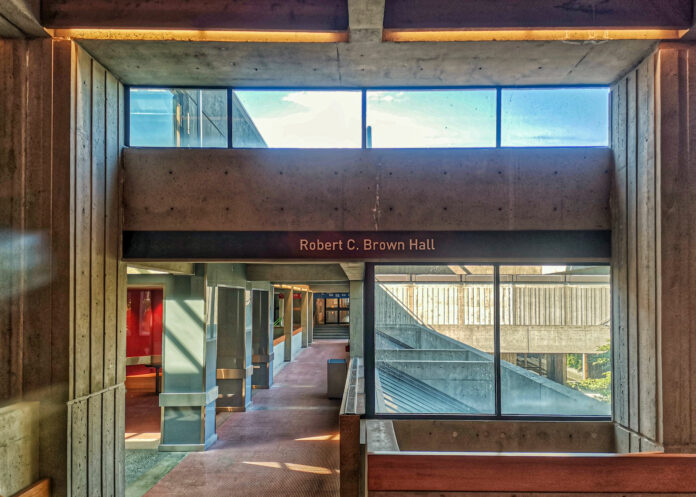
Famous for topping the list of best spots on campus to have a mental breakdown, I firmly believe Robert C. Brown (RCB) Hall receives an undeserved reputation. Many students claim the halls are haunted, deserted, and cold, but I beg to differ. 

If you’re looking to escape the hustle and bustle of the AQ or the large friend groups in the SUB (usually consisting of people from high school who you don’t want to see), consider heading over to RCB. The lack of foot traffic makes it an optimal study spot with limited distractions. 

While you study, feel free to relax and take in the pleasant view of the courtyard pond outside. Sure, there are no koi fish like our other pond, but that just means there are no birds violently swooping into the water for a midday snack. Venture further into RCB and you’ll discover a plethora of washrooms that are always clean, vacant, and awaiting your arrival. Don’t care about a good study session or a good poop? Go for the aesthetic. The sunken seats and tables give RCB strong ‘70s vibes, making it the funkiest spot on campus. 

If you’re still unconvinced, embrace RCB’s quirks instead. Strike up a conversation with a ghost. Get lost in the labyrinth while playing hide-and-seek with your friends. Take advantage of the echo and belt a Mariah Carey banger before your 8:30 a.m. lecture. The possibilities (and RCB Hall itself) are truly endless.

Council readopts agenda to discuss funding of SOCA Black wellness retreat

0
This photo is of the SFU stadium at the Burnaby Campus. The stadium is empty but it is a sunny day.
PHOTO: Krystal Chan / The Peak

By: Eden Chipperfield, News Writer

Editor’s Note: This article was updated on July 20, 2023, to correct that SOCA’s budget is not $100,000 but rather they receive $65,000 per year from the SFSS.

On June 21, The Peak attended the bi-weekly Simon Fraser Student Society (SFSS) council meeting. Business discussed during the meeting included updates on funding for the proposed Students of Caribbean and African Ancestry (SOCA) wellness retreat, a presentation from SFU Advancement and Alumni Engagement, and approving the 2023-2024 SFSS budget. 

SOCA wellness retreat grant proposal rejected

At the Council meeting on May 24, SOCA presented a proposal for holding a wellness retreat in Chilliwack that focuses on Black healing, including mental, emotional, physical, and spiritual health. SOCA requested a $10,000 grant for the retreat, which was met with concern from Thomas Leuth, vice president of the university and academic affairs. Leuth incorrectly stated that SOCA receives a budget of $100,000 per year, so he felt the additional cost request was significant. However, in a statement from SOCA to The Peak, they confirmed they receive $65,000 per year from the SFSS. The meeting ended with president Liam Feng proposing to postpone the matter to the next meeting, which was voted on with unanimous consent.

In the June 21 meeting, the discussion regarding the SOCA retreat was re-adopted into the agenda. SOCA had adjusted its budget, and its new grant request is now $5,875, which was amended from its original $10,000 ask. Leuth inquired why $10,000 was initially requested but later adjusted to $5,875. Emmanuel Adegboyega, vice president of SOCA, explained the $10,000 initially requested was not necessary as there were other funds pulled elsewhere. President Feng inquired where the original numbers for the breakdown originally came from when the budget was initially proposed at the last council meeting. 

Vice president SOCA, Adegboyega, elaborated that the original ask of $10,000 was an approximate estimate of how much is needed for the retreat’s success. After a continuous back and forth within Council, president Feng took a vote. The final count was three in favour, 17 against, and 13 abstentions, meaning the motion failed.  

Presentation from SFU Advancement and Alumni Relations

Erin Morantz and Selina Yano, from SFU Advancement and Alumni Relations, gave a presentation on planning a comprehensive campaign for SFU’s new strategic plan and increased philanthropic support. The purpose of the campaign is to advance the academic mission of SFU, enhance SFU’s ability to attract and retain student teaching talent and researchers, strengthen the SFU brand and reputation, and to boost student, alumni, and community engagement. 

The  goal of bringing the presentation to the SFSS meeting was to ask questions regarding students’ needs, gaps in student funding, and who from SFSS should be invited to sit on the campaign steering committee. Vice president of equity and sustainability, Priyanka Kaur Dhesa, suggested “a focus on low barrier scholarships and awards for students, specifically towards marginalized student groups on campus.” 

Out on Campus Collective constituency group representative, Adriana Cumming-Teicher, suggested reaching out to the director of the Centre of Accessible Learning and the associate director of Equity and Inclusion in student services to give insight on the need for student services and provide more resources. The presentation concluded with Council president Feng stating to both Morantz and Yano, “You support us; we support you.”

Amendment adopted for budget approval

A piece of new business addressed at the meeting was the approval of the 2023/2024 budget submitted by vice president of finance and services, Jadvinder Bolina. Molecular biology and biochemistry student union councillor Sam Killawee proposed an amendment of the motion, suggesting the finance committee prepare a report for the August 2 council meeting to address cost-saving measures to address SFSS’s current deficit. The amendment was adopted with unanimous consent. 

Open letter demands protection for BC’s platform-based workers

0
This is a photo of the SFU reflection pond on the Burnaby campus. There are two people walking across the pond, but they are far in the distance.
PHOTO: Kriti Monga / The Peak

By: Izzy Cheung, Staff Writer

On June 19, BC’s branch of the Canadian Centre for Policy Alternatives (CCPA), and the Centre for Future Work, released a letter pushing for better protection policies for gig workers. The letter was written by members of the CCPA and the Centre for Future Work, and was signed by 61 experts in labour law, policy, and economics — including a few SFU professors. It details some core principles that they urge the BC government to consider. 

Gig work, also referred to as platform-based work, is a type of labour that’s on-demand, often freelance or contract-based, and done via online platforms. This type of work has surged throughout the province in recent years, as its mostly conducted through online digital platforms such as rideshare and food delivery programs. Because platform-based workers are typically classified as independent contractors, they’re rarely granted the same protection policies as those who work under “normal” employment conditions. For a lot of workers, this labour is their main source of income. 

The Peak spoke to Iglika Ivanova, senior economist and public interest researcher for the CCPA, about the letter. 

“This is a huge issue. The lack of protection for those platform-based workers [ . . . ] is a big concern. It’s something that needs to be addressed,” Ivanova said. She noted there have been multiple cases recently where workers are “getting injured on the job and not being able to get any support in terms of workers’ compensation that would have been available if they were working a regular job.” 

Ivanova added, according to a survey conducted by Statistics Canada last December, “56 percent of [platform-based workers] are immigrants across Canada.”  

“It is the main livelihood for many people, and the fact that they have no protections is a very serious problem,” she said. “These workers deserve protection from exploitation and they deserve rights to make at least minimum wage for the time they work.” 

Ivanova outlined three main issues with the ways that these online platforms operate: worker exploitation, current models allowing platforms to avoid the responsibilities and expenses that “normal” employers face, and the lack of protections for these workers transferring the cost of workplace injuries to the broader public. 

The letter outlines some of the “normal” employment conditions that gig workers don’t always have access to: “minimum wage, workers’ compensation, CPP and EI benefits, or supplementary employment benefits like pensions or healthcare.” Tentative solutions to these disparities are also pitched in the letter. For example, they suggest conducting tests to determine whether a worker is an independent contractor or an employee — defined by who the worker provides their services to, as well as how much the platform controls the worker’s tasks, equipment, service standards, and compensation. If the test deems a worker as an employee, then policies enacted during “normal” employment conditions (such as minimum wage, WorkSafe, etc.) must be fulfilled. 

“If there is no WorkSafe BC coverage for these workers when they get into an accident while delivering things or driving for Uber, then there’s just healthcare expenses that everyone pays for through taxes,” Ivanova said. “These platforms [ . . . ] are offloading all the costs either to the individual worker or to society [and] they’re not contributing in the way that other employers are.”  

The letter can be found online on the CCPA’s website

Don’t talk to me and my unread emails

0
Smartphone screen with a lot of notifications
ILLUSTRATION: Christina Cao / The Peak

By: Hailey Miller, Peak Associate

Surely, I can’t be the only one who checks my emails one by one but never bothers to delete any of them. What about seeing notifications from texts and group chats and letting them mingle in the Unread Graveyard? Just me? 

I wonder why my inbox is full in every social connection domain possible — from voicemails, to emails, and everything in between — and then I remember I never bothered making space for them in the first place. I mean, who even has time to sift through all those unopened messages and responses, let alone delete any of them? Not me. I have higher priorities, like watching my phone ring and letting it go straight to voicemail — which, by the way, is most likely full, so don’t bother leaving a message at the tone. I’ll get around to responding to your call, but it’ll be via text, and you’d better give it a week. On that note, if you wait long enough to actually hear my voice message, a voice that doesn’t even sound like my own will tell you to just “hang up already” and text me instead. Why are you calling me in the first place? Are you my doctor’s office? Any test results to report on for the lack of space in my inbox?

Let’s be honest; I don’t want to talk to you on the phone. What is this, the ‘90s? I’m a ‘90s baby, but I would never pick up the phone to talk to people — it’s too anxiety-provoking. I’d rather wait for the robotic “you have one new missed call” instead — or, better yet, “your inbox is full.” Oops.

Don’t even get me started on my message requests box from Instagram, or any other social media platform, for that matter. Oh, so you’re trying to reach me? Go for it. Am I going to respond? Probably not. Sorry, I don’t reply to those of you who try to slide into my DMs. You’re out of luck. You mention me in the group chat in hopes of getting my attention? Go ahead. By the time I see it, your message won’t even be relevant. My bad.

I guess I’m a bit of a procrastinator when it comes to replying to messages, emails, and texts that have no urgency whatsoever. Okay, that might be a bit of an understatement. But if it’s not that important, when exactly do you expect me to pencil in the time to scroll through the nonsense and catch up on gossip while letting my last remaining brain cells fry in front of a screen? Oh, right, I’ll chalk out the time late at night when I should really be sleeping. Perfect. 

Speaking of, allow me to enable “Do Not Disturb” for the evening, so I can at least silence your calls and messages until the morning, all while I surf the internet, scroll through videos, and blankly stare at my unread texts instead.

Wouldn’t it be nice if I actually responded to a message on time? Who am I kidding! I would never do such a thing. But, hypothetically, if I did, I would respond with a thick layer of sarcasm, annoyed at having to make even the slightest effort to reply to a text or return a dreaded call.

So, before I go, let me just check that one last email. Oh, never mind, it’s nothing important. Just another Summer Deals ad from an online store I forgot I subscribed to. Oh, and before you call me, remember: don’t leave your name and number after the beep, because I won’t be getting back to you anytime this week. 

TTYL! Just kidding.

New app lets you take Indigenous-guided tours at your own pace

0
A tranquil scene overlooking a pond covered in a patch of lily pads, surrounded by tall pin trees on a bright, sunny day.
PHOTO: Amirul Anirban / The Peak

By: Petra Chase, Arts & Culture Editor

I’ve spent plenty of hot days biking along the seawall, exploring Xwayxway’s (Stanley Park) lush forests, and spotting salmon berries and squirrels by the lagoon. Even so, I realized I’ve only scratched the surface of what lies in this colossal park (bigger than downtown Vancouver!) after a digital guided tour of Áx̱achu7 (Beaver Lake).

Since 2002, Indigenous-operated Talaysay Tours has promoted “culture revitalization, land-based education, and reclamation” on the land belonging to the xʷməθkʷəy̓əm (Musqueam), Sḵwx̱wú7mesh (Squamish) and Səl̓ílwətaʔ/Selilwitulh (Tsleil-Waututh) peoples. Xwayxway has been their “gathering place and home” for thousands of years. Talaysay Tours’ new app, which launched on June 30, is an exciting milestone — it’s a more accessible option, so more people can experience their captivating tours and learn about “Indigenous culture, geography, history, and language.” 

The app currently features two tours, which guide you as you walk the location or explore from home: the Talking Trees tour and the Talking Totems tour. Located respectively at Áx̱achu7 (Beaver Lake) and Pápiy̓eḵ (Brockton Point), you can visit both in one day with a picnic pit stop. The app also has educational games, like matching trees to their pine cones, and an online gift shop. I took the tour on location.

After a warm introduction video, Talking Trees directed me through a forested trail to a path around the lake, abundant with ecological life. The app is simple and intuitive, with bite-sized videos that appear alongside an interactive map. I was impressed with the location accuracy on the app; as soon as a stop was reached, a video would play, and a guide would point out a specific tree, berry, or plant right next to where you’re standing, before explaining its traditional use.

Parts of the tour were hands-on, allowing you to discover things for yourself. For instance, you’re told to flip over a pálápa (sword fern) to find red spores, which are traditionally used for tenderizing and flavoring meat. This is followed by a story about how children would make a game out of counting the leaves. I learned the names and uses of many fascinating plants, like the frog leaf plantain. These chunky leaves are known to eliminate infections in “record time” and also act as an antihistamine.

I enjoyed learning about how trees are connected and giving in their own unique ways. It was a reminder of how much wisdom they hold, being centuries old. I crumbled the bark of a red alder with my fingertips, which left a copper-red stain, as the guide explained one of its traditional uses as a red pigment. I also learned how to identify a western hemlock by its soft leaves, and that you can eat a few pines as a source of vitamin C.

The lake is a beautiful wetland covered with lily pads, and if you’re lucky, you might spot a frog (I did!). There’s also a variety of birds, and the melodic chirps of the song sparrow followed me as I walked. Being able to do the tour at my own pace was especially nice, as I got to stop at the bird sanctuary bridge, “Grand Central Station” for birds, and observe the black-capped chickadees. The experience took me about an hour. 

The tour videos were filmed in the winter, so not all the berries or plants were in-season. Talaysay Tours is now raising funds to complete the spring/summer-specific edition of the tour. “The new shoots are about to come out, our berries will soon start to flower and we want to be there capturing it all with our guides,” they explained on their Kickstarter page. I still look forward to going back in the winter to feel the waxy white snowberries. As a single-purchase app, you can return to these lessons anytime at no extra cost!

With 18 spots along the trail, there is much to be excited about. Looking up close at the intricacies of the plants and learning from Indigenous wisdom reignited my curiosity about nature. Talaysay Tours promotes the idea that “we are the land and the land is us.” I am extremely grateful to have been able to learn that message through experience, and look forward to taking the Talking Totems tour next!

The Talaysay Tours app can be purchased through App Store or Google Play for $25. Follow Talaysay Tours on Instagram at @talaysay_tours and check out their website for more information.

BCGEU donates $200,000 to TSSU Strike Fund

0
This is a photo of the picket line at SFU Harbour Centre. Members are holding a large banner in front of the doors that reads ON STRIKE
PHOTO: Olivia Sherman / The Peak

By: Olivia Sherman, News Writer

On June 29, the Teaching Support Staff Union (TSSU) held a picket line outside SFU’s Harbour Centre. Paul Finch, the treasurer of the British Columbia General Employees’ Union (BCGEU), was present at the demonstration, where he announced the BCGEU was donating $200,000 toward the TSSU strike fund. 

TSSU chair Kayla Hilstob stated the BCGEU’s donation is for the TSSU’s strike fund, with the most of it funding strike pay for union members. “When we go on picket lines and stop working to put pressure on the employer, they may stop paying us for that time. But the strike fund ensures that TSSU members get paid and can still pay our bills in that case. 

Hilstob said the SFU administration offered a 0.01% increase to their wages. In response, she exclaimed, “I’m tired of this administration running this place of learning like a business!” 

“This powerful act of solidarity means that we can sustain picket lines to keep the pressure up,” said Hilstob. “Paul Finch from BCGEU unequivocally delivered a message that BCGEU would not allow the university admin to starve out TSSU.” According to Hilstob, SFU is aware of BCGEU’s new funding and has not responded. 

Finch said the SFU administration’s lack of support for workers is “a political decision by the university,” and that the BCGEU is “not going to let the university pursue a strategy” of refusing “very reasonable strike demands.” 

According to Finch, it is within the power of the SFU board of directors to improve the working conditions for staff at SFU. “If they say they don’t have that power, they are lying to you,” he continued. 

Derek Sahota, the TSSU’s member advocate, stated that in the last fiscal year, SFU made a $25 million dollar surplus, and “they take that money for whatever they want, and leave our members starving [ . . . ] we have a union-buster in charge of the second-largest public university in BC.” 

Sahota elaborated in a correspondence with The Peak, providing figures from SFU’s financial publications: “TSSU’s position isn’t that wages should be doubled, but it’s very clear there’s room in the budget to make life a lot better for our members who do a large amount of the teaching work on campus.” 

This is an ongoing story. For more information on the ongoing strike, visit the TSSU website: https://www.tssu.ca/

Shared drives: the ultimate setup for a disaster in a group assignment

0
Someone holding a map, standing in front of numerous Google Drive folders
ILLUSTRATION: Raissa Sourabh / The Peak

By: Hana Hoffman, Peak Associate

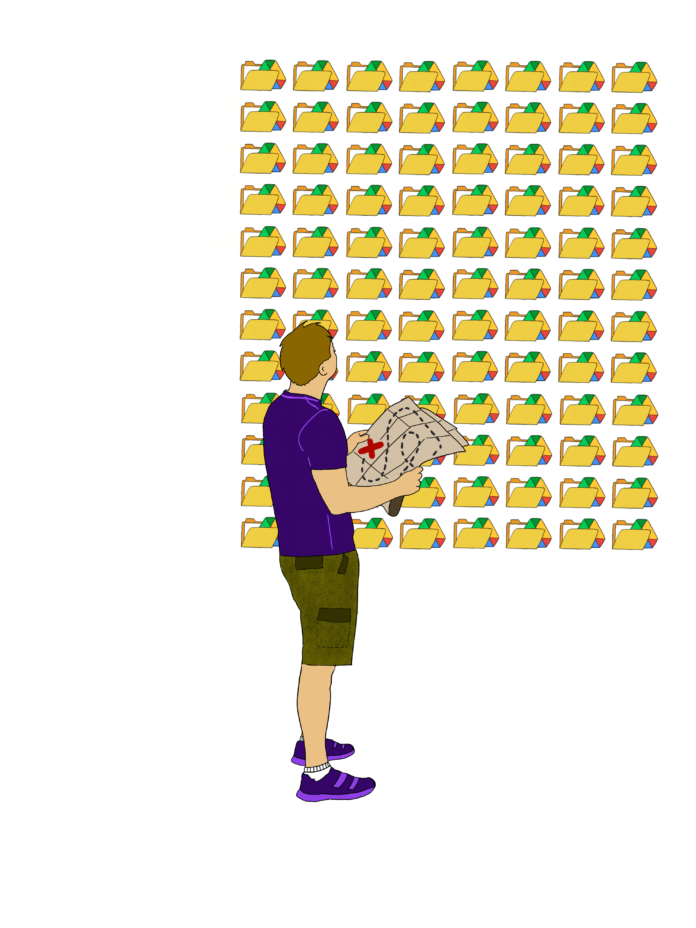
Hey friends. I hope I’m not the only person struggling with this, but I seriously cant think of any more ways to keep folders and documents organized. Folders are supposed to make life EASIER, not harder. So, why are these shared drives so hard to navigate, and when will Dora The Explorer’s map come and help me find the locations of the drive I need to get to??? It would probably take less time for me to drive to California than to find my group’s second draft of the body section of our project.

When I need to find a document in the shared folder, I really don’t want to bother my group and ask them for the link for the fifth time. What if they think I’m a bad student? What if they get annoyed and unfollow me on Instagram?

The only way to avoid these interactions is by doing the impossible: finding it myself. You may be thinking: Why not just stay more organized from now on? Why don’t you star the email or bookmark the link? Honestly, I don’t want to hear it. I don’t even blame myself for not being able to find anything. First of all, why are we using so many different websites to collaborate on the project? There’s Google Docs, Microsoft Word Online, Google Jamboard . . . On top of that we’re using my groupmate’s physical notebook that we can’t even access because they keep forgetting to send us pictures of our notes from brainstorming in class. 

Second of all, no one should expect someone to memorize where everything is, especially while managing multiple email addresses. I’ve got my SFU email, personal email, professional email, spam account email, work email, and fan account email. There are too many drives where links and folders could be sitting!

At the end of the day, I think the best solution would be for SFU to ban group projects from the curriculum. But since I know that’ll never happen, my other solution is to tell my group that I am old-fashioned and do not use modern technology for communication. This means I don’t have an email address, a social media account, or any means of contact other than the telephone at my house. As a result, the rest of the group is only left with two options: gather in-person to do the project with me, or collaborate online and finish the project without me. Either way, I’m cool with it. As long as I don’t have to dig deep to find files in the confusing and frustrating shared drive, I’m satisfied.