Home Blog Page 14

Future Geographies shifts the despair of climate change into artistic inspiration

0
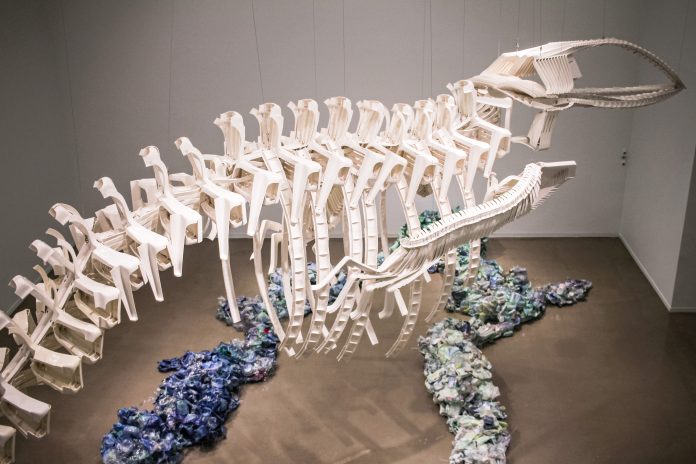
A photo of Brian Jungen’s Cetology, a whale skeleton featured at Future Geographies
PHOTO: Maya Barillas Mohan / The Peak

By: Maya Barillas Mohan, Staff Writer

The words “climate change” often inspire a sweeping flood of anxiety, but the new Vancouver Art Gallery exhibition, Future Geographies, uses these words for education, contemplation, and hope. Spanning multiple floors, the gallery displays a variety of media to deliver ideas and information. On behalf of The Peak, I went on the opening weekend. 

The goal of the exhibition is to “confront pressing questions about our shared future” through sculptures, photography, paintings, and other mixed media forms. The viewer can take their time through sections named “living knowledge,” “consumed earth,” “speculative worlds,” and “material memory.” Each section is spacious, giving visitors and artwork alike breathing room for in-depth reflection. 

Two of my favourite pieces transformed common disposable objects into horrifying, captivating sculptures. Artist Brian Jungen’s whale skeleton (named Cetology) made of white plastic patio chairs looms forebodingly over Liz Larner’s Meerschaum Drift assembly. The large skeleton suspended from the ceiling reminds me of New York’s whale, but Cetology seems to specifically reference increasing plastic pollution. The whale is made of and surrounded by plastic; Jungen merges wildlife with the sheer excess of consumer convenience. As the viewer is guided around Larner’s floor display of painted plastic bottles arranged to look like crashing waves, it’s hard not to reevaluate our own contribution to single-use containers

Rock formations shaped from discarded phones stand atop a literal island of computer cables in Huddled Masses. Artist Jean Shin mimics the shape of “scholar’s rocks” with discarded phones, collected via the electronics recycler Green Citizen. The sculpture draws attention to the deluge of e-waste that comes with modern life, and how technology has become fused with our environment. It was visceral, and almost nauseating, to gaze at these totems of waste. For a record, I snapped a photo. I realized then that my cracked blue phone could belong to an installation like this.

One exhibit that must definitely be experienced in person is LaToya Ruby Frazier’s Flint is Family photojournalism series. A collection of prints and accompanying passages depict the impact of contaminated water on marginalized communities, and then the miraculous solution of the atmospheric water generator. The photos were portrait-style, with sharp depictions of community members in their Sunday best. Part of what incited such a strong reaction for me was the tragedy at every level of this crisis, and the evocative way Frazier handled her descriptions. It’s sad, but at the same time, it’s hopeful. 

Future Geographies accumulates work produced this century from around the world to conceptalize climate and resource issues as globally pressing. The viewer is reminded that everyone can do their part to reduce (Meerschaum Drift), reuse (Huddled Masses), and recycle (Cetology). Climate change is horrifying, but these art works have shown that there is hope of resisting it in multiple ways, both collectively and individually.

I believe it’s important to engage with these ideas as spectators to the interpretation of others, but also be aware of our own placements inside the climate crisis.

Future Geographies will be on display at the Vancouver Art Gallery until January 10, 2027.

Nutritious Nibbles: Chelow kebab

0
A photo of chelow kebab
PHOTO: Taylor and Kevin / Wikimedia Commons

By: Nejdana Houshyar, Peak Associate

Persian cuisine is known for its intense, colourful flavours. It often uses ingredients such as saffron, dried herbs, fresh meat, and delicate fruits like pomegranate — staples in a Persian household. Each dish is intensely prepared and often takes immense time and patience to complete. But once you have tried and created a proper Persian meal from scratch, you will understand the effort. Chelow kebab is Iran’s national dish. It’s composed of saffron rice and ground beef (or lamb) and is often served with grilled tomatoes and sprinkled with sumac powder, a spice made of dried and ground berries of the sumac bush. The meat can be made on a grill, but if you don’t have a grill, on a simple stove — it is bound to taste delicious either way. This recipe, being homemade, will guide you through the process of making chelow kebab using a stove!

Ingredients:

For the meat:

  • 1 pound of ground beef
  • 1 large or 2 medium-sized onions, grated
  • 1 tsp salt
  • 1 tsp pepper
  • 1 tsp turmeric
  • 1 tsp paprika 
  • A pinch of saffron
  • Cooking oil

For the rice:

  • A pinch of saffron
  • ⅓ cup water to activate the saffron
  • 2 cups of rice
  • About 4 cups of water
  • 3–4 tablespoons of butter
  • 1 tsp salt

Optional garnishes:

2 tomatoes

Sumac powder 

Instructions: 

Preparing and cooking your saffron rice

  1. Wash the rice in a bowl till the water runs clear, then soak it in water for 20 minutes. 
  2. After the rice is fully soaked, drain the water.
  3. Then add four cups of water and one tablespoon of salt to a pot and dump the rice in. 
  4. Bring the rice to a boil over medium-high heat and cover the pot with a lid.
  5. Cook for about 15 minutes, or until the water is fully absorbed by the rice.
  6. While the rice is cooking, boil some extra water — about ⅓ cup — and put a pinch of saffron in it until dissolved.
  7. When the water is absorbed (when the rice finishes cooking), take the rice off the stove and let it steam for 10 minutes with the lid still on.
  8. When finished, take some rice and put it in your saffron water, mix it, and then dump it back in the pot.

Making the kebab on a stove

  1. In a bowl, mix the ground beef, grated onion, salt, pepper, turmeric, paprika, and saffron.
  2. Then, put the meat mix in a pan and flatten it into the shape of the pan — think of it as flattening and rounding pizza dough.
  3. Then, grab a spatula and create as many kebab strips in the pan as you like.
  4. Put the pan on medium-high heat and add oil.
  5. When the meat starts to sizzle, lower the heat and cook for about 15 minutes, or until brown, on each side.
  6. At this point, you can add the tomatoes if you would like and let them cook for about seven minutes.
  7. When meat is done, serve with rice (and sprinkle sumac powder if you want extra flavour), and enjoy!

Music as a healing tool: A review of Teresa Alfeld’s Hearse Chasing

0
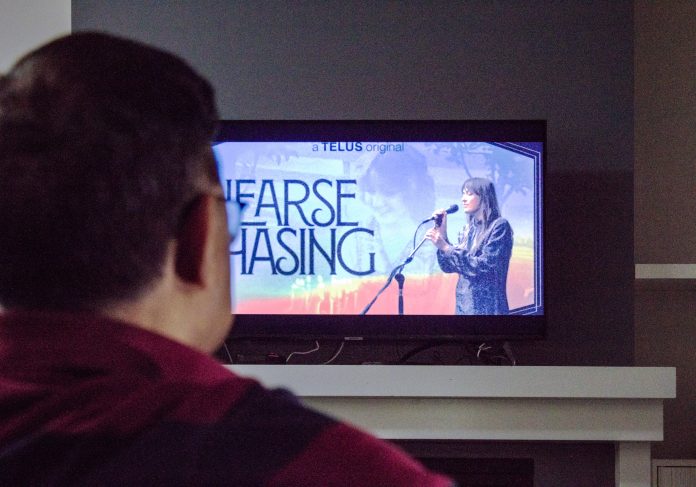
A photo of a person watching the documentary, Hearse Chasing, on the TV
PHOTO: Prerita Garg / The Peak

By: Nejdana Houshyar, Peak Associate

Content warning: brief mention of domestic violence and substance use.

Music can transport one into a completely different world. In Hearse Chasing, a harrowing documentary by SFU alum Teresa Alfeld, music serves as the central thread that sustains hope and ambition. The film follows Cassidy Waring, an indie folk musician, who, through a life of viewing and experiencing abuse, substance use, and the death of her mother, has been diagnosed with complex post-traumatic stress disorder (CPTSD) and travels back to her hometown of Calgary to uncover some truths about her family. 

The film offers a deep dive into the complex, yet familiar, world of Waring’s past. It begins with Waring and her younger brother Cooper exploring their old family home, which is now inhabited by a different family. In these scenes, I could feel the tension and heartbreak both siblings are feeling as they move through this uncanny space. Memories flood back to them, and I was able to empathize with the siblings as home movies overlap. 

The film narrates Waring’s story through interviews with family members and friends, such as her cousin Shelaine, her uncle Chris, and neighbours Lynn and Brad. These accounts seem long overdue, almost as if they were begging to be shared. The emotions in each individual are so palpable and raw, to a point of uncomfortable intimacy — it feels almost wrong to view them. However, this is the beauty Alfeld designs in this film — a discomfort where the audience is almost forced to look at and examine their own lives vis-à-vis the shots from the camera.

The film proves, through these intense conversations, that it is better to experience hardships with a community — one does not need to suffer alone.

The film discusses heavy topics such as domestic violence, alcohol addiction, and death in a thoughtful and sympathetic way. There is no hatred directed towards Waring’s parents, especially her mother, who, although had contributed to the children’s abuse, was a victim of it herself. The family accounts are not only used to understand Waring’s childhood and eventual CPTSD diagnosis but also as a helpful guide to anyone else struggling with similar situations, reassuring them that it does get better.

It is clear that the whole process of creating music — songwriting, producing, and performing — is the strongest tool that helps Waring work through her trauma. Scenes of her writing alone, or with others, provide glimpses of peace in the film. These moments show so much about why Waring became motivated to be a musician. The scene of her sitting with an array of family photos scattered on her bed, writing about her family and mother, shows her chosen outlet to display her emotions in a way she could not previously. During the final scene of the film, every bottled-up emotion and word left unsaid gets laid out as Waring debuts the song she has been working on, “Hearse Chasing.” Waring delivers a raw and emotional performance dedicated to her mother, singing with her eyes in peaceful trance as if she were only in the audience.

You can watch Hearse Chasing on TELUS originals YouTube channel.

Horoscope June 1–6

0

By: Zainab Salam, Editor-in-Chief

Cupid is on leave for quite some time (he’s reportedly on his honeymoon with Psyche — one that doesn’t seem to have an end date), so the planets decided to send in a substitute envoy instead. After several missed stops, Mercury called back — and was reprimanded for not reaching his stop at The Peak. Apparently, he kept on stopping to barter with merchants for the “best deal ever.” Venus has declined a job that is so below her beauty and station, and Saturn is just out to make someone’s life unnecessarily difficult “for character development.” 

The Editor-in-Chief of this publication decided to take matters into her own hands, and voyage on a treacherous journey to retrieve the absolutely necessary celestial intel hidden within the stars themselves. After surviving several retrogrades and an emotionally confusing coffee date, she has returned bearing the only thing more powerful than love itself: unsolicited relationship advice!

As the planets dance in the sky . . . and love lives are in shambles . . . the long-awaited, with bated breaths, heavenly relationship advice tailored for all of you! 


Aries

March 21–April 19

Rushing head-first into love might end with you slamming into one of AQ’s concrete walls — and honey, there are many of those walls everywhere you go. The stars advise you to stop treating every crush like a speedrun challenge. Not every “sup” requires a boombox love confession! Venus in Cancer asks you to delay your marriage proposal just a few more weeks. Maybe better luck when Venus moves into the fiery Leo on June 13. 

Taurus

April 20–May 20

Take your date to the best restaurant ever: the IKEA restaurant! A relationship that cannot survive entirely on meatballs, lingonberry sauce, and “how about this couch?” isn’t even worthwhile. Venus in Cancer urges you to embark on a six-hour furniture labyrinth to test out your possible partner. The one is the person who can actually appreciate the finer things in life — in this case, you need to be budget conscious, so IKEA it is.  

Gemini

May 21–June 20

Your mercurial ways can’t help but to juggle those three crushes, four talking stages, and one sincere yearning for a special someone to notice you. The stars this week suggest that you stop sending mixed signals! Sending “I miss you” at 2:13 a.m. and then replying “lol who is this” a week later, is very stereotypical, but that doesn’t mean you should be a stereotype. Let’s grow up this week, Gemini. I believe in you!  

Cancer

June 21–July 22

Don’t worry. Your classmate, the one you have a crush on, has no idea you’ve already imagined a joint-chequing account with them; or that you’ve mentally planned your future grocery runs together — nothing screams romantic more than an impromptu chicken nuggets purchase on aisle nine. I feel it is my duty to note that your effort of making them “catch a hint” didn’t actually work. Just because they’ve given you their pencil, when you’ve asked to borrow one, doesn’t mean they know you like them. 

Leo

July 23–August 22

Your front-facing camera screen time is becoming spiritually concerning. The stars encourage you to search for other reflective surfaces to admire yourself on. Ask Narcissus, he knew how to find one. On a serious note, the stars ask you to prepare yourself for the ultimate love come mid June! With Venus moving into your sign, you’re fated for a once-in-a-lifetime encounter with a special someone — it might be your reflection in your computer screen during midterm season, but hey, self-love is love.  

Virgo

August 23–September 22

I won’t lie Virgo, it just might be hopeless for you. The South Node stationing in your sign is just a big ‘ole yikes. At this point, your inner monologue has become a 24-hour customer service complaint chain run entirely by you! Like, maybe go on a run to escape the existential dread that’s been accumulating in your catastrophizing little heart? The stars wish to help you, but every time they offer guidance, you respond with “well technically . . . ” and start overanalyzing the advice. For legal purposes, and as a time-saving strategy as instructed by HR, the stars decline to offer advice!

Libra

September 23–October 22

This week a hot new bombshell enters the villa! And the stars are already exhausted with your inability to decide so they decided to exit your villa. At this point, the stars are actually closed for business, because what the hell man, this is the 27th date that you’ve been to this year and you seem to “lose the spark” by the time the entrée makes it onto the table! Like you asked them out . . . ? 

Scorpio

October 23–November 21

I’m not sure how to advise you on how to make your intentions known, but I’ll start with telling you to tone down that stare. You examine your crush like you’re hoping to uncover some classified information. The stars advise you to blink occasionally, and to approach your crush more. 

Sagittarius

November 22–December 21

This week is an auspicious week for you to be a romantic menace. Go out on that date, and proceed to ghost the person you went on that date with. Romance is but a vibe, am I right? WRONG! Jupiter in Cancer warns you against letting life dictate your path. Your crush would like to know if you’re emotionally unavailable or simply hiking somewhere without reception again.  

Capricorn

December 22–January 19

I’ll just say it: you need to practice other flirting techniques. Asking people to provide their credit scores, and five-year-plans won’t cut it for long. Romance can enter your life, once you stop penciling it in. Your partner shouldn’t have to put up with your quarterly performance reviews, and just enjoy romancing you. Saturn in Aries demands that you stop referring to emotional vulnerability as “an inefficient allocation of resources.” 

Aquarius

January 20–February 18

To find your soulmate, or improve your current relationship, the stars advise you to put down that damned notepad from your hand, and actually engage in human interaction. Explaining love through obscure philosophy references and a diagram you drew on a napkin is not flirting. Your crush might not know about Plato’s “ladder of love.” And honestly? They’re on this date trying to learn about you, not Plato.  

Pisces

February 19–March 20

Yes, Pisces, there are plenty of fish in the sea, but apparently you can’t swim. The stars advise you to sign up for swimming lessons to help you catch some “fish.” With Neptune in Aries you’re asked to stop falling in love with people based on “their aura” and one shared passing glance during a lecture that happened a year ago.

Vancouver Whitecaps in danger of franchise relocation

0
Black-and-white illustration of grief-stricken man wearing Whitecaps merch, holding a Whitecaps flag in one hand and a Canadian flag in the other.
ILLUSTRATION: Cliff Ebora / The Peak

By: Jonah Lazar, Staff Writer

After over half a century playing in Vancouver, Major League Soccer (MLS) club the Vancouver Whitecaps may be relocated, as potential buyers of the club look towards Las Vegas as a new home for the franchise. 

Following the Whitecaps being put on sale in December 2024, a potential buyer of the club has been considering relocating elsewhere to increase revenue. Earlier this month, an American investment group led by billionaire Grant Gustavson formally submitted a bid to purchase the club, with the stated goal of relocating the Whitecaps to Las Vegas.

While this potential relocation unfolds, the community has been rallying to keep the team in Vancouver. The Save The Caps movement was founded by the Vancouver Southsiders as an effort to get fans involved in the battle. This movement has garnered support from not just fans of the team, but also businesses reliant on the traffic that the Whitecaps games bring downtown. 

Kevin Kerr, director of events for the Vancouver Southsiders, told The Peak, “This is bigger than just a team leaving.” 

[Some] downtown businesses basically survive on Whitecaps games [ . . . ] So they lose that revenue, their businesses might not be viable.”

— Kevin Kerr, director of events for the Vancouver Southsiders

Over 400 businesses have called on the province to seek solutions to keep the team in Vancouver, following a canvassing campaign conducted by the Save The Caps movement.

The driving force behind this possible relocation is due to the Whitecaps’ stadium revenue. The club currently plays at BC Place, which they lease from PavCo, a corporation of the provincial government. Their current lease with BC Place is not sustainable, according to MLS commissioner Don Garber, because of the division of revenue between the provincial government and the club.

While other MLS clubs are able to sell naming rights of their stadium, advertising rights within their stadium, collect ticket fares, and sell food and beverages, the Vancouver-based club has a contract that requires them to fork over a large amount of the revenue generated from BC Place to the provincial government. The Whitecaps receive just 20% of the food and beverage sales from their matchdays, which is “less than any other team in Major League Soccer,” according to Daily Hive

Garber also cited scheduling conflicts with BC Place’s other events, such as concerts and BC Lions games as an additional reason for the stadium situation being unsustainable. Sportsnet reported that the Whitecaps were forced to play away from home in the playoffs last year due to BC Place having already booked a motocross event, due to the stadium’s lack of scheduling flexibility.  

While the future of the Whitecaps may be up in arms, support for the team is unwavering. “Everyone pretty much wants the team to stay,” said Kerr, “I haven’t met someone that goes to a game that isn’t trying [to get the team to stay to] some effort.” Furthermore, Garber, mayor Ken Sim, and premier David Eby are in continuous conversation about the “the future of the Vancouver Whitecaps,” according to a statement MLS made to The Province, following Eby expressing a committment to keep the Whitecaps in Vancouver.

This could be the second time that Vancouver loses a major sports team franchise to relocation, following NBA team The Vancouver Grizzlies relocation to Memphis, Tennessee, in 2001.


Restored access to SFU Canvas following security breach

0
Illustration of a student’s Canvas layout on computer screen, with question marks replacing typical icons and text
ILLUSTRATION: Victoria Lo / The Peak

By: Marie Jen Galilo, Staff Writer

On May 7, 2026, a security breach on Canvas Cloud prompted Instructure, the parent company of Canvas, to shut down the learning platform. The breach of Canvas Cloud affected the nearly 9,000 institutions that use Canvas Cloud as a learning platform, including SFU and UBC.

According to a previous statement by SFU media relations, SFU made the decision to transfer to Canvas Cloud in January 2026 because it offers “more stability and new features than on-premise systems,” which SFU was using prior to Canvas Cloud.

Instructure first “detected unauthorized activity” on April 29, which prompted the company to investigate. SFU students and staff were first informed of the security breach via email on May 6. The Peak reached out to SFU media relations for a statement, and was referred to SFU’s regularly updated SFU Alerts page

On May 7, a second breach of the Canvas page led Instructure to put Canvas on maintenance mode. According to Instructure, “no additional data was accessed or exfiltrated in this second attack.” Both attacks were carried out using Instructure’s Free-For-Teacher accounts, which have since been disabled. 

On Monday, May 11, the first day of the 2026 summer semester, SFU restricted access to Canvas Cloud, and stated that the restriction was necessary to protect the “information and intellectual property” of students and staff. 

SFU Alerts provided resources to support students following the breach, including tips on how to avoid phishing attempts. Students requiring accommodations were advised to reach out to the Centre for Accessible Learning. Students were also directed to find support networks in Health & Counselling Services, the Multifaith Centre, and 24/7 health support on the MySSP app.

The Peak reached out to SFU’s Graduate Student Society (GSS), and spoke with the director of external relations, Kody Sider, on May 13. “Our main concern [was] for vulnerable populations, especially international students,” he said. “If that data becomes publicly available, like things they’ve said in direct messages or assignments they’ve done that might [not be] seen as proper in their home country and might cause reprisals or damage at home,” added Sider.

Another concern was how research will be affected by the breach. According to Sider, if graduate students are “researching vulnerable populations or have confidential information that was stored on Canvas and it gets released publicly, that could be damaging to research participants and also could put students’ research in jeopardy.” The Peak also reached out to the Simon Fraser Student Society for a statement, but did not receive a response by the publication deadline.

According to multiple news sources, Instructure paid a ransom fee to the offending party, ShinyHunters, on May 11. As reported by Inside Higher Ed, the company shared they received proof of data destruction, indicating that no Canvas data will be made public. 

On May 15, the SFU Alerts page shared an incident fact sheet from Instructure, who shared that cyberhackers obtained the “usernames, email addresses, course names, enrollment information and messages” of staff and students in the first breach.

“None of the data fields we understand to be impacted are intended to include information like passwords, dates of birth, healthcare information, social security numbers, financial information, student grades or disciplinary records.”

— Instructure, parent company of CanvasThe second breach did not take any data.

As of Tuesday, May 19, Canvas was fully operational, although the SFU Alerts page warned that students should “stay aware and alert for phishing scams” following the security breach. Following the return of classes on Canvas, it will not be necessary for students to change their passwords to log in to the platform. Students will also be given until Monday, May 25 to drop courses as they finalize their course schedules for the 2026 summer term.

For the latest updates on the situation, check ServiceHub and the SFU Alerts page.

Student aid should match cost of living

0
A young person stressed out looking at bills
PHOTO: Vitaly Gariev / Unsplash

By: Corbett Gildersleve, Opinions Editor

Many university students get student loans to help pay for their education and living expenses. According to StudentAid BC, monthly living allowance covers shelter, food, local transportation, and miscellaneous expenses. This amount is set by what the federal government considers a “moderate” standard of living, though it’s unclear how this is estimated. There are multiple categories based on whether you’re a single student living at or away from home, if you’re married, and/or have children, each with their own allowances. If you’re living away from home in BC, the monthly allowance is $2,423. However, this number might not be what you receive. There are multiple factors that can affect this amount including your program’s length and your finances. In some cases, your parents might be expected to contribute financially. After doing the math, many students can’t live off this. 

BC’s cost of living varies from place to place, but on average, the monthly cost for a single person ranges from $3,300–$3,800, according to Statistics Canada. In 2025, the Burnaby Beacon reported that Burnaby’s average rent for a one-bedroom apartment was as high as $2,366. This leaves you with $57 for all your other expenses, going off of student aid’s aforementioned monthly allowance. There is a clear disconnect between what StudentAid BC asserts to be sufficient and the reality of the cost.

As a student, you don’t get a discount on living costs. You don’t get 10% off on rent because you’re enrolled at SFU.

You have to compete for that one bedroom apartment against a bunch of people with more competitive applications; such as working professionals, and/or a married couple

Let’s look at SFU. If you’re a new student moved in this summer into a Burnaby campus residence, your average monthly costs are less compared to the market, but you have fewer choices as well. If you’re selected for the Towers (North, West/East), or Courtyard Residence, then you’re required to pay for the meal plan. Adding up the housing and meal plan fee, the cost ranges from $1,771–$2,007 a month. That would leave between $416–$652 a month for transportation, clothing, entertainment, and eating the odd meal outside the dining hall. 

While it’s not possible for a single student living away from home to live off of the maximum monthly allowance given by BC student aid alone, it still doesn’t account for additional expenses. This would include the pink tax where buying common items are more expensive when targeted towards women (e.g. razors, hair cuts, deodorant) or additional living costs for international students (e.g. GuardMe and MSP). It also doesn’t give enough of a buffer for emergency situations. 

If you have to work and take out a student loan, then you have less time to study, to meet with friends, volunteer in a club, or do all the other opportunities that come with being a student. This can negatively impact what social connections you’d make and perhaps mess with the development of new skills which can affect your graduate and/or job applications. The BC and federal governments should not have student aid based on some averaged set of costs but instead based on the local cost of living. It should also take into account other social factors like race and gender to counter issues like the pink tax and inequitable costs. This just further stacks the deck against students by requiring them to work more, take on more debt, and in the end, have less employment opportunities. The government needs to think more about equity instead of base equality.  


Using Canvas means we have 9,000 eggs in one basket

0
ILLUSTRATION: Angelina Tran / The Peak

By: Corbett Gildersleve, Opinions Editor

It’s been an interesting few weeks since SFU announced that there was a cyber-related incident affecting Canvas Cloud on May 5. An estimated 9,000, some during their exam period. ShinyHunters claimed they had information from 275 million accounts. With all these university customers concentrating on Instructure’s software service makes it a juicy target for hacker groups like ShinyHunters. This is why Canadian universities need to work together to develop and host their own software solutions instead of relying on the same third-party companies. 

On May 9, SFU had alerted us that Instructure — the company that develops and runs Canvas — told them that the system breach included students name, ID number, email addresses, and messages sent on Canvas. SFU decided to restrict the use of Canvas Cloud to everyone on May 11 and gave instructors time to download their course materials. However, after Instructure made a deal with the hackers, ShinyHunters, which included them destroying the information they obtained, SFU changed its course and reinstated Canvas Cloud access on May 19. 

Universities in Canada are not under one Federal Privacy Act, instead they follow provincial laws. These acts include BC’s Freedom of Information and Privacy Act (FIPPA) and Alberta’s Protection of Privacy Act (POPA). Private companies must follow the Personal Information Protection and Electronic Documents Act (PIPEDA) or a provincial equivalent like BC’s Personal Information Privacy Act (PIPA). So any company that universities contract services to or use their software tools should follow these laws. However, what if those companies exist outside of Canada? Instructure has offices in the US, England, and the Philippines. That’s three different legal jurisdictions that your data might be transferred to and stored in. 

Upper Harbour maps software tools to their legal justification and if they’re exposed to the US CLOUD Act. This act compels US-based companies through a warrant or subpoena to turn over data stored on servers regardless of their location. According to the mapping, Canvas is exposed to it, as is Slack, Zoom, Discord, Turnitin, and a whole host of other software that students regularly use. Additionally, Upper Harbour constructed a provincial data sovereignty exposure index by looking at their privacy legislation and found that only Québec had strong laws with BC and Alberta coming in next. 

SFU should work with other Canadian post-secondary institutions to develop their own software and infrastructure solutions.

They can collaborate on the privacy requirements they all need to follow, share the knowledge, skills, and costs, through their different IT and web departments. Larger institutions like the University of Toronto could lead the project as they have more resources than smaller colleges and universities. They have servers, networks, and other existing infrastructure that just needs to be connected for this purpose. 

Our private information should only be accessible to organizations that aren’t exposed to other countries’ privacy laws, as we don’t elect their lawmakers and can’t hold them accountable. It wouldn’t be useful for every university to have their own individual Canvas-like software or email system, as that would waste a lot of money by more-or-less creating multiple email or course delivery software. Cyber security is challenging but 109 Canadian universities would be a smaller target compared with the 9,000-ish currently affected, and our personal data wouldn’t be automatically shared with the US government through a warrant or subpoena. 


Buddhists celebrate the teachings of Vesak 2,570 years on

0
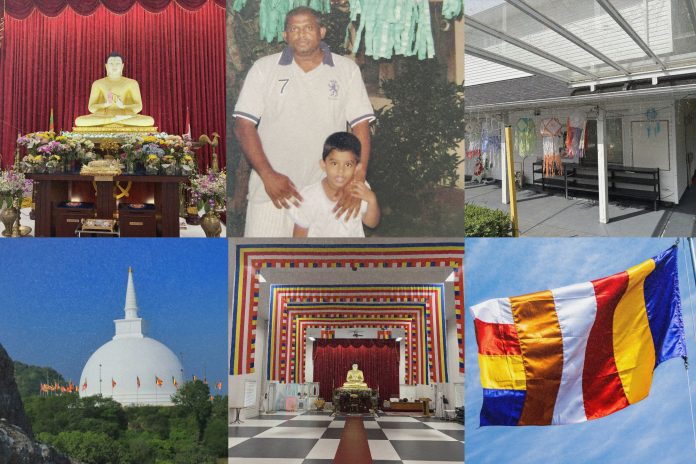
A collage of photos from top left to bottom right: a Buddhist altar, a childhood photo of the author with his father standing in front of two large hanging Vesak lanterns, a string of lanterns hanging outdoors from the overhang of a roof, a Sri Lankan temple surrounded by trees, a Buddhist altar inside a temple, and the Buddhist flag
PHOTOS: Courtesy of Niveja Assalaarachchi, chris robert / Unsplash (flag), and Rathna Deepaya / Unsplash (temple)

By: Niveja Assalaarachchi, News Writer

Vesak is a religious celebration that marks the birth, enlightenment, and parinirvana (passing away) of Siddhartha Gautama, the Lord Buddha. The day is regarded as the most important religious day of the year for the nearly 506 million Buddhists around the world. As a Buddhist myself, I regard the date as not only an important reflection of my faith, but an important point of cultural expression as many different cultures who have adopted Buddhism express this day differently. 

Though generally held on the first full moon day of Maythe interpretation of the date changes depending on the country or sect. In Myanmar, Vesak was celebrated on April 30 this year and in Sri Lanka, where I’m from, it will be celebrated on May 30. 

Though I left Sri Lanka when I was young, I still remember some of the major traditions of the holiday. In Sri Lanka, Vesak is celebrated as a Poya (පොහොය) day, which is a monthly Buddhist holiday held every full moon. Poyas mark important events in the history of the Buddha, and Buddhism in Sri Lanka, with notable Poyas including Poson Poya (පොසොන් පොහොය — commemorating the arrival of Buddhism to the land of Sri Lanka) and Esala Poya ( ඇසළ පොහොය — commemorating Lord Buddha’s first Dharma sermon). In Buddhism, Dharma refers to the nature of the universe.

Vesak is the most important Poya and the whole country rejoices to celebrate the occasion. Street stands known as Dansal (දන්සල්) are held on Poya days like Vesak. While a difficult concept to translate into English, Dansal is generally when a type of food or dish (or other good) is freely given to others as an act of faith. The Thorana (තොරණ), a type of decorated gateway, is often constructed en-masse and depicts certain scenes in the life of the Lord Buddha. One of my core memories is making Vesak lanterns with my family during the time of Vesak Poya. Vesak lanterns, or kudu (කූඩු), are made from paper with a lit candle in the middle to represent the illuminating nature of the teachings of the Buddha. 

Speaking of those teachings, it is this that truly ties Vesak together with all Buddhists around the world. On this day, Buddhists remember the core messages of the faith and the Buddha’s life journey. I spoke to Reverend Dr. Ernest Ng, Buddhist chaplain at the SFU Multifaith Centre

“The core message from the Vesak is also what the Buddha taught us in terms of compassion and wisdom. Compassion, meaning understanding the commonality — the link that is tied in each one of us, all sentient beings, even of all different kinds of existence in the world — that we all have resistance or refrain from suffering and we all pursue happiness,” he said. “Suffering not in a pessimistic sense, but suffering in a sense that we need to understand the predicaments, the challenges that we have in the world.”

Ng highlighted one of Buddhism’s primary teachings, the Four Noble Truths, which explains why suffering happens in this life. The truths are Dukkha — suffering exists in life, Samudaya — craving and attachments causes suffering, Nirodha — suffering can be stopped, and Magga — following the path of the Buddha and his eightfolded path, we can gain enlightenment and escape the suffering of this life. These are teachings that are essential to remember on Vesak and in practicing Buddhism in general.

Ng said that during Vesak Poya, Buddhists try to “learn and also to connect with our community and each other and support each other. So, it’s a good occasion to pay respect but also at the same time, good occasions to connect with our community, to rejoin together.”

For the purposes of this article, I also reached out to my local Buddhist temple, the Buddhist Vihara Society of BC, and connected with a monk who serves there. Venerable Dr. Mirisse Dhammika Thero is a Buddhist monk who is also currently serving as the chief incumbent of the Siri Sudassanarama Senasuna temple in Sri Lanka from abroad. He is also an SFU alum, gaining a PhD in education. He noted that his research focused on the “secular teachings in the Buddha’s past” in regards to “getting rid of stress and practicing mindfulness,” which are core tenets of the faith.

Dhammika Thero said that Buddhism highlights mindfulness (Sathi) and also further emphasizes the impermanence of this world. “That there is no permanent entity of self,” he explained, and we must train our mind to practice compassion and altruism “without asking for any kind of worldly feelings or sensations.” He continued, “Nothing is permanent, including our thoughts, even this physical body. 

“Therefore, when you accomplish your goals, when you come to fulfill your dreams, be honest, be humble, and then give your helping hands to each other in whatever way.” He emphasized that on Vesak — and to follow the Buddhist teachings in general — it is key to give Dana — generosity, Sila — morality, and to do Bhavana — meditate. 

“When we celebrate Vesak, there may be some differences because of culture and tradition . . . But we are coming to the same one point, that is Nibbana.”

— Ven. Mirisse Dhammika Thero, Sri Lankan Buddhist monk, SFU alumnus

Nibbana (also known as Nirvana) is the ultimate goal of all Buddhists, to escape the cycle of rebirth and worldly suffering. As Dhammika Thero put it, it is the “eradication of all kinds of defilement.” 

Ng said that “it’s a very significant day for the Buddhist community, celebrating our teacher, the Siddhartha Buddha. It also signifies, of course, his compassion and wisdom that guided us over 2,500 years ago.”

The complexities of Buddhism and its teachings go far beyond Vesak Poya. When I finished speaking with Dhammika Thero, the monks at the temple gave me the book What the Buddha Taught written by the famous Sri Lankan monk Venerable Dr. Walpola Rahula Thero. The monks pointed out that the book provided a dense yet simple explanation of what Buddhism is and its teachings. It is perfect for anyone who wants to deepen their understanding and learn about Buddhism on a more profound level.

Ng pointed to resources on campus for those interested in engaging with Buddhism. He said that the Multifaith Centre hosts monthly Cha’an and Chat Sessions both in-person at the centre and online.

ඔබ සැමට පින්බර වෙසක් පුන් පොහෝ දිනයක් වේවා! That’s Sinhala for, “May you all have a blessed Vesak Full Moon Poya day!”

Connect with the SFU Multifaith Centre for their monthly meditation sessions held on a Saturday, primarily during the fall and spring semesters.

Connect with the Buddhist Vihara Society for their weekly meditation sessions on Sundays and their monthly Dhamma sermons held every Poya day.

War and peace through the lens of young adults in love

0
A still from A Sad and Beautiful World
IMAGE: Courtesy of Reynard Films, Abbout Productions, Diversity Hire, Sunnyland Film, The Red Sea Fund, and Giant Leap Media

By: Niveja Assalaarachchi, News Writer

On May 1, the Centre for Comparative Muslim Studies, Beirut Film Society and Lebanon Cinema Days Canada premiered the film A Sad and Beautiful World (نجوم الأمل والألم) by the award-winning Lebanese director Cyril Aris at SFU Harbour Centre. The film, set in Lebanon, tells the love story of Nino and Yasmina as they grapple with the Lebanese civil war (1975–1990) caused by a combination of sectarian divides between Lebanon’s major religious groups and spillover impacts from the violence between Palestinian liberation groups and Israel.

Though I was not able to attend the premiere at the time, I managed to watch the film and wanted to highlight my reflections. Throughout the film, the couple struggled to deal with the realities they were experiencing. The duo, who first met in childhood, are reunited later in life as the country falls into sectarian violence. This is coupled with their personal circumstances, such as their evolving personal goals and professional careers. All of this makes Nino and Yasmina wonder whether they would want to continue with their relationship and if they want to raise a family considering their unique and difficult circumstances — circumstances very out of their control. 

Aris did an excellent portrayal of the innocence of young love and the impacts of the harsh sociopolitical realities of their context.

This is all the more painfully reflected outside the screen today as armed conflict, ranging from the genocide in Gaza to the war on Iran to continued civil strife in Myanmar, continue to negatively impact countless families — and young adults like Nino and Yasmina — around the world. The plot development shows resilience, through how the couple first met in their youth and distanced themselves from each other, yet came back time and again. 

One of my favourite scenes in the film, which is portrayed in the trailer as well, is when Nino and Yasmina are innocently running through the streets of Beirut and are stumbling over cars. They then proceed to get yelled at by one of the drivers of one of the vehicles. They make a sprint to a tunnel, where they manage to escape the wrath of the angry man. The scene is full of music traditional to Lebanon and thus makes it a rich, cultural depiction of the culture that the film is set in, despite the turmoils of the socio-political backdrop. This scene is a reflection of the whole movie as it portrays a myriad of emotions of love that co-exist within the realm of war and peace. I believe that it is this combination of an overlying tension between love and society, the drama of two young adults attempting to balance the realities of life and romance, and the film’s overarching commentary on politics in West Asia is what makes A Sad and Beautiful World certainly worth watching.