Home Blog Page 1158

The True Heroines are super ladies on a special mission

0

true heroines 165310

As film and television move into new media, high quality web-based interactive and multiplatform storytelling is finally getting due recognition at Canada’s film and television awards. The Canadian Screen Awards (Geminis) recognized digital media in 2010, and the Leos followed in 2013.

This year, Vancouver’s own The True Heroines achieved national prominence at the Canadian Screen Awards with a nomination for Original Series-Digital Media Fiction, and won Best Web Series at the Leos. The True Heroines is a unique dramedy for the web with a feminist edge that combines a burlesque, science fiction, 1950’s style talkie with live cabaret shows, and an upcoming print comic.

After performing together in Vancouver’s popular cabarets, multi-talented Fiona Vroom, Jovanna Huguet, and Paula Giroday began to dream about finding a way to bridge the gap between film and cabaret.

“Small web series inspired us,” said Vroom. “The web has no barriers and we could create a smaller scale project.” At the time Vroom, Huguet, and Giroday looked to the Canadian series Sanctuary as a model. It began as an eight-series webisode, but was picked up by Syfy network and transformed into a TV series.

The True Heroines is a unique dramedy for the web with a feminist edge.

Friend and cabaret compatriot Joel Sturrock, a performer and choreographer, added his talents to the mix and together the four came up with the idea for The True Heroines.

There’s nothing like The True Heroines out there; as Huguet said, in the British Columbia film and television industry, “when they see a good idea they jump on it. Everyone we approached said yes. So, I guess, we must have had a good idea.” It was not long before The True Heroines found their director, Michelle Ouellet, and their writer, Nicholas Carella.

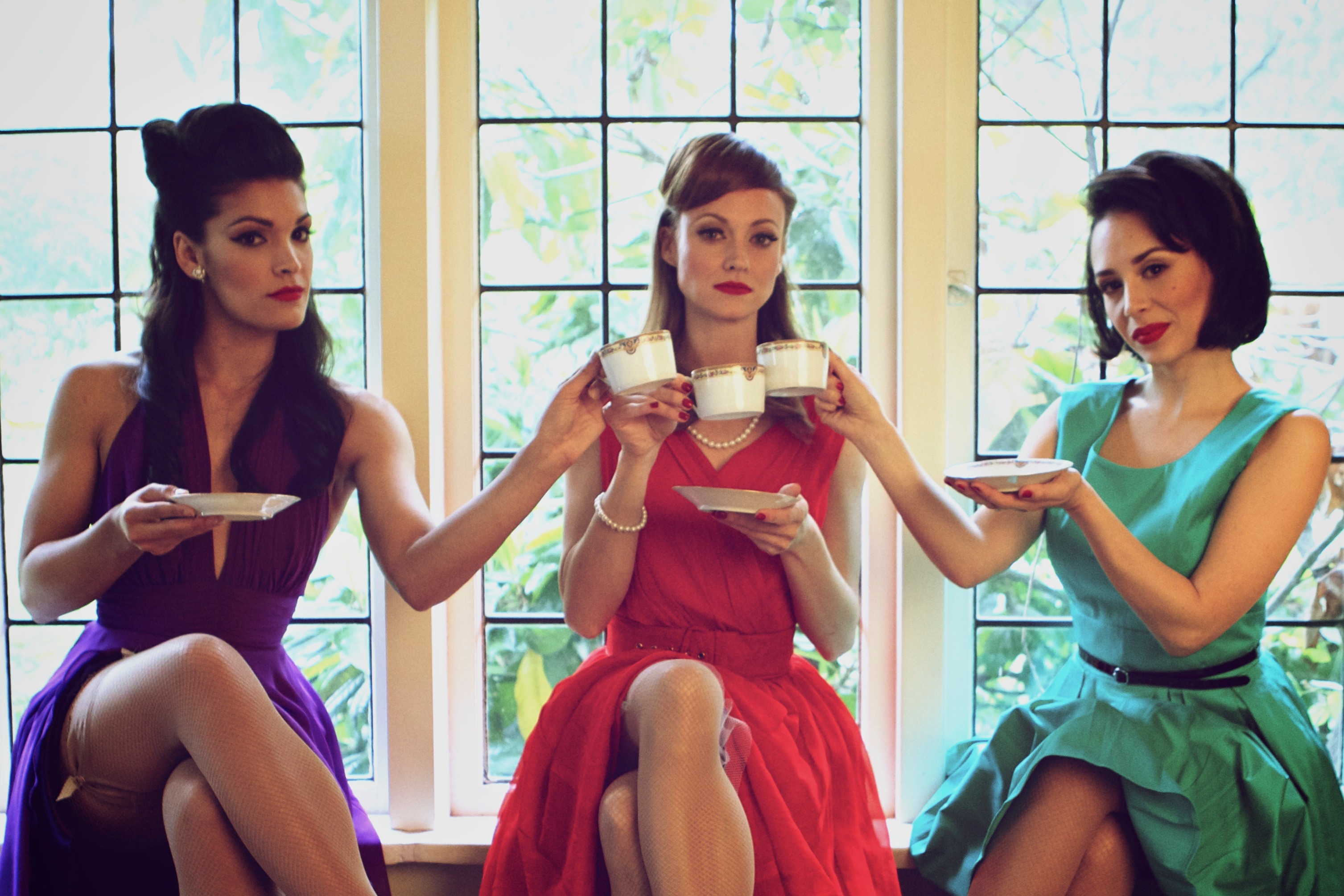
The story follows three housewives with superpowers who lead double lives in small-town Paradise Hill. They are products of a wartime research project, run by The Corporation, to develop super soldiers, otherwise known as Humans with Special Abilities (H.S.A.’s). The three were cabaret dancers in the military entertainment services during World War II. The time is now 1951, and The Corporation is hunting down the H.S.A.’s to hide evidence of their experiments. Hiding their superpowers from their husbands, the true heroines make sure they have “dinner on the table by six” as they try to discover what happened to them and stop The Corporation.

The talented team founded the production company, The True Heroines Entertainment, in 2010 and independently funded two pilot webisodes through live cabaret shows. They then spent two more years fundraising to finish the remaining three episodes in the first season. “It feels surreal. I’m so proud of us,” said Giroday. “We worked with such amazing talent, and our team really pulled together. It feels like we did the right thing.”

On top of gaining critical recognition, The True Heroines recently attracted interest from an executive at Bell Media, and Ouellet and Carella managed to pitch to the Space Network while at the Canadian Screen Awards.

The True Heroines are feeling good about the future, said Giroday: “We’ve had the opportunity to be in front of the right eyes, so we will have to see.”
Love is 224 tweets away

0

New research reveals that couples are falling in love faster than their parents, and it’s all thanks to technology. According to Pixmania.com, the use of social media is reducing the amount of time required for young couples to fall head over heels.

The courting process now takes a mere 224 tweets or a simple 163 text messages. It can happen after a casual 70 Facebook messages. Even a handful of emails or phone calls at 37 and 30, respectively, can have young lovers falling hard.

The study showed that previous generations took much longer to enter into a relationship. For participants aged 55 and older, the average time it took to begin calling one another boyfriend and girlfriend was 78 days. Compare this to the age group of 25 and under, for which the time taken to fall in love was 24 days on average.

Modern communication technology has essentially halved the time to fall in love.

Researchers attribute this to the fact that previous generations were not able to communicate with each other constantly. Instead of following the “three day rule” to contact a date, research revealed 68 per cent of respondents would text someone a mere four hours after a date.

The differences in communication patterns were also seen across gender. On average, a man sends approximately 517 Facebook messages and tweets per year—compared to a woman’s 386—in hopes of wooing a potential suitor.

Technology also proved a useful tool during break ups. Thirty-six per cent were willing to end a relationship with a phone call, 27 per cent by text, and even 13 per cent by base social media.

This research suggests an important shift has occurred in traditional dating practices. According to the marketing director of Pixmania.com, Ghadi Hobeika, “The days of penning a simple love letter to woo your new beau are over.”

Phallic Erections: Seven Penis-Shaped Buildings That Look Just Like Penises!

0

If you’ve ever looked at a building before, you can probably attest to the fact that architecture is pretty weird. Occasionally, whether they mean to or not, an architect will design something that people think looks like something else entirely! Sometimes what people see can be quite rude; the buildings below are prime examples of this. We can’t confirm or deny whether these erections were meant to look so umm, erect or not, but either way that’s how they turned out! So here we go, here are seven of the world’s most questionably phallic-looking structures . . .


Shaigon Tower, Shanghai

Building1_Shanghai
I don’t know about you but doesn’t this building looks a little bit like a penis? It might not be the most obvious example but there’s just something about that top part that looks a little odd to me, if you know what I mean.


American Express Plaza, USA
Seattle copy

At first glance this might just look like any other building but take a closer look. If you ask me the architect must have at least been a little bit inspired by the male form because it looks like a penis to me!


Tampei Tower, Taiwan

PA116485

This is another one that probably normally just blends into the background. Stop for a minute though, looks a little like a penis right?


Alberta School Board Building, Canada

Overhead copy

This one requires an aerial view before we start to see something a little funny. Those two buildings at the bottom right kind of give a rather rude illusion, wouldn’t you say? Maybe I just have a dirty mind, but it looks like a penis to me.


Pisa Tower B, Italy

Pisa

Of course we all know the Leaning Tower of Pisa’s reputation . . . it looks a lot like a slanted tower, but what about that new building that was built behind it last year? A little penisy maybe? I think so at least.


Washington Monument, USA

Washington copy

Personally I don’t see this one, but everyone tells me it looks like a penis. I guess I can kinda see it, maybe near the base, but if you ask me it’s a pretty big stretch to make.


Sydney Opera House, Australia

Sydney

Finally, an obvious one! When I first saw it, I thought I was looking at my own genitals in the mirror! Seriously, I can’t believe they let them build something that looked so obviously like a penis!

Abstinence is a viable option

5

CMYK-Abstinence-ClaraChow

Being abstinent in university isn’t just for the people who aren’t so great at sliding their number across the table at the bar. I have chosen (yes, chosen) to not have premarital sex and have enjoyed the benefits associated with my decision.

Choosing to make sex a part of marriage as opposed to a casual ordeal does not mean that I sit at home in a long skirt with my parents every Friday night. I have a great time with my friends, I enjoyed dating, and now I am happily engaged. I don’t feel like I have missed out on the university experience because I have chosen to remain abstinent, and neither should you.

I am not naive enough to believe that this is the popular choice among most 20-somethings. But I can say that abstinence isn’t just a fallback plan for people who have a hard time getting laid; in fact, it might be more popular than you think.

SFU is a diverse school, with a wide array of cultures and religions represented. With confidence, I can say that many of the cultures that are part of the fabric of our university do not think of sex as casually as North American culture does.

It is important to understand the view that our peers and friends may have been raised with, and why people around us may view abstinence before marriage as valuable.

People are ashamed to choose abstinance. Is this true sexual liberation?

Religions that value this guideline all have different takes, but here is something that most people can probably identify with: despite what we might like to think, our bodies and our emotions are not always easy to tear apart from one another. Sex doesn’t always end as casually as it begins.

Abstinence is not an easy decision being that casual sex is part of our culture and it is an expectation that partaking in it casually is just another step in the growing up experience. Being raised in Canada, choosing to be abstinent was always something I was ashamed of and felt excluded because of.

Changing someone’s mind with regard to their personal decision on sex is something that I do not intend to attempt, but I want to ask, have we become so immersed in a sexual culture that we are beyond understanding someone who chooses an alternative?

It was only a few generations ago that premarital sex was something to be ashamed of; now the pendulum has swung so far the other way that people whose culture or religion leads them to choose abstinence feel ashamed. Is this true sexual liberation?

Whether you consider being abstinent a concept for our grandparent’s generation or find North American culture disgustingly over-sexualized, it is worth at least considering the idea that many of the cultures represented at SFU may have a more conservative view.

If we are truly a university that is sexually liberated, we need to understand, respect, and appreciate those around us.

Perfect pairings for your pleasure

0

wine whistlerWelcome to a column by two seemingly regular suburban hoodlums who lead out of the ordinary, fabulous lives. This column will chronicle our suburban socialite adventures with sex, food, wine, art, and culture.

As two Italian winos, we get cozy with a few bottles every now and again, and again . . . and again. A rambunctious night with friends, dinner with la famiglia, or a post finals bubble bath — all of these situations present a perfect opportunity to dip into your cellar. But, the best pairing is most definitely wine and the bedroom. In honour of this week’s sex issue we suggest marrying your romance with a bottle or two of Barolo.

Imagine that you’re in Whistler, in a chalet during a blizzard. The room is dark. Cave dark. The walls are decorated in dark mahogany panels with moose and deer antlers. There you are, lying on the rustic, parquet floor in front of the crackling wood fire, covered in a bear fur (and not much else) with your lover beside you. The moment is right. You just need to find the perfect companion.

Well . . . instead of the muscled Brazilian across the hall, we recommend you ménage à trois with a Barolo. This powerhouse from the Italian region of Piemonte is a big, soul-warming, almost black-red wine that fills your mouth and seeps down to your toes.

Barolo is made out of the Nebbiolo grape, which is one of the stars of Italy. Like the grapes they come from, these wines have high tannins, huge power, and structure. They evoke flavours such as leather, chocolate, prunes, figs, violets and, sometimes, tar. Be very careful about opening this baby up too early. At the minimum, a Barolo should be aged five years: in the cellar, we have one from 1996 and it’s still considered a baby!

For that sexy chalet evening, if you want to splurge, we suggest the 2007 Gaja Dagromis. Jordan tasted this wine at a fabulous dinner four months ago and it was phenomenal with hints of black currant and tobacco that will stimulate more than your taste buds, and a finish that goes on and on and on! However, for those of us who don’t want to spend $150 on a bottle, we recommend the 2006 Tre Donne Barolo. This is a wine from a small estate yet it gives off all the power and flavour of its more expensive brothers.

Going out before taking it in? La Cucina in North Vancouver offers an old world Barolo that will tempt you and your partner to head for the car. This wine is the perfect prelude to love making. A fragrant bouquet of aromas smoothly caress your tongue. It all wraps up with a vivacious yet tender finish, making your lips weak and your body, well, powerless.

Your partner a cheap drunk? Try Provence’s sister restaurant, The Wine Bar, in Yaletown. Perfect for the novice sipper, this quaint venue offers wines on tap, giving you the opportunity to try an array of freshly un-oxidized vinos. Butter up your partner with a flight or two of some silky wines and find yourselves slinking off your silks in the sheets.

Wine and sex go together like bread and butter, like Beyonce and Jay Z, like calendars and firefighters. These things are just truths, things you can’t argue with, and things you don’t want to live without. Cheers! To arousing wine tasting and sensual lovemaking.

Read my lips: Why sex should be an open conversation

0

CMYK-Lips-Anderson Wang

I haven’t always been comfortable asking for what I want. For most of my teenage years, sex was something I just didn’t really talk about — with friends, maybe, but certainly not with a partner. I had been taught that sex was a language of passion, and not the time for actual language. Why ruin the moment by talking?

It took several failed relationships and lacklustre lays before I learned that open communication — in the bedroom and outside of it — is the most important part of a healthy sexual relationship with another person or persons. Whether it’s a one night stand, a friends with benefits situation, or a boring, meat-and-potatoes monogamous relationship (count me in the third category), the absolute best thing you can do to spice up your sex life is to tell the person with whom you’re having sex what you want — and ask them to do the same.

We learn from movies, TV shows, and yes, porn, to expect an idealized, picture perfect version of sex that pretty much doesn’t exist at all. Let’s be honest here. Real life sex hardly lives up to the glamour and grace we tend to see performed in films, whether PG-13 or NC-17. People’s bodies make funny noises, some positions just don’t work out the way you’d like them to, and no one is a mind reader. These hyper stylized representations of sex and sexuality are fun in moderation, but they betray the reality of sex: sometimes, it’s messy.

Open communication is the most important part of a healthy sexual relationship with another person.

What I eventually learned — once my mental image of the glistening, grunting, piano music in the background version of sex had fallen flat — was that the best way to get what you want out of a sexual relationship is to just go right out and ask for it. The truth is, no matter how emotionally connected you are with another person (or how much you want to bang them), no one knows your own body better than you do.

Now, I’m comfortable talking about any and all decisions I make in the bedroom with my significant other, and both of us end up safer, happier and more satisfied knowing we’re providing the best experience possible for each other.

At first, it wasn’t easy. I felt embarrassed and nervous to talk about my sexual appetites — what I liked, what I didn’t like, what I wanted to change or wanted to try — because I felt like I would be insulting my partner, or making them uncomfortable. The best advice I can give to those feeling the same way I did is to start slow: try to make your partner feel included, while being as honest and upfront as possible.

To make sex an open conversation, you have to break the ice: start by complimenting your partner, crack a joke, and make sure the tone is playful and unserious. (Unless, of course, you’re into serious.)

Opening the lines of communication in a sexual relationship, even if there’s no emotional side there, is also a valuable factor in establishing consent. You’ve probably heard consent being discussed before, but it’s a more nuanced concept than many people realize: giving your consent means that you’re a willing participant in a sexual activity. And consent isn’t only expressed verbally: it can also change based on someone’s level of inebriation, their body language, and a host of other factors.

Even if you’re in a relationship with someone, that doesn’t necessarily guarantee consent — it’s never okay to engage in any sort of sexual activity with someone who expresses any sort of unwillingness, or is unable to consent for any reason.

If you’re feeling uncomfortable in any way, speak up; if you’re not sure that your partner is consenting, check in with them and ask if they like what you’re doing. Consent is one of your most valuable tools in a sexual relationship, because it’s yours (and only yours) to give and to take away.

In the same vein, talking about how best to protect yourselves from STIs and pregnancy is the best way to ensure both you and your partner feel totally secure when you’re getting down to business. Not a fan of the pill? Talk it out. Latex condoms giving you a rash? Chat about a solution. The dreaded STI conversation isn’t the sexiest one you’ll have in your life, but it will lead to plenty more sexiness down the road — mostly because there’s nothing steamier than feeling completely safe and protected when you’re doing the deed.

Ultimately, talking with your partner (or partners) is the best way to make sure that you’re getting everything you want out of your sex life. Who doesn’t like to be told what they’re doing is good — or not so good, for that matter? I don’t know about you, but for me, few things are sexier than being told exactly what a partner wants in the sack, and being able to provide that for them.

Sex can mean a lot of things to a lot of different people, but all sex has one thing in common: it should be enjoyable! Take it from me: the best way to make all of your fantasies come true — and to help make your partner’s come true, too — is to talk about them. Screw politesse: let’s talk about sex!

How I Lost It is a not-so-sexy evening of comedy

0

CMYK-comedy-eleanorqu

Maybe you lost it on a heavenly hotel room duvet sprinkled with silk rose petals, covered in droplets of spilled champagne and sweat reeking of romance. Perhaps it was in the backseat of a ’96 Toyota Camry surrounded by empty water bottles, fast-food containers, and promises.

Heck, maybe you awoke covered in body paint and vomit, wrapped in the arms of a person you only met hours prior! Despite how you bid good riddance to your virginity, I’m sure that we can collectively agree that it was super awkward, exhilarating, messy, adorable, and — most importantly — hilarious.

Recognizing this, comedians Brent Constantine and Stefan MacNeil have joined forces to create what is sure to be a memorable comedic storytelling event. How I Lost It will feature Constantine and MacNeil (along with other renowned stand up comics in Vancouver) talking about how they lost their virginities, making sure to cover every uncomfortable, exciting, disgusting detail along the way.

I sat down with these two masterminds, and this conversation alone should make you nostalgic for the moment that you lost your virginity.


The Peak: You’re both talented comedians who perform regularly in Vancouver. Is this the first show you two have worked on together?

Brent:  Yeah, this is the first show we’ve put on together. Stefan was running a regular monthly room at the Railway, and I’ve done a bunch of stuff around the city as well since I’ve been here [Brent is from Edmonton], but yeah this is the first thing that we’ve done together. We’ve wanted to do something for a little while.

Stefan:  I don’t know how it came up, but we were just talking about it one day, and it was like —  hey! This could be a great show.

Brent:  We were talking about our personal, terrible experiences with sex and just thought ‘This is awful, and we should just tell everybody about this and have them also share in on how disgusting our lives are!’


P: So, essentially, the concept of the show came up when you guys were talking about having shitty sex?

Brent:  Yeah. I think we were at [Stefan’s] house when we were just talking about our different attitudes towards sex.


P: How did you choose the [other] comedians?

Stefan:  Most of them are just friends of ours. We asked a bunch of people if they wanted to do the show, but it’s a very uncomfortable question. You don’t even realize how weird of a question it is. It’s one thing when you’re asking your friends, but then asking people that you just know from around the comedy scene to do this thing . . . you’re like, ‘Hey, you wanna talk about this thing?’ And then as soon as you hit send on Facebook, it’s like, ‘Hmm that’s kind of a weird message . . .’

Brent:  I asked a couple of people, and pretty much everyone is like, ‘I have the best story for you!’ Only one or two people were like, ‘My story is not funny, it’s very romantic.’ But by and large, everyone has an awful experience that they want to share. Or maybe it’s just comedians, I don’t know.

Stefan:  Also when you go see most stand-ups, most people are talking about their sex lives. And not just their sex lives, but it comes up a lot in stand up. So it’s not a hard topic for them to talk about.

Brent: Boom. Is that a pun? But yeah, people like to talk about that kind of stuff, and I really like doing shows where you get people who you know are funny, and they’re doing stuff that’s not in their regular routine. The majority of people are gonna be [doing new material] — well probably all of them because I don’t know of anybody on the show that has material that they already do about their virginity.

Stefan: That was the thing. I like doing storytelling shows. It kind of changes it up from stand up. It’s a lot more interesting and more like an exercise. We tried to shy away from old material ‘cause some people do have bits and you think that they would work out perfectly. But, for this kind of show, what we really wanted was for people to write a story specifically for this.

Brent: One person was chosen because I truly believe they are disgusting, and I think that his story would be the grossest story in the world . . .

Stefan: See, I thought he was a virgin! That’s why we held off on him . . .


P: So is it just virginity that you will be focusing on, or is it gonna end up being weird sex stories in general?

Brent: Well Stefan and I will be hosting, so we might talk about sex in general, but everyone on the show is going to be doing a virginity show.

Stefan: We want it to be about virginity [. . .] that “losing your virginity” story. I think that one’s more interesting, and that’s the one that everybody can relate to.


P: Is that why you think the virginity concept is going to work? 

Stefan:  Your virginity story is so embarrassing, so it would make you feel so much better going to a show where a bunch of people are making fun of themselves while sharing that part, and most people in their 20s can relate to that moment. You can tell one story and people are just gonna be receptive to it. It doesn’t have to hit hard as long as it’s interesting.

How I Lost It will take place on June 24 at 8:00 p.m. at the Cottage Bistro at 4468 Main Street.

Gay men: stop the hookup stigma

0
ILLUSTRATION / C

CMYK-Grindr-chenchen

I speak for all guys when I say we have sex on our minds a lot — like right now (guys, don’t deny it). Naturally, there’s an app for that. Many, in fact. But, like with many online interactions, people are less inhibited than they would be face-to-face, which leads to some pretty nasty situations. . . exacerbated when sex is involved.

This seems to be more prominent in the gay community. What happens on meet-up apps for guys who are interested in guys is pretty ironic, given LGBTQ history. For a society that has long fought for acceptance simply for being who we are, apps such as Grindr relentlessly perpetuate discrimination, exclusion, belittling, and, one could even say, elitism.

It’s only been a few years since the first geosocial networking platform tailored towards gay, bisexual, and bicurious guys launched, and now almost every 20-something gay guy has one on his phone. According to its inventors, apps such as Grindr make “socializing easier” (i.e. put sex at every horny guy’s fingertips).

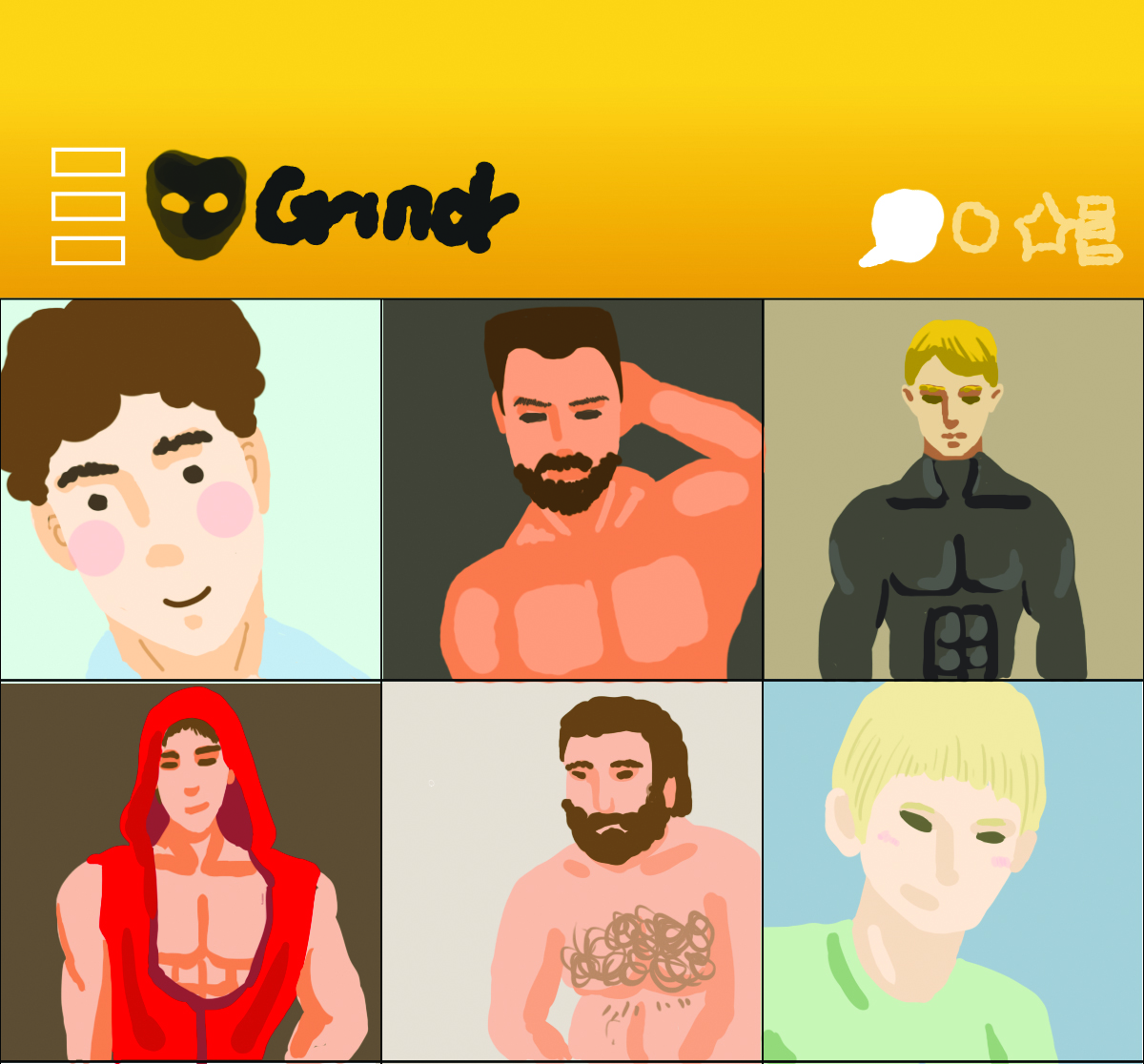
Scrolling through the plethora of Adonis torsos, profiles read as follows: No fems, Masc only, Asians + +, Drama free, Discreet only, No Asians, NSA, Not into twinks, Straight-acting, NEG U B 2, Love bears / otters, Jocks front of the line! Oh, but my personal favourite? Must be built (and variations of this). I’m sorry, not all of us spend five days a week at the gym, taking shirtless/headless selfies.

Apparently, this taxonomy of gays is a growing, unforgiving practice. Categories such as twink (a young, boyish look) or bear (having a hairy body) invalidate gay guys. These categories turn into “gatekeepers” to gay sex. If you don’t fit into a type, you aren’t worthy of intimacy.

This is not to say we should all just have unfiltered processes of getting into bed with everyone, but this casual discrimination and exclusion should be reconsidered when it comes to casual fun/sex. This discrimination denies guys a sense of self-worth as they’re judged on things out of their control such as genetics and race, which affect things far more important than just having sex. Does this level of discrimination sound familiar?

Though we rally together for equality in a hetero-dominant world, there is still much work to be to done. We want everyone else to love and accept us for who we are, yet we can’t even do it amongst ourselves. We use sex as a means to thicken lines of division when it could safely be used to do the complete opposite!

Yes, everyone has preferences, and don’t get me wrong, there’s nothing wrong with having them! But coming off as blatant and rude is not sexy.

This bluntness is also shocking to some heterosexual people as well. In one video, “Straight Men React To Grindr,” a couple of guys say, “I see a lot of abs [. . .] This is just straight up honesty.” Another states, “You cannot have this in the straight world.”

When it comes to guy on guy sex, the interaction seems to be far more straight to the point. Maybe we enjoy being braver than assumed to be. But is parading this forwardness worth the cost of another’s self-worth?

In the virtual sea of perfectly sculpted, pretentious, and discriminating bodies, though, there is still hope. There are those who use “socializing-turned-finding-sex apps” for other purposes, and make these intentions clear: No hookups, Whatever happened to just chatting?, Here 4 friends but open to possibilities.

These are just some enlightening words that seldom appear, but that are the truly sexy ones.

Disability and desire aren’t mutually exclusive

0

6543678649_6357c14d5f_z

Sexy Sick Chic Lit is a new literary genre that was coined by Canadian authors Robyn Michele Levy and Kim Clark during the 2012 Sunshine Coast Festival of the Written Arts. It was at this festival that the two women first met and quickly realized that they had something in common — Levy has Parkinson’s disease and breast cancer, while Clark has multiple sclerosis (MS).

According to Levy’s website, the genre is “written specifically by and about women with chronic diseases and/or disabilities,” and features humorous, sassy, and sometimes even sexy elements.

Last Thursday, they performed at Slocan Hall through Kickstart Disability Arts and Culture. A dozen or so people, mostly older men and women, some in wheelchairs and others with canes, were present. Tea and snacks were laid out on a counter. The event began with introductions, aided by a translator for those with hearing impairments, before the authors took turns reading excerpts from their novels.

Levy is a visual artist and writer who previously worked for CBC Radio. Her first book, Most of Me, is a memoir of her journey with Parkinson’s. The book was shortlisted for the 2012 Steven Leacock Medal of Humour and the 2012 Edna Staebler Award for Creative Non-Fiction.

Clark began writing after being told that she had progressive MS. Her latest book Attemptions, features a collection of fictional stories about women who suffer from physical ailments and the multiple ways they deal with this reality.

Chronic diseases continue to carry a stigma; women and men still hesitate about coming out and talking about them. So, it was heartening to hear both women tell their stories with such humour. Their accounts give hope that, despite everything, the body is not something to be ashamed of.

Levy had her right breast removed due to breast cancer and opted out of reconstructive surgery. Clark believes that it’s important to “decide you’re interested . . . [to] decide to spend time with yourself or have the energy to be interested.”

Ultimately the books are “part of who we are and not everything about us,” says Levy, “[but] it gets the attention of the world.”

Levy’s clever use of words and powerful voice showcase her strength and confidence. In one excerpt, she describes visiting her neighbour, a dentist, in the middle of the night. If you didn’t know her disease had immobilized her left arm, the entry would read almost like a midnight rendezvous. It’s amusing then, that when she sees her neighbour, she says, “floss me,” in the same tone another might say, “kiss me.”

Clark’s excerpts introduce a girl named Mel whose MS afflicted body can only have six more orgasms. With this bizarre situation, we hear Mel trying to figure out the best way to budget this reality, as she fusses with dating sites and dating profiles. While fictional, Mel’s struggle is reflective of the realities of such a disease, mainly the difficulties of managing what used to be a simple, if not common, activity.

Sexy Sick Chic Lit is a genre that may seem geared towards women, but at it’s core it is simply about people who have suffered. Both women and men, old and young, the affected and the unaffected, can read these novels and gain something. Facing chronic diseases and disabilities is difficult, and “having a sense of humour does help,” as Levy says, because in the end, “your voice is your power,” and this is what this genre is truly about.

To find out more about this genre and other events with Clark and Levy, visit sexysickchiclit.wordpress.com.


Let’s talk about masturbation

0

web - shh - (cup)cake_eater Flickr

Girls, we are not ashamed to eat our breakfast in the morning because we are hungry, take our morning wee, or go out for a run to work out our bodies, so why is masturbation still such a big deal to talk about?

Considering the fact that human sexuality is an inherent part of almost everyone’s lives, you would think that it would have been normalized and accepted as just a bodily function by now. But this is not yet the case.

For some reason, it seems like we are far more comfortable talking about a steamy hook up than a little self-loving, and that doesn’t make sense to me.

From my experience this attitude is especially common among women versus men. I believe this is because women are still uncomfortable talking about female sexuality out of the context of being with another individual. This attitude is just archaic, rooted in a patriarchal society in which women are used as sex objects, not active participants in their own sexuality.

Masturbation has been cast out as an activity reserved for the perverse individual, which cannot be true. We do not look at other animal species and make these accusations, so why do we put them on ourselves?

The act of seeking satisfaction doesn’t have to be regarded as an activity purely associated with sex.

It is not like we as humans are special: masturbation is seen all over the animal kingdom. From dogs spending quality time with blankets, to dolphins, parrots, horses, and turtles, it is a widely observed behaviour.

This may sound like a contradiction, but the act of seeking satisfaction doesn’t have to be regarded as a purely sexual activity. We learn how to please ourselves simply because it feels good. Arousal doesn’t have to be based off of porn, fantasy, or being with another individual. We know this because even as infants we are capable of masturbating without any of these thoughts in our heads!

I come from a really open family, so the shame and embarrassment associated with the mere thought of masturbation were not issues for me. But I know that my situation is not typical; I can recall several female friends who simply burst with joy at the chance to talk about their own experiences with masturbation when I brought it up.

This is because most of them had never spoke about it before and had always felt like they were alone. Now, but especially in high school, that isolation can be scary; no girl should ever have to feel that way.

Now, I know not every guy out there is ready to go out and talk about pleasing himself, but I think that society is far more comfortable with the idea of men masturbating than women. That needs to change.

Females out there should not feel like they will be judged for what they do with themselves to make themselves feel good. It is not only healthy to masturbate, it will also make any sexual encounter in the future a lot more comfortable. Masturbation is about learning to please yourself first, and that action should neither be judged nor questioned.