Home Blog Page 1079

Students raise concerns over SFSS Annual General Meeting

1

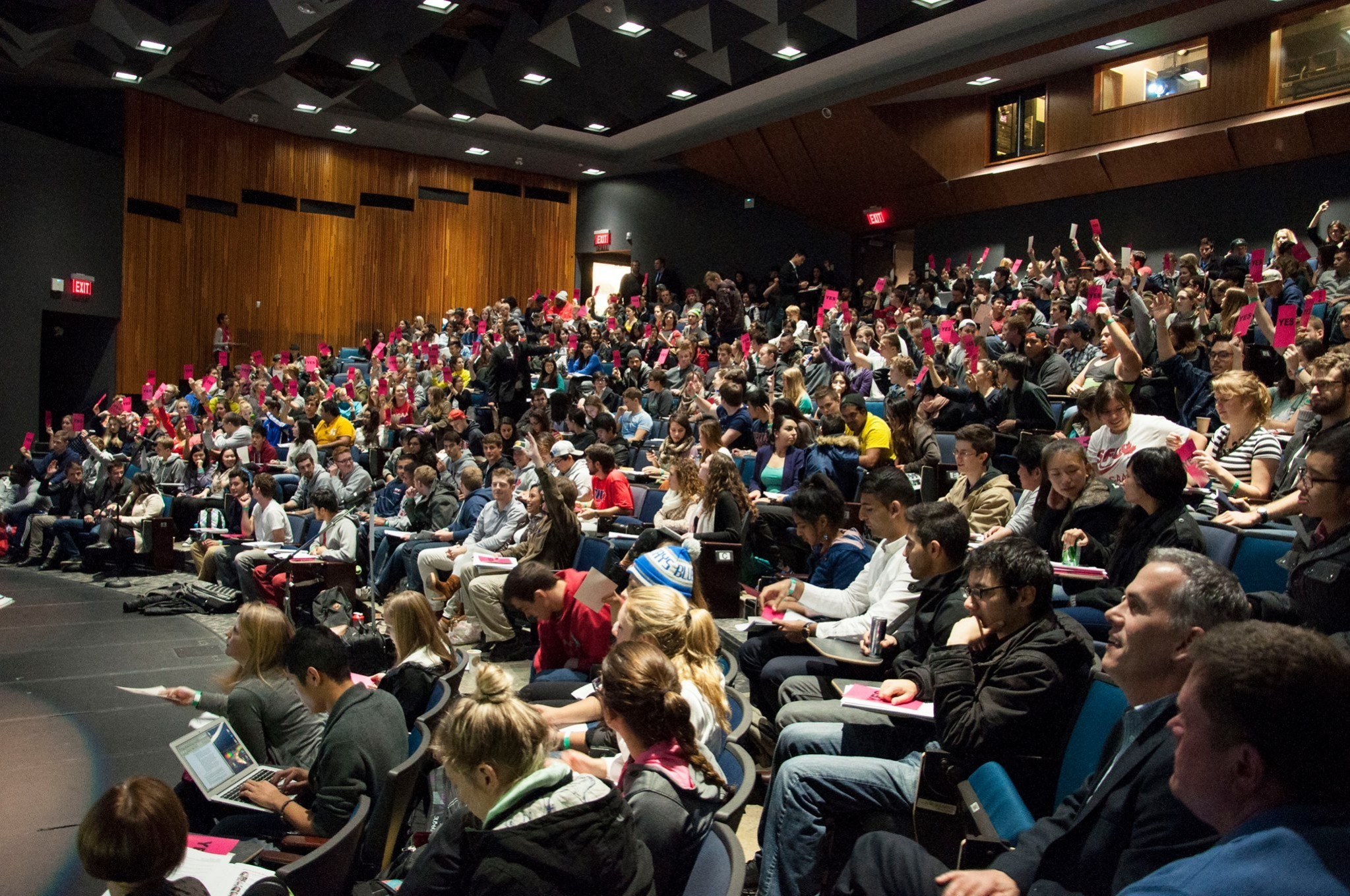
The Simon Fraser Student Society (SFSS) met quorum for the first time in six years at their Annual General Meeting (AGM) on October 22, but not everyone was able to get into the venue, which quickly reached capacity.

With over 400 students in attendance and many more lined up outside of the SFU Theatre, the venue filled up shortly after the meeting began at 1:30 p.m.

As such, not everyone was able to cast their vote on two motions concerning the Build SFU Student Union Building (SUB) and Stadium projects.

Several students in line voiced their concerns to The Peak. “It’s refusing members of the clubs the right to vote,” said Jesse Kazemir, a second year engineering science student. “It sort of renders the people who weren’t let in powerless in terms of the vote. They may not have changed it, but still it’s denying them that right.”

Many students also left after the Build SFU motions, resulting in a loss of quorum for the remainder of the meeting. Consequently, only regular business could be conducted from that point onward.

“The SUB wasn’t the only thing I was planning to vote on. There were a lot of concerns that a few clubs wanted to bring up in light of the SFSS’ policy towards clubs,” said Sarah Kim Dao, a first year computing science student and SFU business alumna. Because an inquorate meeting is only able to discuss regular business, “a lot of the things that the clubs wanted to bring up weren’t brought up at all,” she said.

 Not everyone was able to cast their vote on two motions concerning the Build SFU Student Union Building (SUB) and Stadium projects.

At the SFSS council meeting on Wednesday, student representatives brought up their ideas for how to better accommodate students in the future. Suggestions included allowing students to vote online and planning for an overflow space with a live feed of the meeting to allow more students to follow the action.

Chardaye Bueckert, SFSS president, responded to council members’ concerns and explained that this was a problem that they had not anticipated: “In the past, for our AGM’s, it’s always been a huge struggle to achieve quorum of 250 students, and we booked the largest available inside space which was the SFU Theatre.”

She continued, “The only alternative that could have accommodated more students would have been Convocation Mall, but it was quite a cold and windy day so we made the call to hold the meeting inside, in efforts to try to attract more people, particularly in light of the fact that we hadn’t made quorum for many many years.”

Bueckert stated further that they did not turn any students away: “We just hit fire capacity and couldn’t let that many people in without it being incredibly unsafe [. . . and eventually] everybody who did wait did get into the meeting.”

The SFSS is considering what they can do to maintain these high levels of engagement and accommodate more students. “We do take these concerns very, very seriously and our hope is that going forward we will need a bigger space than the one that we had this year, because there’s going to be so much sustained interest,” Bueckert said.
SFU prepares for its upcoming 50th birthday

0
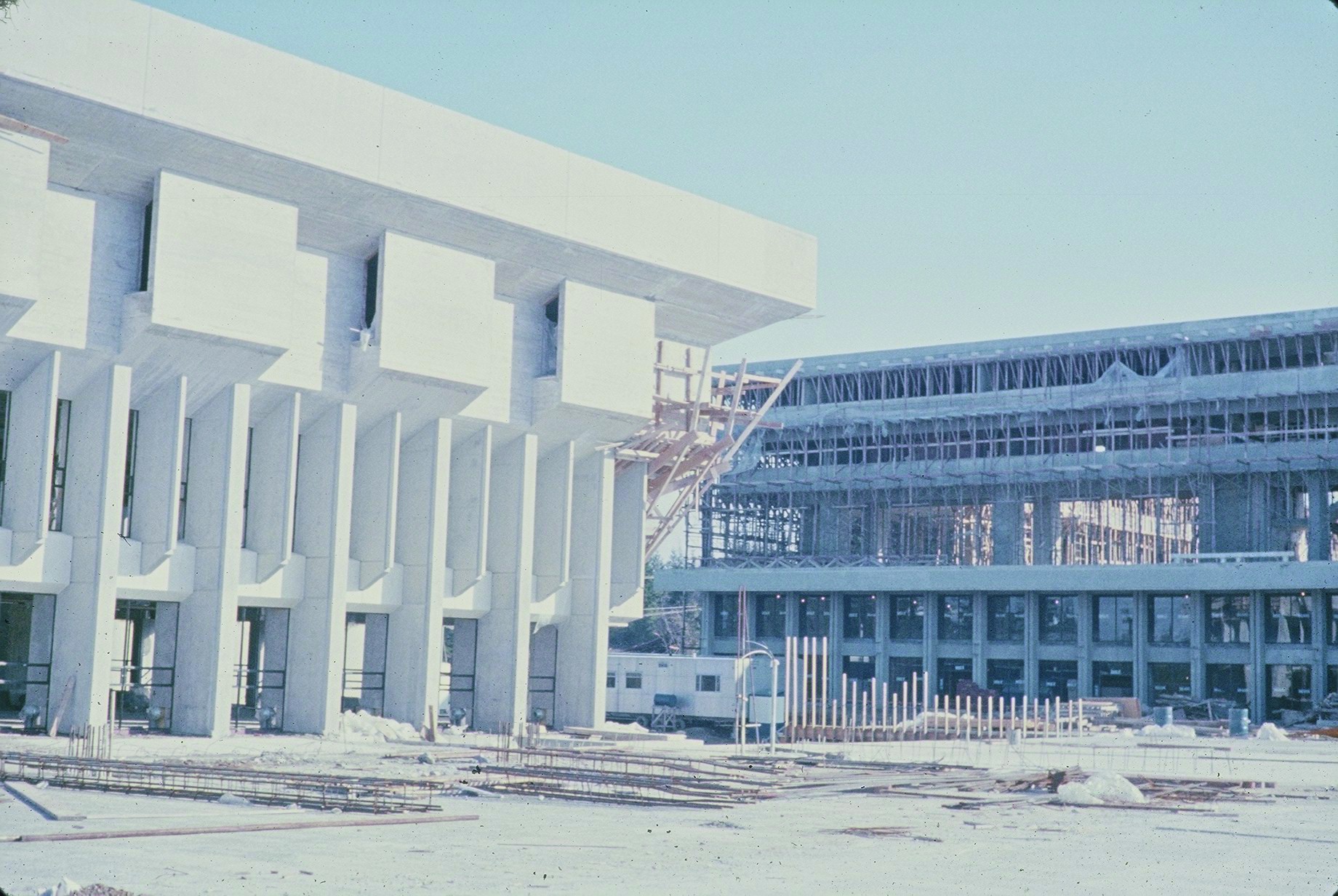
Designed by Arthur Erickson and Geoffrey Massey, the university was built in 1965. Courtesy SFU Archive and Records.


With the university’s 50th birthday less than a year away, SFU administration is preparing a number of events that both students and faculty members can enjoy during the 2015 academic year.

Joanne Curry, SFU associate vice-president, external relations and chair of the 50th Anniversary Planning and Implementation Team mentioned that they “have a whole number of objectives for the 50th celebration, which will essentially take place [from] September 2015 to convocation June 2016.”

According to SFU’s 50th anniversary report, there will be a multitude of events called Signature Initiatives that celebrate a university that has “grown up without growing old.” These will include a World-Wide Week of Welcome, special SFU Clan games and homecomings, and a Burnaby Festival of Learning.

Annual events such as SFU’s Public Square, the Terry Fox Run, the Annual Alumni Gathering, and the President’s BBQ will also be linked to the 50th anniversary celebration.

Different faculties and departments plan to show off their unique initiatives during the anniversary year. For example, Curry speculated that the Faculty of Science might organize a brewing course in which they would brew a specific 50th anniversary beer. “It doesn’t have to be large, it’s up to each department to plan out what they would like to do,” commented Curry.

Curry explained that the university will “use this opportunity to talk about the history of SFU, because it has had such an interesting history, but also [about] the future of SFU.”

Events will celebrate a university that has “grown up without growing old.”

Simon Fraser University opened its doors on September 9, 1965 with an initial class of 2,500 students. The university was named after the explorer Simon Fraser, who discovered the Fraser River in 1808. Originally called Fraser University, the name Simon was added after the administration realised that the abbreviation would otherwise be F.U.

On the university’s 50th birthday, on September 9, 2015, there will be two events: a Morning Ceremony, which will include speeches by SFU president Andrew Petter and other significant community figures, and a Founder’s Ball. During the Founder’s Ball, attendees will be served dinner in Convocation Mall and have a chance to dance under the stars near the AQ Pond. A prominent artist will likely entertain the guests, as well.

Curry noted, “It is an engagement opportunity for the current students, alumni in different countries, prospective students, [and] for [the] community in general.” She stressed the fact that everybody will have the chance to be involved in some form or another throughout the anniversary year.

“It is a great opportunity to raise the profile of SFU. [. . . Some people] have a view from 20 years ago. So, it’s just a great opportunity to showcase SFU and all of its accomplishments and amazing people, students, staff and faculty,” said Curry.

She also noted that the 50th Anniversary Planning and Implementation Team is eager to hear what students would like to see or contribute for “student-led type events.”

Nicole Wong, an SFU co-op student who is helping to plan the anniversary festivities, said, “The anniversary year will be a special one, so be sure to go out and participate in the various events! [. . .] Participating in these events will definitely be a way to ensure that your time at SFU was memorable.”

Curry mentioned that schedules for the fall events will likely be outlined in the spring. “And again, any ideas are more than welcome,” she concluded.

Satellite Signals

0

Woodwards:

Last Wednesday, October 29, in the Djavad Mowafaghian Cinema, Benjamin Bratton delivered a presentation called, “The Stack: Design and Geopolitics in the Age of Planetary-Scale Computing.”

The lecture discussed how computation has grown to be a “global infrastructure that is changing not only how governments govern, but what government even is in the first place.”

Surrey:

SFU’s Faculty of Health Sciences along with the Surrey Firefighters Charitable Society presented a lecture last Tuesday, October 28, on how to recognize and eliminate gendered and racialized violence in media.

Professor of women’s studies at the University of Victoria, Jo-Anne Lee gave the talk in the Surrey City Hall’s council chambers, with a reception following.

Harbour Centre:

This past Sunday, October 26, the SFU Association of Latin American Students (ALAS) gathered on Abbott Street to help those in need with the profits collected during the Havana Night event hosted on October 17 at the Highland Pub.

The ALAS executive team and volunteers prepared over 400 sandwiches and matched each sandwich with an apple and a water bottle to provide the hungry with a basic lunch.

SFU workshop discusses the politics of body image

0
The event addressed how participants might heal from and resist body shaming.


People of all different shapes and sizes gathered at SFU on Saturday, October 25 to discuss and engage in activities concerning body diversity and acceptance.

Hosted by the Simon Fraser Public Interest Research Group (SFPIRG) in collaboration with Fat Panic! Vancouver, the event titled Body Size Diversity: It’s Just How We Roll! took place at SFU’s Burnaby campus. 

The event engaged participants in discussions, writing exercises, and theatre activities to uncover what it is like to be overweight in our society. The team also highlighted how other forms of prejudice and discrimination, such as sexism and racism, interact in our society. 

A total of 24 participants took part in the event, which lasted seven hours. Kalamity Hildebrandt, a social justice educator and consultant with SFPIRG, led participants through all of the activities.

“We started out considering the nature and impact of body shaming and body policing generally — looking at how many forms of injustice use these tools of abuse,” she explained. “Part of what we did during that process was a writing and sharing exercise in which participants completed a number of questions about how they had first been taught body shame, and what this had cost them in their lives, and how they are working to heal from and resist body shaming and policing.”

In the afternoon, participants discussed the politics of fatness in North American society. A theatre performance illustrated situations in which overweight individuals were harassed, and portrayed practical intervention strategies to alleviate harassment.

When asked about what this event means to her and to others, Hildebrandt said, “To me, events like this are incredibly important. I have been doing this work for around 20 years now, so I already know much about the countless ways in which systemic forms of injustice like fat oppression harm people, but I always learn more through what participants choose to share.

“It is always very touching to see how brave people can be in sharing their stories, sometimes for the first time.”

Co-hosting the event was Fat Panic! Vancouver, a group committed to bringing an end to the oppression of overweight individuals.

“It is always very touching to see how brave people can be in sharing their stories, sometimes for the first time.”

Kalamity Hildebrandt,  SFPIRG social justice educator and consultant

In the past, Fat Panic! Vancouver has referenced an article written by Clinton Hallahan and published by The Peak in 2012, titled, “NO FATTIES,” as an example of commonly held views about body diversity; the group aims to displace these views.

According to their website, his article and similar opinions contribute to making the university campus a “more hostile, less inclusive place for many people.”

Together, Fat Panic! Vancouver and SFPIRG plan to host more events to inform people of the prejudice and discrimination towards overweight people, and the harm that this causes.

“Both organizations seek to build a better world — a world in which no one is taught to hate their own, or anyone else’s, body, for any reason,” said Hildebrandt.

Civic Election Special

0

British Columbia’s 2014 civic elections are almost upon us, with candidates battling it out for your vote on November 15.

The Peak caught up with three different SFU students who are running in the upcoming elections in their municipalities. Candidates shared their motivations and visions for their respective positions, as well as how their actions would affect students, if elected.

  ***


Moe KopahiWEB - Kopahi

Coquitlam — City Council

1. Why are you running for this position?

I am running because I bring fresh perspective to the table and want to serve my community (Coquitlam) now that I am almost done with SFU. I believe my background in engineering (familiarity with BC Building Code, BC Fire Code, and LEED) and experience in governance (SFSS four years, Senate four years and basically committee structured government) would be a great asset for Coquitlam council.

2. What changes would you like to see, should you be elected?

I want to increase community engagement by targeting youth and multicultural communities in Coquitlam. You can’t expect the same from the current background with all current councillors from the same background (Canadian) and same age range.

I also want to push for sustainable development and help council make decisions on new projects by educating them on engineering factors and economical influences on neighbourhoods, businesses and community groups.

Last but not least, I think we should push for a convention center in Coquitlam, as currently none exists within the Tri-Cities. Just like Build SFU!

3. What changes would you make that would affect students?

If elected, I will advocate for the following:

1) Increase in 143 buses (Coquitlam – SFU) during peak hours and possibly extending the hours into evenings on the weekdays and continuing the service in the weekends.

2) Extend the Coquitlam library hours during midterm and final exams which makes it more convenient for Douglas College and SFU students to stay local for their studies.

3) More co-op and internship opportunities within the City Hall for post-secondary students.

  ***

WEB - ShenAndy Shen

Coquitlam — City Council

1. Why are you running for this position?

I believe that Coquitlam is brimming with opportunity and has the potential to be a regional leader. We need to focus on job creation, public safety and respect for taxpayer dollars. There is a lot of work ahead. I know the issues, having ran in the last two municipal elections, and I have experience volunteering within the City of Coquitlam and having worked for the federal government for the past few years.

2. What changes would you like to see, should you be elected?

I would like to see the city focus on the three main aspects of my platform: (a) Jobs and the Economy; (b) Public Safety; and (c) Respect for Taxpayer Dollars. We need to do more with job creation — especially since we lost 500 jobs in the past year. People are speeding up and down our streets and we need to invest in public safety to crack down on dangerous behaviours. I want to see the city use our money effectively, efficiently and responsibly, so that we can lower our taxes.

3. What changes would you make that would affect students?

I am focusing on jobs and the economy because I know that students are looking for a place to start a career, and I would like Coquitlam graduates to be able to find a job within Coquitlam. We need to compete with other municipalities to draw businesses into Coquitlam and create good local jobs here at home. Also, Coquitlam needs to work on our transportation plan (i.e. 143 buses) to make it easier to get to and from class, especially during the peak hours and during exam periods when exams may be held on weekends.

  ***

WEB - SwistakAlexander Swistak

Port Moody — School Trustee

1. Why are you running for this position?

I am running because I am concerned about the erosion of public education. I want to preserve for current and future students the educational opportunities that I enjoyed during my schooling in SD43. My commitment to quality public education, constituent outreach, and my respect for learning will inform my decisions as School Trustee. As a successful student of Political Science here at SFU, I have developed a firm grasp of setting, reading and evaluating public policy, and I am excited to put these skills to work for the betterment of our public education system.

2. What changes would you like to see, should you be elected?

I would like to facilitate the inclusion of young taxpayers and those who fund education, yet have no children, in discussions concerning our public education system. Their support for quality public education and student achievement will secure long-term adequate funding and the understanding that we all benefit from an educated and well-adjusted society.  This will only be realized when we have a Trustee who understands the importance of their position and treats it as a full-time position, rather than an add-on to their busy schedule. We have settled too long with mediocrity, and our students have suffered because of it.

3. What changes would you make that would affect students?

I will lobby for increased funding, as our district receives less per student than the provincial average. I will engage constituents to raise awareness of the importance of public education. I will also work with other school boards to improve public education; by forming relationships with constituents, teachers, administrators, support staff and other school boards, I will contribute to building a united front to protect our system. I will help bring an end to the board balancing its budget by excessively laying off district personnel. I’m also committed to finding administrative and operational inefficiencies and directing more funds to students.

Please Stand By

0

We’re having some technical difficulties. We apologize for the inconvenience.

In the meantime, please enjoy this beautiful live performance of Rob Cantor’s “Shia LaBeouf.”

Still not satisfied? If you have any immediate inquiries, please contact [email protected].

SFU Protests Kinder Morgan Pipeline

1

The Peak’s News Editor Leah Bjornson interviews SFU English Professor Stephen Collis is protesting against the construction of the Kinder Morgan pipeline.

Pipeline protesters repel Kinder Morgan crews on Burnaby Mountain

3

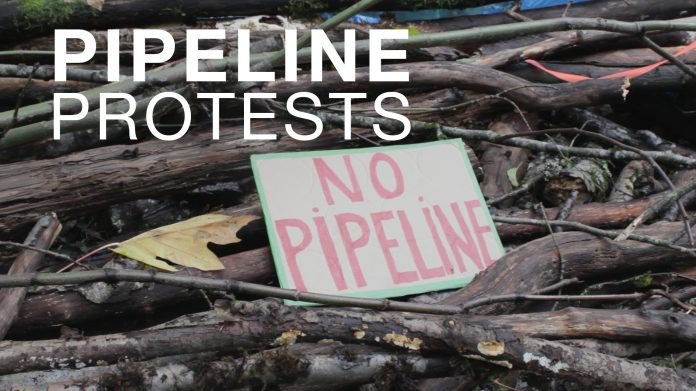
A group of protesters prevented Kinder Morgan from entering testing sites in the Burnaby Mountain Conservation Area on Wednesday morning, where they had planned to resume surveys for their proposed pipeline project.

Protesters linked arms around one of two borehole sites, and one teenager even pinned himself under a Kinder Morgan jeep, saying oil was destroying the earth and that he would stay under jeep for “as long it takes.”

This confrontation follows the National Energy Board’s (NEB) ruling on October 23, stating that the City of Burnaby cannot stand in the way of Kinder Morgan’s plan to test at sites on Burnaby Mountain. The energy company announced on October 24 that they would resume testing after 48 hours.

In response, protestors worked over the weekend to reinforce two blockades which have been present for the past month. Stephen Collis, an SFU professor of English and spokesperson for the protesters said on Monday, “We’re going to peacefully and non-violently stand in their way.”

On Wednesday morning, at 9:30 a.m., Kinder Morgan crews had yet to arrive at the site where a flood of protesters had begun to gather.

When asked why she thought crews had not yet arrived, SFU professor of molecular biology and biochemistry Lynne Quarmby replied, “They’d be smarter than to show up in the presence of all this media and all these people. [. . .] They would be foolish to show up.”

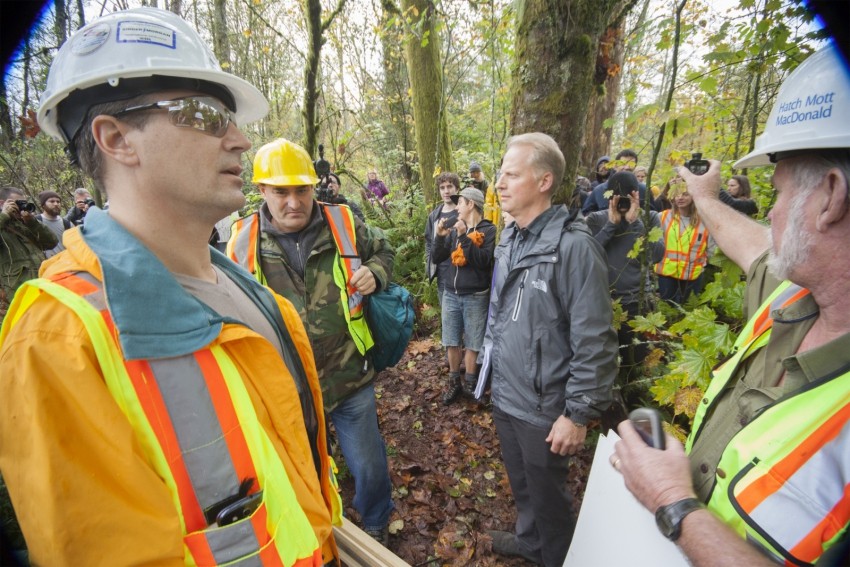
However, at around 10:00 a.m., protesters spotted Kinder Morgan crews advancing into the woods towards the first borehole. Protesters, journalists, and film crews rushed to the site where self-proclaimed caretakers were already blocking crews by linking arms around the site.

“There’s just a tremendous amount of support from the community.”

Lynne Quarmby, SFU professor of molecular biology and biochemistry


Some minutes later, the surveyors left the site. In an e-mail, Greg Toth, senior project director of the Trans Mountain Expansion Project said, “At some locations, our crews were obstructed and have left for the day.”

For Quarmby, this was a victory for the people. “We put out the call, we let people know that we were going to be here, and it’s just phenomenal the number of people that are still pouring in, so there’s just a tremendous amount of support from the community,” she said.

When asked what she thinks the next few days will bring, Quarmby replied, “We expect that they’re going to try to outwait us, but [. . .] I don’t think you can overestimate the commitment of this group of people. We will out-wait them.”

Marketa Irglova and friends perform at St. James Hall

0

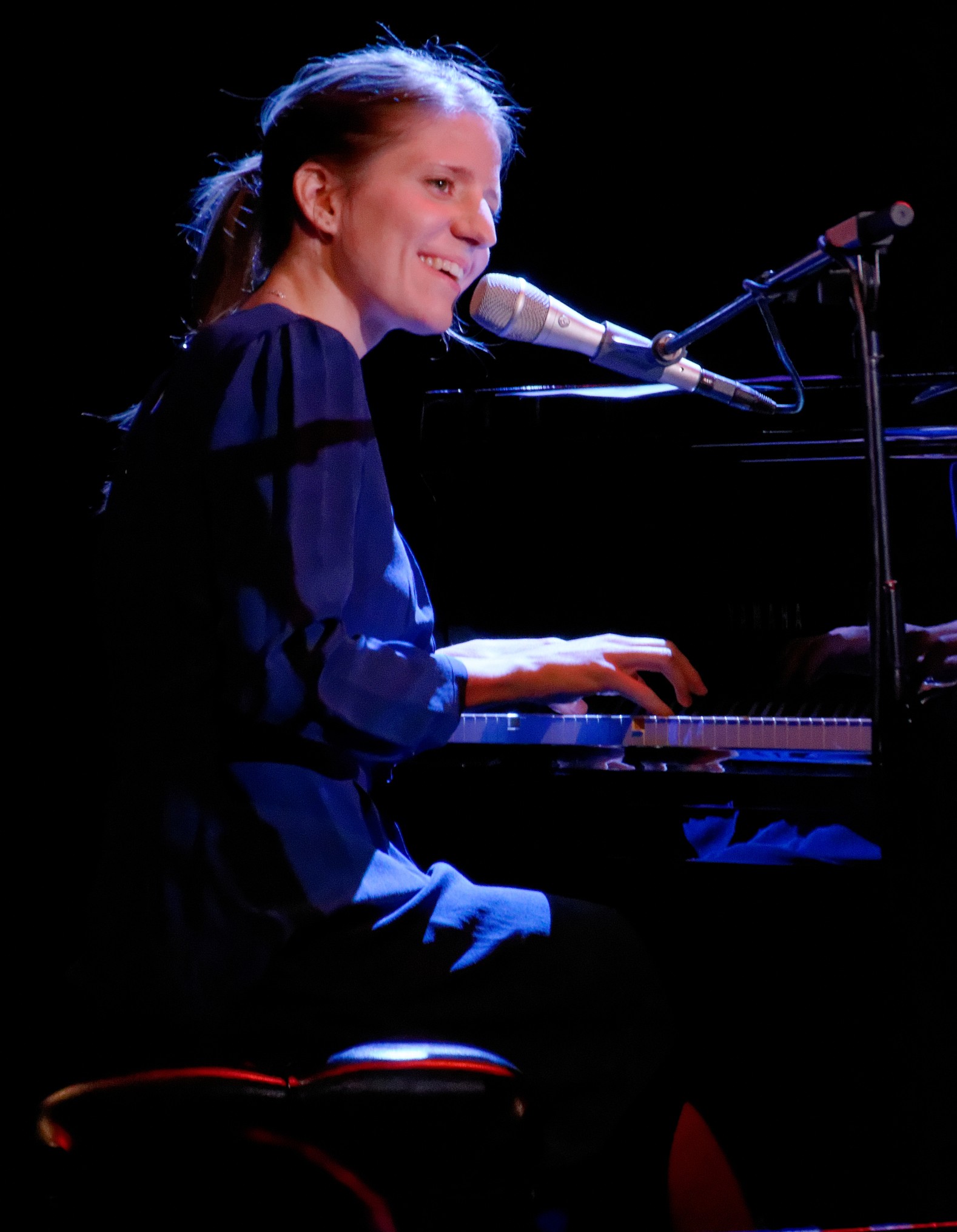
Marketa Irglova has one of the purest, most serene voices I’ve ever heard, and many of her songs have the ability to bring tears to my eyes no matter when I hear them. I was overjoyed when I found out about her stop in Vancouver, as she tours in support of her new solo album, Muna. She was joined by Iranian daf player and vocalist Aida Shahghasemi, and Rob Bochnik and Joe Doyle (who also played with Irglova in the band, The Swell Season), along with opening act, Rosi Golan.

You might know Irglova as half of the duo responsible for the film, and now musical, Once, and as a member of The Swell Season, along with former partner, Glen Hansard. Hansard is another passionate musician who I’m a huge fan of, and together they made wonderful music. The Once soundtrack is not only one of favourite soundtracks, but one of my favourite albums of all time. It is too bad that they parted ways, but I’m glad that they’ve each continued making music on their own.

Irglova focused most of her time on playing new material from Muna, but she threw in a few favourites such as “If You Want Me,” “I Have Loved You Wrong,” and her Academy Award winning song, “Falling Slowly.” If that song doesn’t make you feel something, I don’t know what will. I enjoyed hearing her new music, but it was wonderful to hear those familiar favourites. Shahghasemi did an impressive daf solo, and for one song she switched places with Irglova to play piano.

The beautiful venue of St. James Hall only added to the calming, soothing quality of Irglova’s music. Featuring 27 musicians, Muna has a beautiful choral, symphonic quality to it on songs like “Point of Creation” and “Time Immemorial.” Of her new music, I enjoyed “Without a Map” the most, with its introspective lyrics and immersive quality.

This second solo album is a departure from her Swell Season days, but with its thoughtful lyrics, beautiful melodies, and deeply soothing, spiritual quality, I think it is a genuine representation of her identity and skill as a musician. Muna is the Icelandic verb “to remember,” and that is exactly what I will do with this concert.


Denise Clarke presents a new solo show

0

Denise Clarke is an accomplished, respected contemporary dance artist who is a member of the Order of Canada. Over the course of her career she has been involved in all kinds of productions, but this show is personal.

Clarke entered from stage left wearing a large hooded parka and backpack, trudging along as if through a snowy field. That was in fact what she was doing. Through narration and commentary, Clarke told the story of her trek through an Edmonton park on her way to rehearsal two days before Christmas. She was on her way to rehearse this show, and began to wonder why she was bothering with a solo show that nobody would come to see.

Then she spotted a section of the park that was a pristine blanket of snow, you know, the kind that makes you think ‘wouldn’t it be great to mess up that perfection?’ So she did, and does in the show. She put down her bag and did a sequence of her choreography in the snow. That is, until a laberdoodle and its owner came upon her.

This love of dance, and the power of dance to lift our spirits, is a theme that runs through the show. She tells another story about being in an Ottawa park at 3:00 a.m., and having the urge to dance alone to the Paul Simon coming from her headphones. So she did.

This show is personal on another note, as well. While preparing the show, her brother and dad both passed away, and as she explains, her dad was the type of person who always said he didn’t want her to stop what she was doing “just because he kicked the bucket.”

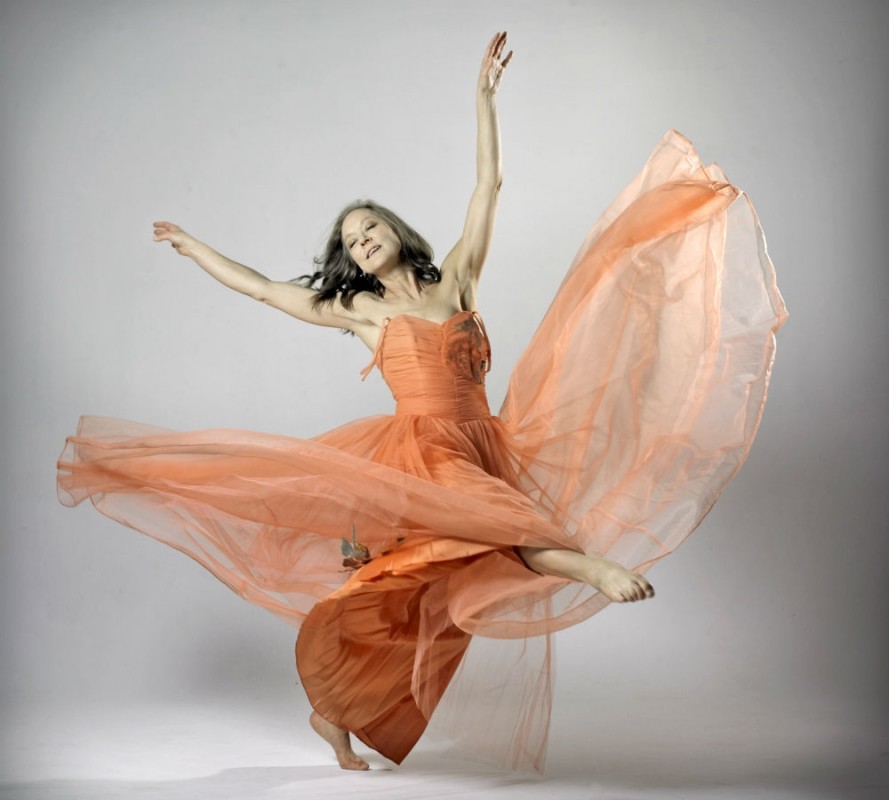
Through all this pain, dance was a large part of her ‘cheer up program,’ and she brought a beautiful peachy pink ballgown to change into and waltz around the stage. She admitted that she’s always wanted to do that in a solo show. For this section, four girls came down from the audience, changed into their dresses, and joined her in a grand waltz.

Another part of this show that I loved were Clarke’s lists, which she translated into movement. She listed her favourite books, each with a corresponding movement, which she dances when she needs cheering up. Her ability to translate story into movement while incorporating witty, entertaining commentary is unlike anything I’ve seen.

Wag was presented October 21 to 25 at the Firehall Arts Centre. For more information, visit firehallartscentre.ca.